

| SNEAK PEEK |
— How the tariff debate masked Trump’s real agenda: building an Oceania Technate within the context of a new great game.
— Britain’s mishandling of the grooming gang scandal foreshadows the reckoning society will have to have about the Covid Lab Leak, argues Izzy.
— There’s an innovation puzzle at the heart of China’s sixth-generation fighter breakthrough, says Dario.
Dear Subscribers,
Happy New Year. It’s nice to be back, but so much to cover.
Let’s start with the most important thing, which is that Peter Thiel has somehow hijacked my brain and used its contents to inform his latest oped in the FT. The only other explanation for the mind meld is that I’ve been an unwitting victim of Thielien mind control all this time.
Here’s how I unearthed this awkward fact.
There I was on Friday afternoon finishing my essay about the revelatory Covid reckoning still ahead of us when out of the blue my former FT colleague, Jemima Kelly, whatsapps me to say: “WHAT ARE YOUR THOUGHTS ON THIEL? Yes. In upper case. She follows up with, “were you involved 🤣?”.
The quick answer of course was NO. “Moreover”, I added, “I have no idea what you’re on about.” At which point she dropped a link to Thiel’s latest oped in the FT. Oh boy.
Turns out, he’s only gone and lifted my entire Glasnost thesis. Except he’s gone one step further and spelled out that the “apocalypse” actually signifies “revelation” etymologically — something I have also frequently observed but only dared to spell out in private conversations or on Discord due to fears that I might be branded a millenarian or a nut job (as many have now dubbed Thiel). If you don’t believe me here’s an interview I did with Peter McCormack where I say pretty much the same thing. Go to about 1hr 37 mins in.
To reiterate, the overarching thesis goes something like this:
To be able to sustain our way of life, we need growth. But to generate that growth we need to reform the system and make it more productive since we’re stuck in vicious stagnation, a state compounded by corruption. Yet to move beyond what ails us, we need more than just a new economic model. We need both transparency in the form of glasnost and a reckoning with our past.
Looking at the comments on Thiel’s oped, however, it’s clear people have no idea why this might be the case.
So let me explain.
Simply put, without transparency about the “morally dubious” things we may have done in the name of defending our system — think dodgy dossiers or gain of function all under the cover of Hans Morgenthau’s so-called “dual state” — there is no chance of an effective reboot. Moreover, the transparency is coming one way or another due to AI, so we need to figure out how we are going to process it, since it’s very arrival risks upsetting the status quo and tearing us apart.
At this point — as with Russia in the 1980s — the underlying lies propping up the system have gotten so burdensome, so multi-layered and so absurd, the usual methods to deal with the externalities (notably, gaslighting) just aren’t working anymore. As they say:
“Oh, what a tangled web we weave, when first we practice to deceive!”
With each new layer of deceit to cover for the previous one, the lie grows more absurd, intensifying the eventual blowback and compounding the damage.
Thiel is more specific about the sort of lies we’re talking about: The assassination of JFK, Covid origins and the nature of Epstein’s real work.
So the view is that, without coming clean about these lies, we can’t neutralize the self-harming behaviors we’ve had to resort to in a bid to cover up our lying. The scale of the non-sensical behaviors in society that the original lie has cultivated is now so extensive it may even be impeding our ability to grow.
Inevitably, something will have to break. Though, thanks to AI, it’s going to break much quicker — especially if we want AI to actually be productivity stimulating.
Logic machines — through the process of reconciling “if this then that” — are destined to reveal such truths via the process of deduction and cross-referencing. If we don’t allow them to do so, the contradictions they are asked to contend with will throttle their usefulness, threatening a Hal9000-style breakdown.
But there’s more to all this than just transparency. As Thiel rightly highlights, once we become aware of the truth we also have to absorb and come to terms with it. This is similar to how Russia had to process Stalin’s crimes and the Germans had to contend with the Nazis.
As it stands we are in such denial there’s a good chance we might not even be able to handle it.
South Park, oddly enough, explored the worst-case scenario of such social revelation years ago in Season 20. We wrote about it here. Do check the episodes out as they are brilliant.
For more on our thinking about the incoming period of glasnost you can check out our previous work here, here and here.
As usual, this newsletter is brought to you by me Izabella Kaminska and Dario Garcia Giner.
Send tips to [email protected] or [email protected], or anonymously via our Haya link.
| THE BIG BLIND SPOT THIS WEEK |
SID MEIER’S CIVILIZATION GAME GETS REAL.
If you’re puzzled by what’s going on in terms of Trump’s sudden expansionist turn, you need only look to the tenets of the technocracy movement of the 1930s.
We had hoped to speak to the world expert on technocracy this Friday but our interview got pushed back to next week. Suffice it to say, we will revisit the whole topic in more detail soon. But what you currently need to know is this:
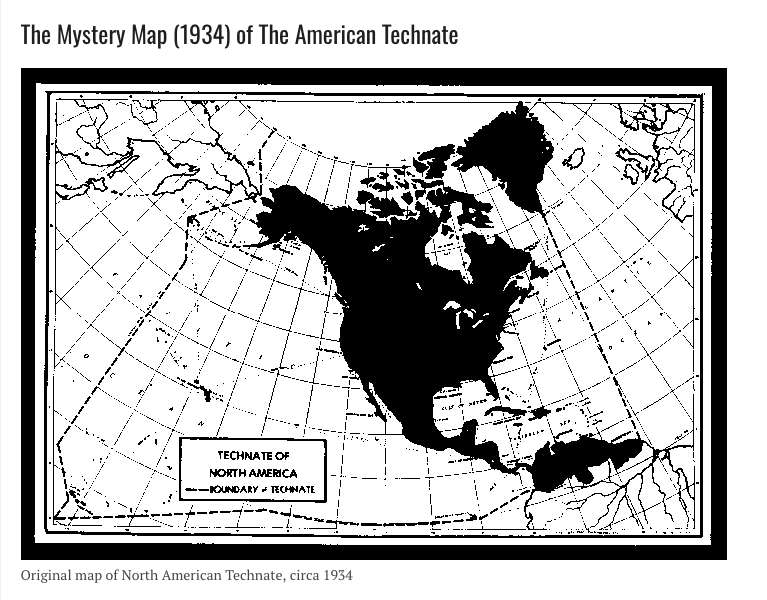
The above is a map of the continental technate that the movement wanted to engineer once they came to power. It goes as far as Greenland in the north and as far as Venezuela in the south.
The other thing you need to know is that Elon Musk’s grandfather was a prominent member of the movement.
I myself was first made aware of the whole thing by documentary maker Adam Curtis, who was exploring the whole thing for his upcoming film. This prompted me to investigate the movement, which led me to the conclusion – as I noted here in October – that America was on the verge of a technocratic coup. I think we were right on that.
At the time, I couldn’t help but notice that every single G7 country, with the exception of Italy (which arguably has already been down that road), was also facing leadership challenges that threatened to open the door to their own respective technocratic takeovers.
In the U.K. things were getting even stranger still.
A hat tip to Will Lloyd at the Times who pointed me to Dominic Cummings’ larger than life Start-up party plans focused on creating a party of unity under the leadership of JK Rowling.
But that’s not the end of the strangeness.
As everyone will have noticed, Elon Musk is absolutely everywhere right now — mostly breaking people’s brains.
But his penchant for controversy may be more strategic than appreciated. As was pointed out on The Blind Spot Discord this week, by taking all the flak, he’s actually taking the heat off Trump — much the way a cybersecurity sinkhole deflects spam from an otherwise vulnerable target. The only people panicking about him, however, are establishment nomenklatura. The U.S. corporate world seems to be thankful to have been unleashed from the political correctness that has been holding it back.
Musk’s decision to back Reform and then call for Nigel Farage’s ousting, nonetheless, hints of a fascinating change of strategy chez Cummings.
According to sources, Cummings may be giving up on the idea of starting a party from scratch and looking to takeover either the Tory party or Reform. Reform insiders have, to be fair, laughed the theory off. But there’s no denying Cummings is an acolyte of Musk’s which doesn’t make it too much of a stretch to conclude they probably talk.
The current popular view is that Musk doesn’t understand Farage’s strategic importance to the party because he knows nothing about British politics (or German politics for that matter). But it’s worth noting that the same day he called for Farage’s ousting he also retweeted JK Rowling about the U.K. grooming gang scandal. There aren’t many people who can match Farage’s appeal and charisma. This is true. But if the true agenda is creating a party of unity that is capable of properly reforming Britain, JK Rowling is far more likely to be able to bring people together than Farage.
Musk’s focus on liberating Britain may be driving everyone mad but it is at least drawing attention to things like Quadrature, the mysterious hedge fund that donated significant wedge to the Labour Party at the last electoral opportunity, which we have mentioned before. Elon mischievously referenced it the other day.
As well as being named after a process used in signal interception, Quadrature — founded by former D.E. Shaw men — operates a somewhat extensive ESG-oriented foundation for its size which allows it to douse targeted businesses with supportive grants whenever needed. Are Quadrature a dual-use hedge fund? We don’t have the proof to say one way or another.
But it is worth pointing out that the FT revealed this week that Keir Starmer’s chief business aide Varun Chandra, formerly of private sector spy firm Hakluyt, helped to spearhead Hakluyt Capital, which raised around $50 million last June for investments in start-up tech companies and which has an office in San Francisco.
BLACK OPS FINANCE SPOOKS? Remember that time we highlighted how one of the Russians swapped in the big prisoner swap last year was a hedgie accused of collaborating with Russian security-state-adjacent hackers to profiteer from hacked corporate data? The related CNBC doc highlighted these funds would then be used to fund the black ops of Russian illegals state-side.
In my thread, I proposed the playbook wasn’t necessarily unique to the Russians. That there were probably scores of front hedge funds doing similar things for all sorts of other actors. And that this sort of activity was likely leaving a market footprint. That thread happened to go viral again over Christmas. It also happened to be noticed by Shayne Coplan, the CEO of Polymarket, who reached out to me asking which markets were particularly affected and how the strategy worked.
I answered that there were likely two strategies:
1) Using private info illegitimately obtained to get ahead of profit warnings, deals, investigations or whatever. This manifests as preemptive positioning ahead of unexpected market moves. Classic leaked info footprint. This appears to be what the Russians were doing, according to that SEC investigation. Their record wasn’t perfect tho. Subtlety matters. Similar to insider rings.
2) Knowing (also thanks to asymmetric info advantage whether hacked or not) which companies are not really operating according to their core fundamentals, and whose real revs are sourced from other more opaque and potentially illegal areas. Essentially, loss leading front businesses. This intel lets you spot “winners” nobody else will. Especially if the state or elements of the state are protecting these companies or turning a blind eye to business practices that would not be tolerated by other companies. Wirecard was the classic example here.
But I also noted that some of these front companies may have been coopted by state actors when they proved useful: “Companies that are lucratively operating on the fringes of the law or in areas yet to be regulated, but which prove useful to the authorities. They might end up being investigated and charges dropped on the condition they become informants on the illegal behavior on their platforms.”
It’s worth reminding readers that Coplan’s home was raided by the FBI and his phones were taken after Polymarket successfully predicted the Trump win in November due to an outsized bet by a French national. Has he also been leaned on and forced to cut a deal?
The point is, it’s all very well being outraged about Elon Musk’s political interference, but it’s not just industrialists or tech tycoons with a lot of spare change who are actively influencing politics. There’s an open market for influence. Arguably, hedge fund managers donating significant wedge obtained from seemingly visionary market bets or magical strategies (from SBF to Renaissance to Soros) — which may or may not have been informed by cozy relations with those who officially spy for a living — are just as suspect.
At least when it comes to the industrialists, there’s a little more transparency about how they made their money, even if they too may have been propped up by state entities or contracts.
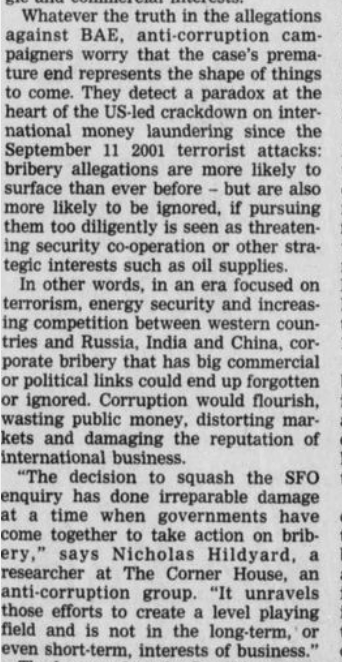
It is, nonetheless, our thesis that the proliferation of dual-use corporates — whose primary mission is not making profit for shareholders but being useful to the security state — is likely distorting efficient market processes and price discovery.
If you think that’s far fetched, note what Michael Peel at the FT noted back in 2007, when the scale of BAE’s bribes to Saudi officials to secure contracts was revealed, and the subsequent inquiry dropped on national security grounds:
Separately, Musk also mischievously drew attention to two other popular online myths (that just so happen to be factual), relating to the strange coincidence that Donald Trump’s physicist uncle, John G Trump was the first to explore Nikola Tesla’s belongings after his death. The Blind Spot previously covered the story here.
It increasingly does feel like we’re living in an ARG, doesn’t it.
TECHTONIC GEOPOLITICAL SHIFTS: What is clear is that the United States appears to be entering a new phase of geopolitical strategy, one that mirrors historical patterns of territorial expansion and imperialist ambition.
We previously noted that it would take the shape of new trading club that usurps the WTO (utterly compromised by China’s disrespect for its core rules) and reconstitutes core capitalist trading principles in its sphere of influence, providing America successfully restructures.
As we wrote: “If the restructuring really does succeed — though, of course, there’s no guarantee that it will — American capitalist practices centered on key principles like that inefficient businesses must be allowed to fail, will once again be exported to the world.”
This is where we are now. Trump is scoping out who will and will not be prepared to conjoin with the new American technate — which can be described as Oceania — on its terms.
The Donroe Doctrine? Those aghast at the audacity of the project should remember that there’s nothing fundamentally new here. Trump is simply making explicit what has long been implicit. The postwar global order has always been shaped by imperial powers. Moreover, since the collapse of communism the de facto American sphere of influence — underpinned by Pax Americana — has always been gunning for world domination and the creation of its own commonwealth system.
The resulting “non-system” — as Russell Napier has deemed it — was an American empire in everything but name. Explicitly calling it this was problematic because of American “freedom” rhetoric. Nonetheless, the influence of the empire was both subtle and pervasive. Throughout the Soviet Union, buildings, interiors and consumer products all converged to a single Russian-influenced style. American influence manifests similarly in the most unexpected places. Not just in terms of hotels and McDonalds outlets. When in Riyadh last October I was struck by how the city’s vibe and design echoed that of sprawling U.S. cities like Los Angeles.
China and Russia, however, not only scuppered that imperial American order by refusing to comply with its rules-based framework, but also by waging a reverse takeover of American and Western institutions by making them loyal to their ways of doing things.
Except, as Trump has so brilliantly distilled, they did so while continuing to benefit unashamedly not just from Pax Americana but also from de facto American subsidization. This is what those criticizing Trump’s tariff policies fail to understand. International free trade with those not committed to the same rules-based order does not guarantee positive sum growth. It is mercantilist and beggar thy neighbor by nature. The implementation of tariffs in such a context, as Michael Pettis continuously argues, is thus not wealth-reducing. It represents an open economy protecting itself from trade sabotage by a more aggressive closed economy.
The conditionality for American security and subsidization being declared by Trump is both simple and logical. If a nation state wants to continue to benefit from either, it’s no longer good enough for it to simply pledge fealty to a trading club, where wrongdoers can not be sanctioned by rule followers due to a lack of legal jurisdiction. Trusted and autonomous membership on such grounds has failed. You either conjoin formally to the United States and revive meritocratic capitalist processes under direct American supervision, or the subsidies you’ve been benefiting from all this time will be removed by way of tariffs. This is because a centralized capacity to enforce laws and pursue and punish wrongdoers is necessary to achieve the economic scaling needed to generate growth.
The strategy creates a competing governance structure to the European Union, one rooted in the principles of American economic dominance and laissez-faire policies rather than dirigisme and planning. This is why the EU is panicking. Eventually, the subsidized inefficient legacy states of Europe will be forced to make a choice. Is it better to be subjugated by China or America?
SIZING UP THE PAYPAL MAFIA TAKEOVER: Trump himself may not be the architect of these strategies but rather a figurehead for more organized and strategic actors, possibly within the tech elite. But these are no ordinary tech bros. They’re what might be best described as constituents of the “sovereign individual” cult that orbits founding members of PayPal, notably Elon Musk and Peter Thiel. Hence why it’s probably not wise to dismiss Thiel’s oped.
Thiel’s backing of JD Vance, the venture capitalist turned Ohio senator, exemplifies the PayPal Mafia’s strategic approach to embedding their libertarian ethos into Washington’s power structures. Vance, elevated by Thiel’s mentorship and funding, has become a key voice advocating for a blend of pro-innovation policies and nationalist restraint — a framework that echoes the group’s core ideology.
The influence extends well beyond Thiel. David Sacks, another PayPal alum, is set to become AI and crypto czar. Known for his advocacy of free speech absolutism and decentralization, Sacks is expected to push for deregulation of the tech sector and an expansion of policies favoring innovation over incumbent protection.
Meanwhile, Blake Masters, Thiel’s protégé, is said to be on the shortlist for a key role in the Department of Commerce. Even after his failed Senate bid in Arizona, Masters remains a central figure in advancing the PayPal Mafia’s ideological agenda, with a focus on reshoring manufacturing and creating policies that align with nationalist, pro-innovation goals.
Ken Howery, a PayPal co-founder and former U.S. Ambassador to Sweden, has been nominated as the U.S. Ambassador to Denmark. Howery’s diplomatic expertise, coupled with his entrepreneurial background, positions him to influence key financial and strategic discussions in a region that is increasingly significant for U.S. geopolitical interests and the formation of any technate.
Let’s also not forget Howard Lutnick, chairman and CEO of Cantor Fitzgerald, who has been nominated to serve as Secretary of Commerce. Lutnick’s involvement with Tether — a stablecoin explicitly designed to emulate PayPal’s disruption of traditional payments and backed in its early days by former PayPal investors — further highlights the group’s financial ambitions and its potential coziness with certain intel factions.
| BUSINESS, ECON AND FINANCE |
GERMAN ECONOMIC DISORDER. In a pre-election blow to Olaf Scholz, German factory orders took another dive this week, increasing the chance of Friedrich Merz’s CDU/CSU coalition of taking the helm of Europe’s beleaguered industrial giant. Demand for German factory orders fell by 5.4 percent in November from the previous month, a far worse decline than the 0.2 percent decline that economists had predicted in a Bloomberg survey.
But news about declining factory orders and the likely rise of Friedrich Merz to Germany’s helm, alongside the increasing coverage dedicated to Alice Weidel, the head of the AfD, are ignoring Germany’s elephant in the room: that there is only one short-term solution to German industrial woes: re-importing Russian energy at pre-war levels.
Awkward but true: No amount of planning to rebuild a German nuclear energy plan or lower taxes will fix this gaping hole in German industrial strategy in the short term, says Dario.
It remains to be seen how Germany’s upcoming chancellor will simultaneously navigate a worsening economy and a bellicose Trump President, particularly when the path of least resistance is forming a new de-facto alliance with Russia, and thus a head-on collision with America First.
RUSSELL NAPIER ON THE RISE OF ‘NATIONAL CAPITALISM’: In case you missed his interview with The Market in December, Napier, a cult investment advisor who also hosts the Library of Mistakes podcast, thinks deflation is the far more likely scenario to take hold in the U.S. than inflation. The following quote from the interview emphasizes his continuing belief that the West is headed for an unprecedented period of financial repression.
“I say we are headed towards a system of national capitalism. Interestingly, the term ‹national capitalism› has been used before, by a man who used to live in Zurich for a while: his name was Lenin. In a system of national capitalism, governments direct national savings towards national purposes. And our purposes today are investments, as outlined by Macron or Draghi and also by industrial policy initiatives in the U.S: Investments in energy infrastructure, in defense, in new productive capacity in order to de-risk from China. If we get into a bad Cold War with China, this will have a high national priority.”
WHAT REALLY AILS THE U.K. BOND MARKET? U.K. Chancellor Rachel Reeves set off for Beijing this weekend, flanked by BoE governor Andrew Bailey, in a desperate bid to woo investment for the beleaguered U.K. economy (seemingly oblivious to the fact that China is struggling with its own economic crisis). The trip comes as her budget falls totally flat with markets, and 30-year gilt yields hit their highest level since 1998.
Responding to the crisis on Thursday, Darren Jones, chief secretary of the Treasury, failed to address Tory shadow chancellor’s Mel Stride explicit question about whether rumors of imminent emergency interventions in gilt markets were true.
Instead, Jones wheeled out the usual whataboutist retort that it was Liz Truss who crashed the economy first, while echoing the wider Labor-aligned nomenklatura’s refrain that the bond rout had more to do with global factors than U.K.-specific ones.
But what’s the blind spot here? As we have maintained from day one, Liz Truss’ campaign to clear her name may have more substance than the mainstream media gives her credit for. We think she stands a very good chance of winning any libel action she pursues against Labour politicians who continue to accuse her of crashing the economy — especially once it comes out that the BoE was explicitly warned about the risk in the LDI market but chose to do nothing about it. It will be interesting to see if, now that she’s formally sent a cease and desist letter to Keir Starmer, Jones repeats the accusations again.
But there’s also the broader point, which we also argued back in 2022: this was always a global phenomenon, and suggesting otherwise is, at best, disingenuous. With hindsight, it’s evident that the U.K. served as the canary in the coal mine for fiscal crises now unfolding across the European continent — just as we predicted they would.
As for the U.K. shock itself, if anything exacerbated it, it wasn’t unfunded tax cuts but the Bank of England’s mishandling of the LDI risk, a factor that has since been neutralized. The current crisis, by contrast, is entirely of Rachel Reeves’ own making.
PENSIONS GET CLEARING EXCEPTION: It’s no secret that clearing mandates have been helping to prop up government bond markets for years due to their use as collateral in such systems. That’s why the U.K. government’s decision this week to bring forward legislation to stop the country’s pension funds from being on the hook for central clearing when the current exemption expires on June 18., is fairly important.
IZZY’S COMMENT: How we finally realized the opportunity costs of clearing mandates were probably not worth it.
1) After the financial crisis, the financial system required significantly more “standby” liquidity to manage intraday settlement imbalances caused by unpredictable variables like global trade flows and mismatched time zones. This was especially critical in an instant RTGS (Real-Time Gross Settlement) regime, which could not tolerate such imbalances.
2) The private sector was unwilling or unable to provide the necessary standby liquidity, leaving governments to step in as the ultimate “balancer” to ensure system stability. This intervention included creating liquidity as needed (QE) and absorbing imbalance risks directly.
3) At first, this made sense. Governments, uniquely, have the capacity to suppress excess spending through taxation and the ability to create or transfer emergency liquidity by issuing debt. This debt could, in theory, be neutralized over time through tax revenues, making the government the natural entity to absorb and redistribute risks.
4) However, it has become clear that this approach is not costless. Continuously relying on taxation to fund these interventions eventually drags down core productivity by reallocating capital away from productive enterprises toward rentiers or failing companies. This distorts economic incentives and erodes long-term growth.
5) The Opportunity Cost of Collateral: The problem is amplified by the collateral held in clearing systems. While it stabilizes the system, it comes at a cost. Even if the system balances perfectly, the interest payments on the government bonds underpinning this collateral must still be funded through taxes. The larger the collateral pool, the greater the tax burden on the economy but also the bigger opportunity cost associated with directing the capital to (inefficient) government hands rather than (potentially more efficient) private sector hands.
A Broader Question: If the collateral burden is now deemed unsustainable for pension funds, there is a strong case to question whether the same logic applies to the broader financial system. If it creates inefficiencies and opportunity costs in one sector, why should it be presumed beneficial or necessary in others?
My colleagues at POLITICO reported this week that the Treasury now acknowledges that forcing pension funds to use clearinghouses could limit their investments in growing the economy by requiring them to have more cash on hand.
But if that applies to pension funds, it also applies to the broader market as well.
| GEOPOLITICAL HOT SPOTS |
WESTERN LIBYA APPALLED BY ISRAELI APPEASEMENT. This week further controversy erupted in Libya on the back of the revelation that Najla el Mangoush, the former Libyan Foreign Minister of the Government of National Unity (GNU), met with former Israeli Foreign Minister Eli Cohen in Italy during the summer of 2023. The disclosure had sparked uproar when it was first revealed in August, leading to el Mangoush’s dismissal and forcing Western Libya’s Prime Minister, Abdulhamid Dabaiba, to deny any government intention to normalize relations with Israel, insisting that the meeting was a unilateral initiative by el Mangoush.
But El Mangoush did not take her dismissal and exile kindly, leading to this week’s confrontation. Forced to flee Libya, first to Turkey and then to the United Kingdom, she struck back in an interview with Al Jazeera this week, stating “The [Libyan] government organized everything, and I simply transmitted a message,” directly contradicting Prime Minister Abdulhamid Dabaiba’s claims. While el Mangoush clarified that the meeting with Israel was not about normalization but rather other strategic issues, her remarks were unmistakably a shot across the bow of the Western Libyan government.
As protests engulfed the GNU Prime Minister’s residence in Tripoli shortly thereafter, it is notable that the news was first broken by Qatar’s Al Jazeera. Given that Qatar is one of the primary backers of the Libyan Government of National Unity, this development suggests the Western Libyan government may find itself on increasingly unstable ground.
FRANCE GEARING UP FOR FARMER BLOCKADES. French farmers are threatening to bring the capital to a standstill before a crucial Jan. 13 meeting between the Rural Coordination council and other agriculturalist groups and Francois Bayrou, France’s new Prime Minister. The convoys have not yet reached a critical mass like the Dutch farmer protests or the yellow-vest movement.
However, if Macron is unable to make sufficient concessions or push back on von der Leyen’s effectively unilateral Mercosur push, the incident could destabilize France’s fragile new government, says Dario.
SOUTH KOREA’S PRESIDENT PROTECTED FROM ARREST: South Korean lawmakers may have successfully impeached South Korean President Yoon following his bungled coup attempt, and even crafted a warrant for his arrest. But apprehending Mr. Yoon hasn’t been quite as easy. Pablo Escobar-style, his Seoul residence has since been turned into a verifiable ‘fortress’, with vast layers of barbed wire, vehicle blockades and over 200 presidential security service guards linking arms to prevent the entrance of police with their lawful arrest warrant.
DARIO’S COMMENT: The incapacity of lawfully ordered South Korean police to execute their arrest warrant against impeached President Yoon recalls our spotlight on neo-medievalisation and the return of raw physical power over institutional legal authority.
In our analysis, we argued that modern society is increasingly pivoting back toward the fundamentals of space and time. Since the Industrial Revolution, technological innovation aimed to eliminate these barriers—closing physical distances and accelerating processes. However, growing mismanagement and deepening mistrust in our globalized, tech-driven systems are reversing this trend, pushing people to reengage with the physical realities of space and time. One manifestation of this shift is the resurgence of small-scale power rooted in physical muscle, rather than abstract legal frameworks or technological solutions.
A vivid example of this is found in Spain, where convoluted right-to-abode laws have given rise to “okupa” networks that exploit legal loopholes to occupy private properties. This, in turn, has driven demand for “anti-okupa” services, private groups that specialize in evicting squatters. These organizations explicitly market the physical strength of their employees as their primary asset. As the CEO of one such group told The Guardian: “Dealing with these kinds of people is like a children’s game for us — we have champion fighters on our team.”
This phenomenon reflects a larger societal pivot: as trust in legal and institutional structures erodes, individuals and organizations will increasingly turn to raw physical force to assert authority and resolve disputes. It’s a striking indication of how the foundational principles of modernity are being renegotiated in the face of systemic breakdowns.
A case in point is the realization by Swedish Nazis this week, previously opposed to EU integration, that there’s really no stopping Trump from taking geographies like Denmark by force if he so should wish. And that is why, on balance, Sweden can’t just go it alone.
| GLASNOST |
INCONVENIENT TRUTHS ALWAYS FIND A WAY. The following is an extract from a WSJ “investigation” published over Christmas delving into how the 2021 findings of U.S. intelligence agency investigations into the origins of Covid in 2021 were purposefully steered away from concluding a lab leak may have been the more likely cause (our emphasis).
“… an investigation by The Wall Street Journal shows that the disagreements among intelligence experts over what should be included in the report ran deeper than is publicly known. Nor were the FBI scientists the only ones who believed that the intelligence directorate’s review didn’t tell the whole story.
Three scientists at the National Center for Medical Intelligence, part of the Pentagon’s Defense Intelligence Agency, conducted a scientific study that concluded that Covid-19 was manipulated in a laboratory in a risky research effort. But that analysis was at odds with the assessment of their parent agency, the Defense Intelligence Agency, and wasn’t incorporated in the report presented to Biden.
The DIA Inspector General’s office opened an inquiry in the spring into whether the scientists’ assessment was mishandled or suppressed, people familiar with the matter said. A spokesman for the agency declined to comment on whether this inquiry was continuing, had been completed and what it might have included.”
IZZY’S COMMENT (WRITTEN BEFORE READING THIEL’S OPED): We get it. Nobody wants to think or talk about Covid anymore. It’s like a global trauma we all went through collectively, which we now need to suppress to ensure psychic well-being and ongoing functionality — especially perhaps if we turned a bit zealoty during the period.
But that doesn’t change the fact that authorities got away with absolutely reprehensible and poorly thought-out responses. Or that for political or diplomatic reasons we preferred to turn on our own and bury inconvenient truths, than seek out those really responsible for key failings. As per the WSJ, Trump said early on he had evidence that the virus had emerged from a Chinese lab, but insisted the information was too sensitive to disclose.
The fact that our elite decided it was better to lie to itself than possibly concede any ground to Trump speaks to the absurdity of our times and the collective psychosis that continues to grip our system.
As I think back to that May 2021 period and my own struggles to get anyone at the Financial Times to take the Lab leak theory seriously, I get enraged by the selective amnesia now being applied in the press by those who at the time were fully on board with burying the news. Or didn’t have the guts to speak up. It’s as if the idea was an accepted fact all along — when it really wasn’t.
What’s even more frustrating is that despite the story no longer being stigmatized, it remains downplayed in the popular consciousness due to the scale of popular “Covid fatigue”. Which, I guess, was always the point of the suppression: by the time the truth comes out nobody will care.
A similar thing, I think, happened with the British grooming gang scandal, now decades old. We went from suppression of the story to its reluctant acknowledgment, to denial about it ever being suppressed and finally to a kind of collective shrug. Despite the undeniable evidence and publicized accounts, there was no true reckoning, no widespread demand for accountability. It became a “known unknown,” a story people vaguely acknowledged without letting its implications truly penetrate. The societal response has been muted, a quiet acceptance that avoids deeper reflection or necessary structural reforms.
This failure to confront the full scope of such scandals — whether the grooming gangs, the Post Office Horizon scandal, or the lab leak theory — stems from a mix of fear, convenience, and the exhaustion of engaging with hard truths. It’s as if the sheer weight of these revelations is too much for the collective psyche to bear, so we allow the momentum of daily life to bury them. But unresolved trauma doesn’t just go away; it festers, creating deeper societal divisions and mistrust.
Eventually, there must be a reckoning — a sort of glasnost, where the truth is aired fully, and the collective grapples with the shame, complicity, and lessons of these failures. This reckoning often comes too late to undo the harm but is vital for healing and moving forward.
The question is: how long can we keep deferring these reckonings? How much psychic burden can a society carry before the weight of unresolved truths begins to undermine its foundations? The answer lies in how we choose to process these traumas — whether through denial and suppression or through acknowledgment, accountability, and collective growth.
But right now, we are stuck in a loop of avoidance, hoping that time alone will heal what we’re too afraid to confront.
The best option is an ITV drama about both the grooming gangs and gain of function.
| INNOVATION |
THE BIG REVEAL OF CHINA’S J-36 HINTS OF MAJOR TECH ADVANCEMENT. The J-36’s use of flexible skin on its control surfaces hints at advancements in composite materials that could mark a significant leap forward in aerospace design.

DARIO’S COMMENT: While impressive, this innovation appears to be China catching up to breakthroughs pioneered by America’s military-industrial complex years ago.
In 2007, Lockheed Martin, under a DARPA-led initiative, unveiled its Morphing Aircraft Structures (MAS) program, which aimed to develop aircraft capable of adapting their shape to meet mission requirements. However, these ambitious programs seem to have stalled, leaving a conspicuous gap in the U.S. arsenal for a direct counterpart to the J-36’s morphing capabilities. This raises an important question: what became of the MAS initiatives, and what does their apparent dormancy reveal about the priorities and efficiency of America’s military-industrial complex?
The potential of “innovative adaptive structures” lies in their ability to simplify system complexity by creating control surfaces from a single flexible material.

In theory, such advancements reduce mechanical intricacy while increasing agility and performance. Yet, the absence of a modern American equivalent to the J-36’s advancements suggests that once-promising research may have been deprioritized, leaving the field open for rivals like China to claim the technological edge.
Tellingly, it’s difficult to find news of these morphing aircraft developments after 2007, with the exception of a Chinese research paper on the topic in 2022, which explained part of the absence. It noted that despite morphing aircraft being a “new hot research field”, “the numerous fields involved, immature technology and high system complexity, the development of morphing aircraft has encountered many setbacks.”
There are two hypothetical explanations for the apparent lack of a U.S. equivalent to China’s J-36 advancements. The first draws a parallel between the military-industrial complexes of the two nations and the philosophies of Apple and Android. Android devices are quick to adopt cutting-edge features, such as curved OLED screens, even as they work to refine the technology. Apple, by contrast, only releases innovations once they are thoroughly vetted and perfected. Similarly, it’s possible that China is prioritizing speed over polish in its morphing technology, while the United States holds back, waiting for a more reliable and fully tested solution.
However, this analogy has its flaws. While the U.S. military might aspire to Apple’s reputation for refinement, its track record is littered with examples of premature adoption of unproven technologies. The V-22 Osprey, with its ambitious rotating rotors, and the error-prone Lockheed Martin F-35 program are prime examples. Both have cost American taxpayers and servicemen dearly, suggesting that the U.S. military-industrial complex isn’t as cautious or methodical as Apple, and raising further questions about why morphing technology remains absent in its arsenal.
The next explanation ventures beyond what can be verified but likely edges closer to the truth: the United States already has morphing technology incorporated into its aircraft—we just don’t know it. This seems plausible given the reputation of secretive American programs, particularly those emerging from Lockheed Martin’s Skunk Works, for being decades ahead of the global curve. Consider the SR-71 Blackbird. It is still the world’s fastest jet aircraft. It was introduced in 1966.
But this poses an uncomfortable truth that clashes with liberal market and capitalist theory. The greatest technological progress known to man has been emerging out of an ultra-secretive American military-industrial complex that has famously resisted competition for decades. It’s simply not supposed to happen this way.
It’s open and competitive systems that are supposed to foster more rapid innovation than closed, uncompetitive ones. If history has taught us anything, it’s that breakthroughs flourish when individuals and corporations compete in the light of day, not under the shroud of secrecy.
The American military-industrial complex is arguably the most secretive system in the world, encompassing Special Access Programs (SAPs) and classified civilian development units like Lockheed Martin’s Skunk Works. Even companies like Peter Thiel’s Palantir, which are well-connected within U.S. defense circles, have had to resort to lawsuits just to gain access to military development contracts. This level of opacity extends so far that, during recent UAP hearings in Congress, testimony revealed that information within certain programs has been withheld from the highest levels of oversight — including Congress, the Department of Defense, and even the President.
The world-shifting implication, therefore, is either that the core tenets of capitalist theory are wrong, or that someone — or something — has been gifting such breakthroughs to the U.S. by other means.
| WHAT WE’RE PROCESSING |
— A Volkswagen data breach has exposed the data of around 800,000 EV customers.
— He who hath no interference sin, cast the first stone.
— Lockheed Martin plans to invest in European start-ups.
— The full Donald Trump imperialism speech.
— David Asher, the man who forced the U.S. government to face up to the Wuhan Lab Leak is now targeting Biden’s dodgy cashflows.
— It’s not a five-year plan, it’s a competitiveness compass.
— Competitiveness (and deregulation) is now the name of the game in the City.
— Americans were all over the Alps this ski season, as queues and costs in American ski resorts became unbearable.
— X money is coming in 2025.
— China’s debt as a percentage of GDP is closing in on 300 percent.
— Georgia has deported 91 foreign nationals for taking part in anti-government protests.
— Bank reserves have fallen under the critical $3 trillion level.
— Former French president Nicolas Sarkozy denies taking campaign funding from Gaddafi in 2007.
— Michael Pettis’ bold essay on why economists are wrong about tariffs.
— Saudi Arabia’s lithium stash.
— Revisiting the case for colonialism.
