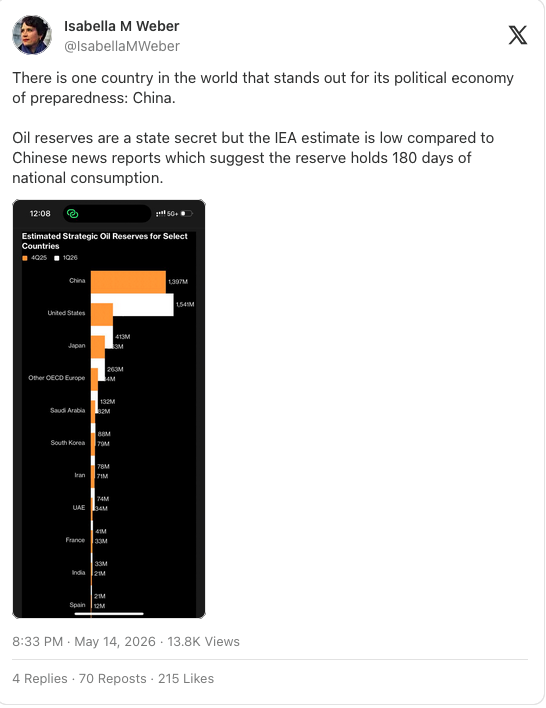
Crises have a habit of sharpening collective awareness of previously obscure facts. In the case of the Iran war, one such revelation has been the sheer scale of China’s oil stockpiles.
But while analysts agree that China’s inventories are enormous, they disagree sharply on what those inventories actually signify.
For example, Isabella Weber, the German economist with a penchant for planned economic management, believes the scale of the reserves reflects the superiority of the country’s communist system and model. As she put it recently on X:
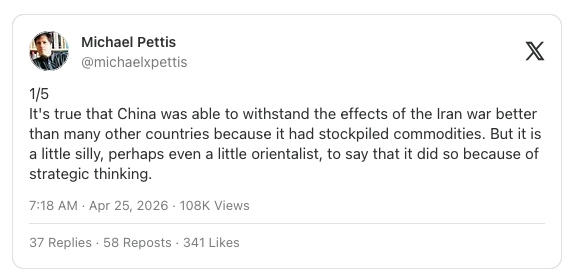
On the other hand, China expert and all-around cool dude Michael Pettis says there is nothing strategic about the stockpiles at all:
Weber’s perspective is arguably the more commonly held one. For many, it feels intuitively correct. A country running such large reserves must obviously be thinking strategically. Why else would so much capital be locked up in idle commodities if not for prudent planning purposes?
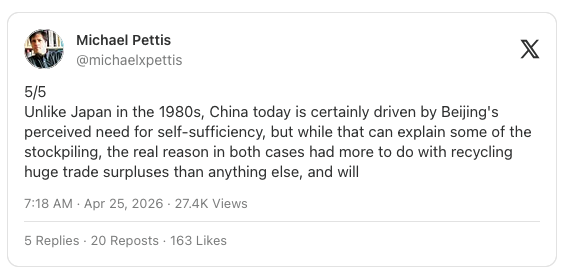
Pettis, by contrast, urges readers to remember that Japan also stockpiled massive amounts of commodities in the late 1980s and that this didn’t work out too well for Tokyo. When the economy turned and commodity prices collapsed, Japan was left holding the bag. The resulting economic drag was certainly not something anyone strategically planned for.
It’s far more likely, in his opinion, that the giant Chinese stockpiles are a symptom of Beijing’s ongoing need to recycle trade surpluses into hard assets, not least because “buying commodities for investment purposes shows up as an import, not an outflow on the capital account.”
So, who to believe?
The more convincing interpretation, in my opinion, is Pettis’. In the presence of ongoing $1tn-plus export surpluses, and a well-publicised reluctance to keep investing in US dollar assets, it seems entirely logical that surpluses must be absorbed some other way that befits China’s mercantilist model — i.e., one that sustains industrial competitiveness by running persistent trade surpluses and by acquiring reserves.
Put more simply, China must continue to build reserve assets if it is to maintain an export-oriented advantage on the global stage. And if those reserves are no longer going to be held in dollars, then what? Certainly not China’s own bonds, since that would undermine the logic of its mercantilism. Commodities seem an obvious fit for a dollar proxy.
The narrative is all the more compelling when you consider the decline in China’s official holdings of Treasuries since 2008:

Except, if commodity stockpiles really are replacing dollar reserves within China’s broader reserve strategy, then Beijing may be inheriting a much larger problem in the process — one that it may already be struggling to manage.
This relates to how such enormous stockpiles are financed. The answer to that question may ultimately explain one of the strangest features of the current energy crisis: the fact Chinese stockpiles are simply refusing to budge, even as energy shortages across the region continue to worsen.
If that’s because the stockpiles are financially encumbered in complex collateral arrangements, this poses a problem for assumptions such as Weber’s, whose interpretation implicitly assumes the stockpiles are readily deployable strategic assets.
To explain how and why this is important, it’s worth unpacking the basics.
Commodities are not only costly and complicated to store at the best of times; they are also a notoriously volatile asset class, prone to severe one-way price risk. Any national strategy that replaces positive-yielding dollar safe assets with commodity stockpiles is, by definition, exchanging income-generating reserves for assets with negative carry and substantially higher mark-to-market risk.
While some of that risk can be hedged away with derivatives, hedging itself is not free. In the context of long-term strategic stockpiles, it is only truly cost-effective when market conditions justify stockpiling in the first place. Maintaining a strategic reserve position regardless of market conditions can therefore become extremely expensive, both in terms of capital intensity and opportunity cost. Moreover, even where such “market neutral” positions appear positive-yielding in yuan terms, there is no guarantee they remain positive-yielding in real economic terms.
The thinking might therefore be that China shouldn’t bother hedging at all. After all, if the stockpiles are genuinely strategic assets, why not simply treat them as a sunk cost?
The problem is that, left unhedged, they explicitly become negative-yielding assets on the state’s balance sheet, exposing the extent to which China’s reserves are depreciating relative to positive-yielding Western equivalents.
Remember, warehousing, security, insurance, and financing costs all accumulate over time, meaning the strategy is only economically neutral (let alone profitable!) when asset-price appreciation continuously compensates for such costs.
It’s precisely to compensate for such costs and risks that central banks have historically tended to put zero-yielding commodity assets held on their balance sheets — most notably gold — to work. Typically, this has involved lending bullion to commercial counterparties such as miners, who benefit from maintaining short positions to hedge future production and are thus prepared to pay a fee for the loan.
That, however, is not as easy with more complex commodities like oil or its products.
Hence, if China really is using commodities to replace the dollar, the strategy only works so long as the value of those stockpiles never falls below what might be called the “monetisation threshold” — the point at which losses must be absorbed fiscally or be buried in the accounts of some other state proxy to avoid being explicitly monetised.
Needless to say, this creates a powerful incentive for a sovereign-scale commodity cornering strategy of Hunt brothers proportions.
In practice, it’s potentially worse than that. The Hunt brothers ultimately had to contend with hard budget constraints. China does not. Its banking system operates under notoriously soft budget constraints, theoretically allowing Chinese banks to finance commodity-cornering strategies in yuan terms almost ad infinitum.
In effect, this amounts to a deeply underappreciated form of QE-style monetary expansion that could be going on in plain sight — one routed through commodity accumulation rather than conventional financial assets.
Bear all this in mind as we attend to the second problem with Weber’s simplistic take on stockpiles.
The case of the missing dollars
But as CFR’s Brad Setser has been banging on for months, it is far from clear that China’s dollar reserves have actually collapsed at all. After carefully reconstructing the official data, Setser has concluded that China’s dollar dependence has instead migrated into a far more opaque part of the financial system: the balance sheets of state-owned Chinese banks.
By his count, Chinese banks’ dollar assets have exceeded their dollar liabilities for some time, implying a net positive dollar position for the banking sector as a whole. In other words, a significant portion of China’s hidden dollar exposure appears to reside on Chinese bank balance sheets, and this is evident because dollar-denominated assets exceed dollar-denominated liabilities.
But there’s more to the story than that. In his latest piece for CFR, Setser reminds readers that China has not disclosed the currency composition of its reserves since at least 2020. Weird, right? More importantly, he argues that Beijing may now be overrelying on sophisticated offshore masking techniques to obscure the true scale and location of its dollar holdings:
“Estimating China’s true holdings of U.S. assets has gotten harder because it seems like China has diversified not just out of the US, but also out of Euroclear (a large Belgium-based custodian). Its holdings in Belgium were a bit too obvious, and the Euroclear custodial arrangement turns out to be punitive to a sanctioned central bank.”
Even this, however, may not fully explain what is really going on with China’s surplus recycling — or where all those dollars are ultimately ending up.
Our theory, which potentially helps explain the discrepancies, is that China’s mercantilist model is now costing more to finance in dollar terms than it generates in direct financial returns. So, while China’s current-account surplus may still exist in a trade-accounting sense, an increasing share of those export earnings may be being disproportionately absorbed by the servicing, collateralisation and rollover of offshore dollar liabilities tied to the mercantilist system itself.
Returning to the original commodity conundrum, my own working hypothesis — given all of the above — is that China’s strategic commodity stockpiles are fulfilling the role of dollar-denominated monetary base funding. Moreover, it’s very possible that this base now underpins the country’s entire export model on increasingly leveraged terms. The reason the leverage remains largely invisible is that the clearing of these commodity-backed “yuan dollars” occurs largely outside the formal dollar-clearing system.
Indeed, rather than accumulating passively as official reserves, such “yuandollars” could be circulating through offshore custodians, state-linked intermediaries and commodity-finance structures. The effect is that the same pool of dollar liquidity is possibly being relent and rehypothecated multiple times over by entities that sit outside the official dollar clearing network.
If that’s true, China may effectively be borrowing back its own surplus dollars at increasingly negative carry in order to fund the acquisition of strategic inventories in a merry-go-round operation that is now generating major diminishing returns.
Questions that need answering
To be clear, I don’t have all the answers. There are still many mysteries and inconsistencies that need to be resolved. What is indisputable, however, is that the official narrative does not adequately account for them.
To encourage better minds than mine to investigate, it is worth spelling out a few of the more obvious anomalies.
For one, it is widely assumed that because Chinese oil imports have declined materially since the Iran war broke out, the country must therefore be offsetting the supply shock by drawing down its vast strategic stockpiles. Indeed, this was precisely the explanation presented to me during an ING macro briefing on Monday.
Yet nearly three months into the Iran war, the highest-quality inventory data available to the market suggests something genuinely startling: there is still no visible sign whatsoever of a meaningful drawdown in Chinese stockpiles. Not a gradual depletion. Not even a modest dent.
While I don’t have a chart to back up this assertion, I can assure you that I have seen the data.
This in itself is very odd. China’s BRI partners are, by many accounts, surviving on fumes, yet the regional hegemon that is supposedly operating from a position of superior strategic resilience [if pro-China narratives are to be believed] appears unwilling to ease the pressure by releasing inventories into the system. This stands in stark contrast to Western powers, which have repeatedly shown a willingness to deploy strategic reserves during periods of stress. At the same time, the US is keenly flexing its hegemonic muscle by ramping up exports to strategic allies.
Au contraire. Not only did China not come to the BRI’s rescue when the Iran crisis struck … quite the opposite: it hunkered down and imposed an export ban.
On that front, the plot thickens further still.
China finally signalled that it was prepared to ease the ban about two weeks ago. Yet, little appears to have changed in practice. As the FT reported on May 14, exports are still not forthcoming:
Chinese exports of jet fuel, gasoline and diesel are languishing far below their levels before the Iran war despite Beijing signalling it would relax a ban, dashing the hopes of other Asian countries desperate for supplies to combat shortages as a result of the conflict. China had signalled its intention to ease the oil products export ban it introduced at the start of the Iran war, and the government agreed in late March to sell some fuel to countries in the region on a humanitarian basis. Several large state oil companies applied for export permits to ship refined products in May.
But China exported just 417,000 barrels per day of refined products in the first two weeks of the month, much lower than its usual exports before the war, according to data compiled by oil research group Kpler. In January and February, China exported about 750,000 barrels per day of refined fuel.
So what is going on?
As far as I can tell, there are really only three plausible explanations for the anomaly — and none of them are especially reassuring.
One: demand destruction inside China is far worse than generally appreciated, with the Iran war conveniently masking the true scale of the downturn.
Two: China would like to draw down its reserves, but cannot. As outlined above, the inventories may now be so deeply encumbered within complex collateral and commodity-financing structures that unwinding them risks destabilising Chinese banks, commodity merchants or even the broader FX regime.
Three: China’s previous rate of stockpiling was so extreme that the recent collapse in imports has merely brought flows back into rough equilibrium.
But that’s not the end of the list of curiosities.
The launch of a yuan-denominated, China-deliverable crude oil futures contract had been anticipated for many years as a potentially transformative moment in global commodity markets.
Yet, when the contract finally arrived in 2018 via the International Energy Exchange (INE), a subsidiary of the Shanghai Futures Exchange, it immediately raised concerns.
Craig Pirrong, one of the world’s leading authorities on commodity derivatives and exchange structures, identified several peculiarities in the underlying structure.
For one, he noted that the contracts embedded substantial basis risk owing to China’s unusual regulatory architecture and the system’s inbuilt currency-conversion constraints. Put simply, any mispricing relative to global benchmarks would be difficult to arbitrage away because capital could not move freely in and out of the system. In the absence of a freely adjusting exchange rate, some other mechanism would therefore have to absorb the imbalance. Second, the INE had implemented a bizarre feature that in all other circumstances would have undermined contract performance: artificially high storage costs.
As a related Bloomberg story explained at the time, this was due to the Chinese government wanting to limit potential cash-and-carry plays:
One of [INE’s] strategies to deter excessive price swings is to set related crude storage costs in China at levels that are at least twice the rate elsewhere. That’s seen discouraging speculators interested in conducting so-called cash and carry trades, which seek to take advantage of differences between the spot price and futures of a commodity.
This matters because it suggests Chinese authorities fully understood that, left unchecked, the market would inevitably use commodity differentials and cash-and-carry trades to circumvent capital controls — and, in the process, expose the distortive effects embedded within China’s broader policy framework.
For Pirrong, this sort of suppression was paradoxical. A derivatives exchange that actively suppresses cash-and-carry arbitrage is unlikely ever to function efficiently, because it undermines the very mechanism through which futures markets perform their core role: price discovery.
As he noted at the time:
The thought that cash-and-carry trades are some dangerous speculative strategy puzzled me–it’s obviously not a directional play, so why would it affect price levels. But perhaps I foolishly took the official explanation at face value. Chinese firms have been notorious for using various storage stratagems as ways of circumventing capital controls and obtaining shadow financing. Perhaps the real reason for the high storage rate is to deter use of the futures market to play such games. Or perhaps there is a tax angle. Back in the day futures spreads were a favored tax strategy in the US (before the laws were changed and the IRS cracked down), and maybe cash-and-carry could facilitate similar games under the Chinese tax code. Just spitballing here, but the stated rationale is so flimsy I have to think there is something else going on.
This brings us to the next curiosity: the peculiar behaviour of Chinese contango — periods when near-dated crude futures trade at a discount to longer-dated contracts.
Since 2018, and with the notable exception of the Covid shock, international crude benchmarks such as Brent have traded overwhelmingly in backwardation, a structure in which near-dated futures command a premium to longer-dated ones.
The Chinese market, however, has behaved rather differently.
Like most global oil markets, Chinese crude futures briefly entered an extreme contango structure during the chaos of 2020. But unlike Brent markets, episodes of contango have continued to recur across various parts of the Chinese curve in the years since.
- From mid 2018-mid 2019
- Mid 2021.
- Periodically from the end of 2022 until mid 2023.
- End of 2023-Beginning of 2024.
- For most of the second half of 2025.
- Periodically (at the very short-end) even in 2026 post Iran.
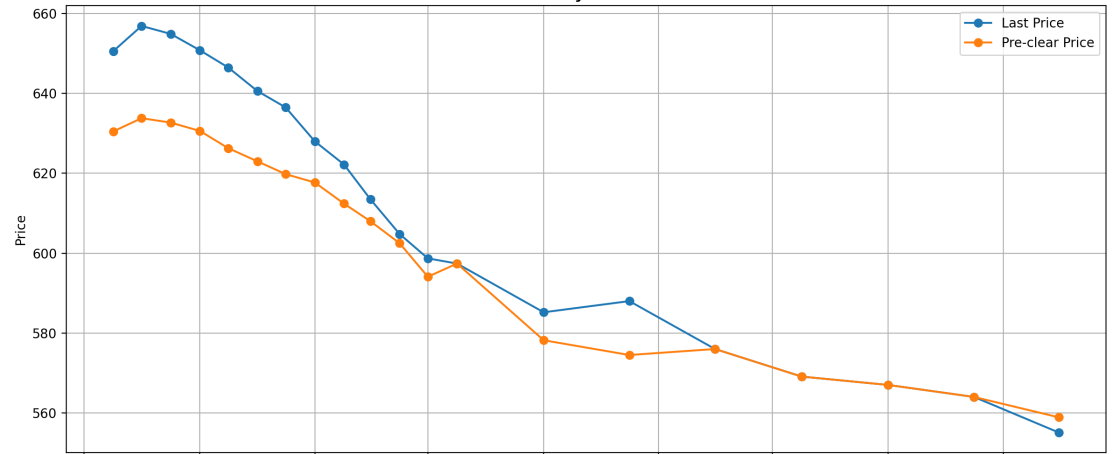
Even as late as May 15 — months into the Iran war and amid severe supply disruption across global energy markets — the Chinese crude curve was still exhibiting contango at the very front end.

For comparison, here are some other snapshots of the curve from other choice periods:


Note: the above charts were generated from INE source data with AI assistance and should therefore be treated as indicative rather than definitive. While efforts were made to corroborate the underlying data, limited familiarity with Chinese-language labelling may have affected the precision of the fact-checking process.
The persistence of the contango matters because of the way roll economics are distributed across the market. In a contango structure, it becomes profitable to hold large physical inventories and sell them forward via derivatives. When the curve flips into backwardation, the opposite occurs: storage becomes costly, and the market effectively incentivises inventories to be liquidated by rewarding paper exposure over physical holdings.
Which raises an obvious question: why does the Chinese market so frequently diverge from global oil-market dynamics?
Is China — despite being one of the world’s largest net oil importers — really so persistently oversupplied that its domestic market repeatedly slips into contango while global benchmarks remain in backwardation?
Or are Chinese authorities instead relying on bank proxies or other intermediaries to support futures prices as a backdoor means of subsidising commodity importers — or entities entangled in commodity-for-dollar collateral structures?
Several features of the INE architecture point to the latter explanation. For example, INE exchange has gone to considerable lengths over recent years to woo foreign entities. This becomes even more striking when one discovers that such foreign entities are permitted to fund margin positions with dollar collateral, despite the overall system ultimately settling in yuan.
Frustratingly, the exchange does not provide data on the scale of the dollar funding in the system — only that such funds must be intermediated through Chinese institutions (which in itself is potentially a red flag).
What does seem clear is that even if Chinese authorities initially designed the yuan-denominated futures market to discourage cash-and-carry arbitrage, the policy appears to have failed to suppress storage incentives.
This may be because the mandated higher price was still too cheap in dollar terms to put off cash-and-carry play. Or it could be because it proved easier to embed the practice within a broader framework of “strategic” accumulation and official liquidity support.
How Chinese oil storage actually works
Explaining how China’s strategic reserves system actually functions is no easy task. Suffice it to say, it bears little resemblance to the reserve-management frameworks typically employed in the West.
Unlike the US Strategic Petroleum Reserve — which is a relatively straightforward sovereign-owned emergency stockpile held in dedicated federally controlled caverns — China’s system operates through a much more opaque and hybridised structure that deliberately blurs the distinction between commercial inventories and state-directed industrial stockpiles.
In that sense, it superficially resembles the European model more than the American one, wherein, strategic reserve obligations are often fulfilled through a combination of state-held inventories, industry-held stocks and specialised stockholding agencies operating under International Energy Agency rules.
In China, too, inventories can sit in commercial tank farms, bonded facilities or company-operated depots rather than in clearly segregated sovereign reserve sites. But this is where the similarities with Europe begin to break down. European systems are ultimately designed around a transparent, rules-based framework. Commercial players are compensated at a predictable rate, either directly or indirectly, for carrying inventories on behalf of the system through mandated stockholding schemes. Traders work those costs into the curve on known known terms — resulting in a transparent cost of doing business.
China’s system, by contrast, appears structured around a much broader set of strategic, industrial, and financial objectives simultaneously. Compensation, for the most part, is baked into the structure of the curve on utterly variable terms.
While there is evidence that the government effectively compensates or incentivises commercial/state-linked players to hold strategic inventory — it usually does so through preferential financing, leasing arrangements, regulatory privileges, or other forms of forbearance or quasi-fiscal support to state-owned companies.
Plus ça change… in other words.
In banking terms, this is the difference between a system in which banks are transparently remunerated by the central bank for holding excess reserves in compliance with clearly defined leverage, liquidity and capital-adequacy requirements, and one in which support is channelled implicitly through opaque policy mandates, balance-sheet forbearance and state-directed credit allocation.
The Shanghai International Energy Exchange (INE) forms an important part of this architecture. Unlike a conventional emergency reserve mechanism, the INE integrates physical crude storage directly into its futures and collateral framework. Crude delivered against INE contracts is stored in approved bonded warehouses operated largely by major state-linked energy firms, while warehouse receipts generated against those inventories underpin the exchange’s physical delivery process.
And, of course, it’s significant that foreign participants are permitted to trade these contracts while posting dollar-currency collateral into the system. The result is a parallel clearing mechanism through which dollar liquidity can interact with strategically warehoused physical crude inside a yuan-settled market structure, and leveraged accordingly.
In that framing, warehouse receipts originated by foreign participants begin to function as something akin to proxy dollars — potentially rehypothecated many times over — inside China’s otherwise tightly controlled financial system.
Periodic contangoes in such circumstances may be necessary to ensure that the underlying dollar base does not exit the system, thereby triggering a collateral squeeze.
There is, moreover, a precedent for this sort of dynamic. Readers may remember that, for years, passive index funds in the West were widely blamed for disconnecting oil prices from underlying economic fundamentals by funnelling vast sums into long-only crude futures positions. In the end, the strategy proved costly for investors, who were forced to absorb the persistent roll costs associated with maintaining those positions. In effect, the structure operated as a quasi-subsidy flowing from passive real-money investors to oil producers and commodity speculators.
The easiest way for China to engineer a similar effect to keep dollar collateral trapped within the system would be for some equivalent of the country’s “National Team” to intervene directly in futures markets whenever positive carry in yuan terms became insufficient to sustain the trade organically.
In practice, this would mean socialising the cost of the contango rolls in exchange for retaining access to the underlying dollar funding base. Economically, the mechanism would not be entirely dissimilar to China’s old FX intervention model, in which the state effectively paid to keep foreign currency embedded within the domestic system.
Where the PBoC once accumulated dollars directly by maintaining an official bid in currency markets, the state may now be indirectly bidding for offshore dollar liquidity through the provision of carry in commodity-finance markets instead. Or something like that.
I’m very open to thoughts and feedback.
If even parts of the above are directionally correct, then China’s commodity stockpiles may be serving a very different function from the one most analysts currently assume.
Moreover, if you found this analysis useful, please do share and spread the word.
Related links:
China’s Invisible Hand Is Distorting Global Oil Markets — Oil Price.com