
| SNEAK PEEK |
— Is a coalition of tech bros and industrialists planning to rescue America in the event all hell breaks loose after the November 5 U.S. election?
— Rumors of the dollar’s demise are greatly exaggerated because alternatives are still too expensive and require even more pre-paid capital.
— China’s economic model faces the same challenges Britain’s feudal lords faced when they lost access to abundant repressed labor.
Dear subscribers,
So much to say and so little time. We, like everyone, are focused on the upcoming U.S. election, but with so much being written about the topic there’s no point adding to the noise.
The blind spot, if any, is what markets will do if the results are indecisive or contested, especially now that news of potentially fraudulent registrations is already making the rounds.
At the extreme end, some are predicting military intervention or martial law based on some recent amendments to an old 2007 DoD directive. But this seems a misreading.
Our hunch, especially given the growing involvement of Elon Musk in Trump’s campaign and Jeff Bezos’ intervention to ensure the Washington Post endorsed no-one, is that in the event of any uncertainty, America is much more likely to be swept into the arms of a caretaker technocratic government.
This would probably be billed as a coalition of industrialists and tech bros — possibly even AIs — who would assert themselves as challengers to the only other viable alternative: the faceless bureaucrats currently calling the shots within the Biden administration.
Yes, yes, it sounds bonkers. But it’s not without precedent. Consider Italy, where the “quick fix” to political deadlock has often been the emergency imposition of non-political experts into leadership roles.
Oh, and in case you didn’t know, Cummings — who famously holds Elon Musk in high regard, admiring him for his forward-thinking and audacious approach to innovation — thinks the best way to sell the idea to the public is to appoint someone like J.K. Rowling as Prime Minister.
You laugh, but it’s all in the spirit of what Elon Musk’s grandfather, Joshua Haldeman — a prominent leader in Canada’s Technocracy movement — had always hoped to achieve.
The movement argued that political and economic systems were inherently flawed and inefficient, proposing instead a centralized system led by engineers and scientists who would control production and resource distribution based on need, not profit. They also envisioned a non-monetary economy and a transition from capitalism to a scientifically organized structure.
In the meantime, they waited quietly in the background until the opportunity to take over the government arrived (all the while wearing cute little uniforms and insignia, a bit like Bond-villain henchmen).

As usual, this newsletter is brought to you by me Izabella Kaminska, and Dario Garcia Giner.
Send tips to [email protected] and [email protected].
| THE BIG BLIND SPOT THIS WEEK |
BRICs-A-BRAG (A LOT): Exclusive to all media this week was news that Vladimir Putin’s challenger payments system, dubbed the “Brics Bridge” had failed to resonate with leaders at the Brics summit in Kazan. This saw it mostly dubbed a flop.
“That’s just disinfo!”: The usual suspects, however, claimed the Western press had falsely puffed up the negative coverage to suppress the bad news about the dollar. “The end of the U.S. dollar may be near and mainstream media are not even mentioning this historical event involving Russia, China, Turkey, Brazil, India, South Africa, Iran, Saudi Arabia… and a total of 36 countries. Insane,” as one aggrieved observer put it to us. You get the picture.
IZZY COMMENT: Common to both takes is the assumption that the technology to displace the dollar is here and that BRICS nations need only wish it into existence. And yet, that couldn’t be further from the truth.
Let’s unpack the technological issues: According to the FT (and others), Putin wants to create a new payments messaging system known as BRICS Bridge. In reality, no such thing exists. The nearest thing to it is a BIS-led project called mBridge, which aims to unite CBDCs operated by the HKMA, the Bank of Thailand, the PBoC, the central bank of the UAE and Saudi Arabia on a single interoperable standard in a way that bypasses dollar dependency.But there’s a problem! Currently, it is Uncle Sam that guarantees value in transit, much the way eBay provides an escrow service that stands between buyers and sellers on its platforms. Taking the dollar out of the equation is easy. What’s not easy is synthesizing a brand new deep-pocketed guarantor that’s trusted by all sides — especially one with the economic wherewithal to be taken seriously in international markets.
Sure, international trust in America’s ability to arbitrate or defend its decisions by force might be fading, but there’s still no better option out there. That’s simply a fact.
Why mBridge can’t resolve this issue: Thus far, the project has been too fixated on applying an engineering solution to what is fundamentally a trust and credit problem. This has ensured that most of its workarounds have stumbled with liquidity issues or other debilitating frictions. That’s why a separate initiative called Project Mariana is now hoping to apply learnings from the crypto space to resolve some of these challenges. But this too is proving problematic.
Liquidity will always be costly: The big idea behind Project Mariana is drawing on DeFi-inspired liquidity solutions that depend on decentralized FX swaps and automated market makers to synthesize liquidity. But this, by any measure, is an insanely costly workaround. It’s like saying, instead of using eBay to oversee a transaction, we need to maintain pre-funded deposits with every single counterparty we might ever wish to transact with so that on the off chance we do, they can clear instantly. [Ed — Sounds a bit like central counterparty clearing but without the central counterparty, no?]
Worse than that, the costliness of the system is only diminished with leverage in a process known as staking. This involves incentivizing speculators to lock up capital in liquidity pools so that it can be drawn upon as and when needed. There’s a catch though. Countries have to pay speculators a fee for the standby service — a bit like replacing a well-known player like eBay with a multitude of smaller loan sharks just because you don’t like eBay’s terms and conditions.
Rents and risks abound: If you consider eBay’s terms so onerous, that anything, even a costlier and less efficient system, is better, then perhaps a transition to a non-dollar system makes sense. But this is far from the superior system many are alleging. In no scenario does the need to pay rents — aka tribute — go away. One powerful overlord is merely replaced by a patchwork of strongmen and mercenaries who are just as costly if not costlier to service.
But it’s not just about the technology: One of the Blind Spot’s ongoing critiques is that so many of these fintech solutions overlook the socio-economic factors that shape payment frictions in the first place. A bit like obsessing about creating the best factory machinery to boost margins when the real bottleneck is insufficient access to raw materials or other structural factors.The point being … international settlement costs and frictions aren’t just technological inefficiencies; they’re reflections of trade imbalances, deeply tied to everything from governance structures to cultural attitudes.
Geopolitical reality is key. America’s unique comparative advantage comes in the shape of the stability, predictability, and cohesiveness of its financial system — a value so sought after by countries that many are happy to subsidize U.S. consumers for access to it. This stability results from a decentralized yet mutually supportive framework that Brics nations struggle to match. Theirs, on the contrary, is a bloc with no common ideology beyond, perhaps, a mutual dislike of the U.S. If the eurozone, which is so much more closely aligned, can’t get passed its differences to iron out internal cross-subsidization issues in defense of the euro, there’s little to no chance the Brics nations will be more capable of doing so.
Subsidy effect: A cross-subsidization feature or redress to a deeper-pocketed guarantor is an essential property of any functioning payment system. Someone simply must be prepared to shoulder the burden of plugging unexpected shortfalls to keep things ticking over. Invariably, the role falls on the strongest member, which inevitably makes the structure political.
For decades, the U.S. effectively served as the guarantor of the global dollar system in this way — implicitly standing ready to cover shortfalls if and when disruptions occurred.
Not that it went seeking this responsibility. Guarantor status was thrust upon America by poor countries with large dollar inflows through a process known as “dollar recycling”, eventually establishing the eurodollar system (aka the intermediation of dollars that circle outside U.S. borders).
This setup, much like today’s stablecoins, relied on substantial pre-funded capital pools at the national level to back dollar-like liabilities that could be easily financialized beyond U.S. borders, while remaining convertible into real dollar funding as needed through intermediaries with U.S. banking connections.
In practice, this amounted to low-credit countries with large dollar inflows ditching the opportunity to redeem U.S. goods and services in favor of engaging in maturity transformation with the U.S. government in the hope that large UST holdings would boost their credibility and ability to trade and invest more broadly. Some might say, this amounted to a de facto pre-payment to the USG for the right to benefit from its guarantee in international markets while still retaining a right to draw on U.S. liquidity whenever needed without friction.
The arrangement was not without costs for such countries. While the holdings still earned interest, locking up capital in this way had distorting effects at home, resulting in large-scale financial repression.
On the flip side, it was the American private sector and not the government that was made structurally responsible for delivering the required liquidity when called upon — usually by way of money market funds, Libor markets and other money market tools or repos centered on swapping long-term Treasury bonds for short-term funds. (The liquidity still had to come at a price, mind you, but arguably a lower price than might otherwise be the case.)
GFC factor: But while the arrangement successfully reduced the riskiness and cost of global trade and commerce for many years, all that changed in 2008 when the U.S. government discovered the private sector had failed to identify and manage the associated risks properly. When push came to shove, there just wasn’t enough liquidity to make good on the arrangement.
To prevent a banking collapse and widespread defaults, the U.S. government had no choice but to honor the implicit guarantee underlying the arrangement — a guarantee that had never been formally tested until then. The resulting cost for America was back-breaking, requiring taxpayer-funded bailouts of banks and prolonged engagement with reputation-tarnishing “money illusion,” aka quantitative easing.
Conditionality now applied! Since then, the U.S. has, quite understandably, insisted on applying much stricter terms and conditions to the use of its currency in global trade. This has, unsurprisingly, proven hard to stomach both for dollar-rich foreign nation-states and Western financial institutions, which are now forced to reserve huge amounts of capital and liquidity when servicing the market, impacting their bottom lines.
Where does that leave things? While the new rules of engagement haven’t been able to kill off eurodollar markets, they have added costs to all sides. The system, for example, increasingly relies on central-counterparty clearing for access to onshore liquidity. Regulation has also made it harder to raise short-term dollar funding against anything other than the highest quality UST collateral. Gone, for example, is the ability to pledge risky dollar-denominated securities in uncleared bilateral markets for funding, because banks with the capacity to distribute such liquidity are de facto penalized for doing so at the capital provisioning level.
All this has made it much more challenging for a country like China — or any large holder of U.S. dollar-denominated assets — to trigger a sudden run on dollar funding by dumping collateral into the repo markets. Indeed, if China were to dump collateral into the repo market sparking volatility, CCPs would be able to limit any associated repo rate spikes by lifting margin requirements in a way that bolsters demand for USTs.
Unsurprisingly, countries like China are frustrated by these added costs and conditions. They’re also unhappy that the only guaranteed way now to raise dollar liquidity quickly — and without losing many cents on the dollar — is by way of outright asset sales, a move that comes with its own costly issues (but more on that below).
Given all this, it’s no surprise that China and other large UST holders have become increasingly vocal about initiatives that aim to replace the dollar in global trade with alternative systems that might offer them more favorable terms.
At first glance, the changing composition of international UST holdings might even suggest they’re acting on these ambitions. The marked decline in China’s UST holdings since 2020, for example, is particularly notable:
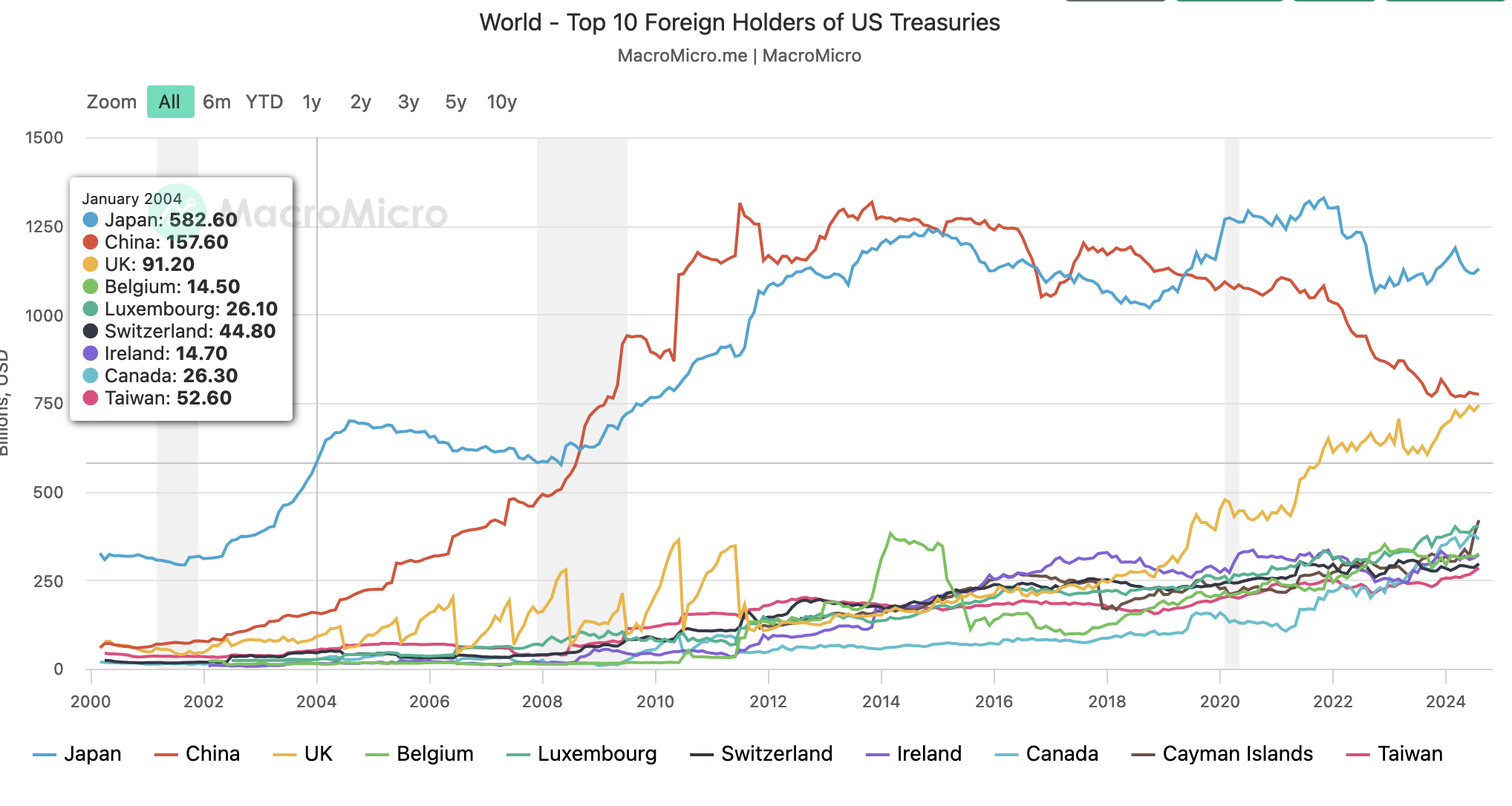
But all may not be what it seems. Looking closer, the USD remains as dominant as ever in global FX transactions, representing some 88 percent of foreign exchange transactions worldwide, while usage in Swift transactions has grown from 47 percent in 2023 to 49 percent in 2024, according to official surveys. When it comes to reserves, the dollar still makes up a not-too-shabby 58 percent of all global holdings:
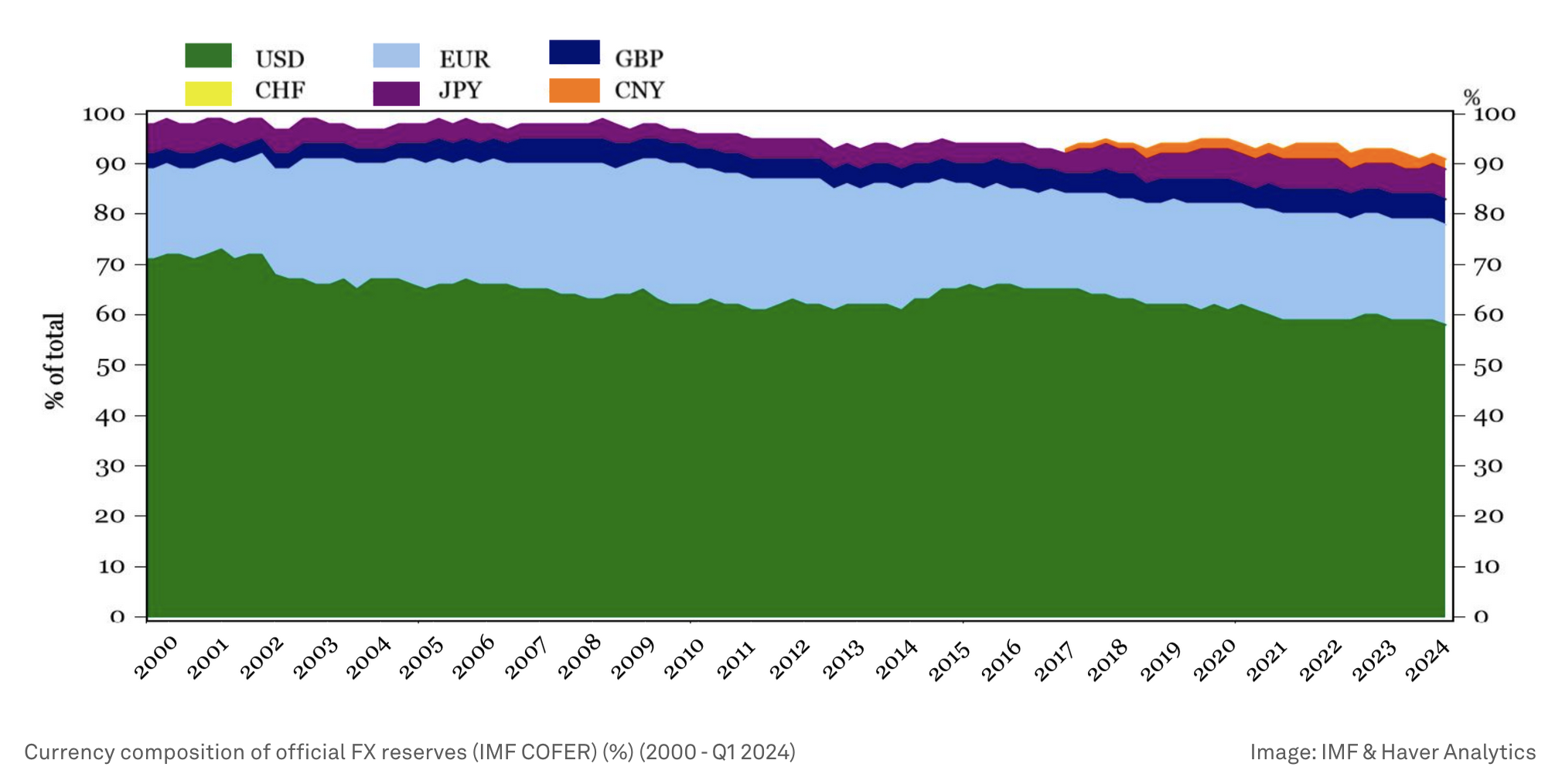
The superficial decline in Chinese UST holdings may therefore be a misdirection — especially if you consider that U.K., Belgium, and Luxembourg holdings, all of which act as proxies for other nations’ UST investments, have more than offset those declines.
But is it a form of repression?
That, really, is the question. Considering that much of the offsetting demand likely comes from central counterparty holdings or financial institutions forced to acquire USTs for regulatory reasons, it’s reasonable to argue that regulation has been strategically engineered to prevent repo rate spikes even if the cost of such action is a constrained banking sector and reduced bank lending to the real economy, and thus potentially also growth.
There’s no doubt that in the U.S. Bidenomics has helped to counter some of this repression, while also stimulating growth, but it’s done so largely by normalizing tariffs. This has had the effect of cutting the US consumer off from the cheap goods being thrown its way by countries that require ever-larger USD guarantees to keep their economic models functioning.
The associated reshoring is a signal the U.S. is no longer prepared to subsidize countries that don’t bend to Western values or rules of engagement — a position that represents a soft form of decolonization that outwardly threatens the era of Pax Americana.
No, SinoPax is not an option:
Some argue, of course, that China’s model is strong enough to stand independently and to establish its own reserve standard. But this view potentially overlooks the true drivers of China’s growth the past few decades while misunderstanding the challenges the country faces in pivoting toward a domestic consumption model.
It also reflects a fundamental misunderstanding of how financial guarantees work. First, who outside of countries strategically excluded from the dollar system would prefer a Chinese guarantee over a U.S. one? Second, how would anyone gain meaningful exposure to the yuan when the vast majority of China’s external debt is dollar-denominated, not yuan-based, and the country continues to run a trade surplus? Lastly, consider the strengthening effect a substantial shift towards a yuan standard would have on the RMB and how that stands to undermine China’s export competitiveness.
THE CHINESE GROWTH PARADOX. Overlooked too often in the BRICS debate is that if China loses its export advantage, the economic repercussions are likely to be severe. In the extreme, factories would fall idle, impacting current workers and all prospective employment in the manufacturing and tech sectors. As job options dry up, young people would face fiercer competition for limited opportunities, resulting in downward mobility, lower wages, and diminished social mobility. Many would be unable to afford housing, marriage, or the family formation traditionally expected by their parents’ generation.
To some degree, we already see this happening with the “lying flat” phenomenon
Facing mounting debt without consistent revenue, state-owned enterprises would likely require government bailouts, stressing public finances. Local governments, unable to rely on export-driven land sales and taxes, would cut social services, leading to public frustration and instability.
Living beyond one’s means: Escaping these negative feedback loops is difficult. If China attempted to redirect this spare capacity toward domestic consumption, it could quickly find itself “living beyond its means,” emulating a wealthy estate without reliable cash flow. Rising domestic demand would then drive prices higher, especially for imported resources like energy and food, leaving consumers with less real purchasing power.
An upcoming reckoning? Pivoting to supplying countries like Russia instead of America would not necessarily solve the problem either, since Russia lacks the necessary spending power to replace U.S. demand, and has limited guarantees of its own to offer. And while China could pivot to a consumer-based model, without reliable export income, it could soon struggle to balance its books.
The feudal precedent: A significant factor holding back a Chinese economic adjustment is also the country’s structural
This comparison, however, does not bode well for China. When feudal repression ended in Britain, its aristocracy could no longer afford to maintain the living standards they had become accustomed to for decades. Many were forced to convert their ancestral estates into public attractions or even to sell them outright, usually to industrialists with far more reliable incomes. A similar adjustment, however, wouldn’t be easy for China. Factories and high-end apartment blocks aren’t so easily repurposed, while automation requires significant upfront investment.
The irony this presents is that while global markets view China as a capital powerhouse capable of snapping up assets and investing abroad if its export model falters, this could easily be turned on its head. Like Britain’s aristocracy, whose grand estates became unsustainable when feudal labor arrangements ended, China’s factories and luxury developments risk becoming financially unviable if the country can’t sustain low wages and strong export demand. If forced to sell these assets to foreign buyers for upkeep, meanwhile, China would once again become economically dependent on foreign capital – a fact that could undermine the Chinese Communist Party’s grip on the economy in destabilizing ways.
BOTTOM LINE: The American market and the dollar have for decades functioned as the essential engine of China’s export-led growth. Without them, China is unlikely to be able to sustain momentum, as its controlled capital flows, currency depreciation risks, and reluctance to liberalize stand in the way of forging any viable challenger system. And even though there’s a growing demand for RMB-based liquidity in countries like Russia, these arrangements can’t replace the stability and predictability offered by the dollar.
That means for the short-to-medium term the Brics narrative is mostly bluster.
LIFE AFTER DOLLAR DEBT: Back in November 2000, an analysis by economist Jason Seligman, Life After Debt, explored the paradoxical consequences of the United States eliminating its federal deficit. Written during a period of surpluses under President Bill Clinton, the paper warned that the disappearance of Treasuries could impede the Federal Reserve’s ability to conduct monetary policy while inducing volatility in money markets and bringing about higher borrowing costs when deficits eventually reappear. Seligman’s conclusion was that while debt elimination offers advantages, it also carries significant risks that demand careful planning and consideration to avoid financial instability.
| BUSINESS, ECON AND FINANCE |
BLOCKCHAIN SCHADENFREUDE: A New York-based firm associated with the height of institutional hype around blockchain is leaking money and is late on filing its 2023 accounts, according to POLITICO‘s Morning Central Banker newsletter.
The banker’s blockchain: R3 made headlines between 2017 and 2018 working with a range of big players including JPMorgan, Goldman Sachs and a number of central banks in the Middle East on blockchain-based “enterprise solutions” designed to streamline financial plumbing. In 2018, the firm also ran into a reportedly €240 million windfall following a legal spat with digital currency rival Ripple.
Nothing to see here: But reports filed with the U.K.-based Companies House registrar, reported here first, show the firm is overdue on its accounts for 2023 after missing an August deadline. Submissions from previous years show it hemorrhaging £37.8 million in 2022 and £38 million in 2021. A recent article by Bloomberg reports that the company is considering options, “ranging from a joint venture to a minority stake sale or an outright sale.” R3 did not immediately respond for comment.
BOTTOM LINE: It’s a sign that the much-ballyhooed promise of enterprise blockchain, which wooed retail investors and central banks alike, may have been overhyped and unable to perform at scale. Even if some central banks still haven’t got the memo.
STELLANTIS CEO SCEPTICAL OF EU TARIFFS ON CHINA EVs: CEO Carlos Tavares claimed that while tariffs are a “good communication tool”, the planned EU tariffs on Chinese EVs will have consequential side effects. Notably, Tavares claimed such tariffs would “increase the overcapacity of the manufacturing system of Europe”, since Chinese EV companies could avoid certain duties by building the cars in the European Union. This overcapacity would “accelerate the need to shut down plants” where many already exist such as France, Italy or Germany, since Chinese companies would stand to gain primarily by building new plants in countries like Hungary, where BYD is building its first European assembly plant.
RAYTHEON ADMITS IT DEFRAUDED THE PENTAGON: According to a $950 million fraud and bribery settlement last week in the United States, arms-maker Raytheon “engaged in criminal schemes to defraud the US government” and paid bribes to secure business in Qatar. The bribes, deployed to obtain lucrative defense contracts, were concealed by falsifying documents to the U.S. government. This settlement also includes RTX’s payments for allegedly deceiving the government about its material and labor costs on bids to justify pricier contracts, and also for double-billing on weapons maintenance contracts.
While this is considered a landmark trial against excesses in the notoriously corrupt armaments industry, it’s not the first time RTX has admitted to misconduct: earlier in 2024, RTX agreed to pay $200 million to settle allegations it had transferred some secretive technology linked to Air Force One and other U.S. military aircraft to China.
| GEOPOLITICAL HOT SPOTS |
PKK STRIKE REIGNITES SYRIA: As we reported last week on the intensification of the stagnant Syrian Civil War, new events definitively prove Syria is boiling over once more: the Kurdish militant group PKK, labeled as a terrorist group by most of the West, has recognized its attack on the industrial compound of drone maker Turkish Aerospace Industries, which killed several plant workers. Now, Turkish planes have struck several Kurdish targets in Syria as retaliation.
The structure of the Syrian Civil War means that while the United States recognizes the PKK as a terrorist organization, the U.S. is the principal backer of the YPG/YPJ Kurdish militia in Syria, which forms most of the brigades of the Syrian Democratic Forces (SDF), the main American proxy holding territory east of the Syrian side of the Euphrates river. This means the Turkish attacks are currently taking place in areas that are technically under the proxy control of the United States.
The YPG/YPJ have long denied supplying weapons to the PKK, since this would jeopardize their position with their NATO allies. But it is widely suspected that not only do local YPG/YPJ militias shelter PKK militias and interests, but that the PKK and YPG/YPJ may be operating under the same strategic umbrella. This explains why Turkish attacks are not just targeting PKK hideouts, but also significant elements of the SDF’s economic infrastructure, such as the many SDF-held oil fields near Qamishli in north-eastern Syria, where some 900 US troops are deployed.The SDF has retaliated against Turkish-held areas in northern Syria, striking Northern Aleppo with a wave of Grad rockets in retaliation.
But going deeper into the PKK attack suggests there may be a split inside the radical Kurdish leadership. The PKK’s founder, Abdullah Ocalan, who is currently imprisoned, was offered parole and the chance to end the war with the PKK by an ally of Erdogan if he renowned violence and disbanded the organization. Such an attack by the PKK, naturally, would put a significant dent in these attempts by Erdogan’s allies to negotiate with the PKK’s leader. This implies some kind of concealed power struggle within the PKK between pro-continuation and pro-peace factions.While the Kurdish/Turkish conflict is often viewed from the West as a one-sided dispute, where Kurdish freedom fighters combat against their oppressive Turkish overlords, the reality is vastly different. While Erdogan is often seen as a key enemy of the Kurdish struggle, particularly due to his administration’s brutal military-first strategy against the PKK in the south-eastern regions of Turkey, many of Erdogan’s voters are in fact Kurdish.
That’s because the PKK’s founding position in favor of egalitarian Marxism, which explains their routine use of female combatants, was as much a reaction against traditional, Islamic Kurdish conservatives as it is against the secular overlordship of Turkish rule since their founding. This explains why the other former major enemy of the PKK, the now disarmed Islamic radical group Kurdish Hezbollah, which operated in southern Turkey and Syria, was primarily composed of Kurds that carried out attacks against both the PKK and the Turkish government. In fact, the Kurdish regions of Turkey are some of the most right-wing and pro-Islamic regions of the country, explaining why Erdogan’s pro-Islamic coalitions have always gained a significant vote share there.While the the PKK’s strike against the Turkish armaments factory was curiously timed, not just coinciding with the armaments trade fair in Turkey but also with Erdogan’s allies’ offer of peace with Ocalan, and with Giorgia Meloni’s comments last week on restarting relations with Syria, the fracture within Kurdish leadership this suggests remains entirely hypothetical. And only time will tell whether this new flareup in Syria between a NATO ally and a Western proxy will continue to intensify.
SAUDI AND IRAN ARE DEEPENING TIES: As the world’s attention focuses on Gaza and Lebanon, an easing of tensions between two Middle Eastern enemies has taken place almost unnoticed: Saudi Arabia and Iran have just carried out joint military drills in the Sea of Oman. This rapprochement continues on the back of the Beijing and Oman-brokered deal in 2023 which saw both countries rebuild their diplomatic relations since being broken in 2014 over the execution of Saudi Shia cleric Ninr al-Nimr.
An expert interviewed by the New Arab claimed that while this agreement may only have been pursued by Saudi Arabia and Iran out of a desire to not upset Beijing, that Israeli military actions in the region are “ giving body to this agreement.”
ISRAEL JOINS SOMALILAND KERFUFFLE: Yet another regional power dipped its toes into the Somaliland saga. This time, it’s Israel, which announced last week that it intends to build a military base in Somaliland, across the Gulf of Aden, so that it can better counter the threat of Yemen’s Houthis.
The deal is rumored to involve a reciprocal recognition of statehood, by Israel, of Somaliland, and is developing this deal alongside the UAE who is mediating on Israel’s behalf. We note that the UAE-owned DP World’s ownership of large stretches of Berbera port in Somaliland would make the UAE a big winner should the port increase in traffic at the expense of neighboring Djibouti, as we’ve written on previously. We also remind our readers that an Israeli base in the Red Sea has long been rumored to exist in a series of islands owned by Eritrea.
| CBANKING |
PRE-POSITIONING NEWS: Sarah Breeden, deputy governor of the Bank of England, told an Institute of International Finance event in Washington, D.C that the United Kingdom’s central bank wasn’t convinced that banks should face an increase in the requirements for liquid holdings to cope with the speed of outflows, POLITICO’s UK Financial Services newsletter reported last week.
“We’re firmly of the view that we shouldn’t push that too far,” she said, instead preferring banks to ready collateral at the central bank that can be converted without stigma in an emergency.
Why not get in position? U.K. banks already have £300 billion prepositioned in this way, she said, calling for it to be part of global discussions.
ALL EYES ON INTRADAY LIQUIDITY (AGAIN): Adam Copeland and Sarah Yu Wang of the Federal Reserve Bank of New York’s research group turned their attention to the intersection of intraday liquidity and instant payment risk. Writing in the NYFed’s Liberty Street Economics blog, they noted: “The timing of payments over Fedwire Funds has garnered attention because shifts in the timing of payments are informative about banks’ demand for reserves and, consequently, the overall level of total reserves in the system. Banks also need substantial amounts of reserves to settle their obligations on Fedwire Securities, especially right at opening.”
Reserves sensitivity: The key observation though, is that the timing of payments — aka the daily swing factor — is sensitive to the overall abundance of reserves in the system. “When there are low levels of aggregate reserves, banks delay payments by a substantial amount. Indeed, from 2015 to 2019, the steady decline in aggregate reserves from more than $2 trillion to less than $2 trillion is accompanied by an almost one-hour shift later in the time of the median payment. Furthermore, the substantial increase in aggregate reserves from 2019 to 2022 coincides with a large shift in payments being settled earlier in the day,” they noted.
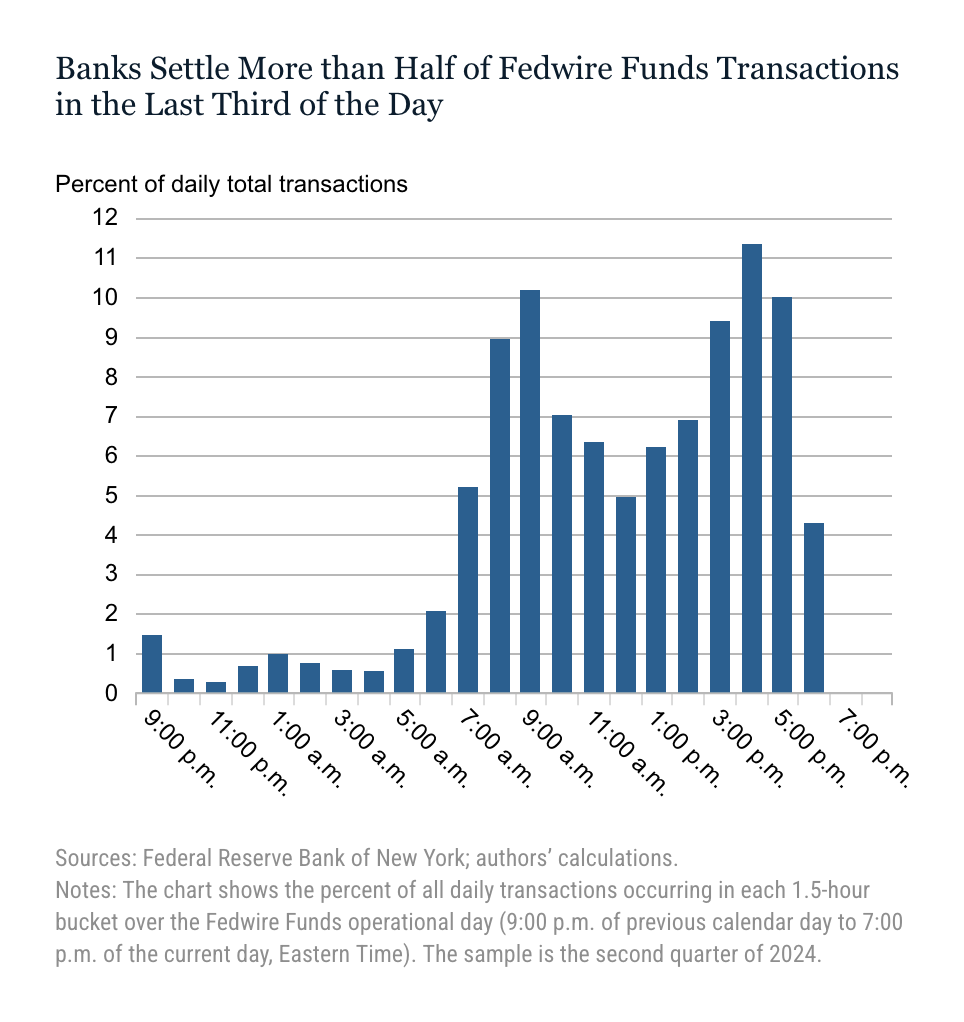
The unanswered question? What do such payment delays mean for financial stability and repo rate sensitivity?
BIS WARNS ON FISCAL OVER-EXTENSION: Agustin Carstens, the big boss at the Bank for International Settlements, warned in a speech last week that it was time for governments to step up and do their bit to keep inflation in check. “While central banks did their job and adjusted monetary policy, fiscal policy has not been correspondingly adjusted in the wake of the pandemic. As a result, fiscal positions are becoming an ever greater concern,” he said.
And don’t forget the ‘region of stability’! “Monetary and fiscal policies must operate within a jointly determined “region of stability” to maintain the trust of the public and financial markets. If they do not, inflationary expectations can become unmoored,” he added. So there you have it, definitely not the central bankers’ fault.
UNCERTAIN FUTURE AFTER LIBYA CENTRAL BANK SCUFFLE: The ouster of the governor of Libya’s central bank is already looking to be a temporary solution to a more intractable problem: the country’s shoddy finances, wrote POLITICO’s Ben Munster this week.
Refresh: Sadiq Al-Kabir, the central bank’s former governor, was replaced earlier this month by a technocratic appointee after he was hounded into exile by militias in late August over a spat with the U.N.-backed government in Tripoli, one of the two feuding factions that emerged from the ruin of the Libyan state in 2011. Part of the reason for the spat was that Al-Kabir — whose institution is the sole legal repository for Libya’s oil wealth — had criticized excessive spending by the Tripoli administration.
Bold new return to status quo: The still-exiled Al-Kabir may have now been replaced, but his point still stands: the Libyan economy is in poor shape. Hard as it is to get a reliable sense of Libya’s opaque economy, a glance at the divided country’s political landscape suggests that things are unlikely to improve so long as its massive oil and gas revenues — its only real source of wealth and only real relevant economic indicator — remain hostage to factional politics.
State capture: As numerous reports by watchdogs and people on the ground have pointed out, the issue is that many of the key institutions in Libya’s economy are either controlled by militias or forced to pander to them. Indeed, one of Al-Kabir’s main criticisms of the government in Tripoli was that the leadership had blown vital funds from oil revenues on lavish diesel and electricity subsidies, seen chiefly as a way to keep onside the armed groups that hold influence over the government.
Bad incentives: That means any government is, by default, in a shaky position and forced to spend more than it can necessarily handle. For thirteen years, Al-Kabir was a deft hand at playing both sides as they vied for access to his institution’s wealth. But the precarious political arrangement underpinning the appointment of his successor, longtime functionary Naji Issa — whom Tripoli was forced to hastily accept after militias threatened to contest its takeover of the Bank — will make it harder for the central bank to resist increasingly desperate calls for funding, as a recent report by Petroleum Economist laid out.
Off to a shabby start: There is already evidence of this. Last week, the central bank increased the amount of dollars Libyans are allowed to purchase to $8,000 from $4,000 annually, according to the Libya Observer. Dollars are sought after not only by ordinary Libyans seeking to stash their wealth away in more stable countries but also by militant groups looking to profit from the difference between the official exchange rate and that in the black market. Increasing their availability is principally seen as serving armed interests — not the economy. (Attempts by MCB to reach out to the new governor have not yet been successful.)
Oil be gone: Moreover, Libya’s oil riches are not as impressive as they once were. Though production is reportedly back up to 1.3 million barrels a day again after it was halted during the crisis, it is prone to abrupt and expensive interruptions, and much of the revenue is wasted anyway. According to a recent report by the Royal United Services Institute, a growing portion continues to be siphoned away by militia-controlled smuggling operations in the east and west, including around $400 million to an obscure private entity. Add that to a continued global decline in oil prices, and Libya’s latest reshuffle doesn’t look so optimistic.
Tough neighborhood: It should of course be noted that Libya isn’t alone in the North African neighborhood when it comes to fiscal problems. Egypt devalued its pound by 40 percent earlier this year as it struggled with its post-2022 economic adjustment. And the North Africa Post reported last week that Tunisia’s President Kais Saied, who has spent most of the last year railing against the terms set by the IMF for a loan package, is now preparing legislation that would strip the central bank of its exclusive power over interest rates, in what looks like a stepping stone to letting the printing presses rip.
| POLITICS, POLITICS, POLITICS |
AFD SAYS ISRAEL IS GOING OVERBOARD: The leader of Germany’s Alternative for Germany (AfD), Tino Chupalla, called for an end to arms exports to both Israel and Ukraine and claimed that Germany needs to cease its “one-sided partisanship” when it comes to Israel. Interestingly, the leader of Germany’s party most associated with Islamophobia, claimed there should be no more “blanket Islamophobia”, as Israel’s actions require “critical and objective engagement”.
Chrupalla’s turn against Israel, which mirrors that of several prominent EU right-wingers such as Giorgia Meloni, come as fears that a wider Middle Eastern war could reignite another immigration crisis in Europe. The German public in general, however, won’t find this a controversial statement. Despite Chancellor Olaf Scholz’s pro-Israeli position, over 68 percent of the German public is against sending more weapons to Israel.
WHO EXACTLY ARE QUADRATURE? We’re referring to the mysterious tax-haven-based hedge fund that donated a cool £4 million to the Labour party during the election run-up. The fund, however, has few notable mentions in the Financial Times, despite being founded by former D.E. Shaw types and managing a major Climate Foundation that gives away millions in grants every year.
Some googling suggests the name might be connected to “quadrature modulation”, a technique widely used in modern telecommunications to increase efficiency and security. We want to know more!
| MEDIA MATTERS |
BRITISH NGO WANTS TO ‘KILL MUSK’S TWITTER’: Leaked monthly agenda templates from the British government-funded Center for Countering Digital Hate listed “Kill Musk’s Twitter” as their primary annual objective. The British nonprofit’s plans included “triggering regulatory action” against X, and for which it held meetings with several groups including the Biden White House, the State Department and organizations like Media Matters for America. The documents have surfaced amid ongoing legal disputes between CCDH and X, after X filed a lawsuit against the nonprofit in 2023 that was dismissed by a federal judge.
| WHAT WE ARE READING AND PROCESSING |
— SocGen’s Albert Edwards put out this chart a few weeks ago, but it’s still worth ruminating on. Our question is, to what degree does this outperformance represent American industrial policy in action?
— Thomas Fazi claimed that Von der Leyen is engaged in an authoritarian plot. He argues that the EU has entered its late-Soviet stage and faced with the bloc’s societal and economic breakdown, escalating geopolitical crises, collapsing democratic legitimacy and mounting “populist” uprisings, “Europe’s political-economic elites have chosen to declare all-out war on what is left of democracy and national sovereignties.”
— Oxfam says it could not verify about 40 percent — or US$7 billion — of where World Bank climate spending in 2020 went.
— Robert Kagan, aka Mr. Victoria Nuland, resigned from his position as editor-at-large at the Washington Post after the newspaper’s owner Jeff Bezos influenced the paper to forgo a Kamala Harris endorsement. Kagan now claims the decision was the outcome of a deal struck between Bezos and Trump.
— The media complex went nuts about revelations that Elon Musk had discussions with Vladimir Putin. But could Musk, who has top-secret clearance, have been acting on behalf of security factions worried about Biden’s mental faculties not being up to the job of preventing nuclear escalation?
— A fascinating piece about how sixteenth-century Venice conducted its affairs in code, so much so that cryptology was professionalized and regulated by the state.
— Rachel Reeves was never a chess champion. Or a BoE economist..

One Response