

By Dario Garcia Giner
To many in the West, Israel’s fierce military posture clashes jarringly with its image as a beacon of democracy and progress in the Middle East. How can a society known for its rule of law, cutting-edge innovation, and bustling nightlife in Tel Aviv also maintain a harsh grip over millions of Palestinians? But maybe the real puzzle here isn’t Israel at all. Perhaps the paradox at the heart of the Israeli system speaks more to a Western unwillingness to confront its own values — and the uncomfortable truth that liberal democracies, even at their best, are often built on similar foundations of force. In exploring the roots of Israel’s security anxieties, we’re forced to look in the mirror and ask: what do we really see?
Yes, it’s a very woke argument. But as ‘wokeism’ gets increasingly discredited in the Trump 2.0, it’s important to consider if — much like a stopped clock — it might occasionally have had a point.
Cognitive dissonance
Israel presents itself as the Middle East’s democratic stronghold, celebrated for its rule of law, liberal foundations, and a booming tech scene that even spills over into Tel Aviv’s vibrant nightlife. Yet, this image clashes starkly with the state’s tight grip over 5 million Palestinians, who live under a regime marked by detentions and checkpoints in the West Bank, and frequent bombardments in Gaza.
Similarly, Israelis claim they have the world’s most advanced military and intelligence organizations, able to pinpoint terrorist targets and minimize civilian casualties. However, more than a year after the October 7 attacks, Israel has failed to achieve key military objectives, such as destroying Hamas, even as it has killed over 40,000 people – 70% of which were women and children, according to the UN.
Something simply does not reconcile. And that something may just be the key to understanding the core of the troubles.
Now, Israel is setting its sights on an even more formidable adversary, Hezbollah. And though ceasefire rumors stir, this will be Israel’s fourth invasion of Lebanon, implying Israel’s aggressive posture against its northern neighbor is less the exception, but rather the rule.
Just like the Americans after 9/11, Israelis argue the tragedies suffered during October 7, and Hamas’ Israeli hostages, justify their outsized military operations in Gaza, since Hezbollah’s consistent mortar and occasional rocket fire has expelled an estimated 60,000 northern Israelis from their homes.
But what goes unnoticed is how the intermittent maintenance of these wars provides Israel’s security bodies with a state of legal exception, that allows them to episodically clear, securitize and advance into even more contested territories.
If the pursuit of the legal exception defines the Israeli state, then perhaps the biggest blind spot in the region is that when push comes to shove, Israel’s interest in vanquishing its enemies is only skin deep. In practice, the state relies on there being a permanent enemy at the door, because without one Israel could lose its raison d’etre.
Emerging in the late 19th century, Zionism, after all, was a nationalist and political movement centered on the idea of establishing a Jewish homeland, as only then would the Jewish people be safe from centuries of systemic persecution, pogroms, and antisemitism. The movement’s core objective was thus to settle and securitize land initially purchased from the then-regent Ottoman Empire, granted by Western nations in 1948, or later seized from native landholders (Palestinians), particularly in 1948 and 1967.
But as and when Israel was forced to take up arms to achieve that objective, the movement increasingly came to resemble European colonial strategies that relied on force to secure their own territories — a point often made by Noam Chomsky. And herein lies the quandary for the West. Not to stand with Israel is to admit the ideological underpinnings of Western states, like America’s own westward territorial expansion, the so-called ‘Manifest Destiny’ policy of the 19th century, has no legitimacy either.
One state is greater than two
Before we dive into a deeper analysis of Israeli intentions, let’s observe the two Israeli long-term survival scenarios.
The first is the preferred scenario: the two-state solution. Below is a map of what it could look like:

In this scenario, Israel would be granted the land it has settled in the West Bank in exchange for providing Palestine with compensatory land in its Negev desert. While Israel and Palestine would both have their capitals in West and East Jerusalem respectively, Old Jerusalem would be administered by an international alliance or organization like the UN. Israel continues to be allowed to patrol the Jordan Valley to maintain defensible borders. This map proposes the official granting of the Golan Heights to Israel as a key incentive to get Israeli nationalists onside. This is the closest map we have to one which could bring peace and disarmament to the Levant.
A similar solution to this was the one signed in the Oslo Accords of 1993 and 1995. Unfortunately, this solution proved entirely unrealistic.
Below is what its opposite survival scenario, Greater Israel or the ‘one-state solution’ could look like:
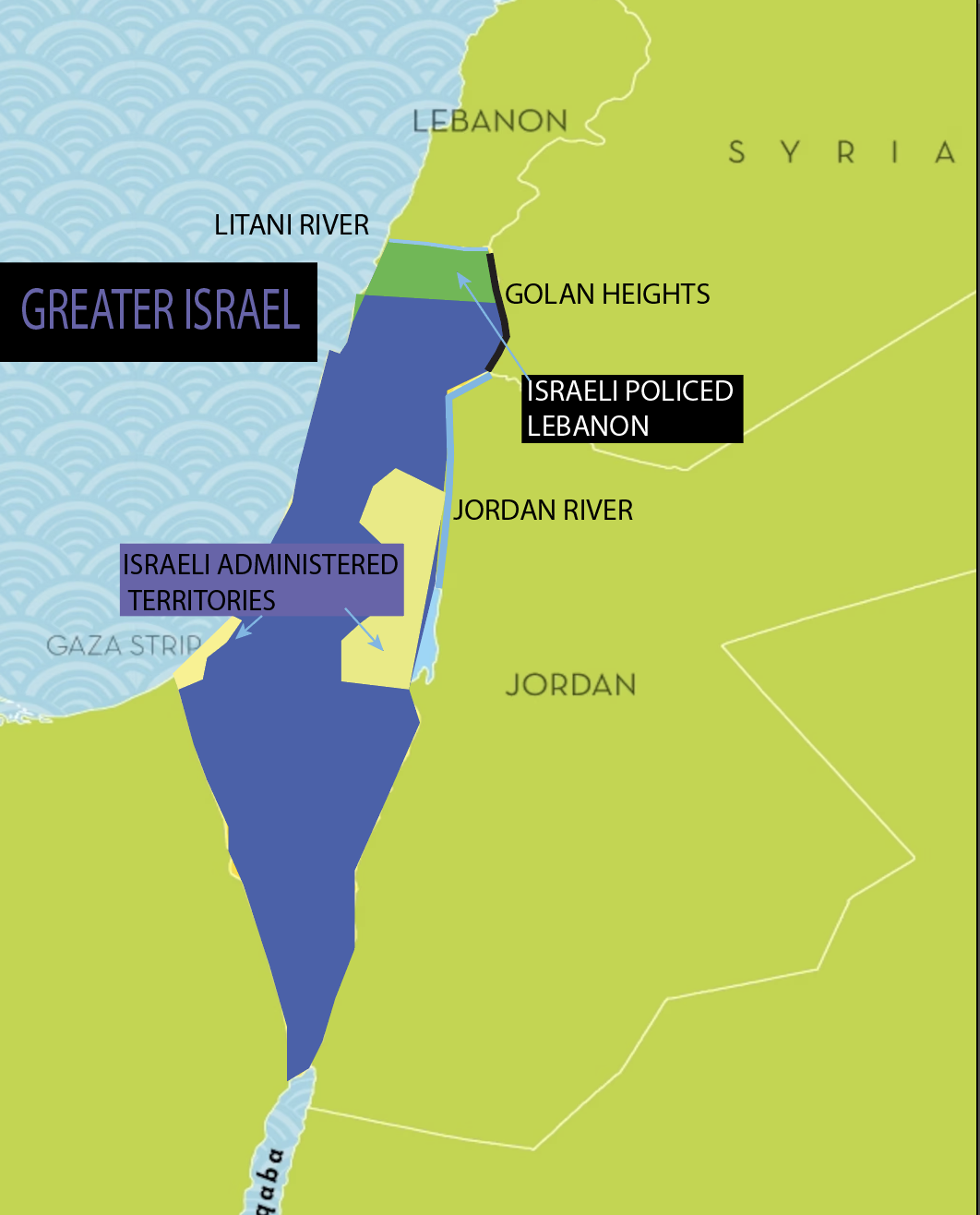
It’s no accident that this map looks very similar to the original map of Israel according to the World Zionist Organisation of 1918: Greater Israel is defined by the geographic logic of defensible borders. These are the Litani River in Lebanon, the Golan Heights of Syria, and the Jordan River.
This map would see the continued occupation of the native Palestinian population by Israeli police and armed forces and the never-ending existence of a Palestinian insurgency as a result. That is unless Israel continues to shift to the extreme right. If so, it may continue to drive out or kill the remaining Palestinian population.
Unfortunately for us, and those involved, Israeli security anxieties mean this map is entirely realistic.
The reasons why the first map is unrealistic and the second isn’t are explained in the top three Israeli reasons for their military actions:
- Most Palestinians would relish in the ethnic cleansing of Israel if they could. “They (the Palestinians) want to exterminate us!” an Israeli told me last year. And they have no shortage of evidence. An oft-cited example is the “from the river to the sea, Palestine will be free” chant.
- Israel’s demographic mean they are drastically outnumbered by their Palestinian opponents (those living in the West Bank and Gaza, as well as the refugees in Jordan and Lebanon) who seek their extermination (est. 9 million vs 6 million).
- Israel’s small size undermines its independence and requires it to annex defensible territory outside its borders — like the Syrian Golan Heights, Southern Lebanon, or the Palestinian territory spanning the Jordan River.
Tragically, all of these points are mostly accurate. The Israelis are hated by the Palestinians, most of whom would be delighted at their eradication, severely outnumbered, and placed across a relatively thin and indefensible stretch of land. These three points are key in showing why the two-state solution could never work for Israel.
It’s also why the 1993-95 Oslo Accords failed, and why the Israeli Prime Minister who signed it was later assassinated by right-wing extremists, allegedly incited by a rising figure on the right: Netanyahu. Most importantly, it would be naive to believe that even in the unlikely case that the Israelis pull out of Palestinian territory in a two-state solution peace would be restored, as memories of conflict always perdure.
In short, Greater Israel is a self-fulfilling prophecy of Israeli security anxieties.
Path dependence
The core issue driving Israel’s pursuit of Greater Israel is, at its heart, straightforward. Political scientist John Preston calls this phenomenon “path dependence”: the idea that choices made in the past constrain or shape the future, often making certain outcomes inevitable. Past decisions create structures that are difficult, if not impossible, to reverse, funnelling societies into a fixed trajectory.
These arguments, unsurprisingly, were raised primarily in Israel. The so-called “New Historians” of Israel, predominantly Israeli historians and academics who emerged in the 1980s challenging established Israeli narratives, drew on leaked and de-classified Israeli government documents to finger Zionism as the principal causal factor in the Israeli-Palestinian wars.
They claimed Israeli security anxieties and its existence in a context of insecurity resulted directly from this founding maxim: Zionism meant the colonization of foreign land in Palestine and the exclusion of natives, who numbered around 1.3 million in 1948, against 640,000 Jewish settlers.
This, they say, was supported by the first Zionist World Congress in 1897, which established the Jewish Colonial Fund to purchase land from absentee landlords in Palestine and sell it to Jewish settlers. Alternatively, the establishment of kibbutzes, utopias of self-development and agriculture, welcomed people of all races and religions: all except the native Palestinians, who were often violently expelled from their land in the Nakba of 1948 or the Six Day War of 1967.
Yet, this necessity clashes with the liberal values that many Israelis hold, much as Western countries face tensions between their security needs and their democratic ideals. This conflict between foundational security needs and democratic values has fueled movements within Israel that favor a two-state solution—most notably the Oslo Accords of 1993-95. However, the foundational imperatives of Israeli security doctrine, deeply intertwined with its Zionist origins, have consistently obstructed such efforts from bearing real fruit.
A state of exception
The only way to reconcile the conflict between Israel’s security imperatives and its moral values is through a concept we frequently explore at The Blind Spot: Carl Schmitt’s theory of the “state of legal exception.”
While Schmitt’s Nazi affiliations make his work a controversial lens through which to view Israel, his 1920s theory on liberal-democratic states ironically offers a strikingly relevant framework. Schmitt argued that these states, especially in matters of security, operate on a foundation of “the state of exception.” As we discussed in a previous piece:
The underpinnings of the normal operation of law in the country are always in the body or person of the state with the right to determine whether they are operating within a “normal” or “exceptional” time. If this point is understood, Schmitt claimed, it was questionable whether any democracies or liberal states existed at all. Rather, all states were simply autocracies in waiting, waiting until the actor who can claim the state of exception will use it to overcome internal and external opposition to their rule.
Thus, in order to establish the exclusionary and colonizing mission of Israel, while acting in accordance with its restrictive Western liberal democratic framework, Israeli security actions simply require a state of war.
This explains why Netanyahu’s rise is intrinsically linked to the creation and survival of Hamas. Indeed, paper after paper in Israeli media has attested to Netanyahu’s empowerment of Israel’s supposed enemy, both in the key role Hamas plays in splitting the Palestinian Authority, and in presenting to the world a vision of a Palestine that seeks the eradication of Israel, negating any viable two-state solution.
Another example is Israel’s new plan for Gaza: the establishment of several ‘security corridors’ staffed with IDF forces, and potentially new settlements, that will cut across Gaza, ostensibly to render Israel more secure from Hamas’ rocket attacks:
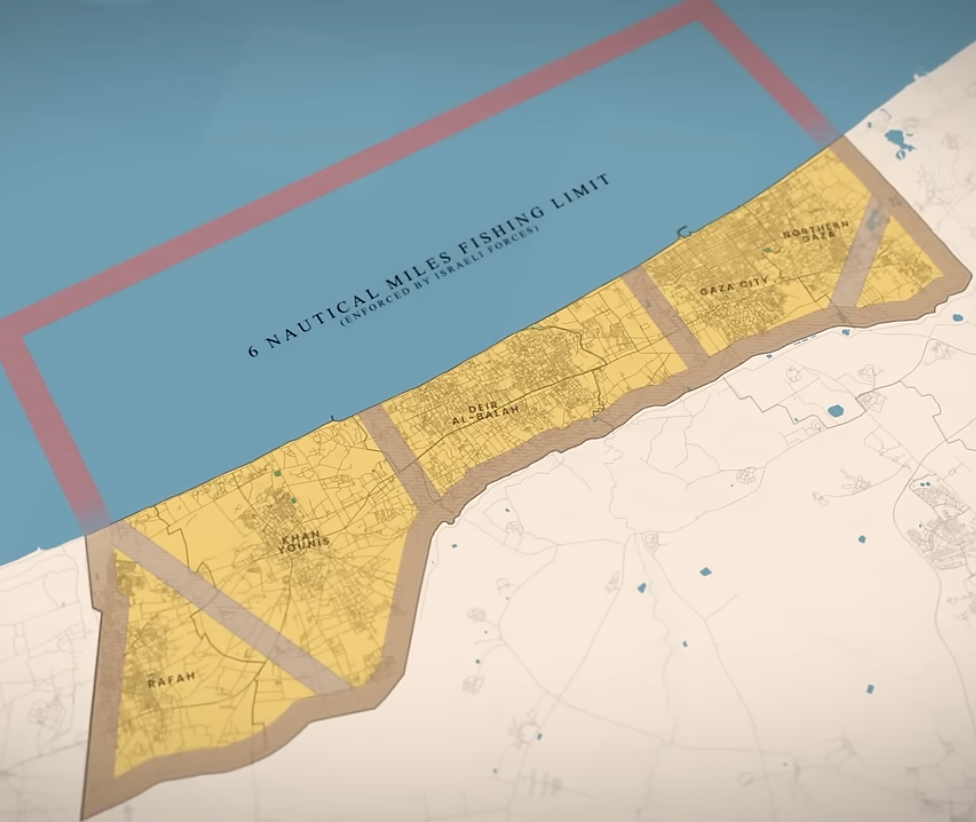
This Gaza ‘solution’ is a case in point of our argument. Its ‘security’ will immediately create more insecurity by lowering the barrier to the requirement of conflict. To harm Israel, instead of spending hundreds on manufacturing a rocket, Hamas need only grab a Kalashnikov and aim it at the nearest Israeli. But more insecurity leads to more states of exception, and more freedom of action for Israeli security efforts.
Israel’s strike upward into Hezbollah is similarly incentivized. Rather than disempowering the Lebanese militant group, an Israeli invasion will reinvigorate Hezbollah’s ostensible goal: to protect Lebanese borders from an Israeli invasion.
These moves allow Israel to continue painting its actions to create Greater Israel as a defensive and legal mission.
The liberal West’s bloody history
But it would be a tragic mistake to consider Israeli expansionism to be merely another tale of a troubled region. Israeli actions are anything but. They are instead a mirror image of the construction of Western states. To paraphrase Noam Chomsky, the Israel-Palestine war is effectively the last phase of European colonial efforts. Perhaps that’s why the West has such trouble coming to grips with the paradox of Israeli legality, liberalism and democracy, in the context of its brutal, colonizing actions — the truth hits too close to home.
After all, the world’s most successful liberal democracy is also its most successful colonial project: the United States. More broadly, every major European state was forged by subduing countless independent cultures, ethnicities, religions, and smaller states that once populated the continent. The dominance of French and Spanish as the national languages of today’s France and Spain was imposed by force. And for a vivid reminder of how England established control over the British Isles, one need only ask a Scotsman about the bloody path to British unity.
To these colonizers, the colonized were much like the Palestinians — irredentists, backward, opposed to civilization and development — waging low-intensity warfare against their betters, and deserving to be crushed. And much like the Israelis and the Palestinians, most Western colonizing powers sought and provoked conflict to expand their influence over broader regions of foreign land. It’s no accident that Israel’s greatest supporters in the West at one point or another in their history exercised military violence to colonize new stretches of land: the United States, Britain, Canada, Australia, France, and Germany.
This explains the liberal paradox of war: the liberal era of the Enlightenment until today has been the most sanguine period of history, with all these conflicts carried out between or by murderous, competing powers claiming to represent the pinnacle of liberal civilization.
And yet, as the recurring rise of Indigenous claims like Britain’s Scottish independence, the pro-decentralization yellow vest movements in France, and Quebec separatism in Canada shows, the savagery exerted in overcoming these decentralizing claims never fully succeeded.
Thus, the dark truth underpinning Western civilization is that it relied on the destruction of competing webs of customs, languages and morals via centralization — which often took the path of war and ethnic cleansing. The path towards the construction of most Western legal orders abroad (and at home) was the state of exception, and so is Israel’s.
War – what is it good for?
The final cautionary tale for the West shown by this example is to question whether these Israeli military actions are worth it. Is today’s Israel congruent with what Israel was supposed to be? The answer is absolutely not.
Israel was founded to secure a peaceful home for the Jewish nation. After thousands of years of living in dispersed, unsafe homes, Jewish people would be able to congregate in a safe haven that would finally mean an end to their persecution.
Today’s — and tomorrow’s Israel — has failed to achieve this. Not only is every Jew in Israel at much greater risk than anywhere in the Western world, either from enemy attacks or from being conscripted and sent on suicidal and traumatizing missions by the IDF, but new movements for Israeli Jews to emigrate and create safe diasporas abroad are gaining in popularity. More critically still, Jewish people have never been so closely concentrated together in an unsafe environment.
And that’s without getting into the subjugation, evictions, tragedy and trauma heaped upon the Palestinians and their consequent impact on surrounding countries, like Lebanon, for this missed objective. The corresponding increase in global antisemitism as a result of Israel’s aggressive actions cannot be understated either.
Whether Israel will ultimately succeed in establishing Greater Israel remains uncertain. If it does, it may mark a tragic historical misstep for the West’s representative in the Levant. But an Israeli failure is just as possible — and, in such a case, the consequences could be equally severe. A defeat might lead to yet another tragic exodus of the Jewish people back to the West, perhaps even to other historic native lands like Ukraine, echoing the devastation that followed the Roman destruction of the Second Temple in Jerusalem.
In all, Israel’s actions serve as a stark lesson for the world — a mirror reflecting the hidden tragedies, violence and contradictions underpinning Western ideals. They remind us that the Western belief in shaping other nations in its own image through force is fundamentally flawed. Whether the adversaries are Native Americans, China, or Russia, promoting an ideology — even a noble one — through violence is like building a house on a swamp. The structure may stand for a while, but eventually, it will sink, taking its inhabitants down with it.
This article was edited on the 20th of January, 2025. We corrected two factual oversights: overestimations of the total number of Palestinians residing around Israel and the number of civilians killed in the Gaza Strip, and corrected the number of displaced individuals by Hezbollah in northern Israel to 60,000 as reported by the NYT.

One Response