

BIDEN’S SECRET WEAPONS OKAY. Whenever there’s a media circus surrounding Trump, it’s worth asking, what’s the news being buried elsewhere? Predictably, one didn’t have to look too far. Both Politico and the New York Times were onto the real story of the day, which was Joe Biden secretly giving Ukraine permission to strike inside Russia with US weapons.
Justification: That decision comes in a bid to help Ukraine protect itself from attacks on the border of Kharkiv.
Oh my. To the lay person this may appear to be no biggie. The Ukrainians have already hit inside the Russian border and are also suspected of carrying out numerous sabotage missions in the country. But there’s a reason to worry.
Scope of usage: According to the NYT, the permission means Ukraine will soon be able to strike into Russia with SCALP missiles from France and Storm Shadow missiles supplied by Britain.
Limitations: It’s not a total free-for-all all: ATACMS or long-range missiles that can strike deep into Russia are still off limits, while Germany is still declining permission to use its 310-mile range Taurus missile. Politico also reported that while “Ukraine can now use American-provided weapons, such as rockets and rocket launchers, to shoot down launched Russian missiles heading toward Kharkiv… they cannot use those weapons to hit civilian infrastructure or launch long-range missiles, such as the Army Tactical Missile System, to hit military targets deep inside Russia.”
The Kremlin view: The problem, as far as the Kremlin sees it, is that these long-range precision weapons cannot be used without space-based reconnaissance. And that means it’s not really the Ukrainians picking out the final target selection as much as NATO. “The final target selection and what is known as launch mission can only be made by highly skilled specialists who rely on this reconnaissance data, technical reconnaissance data. For some attack systems, such as Storm Shadow, these launch missions can be put in automatically, without the need to use Ukrainian military. Who does it? Those who manufacture and those who allegedly supply these attack systems to Ukraine do.”
It’s a NATO war now: That means as far as Russia is concerned “targets are identified and automatically communicated to the relevant crews who may not even realise what exactly they are putting in. A crew, maybe even a Ukrainian crew, then puts in the corresponding launch mission. However, the mission is put together by representatives of NATO countries, not the Ukrainian military.”
Nato weapons delenda est: In a post on Telegram on Friday, former Russian President Dmitry Medvedev warned those countries that have signed off on the usage of such weapons must understand that their military equipment and personnel either operating in Ukraine, or carrying out attacks on Russia from other countries, “will be destroyed.” According to RT, he also stressed that Russia considers all long-range systems used by Ukraine to be directly controlled by NATO personnel. “This is not some kind of ‘military assistance’, this is taking part in a war against us.”
On the domestic propaganda front: Russia is now bigging up the fact that Zelenskyy is operating without an official democratic mandate. That’s despite the majority of Ukrainians agreeing that now is no time to hold elections.
In the TV series House of Cards, a character named Viktor Petrov is the stand-in for real-life Vladimir Putin. Insidious, duplicitous, and two-faced, real Putin’s actions often exceed Petrov’s own fictitious persona. This is one of those examples. Due to the massive disparity in size between Ukraine and Russia, Russia hasn’t been forced to implement the exceptional legal state of martial law, unlike Ukraine. But, more importantly, Putin’s Russia doesn’t need an exceptionality clause to be governed during wartime, unlike Ukraine.
Putin’s point, however, is nevertheless interesting, as it forces us to reckon with the validity of exceptional legal circumstances and the legal validity of decision-making under them. As we will see, and true to Putin’s Petrov-like duplicitous character, Ukraine’s suspension of presidential elections is arguably the most legitimate use of the state of exception in 21st-century Western history.
That is because war is physical, large-scale, and incredibly destructive. Thus, when a state of emergency is declared, the war’s duration, and its cessation, serve to categorise the remit of the exception. Thanks to this, war is the only circumstance in which the powers of exception barely affect the liberal or democratic underpinnings of the state.
Carl Schmitt, the famous German jurist whose wisdom was always undervalued due to his overt affiliation with Nazism, said it best:
The exception is more interesting than the rule. The rule proves nothing; the exception proves everything.
Schmitt’s own theory of the so-called democratic or liberal state, formulated during the 1920s, was that it relied on the “state of exception”. That is, the underpinnings of the normal operation of law in the country are always in the body or person of the state with the right to determine whether they are operating within a “normal” or “exceptional” time. If this point is understood, Schmitt claimed, it was questionable whether any democracies or liberal states existed at all. Rather, all states were simply autocracies in waiting, waiting until the actor who can claim the state of exception will use it to overcome internal and external opposition to their rule.
Unfortunately, most states of emergency are declared during events of dubious beginnings and endings, such as pandemics or terrorist attacks. And their ’emergency’ is inherently questionable. But declaring exceptional legal rights under not-so-exceptional circumstances erodes the democratic and liberal state.
It is this interpretation of a state of exception which allows the exceptional clauses to remain part of ordinary jurisprudence. Wars, on the other hand, rarely require interpretation.
As such, the state of emergency in the West has often been used as an alchemical device to hold powers of dubious legality, supposedly only valid under exceptional circumstances, and transmute them into the ‘ordinary’.
And we’ve seen plenty of examples to validate just how true Schmitt’s statement was. I was in Paris this weekend, where small signs reminded me of one such example:
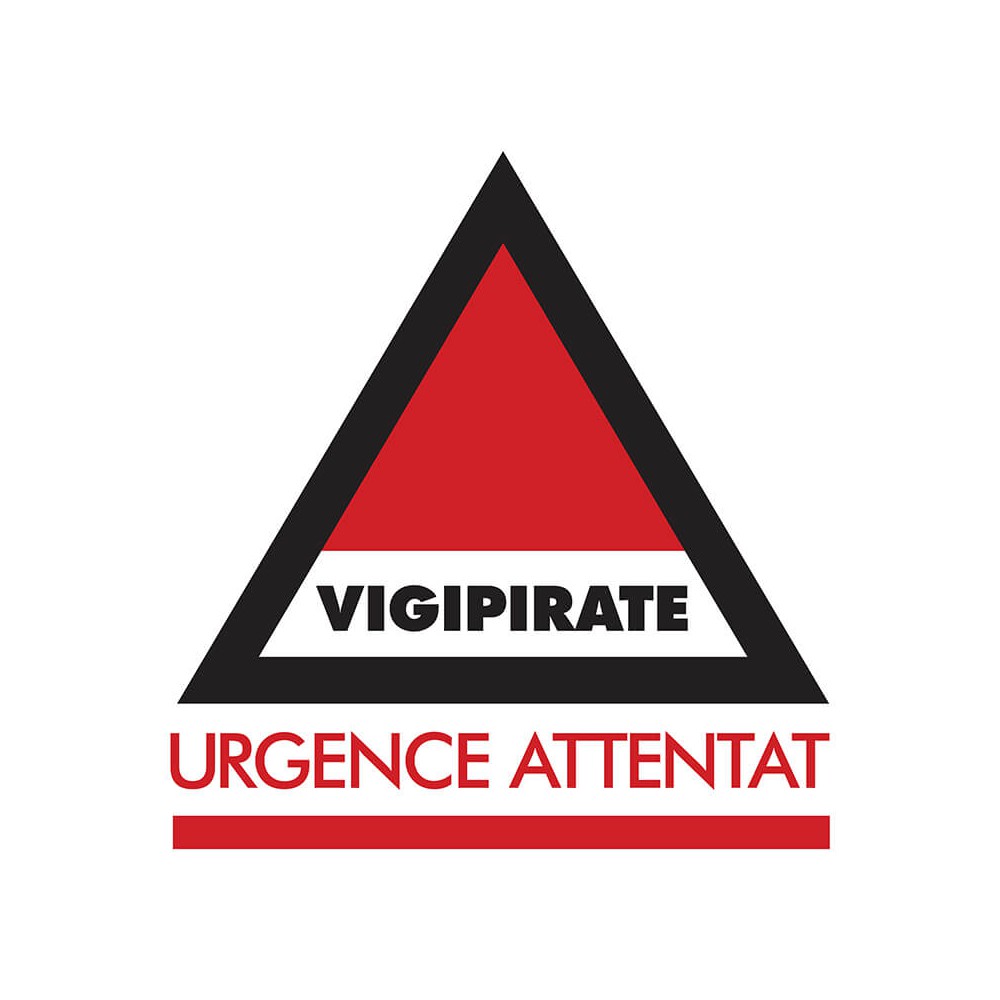
Mostly unnoticed by the Frenchies, these signs can be found outside most railway stations, metros, airports, and even public assembly areas such as churches. In stark words, they urge the population to be vigilant as the French security state is on “high alert” due to the “urgent risk of a terrorist attack”. Confusingly, the state was activated after the Crocus City Hall attack in Moscow — an event which didn’t affect France in the slightest.
In short, the Vigipirate laws aren’t exactly a state of exception. In France, this is coded under the “State of Emergency” statutes, the last country-wide emergency status being declared following the November 2015 Paris attacks. However, they do allow French authorities the powers to strictly control access to public spaces outside their ordinary powers.
And this dovetails into a curiously coincidental time: the Paris Olympics and its security measures. Supposedly anti-terror concerns have led to certain unprecedented measures of security for Parisians during the Olympic Games. Firstly, people transiting through central Paris will require a QR code on them containing a right of passage — effectively the same system of “Covid passports” implemented during the Covid-19 emergency. Secondly, AI-powered cameras using facial recognition will be surveilling individuals all over Paris. Thirdly, significant transport restrictions will take place, where the metro entries and exits from certain areas will be taken out of commission, and most Parisians will be forced to work from home. Critically, the Vigipirate legislation will also allow Parisian police to stop and search random citizens in the city throughout the duration of the Olympics.
Another example cropped up in February, when Kit Klarenberg of the supposedly Russian sympathising rag The Grayzone was detained at UK borders under a “Counter-Terrorism” Act. He was not allowed a lawyer, was unable to refuse to answer questions, and was legally obliged to provide all private passwords on his mobile phone and other devices.
And therein lies the issue with exceptional legal measures — their habit of bleeding into the ordinary operations of the state. Exceptional measures are like catnip to the state — once tasted, the state can never go on without them. Worst of all, these tyrannical powers were enacted mostly after relatively localised terrorist events.
So, while it took the blood of tens of thousands of fighters for basic human rights and freedoms centuries to instil a modicum of constitutionality and legal operations in the state, it only took in most circumstances in the West (with the exception of attrocities like 911) a few dozen bodies murdered by extremists to tear it down. And most of us, filled with fear, cheered the measures from the sidelines.
| BUSINESS, ECON, FINANCE ETC |
DONALD TRUMP AND ELON MUSK ARE BECOMING ALLIES claimed the Wall Street Journal. The journal reported that Donald Trump is allegedly weighing an advisory role for the Tesla CEO should he be re-elected as President in November 2024. This rapprochement occurred due to Musk’s more vocal opinion on both border security and the economy, as well as the efforts of Musk and Nelson Peltz, another billionaire investor, of hosting gatherings of powerful business leaders while trying to convince them not to support Biden’s re-election campaign.
| CENTRAL BANKS |
THE FED IS AMERICA’S SUPERPOWER: ICYMI former BoE deputy governor Paul Tucker penned a spirited defence of Fed independence in the face of claims that a Donald Trump presidency might upend its impartiality. “If U.S. monetary policy were thought to be politicized, even friends and allies would reduce their commitment to the dollar,” Tucker notes. “This would suit no one better than Beijing”
He added: “As I said in my 2022 book Global Discord, the Federal Reserve building in Washington, D.C. is an unknowing headquarters for U.S. world leadership. Given the enormous challenges presented by the new geopolitics, Federal Reserve independence is nothing short of a national security issue. Whatever one thinks of MAGA, citizens of the free world can surely unite in saying, please don’t make America smaller again.”
HAPPY 50TH TO THE PETRODOLLAR: In light of the above, it’s worth noting that the 1974 Nixon-Kissinger petrodollar recycling deal struck with Saudi Arabia marks its 50th anniversary around June 9. There is some speculation on the internet the deal had a 50-year limit attached to it, and a shift could be coming soon. CFR’s Brad Setser, for his part, doesn’t think a 50-year deal was struck, but he did highlight that “the Saudis clearly haven’t been buying fixed income securities of any kind (including US Treasuries) out of their oil surplus over the last 10 years.”
| GEOPOLITICAL HOTSPOTS |
TUCKER CARLSON’S INTERVIEW WITH ECONOMIST JEFFREY SACHS covered several topics, including his assessment of the Ukraine war and American foreign policy. Sachs drew a lot of flak last year for suggesting the obvious: that the NATO alliance was responsible for blowing up the Nord Stream pipeline. But while Tucker and Sachs look into this question, they also explore several others, including: Why America pushed for Ukraine to join NATO, the definition of a Neocon, why regime change never works, and the origins of Covid. Sachs’ views won’t be to everyone’s liking, but he was right there in the Kremlin when many of the now broken promises between the West and Russia were being struck.
CARTHAGO DELENDA EST: Mark Zuckerberg wore a “Carthage will be destroyed” T-shirt in his photoshoot with Bill Gates to mark his 40th birthday and modern-day Carthaginians (aka Tunisians) decided it was likely a veiled message to the North African state, whose 2011 Jasmine revolution was for a long time considered the first and most successful of the Arab Spring colour revolutions. Social media, and notably Facebook, were heralded as a key catalyst for the revolution. The problem is, in recent months, Tunisia’s fledgling democracy has taken a less democratic turn, with the country’s president Kais Saied leading a crackdown on dissident press.
“…the fervor and velocity of the conspiracy theories that swirled around the photo op highlight the real peril happening in Tunisia today, where, amid an economy in a death spiral and a spike in human rights abuses, Saied is cracking down on opposition with a law designed to combat fake news, while trumpeting a nationalist vision of his country spurred on by the continuous specter of Western, Zionist plots against it,” noted New Lines Magazine, a regional specialist publication founded by Syrian-American author Hassan Hassan.
| POLITICS, POLITICS, POLITICS |
YOUTH MOVES RIGHT: The FT probed the increasing appeal of far-right parties to Generation Z, which appears to be leaning further right than its previous cohorts. Most interesting of all, it appears that concerns about inflation, immigration, and employment beat concerns about climate change in the youngest demographic (18-23) in recent polls across certain European countries.
The new Dutch prime minister, Dick Schoof, is a former spook and his election has sent the right-wing sphere into a tailspin. The former Chief of the Dutch intelligence services and top-ranking government bureaucrat is the man selected by Geert Wilder’s PVV, who recently won the Dutch elections, and his four coalition partners to run the country.
Eva Vlaardingerbroek, a prominent right-wing European speaker, was one such example. Taking pride after the election of Wilders, she posted on X: “After five months, a right-wing government has finally been formed! It’s definitely a step in the right direction.” But the election of Dick Schoof has soured her victory.
In response to the appointment, Vlaardingerbroek wrote: “Dick Schoof — or ‘Mr. Deepstate’ as I’d like to call him…”
But there are many solid reasons for her to be unhappy.
Schoof presided over the Dutch Intelligence and Security Service (the AIVD) and served as the head of the National Coordinator of the Counter-Terrorism Unit (NCTV). In these roles, he was responsible for the stringent Dutch Covid regime, and for the rollout of Dutch intelligence’s campaign to supervise the behaviour of Dutch citizens on Twitter with fake accounts.
Schoof is, quite literally, the grey man. Having never held a job outside of public service, his Wikipedia page reads as you’d expect — a man who has slowly but diligently climbed the ladder of bureaucratic power until he reached the very top.
But the real story here is not Dick Schoof’s past. Unlike other politicians, media leaders, or business people with questionable pasts that tie them to the intelligence services, there is no such question with Schoof. He was the top spy. And that’s that.
The real question is why these right-wingers are so surprised by the outcome? Mad-haired Wilders has been a political animal of the Dutch state, having held a parliamentary seat since 1998. Is it surprising such a man would have tended his hand towards a fellow apparatchik? The same goes with Meloni, a member of the chamber of deputies since 2006, and whose backers are still surprised at her basic maintenance of the Italian status quo vis-a-vis immigration, economics, and general policy.
There are, effectively, two minds to the European right — and they are in permanent conflict.
One is the liberal, constitutional aspect. It is primarily concerned with the loss of freedom. A critique of curtails to freedom of speech and action, of the erasure of basic logic and scientific burden of proof for sexuality, the ever-extending powers of the state, and the excessive care given to identity. Its solution is greater freedom.
The second are insecure, nationalistic forces. They are primarily concerned with immigration, an apparent loss of national spirit and race, and the decline of traditional values. Their solution is more control and more security state.
The irony is how contradictory both values are. And more surprisingly still, how such a contradiction hasn’t caused a visible rift. When both are in conflict, control wins over freedom — as we’ve seen with Wilders’ PVV. Or with the legions of right-wing commentators who made a career denouncing identity politics that began critiquing and cancelling sceptics of Israeli policy as “anti-semitic”, such as Ben Shapiro.
What’s becoming clearer with every passing year is that the surveillance state is latching onto the right-wing freedom movement. And the rightoids that aren’t inherently pro-tyranny, like Eva, will continue to be used and then likely sidelined by it.
| LAWFARE |
REFORM UK PREPARES TO CHALLENGE LABOUR’S SCHOOLS TAX RAID legally. Reform leader, Richard Tice, has been assembling a team of lawyers and KCs to fight Sir Keir Starmer’s planned tax raid on private schools in the UK, as the head of Reform called the policy ‘discriminatory.’ The policy, which would add VAT on independent school fees, may also attract a legal challenge from the Independent Schools Council in the UK. While Labour has promised such a move could raise £1.6 billion for the Exchequer, these figures are in doubt, particularly since such a raise in fees would force many parents to pull their children out of these private schools.
| SNEAK PEEK |
— Dario delves into what constitutes the “state of exception” in the democratic world.
— Who is Holland’s new prime minister Dick Schoof really?
— Tunisia’s fledgling democracy is experiencing a few setbacks.
Happy Sunday afternoon, and to those of you fielding half-term, well done. It’s over now. You’ve now got about six weeks to figure out childcare for the summer. Childcare constraints being a thing, this is a shorter-than-usual missive. But we hope it still offers at least a few insights.
As usual the newsletter has been brought to you by me, Izabella Kaminska, and Dario Garcia Giner. Have a good rest of the day.
Send tips to [email protected] and [email protected]
| THE BIG BLIND SPOT THIS WEEK |
BIDEN’S SECRET WEAPONS OKAY. Whenever there’s a media circus surrounding Trump, it’s worth asking, what’s the news being buried elsewhere? Predictably, one didn’t have to look too far. Both Politico and the New York Times were onto the real story of the day, which was Joe Biden secretly giving Ukraine permission to strike inside Russia with US weapons.
Justification: That decision comes in a bid to help Ukraine protect itself from attacks on the border of Kharkiv.
Oh my. To the lay person this may appear to be no biggie. The Ukrainians have already hit inside the Russian border and are also suspected of carrying out numerous sabotage missions in the country. But there’s a reason to worry.
Scope of usage: According to the NYT, the permission means Ukraine will soon be able to strike into Russia with SCALP missiles from France and Storm Shadow missiles supplied by Britain.
Limitations: It’s not a total free-for-all all: ATACMS or long-range missiles that can strike deep into Russia are still off limits, while Germany is still declining permission to use its 310-mile range Taurus missile. Politico also reported that while “Ukraine can now use American-provided weapons, such as rockets and rocket launchers, to shoot down launched Russian missiles heading toward Kharkiv… they cannot use those weapons to hit civilian infrastructure or launch long-range missiles, such as the Army Tactical Missile System, to hit military targets deep inside Russia.”
The Kremlin view: The problem, as far as the Kremlin sees it, is that these long-range precision weapons cannot be used without space-based reconnaissance. And that means it’s not really the Ukrainians picking out the final target selection as much as NATO. “The final target selection and what is known as launch mission can only be made by highly skilled specialists who rely on this reconnaissance data, technical reconnaissance data. For some attack systems, such as Storm Shadow, these launch missions can be put in automatically, without the need to use Ukrainian military. Who does it? Those who manufacture and those who allegedly supply these attack systems to Ukraine do.”
It’s a NATO war now: That means as far as Russia is concerned “targets are identified and automatically communicated to the relevant crews who may not even realise what exactly they are putting in. A crew, maybe even a Ukrainian crew, then puts in the corresponding launch mission. However, the mission is put together by representatives of NATO countries, not the Ukrainian military.”
Nato weapons delenda est: In a post on Telegram on Friday, former Russian President Dmitry Medvedev warned those countries that have signed off on the usage of such weapons must understand that their military equipment and personnel either operating in Ukraine, or carrying out attacks on Russia from other countries, “will be destroyed.” According to RT, he also stressed that Russia considers all long-range systems used by Ukraine to be directly controlled by NATO personnel. “This is not some kind of ‘military assistance’, this is taking part in a war against us.”
On the domestic propaganda front: Russia is now bigging up the fact that Zelenskyy is operating without an official democratic mandate. That’s despite the majority of Ukrainians agreeing that now is no time to hold elections.
In the TV series House of Cards, a character named Viktor Petrov is the stand-in for real-life Vladimir Putin. Insidious, duplicitous, and two-faced, real Putin’s actions often exceed Petrov’s own fictitious persona. This is one of those examples. Due to the massive disparity in size between Ukraine and Russia, Russia hasn’t been forced to implement the exceptional legal state of martial law, unlike Ukraine. But, more importantly, Putin’s Russia doesn’t need an exceptionality clause to be governed during wartime, unlike Ukraine.
Putin’s point, however, is nevertheless interesting, as it forces us to reckon with the validity of exceptional legal circumstances and the legal validity of decision-making under them. As we will see, and true to Putin’s Petrov-like duplicitous character, Ukraine’s suspension of presidential elections is arguably the most legitimate use of the state of exception in 21st-century Western history.
That is because war is physical, large-scale, and incredibly destructive. Thus, when a state of emergency is declared, the war’s duration, and its cessation, serve to categorise the remit of the exception. Thanks to this, war is the only circumstance in which the powers of exception barely affect the liberal or democratic underpinnings of the state.
Carl Schmitt, the famous German jurist whose wisdom was always undervalued due to his overt affiliation with Nazism, said it best:
The exception is more interesting than the rule. The rule proves nothing; the exception proves everything.
Schmitt’s own theory of the so-called democratic or liberal state, formulated during the 1920s, was that it relied on the “state of exception”. That is, the underpinnings of the normal operation of law in the country are always in the body or person of the state with the right to determine whether they are operating within a “normal” or “exceptional” time. If this point is understood, Schmitt claimed, it was questionable whether any democracies or liberal states existed at all. Rather, all states were simply autocracies in waiting, waiting until the actor who can claim the state of exception will use it to overcome internal and external opposition to their rule.
Unfortunately, most states of emergency are declared during events of dubious beginnings and endings, such as pandemics or terrorist attacks. And their ’emergency’ is inherently questionable. But declaring exceptional legal rights under not-so-exceptional circumstances erodes the democratic and liberal state.
It is this interpretation of a state of exception which allows the exceptional clauses to remain part of ordinary jurisprudence. Wars, on the other hand, rarely require interpretation.
As such, the state of emergency in the West has often been used as an alchemical device to hold powers of dubious legality, supposedly only valid under exceptional circumstances, and transmute them into the ‘ordinary’.
And we’ve seen plenty of examples to validate just how true Schmitt’s statement was. I was in Paris this weekend, where small signs reminded me of one such example:
Mostly unnoticed by the Frenchies, these signs can be found outside most railway stations, metros, airports, and even public assembly areas such as churches. In stark words, they urge the population to be vigilant as the French security state is on “high alert” due to the “urgent risk of a terrorist attack”. Confusingly, the state was activated after the Crocus City Hall attack in Moscow — an event which didn’t affect France in the slightest.
In short, the Vigipirate laws aren’t exactly a state of exception. In France, this is coded under the “State of Emergency” statutes, the last country-wide emergency status being declared following the November 2015 Paris attacks. However, they do allow French authorities the powers to strictly control access to public spaces outside their ordinary powers.
And this dovetails into a curiously coincidental time: the Paris Olympics and its security measures. Supposedly anti-terror concerns have led to certain unprecedented measures of security for Parisians during the Olympic Games. Firstly, people transiting through central Paris will require a QR code on them containing a right of passage — effectively the same system of “Covid passports” implemented during the Covid-19 emergency. Secondly, AI-powered cameras using facial recognition will be surveilling individuals all over Paris. Thirdly, significant transport restrictions will take place, where the metro entries and exits from certain areas will be taken out of commission, and most Parisians will be forced to work from home. Critically, the Vigipirate legislation will also allow Parisian police to stop and search random citizens in the city throughout the duration of the Olympics.
Another example cropped up in February, when Kit Klarenberg of the supposedly Russian sympathising rag The Grayzone was detained at UK borders under a “Counter-Terrorism” Act. He was not allowed a lawyer, was unable to refuse to answer questions, and was legally obliged to provide all private passwords on his mobile phone and other devices.
And therein lies the issue with exceptional legal measures — their habit of bleeding into the ordinary operations of the state. Exceptional measures are like catnip to the state — once tasted, the state can never go on without them. Worst of all, these tyrannical powers were enacted mostly after relatively localised terrorist events.
So, while it took the blood of tens of thousands of fighters for basic human rights and freedoms centuries to instil a modicum of constitutionality and legal operations in the state, it only took in most circumstances in the West (with the exception of attrocities like 911) a few dozen bodies murdered by extremists to tear it down. And most of us, filled with fear, cheered the measures from the sidelines.
| BUSINESS, ECON, FINANCE ETC |
DONALD TRUMP AND ELON MUSK ARE BECOMING ALLIES claimed the Wall Street Journal. The journal reported that Donald Trump is allegedly weighing an advisory role for the Tesla CEO should he be re-elected as President in November 2024. This rapprochement occurred due to Musk’s more vocal opinion on both border security and the economy, as well as the efforts of Musk and Nelson Peltz, another billionaire investor, of hosting gatherings of powerful business leaders while trying to convince them not to support Biden’s re-election campaign.
| CENTRAL BANKS |
THE FED IS AMERICA’S SUPERPOWER: ICYMI former BoE deputy governor Paul Tucker penned a spirited defence of Fed independence in the face of claims that a Donald Trump presidency might upend its impartiality. “If U.S. monetary policy were thought to be politicized, even friends and allies would reduce their commitment to the dollar,” Tucker notes. “This would suit no one better than Beijing”
He added: “As I said in my 2022 book Global Discord, the Federal Reserve building in Washington, D.C. is an unknowing headquarters for U.S. world leadership. Given the enormous challenges presented by the new geopolitics, Federal Reserve independence is nothing short of a national security issue. Whatever one thinks of MAGA, citizens of the free world can surely unite in saying, please don’t make America smaller again.”
HAPPY 50TH TO THE PETRODOLLAR: In light of the above, it’s worth noting that the 1974 Nixon-Kissinger petrodollar recycling deal struck with Saudi Arabia marks its 50th anniversary around June 9. There is some speculation on the internet the deal had a 50-year limit attached to it, and a shift could be coming soon. CFR’s Brad Setser, for his part, doesn’t think a 50-year deal was struck, but he did highlight that “the Saudis clearly haven’t been buying fixed income securities of any kind (including US Treasuries) out of their oil surplus over the last 10 years.”
| GEOPOLITICAL HOTSPOTS |
TUCKER CARLSON’S INTERVIEW WITH ECONOMIST JEFFREY SACHS covered several topics, including his assessment of the Ukraine war and American foreign policy. Sachs drew a lot of flak last year for suggesting the obvious: that the NATO alliance was responsible for blowing up the Nord Stream pipeline. But while Tucker and Sachs look into this question, they also explore several others, including: Why America pushed for Ukraine to join NATO, the definition of a Neocon, why regime change never works, and the origins of Covid. Sachs’ views won’t be to everyone’s liking, but he was right there in the Kremlin when many of the now broken promises between the West and Russia were being struck.
CARTHAGO DELENDA EST: Mark Zuckerberg wore a “Carthage will be destroyed” T-shirt in his photoshoot with Bill Gates to mark his 40th birthday and modern-day Carthaginians (aka Tunisians) decided it was likely a veiled message to the North African state, whose 2011 Jasmine revolution was for a long time considered the first and most successful of the Arab Spring colour revolutions. Social media, and notably Facebook, were heralded as a key catalyst for the revolution. The problem is, in recent months, Tunisia’s fledgling democracy has taken a less democratic turn, with the country’s president Kais Saied leading a crackdown on dissident press.
“…the fervor and velocity of the conspiracy theories that swirled around the photo op highlight the real peril happening in Tunisia today, where, amid an economy in a death spiral and a spike in human rights abuses, Saied is cracking down on opposition with a law designed to combat fake news, while trumpeting a nationalist vision of his country spurred on by the continuous specter of Western, Zionist plots against it,” noted New Lines Magazine, a regional specialist publication founded by Syrian-American author Hassan Hassan.
| POLITICS, POLITICS, POLITICS |
YOUTH MOVES RIGHT: The FT probed the increasing appeal of far-right parties to Generation Z, which appears to be leaning further right than its previous cohorts. Most interesting of all, it appears that concerns about inflation, immigration, and employment beat concerns about climate change in the youngest demographic (18-23) in recent polls across certain European countries.
The new Dutch prime minister, Dick Schoof, is a former spook and his election has sent the right-wing sphere into a tailspin. The former Chief of the Dutch intelligence services and top-ranking government bureaucrat is the man selected by Geert Wilder’s PVV, who recently won the Dutch elections, and his four coalition partners to run the country.
Eva Vlaardingerbroek, a prominent right-wing European speaker, was one such example. Taking pride after the election of Wilders, she posted on X: “After five months, a right-wing government has finally been formed! It’s definitely a step in the right direction.” But the election of Dick Schoof has soured her victory.
In response to the appointment, Vlaardingerbroek wrote: “Dick Schoof — or ‘Mr. Deepstate’ as I’d like to call him…”
But there are many solid reasons for her to be unhappy.
Schoof presided over the Dutch Intelligence and Security Service (the AIVD) and served as the head of the National Coordinator of the Counter-Terrorism Unit (NCTV). In these roles, he was responsible for the stringent Dutch Covid regime, and for the rollout of Dutch intelligence’s campaign to supervise the behaviour of Dutch citizens on Twitter with fake accounts.
Schoof is, quite literally, the grey man. Having never held a job outside of public service, his Wikipedia page reads as you’d expect — a man who has slowly but diligently climbed the ladder of bureaucratic power until he reached the very top.
But the real story here is not Dick Schoof’s past. Unlike other politicians, media leaders, or business people with questionable pasts that tie them to the intelligence services, there is no such question with Schoof. He was the top spy. And that’s that.
The real question is why these right-wingers are so surprised by the outcome? Mad-haired Wilders has been a political animal of the Dutch state, having held a parliamentary seat since 1998. Is it surprising such a man would have tended his hand towards a fellow apparatchik? The same goes with Meloni, a member of the chamber of deputies since 2006, and whose backers are still surprised at her basic maintenance of the Italian status quo vis-a-vis immigration, economics, and general policy.
There are, effectively, two minds to the European right — and they are in permanent conflict.
One is the liberal, constitutional aspect. It is primarily concerned with the loss of freedom. A critique of curtails to freedom of speech and action, of the erasure of basic logic and scientific burden of proof for sexuality, the ever-extending powers of the state, and the excessive care given to identity. Its solution is greater freedom.
The second are insecure, nationalistic forces. They are primarily concerned with immigration, an apparent loss of national spirit and race, and the decline of traditional values. Their solution is more control and more security state.
The irony is how contradictory both values are. And more surprisingly still, how such a contradiction hasn’t caused a visible rift. When both are in conflict, control wins over freedom — as we’ve seen with Wilders’ PVV. Or with the legions of right-wing commentators who made a career denouncing identity politics that began critiquing and cancelling sceptics of Israeli policy as “anti-semitic”, such as Ben Shapiro.
What’s becoming clearer with every passing year is that the surveillance state is latching onto the right-wing freedom movement. And the rightoids that aren’t inherently pro-tyranny, like Eva, will continue to be used and then likely sidelined by it.
| LAWFARE |
REFORM UK PREPARES TO CHALLENGE LABOUR’S SCHOOLS TAX RAID legally. Reform leader, Richard Tice, has been assembling a team of lawyers and KCs to fight Sir Keir Starmer’s planned tax raid on private schools in the UK, as the head of Reform called the policy ‘discriminatory.’ The policy, which would add VAT on independent school fees, may also attract a legal challenge from the Independent Schools Council in the UK. While Labour has promised such a move could raise £1.6 billion for the Exchequer, these figures are in doubt, particularly since such a raise in fees would force many parents to pull their children out of these private schools.
One Response