| THE BIG BLIND SPOT THIS WEEK |
PETRODOLLAR DRAMA AND PETROYUANS. The usually unflappable rates market was beset with internet drama on Thursday after a tall tale that the special arrangement between the US and Saudi Arabia on petrodollar recycling “had ended after 50 years” began to circulate across social media channels. The Blind Spot ran into some puzzled rates traders, who weren’t exactly sure what to believe, not least because G7 leaders were gathering at the same time and the U.S. had just expanded sanctions against Russia — making reprisal action plausible.
Coincidence or not? In the end, however, the dollar trash-talk didn’t do too much damage to the greenback’s standing as the world’s preferred settlement currency. While yields had edged slightly higher in the day, they settled lower once it became clear there was no substance to the story.
Suspected patient zero: The source of the drama, or at least its primary amplifier, appeared to be CNBC motormouth Rick Santelli, known for his high-octane politicised rants that have, in the past, spurred libertarian insurgencies. His chatter was amplified further when Mario Nawfal, one of Elon Musk’s favourite news accounts on X, posted — since deleted — that the Saudi petrodollar arrangement had come to an end.
Nothing to see here! We reached out to Nawfal directly and made clear there was nothing to the claim but speculation. He responsibly clarified his post.
Fact vs Fiction: Of course, none of that is to say there wasn’t a secretive gentleman’s agreement struck between then U.S. President Nixon and Saudi Arabia’s King Faisal in 1974 related to petrodollar recycling. The agreement was indeed penned around June 10, making this — as we originally reported in the Blind Spot two weeks ago! — the 50th anniversary year of the deal. It is also true that, in recent years, more facts have been revealed about the nature and scope of the arrangement. What we don’t know and what has never been substantiated is that there was any expiry to the deal.
Talk of the town: That hasn’t stopped the affair from being discussed at length this week. Even crazy Marjorie Taylor Greene was at it. The usually serene Paul Donovan, who pens the daily UBS economic blog, even took notice dispatching an unsurprisingly dismissive take centred on “the dangers of confirming your beliefs” adding the story seemed to have started in the crypto world. But it was journalist Thomas Fazi’s take that rang truest to us.
What really matters: As Fazi pointed out, the petrodollar died over 10 years ago when America achieved energy independence. Since then, it’s actually been transformed into more of a “trade dollar” which changes the dynamics of the current de-dollarisation trend into something else entirely (CFR’s Brad Sester and China-specialist Michael Pettis talk about at length).
Necessity not choice: Remember, while the US had no choice but to import oil from a narrow set of countries abroad in 1974, it has many choices from where it can import finished manufactured goods (including its own shores). It’s just a matter of investment, inclination and valuing variables other than price competitiveness. This is all the more notable given the high-tech “lights out” manufacturing investment we are now engaging in was delayed and derailed by outsourcing to China many years ago. At the time our tech could not compete with impoverished factory serfs, who were still cheaper than major capital investments in technology. The reason we can do it now, however, is because the Chinese factory serfs are lying flat, and demanding real promise of advancement to maintain their culture of overwork.
Won’t somebody please think of the Saudis? Rather than worrying about how the unwind of the petrodollar will impact America, the market should be more concerned with how it changes power dynamics and consumer trends in Saudi Arabia. So much of the kingdom’s prosperity has been linked to the ready and inexhaustible supply of dollars, which they’ve used to bling up their nation-state, invest in premium international property and generally engage in the “good life”. With the end of the petrodollar, however, that extractive dollar tap finally runs dry, meaning all their dollar inflows from now on will have to be sourced either from non-petroleum exports (ever heard of any leading non petro-specific Saudi companies? No, didn’t think so) or from dollar income generated from their existing dollar-generating assets. Casually losing a few billion on a malinvestment in a historic Swiss bank just isn’t going to fly anymore. Investments will have to be far more strategic and positive-sum-focused.
Summering factor: Despite the lucrative petrodollar arrangement all these years, there were some things that money still couldn’t buy for the Saudis. A continental climate was one of them. Projects like Neom may be trying to change that, but it’s not their ultimate success or expense that matters — it’s the quest for self-dependency signal we derive from it. Consider how you might feel if the unfettered access you once enjoyed to the old and new world for summering purposes suddenly became much harder to fund. Adapting to Sochi or Beijing could become a thing, but it probably wouldn’t be a primary preference.
And finally, the security situation: There was always more to the petrodollar than just oil for dollars. The arrangement also provided US security to Saudi Arabia. That, in turn, translated into American protection (and, thus, tolerance) of Wahhabism in the international order. However, this is unlikely to be guaranteed under the security blanket of China, or even Russia (let’s not forget who the separatists were in Chechnya). The Saudis may genuinely be considering striking more “oil for yuan” deals, but any upcoming arrangement is unlikely to be a marriage made in heaven.
The prospect of endless yuan flows a nation can only spend on cheap goods from China or directly in China and Russia just isn’t as tantalising as access to Europe or North America.
| CHINA |
THE ECB WEIGHS IN ON DE-DOLLARISATION: We would like to thank the European Central Bank for helpfully visualising the diminishing international role of the dollar this week by way of the exquisite chart crime below in its annual update on the international role of the euro. 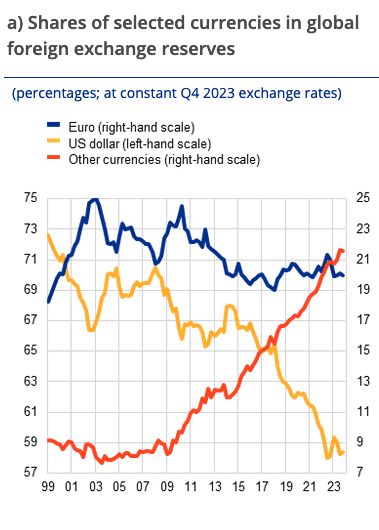
PETROYUANS ARE GO! China successfully sold the third batch of the 1 trillion yuan of ultra-long bonds it announced in May. The headlines screamed that the 50-year bonds achieved record-low yields of 2.53 percent for 35 billion yuan worth of debt ($4.8 billion). But this was hardly surprising given the “record” only starts in May 2024 and that there’s one very desperate buyer on the market with few other options (Russia, we’re looking at you.)
What’s so special about these bonds? Well, first off, it’s what China calls them. But the real reason they’re special is because they are denominated in yuan, ultra long and available to offshore investors. Hitherto such bonds were very rare — largely because most of China’s debt was held domestically by design — part of its closed capital account strategy to enhance its export-oriented growth model. That depended on keeping the yuan consistently undervalued versus the dollar, in the context of much wider financial repression.
What goes around comes around: When you consider that China’s entire growth model was centred on price competitiveness achieved through non-stop official balance-sheet expansion against dollar-denominated asset purchases (aka hoovering up all the dollars Americans flooded into the system to pay for goods in exchange for yuan liquidity) … you realise why the economy was faced with its impossible trilemma. There was no option but to run the economy as hot as possible, while using monetary policy and regulation to dampen the side-effects. The result left Chinese workers with few guaranteed savings options other than real-estate.
But now “times are a-changing”. Both private sector and Chinese government indebtedness on a domestic level is boiling over and the country’s capacity to woo foreign currency by debasing the yuan further to make exports more competitive is petering out. This is because trade wars are a thing now, and Western markets aren’t keen on continuing to give China preferential access regardless of how cheap Chinese goods get.
At the same time, the second issue facing China is that it can’t easily sell off its existing dollar assets to meet hard currency-denominated liabilities or import costs, because that risks overvaluing the yuan and making its exports even less attractive at a time when resource input costs are volatile and domestic demand is languishing. Hence, those sales have now stopped and even begun to rise again as China makes one final dash for export-oriented growth with its cunning plan to flood western markets with its ridiculously (and probably unsustainably) underpriced electric vehicles. 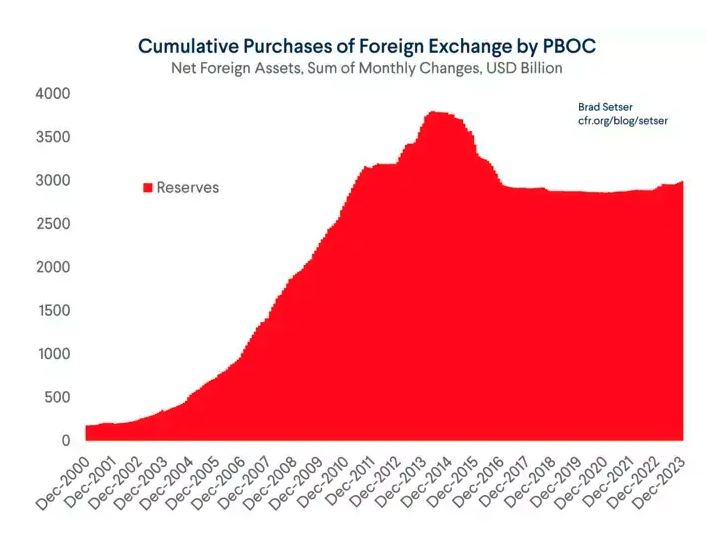
There’s only one option left: To keep things in balance, China must open up its capital account and give foreigners the access they’ve been yearning for — both for trade and investment purposes. This is especially the case now that Russia — an increasingly important source of commodity imports — has nowhere to reinvest the yuan payments it receives for oil exports to China than in gold or cryptocurrency. The decision in May to issue 1 trillion yuan worth of ultra-long special treasury bonds speaks to this point. This is only the fourth time in history such bonds have ever been issued, and the fact they come at a time when US Treasury Secretary Janet Yellen has widened sanctions is probably not a coincidence.
As the PRC itself explained in an official release about the bonds, desperate times call for desperate measures:
China’s first three issuances of special treasury bonds were all out of the need to deal with specific urgent risks and challenges, said Wen Bin, chief economist at China Minsheng Bank. For example, in 1998, it was to replenish bank capital in response to the 1997 Asian financial crisis and the deterioration of the asset quality of domestic commercial banks, while the goal in 2020 was to cope with the negative impact of the epidemic on the economy, according to Wen. China issued new special treasury bonds in 1998, 2007 and 2020 separately.
Impossible trinity: The irony shouldn’t be lost that it’s a form of capital control introduced by the West (sanctions against Russia) that has finally forced China’s hand. It seems ever more evident that it’s now the West’s turn to engage in financial repression. For China, however, that poses the risk that the markets will soon determine its fiscal pathway, not government. It’s either that, or a major revaluation of the yuan that scuppers its exports model for good.
No balance sheet recession here! China in any case is at pains to explain that it’s definitely not in the process of emulating a Japan-style “balance sheet recession” that requires continuous government balance sheet expansion to compensate for the contraction in private balance sheets at a time when its demographics are also collapsing. Richard Koo, who came up with the term, however, politely disagrees. He sees many comparisons between the two situations. Here’s a chart he presented in a session with Peterson Institute’s Nicolas Veron last year highlighting the similarities between the two economies, noting the Chinese government will have no choice but to run an even more substantial budget deficit than Japan did to balance its system. 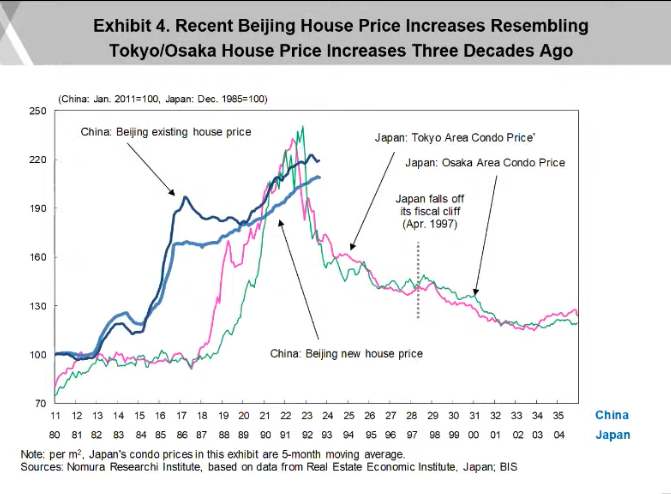
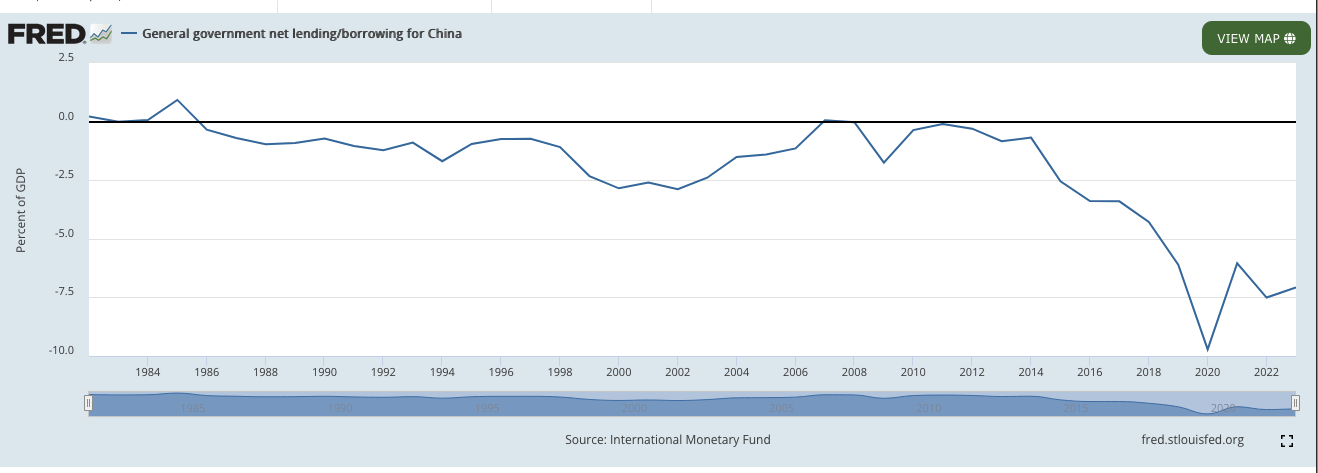
If that’s true, you can be sure that this line is only going to get more negative:
To tell the story even more colourfully, here are some other useful charts via Goldman Sachs.
First, the collapse in wage growth: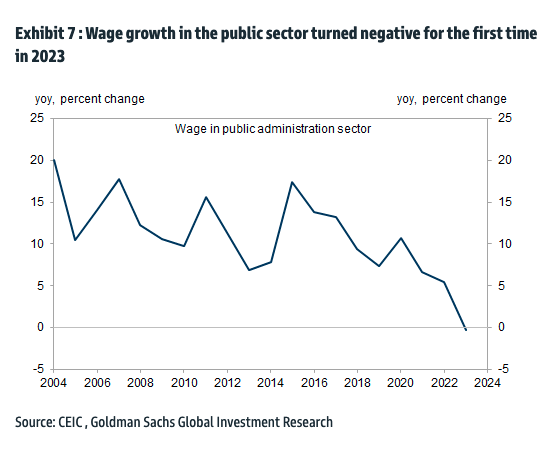
Next, a diagram showing how China’s current debt structure maps out: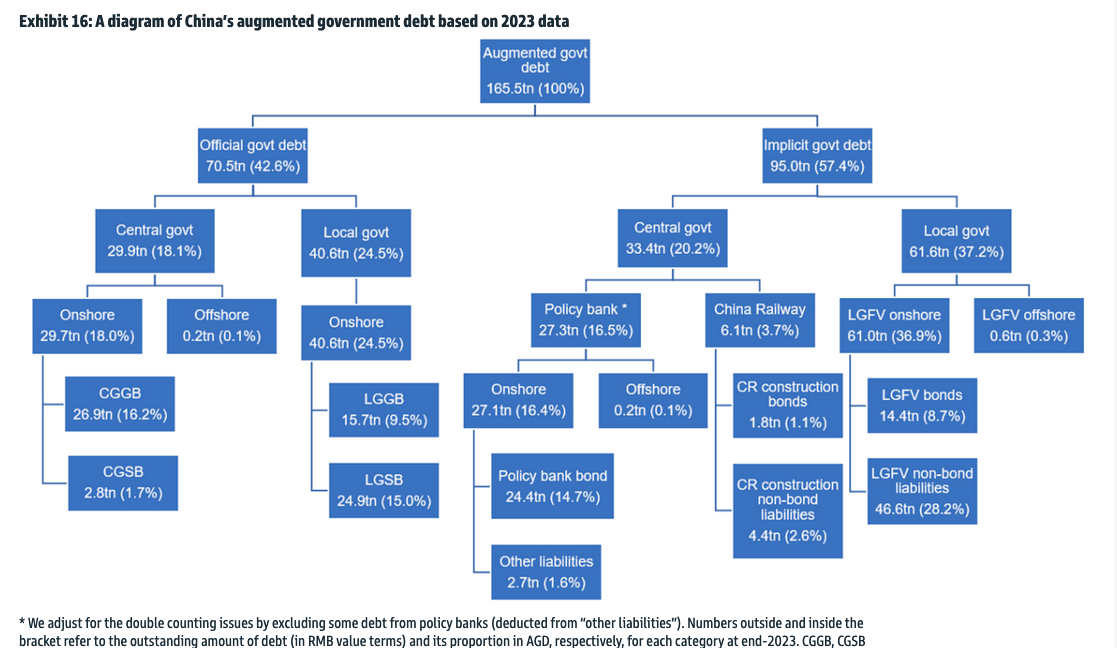
How that debt position has been growing over time:
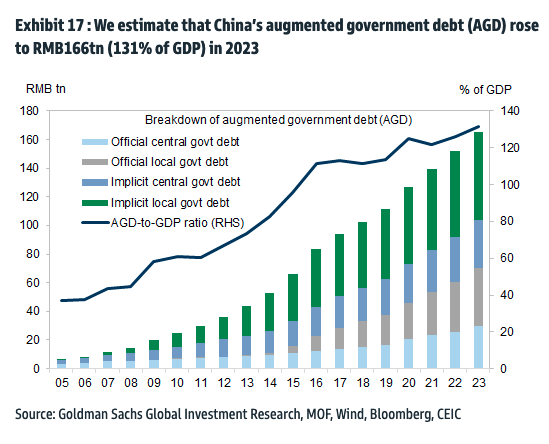
And the shocking demographic situation: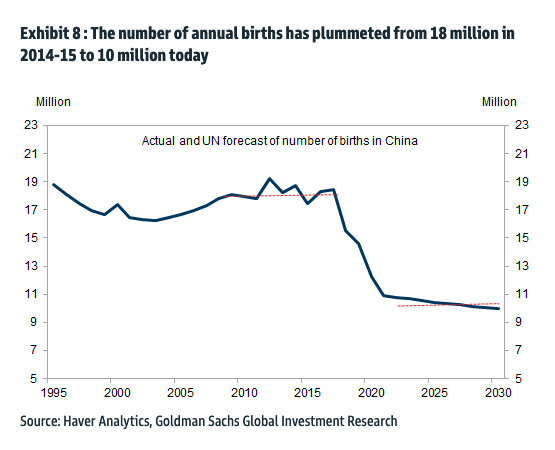
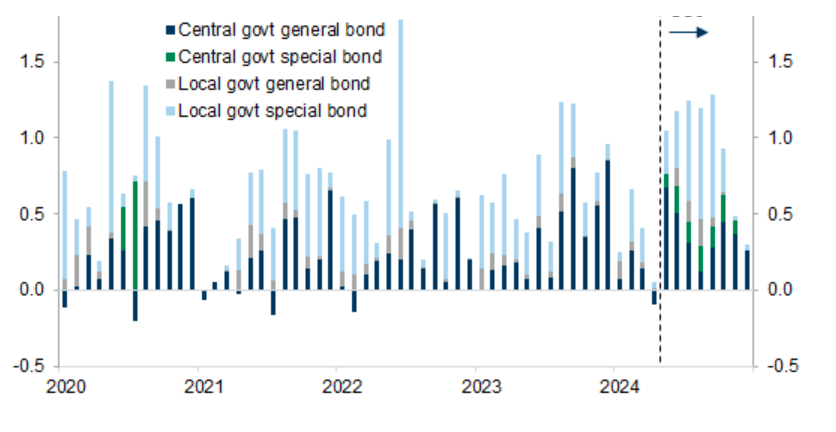
But here, really is the most compelling chart, which shows the degree to which “special government bonds” (which qualify as green) will be moving in on the scene in the years to come to help balance the system.
And we probably need an update of this chart from Dan Nielson since we expect a new entry on the asset side soon enough (if anyone’s seen one please do give us a shout):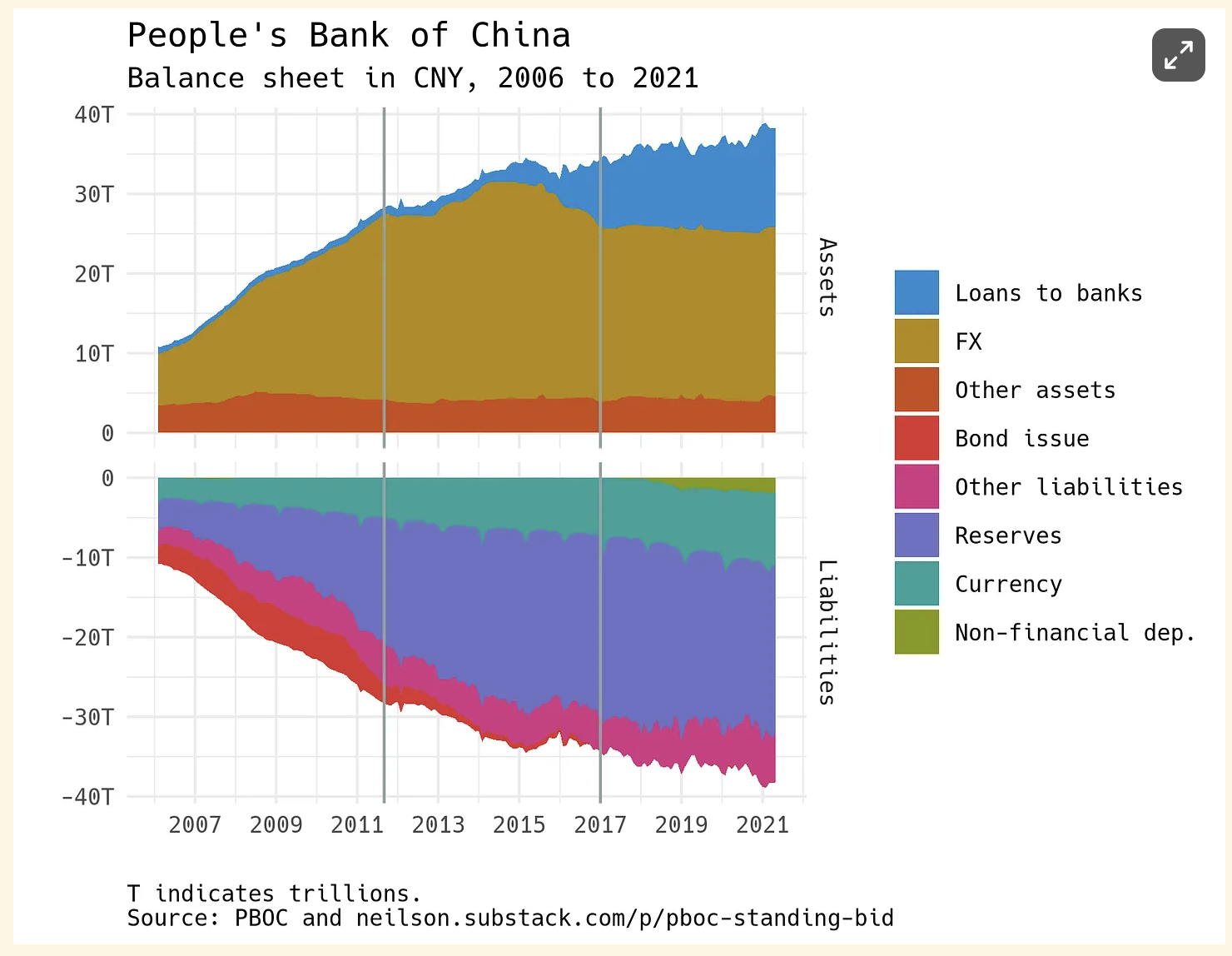
| BUSINESS, ECONOMY, FINANCE ETC |
MIGRANT NON-PRODUCTIVITY: Record immigration hasn’t raised living standards in Britain and has instead masked a surge of “exceptionally bad” productivity since 2008, the left-leaning Resolution Foundation said last week. The think tank outlined its figures within the context of 6 million immigrants arriving in the British economy since 2010. Over the past 16 years, GDP per capita has only grown 4.3 percent, a fraction of the 46 percent increase in GDP over the previous 16 years. Similarly, there was only an average annual productivity growth of 0.4 percent over the past 16 years, the slowest increase in productivity in almost 200 years.
ELON HAS A VIEW ON WHAT AILS THE WEST: Regulation duh. Especially the sort that stops states being able to build high-speed rail networks in California. “Large projects are essentially illegal in California and much of Europe and other countries. So there has to be some garbage collection process for removing rules and regulations in order for society to function and not to get hardening of the arteries to the point where you can’t do anything,” he said in an interview widely shared on X.
FRANCE’S UPCOMING TRUSS FIASCO? In September last year the Blind Spot interviewed one of our favourite investment gurus, Russell Napier, and among his many fascinating takes — mostly centred around his core view that “financial repression in the West is a matter of when not if” — was that France, not the UK, was the real sick man of Europe. Napier also predicted that the Truss mini-budget event would, in the future, be used as an attack on any other politician wanting to pursue a “go for growth” policy, leading most politicians to opt for the safetyism of financial repression instead. “Truss will go down in history as she tried it first, and the markets would not buy it… the markets simply said it won’t work and pushed long-term yields higher to reflect it…That message has gone out to other governments around the world.”
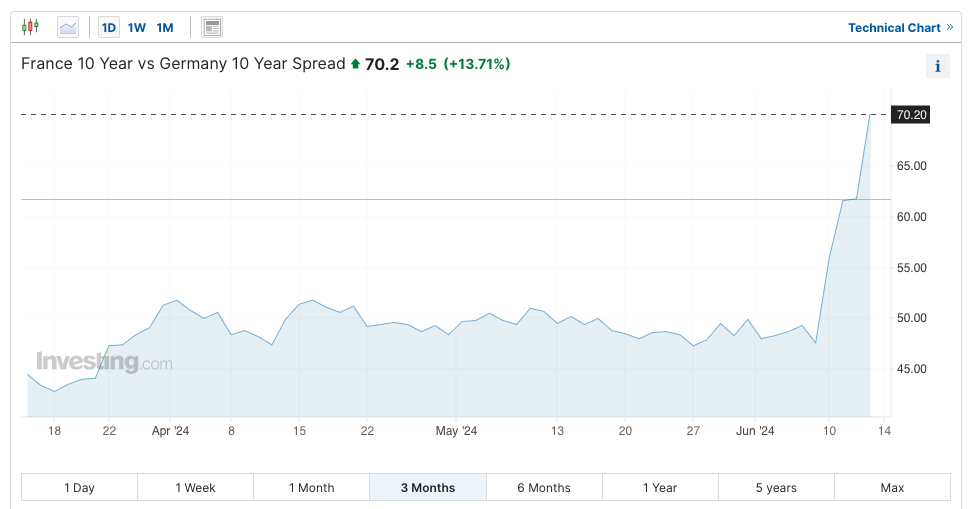
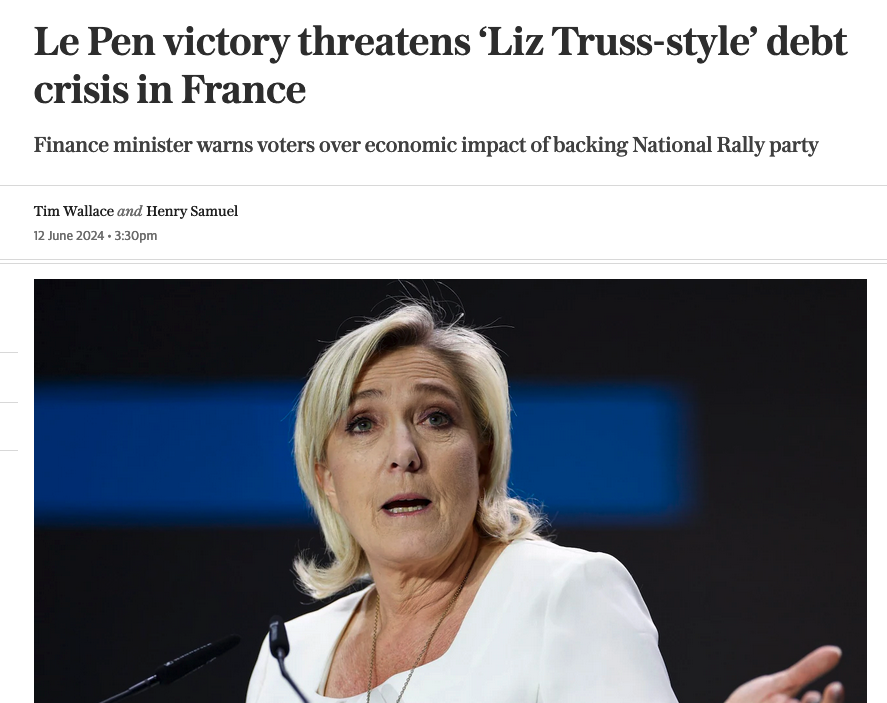
Le Pen’s turn to get the Truss treatment: Lo and behold, the moment has arrived. France is now facing a similar populist threat from a politician bold enough to consider putting her foot on the spending accelerator to try and achieve escape velocity for growth. And as predicted, the markets aren’t having any of it!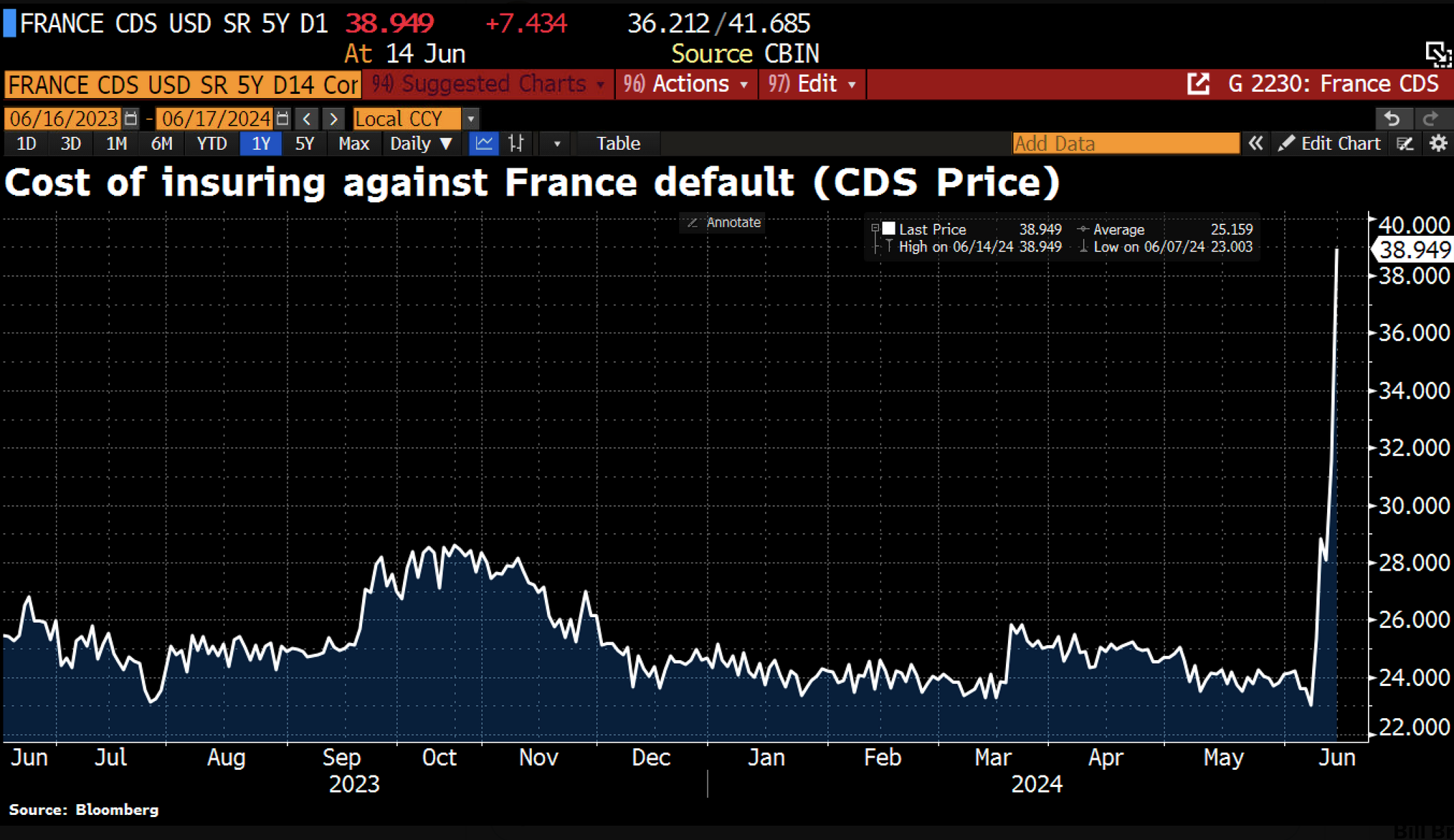
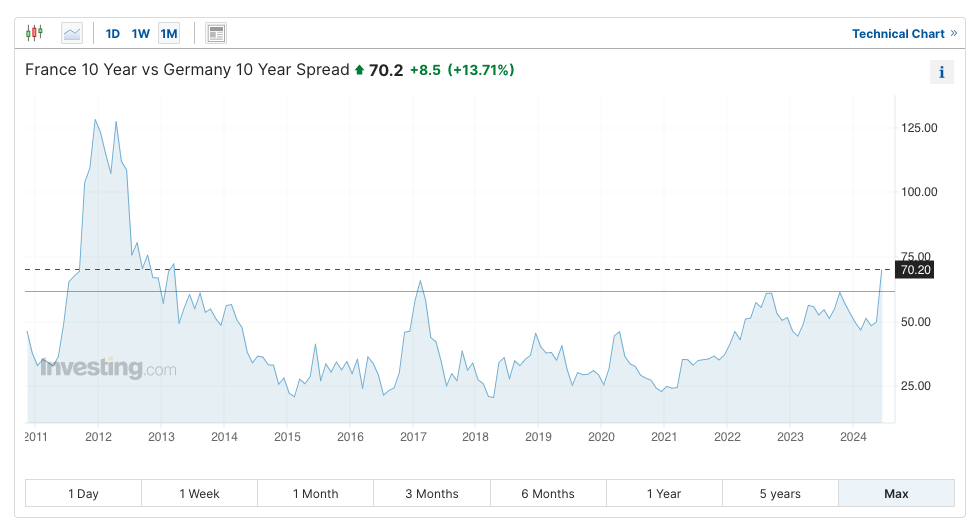
Here’s the French 10-year versus German 10-year bund spread:
Stitch up: And here are the media stories already “pre-casting” an inevitable Le Pen bond market crisis for France. Who needs a political assassination, when you can neutralise populism by handing it an economic time bomb, which you yourself created (or rather, failed to diffuse) — wired for explosion the moment you leave the house. Small surprise Macron ran for the door as soon as he had the opportunity to do so — it provided him with the face-saving exit before the bomb exploded on his watch.
Dead man’s switch: The funny thing is, Macron isn’t even hiding it. As he told Le Monde, when asked if he was saddened by the current situation “Not at all! I’ve been preparing for this for weeks, and I’m thrilled. I threw my live grenade at their feet. Now let’s see how they handle it…”
What to watch for: What will the ECB do to contain the crisis. If it really is dedicated to financial stability, it should take pre-emptive action by dusting off its spread-compressing facility to start buying French government and corporate debt. But that obviously wouldn’t send the intended signal. Far more likely, the ECB will let French bonds break down and only act to stabilise the market once the necessary political adjustments have been made (and when all unfunded spending plans are firmly consigned to a coffin).
The latest from Napier suggests it’s not that profligacy in the name of going for growth is entirely out of the question in establishment circles. It’s just that the money should be directed to growth projects by independent institutions like the ECB, not national governments directly. What centrist technocrats believe the government’s responsibility should be from now on is supporting the policies of an increasingly profligate central (gos)bank. The government can do this by regulating into law the demand that must be engineered for its domestic bonds if yields are to be kept in check in the context of extensive credit creation elsewhere.
Macron gave the strongest hint of that in his Sorbonne speech in April, when he said:
“The third shortcoming is that every year, our savings, to the tune of some €300 billion per year, finance the Americans. In any case, non-Europeans and, especially, the Americans, whether in treasury bonds or venture capital. It’s absurd. So we need to correct these three absurdities by having a real “savings and investment Union”, that is to say by creating the elements of solidarity to make it work, so that our investment funds and all of our capital market players can circulate savings so that they are properly allocated in our economy.”
The eurozone problem: But such a strategy is clearly much harder to deploy in a currency union with 20 respective governments than it is in an economy with its own monetary autonomy. As Napier highlighted in his June 7 newsletter to clients:
“Investors must expect that the ECB will be politicised as its new monetary policy is inherently even more political than what has come before. If Macron or others do indeed change the ECB into an institution focused on growth and not price stability, you must expect higher levels of bank credit growth, higher levels of broad money growth, higher inflation and further losses from bond investments.
Euro trouble in the making: Napier concluded:
“Yield curve control using the balance sheets of member states savings institutions is a massive devolution of monetary authority to each member state. Those in favour of ‘the project’ to create a single state of Europe believe that the nationalists/devolutionists, now on the rise, have accepted the continuation of the single currency and the EU. They might well have but the policies they eschew and will implement are, at the very least, incompatible with the continuation of the single currency.”
DARIO COMMENT: After Macron’s shock announcement of a snap parliamentary election it seems that France has never merited the title of “Europe’s basket case” more than now. As the bitter aftertaste of Le Pen’s victory in European elections reverberated through France, several parties struggled to respond coherently to the changing political makeup of the French electorate.
And things keep getting wilder by the day. The craziness started when Macron surprised everyone by calling on the French to elect new MPs to France’s parliament by June 30 in response to the wildly successful results of Le Pen’s Rassemblement National.
The first to be wrong-footed was Raphael Glucksmann, head of the Socialist Party for the EU elections, who tried to pre-empt Melenchon — the head of the hard left France Insoumise — and his attempts at a broad left-wing coalition by establishing pre-conditions for such an alliance. But Melenchon went ahead and established the ‘New Popular Front’ alliance across left-wing parties anyway, and ignored Gluckmann.
But not to be outdone in silliness, the traditional right-wing party Les Republicains (LR) then had their own moment in the dubious spotlight. This happened after its President, Eric Ciotti, asked for an alliance with Le Pen for the parliamentary elections. His statement broke suddenly with LR’s long-standing cordon sanitaire of Le Pen’s party, and predictably caused a party rift.
Soon after, party grandees of LR stood up to Ciotti, claiming he was speaking in his name only, and calling on him to resign from the party’s presidency. But what came after was certainly the oddest episode of them all. Ciotti reacted by closing his party’s headquarters with his set of keys to prevent his removal as president, leading to several anti-Ciotti LR MPs standing outside the door and calling on emergency services to break it down.

That is, until the party’s general secretary Annie Genevard arrived and managed to open the door thanks to her spare set of keys — after which the political bureau of the LR party announced they had fired Ciotti as the party President. It was quite a scene.

But Ciotti wasn’t done yet. He announced the party meeting didn’t accord with party statutes and as such, he remains President of the LR party – bolstered by the party’s Twitter account, which remains controlled by Ciotti loyalists, and the party’s Vice President. The latest development is that French courts have awarded Eric Ciotti the control of the party, though there is another court hearing coming in 8 days.
And they weren’t the only total meltdown. The entire French political spectrum watched as Marion Marechal, Le Pen’s niece, who joined Eric Zemmour’s super hard-right party, Reconquete, announced on live TV that Zemmour’s party would consider a coalition deal with Le Pen. The catch was that Zemmour was not notified, as his facial reaction showed:

Later, Marion claimed she had met with the RN, and the conditions for the deal were hinted to be the removal of Zemmour from the Reconquete party he had founded. In response to these moves, Zemmour claimed that Marion holds a “world record of betrayals” and she is surrounded by a team of “betrayal professionals.”
As for Macron’s move, which has been widely panned as a panic-driven announcement, there is more to it than meets the eye. The most prevalent view is as outlined by Olivier Blanchard on Twitter; “either the incoherence of the RN program becomes clear during the campaign and it loses the election. Or the RN wins, gets to govern and quickly makes a mess of it.” But the angle may be different — the focus of Macron’s attack may be on the voters for Melenchon rather than LePen. That’s because the current political makeup guarantees that Macron’s heir in 2027 will have to face off with Le Pen in the second round of the Presidential vote — if his party even makes it into the second round. This means Macron’s heir’s best chance at survival is eroding Melenchon’s popularity. This may explain his inflammatory statements after the announcement of surprise parliamentary elections, where he called the Popular Front left-wing alliance Melenchon leaders “anti-semitic” due to Melenchon’s party’s campaigning for Palestinian rights.
This chaos dovetails nicely with other shoddy news coming at this period of Macron’s reign. Notably, Standard & Poor’s downgrading of France’s debt rating from AA to AA-, which proved especially politically damaging to Macron’s government due to its reliability on economic credibility as one of its major assets for re-election and backing from markets.
Meanwhile, in French colonial goings on…
And, of course, there is the Africa debacle. While we have followed the French rout from the region, owing to the increasing prevalence of anti-French sentiment in the governments of the Sahel — especially from Burkina Faso, Mali, and Niger — we’ve become increasingly perplexed by the optics. We remind our readers, for instance, that an unconfirmed leak from French intelligence suggested Macron had advanced warning of the coup in Niger that deposed the French ally Bazoum, but refused to intervene and nip the coup in the bud.
Going further, the withdrawal from French Africa came after Macron pushed for the creation of the ‘Eco’ currency that would replace the CFA franc. Usage of the CFA franc, as we’ve looked at, allows West African countries to benefit from a stable exchange rate with the euro, guaranteeing foreign investment, but has significant drawbacks. The first is the obligation to keep 50 percent of the reserves in French banks, and the second is exposure to the ECB’s rate-setting policies in which it has no say.
The combination of Macron’s willing step back from the CFA Franc, which appears almost wholly beneficial for France and its industries, and the seemingly unwilling step back from the Sahel region, must be understood as part of the same movement.
An interesting article from Les Echos in 2021 certainly clarifies some of this contradiction. Titled “No, French companies don’t reap benefits from Africa”, it put forward some interesting and counterintuitive notions. The first is that Francafrique has long ceased to be a boon to French industry. With the African continent only representing 5.3 percent of foreign commerce carried out by French companies, the 15 countries of the French sphere of influence only accounted for 0.6 percent!
So, ironically, the French section of Africa is the part of Africa that benefits France the least economically, with the favoured countries for foreign investment among French companies being Angola, Nigeria, and South Africa.
This article ended on a sour and strong note: “We cannot justify the exorbitant spending and engagement of the French state with the CFA franc African states for supposedly economic motives, considering the feeble financial and commercial interests these countries suppose for French industry.” Most prescient of all, it was written in 2021 — when tensions in French Africa were only just beginning to surface to the mainstream.
Bottom line: What this suggests is the French pullback from Africa may be more of a calculated withdrawal than a rout. But if this week’s chaotic reaction to the calling of the surprise election is anything to go by, are we really surprised the French have made a logical situation sound chaotic?
| WW3 WATCH |
DRAFTS ARE GOING TO BE A THING: Germany released its new defence plan in case of war for the first time since the Cold War. It outlined concrete measures like conscription, rationing — where Germans will be guaranteed at least one hot meal a day — and the conversion of subway stations into bunkers. The measures have ostensibly been drawn up to prepare the country in case of aggression by Russia, responding to both the alleged threat posed by Russia to the Baltic region, and the threat posed by Russian cyber attacks, espionage and disinformation.
| COMMODITIES |
OIL GLUT INCOMING: The International Energy Agency warned the world was facing a ‘staggering’ surplus of oil by the end of the decade. This glut could equate to millions of barrels of surplus oil barrels a day, which would undermine the ability of OPEC+ to manage the price of crude, the agency said. It might also usher in an unprecedented era of lower oil prices, with negative consequences for oil companies’ bottom line. But energy experts such as Haitham Al Ghais, OPEC’s general secretary, warned of the IEA’s “dangerous” forecast that could cause “energy chaos on a potentially unprecedented scale” should the report induce producers to stop investing in new oil and gas projects.
BANANA REPUBLIC FOR REALZ: An American jury found Chiquita guilty of funding Colombian death squads that were used to kill people near the company’s banana plantations. The verdict marked the first time the company was found liable amid similar lawsuits, a rare finding that blames a private American company for a human rights abuse abroad. The compensation payment of $38.3 million to 16 family members of people killed during Colombia’s civil war by these right-wing paramilitaries funded by Chiquita may be the first one many. While the company has insisted it only made the payments out of fear the death squads would turn their guns on the company, Chiquita has historically been engaged in several dodgy dealings and successful coups in the region, under its former name United Fruit Company.
RUSSIA’S AMUR IS BACK ONLINE: The gas processing plant which was brought offline in 2022 after a fire mysteriously broke out in its facilities is back despite fears it might never be operational again. This is good news for previously stressed helium markets which are now benefiting from a lot of new supply. Prices have adjusted lower as a result, reported Gas World.
| CENTRAL BANKING |
FARAGE’S SWEET REVENGE: It was about this time last year that Nigel Farage, the recently re-anointed leader of Reform UK (the party that aims to unseat the Tories as leaders of His Majesty’s loyal opposition in the next parliament), fell victim to the great debanking trend in financial services due to his Brexity political persuasions.
Being Farage, however, he didn’t just take it on the chin. He engaged in an all-out media assault on the banks, notably Coutts. What followed was a national scandal, and the forced resignations of a number of top banking execs.
What goes around comes around: With bad blood like that, who can be surprised that Reform UK’s big idea on how to fund its “great British tax cut”, the details of which were mailed out to journos on Monday, is — wait for it — going after the banks? But the party won’t be pushing for any ordinary windfall tax. They say they’ve identified some £40 billion of potential savings due to the unfair way the Bank of England facilitates bank free lunches in the first place.
Down the central bank accounting rabbit hole: Key to Reform’s plan are the outsized transfers the Treasury is making to plug BoE QE-related losses, noting they plan to upend the “voluntary payment of base rate interest on the printed money reserves, known as quantitative easing reserves.” This, they say, is not being paid out by other central banks, and so shouldn’t be being paid out by the BoE either. (Editor’s note: This is not strictly true. The ECB, for one, remunerates 99 percent of the reserves it created through QE, currently at a rate of 3.75 percent.)
How it might work in practice: The Blind Spot understands the key to the ins and out of the policy comes in the use of the term “printed money reserves”. In other words, not all bank reserves are slated for non-interest bearing status. Rather, the plan is to segment reserves in different interest-rate tiers.
Important backers: At first sight — due to its imposition on central bank independence — going after how the BoE sets interest rates might seem like political suicide of the Liz Truss mini-budget debacle variety. But Reform may not be entirely out on a limb. Richard Tice, Reform chairman, revealed two former BoE deputy governors — Paul Tucker and Charlie Bean — agree with the idea.
It’ll all end in tiers. Tucker, now a research fellow at Harvard, set out similar thinking in a paper for the Institute for Fiscal Studies in October 2022. The state’s risk exposure to rising interest rates, he said, could be mitigated by not remunerating “the totality of reserves at Bank Rate but only an amount necessary to establish its policy rate in the money markets” and “moving to a system of tiered remuneration.” (Editor’s note: The ECB did experiment with tiering during its negative interest rate phase — albeit, ironically, to relieve the pressure on commercial banks’ P&L sheets, not to increase it.)
ALL EYES ON THE SHORT-TERM REPO FACILITY: The liquidity the Bank of England taketh with one hand, it giveth back with the other. And it’s all thanks to the steady and growing utilisation of its trendiest new tool, the short-term repo facility. It’s time, therefore, to familiarise ourselves with how it works (not least, because Governor Andrew Bailey went out of his way to name drop the importance of the facility in a recent address).
What exactly is it? The short-term repo facility, aka the STR, was first introduced in 2022 to “complement” the BoE’s supply operations. As Bailey explained in May: “The STR allows banks to borrow unlimited amounts of reserves, against gilt collateral, at Bank Rate.”
Why is it important? The facility is being positioned by the BoE as one of the most important tools to help it with its balance sheet unwind “without the risk of any loss of monetary control” as it feels around in the dark for the ever-elusive “Preferred Minimum Range of Reserves (PMMR)” level. That’s the sweet spot where there’s “just enough” liquidity to both satisfy the banking system’s day-to-day settlement needs and protect the transmission mechanism of monetary policy.
Sounds like the opposite of a sterilisation mechanism? Yep, pretty much.
How’s it working thus far? Look on my works, ye mighty, and despair! Here’s a chart Politico knocked up earlier: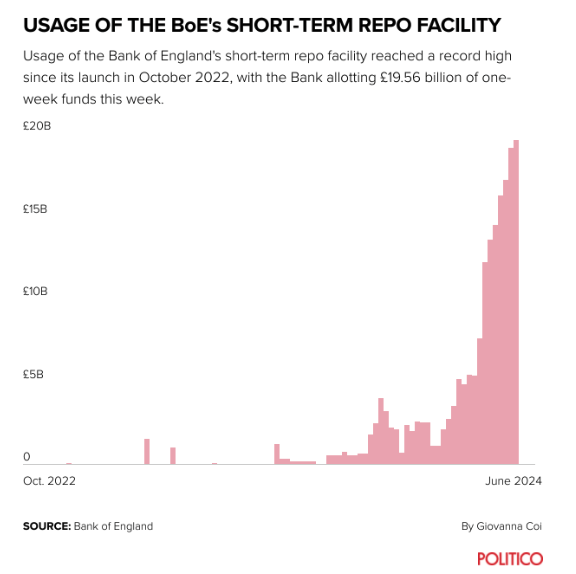
Yikes, that’s a bit of a sharp spike isn’t it? Fear not, that’s intentional, according to Bailey. In fact, it’s positively “encouraging” he said in May, since the uptick shows the BoE is indeed diverting pressure from the wholesale short-term market repo rates. “As the cost of liquidity in the money market edged up temporarily relative to Bank Rate, more banks turned to the facility to borrow reserves from the Bank,” he said. (And we confess to pimping the chart a bit. Had we scaled it against the £770-odd billion in sterling reserve balances, you might not have been so impressed.)
Destigmatisation agenda. Remember, this is all part of the BoE’s slow path toward a pre-positioning regime shift. It wants the market to use its facilities liberally so that it can ensure short-term wholesale repo rates remain anchored to Bank rate. “The Bank is open for business and our facilities should be used as a way for counterparties to access reserves as necessary,” Bailey said.
Panic slowly? Things might be working as intended, but this hasn’t stopped the rates market from clocking that the Sterling Overnight Index Average (SONIA) — which STR is supposed to keep anchored down — has been creeping higher since the beginning of the year regardless. “The recent value of 5.20 percent makes us believe that GBP liquidity conditions have suddenly tightened significantly,” ING’s Michiel Tukker wrote in a report on Thursday.
Watch the trend: “The rapid increase is a clear sign that market liquidity is tightening and some borrowers are willing to pay 5bp above SONIA for their funding,” Tukker observed, adding that “at around £19 billion, the total amount is still manageable, but, with the current trend, this number can increase considerably.”
BOTTOM LINE: The facility could prove an ingenious way for the BoE to swap its fixed interest rate exposures into floating ones. It might also provide the Bank with a new way to steer rates in an environment where financial repression needs a little bit of a helping hand from the BoE… or it could mushroom to high heaven and prove to be an utter disaster.
| HEALTH |
SECRET BIOLABS PART DEUX! The Russians have secret laboratories in Africa, wrote the Robert Lansing Institute, and may be planning to cause a pandemic to blame the US. The newish American think tank (with uncertain funding) found evidence of a Russian biolab buildup through space-based footage in the Central African Republic that showed the complex’s development since 2014. The conclusion that the complex is a biolab is based on the type of construction taking place; modular structures, several of which are connected by closed passageways, all of which appears to be guarded by Russian military personnel.
US ANTIVAX PROPAGANDA: Over in the Philippines, meanwhile, the US launched a clandestine programme aimed at discrediting China’s Sinovac vaccine as payback for Beijing’s efforts to blame Washington for the pandemic, an extensive and meaty analysis by Reuters reveals.
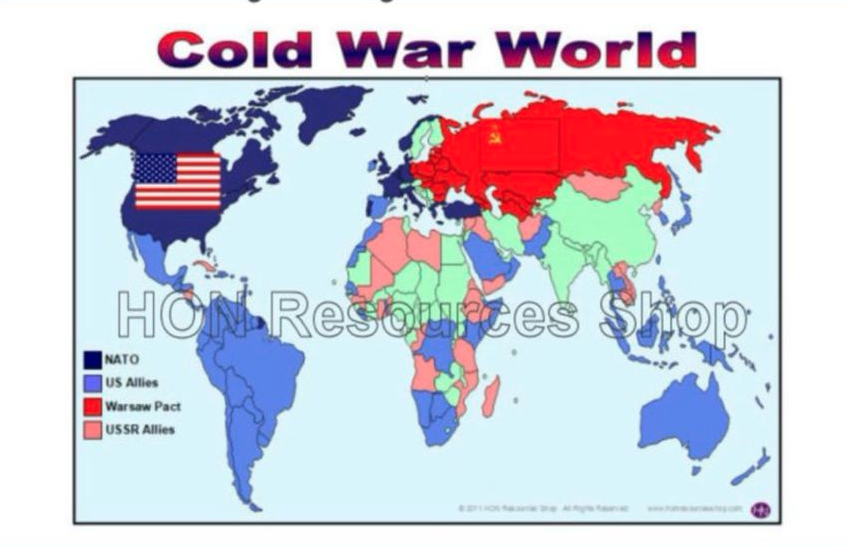
Given the politicised geographic distribution of the many different flavours of Covid vaccines (under the cover of vaccine diplomacy), it certainly does make you think:

| OPEN TABS ON IZZY’S COMPUTER |
NSO Group co-founder launches AI institute at top Israeli university (The Record)
In an initial win for Argentine President Milei, senators approve his key bills after violent protests (AP)
Domestic power struggles, divergencies over various issues make G7 weak, more divided than ever (says China’s Global Times)
Pope Francis became the first pope to address G-7 leaders, joining a summit session dedicated to artificial intelligence. He referenced the 1907 dystopian novel “Lord of the World,” in which technology replaces religion and faith in God. (Washington Post)
The UK’s fiscal rules may constrain growth no matter who wins the general election (Bennett Institute)
Boeing sales tumble as firm gets no orders for the 737 Max for second straight month (ABC news)
‘Go Woke, go broke’ is the true slogan of the Washington Post (New York Post)
Book festival activists are making absurd demands over Baillie Gifford (Guardian)
Surveillance pricing: They spy on you for many reasons, but also to rip you off. (Cory Doctorow)
| UPCOMING |
THINGS WE PLAN TO REVISIT EITHER IN THE NEWSLETTER OR AS AN INDEPENDENT SPOTLIGHT:
— What’s going on with the Epoch Times and its weird money laundering operation?
— Introducing New IP, the Chinese vision of the internet that’s already being eked out on an international level.
—Exploring the drivers behind the G7’s 2021 accord on CBDCs which sets out that non-resident access should be set up in accordance with a pledge to design any future CBDCs in a way that “would avoid the risk of currency substitution in other countries”. Interesting because of its weaponisation potential.
| SNEAK PEEK |
— Why this week’s petrodollar 50th anniversary “fake news” saga demonstrates a major misunderstanding about what really empowers the dollar.
— China is issuing ultra-long bonds at 2.53 percent, but is it a sign of strength or weakness?
— We check in on Russell Napier’s prophetic warnings about why France, not the UK, is the real sick man of Europe. And why a Liz Truss-style stitch-up is probably awaiting Marine Le Pen.
Bonjour mes amis! Well, well, well… WHAT a week. As the saying goes: There are decades where nothing happens, and there are weeks where decades happen. And this certainly felt like one of those. Your time is precious, however, so we will try to get to the point, by front-loading our key commentary right into the intro.
Generally, we try to focus on the stories and/or angles that didn’t get the attention they deserved, but also how small isolated events sometimes have more meaning when slotted into wider trends. One of those “signals” came by way of Labour’s manifesto, which was released on Thursday.
And, well, unless you’ve been living in Ted Kaczynski’s wooden cabin, you will have been exposed by now to Keir Starmer’s central message — hat tip to the Goebbels repetition effect — that Labour will not be hiking the “working man’s” taxes to achieve its growth plan, and that unlike the Tory plan, its plan is FULLY COSTED.
Got that?
But even if that is the case, we don’t think it’s what they’re shouting about loudly that we need to be paying attention to. As former Trotskyite turned conservative Peter Hitchens pointed out this week, the reason Keir Starmer’s Labour is “much worse than” Corbynite Labour — from a right-wing vantage point — is because, unlike Jeremy Corbyn, who he says made no secret of what he was up to and was “totally harmless because you could see him coming from a mile off”, the modern left proceeds with “subtle salami slicing and round the back methods…”
Hitchens is concerned not just that Labour will use devolution as a means to up the tax burden by stealth — transferring more power to local authorities and councils to apply local taxes on everything from homes to cars and roadways — but that Labour will purposefully erode Parliamentary power in a very permanent way to better entrench its captured bureaucracies. As he wrote, in the Mail:
Labour intellectuals have wrestled for years with the problem of how to stop anyone reversing their actions when the people, annoyingly, vote them out. Now they have found a way. This plan will remove huge amounts of power from Parliament. That power will go instead to Edinburgh and Wales, and to big (usually Labour-controlled) local government. Parliament will be forbidden by law to take this power back.
We remain apolitical in our commentary. But the above interests us because of its ancient historical echo. Dario has already dwelled on the idea that socio-economic forces are at work reviving localised fiefdoms, eroding civil liberties and creating dependencies on local hardmen. Here’s a snippet of his original piece: 
The fact that power is drifting from the centre to the local, and from government to non-democratically appointed institutions like the Bank of England, the Office for Budget Responsibility, and others, needs factoring into the wider fabric of economic evolution in the West.
Soon enough, it won’t matter which party comes to power.
Whether they were voted in to pursue a Rwanda asylum plan, to reform the pension system or to cut taxes, all governments will be blocked from pursuing their policy by growing elite structures defending the “status quo”. Such checks and balances may have been inputted to control for rogue populism and radical government, but, as City Minister Andrew Griffith told me on the sidelines of a Politico event last year, they’re now so powerful — and encroach on so many areas — that elected government is left with little jurisdiction over anything.
It reminds me of the set-up in the Scorsese film Casino, where a clueless Philip Green is appointed to head the fictional Tangiers Casino but has no real power over anything.
Meanwhile, I see a narrative being forged that the shift to local power is actually more democratic not less. I’ve seen this applied to China specifically in a positive way. In that rendering, the electorate retains influence on the appointment of local officials, allowing them to satisfy their democratic itch, notably by booting out petty officials deemed useless or corrupt. At the same time, however, the ideological and economic direction of the country is tied to a singular immutable mission and implemented by a professional political elite — whose performance is dubiously measured — that can’t waver from the trend. This supposedly injects their system (and economy!) with stability and “forward guidance” not afforded to democratic systems, allowing transformational change to occur. On the contrary, uncertainty reigns supreme in the West and prohibits any bold streamlined action.
Is this what Labour is going for?
Even if the answer is no, it doesn’t change the fact that the economic and tax problem the party is likely to inherit stems from the unprecedented spending we undertook to fund lockdown. Nor does it change the fact that Labour — and most parties on the left — wanted more lockdown not less, and thus more spending and more profligacy in 2020/2021. In which case blaming the Tories for the fiscal position we’re now in seems disingenuous at best. There was no active opposition for almost two years. We had a government of unity — a fact that seems to have been conveniently forgotten by Rachel Reeves today.
Yet there’s no escaping the fact that we are now all paying the price for our lockdown indulgence, and it seems crazy to me that more isn’t being made of this fact during the campaigning.
Whoever ends up in charge, there are only two plausible options for the economy on the table. The first is a bold “going for growth” slingshot manoeuver that liberates the system from government overreach but could (just as in the fall of communism) leave those who have become too dependent on the system calamitously unprepared and vulnerable. It might work, but only if it spurs productivity to the point that growth diminishes the size of the welfare burden. The second is taxing the rich to keep the bond vigilantes appeased and the welfare state intact (if not expanded) but at the obvious risk of killing off productivity entirely. Oh, there’s one more option: We all push ahead with the war economy model and all become de facto employees of the state.
As usual, this newsletter was brought to you by Izabella Kaminska and Dario Garcia Giner.
Send tips to [email protected] and [email protected]
| THE BIG BLIND SPOT THIS WEEK |
PETRODOLLAR DRAMA AND PETROYUANS. The usually unflappable rates market was beset with internet drama on Thursday after a tall tale that the special arrangement between the US and Saudi Arabia on petrodollar recycling “had ended after 50 years” began to circulate across social media channels. The Blind Spot ran into some puzzled rates traders, who weren’t exactly sure what to believe, not least because G7 leaders were gathering at the same time and the U.S. had just expanded sanctions against Russia — making reprisal action plausible.
Coincidence or not? In the end, however, the dollar trash-talk didn’t do too much damage to the greenback’s standing as the world’s preferred settlement currency. While yields had edged slightly higher in the day, they settled lower once it became clear there was no substance to the story.
Suspected patient zero: The source of the drama, or at least its primary amplifier, appeared to be CNBC motormouth Rick Santelli, known for his high-octane politicised rants that have, in the past, spurred libertarian insurgencies. His chatter was amplified further when Mario Nawfal, one of Elon Musk’s favourite news accounts on X, posted — since deleted — that the Saudi petrodollar arrangement had come to an end.
Nothing to see here! We reached out to Nawfal directly and made clear there was nothing to the claim but speculation. He responsibly clarified his post.
Fact vs Fiction: Of course, none of that is to say there wasn’t a secretive gentleman’s agreement struck between then U.S. President Nixon and Saudi Arabia’s King Faisal in 1974 related to petrodollar recycling. The agreement was indeed penned around June 10, making this — as we originally reported in the Blind Spot two weeks ago! — the 50th anniversary year of the deal. It is also true that, in recent years, more facts have been revealed about the nature and scope of the arrangement. What we don’t know and what has never been substantiated is that there was any expiry to the deal.
Talk of the town: That hasn’t stopped the affair from being discussed at length this week. Even crazy Marjorie Taylor Greene was at it. The usually serene Paul Donovan, who pens the daily UBS economic blog, even took notice dispatching an unsurprisingly dismissive take centred on “the dangers of confirming your beliefs” adding the story seemed to have started in the crypto world. But it was journalist Thomas Fazi’s take that rang truest to us.
What really matters: As Fazi pointed out, the petrodollar died over 10 years ago when America achieved energy independence. Since then, it’s actually been transformed into more of a “trade dollar” which changes the dynamics of the current de-dollarisation trend into something else entirely (CFR’s Brad Sester and China-specialist Michael Pettis talk about at length).
Necessity not choice: Remember, while the US had no choice but to import oil from a narrow set of countries abroad in 1974, it has many choices from where it can import finished manufactured goods (including its own shores). It’s just a matter of investment, inclination and valuing variables other than price competitiveness. This is all the more notable given the high-tech “lights out” manufacturing investment we are now engaging in was delayed and derailed by outsourcing to China many years ago. At the time our tech could not compete with impoverished factory serfs, who were still cheaper than major capital investments in technology. The reason we can do it now, however, is because the Chinese factory serfs are lying flat, and demanding real promise of advancement to maintain their culture of overwork.
Won’t somebody please think of the Saudis? Rather than worrying about how the unwind of the petrodollar will impact America, the market should be more concerned with how it changes power dynamics and consumer trends in Saudi Arabia. So much of the kingdom’s prosperity has been linked to the ready and inexhaustible supply of dollars, which they’ve used to bling up their nation-state, invest in premium international property and generally engage in the “good life”. With the end of the petrodollar, however, that extractive dollar tap finally runs dry, meaning all their dollar inflows from now on will have to be sourced either from non-petroleum exports (ever heard of any leading non petro-specific Saudi companies? No, didn’t think so) or from dollar income generated from their existing dollar-generating assets. Casually losing a few billion on a malinvestment in a historic Swiss bank just isn’t going to fly anymore. Investments will have to be far more strategic and positive-sum-focused.
Summering factor: Despite the lucrative petrodollar arrangement all these years, there were some things that money still couldn’t buy for the Saudis. A continental climate was one of them. Projects like Neom may be trying to change that, but it’s not their ultimate success or expense that matters — it’s the quest for self-dependency signal we derive from it. Consider how you might feel if the unfettered access you once enjoyed to the old and new world for summering purposes suddenly became much harder to fund. Adapting to Sochi or Beijing could become a thing, but it probably wouldn’t be a primary preference.
And finally, the security situation: There was always more to the petrodollar than just oil for dollars. The arrangement also provided US security to Saudi Arabia. That, in turn, translated into American protection (and, thus, tolerance) of Wahhabism in the international order. However, this is unlikely to be guaranteed under the security blanket of China, or even Russia (let’s not forget who the separatists were in Chechnya). The Saudis may genuinely be considering striking more “oil for yuan” deals, but any upcoming arrangement is unlikely to be a marriage made in heaven.
The prospect of endless yuan flows a nation can only spend on cheap goods from China or directly in China and Russia just isn’t as tantalising as access to Europe or North America.
| CHINA |
THE ECB WEIGHS IN ON DE-DOLLARISATION: We would like to thank the European Central Bank for helpfully visualising the diminishing international role of the dollar this week by way of the exquisite chart crime below in its annual update on the international role of the euro.
PETROYUANS ARE GO! China successfully sold the third batch of the 1 trillion yuan of ultra-long bonds it announced in May. The headlines screamed that the 50-year bonds achieved record-low yields of 2.53 percent for 35 billion yuan worth of debt ($4.8 billion). But this was hardly surprising given the “record” only starts in May 2024 and that there’s one very desperate buyer on the market with few other options (Russia, we’re looking at you.)
What’s so special about these bonds? Well, first off, it’s what China calls them. But the real reason they’re special is because they are denominated in yuan, ultra long and available to offshore investors. Hitherto such bonds were very rare — largely because most of China’s debt was held domestically by design — part of its closed capital account strategy to enhance its export-oriented growth model. That depended on keeping the yuan consistently undervalued versus the dollar, in the context of much wider financial repression.
What goes around comes around: When you consider that China’s entire growth model was centred on price competitiveness achieved through non-stop official balance-sheet expansion against dollar-denominated asset purchases (aka hoovering up all the dollars Americans flooded into the system to pay for goods in exchange for yuan liquidity) … you realise why the economy was faced with its impossible trilemma. There was no option but to run the economy as hot as possible, while using monetary policy and regulation to dampen the side-effects. The result left Chinese workers with few guaranteed savings options other than real-estate.
But now “times are a-changing”. Both private sector and Chinese government indebtedness on a domestic level is boiling over and the country’s capacity to woo foreign currency by debasing the yuan further to make exports more competitive is petering out. This is because trade wars are a thing now, and Western markets aren’t keen on continuing to give China preferential access regardless of how cheap Chinese goods get.
At the same time, the second issue facing China is that it can’t easily sell off its existing dollar assets to meet hard currency-denominated liabilities or import costs, because that risks overvaluing the yuan and making its exports even less attractive at a time when resource input costs are volatile and domestic demand is languishing. Hence, those sales have now stopped and even begun to rise again as China makes one final dash for export-oriented growth with its cunning plan to flood western markets with its ridiculously (and probably unsustainably) underpriced electric vehicles.
There’s only one option left: To keep things in balance, China must open up its capital account and give foreigners the access they’ve been yearning for — both for trade and investment purposes. This is especially the case now that Russia — an increasingly important source of commodity imports — has nowhere to reinvest the yuan payments it receives for oil exports to China than in gold or cryptocurrency. The decision in May to issue 1 trillion yuan worth of ultra-long special treasury bonds speaks to this point. This is only the fourth time in history such bonds have ever been issued, and the fact they come at a time when US Treasury Secretary Janet Yellen has widened sanctions is probably not a coincidence.
As the PRC itself explained in an official release about the bonds, desperate times call for desperate measures:
China’s first three issuances of special treasury bonds were all out of the need to deal with specific urgent risks and challenges, said Wen Bin, chief economist at China Minsheng Bank. For example, in 1998, it was to replenish bank capital in response to the 1997 Asian financial crisis and the deterioration of the asset quality of domestic commercial banks, while the goal in 2020 was to cope with the negative impact of the epidemic on the economy, according to Wen. China issued new special treasury bonds in 1998, 2007 and 2020 separately.
Impossible trinity: The irony shouldn’t be lost that it’s a form of capital control introduced by the West (sanctions against Russia) that has finally forced China’s hand. It seems ever more evident that it’s now the West’s turn to engage in financial repression. For China, however, that poses the risk that the markets will soon determine its fiscal pathway, not government. It’s either that, or a major revaluation of the yuan that scuppers its exports model for good.
No balance sheet recession here! China in any case is at pains to explain that it’s definitely not in the process of emulating a Japan-style “balance sheet recession” that requires continuous government balance sheet expansion to compensate for the contraction in private balance sheets at a time when its demographics are also collapsing. Richard Koo, who came up with the term, however, politely disagrees. He sees many comparisons between the two situations. Here’s a chart he presented in a session with Peterson Institute’s Nicolas Veron last year highlighting the similarities between the two economies, noting the Chinese government will have no choice but to run an even more substantial budget deficit than Japan did to balance its system.
If that’s true, you can be sure that this line is only going to get more negative:
To tell the story even more colourfully, here are some other useful charts via Goldman Sachs.
First, the collapse in wage growth:
Next, a diagram showing how China’s current debt structure maps out:
How that debt position has been growing over time:
And the shocking demographic situation:
But here, really is the most compelling chart, which shows the degree to which “special government bonds” (which qualify as green) will be moving in on the scene in the years to come to help balance the system.
And we probably need an update of this chart from Dan Nielson since we expect a new entry on the asset side soon enough (if anyone’s seen one please do give us a shout):
| BUSINESS, ECONOMY, FINANCE ETC |
MIGRANT NON-PRODUCTIVITY: Record immigration hasn’t raised living standards in Britain and has instead masked a surge of “exceptionally bad” productivity since 2008, the left-leaning Resolution Foundation said last week. The think tank outlined its figures within the context of 6 million immigrants arriving in the British economy since 2010. Over the past 16 years, GDP per capita has only grown 4.3 percent, a fraction of the 46 percent increase in GDP over the previous 16 years. Similarly, there was only an average annual productivity growth of 0.4 percent over the past 16 years, the slowest increase in productivity in almost 200 years.
ELON HAS A VIEW ON WHAT AILS THE WEST: Regulation duh. Especially the sort that stops states being able to build high-speed rail networks in California. “Large projects are essentially illegal in California and much of Europe and other countries. So there has to be some garbage collection process for removing rules and regulations in order for society to function and not to get hardening of the arteries to the point where you can’t do anything,” he said in an interview widely shared on X.
FRANCE’S UPCOMING TRUSS FIASCO? In September last year the Blind Spot interviewed one of our favourite investment gurus, Russell Napier, and among his many fascinating takes — mostly centred around his core view that “financial repression in the West is a matter of when not if” — was that France, not the UK, was the real sick man of Europe. Napier also predicted that the Truss mini-budget event would, in the future, be used as an attack on any other politician wanting to pursue a “go for growth” policy, leading most politicians to opt for the safetyism of financial repression instead. “Truss will go down in history as she tried it first, and the markets would not buy it… the markets simply said it won’t work and pushed long-term yields higher to reflect it…That message has gone out to other governments around the world.”
Le Pen’s turn to get the Truss treatment: Lo and behold, the moment has arrived. France is now facing a similar populist threat from a politician bold enough to consider putting her foot on the spending accelerator to try and achieve escape velocity for growth. And as predicted, the markets aren’t having any of it!
Here’s the French 10-year versus German 10-year bund spread:
Stitch up: And here are the media stories already “pre-casting” an inevitable Le Pen bond market crisis for France. Who needs a political assassination, when you can neutralise populism by handing it an economic time bomb, which you yourself created (or rather, failed to diffuse) — wired for explosion the moment you leave the house. Small surprise Macron ran for the door as soon as he had the opportunity to do so — it provided him with the face-saving exit before the bomb exploded on his watch.
Dead man’s switch: The funny thing is, Macron isn’t even hiding it. As he told Le Monde, when asked if he was saddened by the current situation “Not at all! I’ve been preparing for this for weeks, and I’m thrilled. I threw my live grenade at their feet. Now let’s see how they handle it…”
What to watch for: What will the ECB do to contain the crisis. If it really is dedicated to financial stability, it should take pre-emptive action by dusting off its spread-compressing facility to start buying French government and corporate debt. But that obviously wouldn’t send the intended signal. Far more likely, the ECB will let French bonds break down and only act to stabilise the market once the necessary political adjustments have been made (and when all unfunded spending plans are firmly consigned to a coffin).
The latest from Napier suggests it’s not that profligacy in the name of going for growth is entirely out of the question in establishment circles. It’s just that the money should be directed to growth projects by independent institutions like the ECB, not national governments directly. What centrist technocrats believe the government’s responsibility should be from now on is supporting the policies of an increasingly profligate central (gos)bank. The government can do this by regulating into law the demand that must be engineered for its domestic bonds if yields are to be kept in check in the context of extensive credit creation elsewhere.
Macron gave the strongest hint of that in his Sorbonne speech in April, when he said:
“The third shortcoming is that every year, our savings, to the tune of some €300 billion per year, finance the Americans. In any case, non-Europeans and, especially, the Americans, whether in treasury bonds or venture capital. It’s absurd. So we need to correct these three absurdities by having a real “savings and investment Union”, that is to say by creating the elements of solidarity to make it work, so that our investment funds and all of our capital market players can circulate savings so that they are properly allocated in our economy.”
The eurozone problem: But such a strategy is clearly much harder to deploy in a currency union with 20 respective governments than it is in an economy with its own monetary autonomy. As Napier highlighted in his June 7 newsletter to clients:
“Investors must expect that the ECB will be politicised as its new monetary policy is inherently even more political than what has come before. If Macron or others do indeed change the ECB into an institution focused on growth and not price stability, you must expect higher levels of bank credit growth, higher levels of broad money growth, higher inflation and further losses from bond investments.
Euro trouble in the making: Napier concluded:
“Yield curve control using the balance sheets of member states savings institutions is a massive devolution of monetary authority to each member state. Those in favour of ‘the project’ to create a single state of Europe believe that the nationalists/devolutionists, now on the rise, have accepted the continuation of the single currency and the EU. They might well have but the policies they eschew and will implement are, at the very least, incompatible with the continuation of the single currency.”
DARIO COMMENT: After Macron’s shock announcement of a snap parliamentary election it seems that France has never merited the title of “Europe’s basket case” more than now. As the bitter aftertaste of Le Pen’s victory in European elections reverberated through France, several parties struggled to respond coherently to the changing political makeup of the French electorate.
And things keep getting wilder by the day. The craziness started when Macron surprised everyone by calling on the French to elect new MPs to France’s parliament by June 30 in response to the wildly successful results of Le Pen’s Rassemblement National.
The first to be wrong-footed was Raphael Glucksmann, head of the Socialist Party for the EU elections, who tried to pre-empt Melenchon — the head of the hard left France Insoumise — and his attempts at a broad left-wing coalition by establishing pre-conditions for such an alliance. But Melenchon went ahead and established the ‘New Popular Front’ alliance across left-wing parties anyway, and ignored Gluckmann.
But not to be outdone in silliness, the traditional right-wing party Les Republicains (LR) then had their own moment in the dubious spotlight. This happened after its President, Eric Ciotti, asked for an alliance with Le Pen for the parliamentary elections. His statement broke suddenly with LR’s long-standing cordon sanitaire of Le Pen’s party, and predictably caused a party rift.
Soon after, party grandees of LR stood up to Ciotti, claiming he was speaking in his name only, and calling on him to resign from the party’s presidency. But what came after was certainly the oddest episode of them all. Ciotti reacted by closing his party’s headquarters with his set of keys to prevent his removal as president, leading to several anti-Ciotti LR MPs standing outside the door and calling on emergency services to break it down.
That is, until the party’s general secretary Annie Genevard arrived and managed to open the door thanks to her spare set of keys — after which the political bureau of the LR party announced they had fired Ciotti as the party President. It was quite a scene.
But Ciotti wasn’t done yet. He announced the party meeting didn’t accord with party statutes and as such, he remains President of the LR party – bolstered by the party’s Twitter account, which remains controlled by Ciotti loyalists, and the party’s Vice President. The latest development is that French courts have awarded Eric Ciotti the control of the party, though there is another court hearing coming in 8 days.
And they weren’t the only total meltdown. The entire French political spectrum watched as Marion Marechal, Le Pen’s niece, who joined Eric Zemmour’s super hard-right party, Reconquete, announced on live TV that Zemmour’s party would consider a coalition deal with Le Pen. The catch was that Zemmour was not notified, as his facial reaction showed:
Later, Marion claimed she had met with the RN, and the conditions for the deal were hinted to be the removal of Zemmour from the Reconquete party he had founded. In response to these moves, Zemmour claimed that Marion holds a “world record of betrayals” and she is surrounded by a team of “betrayal professionals.”
As for Macron’s move, which has been widely panned as a panic-driven announcement, there is more to it than meets the eye. The most prevalent view is as outlined by Olivier Blanchard on Twitter; “either the incoherence of the RN program becomes clear during the campaign and it loses the election. Or the RN wins, gets to govern and quickly makes a mess of it.” But the angle may be different — the focus of Macron’s attack may be on the voters for Melenchon rather than LePen. That’s because the current political makeup guarantees that Macron’s heir in 2027 will have to face off with Le Pen in the second round of the Presidential vote — if his party even makes it into the second round. This means Macron’s heir’s best chance at survival is eroding Melenchon’s popularity. This may explain his inflammatory statements after the announcement of surprise parliamentary elections, where he called the Popular Front left-wing alliance Melenchon leaders “anti-semitic” due to Melenchon’s party’s campaigning for Palestinian rights.
This chaos dovetails nicely with other shoddy news coming at this period of Macron’s reign. Notably, Standard & Poor’s downgrading of France’s debt rating from AA to AA-, which proved especially politically damaging to Macron’s government due to its reliability on economic credibility as one of its major assets for re-election and backing from markets.
Meanwhile, in French colonial goings on…
And, of course, there is the Africa debacle. While we have followed the French rout from the region, owing to the increasing prevalence of anti-French sentiment in the governments of the Sahel — especially from Burkina Faso, Mali, and Niger — we’ve become increasingly perplexed by the optics. We remind our readers, for instance, that an unconfirmed leak from French intelligence suggested Macron had advanced warning of the coup in Niger that deposed the French ally Bazoum, but refused to intervene and nip the coup in the bud.
Going further, the withdrawal from French Africa came after Macron pushed for the creation of the ‘Eco’ currency that would replace the CFA franc. Usage of the CFA franc, as we’ve looked at, allows West African countries to benefit from a stable exchange rate with the euro, guaranteeing foreign investment, but has significant drawbacks. The first is the obligation to keep 50 percent of the reserves in French banks, and the second is exposure to the ECB’s rate-setting policies in which it has no say.
The combination of Macron’s willing step back from the CFA Franc, which appears almost wholly beneficial for France and its industries, and the seemingly unwilling step back from the Sahel region, must be understood as part of the same movement.
An interesting article from Les Echos in 2021 certainly clarifies some of this contradiction. Titled “No, French companies don’t reap benefits from Africa”, it put forward some interesting and counterintuitive notions. The first is that Francafrique has long ceased to be a boon to French industry. With the African continent only representing 5.3 percent of foreign commerce carried out by French companies, the 15 countries of the French sphere of influence only accounted for 0.6 percent!
So, ironically, the French section of Africa is the part of Africa that benefits France the least economically, with the favoured countries for foreign investment among French companies being Angola, Nigeria, and South Africa.
This article ended on a sour and strong note: “We cannot justify the exorbitant spending and engagement of the French state with the CFA franc African states for supposedly economic motives, considering the feeble financial and commercial interests these countries suppose for French industry.” Most prescient of all, it was written in 2021 — when tensions in French Africa were only just beginning to surface to the mainstream.
Bottom line: What this suggests is the French pullback from Africa may be more of a calculated withdrawal than a rout. But if this week’s chaotic reaction to the calling of the surprise election is anything to go by, are we really surprised the French have made a logical situation sound chaotic?
| WW3 WATCH |
DRAFTS ARE GOING TO BE A THING: Germany released its new defence plan in case of war for the first time since the Cold War. It outlined concrete measures like conscription, rationing — where Germans will be guaranteed at least one hot meal a day — and the conversion of subway stations into bunkers. The measures have ostensibly been drawn up to prepare the country in case of aggression by Russia, responding to both the alleged threat posed by Russia to the Baltic region, and the threat posed by Russian cyber attacks, espionage and disinformation.
| COMMODITIES |
OIL GLUT INCOMING: The International Energy Agency warned the world was facing a ‘staggering’ surplus of oil by the end of the decade. This glut could equate to millions of barrels of surplus oil barrels a day, which would undermine the ability of OPEC+ to manage the price of crude, the agency said. It might also usher in an unprecedented era of lower oil prices, with negative consequences for oil companies’ bottom line. But energy experts such as Haitham Al Ghais, OPEC’s general secretary, warned of the IEA’s “dangerous” forecast that could cause “energy chaos on a potentially unprecedented scale” should the report induce producers to stop investing in new oil and gas projects.
BANANA REPUBLIC FOR REALZ: An American jury found Chiquita guilty of funding Colombian death squads that were used to kill people near the company’s banana plantations. The verdict marked the first time the company was found liable amid similar lawsuits, a rare finding that blames a private American company for a human rights abuse abroad. The compensation payment of $38.3 million to 16 family members of people killed during Colombia’s civil war by these right-wing paramilitaries funded by Chiquita may be the first one many. While the company has insisted it only made the payments out of fear the death squads would turn their guns on the company, Chiquita has historically been engaged in several dodgy dealings and successful coups in the region, under its former name United Fruit Company.
RUSSIA’S AMUR IS BACK ONLINE: The gas processing plant which was brought offline in 2022 after a fire mysteriously broke out in its facilities is back despite fears it might never be operational again. This is good news for previously stressed helium markets which are now benefiting from a lot of new supply. Prices have adjusted lower as a result, reported Gas World.
| CENTRAL BANKING |
FARAGE’S SWEET REVENGE: It was about this time last year that Nigel Farage, the recently re-anointed leader of Reform UK (the party that aims to unseat the Tories as leaders of His Majesty’s loyal opposition in the next parliament), fell victim to the great debanking trend in financial services due to his Brexity political persuasions.
Being Farage, however, he didn’t just take it on the chin. He engaged in an all-out media assault on the banks, notably Coutts. What followed was a national scandal, and the forced resignations of a number of top banking execs.
What goes around comes around: With bad blood like that, who can be surprised that Reform UK’s big idea on how to fund its “great British tax cut”, the details of which were mailed out to journos on Monday, is — wait for it — going after the banks? But the party won’t be pushing for any ordinary windfall tax. They say they’ve identified some £40 billion of potential savings due to the unfair way the Bank of England facilitates bank free lunches in the first place.
Down the central bank accounting rabbit hole: Key to Reform’s plan are the outsized transfers the Treasury is making to plug BoE QE-related losses, noting they plan to upend the “voluntary payment of base rate interest on the printed money reserves, known as quantitative easing reserves.” This, they say, is not being paid out by other central banks, and so shouldn’t be being paid out by the BoE either. (Editor’s note: This is not strictly true. The ECB, for one, remunerates 99 percent of the reserves it created through QE, currently at a rate of 3.75 percent.)
How it might work in practice: The Blind Spot understands the key to the ins and out of the policy comes in the use of the term “printed money reserves”. In other words, not all bank reserves are slated for non-interest bearing status. Rather, the plan is to segment reserves in different interest-rate tiers.
Important backers: At first sight — due to its imposition on central bank independence — going after how the BoE sets interest rates might seem like political suicide of the Liz Truss mini-budget debacle variety. But Reform may not be entirely out on a limb. Richard Tice, Reform chairman, revealed two former BoE deputy governors — Paul Tucker and Charlie Bean — agree with the idea.
It’ll all end in tiers. Tucker, now a research fellow at Harvard, set out similar thinking in a paper for the Institute for Fiscal Studies in October 2022. The state’s risk exposure to rising interest rates, he said, could be mitigated by not remunerating “the totality of reserves at Bank Rate but only an amount necessary to establish its policy rate in the money markets” and “moving to a system of tiered remuneration.” (Editor’s note: The ECB did experiment with tiering during its negative interest rate phase — albeit, ironically, to relieve the pressure on commercial banks’ P&L sheets, not to increase it.)
ALL EYES ON THE SHORT-TERM REPO FACILITY: The liquidity the Bank of England taketh with one hand, it giveth back with the other. And it’s all thanks to the steady and growing utilisation of its trendiest new tool, the short-term repo facility. It’s time, therefore, to familiarise ourselves with how it works (not least, because Governor Andrew Bailey went out of his way to name drop the importance of the facility in a recent address).
What exactly is it? The short-term repo facility, aka the STR, was first introduced in 2022 to “complement” the BoE’s supply operations. As Bailey explained in May: “The STR allows banks to borrow unlimited amounts of reserves, against gilt collateral, at Bank Rate.”
Why is it important? The facility is being positioned by the BoE as one of the most important tools to help it with its balance sheet unwind “without the risk of any loss of monetary control” as it feels around in the dark for the ever-elusive “Preferred Minimum Range of Reserves (PMMR)” level. That’s the sweet spot where there’s “just enough” liquidity to both satisfy the banking system’s day-to-day settlement needs and protect the transmission mechanism of monetary policy.
Sounds like the opposite of a sterilisation mechanism? Yep, pretty much.
How’s it working thus far? Look on my works, ye mighty, and despair! Here’s a chart Politico knocked up earlier:
Yikes, that’s a bit of a sharp spike isn’t it? Fear not, that’s intentional, according to Bailey. In fact, it’s positively “encouraging” he said in May, since the uptick shows the BoE is indeed diverting pressure from the wholesale short-term market repo rates. “As the cost of liquidity in the money market edged up temporarily relative to Bank Rate, more banks turned to the facility to borrow reserves from the Bank,” he said. (And we confess to pimping the chart a bit. Had we scaled it against the £770-odd billion in sterling reserve balances, you might not have been so impressed.)
Destigmatisation agenda. Remember, this is all part of the BoE’s slow path toward a pre-positioning regime shift. It wants the market to use its facilities liberally so that it can ensure short-term wholesale repo rates remain anchored to Bank rate. “The Bank is open for business and our facilities should be used as a way for counterparties to access reserves as necessary,” Bailey said.
Panic slowly? Things might be working as intended, but this hasn’t stopped the rates market from clocking that the Sterling Overnight Index Average (SONIA) — which STR is supposed to keep anchored down — has been creeping higher since the beginning of the year regardless. “The recent value of 5.20 percent makes us believe that GBP liquidity conditions have suddenly tightened significantly,” ING’s Michiel Tukker wrote in a report on Thursday.
Watch the trend: “The rapid increase is a clear sign that market liquidity is tightening and some borrowers are willing to pay 5bp above SONIA for their funding,” Tukker observed, adding that “at around £19 billion, the total amount is still manageable, but, with the current trend, this number can increase considerably.”
BOTTOM LINE: The facility could prove an ingenious way for the BoE to swap its fixed interest rate exposures into floating ones. It might also provide the Bank with a new way to steer rates in an environment where financial repression needs a little bit of a helping hand from the BoE… or it could mushroom to high heaven and prove to be an utter disaster.
| HEALTH |
SECRET BIOLABS PART DEUX! The Russians have secret laboratories in Africa, wrote the Robert Lansing Institute, and may be planning to cause a pandemic to blame the US. The newish American think tank (with uncertain funding) found evidence of a Russian biolab buildup through space-based footage in the Central African Republic that showed the complex’s development since 2014. The conclusion that the complex is a biolab is based on the type of construction taking place; modular structures, several of which are connected by closed passageways, all of which appears to be guarded by Russian military personnel.
US ANTIVAX PROPAGANDA: Over in the Philippines, meanwhile, the US launched a clandestine programme aimed at discrediting China’s Sinovac vaccine as payback for Beijing’s efforts to blame Washington for the pandemic, an extensive and meaty analysis by Reuters reveals.
Given the politicised geographic distribution of the many different flavours of Covid vaccines (under the cover of vaccine diplomacy), it certainly does make you think:
| OPEN TABS ON IZZY’S COMPUTER |
NSO Group co-founder launches AI institute at top Israeli university (The Record)
In an initial win for Argentine President Milei, senators approve his key bills after violent protests (AP)
Domestic power struggles, divergencies over various issues make G7 weak, more divided than ever (says China’s Global Times)
Pope Francis became the first pope to address G-7 leaders, joining a summit session dedicated to artificial intelligence. He referenced the 1907 dystopian novel “Lord of the World,” in which technology replaces religion and faith in God. (Washington Post)
The UK’s fiscal rules may constrain growth no matter who wins the general election (Bennett Institute)
Boeing sales tumble as firm gets no orders for the 737 Max for second straight month (ABC news)
‘Go Woke, go broke’ is the true slogan of the Washington Post (New York Post)
Book festival activists are making absurd demands over Baillie Gifford (Guardian)
Surveillance pricing: They spy on you for many reasons, but also to rip you off. (Cory Doctorow)
| UPCOMING |
THINGS WE PLAN TO REVISIT EITHER IN THE NEWSLETTER OR AS AN INDEPENDENT SPOTLIGHT:
— What’s going on with the Epoch Times and its weird money laundering operation?
— Introducing New IP, the Chinese vision of the internet that’s already being eked out on an international level.
—Exploring the drivers behind the G7’s 2021 accord on CBDCs which sets out that non-resident access should be set up in accordance with a pledge to design any future CBDCs in a way that “would avoid the risk of currency substitution in other countries”. Interesting because of its weaponisation potential.