

| SNEAK PEEK |
— A tale of two Chinas. Izzy explores our growing inability to make sense of what’s really happening in China.
— SocGen’s Albert Edwards thinks the recession everyone was expecting but never came, might finally have arrived.
— Dario updates us on the latest with the Red Sea and Horn of Africa.
Happy Sunday evening, dear readers…
It’s been a huge week, with a lot of news. Not least the late-breaking news that French President Emmanuel Macron has been thrashed by Marine Le Pen’s National Rally party (headed by Jordan Bardella) in European Parliament elections, as largely expected, as has Olaf Scholz’s party in Germany. The surprising element is that Macron has now decided to call a snap election to regain legitimacy.
We’ve had so much news, in fact, we will now have to revisit some key happenings next week, among them events at the Washington Post and the Epoch Times, but also the reaction to Ayaan Hirsi’s (aka Mrs Niall Ferguson) column about how the West may have been subverted in Bari Weiss’ Free Press. (Curiously, given the assertions, the reaction piece now pops up at the top of Google search results rather than the column itself).
Also worth noting is the degree to which Nvidia CEO Jensen Huang is becoming a household name of Steve Jobs proportions. That’s everywhere apart from in European political and financial newsrooms. A straw poll among my colleagues this week showed that hardly any of them had heard of the world’s most talked about chipmaker. This despite Huang’s keynote address in March having received more than 27 million views at the last count and women mobbing him with requests to sign their bras.
We will return to some of these themes next week. For now, here are the signals we plucked out of the noise this week.
As usual, this newsletter has been brought to you by me, Izabella Kaminska, and Dario Garcia Giner.
Send tips to [email protected] and [email protected].
| THE BIG BLIND SPOT THIS WEEK |
A TALE OF TWO CHINAS: If your networks are in any way as varied and diverse as the Blind Spot’s, we suspect you too will be facing extremely conflicting accounts about what’s going on in China right now. You may also have noticed that the two opposing viewpoints are about as extreme as they’ve ever been. On one hand, a good chunk of the financial pundit space thinks China has finally emerged as an epic industrial power capable of matching the West on everything from technology, defence and infrastructure to innovation and culture. On the other, there’s a notable increase in voices convinced that China is a superpower on the brink — and that something very bad is going on there at the macro level, but because of the crackdown on free speech, nobody can get the message out.
White monkey bias? On the positive side, the internet is being routinely flooded with visuals like the one below showing China outpacing the West in all sorts of fields. These are being pushed out and fanned by Western voices often consumed by selective bias. They highlight only the positive and disregard the negative. In this case, the data shows Chinese life expectancy steadily increasing since 1970 and continuing to rise, with US life expectancy beginning to stagnate in the early 2000s and then falling off a dramatic cliff around 2017. This is paired with another chart showing all-cause mortality rates between the ages of 45-54, which fell across the board in other developed countries, actually increased in the United States since approximately 1998. It is worth noting the two tallies on life expectancy are still relatively close, with some fluctuations and data analyses putting the United States’ life expectancy as just above China’s post-Covid. Also, China isn’t even a comparative in the second chart.

Look on my works, ye mighty, and despair! A large chunk of the “only positive” Chinese commentary has been centred on the quality and affordability of Chinese EVs relative to Western ones. These cars, as has been reported pretty much everywhere, are flooding Western markets and causing angst and anxiety for Western manufacturers. Even Izzy’s second-hand EV dealer brother has given them a great review, and he’s genuinely very hard to please. However, that pales in comparison to the endless positivity surrounding China’s prowess in space, with the internet chock full of unabashed praise for Beijing’s recent moon-landing accomplishments.
But it’s also a propaganda war: According to the latest Chinese-originated take on China, it’s Western media, not Chinese media, that are purposefully repressing the truth and engaging in conscious selection bias to make China look as bad as possible. This, at face value, is a strategy intended to sow doubt in the minds of readers and make them lose total trust in what they see and hear from Western sources. Its effectiveness is closely linked to emulating the Western press at their own game: Just flip everything they say about China’s information systems and apply it to them — a strategy which would never have worked with Western audiences until cancel culture became a norm and authorities decided to repress information during the Covid pandemic.
The bigger the lie the more believable it is: The Chinese know such distrust provides them with an opportunity to influence hearts and minds about subjects that have been established rhetoric in the West for decades. For example, on the anniversary of the Tiananmen Square massacre last week, a suspected so-called “white monkey” account put out an X thread questioning the official narrative and the truthfulness of Western accounts of the massacre. It has since been deleted and received a fact check, but not before amassing millions of views. (For a flavour of the original you can see a similar posting the author made the year before.)
Through the looking glass: On the negative narrative side, all our knowledgeable — and, in some cases, on-the-ground — China sources seem to agree that nobody can rely on any data coming out of China right now because the information flow is so overly controlled. Economist Pippa Malmgren says in the latest edition of International Economy: “It’s tricky to track the Chinese economy these days. They’ve turned off the transponders on ships so it’s harder to measure what’s going in and out of China. They raised a Great Digital Wall that keeps Westerners out and the Chinese blind to what’s really happening. For years, observers doubted Chinese data, but now we have a data blackout.”
Economic crisis incoming? Malmgren suggests the fog is intended to obfuscate the economic reality. She draws attention to the Belt and Road initiative’s failure to generate reliable agricultural and commodity imports for China as intended, because of the low quality of infrastructure provided to contracted states. This has made countries that agreed to swap Chinese infrastructure for commodity export deals reluctant to sign up for more deals. Moreover, thanks to inflation and devaluation, the respective states now want to keep the food for themselves and are less concerned about defaulting on China than the US. Separately, Malmgren wonders about why President Xi has been encouraging and even mandating corporate militias, known as the People’s Armed Forces Departments? She speculates it might have something to do with Xi’s decision last year to relax internal migration rules so that factory workers could more easily return to the countryside.
But what about those EVs? As Britain’s likely next chancellor Rachel Reeves noted in May, “if things are cheap just because of huge state subsidies, I don’t think that’s fair on people who work in this country.” She added, “if we end up in a situation where we are entirely reliant on China for our cars, I think that would leave us incredibly exposed.” She may well be right.
China as the original Uber model? We all know there’s no free lunch. If the cheapness of EVs is more of a temporary phenomenon linked to unsustainable government subsidies, rather than Chinese engineering or manufacturing advances, we will know soon enough. The question is, will we know it before Western competitors — currently in the process of pursuing viable unit-cost economics as they wean themselves off their own respective state subsidies — are eviscerated by Chinese loss-leading strategies entirely? As has already proven the case with solar and wind, China stands to capture the entire market for itself if we act too late.
Surely China knows it’s not sustainable? Putting all its bets on EVs is likely a strategic play — a Hail Mary pass to keep China’s uneconomic economic model ticking over for just a few more years. Think of it as one last attempt to pilfer producer surplus from the West by throwing completely unsustainable working practices at the problem in the hope of creating a perpetual Western dependency.
Urban factory fail: The desperation gels with Malmgren’s belief that an increasingly repressed urban factory population is on the verge of capitulating altogether. She reminds us that in a system where “employees” are treated mostly like prisoners, domestic migration controls were designed to keep that population enslaved. But what was once helpful legislation may no longer be so useful. Falling factory orders and growing unemployment have turned an asset into a liability because even a workforce that’s not paid regularly still has to be fed. According to Malmgren if food security cannot be guaranteed, as might be the case now, the Chinese factory model simply doesn’t work.
Media blackout: Other Blind Spot sources concur there could be a full-blown economic collapse going on and we wouldn’t even know it. Concerns this is the case are mounting at the highest circles. Politico Europe’s resident China expert — aka editor-in-chief Jamil Anderlini, who previously spent over a decade in China for the FT — recently attended the annual Bilderberg meeting, where China was high on the agenda for that reason. Other journalists who are still operating from China and who we know and trust agree. They say, after what they saw happen with information control during Covid, almost anything is possible in the Baudrillard “the Gulf War did not take place” sense in China.
What goes around comes around? China’s current self-preservation strategy is focused on flinging our accusations about their own economy back at us. But perhaps it’s not our critiques it should be worried about. In the age of deep fakes and AI domestic trust in its own claims is breaking down just as quickly, if not more quickly than it is for us. Take note, for example, of China’s own “moon-landing truth” movement — it’s a thing.
In other counter-propaganda: The Chinese government’s epic gold purchases this year appear to have catalysed an outbreak of fake gold scams. These have been mostly directed at Chinese retail investors panicking about de-dollarisation and trying to get in on the gold action instead. Meanwhile, according to YouTuber Laowhy86, there’s also been a crackdown — by which we mean accounts being banned and deleted — on social media videos depicting rich Chinese influencers showing off their wealth. This comes after a similar crackdown on social media videos depicting Chinese people living in poverty last year.
If Aleksandr Solzhenitsyn was around today, he might say:
“We know that they are lying, they know that they are lying, they even know that we know they are lying, we also know that they know we know they are lying too, they of course know that we certainly know they know we know they are lying too as well, but they are still lying. In our country, the lie has become not just moral category, but the pillar industry of this country. Hence all the investment in AI.”
DARIO/IZZY COMMENT: The 35th anniversary of the Tiananmen Square protests and what it says about the futility of covert action.
On June 4, 1989, the world was gripped by news that Chinese government troops opened fire on student-led pro-democracy protests. The image of “tank man” defying an armoured column on Tiananmen Square has since then become an iconic symbol of the democratic struggle against totalitarian communism.
As Beijing has cracked down on commemorating this controversial event in Hong Kong, overseas commemorative events have gained in importance, taking place in the United States, Britain, Canada, Australia and Taiwan.
But all may not be as it seems. As with any large event, particularly relating to sensitive points of internal policy between great powers, there appears to be some controversy, especially in China, as to the real scale and nature of the Tiananmen protests and their subsequent crushing.
We were led onto this trail by the X/Twitter posts of Andy Boreham, who in 12 posts claimed that the Western narrative on the Tiananmen protests and crackdown had been falsified. As noted above, it’s since been deleted and received a fact check, but not before amassing millions of views.
But there’s another factor in play, too. Since 1989, the repeated use of the CIA’s “covert action” for regime destabilisation across the world has exposed its modus operandi. That has allowed targets of regime change to cite CIA involvement to cast doubt upon the legitimacy of popular opposition movements against them. Everything is now a potential foreign op, ripe for dismissal. Nothing is authentic.
For those engaging in legitimate opposition, this can be psychologically burdening — not least because the CIA’s success at destabilising regimes has rarely been matched by post-facto State Department support leading to stable and sustained democraies. On the contrary, democracies delivered with the helping hand of covert action have more often than not tended to collapse just a few decades later. The perpetrators are then left to deal with the consequences and reprisals. To wit, the Taliban were honoured guests at Vladimir Putin’s St. Petersburg Economic summit this week. Not exactly what the CIA had in mind we think when they first got involved in Afghanistan.

If you’re not familiar with “the playbook”, we recommend investing some time in the following 2019 lecture by the CIA’s internal historian, David Robarge, which lays out all the times the strategy has worked (at least what’s been declassified), and all the times it has not.
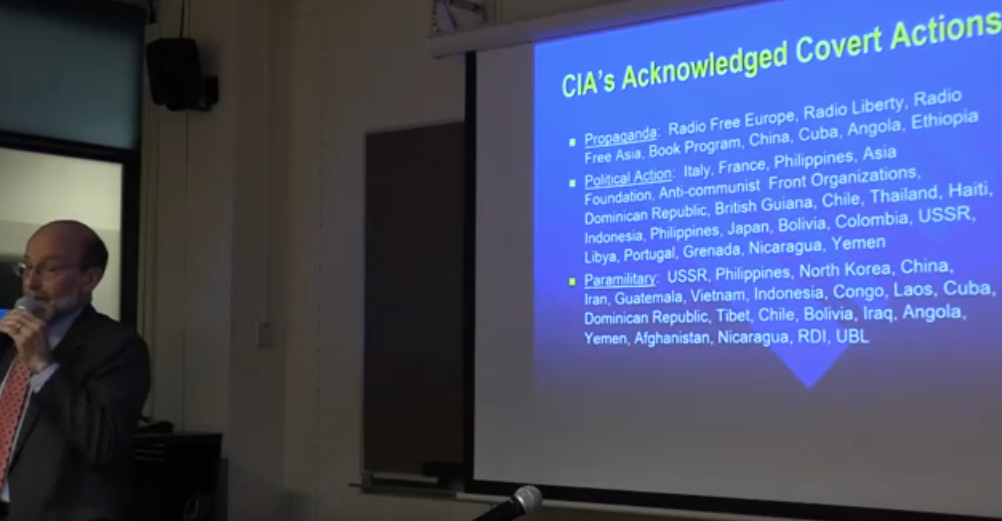
The counter-attack against the playbook has come most decisively in Russia, where Putin himself has become known for funding and backing fake opposition movements to purposefully muddy the waters, making it almost impossible to know who are legitimate protestors and dissidents and who are not. Worse still, it’s become increasingly difficult to tell which movements are authentic and which are merely strategic entrapment. It is a strategy that has helped turn Russia into an effective one-party state and fake democracy.
But before we consider whether the playbook itself has now been exhausted and whether there’s a new, potentially more effective, playbook doing the rounds, it’s worth revisiting the “what if” factor of the covert actions that didn’t quite manage to inject democracy into their target nations.
In the case of Tiananmen Square, there is little doubt that a substantial student protest movement that led to potentially thousands of deaths across China occurred in 1989.
The point of ambiguity surrounds what happened in the square itself.
So while the standard narrative is that Chinese state security opened fire and killed hundreds, if not thousands, of peaceful pro-democracy students protesting in the square, the alternative view is that the deaths were limited to about 300 soldiers and that the violence was triggered by a riot of not-so-peaceful student protesters to which soldiers were forced to respond.
Many of the counter sources still seem dubious and biased, such as this one. The problem is, what was once viewed as circumstantial evidence, is becoming harder to ignore due to growing familiarity with the CIA’s covert action playbook and its plausibly deniable nature. For example, the National Endowment for Democracy, an organisation we now know has deep ties to the CIA, was established just a year prior, in 1988.
The second interesting point is that the violence only started when some individuals triggered a fight in Muxidi, five kilometres away from Tiananmen, attacking army buses with petrol bombs. The use of extremist thugs to provoke a heightening of tensions, however, is a well-known method in Western intelligence circles, and part of the “strategy of tension” we’ve looked over in recent months.
Last, while the students were allowed to leave the square peacefully, and bullets were only used to destroy the sound systems in the square, there’s also the fact that early Western media reports did reference thousands of peaceful students being massacred by the Chinese army by error. This is something BBC reporters have since readily admitted to.
As James Miles, one of the BBC reporters covering the event, has since recounted:
“The standard line now used by foreign journalists is that “hundreds, possibly thousands” died. The Chinese government was quick to exploit the weaknesses in our reporting. By focusing on what happened in the square itself, it began sowing seeds of doubt about the general accuracy of Western reports among Chinese who did not witness what happened. At first this made little difference, since most Beijing residents at least had friends of friends who had seen for themselves that there had been a massacre, even if not in the square. But as the years passed, a new generation emerged with few eyewitness accounts to cling to.”
“There was no Tiananmen Square massacre, but there was a Beijing massacre. The shorthand we often use of the ‘Tiananmen Square protests’ of 1989 gives the impression that this was just a Beijing issue. It was not. Protests occurred in almost every city in China (even in a town on the edge of the Gobi desert). What happened in 1989 was by far the most widespread pro-democracy upheaval in communist China’s history. It was also by far the bloodiest suppression of peaceful dissent.”
But as Miles also notes, hindsight has also been no friend to the West. The alternative narrative’s appeal has only strengthened in light of the economic miracle experienced by communist China in the decades after.
As Miles states, “China’s rapid economic growth, and the far less stellar progress of the ex-communist states of Europe, has helped give credence (among many Chinese) to the government’s claim that China would have descended into chaos were it not for the crackdown.”
Since the counterclaim is that the United States was trying to depose the Chinese government to install a pro-West, democratic government, knowing what we know now about its development, it’s worth considering the growing notion in China and other emerging markets ruled by authoritarians that the West only wants to inflict democracy on economies that would flourish under alternative governance models.
It’s a tempting proposition that a lot of Westerners seem to be falling for.
And yet, the truth might be the exact opposite. What if the West’s best hope for not being dominated by the Chinese was keeping the country communist?
Theda Skocpol is an American sociologist and political scientist at Harvard University. Her revolution theory draws on comparisons of how the revolutions of France, Russia and China played out. Skocpol has identified certain similar trends as essential components for a sustained revolutionary society: a poor economy, natural disasters, food shortages, or security concerns. But more critical to our discussion was her view on what united all those post-revolutionary states together: power, strength, and confidence.
Think about pre-revolutionary or mid-revolutionary China, Russia, or France. Weak, enfeebled states, overburdened by debt, with calamitous security situations. And now think about post-revolutionary China, Russia and France and how they differ from the unstable post-revolutionary environments emanating from the CIA’s arguably inauthentic colour revolutions, which only care about regime rather than social change. Communist Russia immediately went on an, albeit flawed, offensive in Poland, but over the coming decades beat an industrial Germany head-on, which it had completely failed to do in the First World War, and then established itself as a great power for fifty years. France under Napoleon conquered half of Europe. And while China didn’t go on expansionist quests, it certainly managed to shore up its borders, get its internal security situation in check, and even gave a bloodied nose to India and Russia in their respective border wars during the 60s and 70s. And now, almost 80 years after its revolution, it can stand up to the United States economically.
While this revolutionary fervor and strength doesn’t last forever, it tends to last more than just a decade. At least a lifetime.
But Skocpol’s analyses also suggest that the Western notion that China can be a threat to Western interests is overdone precisely because of its prevailing communist nature.
Consider for a moment what might happen if China underwent a democratic, liberal revolution at the society level today. Suddenly, there would be no real impediment to unifying with Taiwan. The country would benefit from an overwhelming increase in its governmental legitimacy, meaning that the raft of resources dedicated to internal control could be switched to external power projection.
And there’s no reason to think a democratic, liberal China would be any friendlier to the West. If anything, it might be more antagonistic. That is because it would no longer be a poorer alternative system to the West, that even its own elites hardly seem to believe in. It would be a competitor system to the West’s own, and would place their propaganda on an equal footing with ours. And while anti-China sentiments would remain among its neighbours, there would be a lot less to fear from a capitalistic, liberal China than an overburdening communist one with dubious legal frameworks, allowing for its influence to grow and dominate.
Being more secure in its footing means China would be freer to expand and make riskier geopolitical moves since its governments would be legitimised by truly popular plebiscites, rather than having to fear spontaneous outbursts on its social media platforms the communist state has no way of channeling into policy.
What makes countries face off against each other, ultimately, is not their systems of governance, but clashes between social norms and competing quests for resources and power. And a democratic and liberal Chinese government, even if less streamlined by being less centralised, would be a far more formidable competitor to Western values than its current insecure, communist variant.
So perhaps the failure of Western intelligence services in Tiananmen Square, wasn’t really a failure. It was more of a lucky break.
| BUSINESS, ECON AND FINANCE |
THE RECESSION THAT NEVER CAME: When the media went to town about the market’s last remaining bear finally capitulating in May regarding the outlook for the US economy, SocGen’s Albert Edwards took it a bit personally. “This just mirrors the swing away investors forecasting recession — likely at exactly the wrong moment. The last bear hasn’t yet turned bullish. I remain resolute,” he tweeted.
A no landing for the “no landing”: The comments couldn’t have been more timely. As Edwards’ research note this week highlighted there was “quite the downward revision to US Q2 growth expectations in just one week” coupled by a surprise fall in May’s manufacturing ISM to 48.7 from 49.2. “Surely that recession which almost everyone has given up on isn’t about to hit?” wrote Edwards. The turn, however, comes amid growing anticipation that the Fed might even have to resume hiking rates. So what’s going on?
A consumer spending mirage. To explain, Edwards highlighted my old colleague Matt Klein’s latest piece at the Overshoot on the remarkably consistent 6 percent rise in Personal Consumption Expenditures since the second half of 2022. As Klein highlights, the biggest driver of that growth since mid-2023 has come from “imputed financial services and non-profits”. What’s that you ask? Why, it’s the fees consumers are charged for financial services, such as the spread between what banks get paid for deposits and what they pay to savers, but also spending on such things as political campaigns. For Edwards, that implies a lot of the price-pressure that’s stopping the Fed from cutting rates is more fake than real.
| LAWFARE |
PUTIN ON AMERICA’S JUSTICE SYSTEM: Speaking at the St Petersburg International Economic Forum, Russian President Vladimir Putin responded to news of Trump’s conviction by highlighting that the political weaponisation of America’s judicial system was “destroying” its democracy. Putin also highlighted the irony that the conviction increased Trump’s ratings by 6 percent and fired up his ability to raise campaign funding. He blamed the phenomenon on the American public losing trust in the United States’ judicial system, commenting the judicial decisions “may have a political ground.”
| POLITICS, POLITICS, POLITICS |
SLOVAK FORGIVENESS: Slovak Prime Minister Robert Fico appeared in public for the first time since being shot and critically wounded in an assassination attempt last month. In a 14-minute video posted on Facebook, he aknowledged that dealing with attack had been extremely difficult for him, but said he forgave his assailant. “I forgive him, and let him sort out what he did and why he did it in his own head”. He had less kind words for his political opponents, however, who he said were indirectly responsible for the attempted assassination. Fico based this accusation on the membership of Juraj Cintula, the would-be assassin, in Slovakia’s political opposition party, and the “evil and political hatred that the politically unsuccessful and frustrated opposition has fanned to unmanageable proportions.” He also claimed the opposition was being funded by foreign agents who are against his pro-peace stance.
| GEOPOLITICS |
NATO’S RUSSIA DEFENSIVE. Nato officials have leaked how they plan to move American troops to the front line in a hypothetical fight against Moscow. They told the Telegraph the plan would rely on several land and sea corridors, which would see NATO forces funnel reinforcements to Russian border areas. Despite the increase in warnings from European political figures, such as Norway’s top general, that the West is facing an invasion from Russia in the next few years, there are still no credible arguments outlining why such a move would be advantageous to Russia in any way.

A SUDANESE DELEGATION ARRIVED IN RUSSIA for talks to finalise an agreement that would finally grant Russia their first port in the continent of Africa in exchange for “vital weapons and munitions” being supplied to the Army of Sudan, Sudanese officials claim.
This update to Sudanese-Russia relations goes to the heart of the evolving developments in the increasingly relevant and ‘hot’ Red Sea and the nearby Horn of Africa.
For starters, Russia has been pining for a port in Sudan for years now, and it seems likely they may finally get it. Their efforts date back to 2017, when during a high-profile visit by then-President of Sudan Omar Al-Bashir to Russia, a deal was broadly agreed for the construction of a logistics and military base in Port of Sudan.
As per the agreement, Sudan was to provide an area to Russia where they could deploy 300 Russian military personnel, four ships, and an unlimited number of commercial vessels in the region for a period of 25 years, in exchange for weapons. Militarnyi also reported the future facility could have eventually allowed for the placement of large military ships and nuclear submarines.
But the agreement proved tricky to ratify. The first complication happened when President Omar Al-Bashir was removed from power in 2019, after which a second agreement to secure the naval base was signed. But the start of the civil war in Sudan in 2023 between the Rapid Support Forces (RSF) and the Sudanese Army turned this to wet paper once more.
There are several curiosities about this recent naval deal. The first is that Russia had recently been tied to Sudan’s RSFs. That’s because the RSF, whose power base is in the southern regions of Sudan, consolidated its power and finances thanks to its hold over numerous gold mines. The Wagner Group, back in its heyday, provided logistical and security support and was granted shares of gold processing plants. This agreement with the Sudanese armed forces suggests Russia is changing tack on the conflict and electing to side with the Sudanese Army.
Another interesting point dovetails into our previous post on the North Atlantic Passage —the new seafaring route that transits through the Polar regions north of Russia. With this base, Russia will have a foot in two of the most important trade routes in the decades to come:

Meanwhile, the conflict in Sudan continues to escalate, with numerous reports outlining the RSF’s brutal pillaging of villages taken from the SAF around the city of El Faher in Sudan’s south. Tom Perriello, the US special envoy for Sudan, warned that the RSF’s advance and increasing interest from global powers like Russia underscored that the situation could become “a 20-25 year version of Somalia on steroids”. “The speed with which this conflict could go from a two-sided war to a seven or eight-sided war where neighbouring countries are pulled in” means it could become “even worse than a Libya 2.0”.
At the same time, another Western power continues to bury its nose in the Horn of Africa: Turkey. The last time we reviewed this topic, the Somalians had just brokered an agreement with Turkey, where the NATO member would provide maritime security details and training to Somalian forces.
And it turns out the Turkish military deal was signed alongside an energy agreement, whereby Turkish companies have been granted licensing agreements for 12 offshore blocks inside of Somalia’s exclusive economic maritime zone. Turkish companies, unlike other American companies that have signed for exploration & drilling rights in the area, will be allowed to extract oil at a reduced cost compared to standard licensing agreements.
Turkish maritime presence around the area will grant Turkey de-facto control over two of the most important worldwide undersea internet cables, the 2Africa Cable and the EASSy Cable, both of which transit right through Somalian territorial waters.
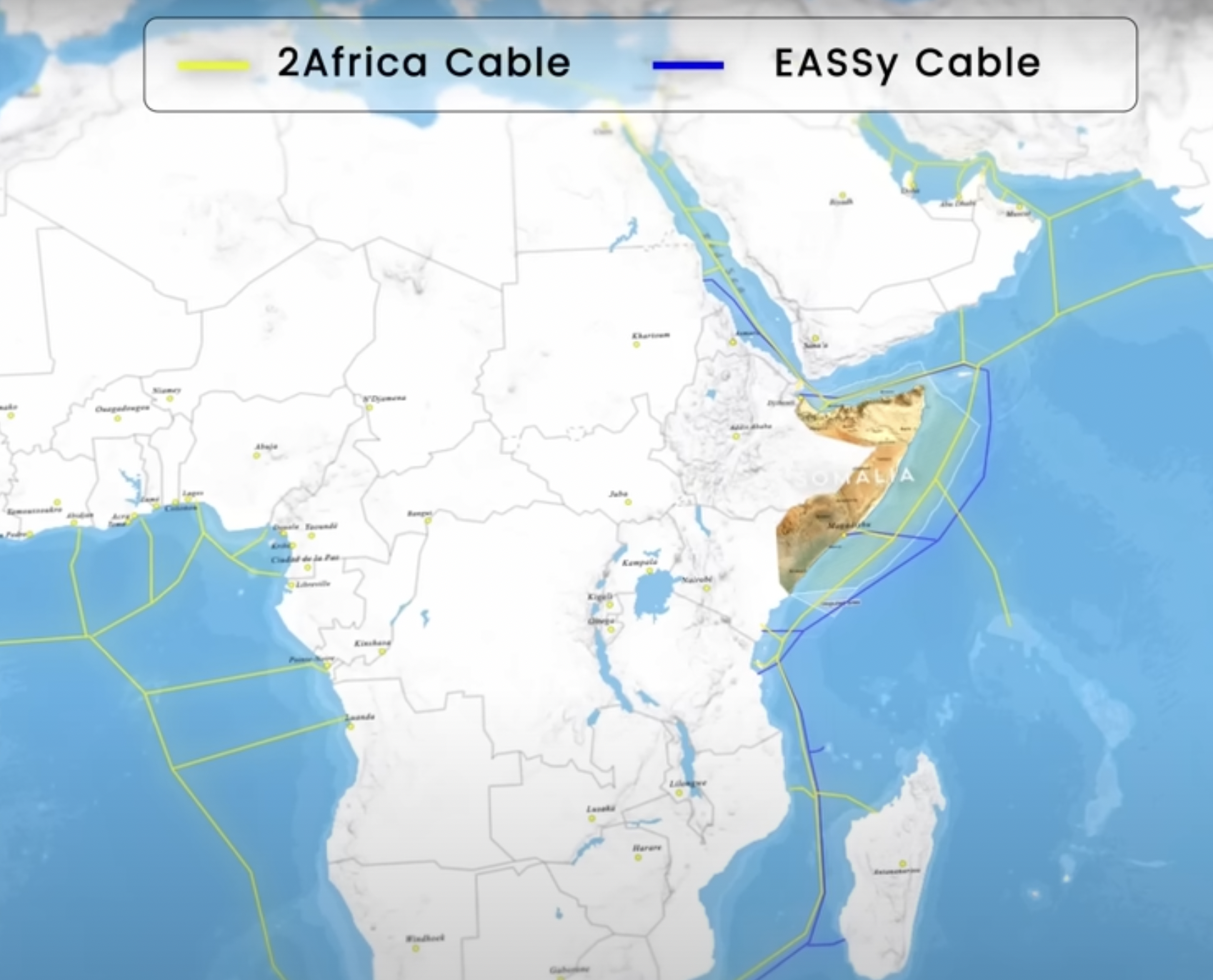
Source: Caspian Report
Bear in mind that Somalia will be producing oil in its own territory for the first time in history by late 2024. But these resources — some 30 billion barrels worth — will take time to exploit. While international oil majors have been vying for Somalian oil for decades now, the development of these resources had stalled due to the overwhelmingly complex security situation in the country since 1991.
This runs parallel to the increase in tensions with de-facto independent Somaliland, which had leased Ethiopia a 20km strip of land for official recognition and control over the port of Berbera. The development of the Port has been threatening Djibouti’s status, since Ethiopia has long been seeking to reduce its dependency on its port.
On the other side of the Horn, the Houthis claimed to successfully strike at Israeli targets in Haifa port on June 6. While the strikes’ veracity was disputed by the IDF, it comes just hours before reports of US and UK airstrikes hitting targets in Yemen on Friday.
In an increasingly multipolar world, primary chokepoints of trade will continue to attract a wide spectrum of ambitious powers to its shores. How this will affect the increase in state-on-state tensions for the countries in the Horn, and whether it could escalate the already ongoing conflicts in Sudan and Yemen remains to be seen.
| HOLY WARS |
SATANIC DRUG GANGS: El Salvador’s president, Nayib Bukele, told Tucker Carlson that the MS-13 gang, which originally started out in California but spread to El Savador, was a Satanic organisation. “They started killing more people… but as the organization grew, they became Satanic. They started doing Satanic rituals…”. Both Tucker and President Bukele questioned why this fact wasn’t more widely reported in English-speaking media. Speaking more broadly on crime in El Salvador Bukele argued they had ‘won’ the war on crime in the country after winning a ‘spiritual war’ beforehand.
Demonic entities: Earlier that week Carlson told the Shawn Ryan show he believed UFOs were probably supernatural in nature.
