

| SNEAK PEEK |
— Authoritarian states are using a UN process to extinguish the internet’s borderless and free nature by transforming it at the root level into a fragmented patchwork of centrally governed protocols.
— An upcoming HBO documentary claims to know Satoshi’s identity, and Izzy knows who it is.
— Dario argues that it’s probably not worth getting too excited about any upcoming government-related UAP revelations.
Happy weekend everyone.
There’s another barrage of info coming our way. So here’s to what looks to be a revelatory week to come.
We begin with that old yarn: Who is or isn’t Satoshi Nakamoto?
You may or may not have seen my Politico piece billing the new HBO documentary that claims to reveal Satoshi’s identity. It’s out next Tuesday at 9 pm Eastern Time (middle of the night for us in Europe).
The piece and related coverage has now gone viral on Twitter, and even spawned a prediction market on Polymarket providing odds on who HBO will reveal. Here are the front runners as of Saturday morning:
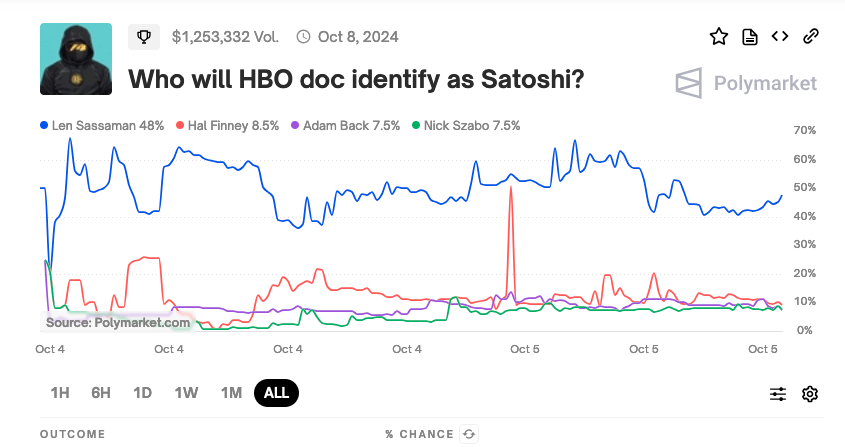
I can exclusively reveal to Blind Spot readers that while I have seen the documentary, and know exactly who they claim Satoshi is, I have been sworn to absolute secrecy. I intend to keep my lips sealed, so don’t bother asking (and or hacking me, as the info is not in my inbox).
What I will say is that, while I don’t think the reveal is an absolute slam dunk, it is very compelling.
Cullen Hoback, the filmmaker behind the documentary, is certainly convinced he’s got the right guy. And part of that conviction is related not just to what went down on screen but rather off screen too. Or so I am told.
For those not familiar with Hoback’s work, he is the guy who cracked the identity of Q in his “Into the Storm” documentary, pinning it all on Ron Watkins, the owner/administrator of the mischievous 8kun website.
Cullen and I crossed paths earlier this year because, it turns out, we were simultaneously looking into the same story — a relatively mysterious one at that, and not at all related to bitcoin. One day we might have enough info to share that story publicly. But I doubt it will be any time soon as it’s very weird and hard to corroborate.
Next week also stands to be the week we find out who really killed JFK, at least if journalist and investigator Jefferson Morley isn’t over hyping his latest findings. He posted on X that he would be publishing “a revelatory story that penetrates and disrupts the government’s 60-year old account of the assassination”. Back in 2022, Morley disclosed evidence of a covert CIA operation involving Lee Harvey Oswald that was still classified, explaining that the CIA had a much deeper involvement with Oswald than previously admitted, especially leading up to the assassination.
On our end, we have two big spotlights for you this week. The first went out yesterday and is a piece by Dario about dam diplomacy in the Blue Nile Delta. You’ll get the second one later this week.
For now, that’s all from us. As usual, this newsletter is brought to you by Izabella Kaminska and Dario Garcia Giner. Send tips to [email protected] or [email protected], or via our Haya link.
| THE BIG BLIND SPOT THIS WEEK |
THE INTERNET YOU KNOW AND LOVE IS DYING: In a significant but massively underreported development during the United Nations Summit of the Future in New York between September 20-23, the final text of the Global Digital Compact (GDC) was quietly agreed upon, marking a turning point for the internet we know and love.
Annexed to the broader ‘Pact for the Future’, the so-called GDC seeks to redefine digital international cooperation in a multilateral world and chop the internet up into different geopolitical segments, where the rules of engagement are centrally dictated, mostly by nation-states. As the new system, which is known as “New IP”, gets adopted, the internet may well turn into something entirely unrecognizable from what it is today.
In the worst case scenario, New IP could transform the internet from a global, open space into a series of tightly governed, nationalized digital ecosystems — much like capital controls or foreign exchange (FX) controls, but for the flow of information.
What’s the logic behind it? Key to the pact’s rationale is a bid to better emphasize human rights and international law in the structure of the internet, while creating certain data transfer efficiencies, such as being able to embed code into data packets so that it can be better executed by routers along the network. The problem is doing so ensures a free and open web will by nature have to be fragmented and more tightly controlled.
What’s the exact proposal? The GDC’s framework outlines a tripartite governance model that will transform the web from its current decentralized, expert-driven model into one where control is divided between governments, corporations, and civil society.
Activists and technologists fear this could usher in an era where national governments wield far more control over digital spaces.
Where did the idea for “New IP” come from? The proposal comes directly from China, and thus the CCP.
China’s view is that restructuring the internet’s core architecture to allow governments to create their own national networks with tighter regulation of content, user activity, and data flows should, in theory, allow more efficient and dynamic management of network traffic. This could potentially improve the performance of certain applications (e.g., real-time holographic communications or advanced IoT systems). This, however, contrasts sharply with the current, open model, which was built on protocols developed by the Internet Engineering Task Force (IETF), and which was designed to ensure global connectivity and freedom of information. New IP aims instead to create a state-regulated infrastructure that aligns with the country’s vision of cyber sovereignty.
Splintering effect: Critics warn that New IP will inevitably lead to a fractured “splinternet” where digital borders mirror geopolitical ones. One fintech expert told the Blind Spot the shift would allow governments — particularly authoritarian ones — to impose unprecedented control over the flow of information and tighten surveillance on their citizens.
What’s the debate? The GDC, while aimed at improving digital governance, is seen by many as a potential enabler of this fragmentation. Organizations like the Internet Corporation for Assigned Names and Numbers (ICANN), the Internet Engineering Task Force (IETF), and the Internet Society have all criticized New IP as a solution to problems that don’t need solving.
Goodbye anonymity! One of the most alarming aspects of New IP is the proposal for mandatory binding of user identities to their internet activities, which critics say would erode privacy and bolster government surveillance.
But there’s an even bigger agenda: China’s efforts to reshape internet standards comes through growing influence among international bodies like the International Telecommunication Union (ITU) and reflect a broader ambition to centralize control, while exporting its norms worldwide. The ITU, traditionally a technical organization focused on telecommunications, is now a battleground where China is pushing to redefine global internet protocols in a way that could favor state control. And sadly, almost nobody in the West is paying attention to the battle.
What’s at stake? Historically, the internet was borne out of decentralized and consensus-driven processes, with standards developed by technical experts rather than governments. But China and its allies, including Russia, Iran, and Saudi Arabia, want international organizations to set key standards in a way that gives states the opportunity to influence, if not outright control, digital spaces in ways hitherto unknown. Ultimately, this is a power struggle over who governs the internet and how.
As one fintech expert told us: “Authoritarian regimes see New IP and the GDC as opportunities to reinforce their control over digital spaces.”
The security argument: Security concerns have always been a double-edged sword in the debate over internet governance. We know the current internet, with its slow-to-evolve core protocols, is vulnerable to hacking, ransomware attacks, and denial of service attacks, which have been exploited by both rogue actors and authoritarian states.
Moreover, the slow adoption of essential updates like the transition from IPv4 to IPv6, which has taken two decades to address, reflects how challenging it is to implement change across a decentralized web. China’s New IP, by contrast, offers a fast track to such adoption. New standards or upgrades would no longer require consensus. They’d just be enforced from the top down.
If authoritarian regimes succeed in leveraging New IP and pushing for more nationalized networks, the internet’s original vision of a borderless, free space is likely to be lost. Instead, the digital universe will be confronted with the rise of digital Berlin walls, and culturally distinct pockets of the internet where entirely different norms are developed and tolerated.
As one expert told us, “without a concerted push from civil society and technologists, the free and open internet could soon be a thing of the past.”
The internet, once a tool for global connectivity and freedom, now faces the risk of becoming a patchwork of controlled, gated digital spaces, each with its own rules, restrictions, and authorities.
The coming years will determine whether the internet remains open or fractures under the weight of national control. It’s time to start paying attention to what’s going on.
| BUSINESS, ECON AND FINANCE |
CARTEL FRENZY: Linklaters analysis revealed this week that competition authorities in key jurisdictions around the world fined businesses a total of €7.8 billion over the years 2021-2023, an increase on the previous three-year period, with €5.4 billion of fines imposed in 2018-2020.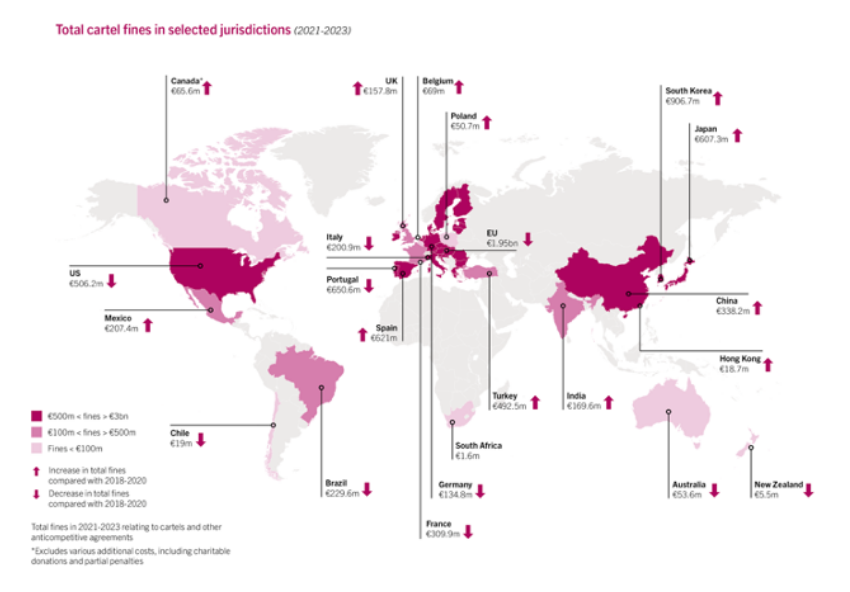
DARK CANADIAN FINANCE: The SEC charged Canada’s TD Securities $15.5 million for manipulating the U.S. Treasury cash securities market through spoofing, an illegal trading strategy. According to the charges, a former TD Securities trader placed non-bona fide orders — orders they had no intention of executing, to manipulate prices in their favor for over a year.
What’s the Blind Spot? The rap sheet against TD Bank is getting pretty extensive, and it’s worth considering how this sort of behavior has been tolerated by regulators for so long. Indeed, what sort of bank is it really?
A very bad bank indeed: To list but a few infractions… TD Bank and its securities arm, TD Securities, have over the past year been embroiled in accusations, such as:
— Spoofing in the U.S. Treasuries market;
— Money laundering, notably linked to Chinese crime groups and illicit fentanyl sales, which could subject the bank to fines of up to $4 billion, especially if broader investigations deliver.
— Penalties for failing to report suspicious transactions (the bank was hit with a $9.2 million penalty for failing to report suspicious transactions, indicative of broader oversight failures in their banking operations).
It’s also worth remembering the bank was implicated in the Allen Stanford affair, and was eventually forced to pay $1.2 billion worth of fines in 2023 related to its involvement. Stanford’s status as a CIA informer only adds to the intrigue about the bank.
| CBANKING |
CBDCs ‘R’ NOT FOR US: The Reserve Bank of Australia decided against going forward with retail CBDCs, opting instead to focus on wholesale applications instead. According to a joint report released with the Treasury on September 18, there is no compelling reason to issue a retail central bank digital currency (CBDC) in Australia at this time as the RBA believes Australians are well-served by the current payments system.
However, the RBA sees more potential in a wholesale CBDC, focusing its efforts on exploring how tokenization and new settlement infrastructure could enhance Australia’s wholesale markets.
MEANWHILE IN CANADA: According to Global Government Fintech, the Canadian central bank updated a ‘digital dollar’ page on its website last week to state that after years of significant research and technical explorations this work was now “completed” and that “with other payments issues gaining prominence”, the Bank would be “shifting its focus to broader payments system research and policy development”.
| HAL 9000 |
AI INVESTMENT IN THE U.K.: Blackstone, the world’s largest asset manager, will spend £10 billion on an AI data center in Blyth, U.K. The company’s data center pipeline is currently valued at $70 billion, in addition to existing assets worth $55 billion. The UK government designated data centers as critical national infrastructure, which allows operators to receive greater government support during emergencies.
AI DEALS: OpenAI, meanwhile, secured $6.6 billion in funding, reaching a valuation of $157 billion. This makes it one of the top three venture-backed startups globally, alongside SpaceX and ByteDance. Microsoft significantly contributed with a $750 million investment, adding to its previous $13 billion
What’s the Blind Spot? Interestingly, despite Apple’s partnership with OpenAI for ChatGPT integration, they chose not to invest in this round, even after prior talks This massive funding highlights OpenAI’s shift from a nonprofit to a for-profit model, a move causing internal tensions and leading to several high-profile exits, including co-founder Ilya Sutskever and CTO Mira Murati.
Why the investment rush? Eric Schmidt told a panel that energy demand for AI was infinite and we are never going to meet our climate goals anyway, so we may as well bet on building AI to solve the problem.
| CHIP WARS |
FLOATING CHIPS: Cerebras, the American semiconductor chip design company, has filed for an IPO and revealed it views Nvidia, AMD, Intel, Microsoft, and Google as key competitors. The filing also revealed the company experienced a major revenue surge in the last year.
What’s the blind spot? The docs also reveal that 83 percent of the company’s total annual revenue came from AI tech group G42, which is partly owned by Abu Dhabi’s sovereign investor Mubadala.
CHINA STILL LAGGING BEHIND: Taiwan’s National Science and Technology Council (NSTC) Minister Wu Cheng-wen, said Taiwan still has a significant lead over China in advanced semiconductor manufacturing of at least a decade. This contradicts a report from the Chinese version of Nikkei Asia, which claimed Taiwan’s lead was only three years. TSMC is already producing 2-nanometer chips, with mass production slated for next year. In contrast, China’s Ministry of Industry and Information Technology announced the development of a system capable of producing 8-nanometer chips, while Shanghai Micro Electronics Equipment Co might achieve 9-nanometer production.
| PERESTROIKA 2.0 |
IT’S OKAY WHEN WE DO IT: Tony Blair, in an interview for POLITICO’s Power Play podcast with Anne McElvoy, suggested that UK Chancellor Rachel Reeves should abandon fiscal rule targets to engage directly in tech investment.
When asked if “you might need to bend some rules that are being set in order to invest more”, Blair responded: “Yeah, I think it’s absolutely essential. We invest and, actually, my Institute’s putting out a paper showing how you would change the fiscal rules to allow you to better to invest in the future.”
He added there was no doubt such investments would yield a significant benefit. “How big? I think over the years, really big,” he said.
The comments, however, contradict the current Labour government’s emphasis on fiscal responsibility and the importance of having budgets rubberstamped by the Office for Budget Responsibility. They also clash with the notion that the markets knew what they were doing when they ejected Liz Truss from power.
Once you go there… That thinking echoes a broader narrative that’s now coming to the fore, focused on the idea that “spending to invest in growth” is fine, providing the investments are state-directed.
Take as an example a recent Financial Times piece by Gus O’Donnell, former permanent secretary to the Treasury, in which he advocates for increased public investment financed through borrowing. By redefining debt to encompass assets acquired through such investments and adopting a longer-term capital plan, O’Donnell claims the U.K. can increase spending without jeopardizing its fiscal stability.
All this, however, represents a marked departure from the narrative that emerged after the LDI scandal and the subsequent criticism leveled at Liz Truss.
The contradiction lies in the inconsistent application of fiscal responsibility. Unfunded tax cuts are presented as inherently reckless, while unfunded spending on sectors deemed strategically important by policymakers is framed as necessary and even beneficial for growth.
It’s all academic: The above ignores the inherent subjectivity about what is more likely to generate growth. There is, after all, no guarantee that state-directed investments will be better simulators than consumers exercising their preferences in the market. Economists remain entirely divided on the matter.
IZZY COMMENT: Making this a debate about the flavor of investment, rather than the scale of unfunded spending is a deflection from an uncomfortable and awkward memory. Truss, ultimately, wasn’t deposed because markets weren’t keen on tax cuts. She was deposed — at least according to the official narrative — because markets were not prepared to fund further U.K. government borrowing irrespective of very vocal commitments to pursuing “go for growth” investments and policies. This, however, has become an inconvenient truth, which must be memory-holed as quickly as possible.
EUROPE MIGHT DIE: France’s President Emmanuel Macron reiterated his warning that the European Union could “die” unless it makes itself more competitive, in a sign he backs Mario Draghi’s assessment of what ails the trading bloc.
What’s the issue? Macron argues that the current global landscape, increasingly dominated by the U.S. and China, threatens the EU’s position. He suggests these larger trade blocs prioritize their own economies, often disregarding international rules, which puts the EU at a disadvantage.
He went on to criticize the EU’s tendency to overregulate its single market while underinvesting and hindering its competitiveness. Again, another alignment with what Draghi has himself concluded.
| MeDIA MaTTERS |
ASSANGE SPOKE PUBLICLY FOR FIRST TIME: Julian Assange addressed Strasbourg’s Council of Europe on the subject of his prosecution and its implications for journalism last week. The testimony didn’t get much airplay in the mainstream press, but you can watch the full conference here.
“Guilty of journalism”: During his testimony, Assange emphasized that he had been prosecuted not for illegal actions, but for operating as a regular journalist, a profession he argued should be protected from state recrimination as a core democratic right.
Assange also highlighted what he described as the chilling effect his case has had on journalism more broadly, noting that the U.S. had set a precedent that could deter other journalists from investigating and exposing sensitive information.
Extraterritoriality: According to Assange, the threat of transnational repression — where governments target individuals beyond their borders — will further weaken the ability of journalists to hold powerful states accountable.
In response, Assange argued “national security journalism” should step up to expose government actions that would otherwise be hidden from public scrutiny. Assange believes that governments should not be able to hide behind national security classifications to prevent scrutiny of their misconduct, nor should they have extraterritorial powers over those who criticize them from afar.
What’s the blind spot? There’s an irony in that Assange’s critique of the U.S. in many ways echoes Western concerns about China’s national security overreach, particularly its extraterritorial application of the Hong Kong National Security Law. Both the U.S. and China have been accused of using national security as a means to suppress dissent and target individuals beyond their borders. The parallels between Assange’s case and concerns about China’s extraterritorial reach highlight a broader global trend of powerful states using national security to limit free expression and control critical narratives.
“The US government asserted a dangerous, dangerous new global legal position: only US citizens have free speech rights,” Assange told the audience. “Europeans and other nationalities do not have free speech rights, but the US claims its Espionage Act still applies to them, regardless of where they are… Now that one foreign government has formally asserted that Europeans have no free speech rights, a dangerous precedent has been set. Other powerful states will inevitably follow suit.”
Does any of this matter? The reaction of power players and journalists in Brussels to the testimony was a resounding “meh” . Whether that’s because the Parliamentary Assembly of the Council of Europe (PACE) is a politically limited organization and largely “toothless” in terms of real policy influence, or because the chilling effect is already doing its work is harder to determine.
Something to ponder: The Assange side takes every opportunity to emphasize that the CIA — under the influence of Mike Pompeo — operated illegally when it attempted to kidnap Assange from the Ecuadorian and assassinate him. But there’s an awkward and unaddressed irony to the whole thing. It’s precisely because Assange’s life was considered to be in danger in the U.S. that he could argue that his extradition was against the Human Rights Act.
| SPOOKY |
SKRIPALS WILL SKIP INQUIRY: The targets of the Salisbury poisonings, Sergei and Yulia Skripal, will not provide evidence at a public inquiry that is to take place on October 14 for fear of another attack by Russian spies.
The judge presiding over the inquiry, Lord Hughes of Ombersley, ruled that it was too risky for the Skripals, currently living under police protection, to appear.
Hacking threat: The inquiry has been delayed due to concerns that Russian spies might hack the court’s IT system and access sensitive information. Government lawyers warned Lord Hughes that Russian hackers could create a hit list of MI5 and MI6 officers, as well as counter-terrorism detectives. The public inquiry is scheduled to take place in Salisbury before moving to London.
What’s the blind spot? Some (albeit Russo-friendly) source think the reason they won’t be appearing is more probably because they are dead.
ANOTHER DUAL USE CORPORATE GOES DOWN: IronNet, a cybersecurity firm founded by former NSA director Keith Alexander, shut down in September 2023 after failing to secure major contracts and meet revenue projections. The company had promised to revolutionize cyber defense, but despite initial success and a valuation of over $3 billion, the company’s products were continuously considered to be subpar and overhyped, says the Associated Press. The company’s association with Andre Pienaar, whose ties to sanctioned Russian oligarch Viktor Vekselberg also raised concerns among former intelligence officials, also drew scrutiny.
What’s the blind spot? The firm also collapsed in part because it had engaged in questionable business practices and entered into associations that could have left the firm vulnerable to meddling by the Kremlin, the AP said.
“I’m honestly ashamed that I was ever an executive at that company,” said Mark Berly, a former IronNet vice president. He said the company’s top leaders cultivated a culture of deceit “just like Theranos.”
| HOly wARS |
HOLY SMOKES: Pope Francis cautioned in an X post that the secularised world was teeming with “magicians, occultism, spiritism, astrologers and satanic sects”. The Pope suggests that even if one successfully rejects the devil, represented by these practices, he might try to re-enter one’s life through the more subtle gateway of superstition.
| X FILES |
MORE UAP WHISTLEBLOWING: The Blind Spot understands news may soon break that another government whistleblower is briefing congress about a secret UFO program that is violating oversight laws. Possibly as soon as Monday.
DARIO COMMENT: But is it even news? The Blind Spot has been following developments relating to the US Congress’ efforts at getting transparency over the US Government’s involvement in so-called UAP or UFOs for the last few years. Regrettably, the field is increasingly proving its inability to move beyond the first post. A case in point may be the revelations above. Yes, it’s likely to be “news-y” that a whistleblower has found the Pentagon had started yet another UAP program and that it failed to disclose its existence to Congress. But it’s also the case the Pentagon’s current program to investigate UAP’s (AARO) may simply be a PR exercise designed to misdirect inquiries into the phenomenon.
So what’s the problem then? The issue is that such revelations are hardly different in substance from those famously brought by the New York Times in 2017, with the revelation that the Pentagon had funded a program called AATIP from 2007 to 2012. Furthermore, while the term ARV first became known after the infamous “Wilson-Davis” memo, we spent all of 2023’s summer poring over Dave Grusch’s testimony — which almost exclusively focused on these reverse engineering claims.
And it gets worse when you start looking at history. Every other decade, there are such whistleblowers, some more dubious than others, which crop up alongside obscure government documents that get leaked alluding to mysterious occurrences the Pentagon is involved in or studying. It happened in the 40s, the 60s, the 80s, the early 2000s, and now. Every time, the nature of the disclosures hardly vary in theme: “There are weird things out there and the government knows!” — or substance — “I pinky promise what I’m saying is true”. And sadly, we’re not any closer to the truth.
Towards a true UAP study: In order to truly grapple with the consequence that we may not be alone, our media must step outside of its comfort zone and stop going after the low-hanging fruit of US government involvement. If we truly aren’t alone, a government’s involvement is arguably the least interesting part of the equation, and the least urgent to solve. But, unfortunately for the truth, it’s the easiest trail to follow by promising factual evidence. Such reliance on so-called ‘facts’ or evidence means this trail is also the easiest to manipulate. That’s why every other decade’s governmental openness about UAP typically claims three to four scalps of heretofore respectable journalists, led down a dead end by whistleblowers and pieces of paper due to their obsession with being foolproof and factual.
On the other hand, knowledge and evidence of the true ‘Phenomenon’ is incredibly hard to come by and analyze, and require a hardened counter-intelligence mind to distill — as we wrote about in 2022. To my knowledge, there is only one voice who has ever managed to do so — the brilliant Jacques Vallee — and his ground-breaking books of the 60s and 70s, particularly Messengers of Deception. But delving into this topic means accepting we know very little (and perhaps can’t know) of our potential overlords. That the only groundbreaking books were written almost half a century ago makes this clear. Unfortunately, prioritizing the mysterious is a step too far in a society that feels uncomfortable admitting our ignorance of anything at all.
