

Damned dams: Why Egypt’s alliance with Somalia is underpinned by dam diplomacy
By Dario Garcia Giner
KEY POINTS:
— Ethiopia’s construction of the Grand Ethiopian Renaissance Dam (GERD) on the Blue Nile has escalated tensions with Egypt, which fears the dam could threaten its crucial water supply, leading to military alliances and proxy conflict in the region.
— A conflict could destabilize the Horn of Africa, a key trade region, drawing in global and regional powers like Turkey and the UAE, while setting the stage for a wider geopolitical struggle reminiscent of pre-World War I dynamics.
— The dam dispute could also severely impact the Nile’s water flow, threatening not just Egypt’s agricultural and economic stability, but also global food security, given Egypt’s role as a major grain importer and the region’s dependence on Nile-based agriculture.
Why Ethopia’s energy solution is Egypt’s problem
The year 2011 saw the beginning of Ethiopia’s construction of the Grand Ethiopian Renaissance Dam or GERD on the Blue Nile tributary.
But this is no ordinary dam. Projected to be the largest hydroelectric plant in Africa and among the 20 largest in the world, the Ethiopian government hopes the dam will be the answer to meet its ever-growing energy demands and maintain its explosive growth in GDP per capita. But being just upstream of the Egyptian Nile, and contributing almost 85 percent of the Nile’s water, it has sent Egypt into a water security tailspin. Every Egyptian, from the taxi driver to the waiter to the hotel staff member, will find a reason to inform tourists as to the urgency of this issue.
And, taking place in the contested Horn of Africa, this upcoming conflict has no shortage of vying geopolitical interests. But unlike previous flareups in the Horn, which were resolved relatively rapidly with one exception (the Somalian jihadist insurgency), this time the great powers — China and the United States — are focused elsewhere. Rather than global policemen seeking peace in their areas of influence, this conflict in the Horn includes several burgeoning, meddling regional players like the UAE and Turkey. This increases the chances of a proxy conflict becoming a regional, and international, intractable conflict.
However, Ethiopia is sticking to its guns: the GERD won’t be a big deal, Ethiopia told the world. It even claims the dam won’t have a negative impact on the downstream water flows of the Nile river. On the contrary, they say it will increase water flows to Egypt through a reduction of evaporation in Lake Nasser.
It’s a legal matter
Egypt begs to differ. For one thing, Egyptian history of nationhood has long centered around its most defining geographical feature: The Nile River, which receives over 85 percent of its water from the Blue Nile tributary set to be dammed by the GERD. Egypt’s history of preoccupation with its water supply led the Egyptian nation to sign the Nile Waters Agreement with the nascent country of Sudan in 1959. This added on to other Nile Waters Agreements between Egypt and the colonial-era Anglo-Ethiopian agreements that restricted Ethiopia’s capacity to develop its Blue Nile waters. Unfortunately for Egypt, Ethiopia claims its national sovereignty supersedes these colonial-era agreements.
Whether Ethiopia is party to these agreements or not is just one of the many international legal battles being waged over the dam. In short, Egypt uses the previous Nile Waters Agreements to argue it holds a legal right over development upstream from the Nile River. Contrariwise, Ethiopia argues that the Blue Nile is in its sovereign territory and that Egypt cannot exert a monopoly on the world’s longest river — one it was more than happy to terraform through the Aswan Dam in 1960.
The issue becomes even more complicated when we look at international law. Egypt and Sudan claim that, according to Article 3 of the UN Convention on Biological Diversity, Ethiopia has an obligation to ensure acts within its jurisdiction don’t damage the environments of nearby states. Conversely, Ethiopia claims this conflicts with its own obligation to ensure adequate living standards for its citizens based on Article 11 of the International Covenant on Economic, Social and Cultural Rights. And this is only a tiny snippet of the myriad of conflicting conventions and international regulations being used in escalating lawfare between Egypt and Ethiopia at the UN. It is also the tail-end of more than 12 years of failed negotiations between the two countries, despite the intervention of the UN, the African Union, and the mediation of other regional powers like Turkey.
How a proxy war may pose a greater risk (see 1914)
And now Egypt is taking matters into its own, military, hands. Egypt’s new alliance with Mogadishu would see Egypt send an additional 5,000 troops over the 5,000 it has already committed as part of the African Union-led Support and Stabilisation Mission in Somalia. It has also sent C-130 military planes chock-full of weapons and ammunition, providing Somalia with the first military aid in over four decades.
This prompted a stern rebuke from Ethiopia, which claimed Egypt was attempting to “destabilize the region”. But Egypt is not alone in carrying out escalatory moves. Ethiopia’s search for a sea port means its land-lease agreement with Somalia’s breakaway region of Somaliland in exchange for official recognition last year provoked the greatest heightening of tensions between Somaliland and their former federal masters in decades.
Naturally, Egypt and Ethiopia are not alone in this conflict. Somaliland’s development of the Berbera Port (with UAE funds) for Ethiopian exports means Djibouti’s own port would lose a much-needed source of funds. As a result, both Somali and Djiboutian funds, weapons and ammunition are finding their way into the hands of pro-Somali and anti-Somaliland militiamen in the regions of Puntland and Jubaland as they continue to destabilize the small African statelet.
Turkey also sees the crisis as the perfect opportunity to gain military and diplomatic influence in Africa’s key trade choke point. This explains Turkey’s energy and military agreements recently minted with Somalia in 2024, providing hydrocarbon platforms, expertise, and naval instructors and assets. Presumably, the greater the crisis, the more chances afforded for Turkey to edge its influence into the region.
Thus, Egypt’s alliance and offer of military support to Somalia only means one thing for Ethiopia: the escalation of conflict against its Somaliland ally, and the threat to its hopes of a seaport. But, for the rest of the world, it means heightening the risk of war in the Horn — perhaps irreversibly.
But let’s not get ahead of ourselves. Egypt and Ethiopia do not share a land border — they’re separated by over 800 kilometres of vast Sudanese territory.
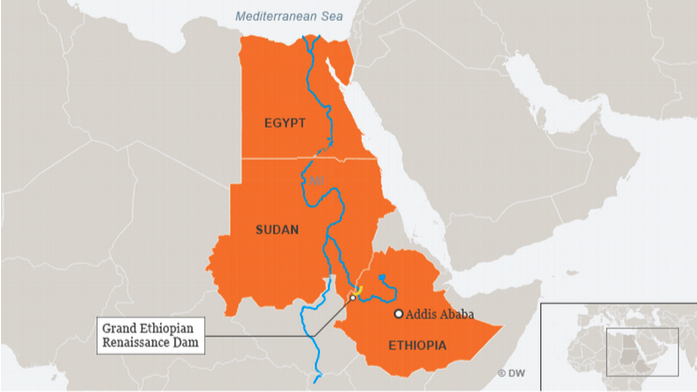
Even if both countries wanted a land war, it’s difficult to see how it could be carried out. Ethiopia is still landlocked, making any sea incursion unviable, and aerial attacks would have to cross the airspace of neutral countries.
The critical issue here is, thus, not an open war between Ethiopia and Egypt. Rather, it is the creation of a regional proxy conflict that may prove intractable due to today’s geopolitical climate.
Other conflicts, like the Ogaden war of the 1970s in Somalia or the Eritrean Independence War against Ethiopia, were resolved relatively rapidly through the intervention of Soviet and Eastern Bloc forces, for instance. But today, no great power lays claim to a sphere of influence in the region. If Sudan’s conflict is anything to go by, the United States, for example, simply wants to wash its hands of the region. Spades of Western media pieces showcased how American apathy towards Sudan’s internal conflict played a key role in escalating the row between two competing generals into a full-fledged civil war.
So the Horn today doesn’t align with a single sphere of influence. Rather, it lays at the intersection of several middling countries’ relatively weak and competing influences. This is exactly the situation that could birth an international proxy war that may prove entirely intractable, putting the world’s largest waterway in the Horn at further risk of blockage.
Facilitating the hardening of trade between East and West, and furthering a respective untangling of mutual commercial interests, the region is quickly resembling the Balkans of 1914 — a seemingly secondary conflict furthered by secondary actors but with consequences of the first order.

One Response