

| SNEAK PEEK |
— How Israel’s 15-month war and Assad’s toppling are reshaping the Middle East.
— Historic parallels underscore the latest UFO whistleblower claims.
Dear subscribers,
As the world’s geopolitical tectonic plates shift beneath our feet before the impending inauguration of President Donald Trump, I (Dario) have gathered sufficient leverage over The Blind Spot’s editorial room to launch an independent quickfire geopolitics (and exopolitics) newsletter.
We promise to include 0 references to Poland. We may also teach you a thing or two about Zoomer lingo. Exciting times ahead.
Izzy’s conventional Blind Spot missive follows on Monday.
Without further ado:
| THE BIG GEOPOLITICS BLIND SPOT |
A NEW MIDDLE EAST
LEBANON USHERS IN NEW PM: In a blow to Hezbollah’s tenure over the fractured Levantine state, Nawaf Salam, previous Lebanese Ambassador to the UN and currently the head of the ICJ in The Hague, has been elected Prime Minister under the country’s new President, Joseph Aoun.
That the historically fractious Lebanese Parliament (85 members out of 128) voted for a candidate not backed by Hezbollah marks a crucial first step toward reducing Hezbollah and Iran’s influence in Lebanon.
This is especially significant as Lebanon has struggled to make major political decisions without Hezbollah’s backing for decades. The Lebanese internet — particularly among the Blind Spot’s Christian Lebanese friends — is understandably thrilled at the prospect.
COMMENT: Geopolitics – much like economics – follows the principles of supply and demand.
The past 15 months of Israeli military actions against Lebanon, Syria and Gaza have fuelled anti-Israeli sentiment in the region.
This means that while Assad’s collapse and the eradication of Hezbollah’s leadership have weakened Iran’s influence in the Levant, Tehran has redirected its in-demand efforts to Jordan. This may be Jordan’s death knell, but it could be fantastic news for Lebanon.
This shift in Iran’s supply routes and proxies is evident on the ground. Reports from the Palestinian Authority, cited by Israeli media, revealed Iran-supplied rocket-propelled grenades, claymores and other heavy weaponry. These were found in seized arms caches in the insurgent hideouts of Jenin’s refugee camp.
A glance at a map clarifies Iran’s strategy:
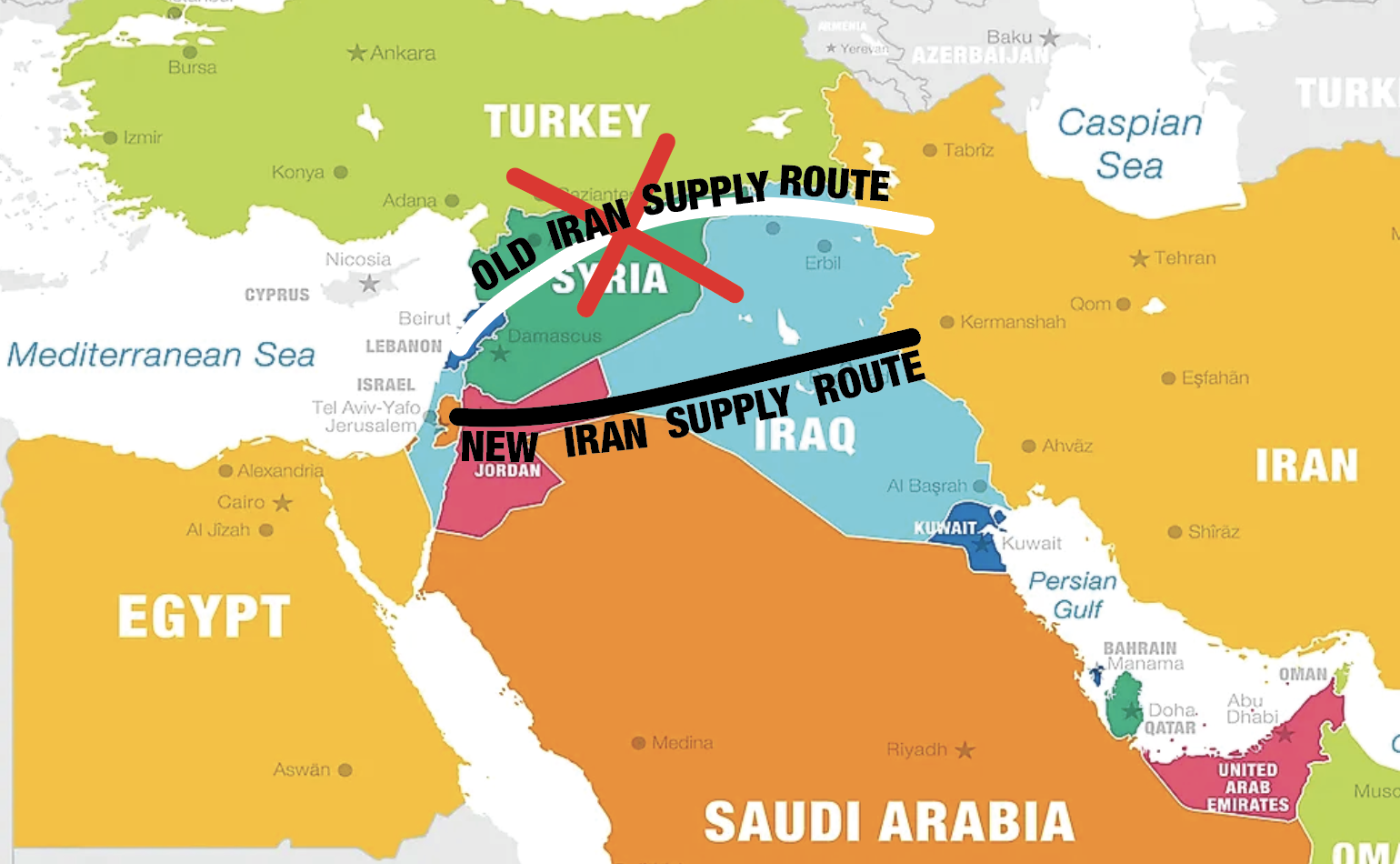
Tehran’s new supply route can still transit through relatively friendly territory. Part of Iraq’s Shia minority is still aligned with Iran – particularly after the Persians went toe-to-toe with Israel during this last year.
WHAT’S THE BLIND SPOT? Israel’s focus will likely shift towards the West Bank after the Gaza ceasefire, collaborating with the Palestinian Authority to put down the jihadist buildup in Jenin. Groups like the Palestinian Islamic Jihad, however, will be bolstered by increased Iranian weapons smuggled through Jordan. But the major blindspot is the weakness of Jordan’s monarchy and the likelihood of a Lebanese renaissance.
Lebanon’s conflict with Israel, and subsequent civil war, only started after militants from the Palestinian Black September movement clashed with Jordan’s King Hussein in 1970, nearly toppling this key Western ally. The monarchy was only saved by expelling the movement, and most Palestinian refugees, to southern Lebanon with the aid of Hafez al-Assad, who sought to increase his leverage over Lebanon.
Jordan’s monarchy, like those of Qatar or Saudi Arabia, was selected by former colonial powers partly due to their lack of internal legitimacy, making them inherently unstable and dependent on Western powers. As we will see in the coming decades, it renders them incredibly vulnerable to grassroots campaigns.
In the decade ahead, the Levant’s only surviving monarchy may end up fighting the battle of its life.
On the other hand, Lebanon’s current financial crisis began in 2016 when Saudi Arabia pulled billions in aid and investment from Lebanon, throwing the country into Iran’s hands. A Lebanese renaissance may occur should Nawaf Salam’s Premiership convince the Gulf states they can sideline Iranian influence in Lebanon.
ChatGPT Zoomer Summary: Lowkey, Israel’s nonstop ops got the region big mad, so Iran’s just switched lanes to Jordan to keep supplying the vibes for the anti-Israeli grind, but fr fr, Jordan’s monarchy is looking sus AF — big yikes for stability.
ISRAEL REBUFFS TURKEY’S DEMANDS TO WITHDRAW FROM SYRIA: After Turkish President Recep Tayyip Erdogan demanded that Israel withdraw its forces from Syria, Israel’s Foreign Ministry responded by calling Turkey the “aggressive imperialist actor in Syria (and in northern Cyprus, Libya, and other areas in the Middle East)”. These comments highlight yet another significant deterioration in Israel-Turkish relations.
COMMENT: Turkey’s growing influence in Syria, and Israel’s invasion, threatens to collapse relations between the two regional powers. But it also underlines the geopolitical quagmire that Israel’s military adventurism has plunged the Jewish state into. It also casts a pall on any notion of normalisation between Israel and the Middle East, collapsing Israel’s branding as the Mediterranean’s Silicon Valley.
Nothing is riskier in geopolitical terms than having a powerful and assertive neighbor. As the last decade has made obvious, Turkey and Israel have consistently been the two most powerful and assertive regimes in the area (besides Iran.)
Turkish influence has been quietly spreading throughout the Middle East and Africa. The vast majority of Turkish FDI in Africa, which grew from $100 million in 2003 to $6.5 billion in 2021, went to North-Eastern Africa and the Horn.
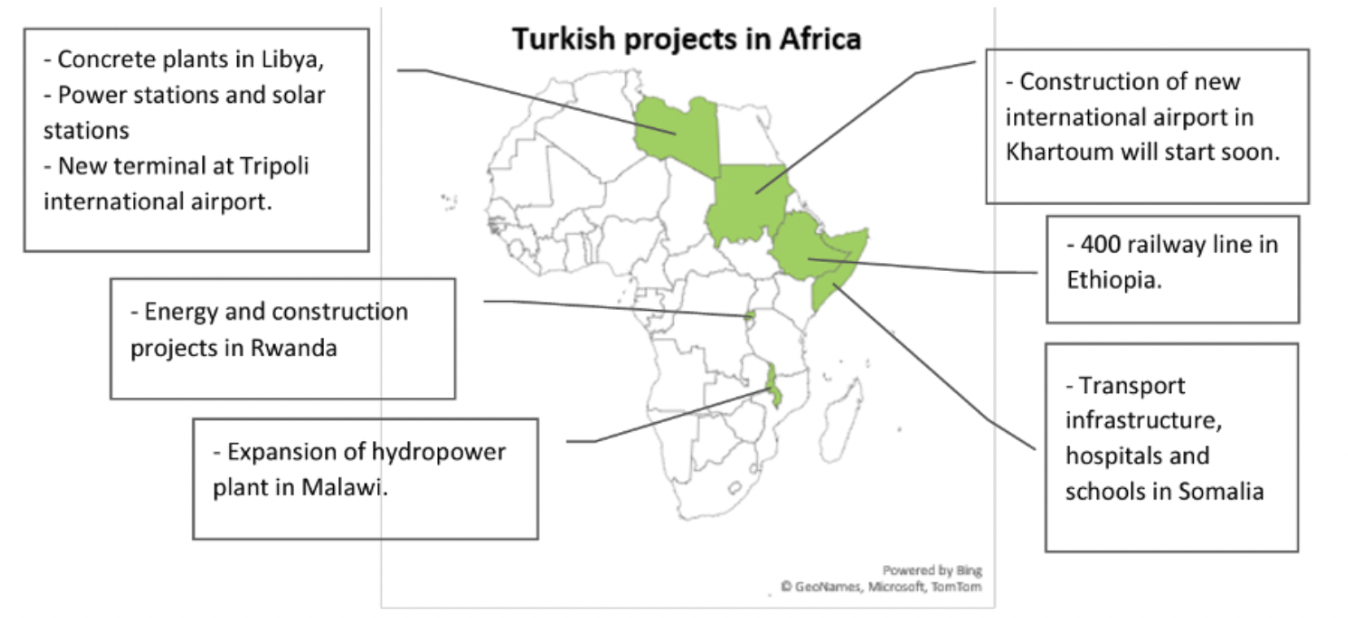
(Source: CBE)
This places Turkey in direct competition with Israel’s influence in the Horn of Africa and Libya, both seen as critical to Israeli security.
Their new status as next-door neighbors in Syria, without their common Iranian foe, opens the door to a tense Turko-Israeli cold war.
WHAT’S THE BLIND SPOT? It’s not just a question of being troublesome neighbors.
Let’s pull out another map to underscore why the downfall of Bashar al-Assad’s regime has created brand new opportunities for Turkish enrichment that no longer include Israel:
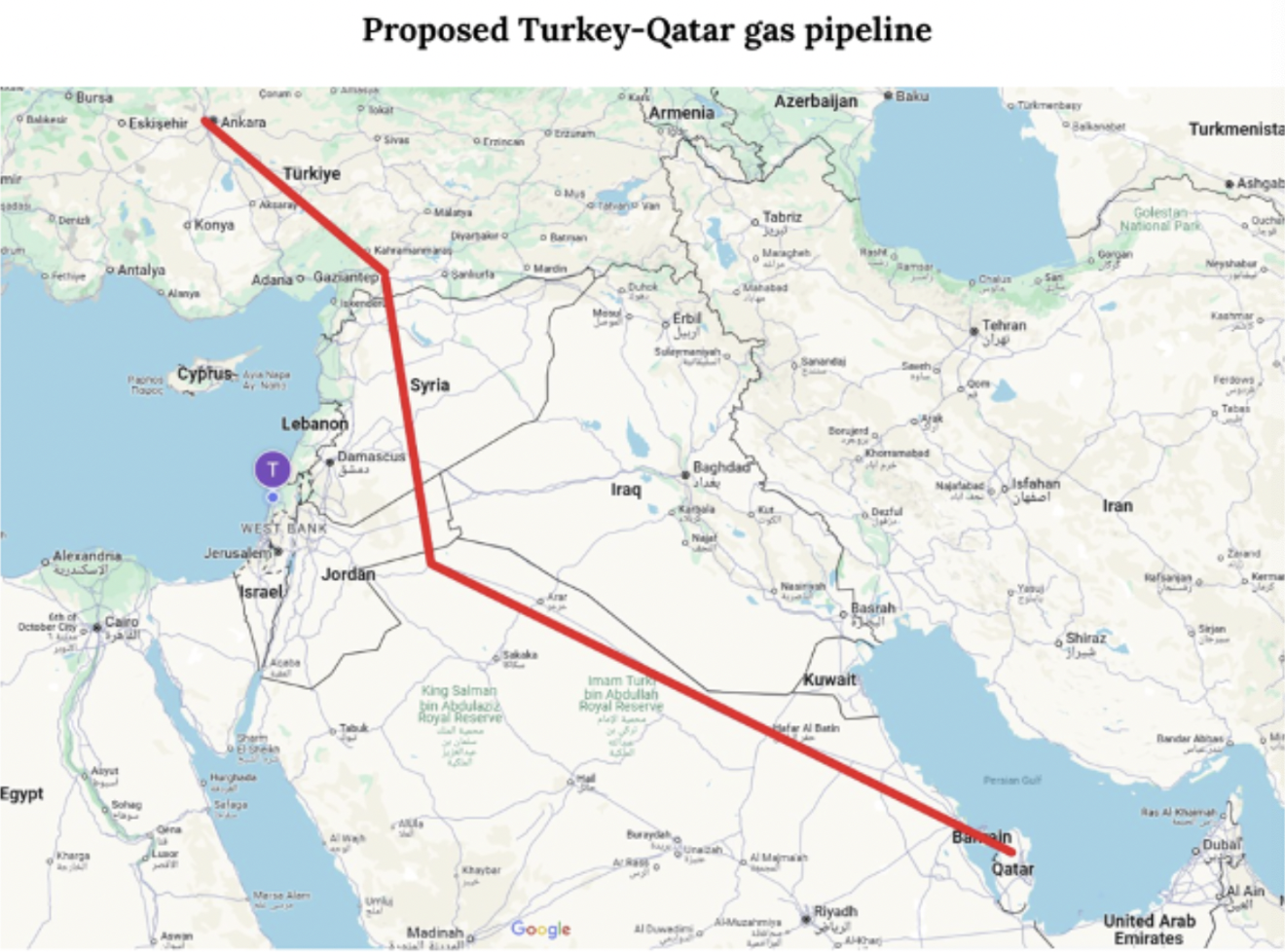 (Source: Begin-Sadat Centre for Strategic Studies)
As we’ve highlighted previously, Turkey and Israeli relations had been improving until Israel’s response to Hamas’ October 7 onslaught. This was primarily due to their common enmity with Iran and involvement in mutually beneficial gas deals.
But with Assad out of the way, the logistics route for Gulf gas to end up in European markets can save a lot of time by routing through Syria rather than Israel. That’s why the collapse of Assad’s regime has revived several Turkish-led infrastructure projects with Qatar and the Gulf states to route gas through central Syria.
This challenge for Israel is compounded by the collapse in support for the Jewish state around the world, and particularly in the Middle East, since its ferocious campaign in Gaza – which even the former Israeli Defence Minister Moshe Yalon described as ethnic cleansing.
Israel’s 15-month assault on Gaza, Syria and Lebanon risks undoing decades of careful diplomatic policy by former Israeli leaders who sought to patch up relations with Middle Eastern powers like Saudi Arabia and the Gulf States. Now, any normalization of relations with Israel for the Gulf countries would be strongly condemned by internal opposition, and may even open up challenges to their rule.
Thus, if this new Middle East sees increased tensions between two fearsome rivals, Israel and Turkey, it’s not difficult to see what partner the Gulf states and Saudi Arabia will prefer to vouch for.
If nothing else, supporting Turkey doesn’t put them at risk of being overthrown and executed by an increasingly anti-Israeli population.
Israel’s branding as the Middle East’s Silicon Valley relied heavily on its increasing partnerships with Gulf states and companies. But this vision is now in doubt. Particularly since Israel finds itself engulfed in military and political conflict, with permanent damage to relations with the neighbours it was so confidently courting.
ChatGPT Zoomer summary: Turkey and Israel are now beefing hard over Syria — Turkey’s chasing that gas bag with the Gulf states, while Israel’s fuming; lookin like a whole Turko-Israeli cold war might pop off, and lowkey, the Gulf’s gonna simp for Turkey to dodge their anti-Israeli mobs.
| SOME OTHER GEOPOLITICS BLIND SPOTS |
SUDAN’S ARMY BASHES THE RSF: The Sudanese military has breached RSF lines around the city of Wad-Madani, the last remaining pocket of RSF resistance in the critical Gezira province near Khartoum. Wad Madani is highly strategic since it stands at the crossroads of several key supply highways linking most states in central Sudan. This success could mark a turning point in the complex Sudanese civil war, which has been ongoing since 2023 with little Western coverage.
ARMENIA-AZERBAIJAN PEACE DEAL FAILS (AGAIN): As peace talks between the two embittered neighbors have faltered once more, escalating verbal rhetoric by Azeri President Ilham Aliyev underscores the risk of the region plunging into open war once more. Aliyev has used this failure in the peace process to highlight Azerbaijan’s desire to open the “Zangezur Corridor”, which would link the Azeri mainland to its Nakhchivan exclave, which is currently parted by Armenia’s resource-rich Syunik province.
DID STARMER RUSH CHAGOS DEAL TO HELP HIS MATE? Chagos islanders furious at the Labour government’s handover of the Chagos archipelago to the Mauritius are questioning whether Sir Keir Starmer is rushing the deal to benefit a lawyer friend of his. Philippe Sands KC, close to the Prime Minister for over 20 years, has acted as counsel to Mauritius since 2010. The Telegraph claimed this deal would mark a huge professional deal for Sands, even if Sir Keir has ditched attempts to get the deal signed before Trump takes office next week.
| THE BIG EXOPOLITICS BLIND SPOT |
NEW UAP WHISTLEBLOWER SAYS UFO RETRIEVAL PROGRAM EXISTS: NewsNation has unveiled a new purported UAP whistleblower, Jake Barber – a former U.S. Air Force veteran, who claims he was involved in the recovery of supposed ‘alien technology’ while working for a secretive American UFO retrieval program. Specifically, the whistleblower claimed he was tasked to retrieve what he described as an “egg-shaped” UFO.
While NewsNation claims that three “high-level military veterans” are backing up Barber’s claims on the record, the Pentagon’s All-Domain Anomaly Resolution Office (AARO) told NewsNation that while it’s aware of his claim, “(AARO) has not discovered any verifiable information to substantiate claims that any programs regarding the possession or reverse-engineering of extraterrestrial materials have existed in the past or exist currently.”
Despite the Pentagon’s rebuff, events over the past two years force us to seriously analyse these claims. Particularly because the Attorney General of the Intelligence Community branded former American military intelligence officer Dave Grusch’s claims last year regarding the existence of similar programs to be “urgent and credible”.
COMMENT: ‘Egg-shaped’ UFOs aren’t commonly featured in mainstream accounts of this phenomenon. Historically, UFOs have been primarily observed as flying saucers or more recently, as ‘tic-tac’ shaped objects.
But that doesn’t reflect the historical record. The Blind Spot found an interesting line of research which shows that NASA’s Bureau of Oceanographic Studies and the U.S. State Department took an interest in a UFO that locals described as “egg-shaped” and about “four meters in diameter” which crashed into a Bolivian hillside in May, 1978 according to an unclassified telegram (Department of State Telegram, La Paz 03804 “Report of Fallen Space Object”). This crash took place amidst an ongoing UFO ‘wave’ in the region.
Bob Pratt, the National Inquirer’s UFO expert flew over the suspected crash site and identified signs of a recent landslide where rocks showed signs of searing – though he identified no debris or objects. Cables from the Bolivians to the US State Department and NASA described findings from an expedition on the 25th of May by Bolivian military officials, which found signs of a recent landslide and apparent searing and burn marks on large rocks nearby, but nothing else.
As you can imagine, the incident was strewn with contradictory reports from a plethora of involved parties. Despite most witnesses describing it as an “egg-shaped object”, some claimed it looked “cylindrical in shape with a flaming tail”. The police chief of nearby Tarija in Bolivia agreed with these other reports, saying that his officers “discovered the object and inspected it (…) a dull metallic cylinder twelve feet long with a few dents,” suggesting the part may have been debris from American or Soviet space operations. No information linking this debris with the known crash of a NASA or Soviet space operation has been made public since the incident.
More curiously still, Leonard Stringfield was a UFO researcher who was contacted by an Argentinian UFO investigator named Nicolas Ojeda. He claimed that the first group of investigators who reached the site had mysteriously vanished and that a “huge” C-130 had carried ‘something’ away from La Paz, Bolivia shortly after the crash. Stringfield then asked a CIA source known to him as “Bob Barry” about the flight. While Barry confirmed the flight did take place, the supposed agent only replied “no comment” when asked what was on it.
WHAT’S THE BLIND SPOT? Suspend disbelief for a moment and consider the possibility that the whistleblower’s claims are completely true. Consider that even if he recovered an egg-shaped UFO, and even if this egg-shaped UFO crashed from the sky — as the May 1978 incident in La Paz did — there is no reason to call it extraterrestrial or ‘alien’.
Occam’s razor suggests that even if this technology isn’t ultra-advanced American engineering, or even if it was built by exotic creatures somehow unknown to us, it is more likely of terrestrial origin.
If nothing else, because in the extreme case that mysterious powers-that-be did want us to look out to the sky for answers, it’s more likely to be happening right under our noses.
ChatGPT Zoomer summary: Bro said the gov got egg-shaped UFO drip, but fr might just be cap or lowkey human tech—either way, plot’s sus af.
Glory to Spain,
Dario
