| SNEAK PEEK |
— The doom loop is coming for the West and coordinated financial repression will be needed to deal with it.
— Why incoming Treasury Secretary Scott Bessent is eyeing the formation of a new liberal trading bloc and exotic securities to counter the worst of it.
— What the TikTok and RedNote dramas reveal about how governments really manage public opinion.
Dear subscribers,
Happy inauguration day and/or commiserations.
Today I bring you news that the Blind Spot’s in-house geopolitics expert, Dario, has decided to break free and forge his own newsletter, which you will have received over the weekend. Since the length of the main newsletter was getting out of hand, we’re going to give this division of labor a shot and see how it goes. So expect two separate (and shorter) send-outs from now on, one focused on geopolitics and the other on finance and economy.
Without further ado, keep scrolling for my latest thinking.
Izzy
Send tips to [email protected] or [email protected], or anonymously via our Haya link.
| THE BIG BLIND SPOT VIEW THIS WEEK |
THE DOOM LOOP COMETH: As the Western world’s most powerful leaders gather in Davos this week for the annual World Economic Forum, they may have other things on their minds than the imminent inauguration of Donald Trump. Those reading the markets carefully may instead be fretting over an uncomfortable economic reality wilfully ignored for too long.
We’re talking about something called the “doom loop”: a relentless cycle of mounting debt, rising borrowing costs, and stagnant growth, which, once triggered, ensnares economies in a downward spiral toward bankruptcy. Eventually, escape becomes nearly impossible without external intervention or drastic recapitalization.
It is that doom loop that now threatens to destabilize not just single European economies, but potentially the entire U.S.-led system.
For years, policymakers downplayed the risks, framing fiscal struggles as isolated national challenges that could be solved with disciplined budgets or targeted reforms. Such narratives provided a veneer of control. But today, as bond markets grow impatient and cracks widen in fiscal frameworks, these comforting stories are unraveling.
France, for instance, is grappling with a deficit that reached 6.2 percent of GDP last year. While the government managed to push through a budget this week by enacting drastic spending cuts, there is growing recognition that far more drastic action will be needed to escape the doom loop’s grip.
“For now, French parties are not ready to accept something that is necessary,” Olivier Blanchard, former chief economist of the IMF, told POLITICO. “It will take a budget crisis, maybe a financial crisis, for parties to sit down and say we’re going to do something.”
France is not alone. The new U.K. government has watched with dismay as its first stab at reviving growth has, in fact, brought it to a halt, raising both taxes and borrowing in the process. Germany is on the verge of abandoning its commitment to a balanced structural budget as millions of its most productive workers head to retirement. Above all, debt seems out of control in the U.S., where the Congressional Budget Office expects a deficit of 6.5 percent of GDP this year despite near full employment and growth of around 3 percent.
There are no new factors driving the doom loop. As my colleague Geoff Smith at POLITICO notes, climate change, aging, rearmament, and the need to reclaim manufacturing capacity from China are all familiarly expensive topics. But they have been pushed to the fore in the last six weeks by a sharp selloff in global bond markets concerned that the latest effort to tackle them — under the leadership of President-elect Donald Trump — is likely only to revive inflation. The U.K.’s benchmark 10-year bond yield hit nearly 5 percent last week. Assuming 2 percent inflation, that means the economy has to grow at 3 percent a year to keep the debt burden stable, something it hasn’t consistently managed in a generation.
Such problems confront leaders with unpalatable trade-offs. But leaders may finally need to level with their populations about the limited and stark options ahead: external bailouts, financial repression, or even outright default — whether through hyperinflation or an explicit refusal to pay.
Of all those options, a descent into financial repression — a scenario where domestic institutions are forced to absorb debt at below-market rates to the detriment of savers — seems the likeliest.
REGION OF STABILITY: Not that the scenario should come as a surprise.
Claudio Borio, then head of the monetary and economic department at the Bank for International Settlements, warned of the incoming dynamics as early as June 2023.
To fend off a doom loop, Borio said, countries would be forced to navigate a concept he had dubbed the “region of stability,” where fiscal and monetary policies work in harmony to maintain trust.
If such navigation failed, he cautioned, shocks would “become increasingly damaging, and policies increasingly destabilizing”.
At that point, fiscal and financial instability could start to reinforce each other, with banks generating losses on government bond holdings that need to be shored up by governments issuing even more debt.
“In turn, these fiscal and financial crises undermine trust in the currency, and
currency depreciation further exacerbates instability,” he wrote.
In the worst case scenario, this would be followed by hyperinflations, such as those experienced in some Latin American emerging market economies in the 1980s and 1990s. Or worse.
DAWN OF NATIONAL CAPITALISM? This is why in the months ahead, as the prospect of a doom loop becomes ever more real, politicians will take heed of Borio’s advice to bring monetary and fiscal policy closer together to keep things in check.
The result will mark the end of independent central banking and the dawn of a new era of financial repression in the West.
At first, such synchronization might not even be obvious.
In its initial phase, it could see governments appealing to the patriotic duty of domestic institutions and savers, offering ever longer-dated bonds or new-fangled smart tokens, on entirely voluntary grounds. In its second phase, it would mandate publicly managed pension funds and insurance schemes to invest funds as the government sees fit.
And finally, if all that fails, it could formally introduce capital and issuance controls to make sure domestic capital doesn’t flee and stays invested in the sectors the government believes will best drive growth and restructuring.
While such a scenario would avoid the open humiliation of default, there’s no doubt it would still come at a steep cost.
Throughout history, whenever financial repression has been applied, it has tended to undermine market confidence, curtail private investment, and more often than not usher in inflationary pressures that erode living standards.
That’s why, if the policy is to work, coordination matters. Moving in unison across the West would not just add credibility to the rollout of such policies, it would prevent first mover disadvantage by reducing the capacity for capital to flee to those countries that have not yet brought in similar measures.
SPECTER OF DEFAULT: For countries unwilling to embrace repression, default looms as the last resort. But default is no longer just an economic calculation — it is a geopolitical gamble.
The United States, whose debt underpins the global financial system, cannot simply walk away from its obligations without profound consequences. Foreign creditors, particularly those who depend on access to U.S. assets and cashflows, may not limit their responses to diplomatic protests or economic sanctions. In a world already fractured by geopolitical tensions, economic instability risks escalating into outright conflict.
During his testimony last week, Trump’s incoming U.S. Treasury Secretary, Scott Bessent, alluded to the gravity of the situation:
“As we begin 2025, Americans are barreling towards an economic crisis at year’s end. If Congress fails to act, Americans will face the largest tax increase in history, a crushing $4 trillion tax hike,” he told the room.
Bar the emergence of a yet-to-be-played Trump card, or an unexpected geopolitical barter deal, the message for Davos is clear: the fiscal reckoning cannot be delayed, and the solutions will not come from piecemeal national responses.
The problems gripping France, Austria, the UK, and the U.S. are not isolated — they are symptomatic of a broader failure of the Western economic model to adapt to decades of growing imbalances.
At Davos, leaders must confront this reality head-on. Whether through coordinated fiscal reforms, cross-border debt restructuring, or a wholesale rethinking of global economic governance, the only path forward is collective. Failure to act risks ceding economic sovereignty to markets—or, worse, to nations capable of exploiting the chaos. The stakes could not be higher.
| ECONOMY |
BESSENT’S TRADING BLOC SOLUTION: To better understand Scott Bessent’s worldview, it’s worth revisiting an oped he wrote last year for the Economist in which he pinpointed what he saw as the root causes of the current doom loop instability. The view echoes our longstanding analysis: that surplus countries have extracted value from the West through unfair trade practices that have prevented free trade benefits from accruing to the Western working and middle classes. It’s a perspective that may defy conventional economic thinking — which preaches that free trade always leads to a wealth effect — but it does compellingly account for why globalization has led to mass disaffection and populism in Western states.
As Bessent explained his logic:
“Ricardian comparative advantage only works to the extent that economic systems are compatible, and therefore trade between the two does not result in imbalances over time.
“If a country with a free market trades with a managed economy, it in effect imports the industrial-policy choices of the managed economy. And because trade clears on a global basis, countries that run significant imbalances affect all participants in the global trading system, not just their bilateral counterparties.”
He expanded on the same point during his testimony to senators last week too.
“Free trade must be also balanced against fair trade, and clearly what has happened is the trade has not been fair. That has fallen on the American workers… China is the most unbalanced economy in the world. They are in a recession and they are trying to export their way out of that.”
None of this is entirely new thinking. China experts Michael Pettis, Diana Choyleva and to a lesser degree George Magnus have argued all this for a long time. But the fact the view may be about to go mainstream could prompt a much wider rethink at policy levels about the pros and cons of free trade in a global economy shaped by many diverse economic systems.
Bessent’s thinking (as expressed in the Economist) further hints at why an expansionist policy may be necessary to counter these negative effects:
“The United States must adopt policies aimed at correcting the sources of imbalances in the international economy. Critically, these measures must act on a global basis, as bilateral actions largely shift imbalances around rather than address their underlying source.”
WHAT’S THE BLIND SPOT? The comments foreshadow not just coordinated action to come but the de facto “Western shield” that Trump will have to position across the Anglo-sphere and all the countries that choose to restructure their economies according to core market economy principles and rebalance the global system.
As I noted in this week’s edition of Erik Townsend’s Macro Voices podcast this is a distinctly different approach to the industrial policy of Biden, which in hindsight was clearly focusing on beating China at its own game by operating more like China.
Criticizing the Biden policy in his oped, Bessent noted that “interventions at the macroeconomic level, like broad-based tariffs, will be more effective than microeconomic interventions like industrial policy that generally rely on the government to pick winners and losers.”
This, of course, is hardly the rhetoric of a man who wants to continue to engage in industrial policy, as many commenters allege.
Much more likely, Bessent’s plan is to unleash the forces of laissez-faire capitalism (and all the grift that goes with it) — albeit — within a closely policed walled garden, into which only those happy to conform to the same values and security norms as America will be allowed in.
As Bessent indicated about the new system: “American security assurances and market access should be linked with commitments from allies to spend more on our collective security and to structure their economies in ways that reduce imbalances over time. Such a linked system of security and economic alliances should be dynamic to incentivize behavior that aligns with American interests. Countries could move closer to or further from the center of this system of relationships based on their revealed preferences.”
This is arguably also a departure from the more subtle industrial policy that’s been in play in the United States ever since 2008, if not 2001.
WHAT CAN WE EXPECT? Overcoming the doom loop within the context of maintaining a laissez-faire market economy is not going to be easy. Creative solutions will be required to engineer financial repression without completely annihilating market freedoms.
The key question for investors to consider, therefore, is how financial repression will differ in the U.S. versus what it has looked like in China — a country that has historically financed subsidies for its export-driven industrial policy by suppressing the household share of national income.
In the first instance, it seems clear, Bessent will aim to do a Liz Truss and go for growth by unleashing entrepreneurial activity through tax cuts and deregulation.
Those tax cuts, however, will still need to be funded, especially if the suspension of Chinese trade surpluses results in UST liquidation.
Tariffs, we suspect, will do the bulk of the repressive work, curbing consumption via domestic price rises. Except, rather than channeling that repressed consumption into the funding of export-oriented industrial policy, as is the case in China, the repressed consumption will fund stimulative tax cuts while simultaneously creating consumer demand for the products of newly established or expanded domestic businesses. A hypothetical win-win.
But here’s where things get creative. To keep everything balanced throughout the transition — and to maintain a lid on inflation in the process — the Treasury will probably be tempted to issue super long-dated “MAGA bonds” or even new-fangled tokens (aka zero-coupon perpetual bonds) that appeal to patriotic sentiments.
On that note, see how Trump’s latest memecoin markets itself:
“Trump Memes are intended to function as an expression of support for, and engagement with, the ideals and beliefs embodied by the symbol “$TRUMP” and the associated artwork, and are not intended to be, or to be the subject of, an investment opportunity, investment contract, or security of any type.
THE CHINA FACTOR: It’s plain to see, none of the above will be good for China. To counter domestic instability and the economic depression it is already facing, China could soon be tempted to join Trump at the negotiating table to figure out a mutually beneficial deal.
There are already indicators that a parlay is incoming. JD Vance announced on Sunday he had held a pre-inauguration meeting with China’s VP, Han Zheng.
This is notable because Vance is the sponsor of Congress’ Chinese selective default bill, which aims to write off up to $1 trillion in U.S. debt owed to China in exchange for the U.S. giving up its claim on historic sums owed to it by the former Imperial Chinese government and access to its markets.
Can a deal be done here? We think — given the much stranger things that are already happening — that yes, it’s a genuine possibility.
| MEDIA MATTERS |
A RED NOTE OP? You may have seen the news that American TikTok users, upset with the imminent ban of their favorite app in the U.S., had started flocking to a Chinese social media app called Xiaohongshu, which translates to “Little Red Book” — also dubbed RedNote.
The Chicom view: China fans have been quick to frame the news as a big culture war win for China, arguing that disaffected Americans are now able to see for themselves how much better life in China is than in the U.S., exposing Washington’s lies about life in China.
But is this really the case? It’s worth remembering that influence works both ways. Americans may be learning about the state of China, but they will also be bringing their “woke” and hyper-sensitive perspectives on everything from politics to family and sexual life to the Chinese. Second, as masterfully explained by Winston Sterzel — aka Serpentza — on Youtube, chances are it won’t be too long before U.S. defectors realize for themselves that RedNote, far from being a liberating and redpilling experience, is a far more controlled and censored platform than anything they’ve experienced in the West, where reality is not what it seems. As Sterzel noted, if content on RedNote skews towards clips of rich Chinese engaging in decadent consumerist behaviors, that’s only because that’s the perception the CCP wants to cultivate. It doesn’t necessarily mean it’s real.
WHAT’S THE BLIND SPOT? The mass arrival of Americans on Chinese platforms is as much of a problem for China as it is for the American government. Hence, it’s unlikely the TikTok ban will last for long. It’s in both parties’ interests to get it going again, but on fair terms. Indeed, Trump has already indicated he will issue an executive order to reverse the ban until a safe pair of hands, with the right political sentiments, is found to acquire it on a joint-venture basis to ensure it complies with U.S. policy.
On that basis, the real story with TikTok and RedNote is arguably what the saga reveals about how platforms are brought to heel by governments more widely, but also how friendly billionaires are maneuvered to oversee such assets on the government’s behalf.
| COMMODITIES |
END OF THE SAUDI/U.S. OIL RELATIONSHIP? Bloomberg’s Javier Blas highlighted last week that U.S. imports of Saudi crude had plunged to their lowest in almost 40 years in 2024.
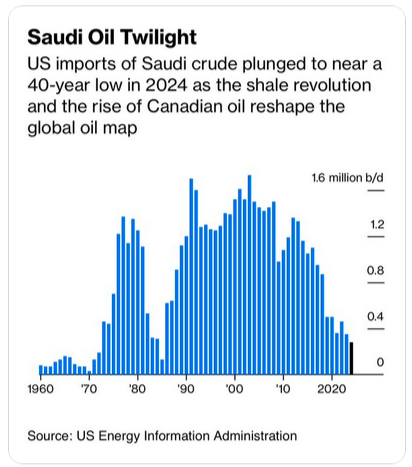
WHAT’S THE BLIND SPOT? If the Trump admin is going to deliver successful domestic restructuring it’s going to have to counter inflation by flooding the system with oil. But to do that it needs to incentivize production, which in turn requires either major contango in the futures curve or, failing that, Saudi to stop pumping.
The obvious move is refilling the SPR, and using Saudi volumes to do it with.
| WHAT WE’RE PROCESSING |
— Speculation mounts that Elon Musk might be interested in rescuing Intel.
— Gifted American kids begin to wonder about the special education programs they were subjected to.
— Whatever happened to Silk Ventures?
— The Atlantic was not impressed with Peter Thiel’s FT oped.
— Axel Springer’s boss, Mathias Dopfner, had views about the future of journalism and the need to agree to disagree rather than censor.
— Media complex “expert” Mike Benz eloquently explained why the USG has an interest in pumping stablecoins like Tether. “Crypto is bullshit, but I’m bullish on bullshit, because I’m long on CIA money laundering and on shady stablecoins being increasingly pumped up by the US government to purchase US Treasuries to stave off dollar crisis.”
— Mel Gibson, Jon Voight and Sylvester Stallone are bringing the 80s back to Hollywood.
— Short seller Nathan Anderson has shut down Hindenburg Research.
— Pro-Moscow candidate Zoran Milanovic secured a second term in Croatia.
— The downfall of U.K. investment minister Tulip Siddiq.