

| SNEAK PEEK |
— Izzy argues that economic reform of the Western economy won’t work without Glasnost.
— Markets need to start thinking about how a power vacuum in both France and the United States could open the door to martial law.
— Dario explains what’s been happening in Kenya this week, and how it fits into the global picture.
Happy Sunday dear readers. We hope you enjoy it, because, this coming week could end up being tumultuous. We sense there is a paradigm shift going on. But then again, who knows, we might be wrong. It all depends on how much moderation and “Melonification” there will be in Paris this week. For a proper breakdown of our thinking, since things are moving so quickly, do check out the little experimental podcast Dario and I have been engaging in. I think this is the best place this weekend to get a full assessment of how I see next week potentially unfolding. And if YouTube makes you queasy, it’s also on Spotify and Apple pods.
Since next week is likely to be very busy, I also encourage readers to keep an eye on my Twitter handle for the latest analysis. The main things I will be tracking are: 1) How the French election plays out and the likely impact on markets; 2) The UK response and if it leads to any policy twist on Brexit from Labour; 3) Ongoing glasnost in America about the fact Joe Biden is not really in control of the country.
We’re also strategically late and sparse today because we wanted to bring you news from the BIS annual economic report — which we, as reporters, get on an embargoed basis, in this case agreeing not to share it until Sunday.
See below for more and buckle up, because it’s going to be a crazy ride. And sorry for typos! There are probably many this week.
As usual, this newsletter is brought to you by me, Izabella Kaminska, and Dario Garcia Giner.
Send tips to [email protected] and [email protected]
| THE BIG BLIND SPOT THIS WEEK |
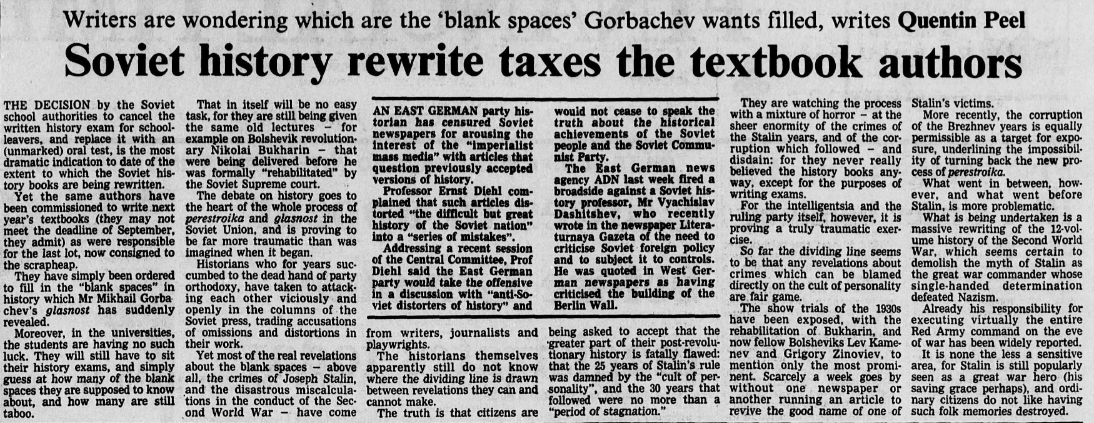
GLASNOST, RESTRUCTURING AND REFORM. “In the long run, structural reforms are key to lifting living standards and giving people a sense of security,” Claudio Borio, Head of Research and Policy Analysis at the Bank for International Settlements, told a press briefing ahead of the publication of the BIS’s annual economic report on Sunday.
FROM THE ARCHIVE:
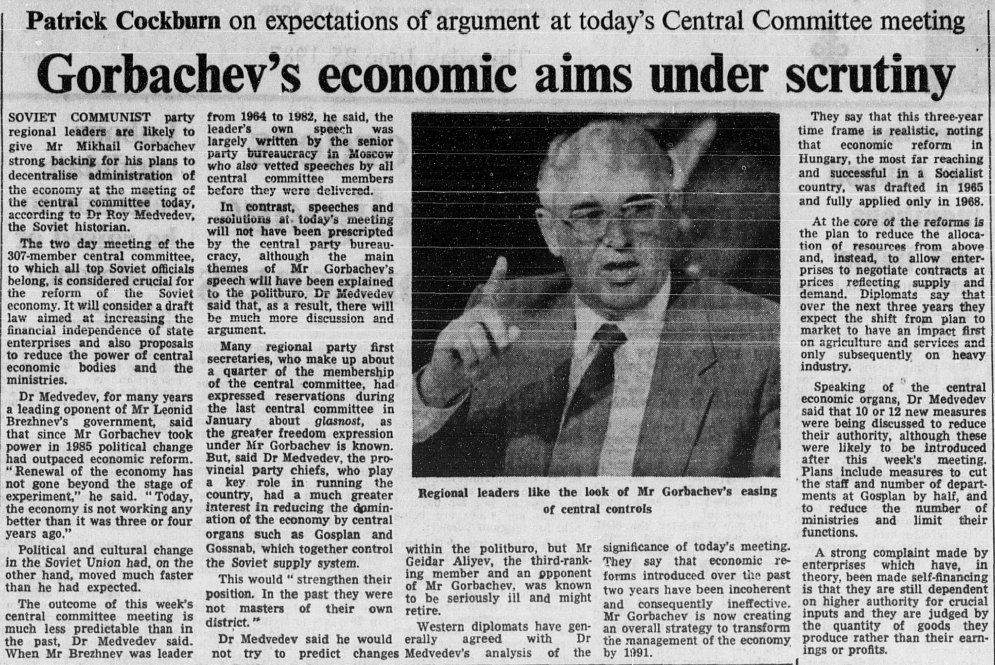
FROM THE ARCHIVE:
ZERO HOUR: Those living through extraordinary times are often doomed not to recognise it until after the fact. And then they feel stupid for not having recognised the obvious while it was going on. The phenomenon is something documentary-maker Adam Curtis has described as “hypernormalisation”, an effect that renders society — especially, public intellectuals and elites — unable to recognise the actually abnormal. It’s a form of reality denial and parallel fantasy formation on a systemic and institutional level. It plays out as a conspiracy of silence to talk about failings and weaknesses — notably, by the very elites and intelligentsia responsible for contributing to those failings, not least because they still have the power to make discussion of such failings taboo. Nobody likes to admit they might be wrong or in decline. This is especially hard for an expressly confident and historically powerful society. Many societies have experienced this, from the Roman to the Ottoman and British empires. But its most acute and relatable incarnation was during the fall of the Soviet Union, and that’s the lens through which I think it’s best to analyse our current situation.
The truth has been staring us in the face for a long time: We were just still too trusting to articulate it. In this week’s newsletter, I want to focus on what is now becoming obvious even to those who have been in firm denial for years. It’s a shift that is happening very quickly. And that truth is the fact that we in the West have been contending with power faction wars since at least 2012 centred on how best to restructure a self-evidently failing system, similar to that experienced by China in the 1970s and the Soviet Union in 1980s. The difference is, our overseers haven’t yet come clean to the citizens about the fact that a would-be restructuring is being attempted. Yes, for sure, the population has sensed there has been something deeply wrong for some time. But nobody has been explicit about it. And that can likely no longer go on.
How did we get here? That answer is complex. But three key reasons stand out beyond others. The first relates to the fact that we in the capitalist West gave up on the key tenets of our own doctrine somewhere around 2008. Rather than letting the system purge itself of its corrupt and predatory practices by letting them go bankrupt through market forces (as capitalism preaches should happen) we decided to bail them out and socialise the losses. This began the process of inevitable decline. The second key reason, which is only now becoming self-evident, is that we came under the malign influence of China and other corrupted states, and began to operate more like they do than a capitalist society. The third relates to the corrupted way we rolled out digitalisation, which we wrongly assumed was productivity-enhancing in all its forms, when, actually, it was mostly an accelerated zero sum game.
Time to reframe our thinking: Once we acknowledge that the system has been in need of deep restructuring for some time and that there has been a battle among the top echelons of power about how that restructuring should look (ideally, without letting the cat out of the bag), everything begins to make more sense.
A short history of restructuring and reform in the West: The first real restructuring effort came in 2016, both in Britain and in the US. Indeed, in the form of Brexit and Trump. Viewed through the prism of a call for restructuring by the people and a factional dispute within the establishment about the best remedy for how to realign the system, you realise why the establishment’s response to both of them was so extreme and panicked.
Nobody likes reformists: In the grand historical context, it is the norm for would-be reformists to face backlash and suppression by the ruling powers. In Russia, particularly during the Soviet era, reformists like Alexei Kosygin, who attempted economic reforms in the 1960s, were sidelined by the conservative elements of the Communist Party, ultimately stifling their efforts. The most notable example, however, Mikhail Gorbachev, whose policies of glasnost (openness) and perestroika (restructuring) in the 1980s aimed to reform the stagnant Soviet economy and political system. Despite initial support, Gorbachev faced intense backlash from hardliners within the Communist Party, leading to a coup attempt in 1991 and ultimately contributing to the collapse of the Soviet Union. In China, the fate of reformists has been similarly harsh. During the late 1950s and early 1960s, figures like Peng Dehuai, who criticised Mao Zedong’s Great Leap Forward, were purged and subjected to severe political persecution.
The flavour of reform matters. The recent history of would-be Western reform can be roughly summarised as a battle between those convinced system stagnation can only be addressed with more market-based reform and those convinced that the better solution is doubling down on the Chinese way of doing things and moving even more towards a planned society. Seen in this way the “Make America Great Again” movement was the original reformist political movement. But it’s also true that many of Trump’s ideas had much in common with those of his adversaries. By 2016 both sides, for example, had pretty much concluded that globalisation had reached a natural limit due to China not being prepared to abide by the rulebook of international trade. China’s reluctance to liberalise or to engage in reciprocal trade meant competing with it on the international stage had become impossible. But, whereas Trump’s policy prescription was protectionism, aimed at buying time to revert to known working (and productive) practices that benefited the middle-class American worker — directing whatever scarce credit was left to areas of the economy that could quickly induce productivity so that the system could be rebooted in a liberal way — the establishment had different ideas. More specifically, the establishment wasn’t prepared to give up on its plan.
Where the reformists and the establishment differed: Trump’s philosophy at heart was aimed at cultural as well as market-based economic renewal. That meant coming clean about the management failings that had brought us to where we are, and addressing something he himself knew only too well had been the real driver of the stagnation (since he’d been part of it): corruption, unproductive vested interests and the unconstrained growth of bureaucracy, the military-industrial complex and unfunded welfare. Coming clean meant purging the system of these predatory forces and exposing them for what they were. It also meant being honest about the degree of excess and corruption in the system. Like any good CEO engaged in a corporate restructuring, firing and redundancy would have to be par for the course. Unsurprisingly, this was never going to go down well with the vested interests.
The establishment on the other hand, obsessed with not ceding power, became convinced it wasn’t their policy prescriptions that were causing stagnation, but, rather, under-investment. The pathway out of stagnation in their opinion was more planning, more repression and more government intervention — not less. All this in the context too, of more protectionism.
The backlash: Nobody likes to be purged. But those in power who might be held responsible for past wrongs especially don’t want to be purged. Trump’s ascent to power, and the restructuring he proposed, posed an obvious threat to the entrenched (and largely useless and in some cases even criminal) nomenklatura. Unsurprisingly, they chose to close ranks and sabotage his reforms, both because the restructuring threatened their standing but also because they could not admit their own role in the system’s failures.
We all became Putin: When you know you abused power when you had it, and the Constitution limits your powers by design, you have no choice but to engage in creative self-preservation to protect yourself from repercussions. In America, that self-preservation force has taken the form of “in family” succession planning, from Clinton, to Bush to Obama. By 2020, political self-preservation had begun influencing the growing factional splits within most of the main parties across the Western world as legacy interests clashed with forces of renewal. As in Russia and China, everything became split between loyalists of the older powers seeking self-preservation and those arguing for change. Biden’s insane candidacy — because he was certainly not fit for the job back in 2020 — arose out of that context. Biden was seen as malleable, controllable, and, by all other measures, an excellent frontman for the real nomenklatura who needed to protect their interests and who had become convinced the reforms themselves were a threat to their policy prescriptions which just needed more time.
Bidenomics: Coming out of Covid, the system was self-evidently failing. Reform had to happen, it was just a question of how to do it without toppling the power structure or too many vested interests (itself a paradox). Also at issue was how to engage in a mass system restructuring that took America off a market-based economy and into a planned economy without the public being fully aware or invited to vote on it. The evolving branding around the reformist agenda tells the story nicely. What started as “the great reset” became “build back better”, and eventually turned into the far more innocuous-sounding “inflation reduction act” — a last-ditch attempt at addressing the supply-side problems coming our way that would double down on credit rationing and the black-listing of capital allocation to unapproved sectors.
Which brings us to now: IRA unleashed forces even Liz Truss could not have fathomed. But it also directed those forces (aka subsidies) at sectors that suited the ruling faction to support, rather than the economy. The size and scope of the programme meant almost no other Western bloc member could compete. From America’s point of view that made it very effective in the short term. It turns out that running the economy hot while deploying protectionist tariffs can let you steal growth from other parts of the world and outperform. This is especially the case if the monetary policy powers have your back.
What now? IRA has thus far been successful at helping America defy a hard landing. But America is not an island. Its (frankly moderate) growth has come at the cost of Europe’s, which means it’s unlikely to have been positive sum in nature. This poses a problem not just for Europe, but America too. Without true positive sum growth, the growth rate is unlikely to be sustainable.
Europe’s own restructuring: The fact that Europe has been thrown under the bus by America has been self-evident to European powers since at least 2022. This is when France’s president Emmanuel Macron first began making loud noises about the need for strategic autonomy, with a view to getting Europe in shape competitively so it too can engage in zero-sum subsidy wars. But America’s withdrawal has also left Europe vulnerable and paranoid. And just like in America there is a major disagreement about the form of restructuring Europe needs. Even in Brexit Britain, there is a fight about whether reform should mean going it alone with more market-based solutions or leaning into planning on an even more intensive level than the EU.
Competitiveness as a euphemism: It’s easy to confuse all the talk about competitiveness with actual competitiveness. That’s because the phrase has become an effective euphemism not for actual competitiveness, but for how quickly we can become more like China and a planned economy.
The importance of Draghi’s report: The technocrats have and always will believe in dirigisme. This is all the more the case now that artificial intelligence has arrived on the scene with the promise of delivering AI Gosplan. They seem convinced that with AI the planning can work. And, while individual nation-states of the EU will never be allowed to run their economies hot in the name of domestic restructuring, that does not apply on the European level. This is why Mario Draghi has been wheeled out to figure out how best to restructure the EU economy. And this is why Draghi has been working on the “new plan” for a good number of months now. The final draft was due out in July. Whether it is revealed then or not entirely depends on what happens in France this week.
PARALLELS FROM HISTORY: The great factional splits of the 1980s in Soviet Russia centred on ideological disputes between communists, who remained committed to the system even if they agreed it needed to be purged of its rogue elements and market-based reformists who wanted to breakup the system altogether. In the latter category, there were also the Make Russia Great Again traditionalists, known as the “National Patriotic Front Memory” party, also known as the Pamyat society. The Pamyat party were often described as proto-fascist chauvinists and anti-semites, but in reality were centred on spiritual and national revival. One of the movement’s best-known offshoots came in the form of Alexander Dugin’s doctrine of Eurasianism, which adapted the movement by purging it of its Nazi and racist elements while maintaining its focus on nationalist orientation. Dugin had served as a member of the Pamyat Central Council throughout 1988 and 1989.
| GLOBAL ECONOMY |
THE BIS POSITION: The latest Annual Economic Report from the Bank for International Settlements makes it quite clear that the world’s central banking community is on board with economic reform, but on a global level: “Structural reforms should aim to create an environment in which supply-side forces can play their full role. This means promoting competition, enhancing labour and product market flexibility, and spurring innovation,” the report noted.
Acknowledging the need for credit rationing: But the BIS are also realists. They understand the West is languishing and credit rationing will have to be factored into the mix. “It also means a judicious deployment of scarce public funds to support the economy’s adjustment to the new realities. In all this, there is also room for international dialogue to forge consensus on blueprints and best practices, not least in response to emerging priorities such as climate change and artificial intelligence. After all, these pose common challenges to humanity, and overcoming them will benefit everyone,” the BIS noted.
It’s a matter of when not if inflation returns: “In this challenging landscape, policies will need to finish the job of guiding the economy back to price stability and set the foundation for durable growth. In doing so, macroeconomic policies will need to keep a firm eye on the longer-term consequences of near-term decisions. Monetary policy will need to stay alert to a re-emergence of inflationary pressures and preserve the regained room for manoeuvre. Fiscal consolidation remains essential to support disinflation and restore debt sustainability. Prudential policy needs to remain vigilant and continue the efforts to strengthen the resilience of the financial system. Structural reform efforts, which have flagged for too long, need to be revived to support higher sustainable growth and a better income distribution. Enhancing growth and resilience through reforms that foster competition, flexibility and innovation will improve economic well-being and ensure the capacity for effective macro-stabilisation policy responses, when the need arises.”
*** Turns out negative equity might be an issue***: Readers may remember the great debate over whether central bank losses matter or not. In that debate, TBS firmly argued they do matter because they’re only sustainable for as long as trust in the currency is maintained and inflation is kept in check. The BIS’ Agustin Carstens, however, wrote an entire oped in the FT in February 2023 defending central banks’ capacity to weather losses for an extended period of time. Well, there’s been some backchannelling (our emphasis):
“Technically, whether a central bank is making losses or, indeed, whether its capital is negative, is of little consequence for its operations. Indeed, history shows that central banks have been able to operate successfully notwithstanding extended periods of losses and with negative capital (for example, the central banks of Chile, Czechia, Israel and Mexico), without compromising their mandates. What could prevent the central bank from fulfilling its mandate is the public losing confidence in the currency. This ultimately depends on the condition of the consolidated central bank and government financial position. Central banks can prevent the technical default of the sovereign through their power to issue money, ie irredeemable liabilities. But acceptance of those liabilities, in turn, ultimately hinges on the sovereign’s power to tax. Central bank losses can weaken the fiscal position of the state. In accounting terms, this impact crystallises most visibly in central bank remittances to the government. But central bank losses are generally not large enough to play a decisive role in this respect.
Tie that to Isabel Schnabel’s recent admission that “the experience over the past 15 years suggests, however, that the effectiveness of QE in stimulating aggregate demand is state dependent and that QE can come with costs that might be higher than those of other policy instruments,” and you see that actually it’s clear central bankers believe we are at the limits of using money printing as a mechanism for further support of the economy, but also that they now believe their previous actions have constrained government’s ability to initiate fiscal responses.
Regarding that fiscal issue: Speaking to reporters ahead of the report Claudio Borio warned: “Fiscal support continues to affect demand and inflation in many countries. There is a risk that too much fiscal stimulus could add further fuel to inflation and undo the hard-earned progress by acting at crossed purposes with monetary policy.” He added. “The medium-term outlook for public finances is even more concerning. It poses the biggest threat to macroeconomic and financial stability. Without consolidation, public sector debt ratios are set to climb even if interest rates remain below economic growth rates. With mounting spending needs markets could at some point question fiscal sustainability. We know from experience things look sustainable until they suddenly no longer do. That is how markets work.”
Protectionism (aka competitiveness) is the wrong way forward: “Finally, the increasing turn to protectionist measures in many jurisdictions is also a cause for great concern. Such measures risk making economies less dynamic, less innovative and less competitive. They can also make the world economy more inflation prone,” Borio said.
Not good.
| BUSINESs, ECONOMICS AND FINANCE |
INDUSTRIAL POLICY IS A NOSTALGIC PIPE DREAM wrote James Galbraith for Project Syndicate, who (echoing TBS) claimed the key problem for the West is that our elites don’t understand what really ails the economy. This means the call to address the imbalances created by decades of neoliberalism by progressive thinkers who are calling for innovation and state-led directives to create wealth “for the many” and deal with climate change while reducing market concentration and power is fundamentally mistaken. The fundamental issue in Galbraith’s opinion is that the governments in charge of such a change would still be in the web of military contractors, banks, and tech tycoons that are the result of these decades of neoliberal policies in the first place. Small surprise the leading voices calling for such “progressive” reforms are people like Adam Tooze and Isabella Weber.
To reiterate the TBS position: The problem that ails the West is corruption. As we noted in last week’s newsletter, post-war dirigisme in Europe and the New Deal in America worked because the system had just gone through a major cohesive exercise. This is not the case today.
THE US AIR FORCE OUSTED THE HEAD OF ITS ICBM PROGRAM this week, with the service citing a “failure to follow organisational procedure.” While the Air Force claimed such a removal was separate from an ongoing inquiry into soaring costs at the ICBM program — which have soared at least 37 percent to an estimated $131 billion, the timing is anything but unsuspicious. Colonel Charles Clegg’s removal for failing to “follow organisation procedures” was not elaborated on by the Air Force’s statement.
THE EUROPEAN MODEL IS IN DANGER OF COLLAPSE said friend of TBS and the founder of Yelp, David Galbraith. Europe’s original model was threatened with collapse due to its “Goldilocks” problem, where Europe’s social model rewarded effort without punishing bad luck. Now, Galbraith says, that effort isn’t rewarded enough to incentivise funding against bad luck, lowering funding. Meanwhile, the cost of that funding is increasing due to demographic changes. Add on to that a failure to transition from the industrial to the information era and this creates a tipping point post-Covid where a misaligned incentive feedback loop and lack of collapse could cause economic collapse.
ANOTHER BLOW TO THE EV NARRATIVE THIS WEEK as Ford suspended the production of new EV models after claiming losses of over $1.3 billion from its electric vehicles division. “We will not launch a second-gen [EV] product unless it’s profitable within the first year and we are going to get a return on that capital we’re investing”, Ford disclosed. This suggests there will be a longer runway for ICE/hybrids as major auto manufacturers continue to reach economies of scale in EV production to achieve productivity goals.
| GLASNOST |
JULIAN ASSANGE WAS RELEASED ON GEORGE ORWELL’S BIRTHDAY: After nearly 12 years without freedom, the world’s most famous whistleblowing facilitator, Julian Assange, was released after pleading guilty to a single felony under the US Espionage Act and repatriated to his native Australia where he joined his wife and children. At the same time, Wikileaks deleted its DNC files. What the world wants to know is, what will Assange do next? Tucker Carlson is in Australia lined up to interview him.
TRUMP SUGGESTED THE CIA STOPPED HIM FROM RELEASING ALL THE JFK FILES, a portion of which he originally released in his first term as President. If he were reelected, Trump claimed, he was “just going to do it” and release all the files, including those he was advised to keep under wraps: “This wasn’t CIA that asked me, but I think CIA was probably behind it. They would’ve preferred that I not release the rest of it.”
BIDEN WAS THROWN UNDER THE BUS: The illusion that President Joe Biden was in control of United States or even compos mentis was fully shattered on Thursday night after he appeared on stage in a debate with Donald Trump and failed to speak in anything resembling a coherent narrative.
The real news isn’t that there’s a power vacuum at the top of the most important global economy in the world. It’s the fact that vacuum has been filled for some time by unknown forces, which means the country has been operating unconstitutionally for some time. Bill Hicks, in other words, was right.
If that’s true, America may never have been more vulnerable to an actual coup than now. With the main opposition facing jail and no clearcut political challenger in the mix for November, the Blind Spot isn’t who will be Biden’s successor. It’s who is the nomenklatura and what interests are they desperate to protect, and to what lengths will they go?
There are only a handful of pathways forward.
1) The Kayfabe continues, with a Medvedev-type continuation candidate rolled out to slot into Biden’s seat. The press and elite system continues to pretend all is well, when really it is not. That candidate would most likely be Michelle Obama or Hillary Clinton, in a continuation of the old regime. If that’s the case, the real peril is now, because with nobody prepared to hand power to Kamala Harris in the interim, the situation is ripe for the military taking control in the event of any crisis or war escalation. That it in itself is complicated by the question of how united the US military even is? Which particular faction would be likely to cross the Rubicon first? It’s also worth remembering the Jan 6 precedent has now conditioned the public to accept military presence in the capitol on election day, making it much easier to declare martial law than ever before.
2) The pretence about Biden cognitive incompetence continues on and he is kept in operational mode until November. But knowing the electorate will never accept a continuation candidate, the nomenklatura decides to capitulate in terms of maintaining control of the candidacy. In response, the free-elements of the Democrat party are finally able to put their weight behind RFK Jr who is already on the ballot in most states. RFK Jr leads a renewal of the Democrat party, and the period between now and then is centred on Glasnost. Akin to Gorbachev admitting reform and openness is needed. That openness includes coming clean about past crimes, and the JFK files are finally opened. The electorate finally gets a choice with RFK Jr representing the “New Deal” option and Trump the market option.
3) Civil strife unfolds because markets fail in Europe and contagion spreads. Martial law is declared. Power flows to the Joint Chiefs of Staff, now chaired by airforce man Charles Quinton Brown Jr.
| VIVE LA FRANCE! |
VICTORY FOR THE FAR LEFT OR FAR RIGHT COULD MEAN CIVIL WAR claimed Macron this week as the French President tried to scare French citizens into supporting his beleaguered Renaissance centrist party. Macron claimed both parties’ pursued divisive policies that could spark outright violence and civil war: The far right by reducing people to their religion or origin, and the far left by reducing people to their religious or ethnic group. The latest polls suggested that the National Rally could win 35 percent of the first round vote this Sunday, where the left-wing alliance would gain 27 percent, leaving Macron’s centrists third on 19 percent.
Pathway number 1): Macron’s centrist party remains in the race and proceeds to the second round on July 7. If that happens, markets will remain placid. We kick the can down the road until July 7.
Pathway number 2): Macron’s centrist party are wiped out, but Le Pen/Bardella do a “Meloni” and pledge to work with Europe, moderate their nationalist stance and vow to keep spending in check. The political strategy focuses on aligning with Orban, Meloni and forming a nationalist bloc in the EU. We buy time until July 7, and everything hangs on whether the population goes for a moderated Le Pen party or leans left. On July 7, a win for the left would be the most likely to unnerve markets, since they are the least likely to moderate. In the longer run, if Le Pen’s National Rally goes ahead and forges nationalist blocs within the EU, Draghi’s centralising reforms are unlikely to succeed for Europe. Markets will slowly figure this out, but it might take a while.
Pathway number 3): Macron’s centrist party are wiped out, and Le Pen’s National Rally does not moderate enough. French bond yields begin to spike, and the euro’s value begins to fall as capital flees Europe for Switzerland, the US and Britain. Contagion brews, just in time for the international central banking gathering occurring this week in Sintra Portugal.
Pathways within the third pathway:
1) The ECB determines it cannot intervene in bond yields because France is in an excessive deficit procedure that technically prevents the ECB from deploying its Transmission Protection Instrument. As Russell Napier speculated last week, the technocrats determine that by not intervening both Le Pen and the electorate is more likely to be taught a lesson by July 7, which will see them vote for moderation. Chaos pursues and Macron moves to declare martial law with the use of something called Article 14. The necessary political adjustments are made and Le Pen is brought under the thumb of the centrists.
2) The ECB intervenes swiftly, breaks its own rules, and fails to encourage political moderation. This works well for France at first, but within weeks/months the moral hazard becomes clear. The resolution eventually sows discontent among fiscally prudent nations, and skewers France’s chances of becoming the financial centre of Europe in Mario Draghi’s re-envisioned plan for the bloc. But it also exposes that Europe’s new fiscal rule framework is entirely toothless, rupturing bloc cohesiveness. With no other way to penalise France for its bad practices, EU leaders know that eventually, they will have to resort to threatening France with the removal of its voting rights. That, however, is tantamount to involuntary Frexit — hence, Macron’s heartfelt warning in Europe that if populism isn’t nipped in the bud “Europe could die”. Technocrats also recognise that Draghi’s best-hatched plan for the bloc cannot work without France.
3) The ECB opts not to intervene in bond markets, but central bankers gathered in Sintra decide to respond to potentially unprecedented FX volatility by creating a new managed exchange system. In the new Plaza Accord, foreign European central banks would support the euro, and in so doing send their capital into Europe to buffer it up. While this would not resolve the French debt situation, it could open the door to both Switzerland joining and the UK rejoining the EU.
The UK dimension
1) In the event of chaos in France, the circumstances play both into Nigel Farage’s Reform hands — “You see? We told you Europe was a basket case!”, and Labour’s “You can trust us to manage European capital better than France and the Tories.”
2) If a move by the BoE is seen as system stabilising, this could empower Labour to officially declare “we are stronger together”, and put rejoining Europe back on the agenda. July 4 in that way becomes a renewed referendum, with Reform and Labour becoming the main two contenders.
Luckily there’s also a Nato summit scheduled for July 9.
| gEOPOLITICAL HOT SPOTS |
KENYA SUFFERS DEADLY PROTESTS: At least 23 people were killed this week in violent clashes in Kenya this week after thousands of protesters stormed parliament over planned tax hikes.
DARIO COMMENT: Kenyan protests against proposed tax hikes turned deadly this week as large groups of young Kenyans protested in Nairobi and most Kenyan counties this week against the controversial finance bill which contains numerous unpopular tax proposals.
Kenyan youths have been on the streets for upwards of a week now, with dozens killed and hundreds allegedly abducted by the country’s security forces. Amid tear gas and charges from police, the protesters even managed to breach and storm the Kenyan parliament, prompting the mass evacuation of government employees. The mass repression has brought Kenyan authorities widespread condemnation from local and international human rights groups and NGOs.
While Kenyan President William Ruto had denounced the protests on Tuesday as “treasonous”, he appears to have quickly backtracked from the most controversial aspects of the finance bill later in the week.
But there may be more to it than the controversial finance bill in question.
Western media are outlining that the direct reason for the protests was President Ruto’s taxation policies, which have raised the duties on everything from gasoline to wheelchair tires, bread and sanitary pads. These measures have taken place in order to placate the IMF, whose loan program plays a crucial role in supporting Kenya’s finances.
Bloomberg wrote that Ruto now faces a dangerous choice — “between the IMF and the streets”. Until his recent U-Turn on the finance bill, President Ruto had repeatedly chosen the fiscal taxes the IMF has laid out as essential to right Kenya’s struggling economy.
These tough decisions, as Bloomberg calls them, had a directly positive impact on Kenya’s macroeconomic situation. The Kenyan shilling is the world’s best-performing currency this year, gaining 21.4 percent against the US dollar since the start of the year. In dollar terms, the Nairobi Stock Exchange has had the best returns so far this year among 92 primary gauges tracked by Bloomberg, with a return of 49.6 percent. And, in February, Kenya tapped international debt markets after years of being priced out, repurchasing $1.44 billion of its $2 billion eurobonds debt via the issuance of new dollar bonds priced at 9.75 percent.
But as typically occurs with these policies, their economic improvements haven’t been felt on the street — quite the opposite. We’ve surfed the Reddit community for Kenyans and spied the makings of a real societal outrage over Kenya’s governance. This isn’t your typical small-scale protest at overpriced basic commodities. Rather, young Kenyans are not just dissatisfied with their President, but with the entire system of Kenyan politics. It follows the same tried-and-tested development country storyline: Overly generous to the rich and government-connected, and unduly harsh towards everyone else.
And it appears that the IMF agrees with some of these young Kenyans’ sentiments. Following Ruto’s U-turn on the finance bill, the IMF’s suggestions have taken a more ominous tone. On Thursday night, the IMF’s first official statement on the protests outlined the institution’s worry about increasing violence in Nairobi, while straying clear of discussing the issues at hand. But an anonymous senior official at the IMF told Business Daily Africa that the real problem with Kenya was “luxury in government”: “There is a lot of luxury in government, which we found to be the real cause of pain to the people. This can free up lots of money to go to the targeted social and development programs.”
And most uniquely for this series of events in an African country, American elites’ families appear to be deeply involved in the protests. Auma Obama, the half-sister of Barack Obama, was teargassed by police while conducting an interview with CNN live on air while protesting against the bill. Auma Obama is a Kenyan-British activist, who claimed she’d attended the protests to demonstrate for the rights of young Kenyans.
Martin Luther’s son, Martin Luther King III and his wife, both pleaded with African Stream while in Kenya for the Kenyan government to allow space for a non-violent movement for peace and reconciliation to mature, rather than opting for repression.
Alongside this debate on the Kenyan cost of living and corruption crisis runs the very interesting integration of Kenya into the Western security circuit. This integration, coincidentally, appears to have been solidified this week. For starters, Kenya was elevated to the status of “Major Non-NATO Ally”, which had been pledged following Ruto’s visit to D.C. last month but was confirmed this Wednesday. This is a remarkable event since Kenya is Africa’s first sub-Saharan country that has been granted such a distinction.
While the designation is described as largely symbolic, the links it fosters between designated nations and the American military is anything but. A critical symbol of closeness in the American relationship is the financial, surplus, and military expertise provided by the American military. The Justified Accord military exercise, for instance, recently took place from June 10-13 with Kenyan and American soldiers in the mix, alongside pledges by the United States to upgrade a Kenyan military base in the country’s north.
This week also saw the European Union send its first batch of military support, worth €20 million, to the Kenya Defence Forces to aid them against the Somali militant group of Al Shabab.
Lastly, hundreds of Kenyan police landed this week in the embattled city of Port-au-Prince, the capital of Haiti, as part of a long-awaited US and UN-backed mission to fight gangs and bring order to the Caribbean nation that has been torn apart by violence, gang warfare and spreading hunger. Some Kenyan sources claim this Kenyan police force was sent on the initiative of the US Ambassador to Kenya, which Kenya accepted, simply because humanitarian missions provide healthy cash inflows to those who take on these missions. But we’d wager it has as much to do with Kenya’s integration into Western military strategies than straightforward funding opportunities.
This choice for greater closeness to Kenya was ostensibly made by American officials keen to expand on the “friendshoring” trend by bringing developing countries that are ‘value-aligned’ with the West diplomatically closer. This included the acceleration of negotiations for the Kenyan-American Strategic Trade and Investment Partnership, a free trade agreement which is due to be negotiated by the end of this year, and the reauthorisation of the African Growth and Opportunity Act, which allows exports from certain sub-Saharan countries duty-free access to the US market.
The thing buzzing around most in my mind, however, is just how odd the timings — and how seemingly disparate — the events this week in Kenya are. Even browsing through the Kenya Reddit community, which is alight with viral comments denouncing Kenya’s governmental culture and President Ruto, you find scant comments criticising Kenya’s NATO-friendly designation. While several commenters have posted questions regarding the unusual timing of Kenya dispatching hundreds of police officers to Haiti in the middle of widespread revolt, a connection between the two events, protests and military closeness, seems to be missing.
| OPEN TABS AND TLDR |
— Boeing’s outgoing CEO, Dave Calhoun, was grilled by Congress about his salary, which amounted to $32.8 million last year, a 45 percent increase on the year before.
— Oxford professor Carl Heneghan extracted the main points from the Kansas Attorney General’s lawsuit against Pfizer.
— Tucker Carlson sat down with journalist Matt Taibbi.
— The EU’s evolving China sanctions strategy.
— International scrutiny of Poland must continue under the Tusk government (Notes from Poland).
— Something bad is happening in the US Treasury market.
— Donald Trump’s economy plans get the Project Fear treatment.
— The BIS wants to use AI to nowcast the global economy.
— Canada’s Justin Trudeau has a wake-up call.
— How French markets connect to American markets. It’s all about the eurodollar markets.
— Alexander Dugin predicts the beginning of a global civil war.
— Germany’s autobahns are falling apart.
— All the parties are lying about the economy, says the Institute for Fiscal Studies.
