
If you’re not knee deep in crypto goings on, the news this Monday morning that the Celsius network is in trouble might not mean very much to you.
But what’s going on may have serious repercussions for the entire crypto network. Bitcoin is down 10.46 per cent in the last 24 hours on the news.
Here’s the announcement from the network that sparked all the commotion:
.@CelsiusNetwork is pausing all withdrawals, Swap, and transfers between accounts. Acting in the interest of our community is our top priority. Our operations continue and we will continue to share information with the community. More here: https://t.co/CvjORUICs2
— Celsius (@CelsiusNetwork) June 13, 2022
And here’s the Celsius coin price action as a result of that announcement (charts courtesy of coinmarketcap.com):
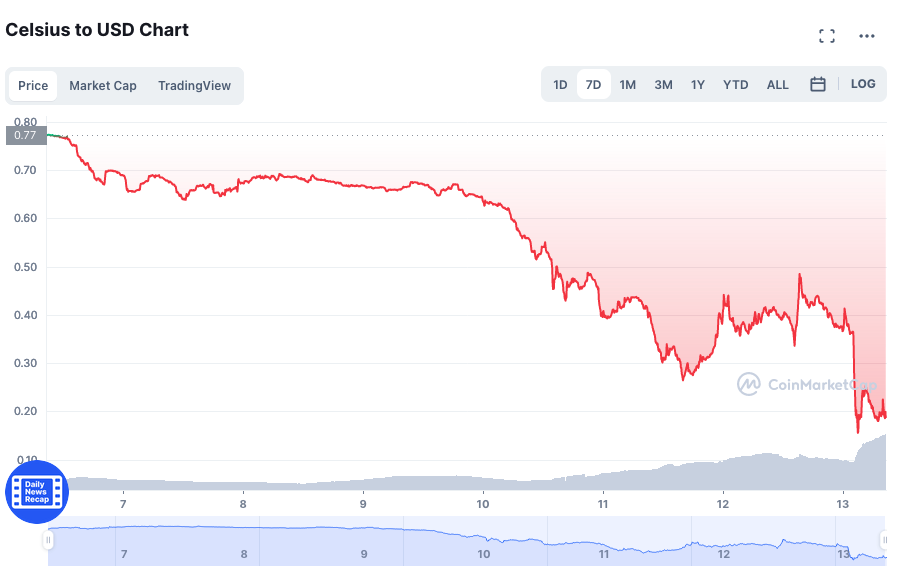
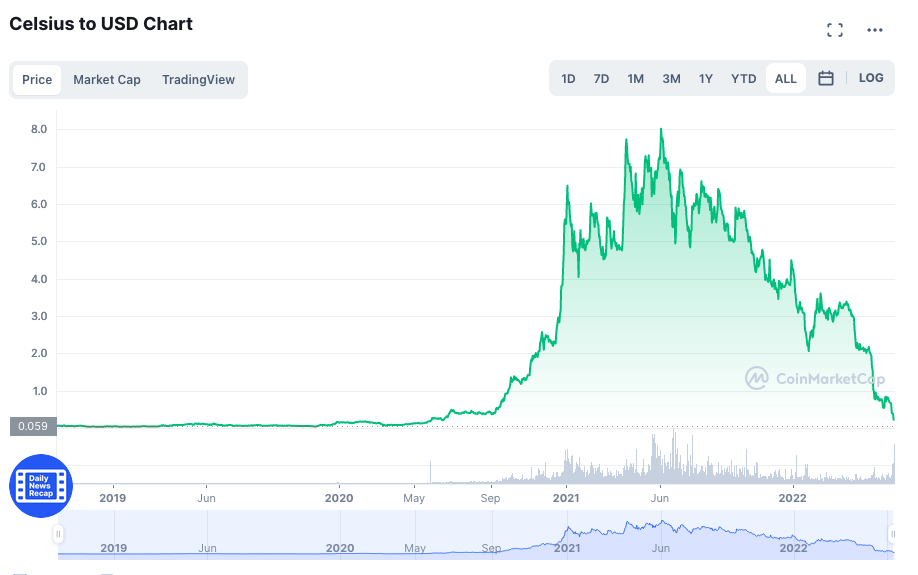
As noted, the latest trouble is down to Celsius freezing withdrawals on “extreme market conditions”.
But this commotion was hardly unexpected.
As the Blind Spot’s spotlight on the Luna debacle, co-authored with Frances Coppola last month, noted there was always entanglement with Celsius via “DeFi” relationships. Here’s the relevant extract (our emphasis):
If the stablecoin issuer owns a lender, it can make money from lending while providing the stablecoin free of charge.
Terraform Labs, issuer of the failed UST stablecoin, owns a crypto bank, Anchor Protocol, and an investment platform, Mirror Protocol. UST is the native token of both platforms, and on Anchor, Luna is used as collateral for lending. Both have publicly traded “governance tokens”, aka shares. Sounds familiar, doesn’t it?
When UST and Luna were doing well, Anchor and Mirror generated income for Terraform Labs. But now, of course, there isn’t any income. There’s only a huge pile of worthless tokens and unrecoverable loans, and the share prices of the two platforms have crashed to nearly zero.
What few clocked was that there was a run on Anchor Protocol at the time of Terra’s collapse. It was led by the crypto bank Celsius, which had deposited half a billion UST with the crypto lender. All remaining depositors will have lost almost all of their money, not because Anchor is bust (though it probably is) but because UST is.
When a stablecoin dies, the ecosystem that depends on that stablecoin dies too. Trying to generate income from stablecoins carries significant risks: a sudden spike in redemption demands for either a fractionally-reserved or algorithmic stablecoin which, in turn, can collapse the whole house of cards; runs on crypto banks can also knock stablecoins off their pegs.
However, ecosystems built on stablecoins fully-reserved with safe assets or issued by a public institution backed by a tax-raising fiscal authority, would be at much lower risk of failure. This, of course, is why in the conventional system, money is publicly issued by a central bank and backed by a tax-raising fiscal authority. Do we really need to make the mistakes of the past all over again to prove this point? Apparently, the answer is yes.
The takeaway is that these are all ongoing repercussions from the great Terra/Luna stablecoin debacle. It’s also yet more evidence that crypto and blockchain have done little to prevent systemic risk reappearing within financial systems.
As ever Frances Coppola is worth following on all this. Do keep track of her Twitter feed.