A spotlight on strange petchem effects
That Russian sanctions on the back of the Ukraine war are disrupting commodity markets is old news. We all know energy and commodity prices are the key drivers of 40-year busting inflation prints and other supply-side disruptions.
What is still to be appropriately acknowledged, however, is the degree to which our very own sanction policies against Russia are likely to hurt us more than them in the medium term.
Strange and unprecedented things have started to occur in the usual pricing relationships that govern energy markets. In European petchem markets, toluene – an important industrial feedstock – is trading OVER benzene. Since toluene is used mainly for benzene production, this is highly unusual and arguably akin to a type of inverted yield curve stress signal for energy markets. Gasoline, meanwhile, is trading at a record $500 over naphtha. Unprecedented.
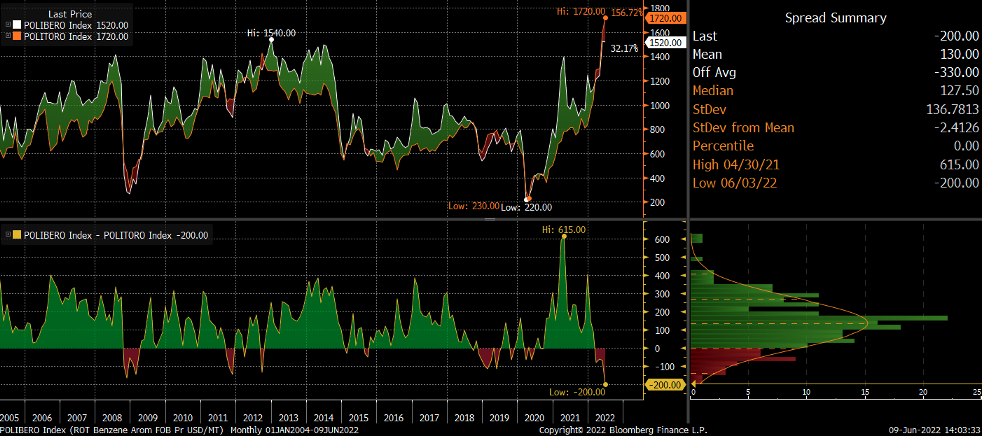
All of this comes as a result of the whack-a-mole game we have created due to the capex constraint in the system.
The political classes are still to awaken to the reality that demand destruction will not solve the commodity deficit problem (at least not without painful and socially disruptive consequences). Nor, it seems, do they understand that renewables alone cannot sweep in to fill the gap. The reluctance to admit this reality is the truly perplexing factor at hand.
By demanding a ban on the sale of new combustion engine vehicles as early as 2030 and 2035, these politicians are writing checks their bodies simply can’t cash. There is no way such bans can be materialised without drastic tolls on the quality of life in European countries. Despite this, the gung-ho bravado from politicians like Boris Johnson continues. As do the claims that such targets can be achieved in a way that is net positive for everyone. This, frankly, is equivalent to gross misselling. It might even be considered a type of fraud.
Renewables or no renewables, Russian sanctions or no Russian sanctions, there is a massive capex issue at the heart of the commodities story. Unless more refineries, fields and resources are developed global growth will be stalled. And if global growth is stalled, our capacity to fund and balance the legacy debt in the system (as well as to defend ourselves from hostile enemy states) will be stalled too. That situation invites a global financial crisis of a scale that no central bank will be able to fight with money printing.
I’ve said this before, but what we face – bar a miracle energy innovation handed to us by the UAPs that Congress, NASA, and the US defence sector have suddenly become obsessed with talking about – is a potential USSR-style restructuring of the Western economy.
The IMF is clearly cognisant of the problem. I was recently approached by a head hunter about applying for this media relations role. In that approach they noted:
If one subscribes to Mr. Dimon’s “hurricane” comment, there is no pleasant way of saying that the role is likely to be very intense over the next few years with global interest in the Fund’s forecasts and elevated national interest in lending programs.
Fear not Blind Spot readers. I am not going to abandon you all for a stab at spinning positive narratives about the delivery of conditional lending programmes to hard-up countries. For as long as TBS is not clobbered by financial headwinds itself, it will remain committed to bringing you unfiltered reportage and analysis. But the outreach speaks of the trend at hand.
Closer to home, energy experts that I have been speaking to this week, some of whom operate at a government advisory level, are also at their wits’ end. Their concern is that we are facing constraints that will lead to potential rationing come winter, and by the time the shortages strike, governments will be left helpless to combat the disruptions. What’s more, these experts are adamant that Russia is only the icing on the cake of an already stressed supply situation which was brought about by years’ worth of underinvestment due to ESG and net zero green policy.
By singing from a single hymn sheet on key issues and using multi-year targets to achieve specific goals, there is no doubt in my mind that ESG is now emulating a central planning system. We’ve experienced those before – they didn’t work out too well. There are always unintended consequences with such plans. Some might challenge that China has managed quite well with its five-year planning system. I would counter that much of that success is down to the West allowing China to achieve it at the West’s expense.
Now that European countries are having to revive coal-fired power generation to deal with the energy deficit, you would think ESG’s “win-win” messaging might finally have been exposed as bunkum. But no. I’ve been told the hymn has simply been adapted. Burning coal is now to be considered better for us than burning natgas because of the lower methane output. My energy experts dispute this as an obvious lie. Meanwhile, poor countries, the net zero lobbyists say, will be okay because they will be able to leapfrog over the fossil-fuel burning phase altogether. That might be true in rural and isolated regions to some degree, but the idea that the citizens of Lagos will go straight to owning expensive newly made electric cars rather than relying on second hand combustion engines is frankly delusional.
Whack-a-mole markets
But let’s return to the petchems issue and explain what it means for markets and consumers.
In normal times, petrochemical products sit at the top of the oil and gas value chain. But due to refinery capacity shortages, and the fact we have lost some 2mbpd of refining capacity due to the negative margins experienced over the Covid era, the transportation fuel pool is having to draw as much input from other fuel pools as possible. Some of these would ordinarily flow into petrochemical feedstocks.
This means in trying to solve a natgas shortage, we have arguably created a diesel shortage. And in trying to solve the diesel shortage, we have now inadvertently created an octane shortage.
The chemistry here is complicated. But suffice to say gasoline is a blended product that needs a certain amount of octane to work in a car. There are lots of different things that are high octane and can go into the blend. In that sense it’s a bit like mixing ingredients together when baking a cake. And just like a baker might change the recipe if one ingredient gets a bit too pricey, or replaces it with something else, the same thing happens with gasoline blending.
One of the low-cost inputs into gasoline is naphtha, which is also used for making plastics. At the moment, because of Chinese lockdown effects, demand for plastics is very low.
Also troubling the water is an unusually intensive “steam cracker” maintenance period.
To illustrate the downtime see this chart from JBC Energy:
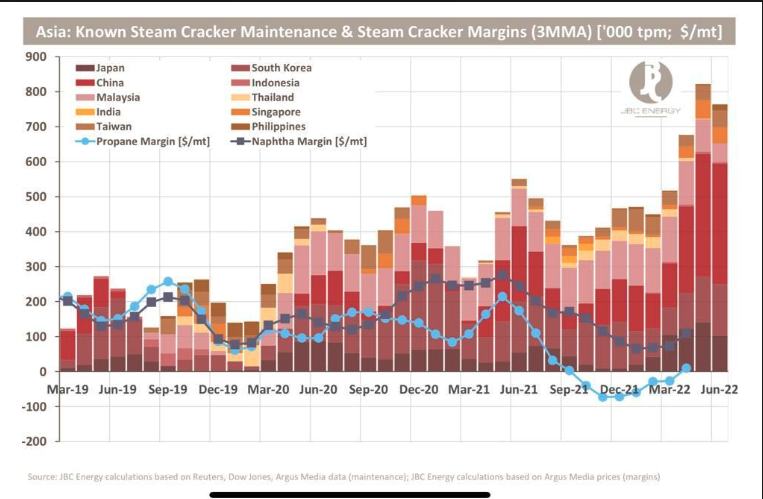
What is now becoming clear is that as a result of these demand imbalances, ‘light’ naphtha is discounting to extreme levels to incentivise use in gasoline and fuel markets.
As Reuters reported on June 10:
NEW DELHI, June 10 (Reuters) – An oversupply of naphtha at a time of poor demand has squeezed the product’s Asian margins to their weakest levels since the 2008 global financial crisis, traders and analysts said.
This is occurring at the same time we have an octane deficit which can’t currently be met due to insufficient refinery capacity.
The result is a situation where the high-octane gasoline component, reformate, is trading at a record $250 per metric tonne. The ‘heavy’ naphtha feedstock for reformate production, on the other hand, is being discounted to $750 per metric tonne versus a discount norm of about $100.
So even though there is plenty of spare naphtha around, there is not enough octane available to send it into the gasoline and fuel markets.
Now, all this may be a short-term abberation. If and when the steam crackers come back online a lot of these imbalances may be resolved. And yet, if demand destruction for plastic-based goods really does entrench itself, this could generate some strange externalities for fuel markets.
To put that in historical context, when discretionary consumption collapsed as a result of the 2008 financial crisis this hit plastic demand very hard at the time too. Naphtha prices fell off a cliff accordingly. This in turn caused gasoline to crater too.
What’s happening now with plastics demand is similar, but the effects on the gasoline market are the opposite. Demand for plastics has temporarily collapsed because of Chinese lockdown reasons but because we can’t make enough octane gasoline prices are remaining stubbornly high and will remain so unless new refining capacity comes online.
Since that is unlikely in the current ESG environment, if plastic demand ever revives after Chinese lockdown effects ease, there will have to be hard choices that will have to be made between plastics or fuels.
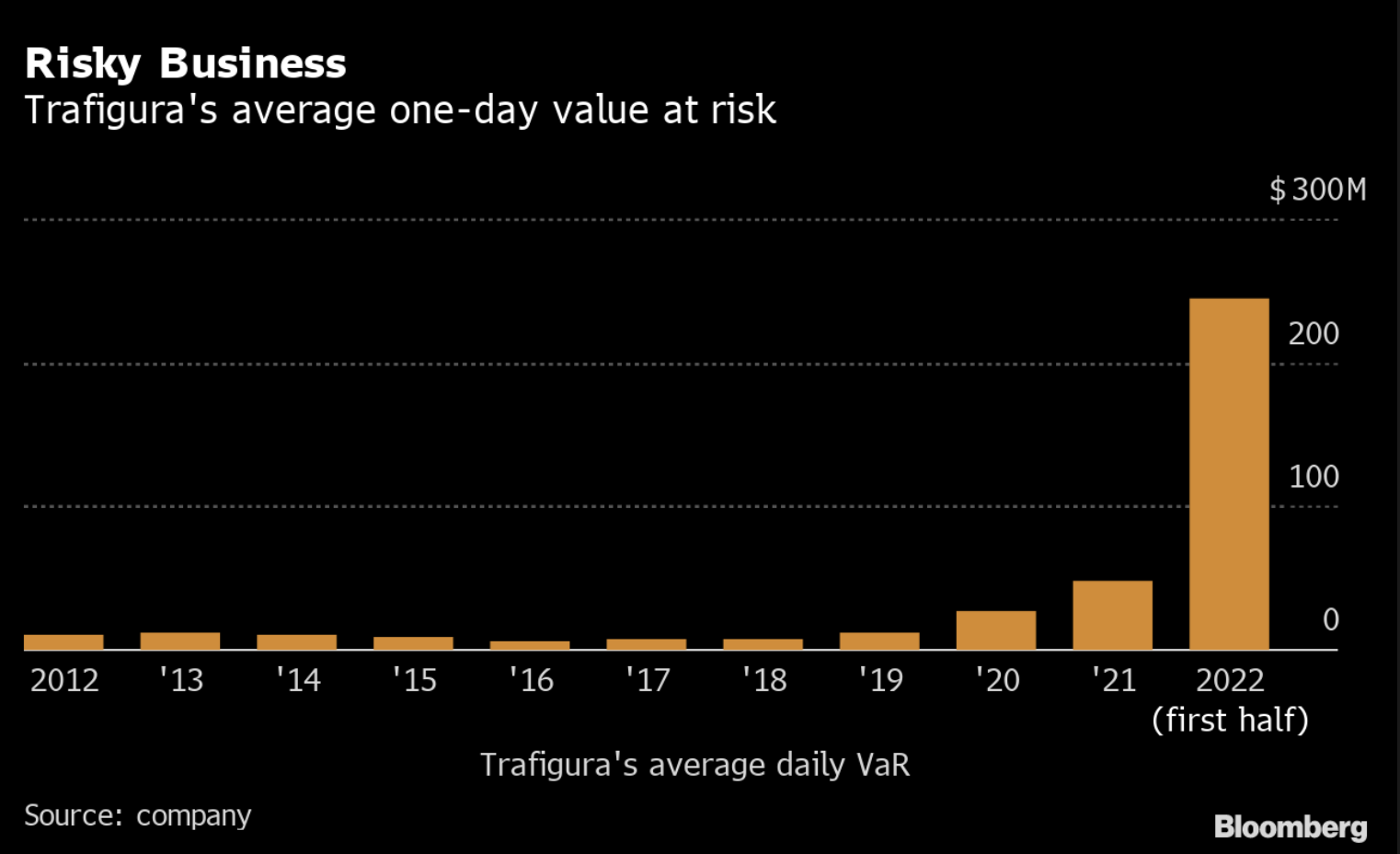
It’s worth noting that the unprecedented nature of the current environment, including the constraints on business as usual, are clearly manifesting in the results of energy traders like Trafigura.
Here’s a chart from Bloomberg’s story about Trafigura’s latest results, depicting how radically the trader’s daily value-at-risk has risen in 2022. VaR reflects how much a trading company can lose on a normal trading day.