

By Frances Coppola and Izabella Kaminska
There are many popular adages in finance. One is that there is nothing new under the sun. Another is that there is a sucker born every minute. With the crashtastic collapse of USDTerra (UST) in May, an algorithmic stablecoin whose units were supposed to track the value of the fiat dollar and had a notional market capitalisation of $11.28bn, these two sayings are coming together like never before.
News of UST busting its peg on May 10 travelled quickly through the market, infecting the broader crypto and stablecoin complex. Within a few days, the unit price of UST had fallen to 11 cents, wiping over $10bn of UST’s market cap. Bitcoin and the other flagship coins were soon clocking in between 20-40 per cent losses on the week.
At the time of publication, Terra was still trading at about a tenth of its intended value.
But hints that the coin was under stress could be seen as early as March 2022, when the issuer, Do Kwon’s Terraform Labs, acquired $2.4bn of bitcoin to help bolster its reserve position.
This probably proved a fatal mistake.
Algorithmic stablecoins, such as Terra, had supposedly innovated their way out of the need to carry transparent reserve systems.
Unlike their collateral-backed cousins, such as Tether, they were backed by an algorithm underpinned by an arbitrage mechanism linked to a related cryptocoin called Luna. Luna coins would be dripped in and out of Terra’s reserve as and when needed to maintain its market price at $1.
How it worked
This was supposed to be an entirely self-supporting, endogenous arrangement – a type of perpetual motion machine. The system itself bought and sold Luna and Terra to keep Terra on its peg. When Terra’s price was below $1, traders could sell their Terra to the system at par, which would give them an equivalent (essentially discounted) quantity of Luna which they could sell to the market at a profit – bringing the two values into line. When Terra’s price was above $1, traders could use their Luna to exclusively buy Terra at par and sell it to the market for a dollar profit.
Whenever Luna was absorbed by the Terra system, it was de facto immobilised (or in the parlance of crypto “burned”) until the arbitrage shifted and it could be sold back to the market again. Similarly, when UST was absorbed, it was immobilised (or burned) until it too could be sold again.
Shifting the balance between UST and Luna controlled the liquidity in the system so as to maintain UST’s target price. It was intentionally similar to the way the Fed’s open market operations shift the balance between bank reserves and collateral to control the amount of liquidity in the system and hence maintain the Fed Funds Rate within its target range. The key difference, of course, is that Terra, not being a central bank, did not have a tax-raising fiscal authority guaranteeing its liabilities.
Traders could therefore earn risk-free profits by keeping Terra on its peg, much like they do with ETFs forcing them to track their target indices through arbitrage mechanisms that bridge the net asset values of the funds and the market value of the units.
If it worked as intended, the mechanism would transfer volatility from UST to Luna, so Luna’s price would be intrinsically volatile while UST’s would be approximately fixed to the asset it was tracking.
In other words, price stability was engineered by either expanding or contracting the Luna balance sheet in relative proportions. Additionally by arbitraging the difference between the cost of debt financing via UST and equity financing via Luna.
However, Luna was a traded token in its own right too, so in reality, the market determined the price of both Luna and UST. If Luna’s market price rose in the course of normal market trading, the market value of the “burned” Luna reserves underpinning UST would also rise, tending to pull UST above its peg and automatically triggering a mint UST/ burn Luna cycle. Reducing Luna’s supply when market demand was high would increase its price further, putting more upwards pressure on UST’s peg, and increasing the rate at which new UST was minted. Even when Luna’s price was rising, traders would want to earn risk-free profits by exchanging Luna for cheap UST.
Similarly, if Luna’s market price fell, there would be downward pressure on UST’s peg, automatically triggering a minting of Luna. If traders bought this new Luna, then the UST peg would hold. The designers of the system assumed that traders who bought the Luna would hold it in anticipation of the market recovering. But traders could also sell it immediately to claim the risk-free profit. If most of them opted to sell, this would set up a downwards price spiral for both Luna and UST. As UST fell off its peg, the stabilisation mechanism would print more Luna, reducing Luna’s price further, therefore knocking UST still further off its peg.
Death spiral mechanics
In 2021, just such a “death spiral” destroyed the stablecoin Iron and its related cryptocoin Titan. However, in that case, there was a clear incentive for traders to sell. Iron was 75 per cent collateralised with the fully reserved stablecoin USDC, issued by Circle, and it could be redeemed at par for 75 USDC and $25 worth of Titan. If Iron’s price could be reduced to less than 75 cents, therefore, there were free dollars to be claimed. Consequently, traders had an incentive to force Iron far off its peg by buying newly minted Titans and immediately selling them.
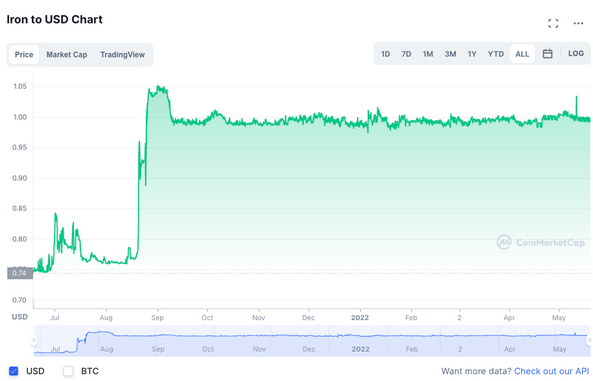
There was a similar perverse incentive underlying Terra’s death spiral.
In March 2022, perhaps spooked by market volatility and the threat of rising interest rates, Terraform Labs decided to part-collateralise UST with other assets. It bought $2.4bn of BTC and smaller quantities of USDC, USDT (issued by Tether) and Binance’s native coin BNB. The new reserves would be managed by a separate not-for-profit organisation, Luna Foundation Guard. So, instead of a simple arbitrage between fixed and floating price assets issued by the same organisation, the stabilisation mechanism now had another element: third-party assets.
The purpose of the new reserve was to provide a last-resort backstop for UST. Luna Foundation Guard’s website explains:
“In an event where the market price of UST materially deviates from the USD peg, holders of UST will be able to close the arbitrage and bring the market price of UST back to the peg by swapping UST for major, non-correlated assets like BTC that capitalize[sic] the reserve.”
The problem with this is that the supply of third-party assets is not infinite. Once they have been sold, there is nothing left to defend the peg with, so the price sinks to its natural level. For an algorithmic stablecoin whose equity coin is already worthless (otherwise it wouldn’t have sold its third-party assets), that is zero.
Far from instilling confidence by giving UST holders an exit route, the new reserve actually destroyed confidence in the stabilisation mechanism. It signalled to the markets that UST/Luna arbitrage could not be relied upon to maintain the USD peg. On the contrary, it hinted that Terraform Lab’s creditworthiness was effectively junk and that UST was far overvalued at a unit price of $1. That meant Luna’s price should be close to zero.
As for traders with deep pockets, the new reserve dangled a valuable carrot. If they could force UST far enough off its peg, they could exchange UST for BTC at fire sale prices. All they needed to do was crash the price of Luna, and they knew how to do that: exchange UST for new Luna, immediately sell the new Luna for UST, then exchange the UST for more, new Luna…rinse and repeat. Once Luna’s price was close to zero, Luna Foundation Guard would allow them to exchange their depreciated UST for BTC – at par because the whole point of the sale would be to restore the dollar peg. It would be free money.
Of course none of this is really all that exceptional.
Since 1934, the US government has operated an Exchange Stabilization Fund (ESF) for the purpose of stabilising the value of the US dollar. It does this by absorbing or releasing SDRs, and other assets, from the fund in line with stated dollar valuation policy objectives – often vis-a-vis volatile exchange rates of those countries it wants to help.
In 2020, it was the ESF which provided the equity boost the Federal Reserve needed to fund $454bn of lending programmes, which were later expanded into $4tn worth of lending capacity. Or what the crypto world might call “minted” into being.
But the reason the ESF works as a stabilisation mechanism for the dollar and algo stablecoins do not, is because unlike its crypto competitors the fund is ultimately backstopped by the US government and its ability to always raise more capital through the taxing process.
That is an essential lifeline cryptocoins will never have, and why they will always be disadvantaged relative to fiat.
Regulatory fallout
Policymakers and regulators will now be poring over the debris of the stablecoin market – which has ruptured crypto confidence far and wide – to try and figure out what lessons can be learned from the debacle. Some will argue the incident proves crypto must be better regulated. Others will see it as a contained crisis which at least brings some semblance of caveat emptor and moral hazard back to the market. “Let them fail,” being the attitude at hand.
When making heads or tails of the fallout, however, few will home in on the key issue at hand. It is that the Luna/Terra relationship, managed by Terraform Labs, operated very much like the classic relationship the board of a bank manages between its equity and debt capital.
The only difference being that, unlike a bank, which has a vertically integrated structure and safeguards on how much equity it can bring to market at any given time, the Luna/Terra capital pools were unbundled, visible to everyone and entirely open-ended.
Equally important and again unlike a bank, Terra’s dollar-pegged liabilities were guaranteed in theory but not necessarily in practice.
It was Anat Admati, professor of finance and economics at Stanford University, who was one of the first to highlight that it was banks’ reluctance to draw on equity funding in the good times and only tap it in the bad times that helped generate their own death spirals in 2008. At the time, most banks considered equity financing deeply expensive, because it had to compete with the relatively very low cost of debt financing, they benefited from as licensed institutions that could take funding from depositors. Shareholders, too, demanded exceptionally high returns on equity from banks relative to corporations in other industries, which could only be achieved by means of exceptionally high leverage.
What market value banks could skim from high leverage was thus instinctively returned to as small a group of equity investors as possible.
What this resulted in was a scenario where share buybacks and dividends – the hallowed return on equity – became industry benchmarks for top performing banks in the good times. This was when debt financing and liquidity was free flowing and plenty.
When the economic environment shifted, and debt financing suddenly became scarce, the extraordinarily thin “equity cushion” banks were relying on became brazenly insufficient. It was at this point – during a similar death spiral for the value of bank equity – that banks took to issuing stock to help bolster and support their capacity to meet depositor redemptions, and in their own way not to break a buck on the sums they owed them.
The problem by this time was there was no one out there willing to buy the equity. Bank stock prices tanked and the ability to support bank liabilities tanked with it.
Eventually, as is well known, it took the public balance sheet in the form of equity injections to come to the rescue of distressed banks to stabilise depositor outflows and reassert the depositor “peg” – this being the ability of depositors to withdraw all of the money they held at the bank and not just bits of it.
In this way, the mechanics and forces at play in the 2008 crisis are a violent reminder of those at play in 2022 in the stablecoin market.
Narrow banks in disguise
One of the reasons this reprise in crypto markets was not immediately obvious was because of the tendency of the crypto market to invent new systems in name only. It’s a sleight of hand that has long obscured the reality of what really underwrites so many crypto offerings. Notably, pre-existing financial structures or systems that are merely being rebranded as being new or highly innovative when they are not really.
To the experienced eye, it would have been immediately obvious that collateral-backed stablecoins were equivalent to a host of other pre-existing financial products from MMFs and ETFs to Venmo and PayPal. What all of these had in common was that they represented a form of narrow banking.
Narrow banks are otherwise known as “full-reserve banks”. They are beloved by hard money enthusiasts, goldbugs, and Austrian School economists. However, in practice, they are expensive to operate and stifling to economic growth.
Algorithmic stablecoins may have looked exotic and new by comparison. But they too were just another manifestation of structures that had come before. A good legacy equivalent is that of synthetic ETFs or Exchange Traded Notes (like those recently halted by Barclays). Such synthetics differ from collateral-backed ETFs (like the SPDR) – in very similar ways as Terra differs from Tether.
In most cases, these equivalents rely on both market confidence in the underlying issuer and the algorithm that prices their implied “net asset value” to keep the units tracking specific indices or assets.
But what’s really doing the hard work behind the scenes is often nothing more than a “dumb” contract, usually a total return swap or a bond, which uses the credit relationship it establishes between the issuer and the buyer to synthesise the tracked performance of a targeted asset.
How the issuers invest the proceeds raised from the issuance of their notes or units, meanwhile, remains entirely discretionary. What matters for the performance of the notes is the good standing and credit of the issuer bodies. That appears to have also been the case with Terra.
For as long as Terra went uncollateralised, whether the market appreciated it or not, the whole thing wasn’t backed by an algorithm, but by the creditworthiness of Terraform Labs. More specifically, it was backed by the capacity of Terraform Labs’ ability to keep tapping a favourably-priced equity market whenever it needed to by way of continuous issuance of Luna coins.
The real-world equivalent would be if a Blackrock ETF tracking the dollar accepted creation baskets made up of Blackrock shares, on the basis that $0.99 of ETF shares entitled holders to $1’s worth of Blackrock shares in return. Or alternatively, $1 worth of Blackrock shares entitled holders to $1.01 of ETF share.
That the market trusted this group at all is the strange thing, given the history of the issuer.
Where’s the credit risk?
Terra isn’t the first stablecoin created by Terraform Labs – and it isn’t the first to fail, either. In November 2020, a pair of Terraform Labs coders (performing under the pseudonyms “Rick” and “Morty”) issued an algorithmic stablecoin called Basis Cash (BAC). This was modelled on an earlier algorithmic stablecoin called Basis (previously Basecoin), which was abruptly shut down in December 2018 when its CEO realised that U.S. securities laws would apply to its tokens.
Basis Cash’s stabilisation mechanism relied on a complicated system of bond and share issuance and buybacks. When the BAC stablecoin’s price dropped below $1, the smart contract would issue bonds for sale at the price of 1 BAC, thus withdrawing BAC from circulation. Assuming market demand for BAC did not fall, the reduced supply would, in theory, raise its price to the target $1.
Conversely, if the price rose above $1, new BAC would be issued, firstly to bondholders to redeem their bonds at par, and secondly as a dividend (“seigniorage”) payment to holders of Basis Shares. Again, assuming market demand for BAC did not fall, the increased supply of BAC would, in theory, reduce its price to $1.
But Basis Cash fell off its peg almost as soon as it was issued, and never regained it. By the end of January 2021, it was trading at only 30 cents. Today, it is worth less than a cent.
This was not the only algo coin to fail. Empty Set Dollar, also based on the original Basis design, was launched at the end of August 2020, It lost control of its peg in December 2020, and by the end of January 2021 was trading at only 19 cents. Like Basis Cash, it is now worth less than a cent.
Similarly, Terra’s stabilisation mechanism was derived from the original Basis design, and the IRON stablecoin that spectacularly crashed in June 2021 relied on a comparable stabilisation mechanism.
It’s not really surprising that stablecoin issuers keep going back to essentially the same model: people have been fascinated by perpetual motion machines since time immemorial. No one, however, has ever succeeded in making one, because we live in a world of change, and perpetual motion machines only work if nothing ever changes.
In Terra’s case, a change intended to make the machine more stable in fact destabilised it, because it distorted the financial incentives on which the mechanism depended. That being said, if the creation of the new BTC reserve hadn’t destabilised it, something else probably would have.
If it’s financially secure, it’s usually not profitable
So, what was the impetus for issuers like Kwon to focus on these innovations? For the most part, it was probably the realisation that conventional stablecoins – due to their similarities with narrow banks – are exceedingly low-margin businesses. In a lot of cases, they may even be unprofitable.
This is because managing other people’s money prudently and in a way that always protects capital is actually really hard. Even if those assets are fully reserved, some sort of outperformance has to be generated to cover the administration costs. The safest way to do that is to charge fees, but this hinders competitiveness in the market since it generates a de facto negative interest rate. Another option is cross-selling some other service to the captured user base, like loan products or such the like. But this gets into bank-like activity.
The bigger temptation, therefore, at least in the first instance, is to invest the funds in your care into far riskier assets (with far greater potential upside) than those you are openly tracking.
History shows that full-reserve or “narrow” banks eventually become fractional-reserve banks or disappear. For example, the UK’s Trustee Savings Banks were full-reserve banks specifically created to encourage the poor to save. They were prevented by law from lending and obliged to back all customer deposits with government debt or deposits at the Bank of England. Depositors were guaranteed redemption at par. TSBs were philanthropic institutions, so there wasn’t a great drive to make profits. But even so, there were repeated attempts to change the law to allow them to lend.
In 1975, concerned that TSBs could not compete with lending banks that could offer higher interest rates to depositors, the government gave them the power to lend. Although, once they could lend, they were no longer distinctive. They failed to make headway in the consumer lending market, and deposits gradually slipped away. In 1984, the TSBs (with the exception of Airdrie Savings Bank) were merged into a single corporation. And in 1986, the corporation was floated. However, it did not survive long as an independent institution. In 1995, it merged with Lloyds Bank. Airdrie Savings Bank survived for longer, but finally closed its doors in 2017.
“The TSB” was re-floated by Lloyds in 2014 and now exists as an independent bank though it is no longer a full-reserve bank. It’s just a medium-sized fractional reserve bank. The only full-reserve bank now remaining in the U.K. is the government-owned National Savings & Investment (NS&I).
In the crypto world, the reserved stablecoin USDT is a case study in how full-reserve banking morphed into fractional reserve as its issuer, Tether, tried to find a way of making profits. Originally, Tether advertised USDT as fully backed by actual dollars: “every Tether is always backed 1-to-1 by traditional currency held in our reserves,” said its website. But in 2019, the website changed. No longer was every Tether backed 1-to-1 by traditional currency. Instead, it was backed by a variety of assets, including opaque third party loans and loans to affiliates:

We now know that the “loans to affiliates” were a loan to Tether’s sister exchange, Bitfinex, to keep it afloat after it lost $850m in the failed shadow bank Crypto Capital Corporation. But the nature and extent of its third party loans remained opaque.
Tether now produces monthly attestation reports disclosing the extent and nature of its assets. The latest one, issued in May 2022 for a reporting date of March 31 2022, reveals that its assets are a mixture of cash, government debt, corporate debt, precious metals, and cryptocurrencies:

The value of issued tokens is US$82,188,190,813. So USDT is now to all intents and purposes fractionally reserved. Furthermore, the statement of consolidated assets reveals that Tether’s equity is less than 0.2% of total (unweighted) assets. So, much like pre-2008 shadow banks, it is extremely highly leveraged.
When Terra failed, there was a general sell-off in the crypto market. The fully-reserved stablecoins USDC and Binance USD rose above their dollar pegs as investors piled into them to stop their losses. But USDT fell off its USD peg too. In fact, it sold off as if it was a risky asset. This was partly because of confusion between USDT and UST but it also reflected the market’s view that a fractionally-reserved stablecoin is more risky than a fully-reserved one. USDT is used as a medium of exchange, but not as a safe store of value.
There is now a strong push from both regulators and crypto insiders to force stablecoin issuers to become “narrow banks”, like the Trustee Savings Banks.
Writing in Risk magazine, the IMF’s Manmohan Singh and Caitlin Long, CEO of Custodia Bank, argued that stablecoin issuers should back their coins with central bank deposits and short-term government debt. Although such an arrangement would undoubtedly be safe, it would, in effect, make reserved stablecoins public sector institutions, dependent on the government for income and unable to diversify their offering to improve shareholder returns. It might be simpler for the central bank to issue a stablecoin itself for use in blockchain-based payments systems.
However, stablecoins don’t have to be backed with risky assets to generate income. Circle’s USDC is widely used as collateral for crypto lending. Meanwhile, several crypto companies have attempted to create lending products using pledged and deposited stablecoins. Nevertheless, the legal status of these products is unclear: the SEC and several states are pursuing legal action against at least two lenders for failing to register their products as securities, and Coinbase was forced to pull its Lend product before launch when the SEC threatened legal action if the launch went ahead.
If the stablecoin issuer owns a lender, it can make money from lending while providing the stablecoin free of charge.
Terraform Labs, issuer of the failed UST stablecoin, owns a crypto bank, Anchor Protocol, and an investment platform, Mirror Protocol. UST is the native token of both platforms, and on Anchor, Luna is used as collateral for lending. Both have publicly traded “governance tokens”, aka shares. Sounds familiar, doesn’t it?
When UST and Luna were doing well, Anchor and Mirror generated income for Terraform Labs. But now, of course, there isn’t any income. There’s only a huge pile of worthless tokens and unrecoverable loans, and the share prices of the two platforms have crashed to nearly zero.
What few clocked was that there was a run on Anchor Protocol at the time of Terra’s collapse. It was led by the crypto bank Celsius, which had deposited half a billion UST with the crypto lender. All remaining depositors will have lost almost all of their money, not because Anchor is bust (though it probably is) but because UST is.
When a stablecoin dies, the ecosystem that depends on that stablecoin dies too. Trying to generate income from stablecoins carries significant risks: a sudden spike in redemption demands for either a fractionally-reserved or algorithmic stablecoin which, in turn, can collapse the whole house of cards; runs on crypto banks can also knock stablecoins off their pegs.
However, ecosystems built on stablecoins fully-reserved with safe assets or issued by a public institution backed by a tax-raising fiscal authority, would be at much lower risk of failure. This, of course, is why in the conventional system, money is publicly issued by a central bank and backed by a tax-raising fiscal authority. Do we really need to make the mistakes of the past all over again to prove this point? Apparently, the answer is yes.
What has happened before will happen again
When Jonathan Ford, former FT editor who now fronts the “A Long Time in Finance” podcast first heard about the Terra debacle, his market knowledge brought up another worthwhile analogy from the past.
“If you want to go right back in history, get a book called Chapter of Erie about the way American entrepreneurs financed the railways,” he told TBS in an email. “Railroad companies would raise equity to build a line. The directors would then lend the companies lots of money that was convertible into shares. They would then issue a series of disastrous announcements (railroad construction delayed, a rival opening a competing line) so the price collapsed. They would then convert their loan stock into equity and take control of the venture. The bad news would mysteriously disappear.”
The death spiral risk associated with such revolving-door equity-to-debt conversions eventually became well understood. Today, the issuance by corporates of “non-fixed conversion ratio convertibles” is usually considered a red flag for investors.
“There was a time when more established companies would issue convertibles with a non-fixed conversion ratio, but I think it has become more unrespectable now, largely because there is a strong boiler room flavour to most death spiral financings,” Ford said.
Craig Pirrong, a derivatives expert at Houston University, had another historical analogue in mind. He likened the Luna affair to the time Enron, the energy-trading behemoth with a penchant for financial engineering, blew up under the weight of its own hubris in 2001.
Peak Enron madness involved the company’s then CFO, Andy Fastow, structuring a slew of Special Purpose Entities (dubbed the “raptors”) to take advantage of what was still a massively inflated stock valuation to recapitalise the company’s increasingly underwater assets. Eventually, the system gobbled itself up:
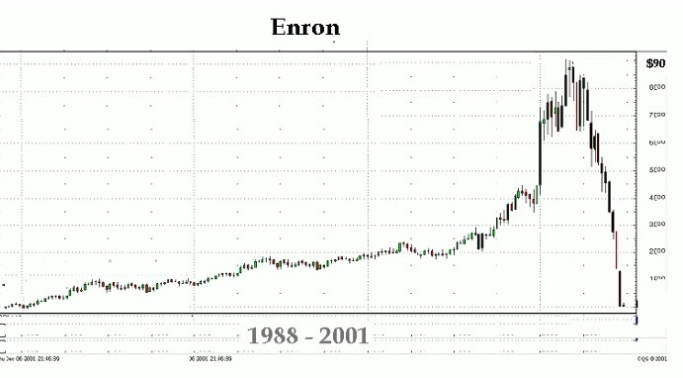
Compare and contrast with:
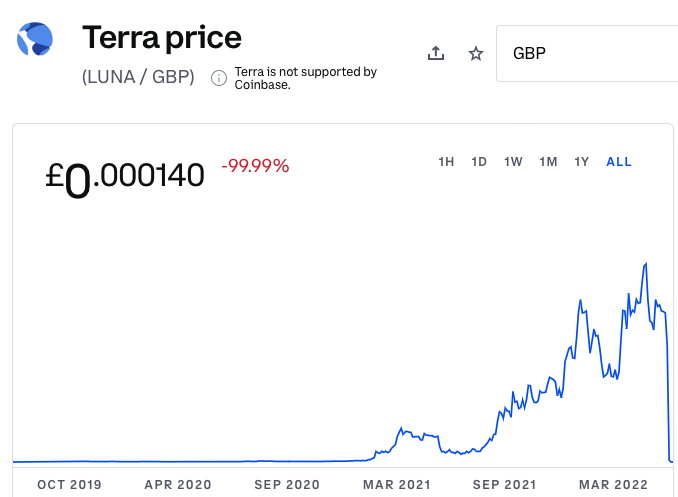
As Pirrong notes (our emphasis):
“The crashing Luna increased the incentive to liquidate TerraUSD which accelerated the downward spiral. If this problem sounds familiar, it should, and is another illustration of nothing new under the financial sun. Anybody know what I’m thinking about?
That’s right. Enron. Enron set up various special purpose entities in which it placed dodgy assets. Enron protected investors in the SPEs by promising to sell Enron stock to cover losses. When the losses crystalized, Enron had to sell more and more stock, driving down its stock price, a process that eventually resulted in Enron’s messy demise.
The analogy isn’t exact, but it surely rhymes. A scheme intended to prop up the value of one thing by promising to sell more of another thing is inherently unstable because performing on the guarantee undermines the value of what you are guaranteeing it with (because you have to issue more of it), which makes the guarantee worth less, which creates incentives to run to cash in on the guarantee while you can, which triggers a lot of issuance of what you are guaranteeing it with, driving down its value.”
That, however, was not the only notable similarity between Enron and Luna/Terra. Enron was also known for being a hub for financial engineering and experimentation, in many cases inventing entirely new securities – like weather derivatives – from scratch. The people Enron employed, meanwhile, were colloquially referred to as “The smartest guys in the Room” due to their geek credentials and capacity to always find a quick way to make a dime.
In fact, what Enron taught us was that “smartness” is not necessarily correlated with a broader understanding of how human systems operate. Sometimes geeks bearing financial weapons of destruction also bring chaos, not because they’re stupider than they thought, but because they so often fail to understand that not everything can be reduced to a formula or an algorithm in a social system. The lesson from the Terra/Luna debacle is not too different.
In an irony of ironies, Vitalik Buterin, the creator of the Ethereum network, is now recommending deposit insurance for stablecoins, with FDIC as a reference model.
For many it will be entertaining watching the crypto industry re-running the history of finance on fast forward. Sadly, the collateral damage is increasing with every fallout…and this is all so unnecessary.
Going through the motions yourself is often a valuable learning exercise. We urge our children to learn by having a go and getting things wrong as well as right. But sometimes, it also pays to trust those who have come before us. They’ve been throught it all before.
Very rarely is there anything truly new to be found under the sun. Technology evolves, but basic human instincts, responses and emotions remain the same. Since finance is a social system, those forces influence technological innovations in the field, not the other way around.

One Response
Thank you…..love the long form, when I have the time to read them.