
TLDR: The eurodollar-paradigm may be at risk if Western institutions can no longer afford to keep financing commodity trades due to self-reinforcing inflationary pressures. The crossover to countertrade, and prefunded letters of credit, might then come pretty quick.
All markets need financing. Commodities are no exception. But the sector does come with its own unique quirks, and these are probably worth paying attention to in the current volatile environment.
As it stands, physical commodity traders (especially intermediaries like Trafigura, Glencore, Vitol etc) draw trade finance in three key ways: letters of credit (LCs), open credit, or prepayments.
The last of those, prepayment, is probably the most resilient in current market dynamics, but it’s also the most costly. That means, currently, it’s the least common of the three.
The second, open credit — where a company vets another company and a bilateral credit line is established — is pretty common but not always practical. Open credit lines are usually only established between counterparts of equal standing (say two FTSE listed commodity houses/producers), meaning they’re not all that suitable for exotic deals in tough trading environments.
LCs — which tend to be used in specific transactions or cargoes where there are counterparts of varying quality in the chain — are probably the most common. But they also come with their own unique issues.
To understand those issues it’s first important to explain how LCs fit into the trading picture.
In normal circumstances sellers demand LCs so that in the event of a default by the buyer or intermediary they can still get paid by the bank, despite having relinquished title to the underlying commodities they have sold (because the commodities are in transit).
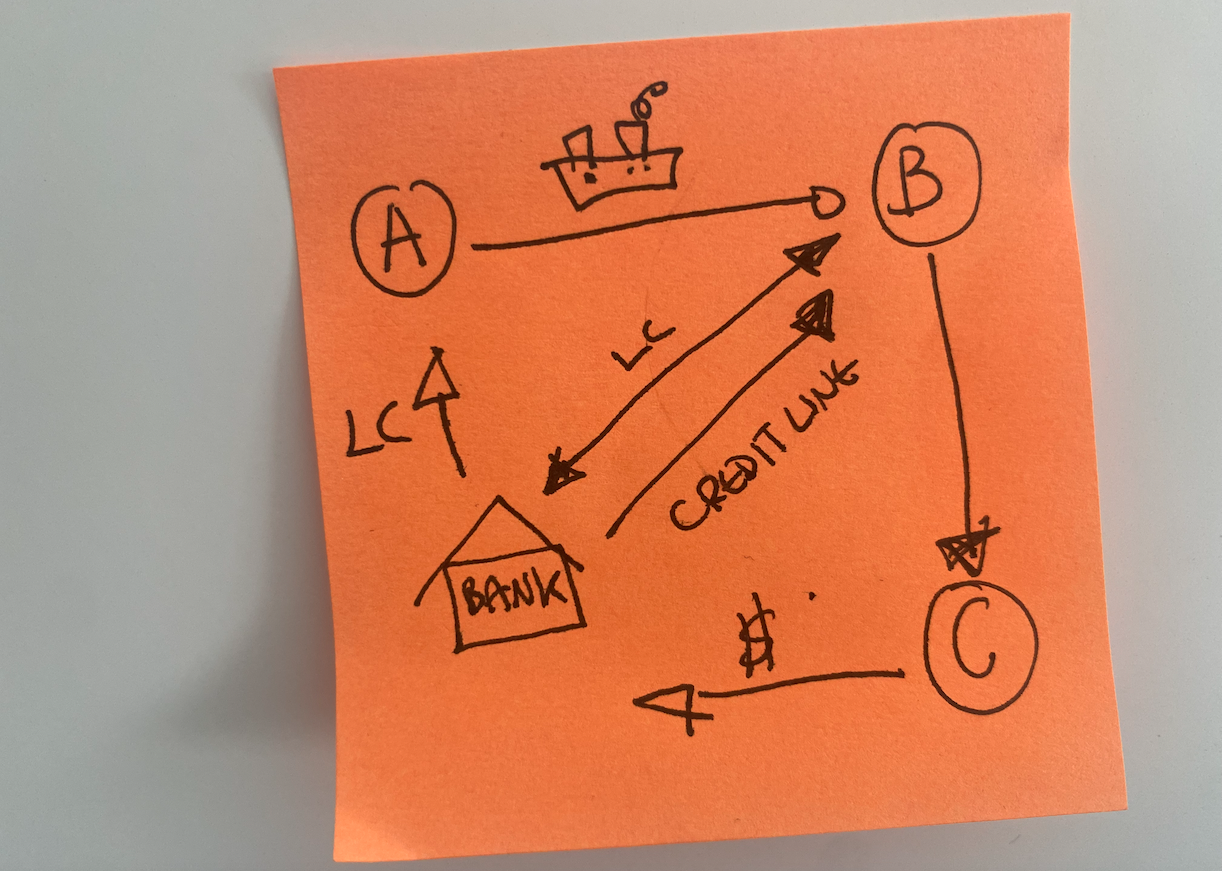
Before a commodity trading firm can get an LC from a bank, they also usually need to establish a revolving credit facility with a banking institution. The size and scope of that facility is a function of the creditworthiness of the intermediary as well as the breadth and scope of their activity. No surprise there.
But when markets are as volatile as they are now, it’s not as simple as just going to the finance market as and when needed. So while news reports may be focusing on the likes of Trafigura needing additional financing to meet margin calls, what many are missing is that loading up on more “credit” doesn’t necessarily address the broader breakdown in some of these credit relationships.
Key to this breakdown is that as the price of commodities goes up, so does the respective cost of doing business. Unsurprisingly that puts existing credit facilities under pressure as high prices eat up capacity quickly. When capacity is constrained, LCs can’t be issued. The commodity trade itself grinds to a halt.
The question that needs answering then is why would banks be reluctant to extend credit lines further, leaving commodity houses like Trafigura having to go to non-bank players like private equity groups for further assistance?
A large part of a answer may be related to the interplay between hedges, letters of credit, and credit facility utilisation rates.
As one informed market participant told me:
When a trading house gets a credit line from a bank they have to ensure a high utilisation rate of that line, because banks tend to operate “a use it or lose it policy”.
So if you have $1bn but only use 20%, they will reduce it in time.
In a scenario where a commodity trader has a $1bn line, and oil trades at $100 and they buy 8m barrels, that means they only have about 20 per cent left of the line to fund initial or variation margins on any hedges.
The vast majority of commodities bought by intermediaries are sold within 60 days, meaning the hedges are bought back within 60 days too. So it’s pretty rare in the course of an open 60-day deal for the price to experience a five sigma event.
And here’s the key point:
If a prudent trader was to reserve 20% of their line for hedging fluctuation purposes (and margin calls), the vast majority of time a huge chunk of the line would never be used. In that scenario, banks would start pulling the lines.
That implies current banking practice could be throwing gas on an already out of control fire.
It also suggests that unless a financier is prepared to be more forgiving about the utilisation rates they accept from commodity houses (or what might also be described the unutilised “reserve”), the amount of volumetric business that can be done in the economy as a whole could be diminished — leading to further shortages, bottlenecks and further price rises.
So what are the conditions that would cause a bank to stop extending credit in such an environment? Is it a fear that there could be a systemic spillover into other things if commodity prices remain as volatile as they are today? Is it a fear that volatility is only going to get higher? Or is it some arcane Basel III ruling about how unutilised credit facilities impact banking leverage ratios and have to be accounted or booked vis a vis derivatives and other exposures?
What seems evident either way is that banks need a hell of an interest rate incentive — especially given the still relatively low cost of dollar funding — to be tempted back into the market at the moment.
As an example, Peabody, a coal producer with an A- rating, is having to pay Goldman 10 per cent on their new facility. Yes, Goldman knows Peabody are struggling to cover their hedges and are in no position to dictate terms (even if they could eventually sell inventory into the market to raise cash). And yes that makes Peabody exploitable (so there may be some opportunism in play).
But even the proverbial Vampire squid are pragmatic enough to know that gouging long-term clients opportunistically is self-defeating in the long term. Goldman are also shrewd enough to know nobody benefits from the negative feedback loop that the introduction of these sorts of interest rates might induce across the board.
After all, if banks are only prepared to offer 10 per cent deals, commodity prices will inevitably have to rise to cover the additional costs of financing. This fact alone throws further fuel on already sizeable inflationary pressures. Paying 10 per cent for a reserve you might not even use, meanwhile, in only going to encourage higher utilisation rates still — leaving little wiggle room for future shocks or margin calls.
In the first instance all of the above opens the door to more and more inflation. In the second instance, it opens the door to the creation of arbitrages that nobody can afford to close — and prices having to get even further out of whack just to justify bringing any commodities home at all.
If that reminds you of the old cross-currency basis swap conundrum in money markets, where covered interest parity — which used to be considered a physical law in international finance — ended up being inexplicably violated for long durations of time, you wouldn’t be the only one.
The mechanical issues are not dissimilar.
As Borio, McCauley, McGuire and Sushko noted on the parity issue in 2016:
A growing demand for dollar hedges on the part of banks, institutional investors and issuers of non-US dollar bonds has put pressure on the basis. At the same time, limits to arbitrage (in the sense discussed by Shleifer and Vishny (1997), among others) have become more binding. These reflect lower balance sheet capacity because of tighter management of the risks involved and the associated balance sheet constraints. Empirically, we find that proxies for the volume of hedging demand, together with proxies for balance sheet costs, help explain CIP violations, both across currencies and over time. If the factors we identify are the right ones, CIP deviations look to be here to stay even in non-crisis times, as long as the demand for currency hedges is sufficiently high and imbalanced across currencies.
As they also noted a key driver of this market weirdness was the shift from unsecured to secured funding sources, notably repo markets, in the aftermath of the global financial crisis.
Commodity trade finance is, of course, the ultimate secured form of finance. And perhaps the fact banks have become resistant to keeping credit lines open that aren’t being utilised is a factor of the same phenomenon.
What is clear is that the commodity market has been de facto absorbing that risk directly instead — perhaps without even knowing it.
What is also clear is (if the cross-currency basis swap market is anything to go by) arbitrage windows might have to get fairly enormous to justify players coming into the market at all.
It’s also worth noting, this is quite different to the last great oil arbitrage abberation which occurred when the differential between Brent crude and WTI crude couldn’t be closed out because of physical storage constraints at the WTI delivery point in Cushing Oklahoma. Back then prices had to get to the point where trucking oil to other locations throughout the United States made economic sense.
This time round, it’s worth considering that it might be dollar funding itself that might become the critical constraint.
None of this is good for supply, prices or inflation. Or, for that matter, dollar hegemony.
What it does imply to my mind, however, is that countertrade and prepayment might be about to make a huge comeback.
And if you think it’s unlikely that things could just flip from funding to not funding these sorts of trades, it’s worth (as usual) looking to history.
Here’s a worthwhile snippet from an old John Dizard piece in Fortune Magazine from February, 1983 entitled The Explosion of International Barter (my emphasis):
“The new countertraders have become big time as the business has gone from a regional pecularity to a worldwave wave. Petar Jankovi of Alcon Ltd, a London-based East European trade specialist says, “the basis for countertrade with the East was bureacratic inefficiency. The basis for the new countertrade with the Third World is the cutting off of bank credit. The banks have gone from lending on anything to lending on nothing.” The Third World trade also involves more commodities and fewer hard-to-sell manfucatured goods. It requires more money, more staff, and wider contacts than the Viennese have developed up to now. So companies such as GM, Sears, Phibro-Salomon, and Citicorp have recently moved into the vacuum.
But as it also warns:
Even barter transactions require banking. “You don’t stand on one side of a border and shove wheat over as they hand you vats of chemicals,” a Viennese countertrader points out. “You take their goods, sell them, put the cash in a blocked account, and then use the cash to fund a letter of credit.”
Hello stablecoins!

6 Responses
Hey Izabella, Peabody’s secured bonds are currently B3 rated (agencies most certainly a lot behind the curve), yield-to-call 1 year is just above 5%. So if the GS line is unsecured, still a nice trade for them, but at least looks a lot less outrageous.
That’s very interesting. Thanks for that context. Even so, it seems at the moment there’s no offer at all on any extensions. (If FT reporting is correct about the group wide efforts to try and get government help to secure financing.) also I think the potential interest rate escalation/inflation risk in terms of covering interest rate cost in margins remains as described.
I’m coming to the conclusion there are only three possible pathways:
1) prepayment (least attractive option and would lead to terrible price escalation at the retail level.)
2) unwinding of some leverage ratio rulings and other regulatory constraints that see the vol risk transferred to banks. Possibly palatable with a govt guarantee.
3) National intervention or the creation of state sponsored traders.
Excellent and thought provoking, as always.
Just a small suggestion. While the blog is still young, you might want to start putting together a little glossary of terms/list of key concepts that new readers (or those who might be less familiar with the subject matter) might refer to, or might point out to when discussing your blogs with third parties that might be a bit less familiar with some of the terminology.
Thanks for the feedback! And yes good idea.