
Online grocery shopping feels more efficient. It also looks easier to do. But is it? Is it really?
True efficiency adds to productivity. In the classic textbook sense of productivity, that means for every x input you get ever more y output.
For supermarket businesses, productivity translates into being able to achieve the exact same outcome (a wholesome and happy weekly shop which allows all consumers to get exactly what they need and desire for the lowest price possible) using as little capital/labour as possible or while increasing margins.
If online shopping really created efficiencies, however, stores that were first to offer such services would have out-competed rivals in ways that either lowered their capital intensity, returned more capital to investors, returned savings to customers or allowed for much broader expansion.
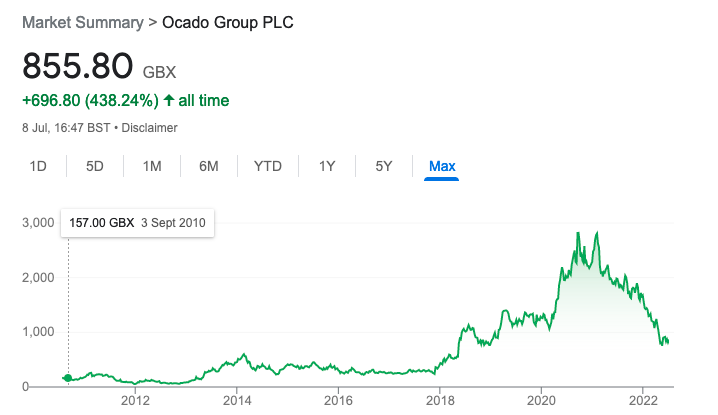
But while Ocado and the online shopping it facilitates has expanded greatly in the 12 years since it listed on the London Stock Exchange, the practice has done little to lower capital intensity across the industry.
As the Sunday Times noted on June 12:
In its 12 years as a public company, Ocado has racked up £2.6 billion of capital expenditure and generated cumulative pre-tax losses of £484 million. Analysts estimate Ocado will make a negative return on capital employed of 9.7 per cent this year, compared with a 7.4 per cent positive return at Tesco. Traditional supermarkets, meanwhile, refuse to disclose the profits (or lack of) churned out by their web businesses, leaving many analysts to conclude they are barely breaking even.
“The whole market has been an abject failure when it comes to return on invested capital. If supermarkets had set out 25 years ago that these are the returns we will get [online], they wouldn’t have even bothered,” said Shore Capital analyst Clive Black.
Rather than making supermarkets more productive, online shopping may be more akin to a luxury service that can’t actually charge much of a premium.
The only way to make returns, therefore, is through hyper-scaling — which translates to becoming an oligopoly or a monopoly. Not something regulators are usually fond of.
To figure out if things in online grocery really are that dour, we spoke with Bruno Monteyne, a senior analyst covering European food and household, personal care and cosmetics at Bernstein Research as well as William Woods, Bernstein’s European food retail and food delivery analyst.
For the most part, Monteyne’s view — supported by Woods’ — was that the sector’s infinitesimal margins are a reflection of the infinitesimal margins in the supermarket business as a whole. As he noted to TBS:
Grocery ecommerce from the old Ocado style point of view a high asset turn business. If you do it well, you can turn your capital three times better. But given that the industry never makes an excess return (it never makes an excess return because there’s no proper differentiation because you go from the nearest to the cheapest), if you’re lucky supermarkets makes 4-5 per cent Ebit margin and online makes 1-1.5 per cent. That might sound miserably low, but from a returns point of view it is as good or as bad as the old world. So that’s sort of the best to achieve. But this does assume you’re at scale.
There are companies like Walmart, says Bruno, that weren’t doing online right or not at enough scale. Covid, however, in many cases gave them the opportunity to scale and learn. The business is still margin dilutive, says Monteyne, but this reflects “the miserable nature of food retail in general”.
Tesco and Sainsbury have improved their profitability to a 3 per cent margin in some cases, says Woods but that’s mainly due to better drop density (delivering more orders in a smaller amount of space).
From Monteyne’s perspective, however, it’s not all bad news. Even if online grocery can only deliver a 1-1.5 per cent margin, it can still operate at a much higher scale than conventional bricks and mortar stores. “A store you can only scale so far,” says Monteyne. “Bigger ecommerce centres become more efficient. So if you have more economies of scale than you had before, and you have the margin, that tells you that as consumers shift online and retailers follow, this will accelerate consolidation in grocery retail.”
Historically regulators have obstructed supermarket consolidation at every opportunity. But according to Monteyne in the age of Amazon something might have to give. “Amazon can kill everybody but a grocery store can’t buy anything. It makes no sense.”
“My own personal view is that there will only be three big supermarkets in 10 years time,” he told The Blind Spot.
Not that that should include Amazon. The world’s largest online retail platform has failed to make significant strides in the grocery sector and if anything, he notes, is pivoting to trying to sell instant check-out technology in white-label form to incumbents.
Instant grocery delivery death?
Both analysts were much less optimistic about prospects for instant grocery companies like Gorillas. If the big supermarkets can’t achieve more than a 1-1.5 per cent margin on a very large scale basis, the chances of Gorillas, which is even more labour intensive, being able to maintain a competitive advantage is extremely small, they said. The unit economics, for now, simply don’t work. The company is struggling to be profitable on a single order basis and yet, despite its labour intensity, has had to cut jobs to conserve cash in the last few months. It is now looking to collaborate with large retailers, like Casino, to survive.
Most recently it announced the closure of its Italian business, after struggling to find a buyer for it.
The only way instant grocery might survive, according to William, is by adding significant markups on goods. In a cost-of-living crisis, however, that is unlikely to be a winning strategy — especially in a sector that is as famously price-competitive as grocery.
The only other potential rescue for the model, says Woods, is leaning into labour arbitrage. But that’s not going to happen in the West:
“If you look to Delivery Heroes, they are profitable in Saudi Arabia in the Middle East. And that’s just because they basically play labour arbitrage on the low cost of migrant labour. I think it’s pretty hard to make that 15-minute delivery profitable without charging significant delivery fees in the medium term.”
To us, the above is a clear admission of the fundamental master-serf dynamic of online (and especially instant) grocery business as well as its fundamental regressive nature.
None of which should be news to legacy readers of FT Alphaville, the former home of this author. Some readers might remember the time she signed up to be a Deliveroo rider to expose the fully regressive nature of the industry.
Clearly Gorillas boss, Kagan Sumer, missed the video:

4 Responses