The below is a repost from the Blind Spot’s pop-up venture, The Peg, which was first published on December 11, 2025.
In September 2015, wedged into the back of a Shanghai taxi, a young mathematician and his co-founder began to sketch out a strange, expiry-less futures contract to solve a nagging problem on their crypto exchange.
That invention was the perpetual future. It has since grown into crypto’s dominant derivative, despite remaining mostly unheard of in traditional financial circles.
In recent weeks, a few observers have begun to notice that the instrument is gaining influence over the evolution of the modern financial system. But the commentary remains narrow and dismissive. Significantly, it fails to frame the tool in the context of three other major structural shifts: the return of scarce-reserve operating regimes in central banking, the demise of unsecured funding as an emergency source of liquidity, and the growing cost of funding the international dollar payments float.
Against that backdrop, the rise of stablecoins has created a new source of fully collateralized, short-term dollar funding. And yet, strikingly, no central authority influences the pricing and settlement of that liquidity at the margin. For now, the system self-clears mostly through funding rates derived from perpetual futures, wherever stablecoins are traded.
Fascinatingly, while it took years of analysis, consultation, and development by a committee of many official bodies for the official system to create a viable successor to the London Interbank Offered Rate (LIBOR), the funding rates derived from perpetual futures — which now clear trillions of dollars of stablecoins daily — emerged entirely organically.
All this comes as an academic debate rages between central bankers over the best way to reduce the role of unsecured Fed Funds in both transmitting monetary policy and pricing marginal liquidity. Fed officials know the old system no longer makes sense. But no one yet agrees on which market rates a new operational framework should be structured on.
And yet, if the history of LIBOR and eurodollar markets is any guide, the true cost of marginal dollar funding is always at the intersection of official and unofficial systems. Since stablecoins are the new “secured” eurodollars, that suggests the most accurate, real-time indicator of systemic funding stress could emerge to be the funding rates that help clear those systems.
The idea that perpetual futures now hold the key to absorbing, pricing, and alleviating liquidity pressures that traditional mechanisms can no longer handle gracefully, however, continues to evade central bankers.
With all these factors in play, it’s worth looking back at how these instruments came to be and the problem they were initially created to solve. Below is that story, told from my unique vantage point covering the crypto industry from its earliest days.
At the center of the narrative is Ben Delo, the finely spoken Oxford-trained mathematician who co-founded the Hong Kong-based BitMEX exchange in 2014 with Arthur Hayes, a straight-talking American from Detroit, and Samuel Reed, another American, albeit the least public-facing of the group. The trio gained international notoriety in 2020 when U.S. authorities charged all three of them with violating the Bank Secrecy Act, a case rooted in BitMEX’s failure to implement adequate anti-money-laundering controls even as it became the premier venue for crypto-derivatives trading. Public attention returned to them again in 2025, when Donald Trump unexpectedly issued them a pardon.
Yet, long before any of those headlines, the trio were simply entrepreneurs trying to fix what traders disliked about crypto futures.
I first crossed paths with one of them in 2017, while reporting for FT Alphaville. At the time, I was covering crypto’s latest craze, Initial Coin Offerings (ICOs), and had been encouraged to chat with Arthur Hayes. My contacts described him as a uniquely market-savvy industry commentator and, most importantly, one who was capable of offering a realistic and pragmatic perspective on market developments.
As ever, when interacting with crypto voices, I was wary. During those years, crypto hype and grifting were rampant, and everyone was pushing an agenda. But Hayes did not disappoint. When we spoke, he offered a refreshingly sober and to-the-point analysis. Unlike many others I routinely spoke with, he seemed well-versed in how financial markets really operated, but also acutely resilient to crypto sensationalism and bullshit.
With respect to ICOs, he cut straight to the point:
“People are willing to spend on something, but they own nothing [in the end]. It’s a promise from a development team which may or may not be useful to people in the market.
“I think it’s interesting that people can raise $10m in minutes based on a dream.”
I didn’t appreciate it at the time, but there was a deeper subtext to Hayes’s comments.
Unbeknownst to me, the BitMEX exchange was at the time experiencing a radical surge in profitability, linked in part to the fast-emerging “blockchain for everything” ICO narrative. Insane amounts of cash were swishing through the crypto ecosystem on the back of whimsical ideas like “Dentacoin”, a token to be used exclusively for dental payments. BitMEX was a clear beneficiary of the mania. Yet for its founders, the windfall must have felt strangely bittersweet.
Just a few years earlier, it had been so much tougher for them to interest investors.
As Ben Delo would later tell me, from 2014 to 2016, they tried repeatedly to raise funding, only to be met with closed doors and unethusiastic reactions.
With no external support, the trio pushed on, pouring their own savings into the business while working out of coffee shops and apartments to keep the BitMEX project alive. Progress was slow, but organic.
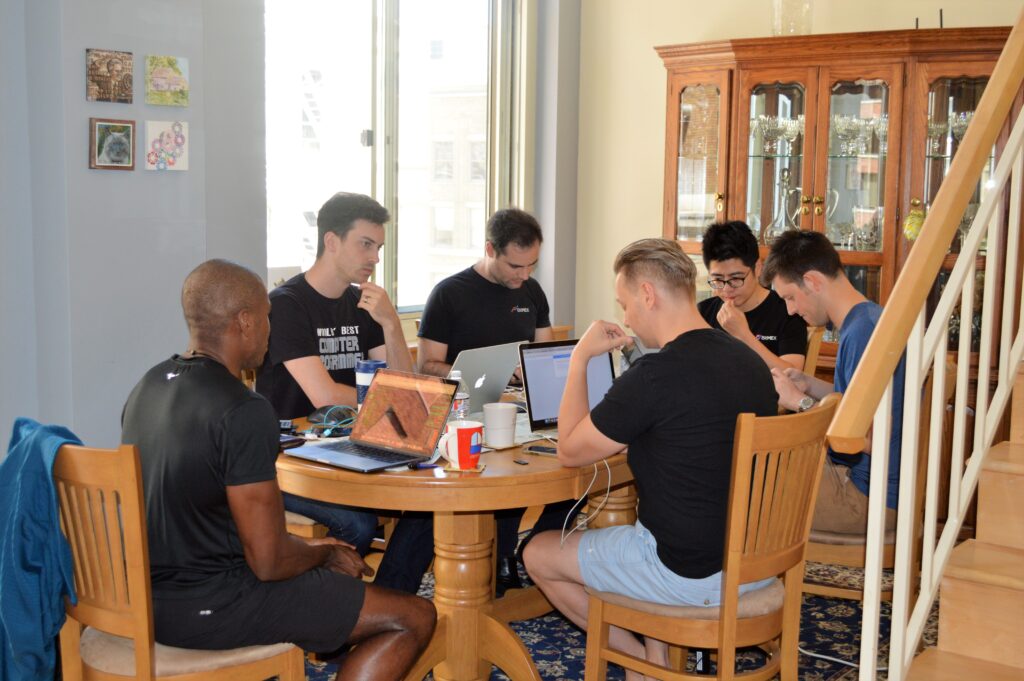
Eventually, in September 2015, Ben Delo would have a brainwave that dramatically altered their fortunes. In the course of trying to make leveraged trading more accessible for retail users on their system, he stumbled upon the idea for a novel, expiry-less derivative — the perpetual future. By 2019, the innovation would transform BitMEX into one of the most profitable exchanges in the industry.
It was around the same time that Delo’s idea was propelling the exchange to its zenith— i.e. just before Covid broke — that I found myself embroiled in a very different BitMEX encounter.
A whistleblower from within the company had reached out to me, eager to share allegations of regulatory violations at the exchange. The person claimed the founders were knowingly skirting anti-money laundering regulations to boost profits. Bloomberg had already reported authorities were investigating the firm, the person noted, but there were many more details they had missed that could still be shared with the FT.
The story didn’t go far. Just as I was preparing to dig in, Covid hit and swallowed the news agenda. Adding to the paralysis, the source got cold feet and failed to deliver the evidence I had requested to confirm allegations, out of fear that doing so could jeopardize the wider case being pursued by the U.S. Department of Justice and the CFTC. Before the FT team could pursue things independently, markets were crashing, and the FT was being consumed by its own money-laundering blockbuster, that of Wirecard.
Even so, what stayed with me most about that encounter with the whistleblower was the contradiction at the heart of the person’s account. The individual was intent on exposing alleged wrongdoing at BitMEX. Yet despite it all, they remained unfailingly admiring of the very people they were implicating, going out of their way to praise the firm’s professionalism and, in particular, Ben Delo’s intellect — in particular his role in devising the “perpetual future”.
I was hooked on the concept from that moment on.
Perpetual, what?
Until that encounter with the whistleblower, I had never heard of a “perpetual future.” This was mildly embarrassing, since I’d spent years covering commodity futures and was supposed to be a bit of a derivative expert. But the mechanics of this newfangled instrument completely eluded me. I remember staring at the BitMEX interface, trying to decode its logic, feeling more than a little out of my depth.
Slowly, as I experimented with my meager bitcoin fortunes on the platform (worth about $10), things became clearer: perpetual futures I started to realize weren’t just a nifty crypto trading tool. They were also a new type of self-regulating LIBOR, the wholesale funding rate that had famously failed during the 2008 global financial crisis. In that sense, they hinted at a new kind of financial architecture in the making — one capable of bringing transparency to otherwise murky and under-scrutinized areas of funding markets, notably at the intraday level.
The striking thing was that the crypto industry didn’t have a clue about the significance of what they’d created. Nor did they, seemingly, have the central banking expertise to understand how it could fit into the new secured-funding paradigm the financial system was moving toward.
I thought to myself: I must speak to Delo directly. I need to understand how he arrived at this system and how much he knows about the wider plumbing problems affecting the dollar systems.
Unfortunately, whatever ambitions I had for an interview were soon derailed by the competing pressures of lockdown, daily editing duties, writing columns, and looking after my young daughter.
Most consequentially, on October 1, 2020, the inevitable finally happened. Delo and his co-founders were charged with violations of U.S. law — precisely as the whistleblower had predicted. For what it’s worth, I don’t think it will come as a surprise to the BitMEX founders that it was one of their own who informed on them. U.S. authorities operate a transparent whistleblower bounty system, and the evidence presented at trial would have made it clear that someone from inside the firm had been cooperating. They may, however, be surprised to learn that their story was being shopped to media outlets in the months before the charges.
The circumstances, nonetheless, meant that any hope I had of pursuing the story had evaporated. BitMEX was now engulfed in a legal quagmire, and the founders were inevitably going to disappear from public view. Delo would eventually travel to New York in March 2021 and surrender himself to authorities, pleading not guilty to the charges. In February 2022, following criminal proceedings under the Bank Secrecy Act, all three would enter guilty pleas. Under the terms of their final settlement, each paid a US$10 million fine and — in Delo’s case — received a 30-month probationary sentence.
It wasn’t the worst outcome. BitMEX would have to implement full KYC and AML protocols to continue operating, but all three founders would be allowed to retain the substantial fortunes they had amassed over the past few years.
By February 2022, I had left the FT and launched the Blind Spot, which meant I was finally free to pursue my own editorial agenda after about a year (or more) of finding it increasingly difficult to pursue stories at the newspaper.
It took a few more months to get my new operation running, but eventually I was able to return to get back on the story. By then, BitMEX’s legal troubles had largely been resolved, and it seemed an appropriate moment to approach Delo. When I made contact, he was initially hesitant, but eventually agreed to talk.
And so, on June 28, 2022, I found myself in Delo’s oddly spartan Westminster offices, listening to his account of how he invented the perpetual future — a grandfather clock chiming methodically away in the background as we spoke.
We spoke for nearly two and a half hours (or at least three gongs), focused almost entirely on the wonky dynamics of the perpetual future creation story.
It has been more than three years since that conversation, so readers may reasonably wonder why they’re only seeing the full story now. The blame, I’m afraid, lies squarely with me and the pains of start-up life.
Determined to do the piece justice, I kept postponing the big write-up, imagining I would tackle it in mythical “10 percent time” that never materialized. Complicating matters further, I had already promised Bloomberg the key elements of the story — believing that Delo deserved wider distribution than the Blind Spot alone could offer.
That Bloomberg story eventually came out on August 31, 2022. It wasn’t the big narrative I’d hoped to write, but it told just enough of the story to make me feel satisfied the fundamentals were now on the public record, so I could delay the bigger story until the day I could properly focus on it.
Unbelievably, that day didn’t come until this weekend, for reasons that will soon become evident.
In some ways, the delay is no bad thing. I now have far more pieces of the story than I did back then. Besides, as the great literary procrastinator Douglas Adams of Hitchhiker’s Guide to the Galaxy fame once expressed, for creatives, it’s often the last mile that is the hardest to finish.
The origins
As noted, the search for the ultimate derivative product began — fittingly — in the back of a Shanghai taxi in September 2015. Delo and Hayes were in China for a startup accelerator, puzzling over a growing wave of customer complaints about BitMEX’s futures contracts. Though both were well-versed in traditional derivatives, they were slowly realizing that crypto traders hated any instrument that had a fixed expiry date and resented being forced to close or roll over their positions.
A mathematician and engineer by training, Delo had always valued speed, determinism, and market structure.
Before creating BitMEX, he had honed his skills as a financial engineer, building trading algorithms and data systems for GSA Capital and JP Morgan. At the former institution, he had worked directly with Alex Gerko, a Russian-born mathematics genius who went on to become one of Britain’s richest men.
Delo’s interest in Bitcoin began around 2013, born more of intellectual curiosity than of ideological fervor. The motivation for his first Bitcoin purchase, he would tell me, was driven by a desire to better understand how the system worked. “It appealed to me as a novel technology that I wanted to learn more about,” he said.
It didn’t take long, however, for Delo’s curiosity to collide with the messy reality of early crypto infrastructure. The exchanges he began encountering were slow, fragile, and prone to catastrophic failure. Too many had been scarred by operational lapses or outright hacks, eroding trust and making the market all but unusable for anyone accustomed to the standards of professional trading. Delo soon recognized that the sector’s technological promise was being smothered by its own plumbing.
For a long time, Delo sought to avoid such risks. His preferred way of acquiring bitcoin was through LocalBitcoins, an early peer-to-peer marketplace that matched buyers and sellers in person, avoiding many of those pitfalls. It was through LocalBitcoins that Delo eventually met Arthur Hayes, a former equity derivatives trader from Deutsche Bank and Citi with a Wharton finance background. The two hit it off immediately, bonding over their shared understanding of crypto’s deepest market structure flaws — and what it would take to fix them.
Both had noticed something most others had missed: almost none of the existing exchanges understood margining. They figured this would obviously be an enormous opportunity for anyone who did.
Hayes soon pitched Delo on launching a derivatives exchange that would apply traditional finance’s margining discipline to crypto.
They two struck up an agreement. Delo would focus on building the system’s machinery, while Hayes would focus on funding and promotion. They would, however, also need a software engineer, which is how Sam Reed, then based in Hong Kong, was brought in as the third co-founder of BitMEX. Together, in 2014, the three founded HDR Global Trading, the parent company of BitMEX, with ‘HDR’ standing for Hayes-Delo-Reed.
In that sense, Delo said, BitMEX was built in the shadow of the fall of Mt. Gox, an early crypto exchange that famously lost 850,000 Bitcoin in 2014 without even realizing it.
Although the whole picture wasn’t immediately apparent at the time, Mt. Gox’s failure had stemmed less from a single devastating hack than from years of accumulated operational shortcomings. Originally launched in 2010 as a repurposed website for trading Magic: The Gathering cards, the crypto exchange had grown faster than its infrastructure could support. Its matching engine and wallet software were notoriously fragile, and by 2011–2013, a mix of accounting bugs, unrecorded withdrawals, and exploitable flaws (most famously the “transaction malleability” issue) had created a large and mostly invisible shortfall in customer balances.
When Mt. Gox filed for bankruptcy on February 28, 2014, the revelation that it had lost roughly 650,000–850,000 bitcoins shocked the crypto community. Everyone immediately suspected fraud or a hack. Even the owner of the exchange. But over time, it emerged that the losses had actually accumulated slowly over years, fueled by slow-drain theft, human error and poor reconciliation.
The founders agreed their trading platform would be designed so rigorously that another Mt. Gox simply could never happen.
To guard against such risks, Delo’s big idea was to design the BitMEX system so that everything was reconciled to zero at all times. “I built the BitMEX trading engine to never, ever lose a penny,” he explained, emphasizing that to that day the system had never lost a single satoshi. “If it’s not zero sum, you’ve either created or destroyed Bitcoin, which is impossible.”
To make this possible, BitMEX introduced a real-time audit mechanism, which confirmed at every moment that the Bitcoin accounted for by the trading engine equalled the amount held in the exchange’s wallets.
A design this disciplined should, in theory, have easily captured investors’ imagination.
Yet, when the trio set out to raise external funding, they discovered they had chosen the worst possible moment to launch a crypto exchange. It was the depths of the 2014 “crypto winter,” a period in which venture capital had all but abandoned exchanges and anything associated with Bitcoin. The fashion of the moment was “enterprise blockchain,” not trading infrastructure. As a result, no one wanted to back them.
“We turned up in 2014 when exchanges already existed. VCs were already invested,” he told me during a sit-down interview in 2022. “Arthur was approaching the VCs, and they started saying silly things like, ‘Oh no, we’re not investing in Bitcoin anymore. We’re investing in blockchain with a straight face’ and we’d say, ‘What is blockchain?’ and they wouldn’t have a clue.”
With capital scarce and interest nonexistent, the founders were forced to pool their own savings to bootstrap BitMEX independently.
Ironically, the absence of external capital would later prove to be an advantage. Unlike most exchanges, BitMEX remained almost entirely in the founders’ hands, and by 2018 — when the platform was generating roughly $1 billion in annual profits — it was the trio, rather than a roster of venture backers, who reaped the rewards. In 2019, annual trading reached $1 trillion, and Delo’s 30 percent stake was valued at $3.6 billion.

The founders’ first major breakthrough, however, had little to do with perpetual futures. It was centered rather on something far cruder: extreme leverage.
Delo and Hayes were aware that traditional markets rarely permitted more than 2x or 3x leverage for retail traders — a $1,000 stake typically bought you a $2,000 or $3,000 position. They believed, however, that crypto could support a far more aggressive exposure without jeopardizing a customer’s entire account. This insight would eventually lead to the innovation of “isolated margin,” a safeguard that walled off each trade from the rest of a user’s balance.
Under the model, a single losing position could no longer wipe out an entire account. As a result, a trader with just $100 could control a $10,000 position, with no further liability if the market moved against him. Even the slightest price move in Bitcoin could make — or erase — a fortune, but any losses would be strictly limited to the margin the user had committed.
The safety net, paradoxically, also made riskier bets possible — something that would prove immensely profitable for BitMEX, since the bulk of its revenues came from fees.
The day BitMEX officially raised its leverage ceiling from 50x to 100x, volumes exploded, Delo recalled. It was also the day the exchange finally became profitable.
At the heart of the magic formula was Delo’s real-time margining system. “Every time the mark price changed, we calculated the value of every position and every trader’s margin,” he explained. “We knew instantly whether a position needed to be liquidated. And if it did, it happened immediately — not minutes later through some manual process, but before the price could move further against the trader.”
Many exchanges already had forced-liquidation policies, but BitMEX’s key innovation was making the process cheaper and more orderly. Crucially, liquidations weren’t triggered by BitMEX’s own internal price, which could be distorted by thin liquidity, but by an independent third-party index. That design helped prevent cascading sell-offs and insulated the platform from its own market impact.
“No one likes getting liquidated, but we tried to be as upfront and transparent about it as possible, so that there would be no surprises,” Delo said.
The system would soon give rise to the phenomenon of “involuntary liquidations” — aka getting “rekt” — inspiring its own meme culture.
Going perpetual
Despite the early success of the leveraged products, by 2015, the futures-based exchange was facing other issues. Part of the problem was the complexity of derivatives.
Retail crypto traders were not accustomed to the fact that futures contracts came with fixed expiry dates. Initially, as per traditional markets, where a trader can buy oil for June delivery or wheat for December, bitcoin futures were staggered over expiry intervals. But, as is normal practice with futures, their prices over time often drifted away from the spot price, reflecting expectations of future supply and demand for the underlying commodity. Traditionally, the extent to which a futures contract trades at a premium or discount to spot is known as the basis.
But while such slippage is well understood in traditional markets, the founders soon realized that many BitMEX traders struggled to grasp the dynamics. Moreover, this confusion was now limiting further uptake.
It was during the aforementioned taxi trip in Shanghai, as Delo and Hayes were mulling over the flaws in their products, that Delo began wondering: what if a future didn’t need to expire?
Turning the idea over in his head, Delo determined came to the conlusion didn’t want to think about rollovers or the basis at all. They wanted clean, uninterrupted exposure to bitcoin’s price. And that was that.
Why not then, he thought, create a perpetual swap, aka a futures contract with no expiry?
On the face of it, the idea sounded absurd. When Delo floated it past a quant friend, he was met with immediate skepticism: an expiry-less contract, the friend argued, would have a fair value of infinity. “You’d have to pull the interest rate out of it,” he immediately told Delo.
But the feedback triggered a deeper insight in Delo’s mind. Since traders didn’t want the cost of financing embedded in bitcoin’s price, why not strip it out altogether? The cleanest way to do that, he decided, would be to pair each position with a dynamic funding rate.
The immediate challenge, he realized, would be determining that rate. Delo realized that for this to work, he would need a market-driven benchmark — something that functioned very similarly to LIBOR but for crypto. But in 2015, no such reference existed. The closest proxies were the lending rates on spot exchanges such as Bitfinex and Poloniex, where users lent dollars or bitcoin to facilitate long and short positions. Imperfect, yes, but usable as a starting point.
This was the initial breakthrough the perpetual future needed to get going.
When the first iteration of the contracts launched in May 2016, traders seized on them with extraordinary enthusiasm. Exchange volumes hit new highs almost immediately. Many viewed perps as an almost magical thing: all the leverage of a future, but without any of the messy rollovers. And their mechanics were far easier to grasp than the instruments traders had wrestled with before.
Moreover, BitMEX’s extensive array of weekly and daily expiring futures, with complicated tickers like XBT 7D, XBT 48h, and XBT 24h, could now be expired. “We got rid of all of them, and replaced them with one swap literally just called XBT USD,” Delo recalled.
The simplification had another unintended positive effect: it immediately concentrated liquidity, making BitMEX markets even deeper and far more efficient.
Surge pricing for liquidity
There was no doubt that traders loved the product. The problem was that traders were loving the product too much. Despite the funding adjustment, futures prices had begun to drift over the spot price. Sometimes as much as by 5 percent or more. It seemed the proxy funding rate Delo had engineered from third-party lending data was lagging behind real market conditions.
This, Delo said, created a serious issue: traders who went long with only a 1 percent margin were now far likely to face liquidation if the perpetual snapped back to the spot price. Worse, they could claim that their liquidations had been triggered by an off-market rate — and that the system had treated them unfairly.
To address the issue, Delo’s first instinct was to approach market-makers and point out that there was an easy 5 percent to be made from shorting the market when it was off kilter, and bringing it back in line with the spot index. Market-makers weren’t convinced. They told Delo there was too great a risk that the premium would widen even further, to, say, 10 percent or more.
It was then that Delo realized the real issue was that the funding rate wasn’t high enough to attract the required number of short sellers needed to balance the market.
He would have to create a new mechanism that adjusted for the variance.
This could be done by measuring, minute by minute, how far the perpetual contract — then still called a total return swap — was drifting from the underlying spot price. That deviation became known as the “premium index” and would help to determine the funding rate, updating every eight hours and settling automatically at each interval, whether in bitcoin or stablecoin.
“It was the first time an index had used our own data,” Delo explained.
Mechanically, the rate was derived from the difference between the price of the BitMEX swap and its premium relative to the benchmark spot index.
But to make the measure as robust as possible, Delo didn’t rely solely on traded prices to engineer it. The calculation would be based on a “depth-weighted spread” drawn from the mid-price of the entire BitMEX order book. This, in turn, would be offset against the contract’s current “fair price,” as calculated by the spot price of bitcoin plus the basis derived from the previous funding rate.
The new system effectively previewed the funding rate for the next eight-hour period. For the most part, it remained positive, reflecting the market’s natural long bias while encouraging shorts to enter to correct the drift.
“And [the short-sellers] would come in early. Earn their 1 percent, then either hold the position, trade out, hedge, or whatever,” Delo said, noting the critical point was that “their reaction was to come into the market and lower that premium.”
The result was a virtuous cycle.
When longs drove the perpetual above spot, the funding cost of holding those positions rose sharply. When shorts dominated, the rate fell.
Delo dubbed the mechanism a type of “surge pricing for liquidity”: when demand tilted in one direction, the funding rate nudged traders to push prices back into line, keeping the perpetual closely tied to spot.
“If you actually look at how it works mathematically, we were getting rid of the Bitcoin overnight rate and the dollar overnight rate. They actually became irrelevant,” he explained. “They were in there as kind of a vestige of the evolution of the system. But the funding rate had become solely determined by the product’s premium itself over the underlying spot rate. So, surge pricing,“ said Delo.
For BitMEX, the perpetual future quickly became its defining innovation.
Trading activity exploded, and within just a few years, the “perp” had evolved from a niche experiment into the market’s standard instrument. What began as BitMEX’s flagship product was soon widely copied across the industry, ultimately becoming the default way traders accessed leverage in crypto.
As the chart below from a16zcrypto shows, the contracts have since become the bread and butter of the DeFi industry and today represent trillions of dollars in trading activity.

A shadow interest rate?
Delo didn’t think about the broader application of perpetual futures for quite some time. “We were just trying to solve a customer problem,” he said, noting that once the idea had been conceived, he was able to code the mechanism in its entirety over a three-hour flight from Singapore to Hong Kong.
“Having invented it, and it worked so well, I couldn’t believe it didn’t already exist,” he reflected.
In Delo’s opinion, however, there’s nothing intrinsically special about the swap that requires it to be based on Bitcoin. It can just as easily be applied to equities, gold, oil, or any other commodity.
The outcome in all those cases, ultimately, is something akin to a “secured by name” but “highly leveraged in practice” offshore funding rate — that can, in theory, be applied to any asset class with a liquid spot market. Even the dollar itself (say, in a format that emulates an overnight index swap).
In all such cases the mechanics work similarly: whenever perp funding rates surge, the market is signaling that returns can be made by taking the other side of the trade.
The implication is that demand for leveraged exposure in the offshore system is outstripping the system’s dollar liquidity, and anyone prepared to take the other side can earn an attractive return for supplying it.
Critically, because that demand is leveraged when this happens a new source of demand for U.S. Treasuries is simultaneously being created, one that transcends the current supply of loanable funds in the market.
The deeper implication is that this shadow “price of liquidity” lives entirely outside the Federal Reserve’s control.
As a consequence, whenever the perp rate sits well above the Fed’s own policy rate, the arbitrage is obvious: borrow bank dollars at the lower administered rate, convert them into stablecoins, and capture the higher synthetic yield in the perpetual market. That dynamic pulls new demand into stablecoins and, through their reserve managers, into Treasury bills. Conversely, if the Fed tightens policy above the prevailing perp rate, the incentive reverses: stablecoins are redeemed, issuers must sell Treasuries to meet withdrawals, and the marginal buyer of short-dated government paper disappears.
In that sense, the perpetual funding rate becomes both a floor and a ceiling for U.S. monetary policy — a shadow interest rate that reflects the true marginal cost of dollar liquidity for any trader with access to stablecoins. Too high relative to the policy rate, and it drags liquidity out of banks and into crypto/USTs; too low, and it forces a deleveraging that spills back into the Treasury market.
Moreover, if exchanges ever launched perpetual futures on the dollar itself, the funding rate would become a pure measure of stablecoin-based dollar scarcity — a crypto-native LIBOR. It would be technically “unsecured,” but its level would be shaped by the collateral conditions of a massively leveraged market. Rather than converging to the Fed’s policy rate, it would reveal the true marginal cost of offshore dollar liquidity, independent of the Federal Reserve’s control.
Over time, of course, markets tend toward equilibrium. If stablecoin-funded perp rate sat far above the Fed’s policy rate, the arbitrage should eventually pull enough liquidity out of the core banking system and into the stablecoin–perp complex that the two begin to converge. At that point, the perpetual swap would cease to be a shadow challenger to the Fed and instead become a kind of parallel, market-driven funding benchmark — one that reflects true marginal liquidity conditions for any asset tied into the system. That convergence, however, would come at the expense of Federal Reserve oversight, since liquidity would now be flowing to jurisdictions that don’t comply with Basel banking rules.
More than likely, the Fed would do everything in its power to restrict such arbitrage, much as it already has done with eurodollar markets after the financial crisis. If the U.S. Treasury also refused to feed T-bill supply into the market over and above its immediate funding needs or debt ceiling, then offshore perp rates would remain elevated by design.
In such an environment, the only actors capable of expanding the synthetic dollar supply would be large pre-existing foreign holders of Treasuries — such as China, Japan, and others. If perp rates remained elevated, they would be strongly incentivized to liquify their reserves by issuing their own USD stablecoins and lending them into the perp market to capture the arbitrage.
If, by some unexpected channel, covered interest parity between the two systems did take hold (aligning the perp rate with the Fed’s rate), the perp’s power would become even clearer in markets beyond crypto. Applied to gold, for instance, a perpetual swap on XAUT or any other bullion-backed token could produce a far more accurate and transparent forward rate than today’s opaque mix of CME futures pricing and private interbank bullion lending quotes. The LBMA’s true cost of secured gold funding — still largely hidden from public view — would suddenly become observable in real time through the swap’s funding mechanism.
That level of transparency, Delo argues, is precisely why most traditional financial platforms will hesitate to adopt the perp model. It would not merely undercut their margins; it would expose the economics of their own funding markets to open scrutiny.
“What makes the swap unique is that the swap is actually a market, a dynamic market, which doesn’t require the platform itself to put up capital or have market or be the market maker. It just naturally attracts market makers… buyers and sellers … longs and shorts. It attracts price takers and price makers, and brings them all together,” Delo said.
The ultimate irony is that a mechanism originally designed to keep a derivative instrument tethered to its spot price may, in time, exert its own gravitational pull on the broader dollar system.
Free speech crusader
This is not, it turns out, the end of my Ben Delo story. Many readers will know that I drift around the free-speech community — one cause, I believe, a journalist can support without compromising their credibility since free expression does not betray the profession’s basic duty of neutrality.
So it came as something of a shock when, in the summer of 2023 — still feeling guilty for not having delivered this piece — I once again found myself back in Delo’s Westminster offices. This time, though, I had been invited to a free-speech gathering that, to my surprise, was hosted by Delo himself. Until that moment, I had no idea that Delo had been quietly operating behind the scenes as a patron of the cause. And yes, of course, I was mortified by the awkwardness.
Luckily, the Telegraph has been far more effective than me at telling his story. Last week, they gave Ben Delo’s free speech work a timely and extensive write-up, which finally motivated me to finish this piece.
If I have any excuse for the delay, it’s that writers today can be muffled not only by government diktats, libel threats, or lawfare, but also by the simple absence of time. When earning a living at institutions that pay the bills requires you to “sing for your supper” — and to do so within the confines of their editorial priorities — passion projects inevitably slip down the list.
Sometimes, it is not censorship that stops a story from being told, but the cost of life.
Related links:
Why ‘perps’ could be the next big thing after stablecoins — The Peg
Perpetual futures, explained — Bits about Money
The Fed’s quiet pivot to servicing intraday liquidity — and why it matters — The Blind Spot
The British crypto billionaire funding free speech battles against the police — The Telegraph