The big news this week is the freezing of approximately $182 million worth of USDT across five Tron wallet addresses in what has been described as one of its largest single-day actions.
The even bigger news is the suspicion that these assets may have belonged to the Venezuelan government, and that Tether — long considered a safe haven for illicit capital flows — is seizing sovereign assets at the U.S. government’s behest.
What we know for sure is that the move was carried out under compliance and enforcement procedures, and while it has not been officially confirmed that these specific wallets held Venezuelan oil proceeds, analysts and on-chain commentators across are making that connection.
Internet chat suggests some of the frozen funds may overlap with addresses used in Venezuela-related activity, given the country’s heavy reliance on USDT.
According to the WSJ, Venezuela’s oil trade has become deeply entangled with the Tether stablecoin. It cites a podcast with Venezuelan economist Asdrúbal Oliveros on how stablecoins have created a direct link between the Venezuelan economy and the crypto world, primarily driven by the oil sector.
In the podcast, Oliveros highlights that nearly 80 percent of the country’s oil income is being collected in cryptocurrencies or stablecoins. This massive inflow of digital assets, he adds, is the primary reason why USDT has become a recurring theme in business conversations and corporate operations throughout the country.
However, Oliveros points out that the government has found it difficult to transform its crypto-wealth into usable liquidity for the economy, since conversion into usable currency requires passing through various compliance controls. This has kept a lot of the funds locked up. The outcome is that Venezuela’s oil income has not been flowing back into the domestic economy, which has impacted the official exchange rate, causing it to spike.
Oliveros also suggests the Venezuelan government has struggled to manage its crypto and stablecoin wealth competently. He hints that secret phrases for wallets were mishandled or lost amid an overdependence on personal wallets and a general lack of internal compliance protocols or periodic reconciliations.
Existential issue?
If it turns out to be true that the frozen funds belong to Venezuela, the question on everyone’s mind is how this will impact Tether’s reputation as the go-to alternative monetary system in the developing world, especially in jurisdictions that lack financial stability or that are under international sanctions.
At the launch of Bytetree’s new combined Bitcoin Gold exposure ETN, BOLD, at the London Stock Exchange on Tuesday, prominent members of London’s crypto and gold investment community speculated there could be major reverberations for the stablecoin, if not beyond.
Bitcoin investor, advocate, and comedian, Dominic Frisby — also a vocal champion of digital privacy — told the Peg he wouldn’t be surprised if the episode spooked crypto capital in much the same way that talk of formally seizing Russia’s assets held at Euroclear unsettled international sovereign investors in euro- and dollar-denominated assets.
For all the talk of Tether’s unregulated, high-risk, and non-compliant status, the stablecoin behemoth has made no secret of its growing collaboration with international enforcement authorities over the past year, even as it retains a base in the light-touch and crypto-friendly jurisdiction of El Salvador.
CEO Paolo Ardoino told The Peg in October Tether was the only stablecoin and crypto company that regularly collaborated with the U.S. DoJ and which had also “onboarded” the FBI and U.S. Secret Services.
“We worked with them to freeze the Garantex, which is a Russian exchange,” he said, while confirming that Tether was growing its presence in the commodity-related supply chain finance market.
According to the WSJ, blockchain-surveillance firm TRM Labs has a partnership with Tether to help track illicit activity involving USDT on the Tron blockchain. The company’s global head of policy, Ari Redbord, told the newspaper that the stablecoin’s role in Venezuelan life was complex. “They [stablecoins] can be a civilian lifeline and, under sanctions pressure, a tool for evasion.”
His comments underline that while USDT has become deeply embedded in the Venezuelan economy as a financial lifeline for everyday citizens struggling with the effects of acute inflation, its technology can and is simultaneously exploited by bad actors to move funds in ways that raise sanctions-compliance concerns.
Except, Tether has now demonstrated that is also willing to freeze USDT on networks like TRON when addresses are flagged for sanctions or illicit links. In doing so, it has made clear that stablecoins are not immune from discretionary enforcement, even when they function as critical financial infrastructure on the ground.
Moreover, the move comes just weeks after Brussels — after years of posturing, planning, and legal preparation — balked at the final hurdle on explicitly seizing Russia’s frozen assets on fears it might undermine the international appeal of the euro. The resulting signal to markets and nation states may just be that keeping your money in stablecoins like Tether is more risky than keeping it in official assets after all.
Whether that reality poses an existential risk for Tether’s offshore business model in the weeks and months to come remains to be seen. But there’s a very strong argument doing the rounds in crypto circles that stablecoins might never again be seen the same way by international investors.
At a minimum, the episode suggests that the rise of the so-called “Donroe Doctrine” now extends beyond geopolitics and statecraft into the heart of global financial markets. And Tether, by almost any measure, sits squarely within the Donroe Doctrine’s zone of influence.
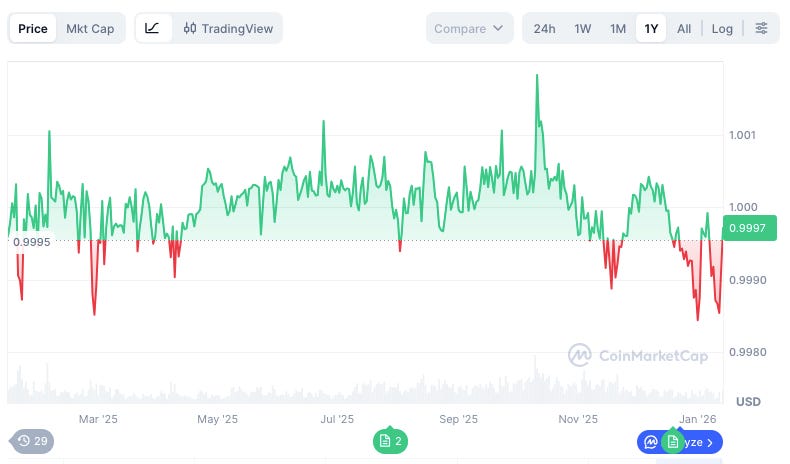
For now, aside from a marginal wobble over the past month, Tether’s peg is holding steady. A clearer sign of stress would be evidence that capital inflows are slowing materially — or, more ominously, beginning to reverse into outflows.
Tether’s next attestation is expected in late January/early February.