

This is a guest contribution from anon.
For most of 2025, China looked like the world’s hungriest oil hoarder, socking away over 100 million barrels over the last five months — roughly 700,000 barrels a day of demand that kept crude markets tighter than they really were. It helped benchmark crudes like WTI and Brent remain backwardated in terms of the futures curve by effectively taking supply off the active market and preventing the anticipated stock builds in the rest of the world from occurring.
That buying spree lifted total Chinese demand above 15.5 million barrels a day, helping to prop up prices just when traders were nervously eyeing signs of oversupply.
But a yet-to-be-noticed blind spot is that Beijing’s appetite may finally be cooling.
Refinery runs look like they may have peaked in September, and seaborne imports slipped from 51 million barrels in August to just 43 million in September after Saudi Arabia’s aggressive pricing made crude look less appetizing. While they have storage space to continue buying, their previous opportunistic buying patterns would suggest they are happy to take a breather and let prices retrace further, much to the pleasure of Mr Trump and Mr. Bessent.
Domestically, Chinese demand continues to weaken, with major road transportation fuels, gasoline and diesel, showing continued signs of contraction as EV vehicles and LNG trucks eat into their demand pool.
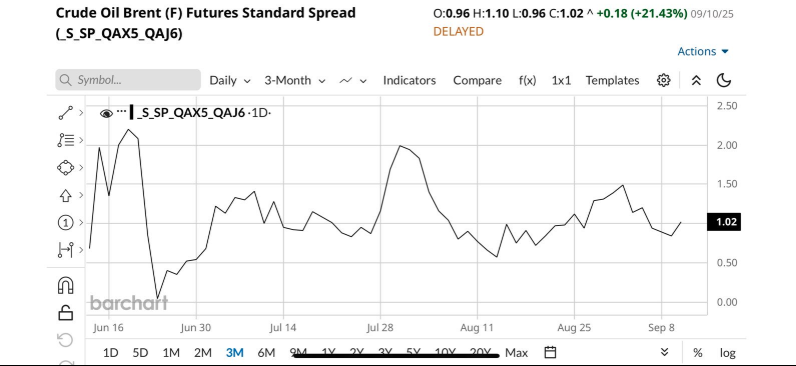
That potential cooling demand is rippling into the forward curve. Brent calendar spreads have softened significantly over the past few months, signaling expectations of heavier supply and swelling inventories into late 2025, which some say could be as great as 3 mbpd. The rolling six-month spread, once a muscular $4 backwardation in January, has sagged to around a buck so far in September — the weakest since the immediate post-pandemic years, and in the 40-45th percentile range of monthly levels.
The below shows the spread between Nov 25 Brent vs April 26 Brent, highlighting a lighter than usual backwardation for this time of year:
Of course, history suggests Beijing won’t stay on the sidelines for long. China has consistently swooped in when prices tumble, stockpiling cheap barrels and turning market weakness into a buying opportunity, and setting the next floor.
For now, though, the oil world’s biggest swing buyer is on pause — and that pause is weighing heavily on the curve.
Why it matters? Reduced Chinese oil demand could act as a buffer to the inflationary effects of Trumpian tariffs by keeping energy prices lower. It also suggests contango could be coming back to the market soon, unless OPEC moves to artificially prop the market up.
