


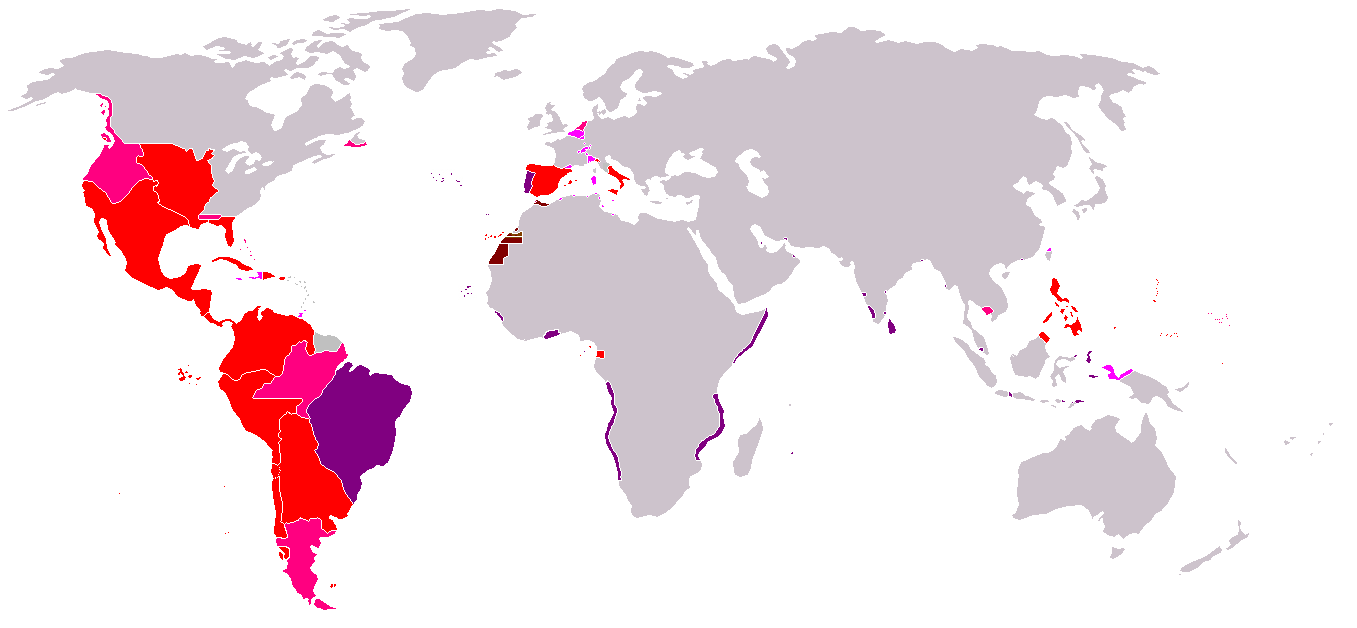
A Triggernometry conversation with historian Dominic Sandbrook about Empire triggers Dario to retrace his roots and argue that, contrary to popular belief, it was the Spanish that had the best empire in the world, not the British.
Continuing the Spanish theme, Dario takes a closer look at the burgeoning fiefdom of Amancio Ortega, the reclusive Galician billionaire behind fashion giant Inditex (best known for Zara).
Dario explains how Ortega has quietly become one of the most influential private actors in Spanish public life. Through large-scale donations — most recently funding a state-of-the-art proton therapy clinic in Galicia — Ortega has stepped into roles once reserved for the state, reshaping healthcare, urban spaces, and even cultural life.
But his influence also extends beyond philanthropy: by anchoring Inditex’s global empire in his provincial hometown, Ortega has transformed the once-sleepy port city of A Coruña into an unexpected hub of international talent and prestige, raising larger questions about how private wealth is increasingly assuming the functions of governance.

Dario here. It’s good to be back.
I was incensed to watch a typically Anglo comparison of Empire on this otherwise mediocre conversation on Triggernometry with Dominic Sandbrook. Ambitiously named “The Best Conversation About History You’ve Ever Heard”, it contains valuable, insightful, and novel comments like “we shouldn’t tear down statues” and “most historical leaders aren’t inherently evil”.
But this dynamic throuple doesn’t stop there. After claiming that we shouldn’t judge empires and historical figures by modern standards and that we should beware of biased anachronisms, they proceed to claim the British Empire was the best because the Spanish infected the natives with smallpox and Cortés was a brutal figure.
In broad strokes, the Spanish argue that the British didn’t unconsciously engage in biowarfare by infecting the natives with smallpox because its preferred policy was exterminating, sidelining, or expelling those natives from their lands. In contrast, the Spanish always operated a policy of mestizaje, aka tactical racial mixing of newly discovered populations so as to integrate them into Spain and the Catholic Church.
Just look at the products of the British Empire: entirely Anglo-Saxonised or racially split societies (the United States, Canada, Australia, South Africa, Rhodesia). In contrast, a minute proportion of Latin American society remains white or native, since the vast majority quickly turned mestizo.
This was no accident: Spain’s conquest of Latin America was intended on the principles of absorption rather than subjugation or expulsion.
And while much is made of Cortés’ couple of dozen horses and guns, the real handiwork of Spain’s colonisation was inter-native diplomacy, as they skilfully navigated complex regional alliances to superimpose Spanish sovereignty over the continent.
It’s worthwhile noting that independence from Spain in the 19th century was fostered by the white portions of Latin American society, backed by the Anglos and Americans, with mestizo armies fighting for the unified Spanish cause.
That has led pan-Spanish revisionists to call it “the only Empire colonized by natives, and made independent by colonizers”.
What’s surprising is just how many professional British historians continue to uncritically buy into the British Black Legend of Spain. A Black Legend represents a negative bias levelled at whichever nation enjoys superpower status. While today’s most prominent Black Legend involves calling Americans dumb or uncultured, 500 years ago, it was calling the Spanish barbarous and totalitarian.
That professional British historians continue to parrot these long-debunked points almost half a millennium after the fact speaks to the power of the British pen.
Taking my patriotic hat off, here’s the rest of the newsletter. I promise it will be (only slightly) less biased than the above.

An advanced proton therapy clinic built in Galicia, Spain, is nearing completion. If you’ve never heard of it, proton therapy is a novel method of radiation therapy that uses a precise beam of protons to irradiate diseased tissue, often to treat cancer. Studies have found the method may have far fewer side effects than traditional radiation treatment.
But this is no ordinary clinic. Rather, it sits at the forefront of a quiet revolution in Spain that showcases a subtle shift towards neomedieval sovereign fragmentation in Spain.
The proton therapy clinic in question, among 10 others being built across the country, is only one example of the almost 3,000 clinics currently being upgraded with cutting-edge equipment (among other projects for Spain’s healthcare sector) thanks to a €280mn gift by the private foundation of Spain’s wealthiest man: Amancio Ortega.
The project is cutting-edge in more ways than that: it represents an unusually harmonious collaboration between private enterprise, the Health Ministry, and Spanish regional governments. Politicians of all colors have put aside their usual bickering to greenlight the projects while accepting the uncomfortable truth that Spain needs Ortega’s philanthropy.
The story may seem like just another example of a billionaire’s largesse, pumping money into tax-efficient charitable structures. But there’s much more than meets the eye. These donations are just the visible superstructure of a deeper shift in both Coruna and Western states, which is seeing power and sovereignty move away from the state and into private hands that express that power locally.
The reasons why are obvious. As our governments become increasingly saddled with debt, bureaucratic ineptitude and popular mistrust, efficient family-run businesses that care about their hometowns are finding it easy to quietly usurp local governance structures. Judging from Coruna’s transformation, this may be a good thing.
To understand why, we must first delve into Amancio Ortega and the region that shaped this uniquely mysterious billionaire.
Galician magic
Andalucia is to foreigners what Galicia is to the Spanish elite: the seat of Spain’s soul.
Nestled in the north-west, just above Portugal, the region has long hosted Spain’s most influential families: Madrid’s ruling class and aristocracy rush here to escape the summer heat. The middling Spanish bourgeoisie quickly followed suit. As I write, Franco’s old northern getaway, the Pazo de Meiras, sits less than a kilometre away.

The Spanish flock to Galicia for all the reasons tourists tend to stay away: its terrible climate. The region has the unfortunate distinction of suffering more rainfall than most of Britain, outside of northern Scotland.
It was this mysterious, obscure climate that birthed the world’s most secretive billionaire: Amancio Ortega. For a long time, his likeness was unknown to the media outside of Galicia. The few times his image appeared in the late 20th century, they were taken in such a way that it wouldn’t betray his day-to-day appearance. It’s only in recent years that his name and image have become more commonly reproduced.
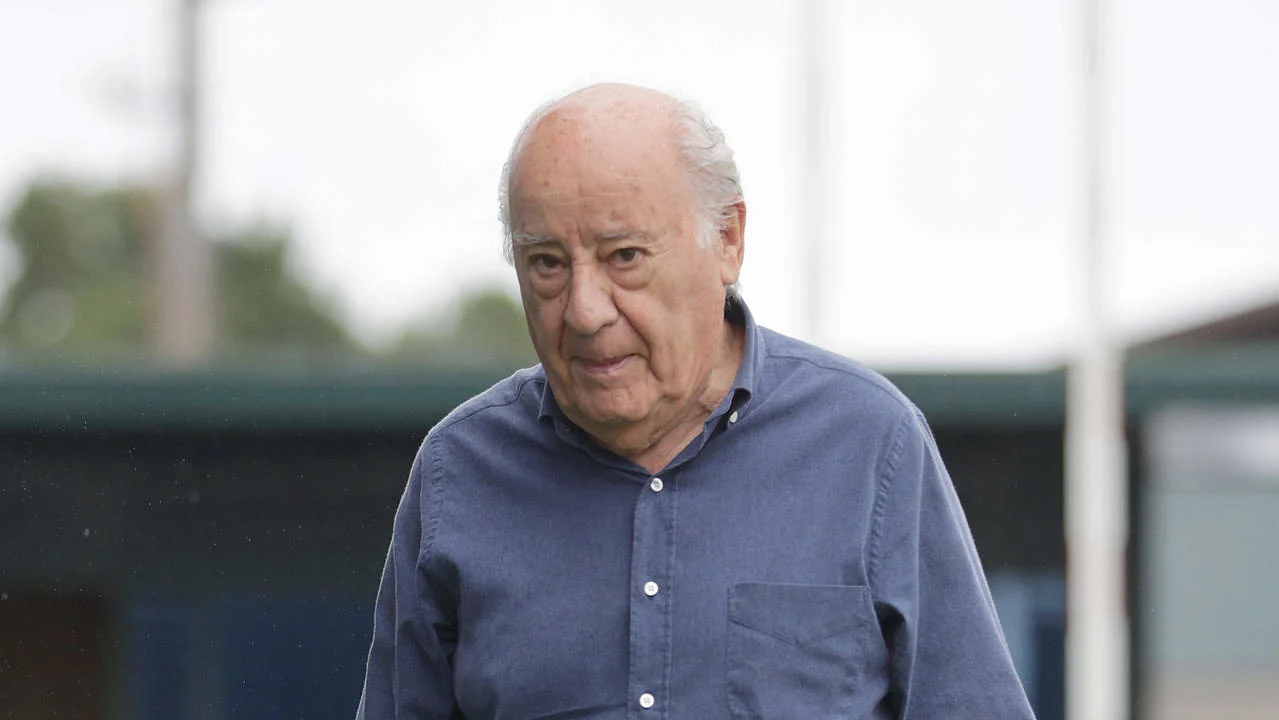
But if you ask locals, his behaviours are not that mysterious. To them, they’re typical of Galicians. “He’s just a Gallego”. Galicians are a people known for being elusive, isolated, and mysterious. A nation of lighthouse-keepers, in other words. For instance, asked when the bus would arrive at its destination, the Galician bus driver shrugged and told my sister, “Llegara cuando llegara” (it’ll arrive when it arrives).
This behaviour proves particularly incomprehensible to foreigners.
This week, I spoke with a Galician entrepreneur who played middleman in a failed acquisition of a large commercial property in Miami on behalf of Ortega back when the Spanish businessman was still mostly unknown, in the late 90s. The seller, a well-known American businessman, couldn’t understand why this unknown Spanish buyer refused to visit the property he was about to purchase for $110 million, or even to speak with him: “Pedro, I’m used to negotiating… ‘top to top’.”
That mentality, unsurprisingly, has been passed on to Amancio Ortega’s heir in Inditex, his third daughter, Marta Ortega.
PRIVATE URBAN DEVELOPMENT: Despite Ortega only being appointed as the non-executive Chair of Inditex in April 2022, replacing former professional CEO Pablo Isla, it was seen in the press as the epitome of nepotistic behaviour.
“One of Amancio Ortega’s great successes is that he professionalised the company and reduced the role of the family,” Lorenzo Bernaldo de Quirós, president of Freemarket, a Madrid-based consultancy, told the Financial Times after the announcement. “This is a backwards step.”
But two years later, and after a duplication in the share price level, Marta seems to have been cut out of the same Galician stock as her father. Notwithstanding her higher profile in the foreign press, she’s no stranger to locals in the obscure Galician village she lives in: in spite of a personal fortune numbering in the dozens of billions, she still does her own grocery shopping.
The largesse of her own personal Marta Ortega Perez Foundation (MOP) and its work in Coruna has attracted plaudits far and wide. It recently redeveloped disused parts of Coruna’s industrial port, containing an old cement factory, and shaped the space into an exhibition hall. It currently hosts a magnificent exhibit showcasing celebrated photographer David Bailey’s work and personal life. Nearby, an Instagram-friendly spot built by MOP attracts young, hip crowds to its Ziggurat-like monument:
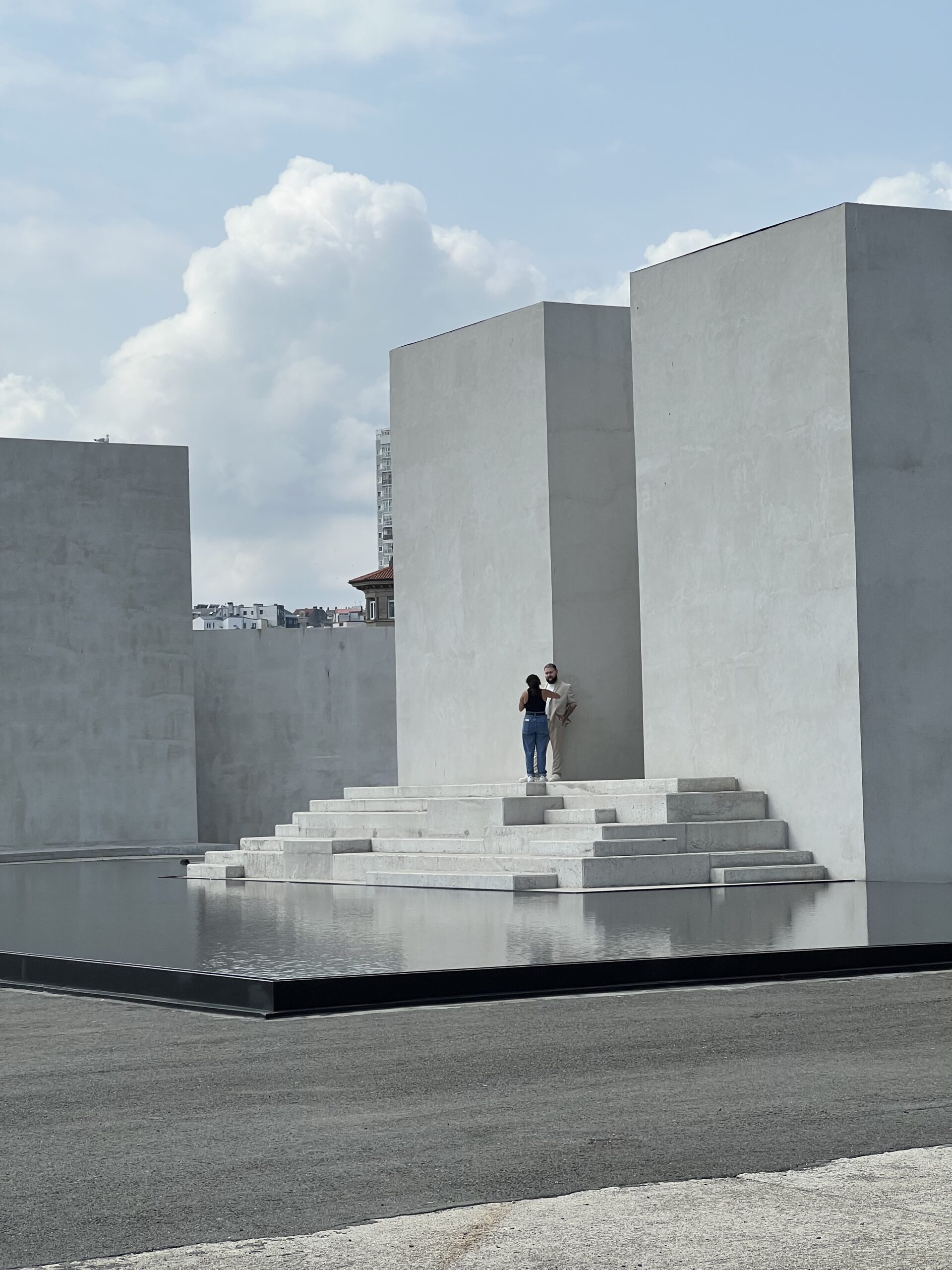
The impact of this foundation is not impersonal. To the contrary. “This Marta is really impressing me”, I overheard a passerby comment. And her Foundation is only the tip of what the Ortega family has achieved in Coruna. Locals have expressed amazement at the sudden presence of international tourists and the increasingly cosmopolitan crowd.
Many of these are high-flying consultants, logistics experts, and other professional services who, due to the Ortega’s stubborn refusal to leave Galicia, have been forced to relocate to this heretofore unknown moody corner of Spain.
It is no exaggeration to say that Ortega’s regionalism has transformed Coruna from the sleepy, mostly unknown Galician capital it was to a spot of worldwide cultural and professional relevance.
An accursed necessity
The Ortega’s example is widespread across Spain. Juan Roig, CEO and the largest shareholder of supermarket chain Mercadona, for instance, was one of the primary care providers to victims of the DANA floods in Valencia. On the other hand, the Valencian administration’s confused, haphazard, and incompetent assistance almost brought its government down.
While the Ortegas are generally well regarded, particularly in Galicia, history is replete with examples of spendthrift and patriotic businessmen whose enterprises later become hollowed out in a mad dash for profitability. Milton S. Hershey, founder of the Hershey chocolate bar, springs to mind.
Such a negative shift would only be more impactful in an age of centralised paralysis. And once a pivotal role has been given to these private initiatives, it’s hard to see how the populace could take it back should it turn tyrannical.
Medieval Italy experienced a similar situation. Freed from the burdensome oppression of the distant Holy Roman Empire’s administration, the wealthy and independent northern Italian city-states like Venice, Florence, and Milan proudly emerged.
“No democracy with dignity should accept handouts from billionaires”, claimed the far-left Pablo Iglesias, pronouncing himself against Ortega’s medical donation to the Spanish healthcare sector.
Spain may still be a democracy on paper. But casting an eye on the history of deep-seated corruption across both parties and in our public sector, it’s difficult to claim we’re still dignified.
So while Pablo Iglesias may not be wrong, I struggle to see what other choice we have.

Last week, the U.S. deployed warships to the Caribbean, ostensibly for anti-cartel strikes, but outlets across the board have questioned what the unusually large U.S. Navy flotilla’s true purpose really was. Officially, the flotilla was on an anti-narcotics mission. Given the proximity to the Venezuelan coasts and the State Department’s publication that a strike against a drug vessel had occurred, the likely target was the powerful Cartel de Los Soles.
For those who don’t know, the Cartel de Los Soles is named after the sun-like emblem carried by Venezuelan generals. Both the U.S. Treasury and other Latin American countries like Peru accuse Nicolas Maduro, Venezuela’s president, of personally running the criminal group.
Maduro’s response to the U.S. provocation was decisive. He called upon civilians and reservists to mobilize into militias, claiming almost 4 million members were prepared to defend the country’s coastlines from an unnamed “enemy”.
As such, analysts told the BBC that the risks of the conflict escalating into an outright confrontation with the Venezuelan government were high. The Pentagon revealed Venezuela engaged in its own counter-provocation, dispatching two military aircraft to fly near a U.S. Navy vessel in Venezuelan coastal waters.
The DOD responded, noting: “The cartel running Venezuela is strongly advised not to pursue any further effort to obstruct, deter or interfere with counter-narcotics and counter-terror operations carried out by the U.S. military.”
But the flotilla’s impact goes beyond Venezuela. The region is already jittery about the U.S. taking the law into its own hands in Central and South America when it comes to fighting drug cartels. Earlier, in August, the Guardian reported that Mexico’s senate had devolved into violence after a heated discussion over the presence of American troops in Mexico and whether it amounted to an “invasion”.
Mexican President Claudia Sheinbaum rejected the idea, noting there was an agreement between both countries to “cooperate, collaborate, but there will be no invasion… It’s absolutely off the table.”
The Blind Spot take
Nothing is true until officially denied. But tales of invasion are too simplistic. What we’re observing is the U.S.’ shift from a global Empire to an American one.
Underscoring Trump’s flotilla is the clear threat of military intervention against Latin American governments that harbour cartel infrastructure or which, in the case of Venezuela, literally comprise one.
These interventions are legally covered by the designation of certain drug cartels as terrorist organizations, allowing the U.S. military strike capacity on these cartels beyond its borders without the permission of national governments.
We called this change out when Trump outlined it at the start of his Presidency. The move effectively gives the United States a legal casus belli against most governments in Latin America since cartels’ outsized power and funds mean they are strongly enmeshed with regional state infrastructure and politicians, whether with state consent (as in the case of Venezuela) or despite it.
That being said, the nature of this particular operation seems less like a move towards regime change in Venezuela and more like negotiation under fire. It’s only once we zoom out that the operation’s real intent becomes clear: redrawing the lines of direct U.S. geopolitical control closer to home.
We can’t be certain of our de-escalatory prediction. But the facts bear it out: a month ago, the Trump administration reissued Biden-era licenses to U.S. energy giant Chevron so it could resume Venezuelan oil operations. Chevron tankers began re-depositing Venezuelan crude into U.S. markets last week.
It also comes alongside voices aligned with both Maduro and Trump, which recognize that war and regime change are a long way away. “Behind the scenes, it’s business as usual”, a U.S. official told The Washington Post last week.
This suggests the flotilla is part of a carrots-and-sticks approach to bend the Maduro regime to Trump’s will. Theatrical, as ever.
But the more interesting suggestion is what this means for American power in Latin America. In many ways, it reminds me of Diocletian’s splitting of the Roman Empire into Western and Eastern spheres. Struggling to carve out American interests in an increasingly multipolar global environment where U.S. debt increasingly constrains its once-overwhelming military projection, the U.S. is cutting its losses.
Instead, the U.S. will become physically dominant over its own continent and forcefully re-align it with its national goals, while relying on tools like alliances, the dollar, and stablecoins to project power overseas. From this perspective, the regional American intervention fulfils a double role: bending Maduro while signalling forceful intent to the entire region.
This is to say: the U.S. is going from 20 percent worth of influence in 100 percent of the world, to 100 percent of influence in 20 percent of the world. And if we look at how the administrative split between East and Western Rome strengthened their respective administrations, this could be the right move.
Takes one to know one?
Israel’s controversial prime minister, Bibi Netanyahu, recognized the Armenian genocide during a podcast with Armenian-born presenter Patrick Bet-David on August 27.
Turkey has long denied allegations that their mass killings and forced deportations of hundreds of thousands of Armenians amounted to genocide.
Two days later, the Turkish Foreign Minister announced the country had completely severed economic and trade ties with Israel, while closing its airspace to Israeli aircraft, ostensibly in response to the war in Gaza.
The Blind Spot take:
Netanyahu’s comments were another diplomatic retaliation in response to an increasingly wide rift between the West’s closest allies in the Levant.
As we outlined months ago, the power struggle between these Western allies is becoming increasingly bitter after the collapse of the Al-Assad dynasty in Syria created a power vacuum that both regional powers have seized upon.
On the one hand, Turkey has become one of the new Syrian regime’s main backers. On the other hand, Israel continues to support Druze independence movements in the country’s southern Sweida region and uses this as a pretext to entrench its military presence there. Officially a Muslim group, the Druze, which are spread out across Lebanon, Syria, and Israel, secretively practice a highly insular, esoteric religion that pre-dates Islam.
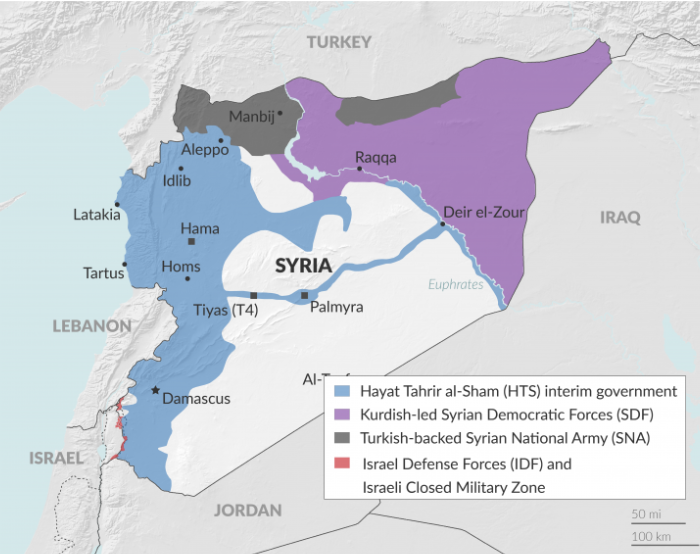
While a direct military flare-up between these Western partners is unlikely, their struggle over Syria clearly shows the embattled country’s war is far from over.
While only the Israeli-backed Druze rebellion has recently made headlines, we wouldn’t be surprised to see Israel begin to covertly support the re-emergence of an organised ex-Assadist, Alawite resistance to the Syrian regime in the country’s west in the coming months and years, despite their traditional animosity, because Israel could easily supply them weapons to oppose the Turkish-backed Syrian regime by sea.

The curious case of the German candidate deaths
Seven candidates for the controversial Alternative for Germany party died “suddenly and unexpectedly” within two weeks of the regional elections, amidst unexpected deaths of at least 16 other political candidates in the region.
While public information suggests the regional police have not classified these individuals’ deaths as suspicious, the increasingly polarised atmosphere in Germany has left AfD voters questioning what really happened.
Local media have outlined that in all districts where an involved candidate has died, completed postal ballots need to be recast. Regardless, spokesmen for the local electoral commission claim the number of deaths is “not significantly higher” than in previous elections.
The Blind Spot take
To our mind, that’s not the strangest thing happening in the NRW elections.
What’s genuinely bizarre is that after a decade of tone-deaf, uncritically pro-migration, centrist policies in Europe, all parties except the AfD in NRW have signed a “fairness agreement” in Cologne regarding migration.
This so-called Fairness Agreement has committed these parties to promoting “tolerance and peaceful coexistence among people of different origins, cultures, and religions“.
Naturally, this sounds great. But the optics are terrible — especially if you want to guarantee tolerance and peace between cultures and religions.
As you can imagine, this was quickly turned by the AfD into an “immigration muzzle”, which restricts all parties but the AfD from honestly talking about the numerous scandals related to immigration policy in Germany’s NSW.
Dying empires, its citizens bloated by inaction, bureaucracy, and welfare, are often settled by less economically prosperous but dynamic immigrants. Just ask Rome.
This wasn’t always a bad thing — many of the so-called barbarian ‘invaders’ were invited in at the pleasure of the local populace, often to kick out less friendly barbarians like the Huns.
But all of these potential benefits disappear if our centrist parties are paralyzed by the fear of committing politically incorrect speech in calling out the outsized proportion of crimes committed by Europe’s careless migration policy, for example.
As long as Europe’s centre remains unable to call out the downsides of our immigration policy, and of the cultural confusion posed by many of these migrants, they’re setting the course to a takeover by the hard right, complete with all the nasty consequences that may follow.

Tell me we’re at war without officially telling me we’re at war
In a move that nobody saw coming, Donald Trump announced a couple of weeks ago that he would be changing the name of the Department of Defense to the Department of War.
War Department “just sounded better” than Defence Department, claimed the President on August 25, exclaiming “I don’t want to be defense only… we want offense too”.
The propaganda pressures of the rising Cold War led both the United States and the Soviet Union to claim to be singlehandedly pursuing peace; only the ‘other side’ pursued war. This idea finds a modern counterpart in Izzy’s “mutual liberation syndrome”.
Unfortunately, this competition for the hearts and minds of the world, alongside the rise of international law (which prohibited offensive warfare), resulted in the popular use of Orwellian euphemisms like “Defense” instead of “War.”
It doesn’t take a genius to figure out that euphemisms of this sort are a conscious linguistic trick to blunt our reaction functions to horror and undermine our democratic oversight. Left unchecked, they have the potential to open the door to the quintessential banality of evil that manifests when good men do nothing. It is the linguistic equivalent of a shell company or accounting window dressing.
This point was perhaps best expressed by comic George Carlin, who noted in a 1988 skit that “Americans can’t really handle the truth, so they invent soft language to protect themselves, and it gets worse with every generation.”
In a similar way, accepting that offensive wars should not be carried out and overseen by countries’ “Defense” departments helps to anchor morality to the reality that all war is bad. It does this notably by dispelling the notion that we are only ever the “good guys” engaged in defensive action.
Chinese robot tank reveal
Amidst all the chatter about the Chinese military parade in Beijing, one significant innovation was not on display. China had previously revealed its new light tank named the VU-T10 in July, which may become the world’s most heavily armed unmanned combat vehicle, amid an impressive array of military weaponry unveiled during its recent parade in Beijing.

The Blind Spot Take
DARIO COMMENT: We have long suspected that the role of armoured vehicles in contemporary warfare will shift from heavily armoured, manned tanks to unmanned, lightly armoured vehicles.
The reasons for this shift are obvious. The economics of drone warfare render tanks increasingly vulnerable, while drones’ versatility means they can always stay one step ahead of countermeasures.
For instance, when tanks increased their armoured protection in Ukraine, their respective adversaries simply deployed heavier drones. As electronic warfare measures were established along the front, drones continued their missions via fibre-optic cable.
But that doesn’t mean armoured vehicles will disappear — they still have a critical role to play. They can still take a few hits from cheap drones while deploying infantry, covering their deployment with superior firepower.
It just means they must adapt to the new economics of war. That means no more throwing away highly expensive, superbly armed pieces of equipment (heavy tanks) alongside precious manpower.
Not only does it take months to train tank gunners and drivers, these expensive tanks are also valuable targets that attract drones like moths to a flame.
This mis-adaptation to contemporary warfare by current tank units in Ukraine means these heretofore fearsome units have become highly conservative, hiding in the rear and only occasionally emerging to engage in indirect fire on enemy positions.
Better deploy these valuable troops in secret, underground trenches far from the frontline, as they remotely control relatively cheap, unmanned ground vehicles with decent armour and excellent agility.
That’s all from us. Glory to Spain,
