

PHARMA LIABILITIES: Pharma giant AstraZeneca admitted in court documents for the first time last week that its Covid vaccine can cause a “rare side effect”. The belated admission comes despite a plethora of governments linking the vaccine maker’s product to blood clots from as early as 2021, and in some cases even withdrawing the product from distribution. The first case lodged against AZ was filed by Jamie Scott, a father of two who was left with permanent brain damage after developing a blood clot in his brain. Despite this admission, AstraZeneca continues to contest Scott’s claims.
ECOHEALTH’S DASZAK TESTIFIES: The House Covid panel grilled EcoHealth Alliance Dr. Peter Daszak on the role the non-profit played at the Wuhan Institute of Virology and how it may or may not have contributed to the origins of Covid 19. Daszak repeated the line he has maintained publicly ever since EcoHealth fell under media scrutiny, noting his organisation and staff had been subjected to disinformation and false allegations, even as they have worked hard to cooperate with authorities. “We estimate over 15 million pages of EcoHealth Alliance documents have been shared with authorities,” he said. Daszak also went on to deny his organisation had been involved in controversial gain-of-function work.
GOF or not? Those claims, however, contradict sworn statements by NIH principal director Lawrence Tabak and Dr. Ralph Baric. The latter told panel members on January 22 that his work with EcoHealth “absolutely” constituted gain-of-function research. According to the New York Post, Baric had also privately told Daszak it was “a load of BS” to maintain the SARS-like experiments were undertaken with sufficient safety measures.
Cooperative or not? Brad Wenstrup, the chair of the Select Subcommittee on the Coronavirus Pandemic, meanwhile, noted that “Dr. Daszak has been less-than-cooperative with the select committee.”
Damning conclusion: At the same time, the House committee’s staff-level report recommended Daszak be formally debarred and criminally investigated as a result of his actions prior to and during the COVID-19 pandemic.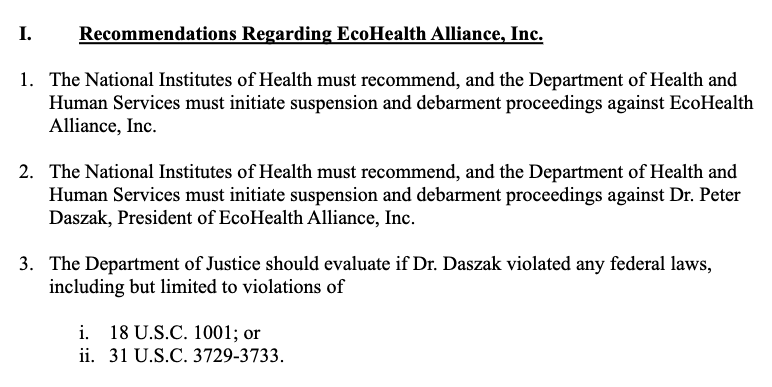
Defiant: Daszak, a prolific poster on X, maintained his defiance against accusations after the hearing, too.
Katherine Eban strikes again: The journalist who wrote the first definitive mainstream story linking the virus to gain-of-function research back in May 2021 returned this week with an exclusive account of Ralph Baric’s closed-door testimony to congressional investigators. According to Eban, Baric — who has stayed silent about the matter until now — had long worried about biosafety protocols in China and urged his Chinese counterpart Shi Zhengli to move her work to a more secure biosafety level 3 lab.
Scientific naivety? “While there is little in the 212-page transcript that is likely to markedly shift the debate on how COVID-19 originated, the picture that emerges is of an American scientist who is deeply wary of his Chinese counterparts and has no way of knowing if or how they may have made use of the groundbreaking research techniques he developed,” Eban wrote.
You can watch the whole testimony here. Nature’s account of the hearing, meanwhile, is here.
STRATEGIC CHINESE FENTANYL ATTACK? Mike Gallagher, the former chair of the House Select Committee on the Chinese Communist Party, penned an oped in the Washington Post outlining a bipartisan investigation that had revealed the CCP “essentially pays Chinese companies to send illegal synthetic narcotics such as fentanyl and fentanyl precursors abroad.”
Subsidising America’s addiction problem: “The party provides subsidies in the form of rebates for the value-added tax, or VAT, to companies that manufacture fentanyl analogues, precursors and other synthetic narcotics, so long as the products are sold outside China. The Communist Party uses VAT rebates to dramatically increase exports of other goods, and we now know that it has created distinct rebate categories for entire classes of illicit synthetic narcotics,” Gallagher wrote. “All companies in China are eligible for this national subsidy, giving them a strong incentive to produce these illegal narcotics for sale abroad.”
EXTRADITION: Meanwhile, a high-ranking member of the Jalisco New Generation Cartel in Mexico was extradited to the United States to face charges of coordinating illegal drug shipments to the country and related money laundering schemes.
| POlITICS, POLITICS, POLITICS |
BUKELE INVESTIGATES ENTIRE PRESIDENTIAL CABINET: El Salvador’s president, Nayib Bukele, gathered his cabinet last week to tell them they will all be investigated for corruption and bribery. Bukele’s move comes in a bid to be “well remembered” not just as a “man who isn’t a thief” but one who “also doesn’t surround himself with thieves”. The corruption probe will see every member of his presidential cabinet undergo checks by the country’s Attorney General. The news follows the arrest of presidential appointee for strategic projects, Christian Sandoval, earlier this week, after he was accused of using his position to ask for bribes from companies and people involved in the strategic governmental projects of which he was in charge.
| GEOPOLITICAL HOT SPOTS |
FOREIGN AGENT BILL ROCKS TBILISI (AGAIN): Protests in the capital of former Soviet Republic Georgia against a proposed law to limit the influence of “foreign agents” turned violent this week. The ruling Georgian Dream party says the bill is needed to “boost transparency” of foreign funding, but protesters say it could be used to crush dissent ahead of elections this year.
Thousands of Georgians protested outside their parliament against what Western media and Georgian opposition members have dubbed a “Russian-inspired law”.
And while MPs have approved the second reading of the controversial “foreign agents” bill this Wednesday, the European Union has already outlined that its passing could harm Tbilisi’s ambitions of joining the bloc.
The Foreign Agents bill, if it were to pass, would force media outlets, opposition figures, and NGOs to register as agents of a foreign power if they garner over 20 percent of their funding from sources external to Georgia.
It sounds simple enough. So why the kerfuffle?
The critical issue with the bill, Georgian opposition members point out, is that a similar law was enforced in Russia in 2012. Since then, the Kremlin has used it to marginalise voices who challenge Putin’s rule, which includes cultural figures, media organisations and civil society groups.
And you won’t find much commentary in the West that dissents from this perspective. The law is called “authoritarian”, “Russian inspired” and reams of Georgian protesters on the streets seem to validate the notion. Even Georgian President, Salome Zourabichvili, has said she will attempt to veto the bill passed by Georgian congress members, calling for “#notoRussianlaw” on X.
This opposition has led the ruling Georgia Dream party, which tabled the motion, to be called a “Pro-Russian” party. This appears to gel with Georgia’s apparent position of neutrality towards its Eastern neighbour, with Georgia officially refusing to enter into any Western sanctions regime against the country on the back of its invasion of Ukraine.
Nor does it help that the party’s founder, billionaire Bidzina Ivanishvili — who made his fortune in Russia — has been plagued with accusations of being pro-Kremlin. Or that Georgia’s government opted for neutrality while Russia invaded Ukraine.
But there’s more to it than that. The Andrew Carnegie Endowment for International Peace has an interesting piece explaining why such reforms don’t really make the Georgia Dream party pro-Russian.
Key to this, as ever, is recent history, notably 2008, when Russia invaded some 20 percent of the country. Despite Western posturing, Georgia was left alone to bear the brunt of the Russian assault. That has knocked faith in NATO. While an overwhelming majority of Georgian society wants to join the EU, realism prevails when it comes to expectations of NATO or Western military protection. As a result, the country’s neutrality should be seen as a careful calculation in self-preservation (do not antagonise the bear) rather than a geopolitically preferential slant.
The Carnegie Endowment instead argues the reasons for the “foreign agents” bill should be seen in the relations between Georgia and the European Union. It found the law was drafted after the European Commission granted candidate status to Ukraine and Moldova but not Georgia, instead issuing the country with a list of recommendations.
“The simplest (reason for drafting this law) is that Georgian Dream wanted to limit the ability of the opposition and independent media to constantly stir things up. Another explanation (…) is an attempt to bargain with the EU” with this law.
Remember, although 80 percent of Georgians or more support joining the European Union, the Georgian Dream party is four times more popular than the opposition coalition led by Georgian President Saakashvili that Western media consistently cites as ground zero for massively popular pro-Georgian, anti-Russian policies.
So why the “massive” street protests? Well, if you heard the Georgian Dream’s founder’s speech, it’s because a “global party of war” controls the country’s pro-western opposition through its foreign intelligence services. The view of the Western media and Georgian opposition on the other hand is the people are against the authoritarian leanings of this law, notably, its ability to be used to crush dissent from the Georgian government’s position.
In a way, the latter is true enough. The Russian-inspired Foreign Agents bill was certainly used to oppress individuals who, mostly, have kinder and more agreeable politics, and often with the use of brute police force. But it’s also true that the opposition really is funded and supported by American or European sources who are anti-Russian and are pro-Western.
The reason why the Western-funded opposition wants to avoid this bill is, arguably, because of how obvious its sources of funding, and implicit geopolitical bias, would become – not necessarily because it’s a pro-Russian law.
In the West, meanwhile, there remains a wilful blindness to how our intelligence services can, do, and have weaponised NGOs as covers for their geopolitical work. Unlike foreign embassies, which are known to have a covert element to them, the same isn’t supposed to apply to NGOs and media organisations. In practice, it obviously and increasingly does. But acknowledging that a lot of these entities do operate as covers for Western geopolitical and particularly American interests, seems to be a step too far.
| MEDIA MATTERS |
GHOST ARMY IS BACK: Exactly one year after it broke the internet with its original creepy-as-hell “we mess with your brains” recruitment video, America’s 4th PSYOP group returned with a fresh mind-bending offering. The new effort is still just as dark as the original one, but the theme has shifted. The 3-minute, 11-second video is overlayed with extracts of JFK speeches focused on the difficulties of guaranteeing freedom. “When man is enslaved, all of them are not free”.
Subliminal anti-China messaging? The video then shifts to the sound of a 1950s-era male explaining that “modern war has become a struggle for men’s minds as well as for their body.” The voice adds, “today, we face an enemy that spends enormous sums of money and manpower all over the world in an attempt to subvert the thinking of the people of the free world” as shots of the yuan and Chinese infrastructure are overlayed. “Art is not a form of propaganda; it is a form of truth,” concludes JFK.
The man behind the curtain: For more on the thinking behind these ads, check out this Pineland Underground podcast episode, which features an interview with Major Lamb, the creator of the Ghosts in the Machine video.
| SNEAK PEEK |
— A SocGen trader flung out of the bank for unauthorised risk-taking takes to social media to call for “trader justice” and new dismissal rules.
— Georgia’s foreign agent bill is causing havoc on the streets of Tbilisi again.
— Dario argues that Chinese EV competitiveness isn’t down to subsidies or forced labour usage, but smart vertical integration.
— We catch up on what EcoHealth’s Peter Daszak told the US House Covid committee.
A jolly Saturday morning to y’all,
We now know the gilt market was already on edge that week due to the impact of depleting collateral reserves among LDI funds; the BoE had already flagged it way back in August as the week it planned to start selling bonds, and, of course, the Queen had died, meaning BoE meetings (and thus also markets) had to be recalibrated around the two-week lag of the mourning period. Meanwhile, the day before her budget announcement, the BoE had hiked rates less than expected.
If we assume the BoE did have a duty to bend to Truss’ policy, then perhaps Truss’ rage against the BoE is justified.
Makes you think, doesn’t it?
Send tips to [email protected] and [email protected]
| SANCTIONS |
WHY SANCTIONS AREN’T WORKING: The U.K.’s sanctions agency, which should have come to the fore after the myriad of sanctions imposed on Russians after the country invaded Ukraine, is inefficient and inexperienced, MPs on the Treasury Committee were told Tuesday.
MPs told: Tom Keatinge, Director of the Centre for Financial Crime and Security Studies at the Royal United Services Industry (RUSI), said that if he had only one recommendation it would be “to create an agency which is pulling in all the information and intelligence that is needed to ensure sanctions are implemented effectively.” But, he conceded, this would involve active monitoring of shipping routes and active maritime policing.
It’s implementation! Keatinge said the U.K. should do more with what it has: “I would stress that it is about how you implement the sanctions you have decided to levy,” he told the committee. This echoes the words of a sanctions lawyer MFS U.K. spoke to under condition of anonymity, who said the government needed to “stop passing more pieces of legislation so they feel like they’re doing something,” and “focus on implementing what’s already in place”.
How the oil price cap spawned a parallel market: In evidence provided to the committee, the International Group of P&I Clubs, a key source of maritime insurance, spoke of the flawed logic and political naivety behind the price cap. “Most ships that now trade in Russian oil and oil products (whether OPC compliant or not) operate under the rules of jurisdictions in which the OPC does not apply, and in countries where it is not observed,” the P&I Club evidence noted. “Provided the owners and operators of ships that carry Russian oil and oil products do not have a G7 jurisdiction nexus, they are entitled to operate entirely legally in accordance with the rules and laws that apply to them.”
The shadow fleet problem: The P&I club went on to explain how the extent and scale of these operations has led to the growth in what observers and commentators have referred to as a “shadow or parallel fleet of ships” carrying Russian oil and oil products (above or below the OPC). “This growth in so-called parallel markets is a direct consequence of the introduction of a regime that imposes severe restrictions and compliance obligations on entities that operate within the G7 while allowing entities outside the G7 the freedom to operate legitimately, provided there is no G7 nexus.”
Unenforceable. The insurers’ conclusion was that the OPC appeared increasingly unenforceable as more ships and associated services move into this parallel trade. The risk now was that even more tankers, beyond the 800 that have already left, would flee the International Group for the parallel jurisdiction. “The sale and purchase of Russian oil above the price cap has led to an expansion of a parallel market of traders, shipowners and insurers who operate out of G7 coalition jurisdictions. This growth in parallel activities now appears to account for the majority of Russian oil and oil products shipped to third countries which undermines the policy objectives of the OPC regime.”
Territories trouble: Ben Cowdock, investigations lead at Transparency International, told MPs that crown dependencies and overseas territories were also examples of how Britain’s sanctions implementation falls flat. Cowdock referenced the importance of public registers of ownership, something which was highlighted in a cross-party parliamentary Economic Crime Manifesto published last month: “The overseas territories have still not complied with the law [on beneficial ownership] and the crown dependencies have reneged on their commitment to implement public registers,” Cowdock said. He added that only Gibraltar had made a publicly accessible register and there were still issues with it.
Financial engineering to save the day? Keatinge, however, pushed back against claims the seizure of Russian assets would jeopardise the euro or Western markets. “There are plenty of well-argued papers that make it clear we wouldn’t be in breach of international law,” he said, adding there were a bunch of financial engineering ideas out there. He further noted doing so would provide a strong deterrent against other countries doing the same thing. “It’s only bad if you’re planning on invading a neighbour,” he said.
As previously highlighted by TBS, one of the least talked about constraints on the efficacy of sanctions is the scale and scope of yet-to-be discovered Russian assets due to the opacity that still prevails across European offshore centres. This, in particular, applies to ongoing resistance by offshore centres to reveal beneficial ownership information.
Ben Cowdock of Transparency International was among the first we’ve seen to publicly raise the issue.
The key obstructing issue, as we wrote before, is that a decision in the Court of Justice of the European Union in 2023 deemed the exposure of beneficial ownership a breach of privacy that clashed with human rights. This, the offshores argued, meant they were now legally exposed to lawsuits if they went ahead with their originally intended plan of providing access to registers by 2023.
It is now May 2024, and the offshores are still dragging their feet on how to proceed, with some, such as Jersey, initiating public consultations which aren’t slated to close until at least June.
| BUSINESS, FINANCE, ECON, ETC. … |
DELTA ONE STRIKES AGAIN: Former SocGen trader Kavish Kataria made headlines on Friday after he took to LinkedIn to post “his version of the story” behind why he was fired by the bank in 2023. The post comes after SocGen announced on Tuesday that it had identified a “one-off trading incident in 2023” involving two traders ahead of its Q1 report on Friday (which, incidentally, revealed the bank saw net income fall less than expected on the back of a strong performance in equity derivative sales.)
World’s smallest violin? In the LinkedIn post, Kataria — who sports designer sunglasses and a quiff in his profile photo, which is also captioned “open to work” — said he felt scapegoated. He called on regulators to introduce rules to protect traders from ruthless employers keen to scapegoat them. “It’s very easy for everyone to read the story and start shaming but unless knowing both sides of the story people shouldn’t judge or try to bring the other person down,” he wrote, adding, “Trading industry is so big but there are no rules or regulations which fight for trader justice… Every time something goes wrong in the organisation, traders are only held responsible for wrongdoings without listening to their side of the story.”
Seeking trader justice: Hong-Kong based Kataria, who worked on SocGen’s Delta One desk — the same department as SocGen’s most high-profile rogue trader, Jerome Kerviel — said he would like to request “everyone to make rules for us as well so that we are not thrown overnight from the company without getting justice.”
Scapegoating solidarity: Kerviel, for one, appeared relieved that history was repeating itself, posting a picture of himself in a SocGen cap with the comment that “after 16 years, I can finally move on … wishing the traders good luck.”
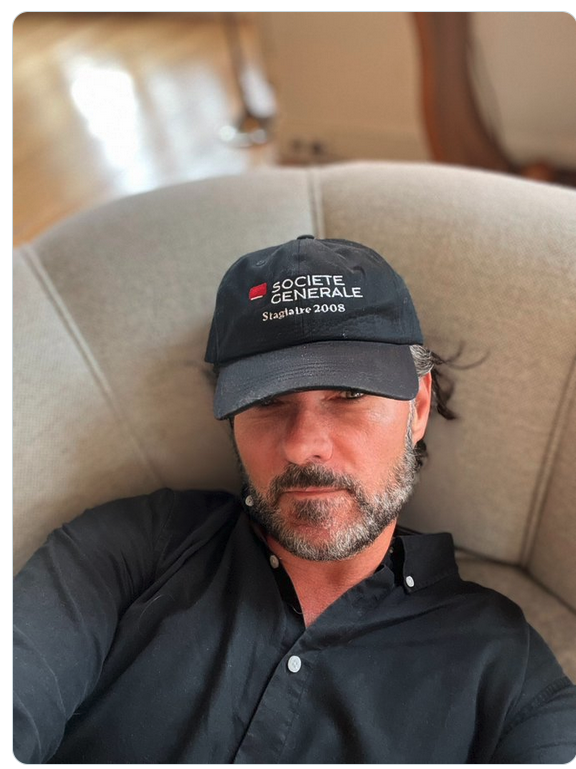
Scapegoats united. Former UBS trader Kweku Adoboli, jailed in 2012 for causing a £1.8 billion loss at the Swiss bank, had also claimed in his defence that senior managers had been aware of his unauthorised risk-taking. “The banks are so powerful, have so much leverage over all the regulators, that it is very easy to paint the traders as the bad actors,” Adoboli told TBS/POLITICO. “The question is what is a genuine bad actor, and who gets to determine that.”
BTW did you know? Back in 2016, a French labour court awarded Kerviel, a total of €450,000 ($511,000), because he had been fired without “real or serious cause.” The judge’s ruling added that “Societe Generale could not pretend it hadn’t been aware of the unauthorised trades conducted by Mr. Kerviel”. That judgment, however, was overruled by an Appeals court in 2018.
But according to Kataria, the strategy, which involved options on Indian indices, was conducted for up to 4 months and made almost 2 million euros during that period. “I was doing well in my job and I had already hit my PL budget with 4 months spare in a year,” Kataria wrote, adding he had no intention of hiding the trades from anyone and that if the bank was not aware of them it’s because other departments were not doing their job properly.
Whether Kataria was justifiably fired or not is beyond the capacity of this newsletter to determine. But his claim that traders are often not properly protected by the law has merit. The public perception that traders are generally reckless risk-takers who put other people’s money on the line without due care and consideration, ensures there is very little public sympathy or support for those who are potentially treated unfairly by the system. As far as the court of public opinion is concerned, when banks accuse traders of rogue or illicit trading, the institution’s word is taken as gospel while the trader is usually assumed guilty before proven innocent. The fact that banks are systemically incentivised to nail wrongdoing on individual scapegoats to mask broader institutional failings is rarely acknowledged in the discourse.
What a lot of the public doesn’t understand is that while traders are generally very well-remunerated, that doesn’t mean they are necessarily rich enough to pursue a lengthy legal case against an employer. Moreover, while some do get very well paid indeed, institutions are still inclined to wheedle their way out of paying contracted bonuses at any opportunity possible. So while all sorts of deals are promised to get top talent through the door, as per Kataria, that doesn’t necessarily mean they are ever delivered.
That can create a perverse incentive structure, where the better you perform the more likely you are to be fired so that the bank can s̶t̶e̶a̶l̶ withhold what it owes you for itself.
In such cases pursuing an unfair dismissal case can be even more detrimental to a trader’s career. Often, institutions offer up some small fraction of an entitled bonus to guarantee a quick settlement fix, on the proviso the trader does not pursue an unfair dismissal case against them formally (even if they have one). The problem for a trader, especially one that is only getting on the ladder, they probably need that capital to finance any potential unfair dismissal case. That’s without accounting for the fact that pursuing an unfair dismissal case, even if it’s successful, is a one-way ticket to never being employed in your sector again on grounds you might be deemed too litigious. They’re essentially snookered from the get-go.
One of the reasons all this is an unfortunate development is because banking and trading used to be just a few of the world’s professions — beyond the realms of Hollywood, sport and music — where real social mobility could occur, from the lowest working-class ranks to the top tier of society. The industry also had a reputation for valuing working-class nouse over academic credentials and a reputation for never breaking its contracts. This, however, no longer really applies.
It’s worth remembering, too, the degree to which the trading profession as a whole is afflicted by the inclusion of excessive non-competes clauses in work contracts. These can constitute a modern-day serfdom mechanism and, thus far, only in the US, has this been exposed as out of sync with broader human rights and competition law.
SECOND BOEING WHISTLEBLOWER DIES: Joshua Dean, a 45-year-old former Boeing employee who whistleblew about the company’s manufacturing defects in its 737 Max range, died this week after a short illness according to reports. According to the Seattle Times, Dean’s death comes after he was hospitalised for having trouble breathing. The internet, naturally, has now gone into overdrive about the coincidence of not one but two whistleblowers dying within a very short space of time. John Barnett, 62, was found dead in March from what appeared to be a self-inflicted gunshot wound.
STARBUCKS COLLAPSE: Anecdotal evidence of demand destruction at the consumer level in the US finally came to the fore this week, even as Jerome Powell continued to defy pressure to cut rates. The biggest surprise came from coffee giant Starbucks, which reported a surprise drop in sales in the first quarter sending its shares down as much as 17 percent. Yum Brands’ key outlets, Pizza Hut, KFC and Taco Bell were also hit by a slowdown, as was McDonald’s. 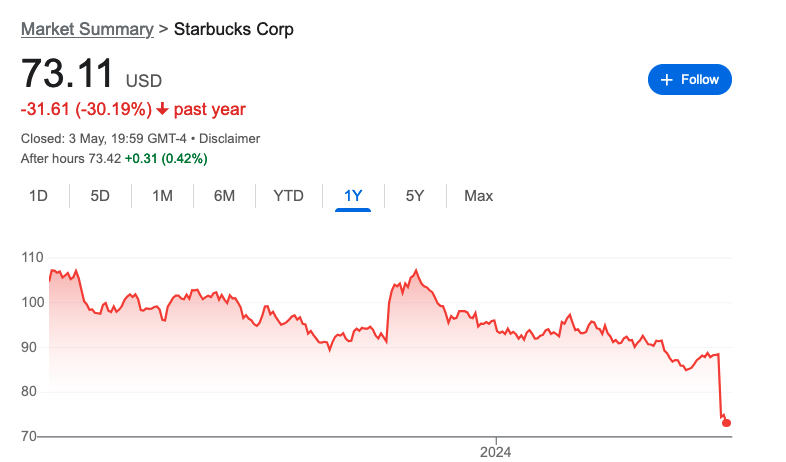
| COMMODITY CORNER |
PREPPING FOR EV REVOLUTION OR WAR? The following chart from Steno Research caught our eye: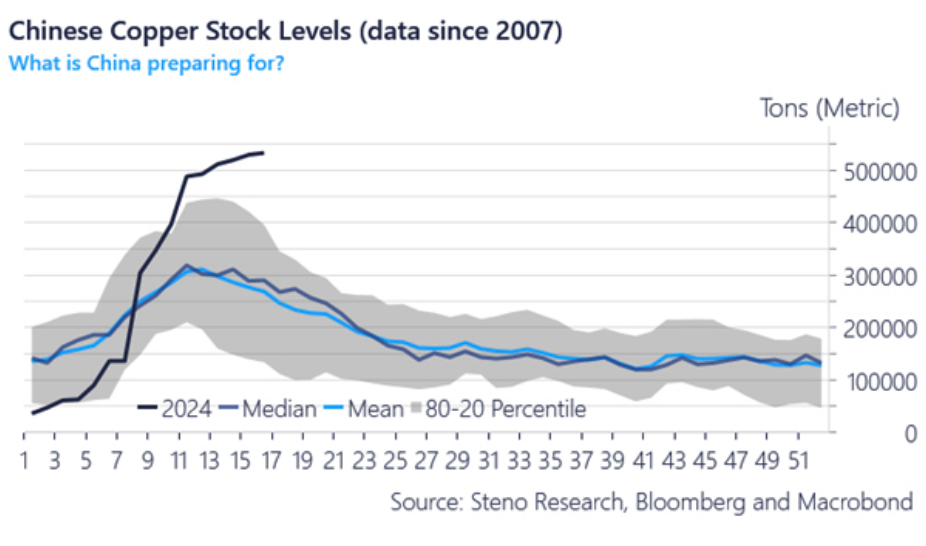
COCOA CORRECTION: Cocoa’s eye-watering run of the past couple of months, which saw the chocolatey commodity notch up record prices of $11,722 per ton, finally came to a shuddering halt this week. Futures contracts traded in New York finished the week almost 30 percent lower than their highest point. Not that the industry wasn’t bracing for an inevitable correction. “What goes up fast comes down fast,” warned Peter Feld, CEO of the world’s biggest chocolate maker Barry Callebaut, earlier this month. The only question at the time was how soon the crash would come.
| MOBILITY |
FORD ADMITS IT LOSES MONEY ON EVERY EV. America’s iconic automaker said it lost around $130,000 per vehicle it sold in the first quarter of 2024, equating to approximately 10,000. The ongoing EV price war with China has led to even steeper losses for Ford’s EV division, with an almost 84 percent drop in revenues compared to Q1 in 2023, despite sales only being down around 20 percent relative to the same period last year.
Western EV producers are facing the battle of their lives. Tesla’s once formidable stock-market performance has been languishing since at least 2023, while the unsustainable debt loads of rivals Rivian or Lucid are thrusting both automakers into an existential crisis. The news is no better for established internal combustion engine (ICE) producers trying to break into EVs. Ford revealed this week it has been losing up to $120,000 on every single EV it sells. All of this while customers are still coming to terms with range anxiety, extremely high charge times, and ongoing premiums relative to traditional ICE cars.
Enter scene: Chinese EV producers. BYD made waves earlier this year when it released its BYD Seagull vehicle priced at under $10,000. And they’re not the only price-beating Chinese EV company in town. Geely’s 2024 Panda car comes in at a whopping $5,500 dollars. The bargain basement prices on offer are making Chinese EVs so competitive that Chinese car exports surpassed imports in 2023 for the first time in history.
In a protectionist move, the European Commission has already launched a “fact-finding” mission into the role that government subsidies are playing in giving Chinese electric cars the edge. Commission President, Ursula von der Leyen, has already pledged to look into what tariffs may be needed to protect European and Western producers once the investigation concludes.
But the story is not a new one. It’s long been asserted that Chinese manufacturers benefit hugely from not being bound by the strict production and human rights guidelines that apply to Western manufacturers. Before joining Politico, Izzy contributed to a Michael Shellenberg story, which looked into similar trends with Chinese solar panel producers, who publish questionable figures relating to their carbon footprints and likely utilise elements of forced labour to keep their solar panel production costs down. The unfair advantage has, over the years, allowed Chinese solar panel producers to flood Western markets, and displace once-prominent manufacturers in Germany and Japan.
The same broad characteristics affect Chinese EV production. Search online and you’ll find reams of Western media talking about the alleged existence of forced labour in Chinese EV supply chains. Then there are the official government subsidies — up to three or four times the size of subsidies in OECD countries, amounting to a massive, predatory trade violation.
But is that the real story?
Search a little deeper into the public claims of forced labour and they all point to a series of Xinjiang-based companies such as Xinjiang Nonferrous Metal Industry Group, which processes the minerals needed to create EV batteries. Most of the inputs, such as lithium or aluminium, are mined in Argentina, Australia or the DRC, with the outputs going to EV producers like BYD and Geely.
The real competitive advantage certainly appears to be Xinjiang Nonferrous Group’s connections to the People’s Republic of China’s alleged “reeducation” program for the Uyghur minority in Xinjiang – effectively, a series of forced labour camps.
But there’s a kicker: non-Chinese companies have just as many links to these Xinjian-based processors as Chinese ones. Volkswagen, Toyota and Tesla, for instance, all source their aluminium parts and battery components from the region. Volkswagen even claimed that since they don’t control their Chinese subsidiaries under their agreement with SAIC, a Chinese carmaker, they aren’t responsible for its human rights impacts under German supply chain law. On that basis, Chinese EV companies may be no more guilty than their Western counterparts.
So, perhaps, all the edge lies in the subsidies? Well, if that’s the case, China might have a bone to pick with Western governments too.
Elon Musk’s Tesla has been just as much of a beneficiary of state aid as any Chinese company, both in terms of the critical loan programmes the company benefited from in the noughties, to the $4.9 billion it received in government subsidies it has received over the decade. And let us not forget that both General Motors and Chrysler received state bailouts during the financial crisis. Over in the EU, the situation is not much different. The bloc still offers an array of tax breaks and subsidies for manufacturers and buyers of electric vehicles, ensuring key beneficiaries like Volkswagen and Renault have little incentive to compete on price.
All this, by the way, comes without considering the role that legislation plays in baking in market preference for EVs by banning or regulating ICE access into city centres.
So if the advantages don’t lie there where do they lie? The obvious contender, beyond superior access to raw materials for EV battery manufacturing — since China owns the largest cobalt and lithium mines on continents other than its own — may lie in the deployment of another Western invention: the vertically integrated company.
Analysts mostly agree the real differentiator seems to be that Chinese EVs have a far more integrated and streamlined in-house supply chain. Let’s put this into perspective. A Tesla Model 3 made in China has around 46 percent of its components manufactured in house. BYD’s Seal EV, on the other hand, has around 75 per cent. And while Western automakers that pivoted into EV manufacturing, or an EV pure-play like Tesla or Rivian, had to learn the ropes of battery manufacturing, Chinese EV makers had many more decades of experience in the manufacturing of a wide range of other electric battery vehicles like Geely’s motorcycle batteries or BYD’s bus batteries, which allegedly allowed them to improve their in-house battery expertise far more quickly than Western competitors.
The real question, therefore, is not why Chinese EVs are so cheap. Rather, it’s why Western EVs are so expensive and unprofitable. Perhaps the answer lies in the short-termist quarterly thinking that pervades Western corporates, and which eschews long-term thinking and research and development in favour of quick stock-market wins.
The question then goes full circle back to Western regulators’ follies. Not content with pricing out the urban poor and lower middle classes from acceptable vehicles, forcing them to purchase overpriced cars that can run for little more than a few hundred miles after an hour-long charge, they are now preoccupied with imposing prohibitive tariffs on the only carmakers that could successfully cater to those priced-out by the economics.
| COLD WAR 2 |
GERMANY IS COLLATERAL DAMAGE IN AMERICA’S NEW COLD WAR wrote anonymous finance blogger, the Climateer, citing economist Michael Hudson’s latest opinion piece which was published in Berliner Zeitung on March 29. According to Hudson, whom Climateer describes as a Marxist economist, Germany is finally beginning to understand the true cost of American-pressured Russian sanctions, but the current toll is likely to pale in significance to the costs yet to come when America moves to prepare for the next stage of its confrontation with China.
Isolating China: According to Hudson, the Biden team seeks to lock Europe into its economic orbit as part of a drive to isolate China and its supporters, hoping that this will disrupt their economies and create popular pressure to surrender their hopes “for a new multipolar economic order”. The aim of Russian sanctions has purposefully been “to lock Germany, France and other countries into a dependency relationship on the United States”, even if the Americans prefer the phrasing that it means Europe has “freed itself” from dependency on Russian gas.
Bad trade: Hudson noted that, in reality, this has forced Europe to import US liquified natural gas (LNG) at prices three to four times higher, while “divesting itself of its business linkages with Russia, and moving some of its major industrial companies to the United States (or, even, China) to obtain the gas needed to produce their manufactures and chemicals.”
Allies or frenemies? Back in February 2022, Hudson reminded readers that America’s real adversaries were its European and other allies, which is why the real agenda is to keep them from trading with Russia and China.
| HOLY WARS |
BORN AGAIN BRAND. Russell Brand, the former actor turned current affairs social media pundit who also stands accused of a series of historic sex crimes, announced last weekend he had been baptised — though it wasn’t immediately clear into which Christian denomination. While some news outlets questioned the authenticity of Brand’s conversion, not least because he mentioned he was using tarot cards just hours after going into the waters of the Thames for the spiritual ritual, he has in the past called for living with “hybrid modalities” in his Christian beliefs. His wife, meanwhile, is a practicing Catholic. Brand, said he felt “changed, transitioned” after the event. According to his Instagram video, the baptism’s bliss far exceeded the highs from the many illicit substances he’s taken over his life.
Holy influencers! Brand is not the only high-profile political influencer to have converted this month. Right-wing firebrand and former Daily Wire host, Candace Owens, delighted many in the Catholic community when she announced on April 22 she had officially converted to Catholicism too, writing, “I do not fear, Christ is King”. Between them Brand and Owens command a following in the double-digit millions across various social media sites.
| HEALTH OF THE NATION |
PHARMA LIABILITIES: Pharma giant AstraZeneca admitted in court documents for the first time last week that its Covid vaccine can cause a “rare side effect”. The belated admission comes despite a plethora of governments linking the vaccine maker’s product to blood clots from as early as 2021, and in some cases even withdrawing the product from distribution. The first case lodged against AZ was filed by Jamie Scott, a father of two who was left with permanent brain damage after developing a blood clot in his brain. Despite this admission, AstraZeneca continues to contest Scott’s claims.
ECOHEALTH’S DASZAK TESTIFIES: The House Covid panel grilled EcoHealth Alliance Dr. Peter Daszak on the role the non-profit played at the Wuhan Institute of Virology and how it may or may not have contributed to the origins of Covid 19. Daszak repeated the line he has maintained publicly ever since EcoHealth fell under media scrutiny, noting his organisation and staff had been subjected to disinformation and false allegations, even as they have worked hard to cooperate with authorities. “We estimate over 15 million pages of EcoHealth Alliance documents have been shared with authorities,” he said. Daszak also went on to deny his organisation had been involved in controversial gain-of-function work.
GOF or not? Those claims, however, contradict sworn statements by NIH principal director Lawrence Tabak and Dr. Ralph Baric. The latter told panel members on January 22 that his work with EcoHealth “absolutely” constituted gain-of-function research. According to the New York Post, Baric had also privately told Daszak it was “a load of BS” to maintain the SARS-like experiments were undertaken with sufficient safety measures.
Cooperative or not? Brad Wenstrup, the chair of the Select Subcommittee on the Coronavirus Pandemic, meanwhile, noted that “Dr. Daszak has been less-than-cooperative with the select committee.”
Damning conclusion: At the same time, the House committee’s staff-level report recommended Daszak be formally debarred and criminally investigated as a result of his actions prior to and during the COVID-19 pandemic.
Defiant: Daszak, a prolific poster on X, maintained his defiance against accusations after the hearing, too.
Katherine Eban strikes again: The journalist who wrote the first definitive mainstream story linking the virus to gain-of-function research back in May 2021 returned this week with an exclusive account of Ralph Baric’s closed-door testimony to congressional investigators. According to Eban, Baric — who has stayed silent about the matter until now — had long worried about biosafety protocols in China and urged his Chinese counterpart Shi Zhengli to move her work to a more secure biosafety level 3 lab.
Scientific naivety? “While there is little in the 212-page transcript that is likely to markedly shift the debate on how COVID-19 originated, the picture that emerges is of an American scientist who is deeply wary of his Chinese counterparts and has no way of knowing if or how they may have made use of the groundbreaking research techniques he developed,” Eban wrote.
You can watch the whole testimony here. Nature’s account of the hearing, meanwhile, is here.
STRATEGIC CHINESE FENTANYL ATTACK? Mike Gallagher, the former chair of the House Select Committee on the Chinese Communist Party, penned an oped in the Washington Post outlining a bipartisan investigation that had revealed the CCP “essentially pays Chinese companies to send illegal synthetic narcotics such as fentanyl and fentanyl precursors abroad.”
Subsidising America’s addiction problem: “The party provides subsidies in the form of rebates for the value-added tax, or VAT, to companies that manufacture fentanyl analogues, precursors and other synthetic narcotics, so long as the products are sold outside China. The Communist Party uses VAT rebates to dramatically increase exports of other goods, and we now know that it has created distinct rebate categories for entire classes of illicit synthetic narcotics,” Gallagher wrote. “All companies in China are eligible for this national subsidy, giving them a strong incentive to produce these illegal narcotics for sale abroad.”
EXTRADITION: Meanwhile, a high-ranking member of the Jalisco New Generation Cartel in Mexico was extradited to the United States to face charges of coordinating illegal drug shipments to the country and related money laundering schemes.
| POlITICS, POLITICS, POLITICS |
BUKELE INVESTIGATES ENTIRE PRESIDENTIAL CABINET: El Salvador’s president, Nayib Bukele, gathered his cabinet last week to tell them they will all be investigated for corruption and bribery. Bukele’s move comes in a bid to be “well remembered” not just as a “man who isn’t a thief” but one who “also doesn’t surround himself with thieves”. The corruption probe will see every member of his presidential cabinet undergo checks by the country’s Attorney General. The news follows the arrest of presidential appointee for strategic projects, Christian Sandoval, earlier this week, after he was accused of using his position to ask for bribes from companies and people involved in the strategic governmental projects of which he was in charge.
| GEOPOLITICAL HOT SPOTS |
FOREIGN AGENT BILL ROCKS TBILISI (AGAIN): Protests in the capital of former Soviet Republic Georgia against a proposed law to limit the influence of “foreign agents” turned violent this week. The ruling Georgian Dream party says the bill is needed to “boost transparency” of foreign funding, but protesters say it could be used to crush dissent ahead of elections this year.
Thousands of Georgians protested outside their parliament against what Western media and Georgian opposition members have dubbed a “Russian-inspired law”.
And while MPs have approved the second reading of the controversial “foreign agents” bill this Wednesday, the European Union has already outlined that its passing could harm Tbilisi’s ambitions of joining the bloc.
The Foreign Agents bill, if it were to pass, would force media outlets, opposition figures, and NGOs to register as agents of a foreign power if they garner over 20 percent of their funding from sources external to Georgia.
It sounds simple enough. So why the kerfuffle?
The critical issue with the bill, Georgian opposition members point out, is that a similar law was enforced in Russia in 2012. Since then, the Kremlin has used it to marginalise voices who challenge Putin’s rule, which includes cultural figures, media organisations and civil society groups.
And you won’t find much commentary in the West that dissents from this perspective. The law is called “authoritarian”, “Russian inspired” and reams of Georgian protesters on the streets seem to validate the notion. Even Georgian President, Salome Zourabichvili, has said she will attempt to veto the bill passed by Georgian congress members, calling for “#notoRussianlaw” on X.
This opposition has led the ruling Georgia Dream party, which tabled the motion, to be called a “Pro-Russian” party. This appears to gel with Georgia’s apparent position of neutrality towards its Eastern neighbour, with Georgia officially refusing to enter into any Western sanctions regime against the country on the back of its invasion of Ukraine.
Nor does it help that the party’s founder, billionaire Bidzina Ivanishvili — who made his fortune in Russia — has been plagued with accusations of being pro-Kremlin. Or that Georgia’s government opted for neutrality while Russia invaded Ukraine.
But there’s more to it than that. The Andrew Carnegie Endowment for International Peace has an interesting piece explaining why such reforms don’t really make the Georgia Dream party pro-Russian.
Key to this, as ever, is recent history, notably 2008, when Russia invaded some 20 percent of the country. Despite Western posturing, Georgia was left alone to bear the brunt of the Russian assault. That has knocked faith in NATO. While an overwhelming majority of Georgian society wants to join the EU, realism prevails when it comes to expectations of NATO or Western military protection. As a result, the country’s neutrality should be seen as a careful calculation in self-preservation (do not antagonise the bear) rather than a geopolitically preferential slant.
The Carnegie Endowment instead argues the reasons for the “foreign agents” bill should be seen in the relations between Georgia and the European Union. It found the law was drafted after the European Commission granted candidate status to Ukraine and Moldova but not Georgia, instead issuing the country with a list of recommendations.
“The simplest (reason for drafting this law) is that Georgian Dream wanted to limit the ability of the opposition and independent media to constantly stir things up. Another explanation (…) is an attempt to bargain with the EU” with this law.
Remember, although 80 percent of Georgians or more support joining the European Union, the Georgian Dream party is four times more popular than the opposition coalition led by Georgian President Saakashvili that Western media consistently cites as ground zero for massively popular pro-Georgian, anti-Russian policies.
So why the “massive” street protests? Well, if you heard the Georgian Dream’s founder’s speech, it’s because a “global party of war” controls the country’s pro-western opposition through its foreign intelligence services. The view of the Western media and Georgian opposition on the other hand is the people are against the authoritarian leanings of this law, notably, its ability to be used to crush dissent from the Georgian government’s position.
In a way, the latter is true enough. The Russian-inspired Foreign Agents bill was certainly used to oppress individuals who, mostly, have kinder and more agreeable politics, and often with the use of brute police force. But it’s also true that the opposition really is funded and supported by American or European sources who are anti-Russian and are pro-Western.
The reason why the Western-funded opposition wants to avoid this bill is, arguably, because of how obvious its sources of funding, and implicit geopolitical bias, would become – not necessarily because it’s a pro-Russian law.
In the West, meanwhile, there remains a wilful blindness to how our intelligence services can, do, and have weaponised NGOs as covers for their geopolitical work. Unlike foreign embassies, which are known to have a covert element to them, the same isn’t supposed to apply to NGOs and media organisations. In practice, it obviously and increasingly does. But acknowledging that a lot of these entities do operate as covers for Western geopolitical and particularly American interests, seems to be a step too far.
| MEDIA MATTERS |
GHOST ARMY IS BACK: Exactly one year after it broke the internet with its original creepy-as-hell “we mess with your brains” recruitment video, America’s 4th PSYOP group returned with a fresh mind-bending offering. The new effort is still just as dark as the original one, but the theme has shifted. The 3-minute, 11-second video is overlayed with extracts of JFK speeches focused on the difficulties of guaranteeing freedom. “When man is enslaved, all of them are not free”.
Subliminal anti-China messaging? The video then shifts to the sound of a 1950s-era male explaining that “modern war has become a struggle for men’s minds as well as for their body.” The voice adds, “today, we face an enemy that spends enormous sums of money and manpower all over the world in an attempt to subvert the thinking of the people of the free world” as shots of the yuan and Chinese infrastructure are overlayed. “Art is not a form of propaganda; it is a form of truth,” concludes JFK.
The man behind the curtain: For more on the thinking behind these ads, check out this Pineland Underground podcast episode, which features an interview with Major Lamb, the creator of the Ghosts in the Machine video.
One Response