| SNEAK PEEK |
— We take a closer look at the IBAN/Swift scandal threatening to take down the Vatican.
— Why there’s more to the EU-U.S. trade deal than meets the eye.
— Introducing the latest twist in the Marsalek Wirecard affair: The curious case of the Men from U.N.C.L.E
Greetings everyone,
We appreciate it’s been a while since our last newsletter, so thank you for your patience, especially if you didn’t make it to Teufelsberg for our summer party. Those who did, thank you so much for coming. And thank you to Bruce for being our secondary host.
The Blind Spot team had a fab time, and the venue was really something else. If you’ve not been to the Teufelsberg, we definitely recommend going. I learned many fascinating things about the so-called “Devil’s Mountain” of Berlin. Not least that it was the original site of what Hitler hoped would become Germany’s premier technical university. The carcass of the building he never quite completed was later repurposed by Berliners to store all the rubble of the ruined city. The NSA later built its listening station on the artificial hill, complete with its famous white geodesic domes.
The site is eerie, to say the least. So it’s fitting that movie director David Lynch tried to buy it in 2007 with the hope of turning it into a transcendental meditation center. That attempt, however, failed miserably when the Germans attending his press conference reacted badly to Lynch’s guru announcing the site would be dedicated to Germany’s future invincibility. Lynch later claimed he had underestimated how deeply Berliners would react to terminology echoing World War II ideology.
Of course, what goes on at the Teufelsberg stays at the Teufelsberg. So this is all we can release from the party (those of us who go to the top): 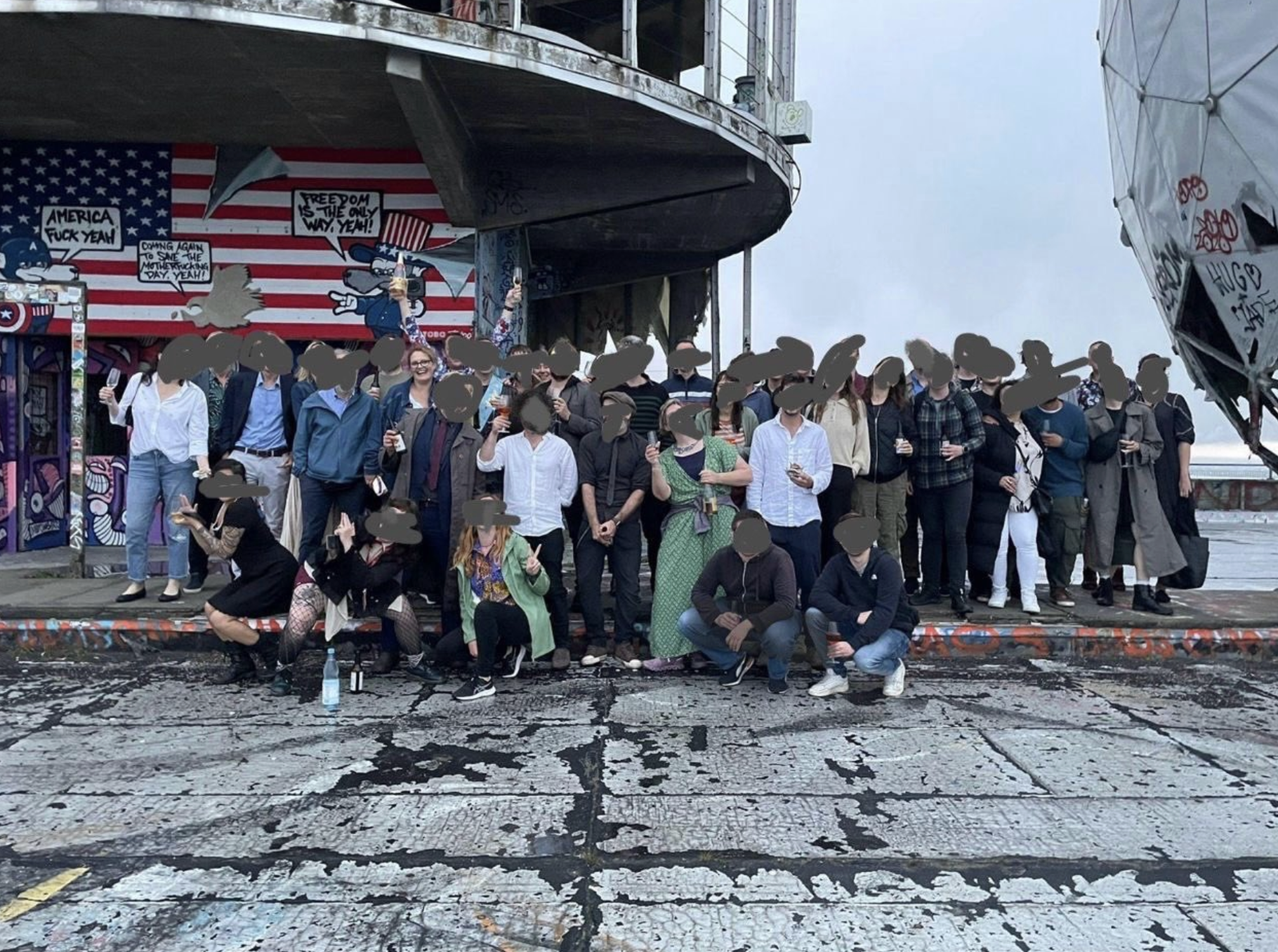
A round-up of some of the other photos I took can be found here.
For a clue about topics discussed and guests attended, we strongly recommend readers check out the FT’s Paul Murphy and Sam Jones’ latest spin-off Wirecard podcast, Agent of Chaos, which tracks the spy side of the original story by way of a deep dive into the life and motivations of Jan Marsalek, the man behind the fraud. [Not to be confused with HBO’s mini doc Agent of Chaos, which tracks how the Russians “hacked” the 2016 election. Which may or may not have aged well. We haven’t seen it.] More on Marsalek below.
| THE BIG BLIND SPOT THIS WEEK |
VATICAN’S SWIFT SCANDAL: We’re sticking to the Marsalek theme and starting with a big shout-out to my colleague Ben Munster at POLITICO for flagging an absolutely incredible (and massively underreported) Vatican story in Playbook this week, which pertains to… you’ve guessed it: money laundering.
God’s laundromat? The thrust of the story is that a former Vatican auditor has reignited controversy over the Holy See’s murky financial systems by accusing its treasury department of deploying a covert capability to retroactively alter international bank transfers — a feature one expert has described as “a skeleton key for money laundering.”
At a press conference in Rome last week, 76-year-old Libero Milone — the first auditor-general of the Vatican appointed by Pope Francis in 2015 — confirmed earlier reporting by The Pillar, an independent Catholic news outlet in the U.S., that officials within the Vatican’s central financial authority, APSA, had the ability to change IBAN codes and beneficiary names on SWIFT transfers after the fact.
“I have a piece of paper which says that they can change the transactions — they can change the name — at any time,” Milone told Playbook last week, adding that he had tried to raise the matter directly with Pope Francis but received no response.
Escalating the matter: Milone is now seeking a personal audience with the new pontiff, Pope Leo XIV, to present his evidence, after a Vatican court dismissed his wrongful dismissal appeal for the second time and ordered redactions of documents he considers essential to his case.
The entity at the heart of the claims is APSA — the Administration of the Patrimony of the Apostolic See — which manages the Vatican’s real estate portfolio and functions as its de facto treasury.
Why it matters: The implications of Milone’s claim are grave. In conventional finance, IBANs (International Bank Account Numbers) are meant to provide immutable records of cross-border payments. The ability to alter those details retroactively would undermine the integrity of the entire transaction system — potentially enabling officials to mask payment origins or destinations, fabricate financial records, and thwart anti-money laundering efforts. Such manipulation, if true, would not only constitute a violation of SWIFT protocols but could place the Vatican at risk of sanctions or blacklisting from international financial networks.
The Vatican has firmly denied the claims. In an official statement issued shortly after Milone’s press conference, spokesman Matteo Bruni insisted that APSA “did not have, in 2016, and does not have today, any ‘private’ clients” and serves only curial institutions and the Vatican City State. He added that the management of SWIFT messages is outsourced to certified operators under strict controls, and that audits conducted between 2020 and 2024 had not uncovered any irregularities.
Pell scandal throwback: Still, Milone’s assertions have reignited concerns first raised by the late Cardinal George Pell in 2016, when he attempted to reform the Vatican’s financial apparatus. Pell had privately warned senior figures that APSA may have been using its SWIFT access to conceal the true origin or purpose of certain fund flows — a red flag for money laundering. In December 2018, Pell was convicted of child sexual abuse in Australia and spent 404 days in prison, largely in solitary confinement. He maintained his innocence throughout the affair, and after spending over 13 months in prison, mostly in solitary confinement, Pell was finally unanimously acquitted by the High Court of Australia in April 2020.
Follow up: Milone, then the Vatican’s top auditor, was instructed to investigate. Not long after, in 2017, Milone too was forced to resign under pressure from the Vatican’s internal police, accused of “spying” — an allegation he has always denied. He maintains his ouster was orchestrated by officials, including the now-disgraced Cardinal Angelo Becciu, in retaliation for uncovering serious financial misconduct.
Blackmail factor? Milone claims to be sitting on a cache of additional documents that could cause further embarrassment to the Church but insists he has no intention of using them for leverage. “I’m not trying to blackmail anybody,” he said. “I just want my name cleared and my reputation restored.”
Precarious finances: The revelations come at a delicate time for the Vatican, which has spent the past decade trying to rebuild credibility after a series of financial and sexual abuse scandals. The Holy See is under growing fiscal pressure, increasingly dependent on donations from the faithful, and under scrutiny from global financial authorities. Even small signs of impropriety could threaten its fragile standing with correspondent banks and international regulators.
The Vatican’s financial apparatus — particularly APSA and the Institute for the Works of Religion (commonly referred to as the Vatican Bank) — has long faced allegations of facilitating covert transactions on behalf of intelligence services.
In the 1970s and 80s, Roberto Calvi, the chairman of Banco Ambrosiano (and close associate of the Vatican Bank), was famously found hanging under Blackfriars Bridge in London in what many believe was a mafia hit. Calvi’s bank collapsed with massive unexplained debts linked to off-the-books transfers into Eastern Europe. Decades later, investigations suggested that some of those funds may have been channeled with CIA assistance to support anti-communist operations during the Cold War (supposedly to fund Solidarity, under Pope John Paul II) — all under the cover of Vatican financial opacity.
Whether or not Milone’s latest accusations stand up to legal scrutiny, they revive that historical pattern of secretive finance, blurred lines between church and state, and allegations of politically motivated interference in internal investigations. The Vatican’s insistence that all transactions are now under proper oversight may reassure some. But for critics, the unanswered question remains: if such a system did exist, who used it — and for what purpose?
If Milone gets his audience with the Pope, the world may yet find out.
In the meantime, here’s a picture I took of Pope John Paul’s popemobile when I was at the Gdansk Solidarity museum in July (before heading to Berlin):

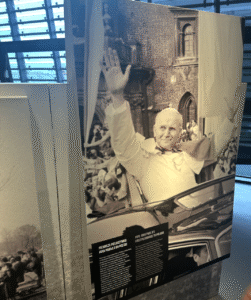
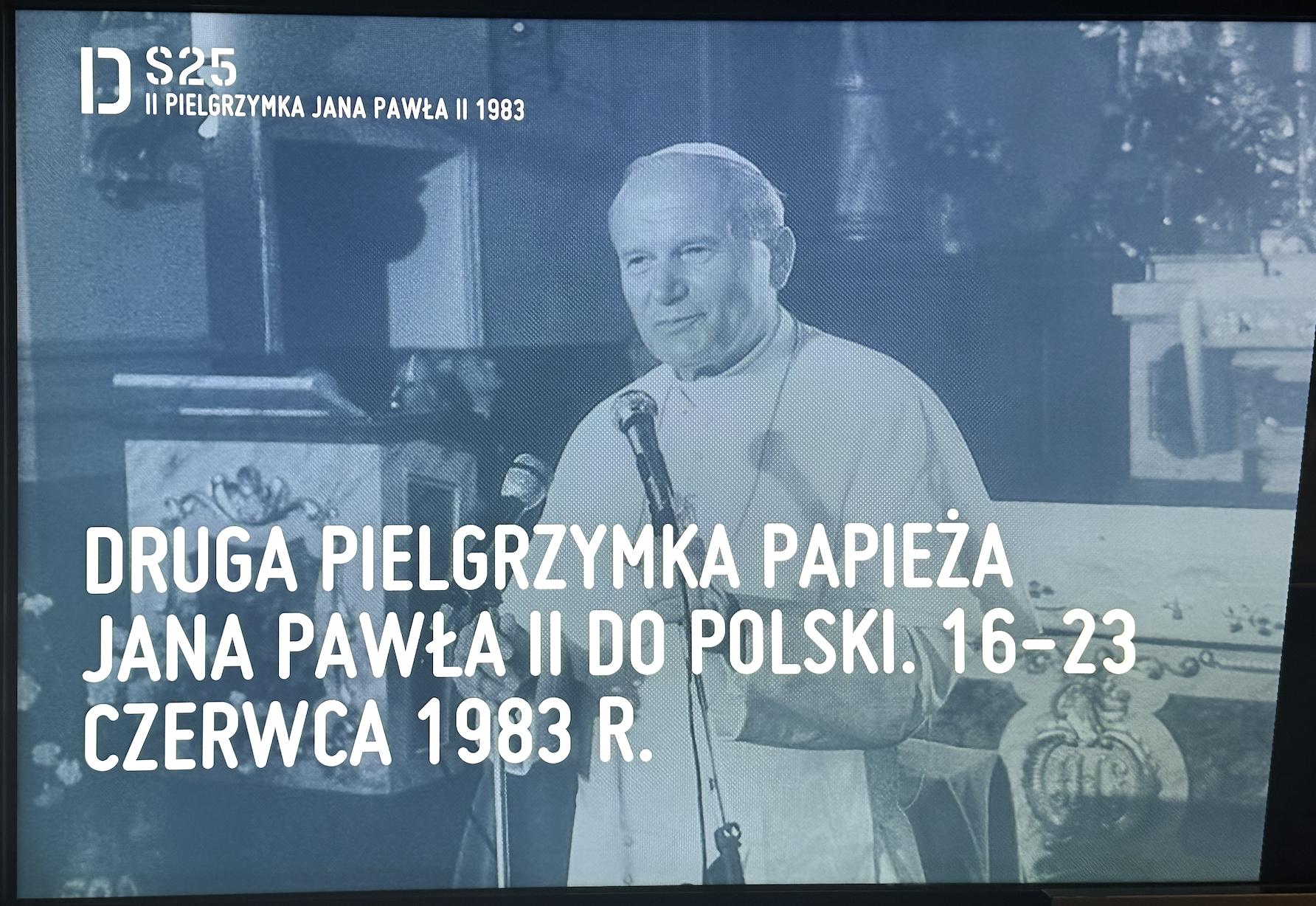
If you’re a Cold War history junkie, the museum — which is situated next to the Gdansk shipyards where Solidarity came to be — is definitely worth a visit, at a minimum to see how the whole thing is framed. Interestingly, I would note, there are no Solidarnosc pins or flags available at the gift shop.
We also stopped off at Ronald Reagan Park: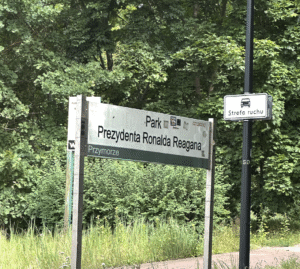
My husband made an interesting observation while we were driving through Poland, though: you really can’t go very far without continuously being navigated to some sort of variation of “Jana Pawla” street.
| BUSINESS, ECON AND FINANCE |
EU-U.S. TRADE DEAL: REALITY OR FACADE? What was originally framed as a terrible deal for the EU, may not be entirely what it seems. The EU, my colleagues at POLITICO say, doesn’t have the power to deliver on many of the promises made, as it can’t decide how to spend private money. “[The EU] is not China, right?” Nils Redeker from the Jacques Delors Centre think tank said.
But that’s not even the real story. The $600 billion EU investment promise might really be a grim foreboding of upcoming capital flight from Europe to the U.S.
How come? Well, it’s all really a response to Trump’s “Big Beautiful Bill” which includes a very generous allowance for 100 percent up-front expensing on capital investments made in the U.S. Usually, companies must write off large capital expenditures like factories, laboratories, and machinery slowly over decades through depreciation. But under the new Trump rule, a much wider array of firms can now deduct the full cost immediately, dramatically lowering their U.S. tax bill in the early years and boosting the returns on investment.
A lighter touch version of the trick has already been contributing to large capital flows from Europe to the U.S. Since 2018, European companies — especially in pharma, energy, and manufacturing — have quietly been able to shift billions in planned investment toward the U.S., drawn by the more favorable fiscal treatment, cheaper energy, and regulatory clarity.
Why it matters now? By reviving the rule just as it was scheduled to sunset, the U.S. is not only ensuring a continued inflow of foreign investment but also blocking European efforts to lure that capital back. That’s even as Brussels tries to ramp up subsidies and relax state aid rules to stimulate domestic reindustrialization, it simply can’t match the raw fiscal firepower or tax autonomy of Washington.
And what’s in it for the EU? The EU now has a better public narrative to explain capital flight out of Europe to the U.S. on tax treatment grounds. It’s all due to the “deal”, not less favorable conditions in Europe.
| PODCASTS OF INTEREST |
AGENT OF CHAOS: We’ve already promoted Paul and Sam’s podcast, but for diehard Wirecard followers, it might be worth highlighting some of the factoids that emerge from it that even I didn’t know about.
1. I was not aware that Marsalek had tried to get Paul Murphy to spin Russian-friendly narratives about the Salisbury poisonings in the FT, or offered to provide him with Russia-sourced intel scoops if he played along. (Marsalek’s narrative was that the British had tried to bump off Skripal.)
2. I didn’t realize Marsalek had shown Paul himself the Novichok formula. (The way I originally heard the story was that Marsalek had been seen showing it off around his networks).
3. I didn’t know Paul had gone behind Dan’s back to see Marsalek. (The meetings had been reported by Dan, but not that Dan didn’t know about them. I was only orbiting this story at arm’s length while at the FT, so I wasn’t surprised I hadn’t known about any of these details when the book and Netflix doc came out.)
4. I didn’t know the Honourable School Boy was one of Sam’s favorite Le Carré books.
Separately (not in the podcast), I didn’t know until recently that Paul (whom I sat next to for about 10 years and who taught me everything I know about financial journalism, and who I consider a mentor) had covered BCCI in his early days at The Banker. I had thus underappreciated his expertise in such matters!
Men from U.N.C.L.E: If you start the podcast, do persevere to the final episode if you can. It’s in that that Paul and Sam finally report on an aspect of the story that I did know about for a long time, and which I always found fascinating, but didn’t divulge as it wasn’t my story to tell. It’s that Paul had, around 2019, gotten his hands on communications from Marsalek showing he was plugged into a network that called referred to itself as “the Uncles” (presumably after the hit spy show Man from U.N.C.L.E).
The communications discussed all sorts of strange operations, including one plan to try and use the network’s influence to move the Austrian embassy from Tel Aviv to Jerusalem.
At the time, Paul was still insisting that Marsalek’s spy stories were fantastical and delusions of grandeur. But as the podcast reveals, it was later transpired that the Uncle network included intel operators of many colors, including those affiliated with the CIA. In May this year, meanwhile, it was revealed that Marsalek himself had been tapped by the CIA to try and help the agency airlift 200 personnel out of Kabul in 2021.
This sort of cross-agency cooperation was famously a hallmark of the U.N.C.L.E series. In the fictional rendering, U.N.C.L.E (which stands for United Network Command for Law and Enforcement) was headquartered in New York, and brought together personnel from both sides of the Iron Curtain — particularly the U.S. and the Soviet Union — to fight a common enemy.
Napoleon Solo, the key protagonist, was an American (played by Robert Vaughn), and Illya Kuryakin, his sidekick, was a Soviet (played by David McCallum), reflecting a rare moment of Cold War-era media where East and West are shown working together constructively. Both report to the British-sounding Alexander Waverly.
In the fictional account, the common enemy, meanwhile, was T.H.R.U.S.H. , the Technological Hierarchy for the Removal of Undesirables and the Subjugation of Humanity.
WIND OF CHANGE: Speaking of spies intersecting with culture, one other podcast of interest we recommend, if you’ve not come across it yet, is New Yorker journalist Patrick Radden Keefe’s crusade to uncover if the urban myth that the CIA composed the Cold War classic “Wind of Change” could possibly be grounded in reality.
Along the way, Keefe interviews former CIA agents, espionage historians, musicians, band managers like Doc McGhee, fans who smuggled Western music behind the Iron Curtain, and music experts — with each character adding pieces of context, evidence, or speculation to the puzzle. The investigation culminates in a one‑on‑one interview with Klaus Meine, the Scorpions’ frontman, who asserts he personally wrote the song, denying CIA involvement. [Though, when we asked ChatGPT which songwriter was a better fit, it suggested Diane Warren, the prolific songwriter behind hits like Aerosmith’s “I Don’t Want to Miss a Thing”, Starship’s “Nothing’s gonna stop us now”, and err, the Scorpions’ “Here in my heart”.]
As it happens, Dario and I found ourselves in Marbella the day the Scorpions were performing, and obviously, having just come back from Berlin, how could we not attend?
While Klaus Meine is looking very Joe Biden these days, he still didn’t disappoint.
| WHAT WE’RE PROCESSING |
— Spain’s scandal-plagued prime minister should step down, argues the Economist.
— How Marshall McLuhan got absolutely everything right about the internet notably the fact that World War III will be “a guerrilla information war with no division between military and civilian participation”.
— Saudi stock market troubles signal market doubts in MBS’s 2030 vision.
— Jack Dorsey launches BitChat, the app vying to become the radio free world of the “Online Safety Act” era.