

| SNEAK PEEK |
— There’s a big hullabaloo surrounding China’s recent issuance of dollar-denominated bonds in Riyadh. But Izzy argues this is not the show of strength most think it is.
— Privatization vs Nationalisation: Why not all deregulation is being made equal. Izzy runs through the very different agendas of the competing transatlantic “efficiency” drives.
Dear subscribers,
It’s hard to articulate in words the madness going down in DC and Mar-a-Lago right now. But I will try.
Because if you’re in the MSM liberal bubble or on BlueSky, you probably won’t be on top of “the rumortrage”. Not only is it very entertaining, it may turn out to be a bit of a blind spot.
Though, if you really want to get into the vibe of what is supposedly happening, picture yourself as a destitute middle-aged East German who has had to queue all day for a loaf of bread on a cold and windy November day in 1989. And consider that it was while you were standing in line that you first got wind of the gossip that something fairly monumental was going down at the Kremlin. Whispers first. But soon, very pronounced rumors. Later, debunked, but then very suddenly, to your utter delight, a slow trickle of confirmations… until. Wait, what? Did the Berlin Wall just… fall? Impossible!
And so it was that on Friday Republican senator Matt Gaetz withdrew his candidacy to be Trump’s Attorney General, saying he felt the sexual accusations against him would lead to a protracted wrangle with Democrats and RINOs distracting from the “important work to be done”.
What you might not have spotted, however, was that just a little earlier, working attorney, Google-fortune divorcee and RFK Jr’s running mate Nicole Shanahan, put out a cryptic X post claiming “there are two potential appointments that could be coming down the pike that would be a disaster for the people, our health, and the integrity of this administration.”
Well, suffice it to say, all this may be connected. But to get really clued in you need to read this extended X thread first.
The TLDR, if you don’t have time, is that the post explains how Gaetz — who happens to be married to the wife of Oculus creator and the founder of defense contractor Anduril, Palmer Lucky — may have been honey-potted in a complex scheme run by the FBI and factions of the CIA. The extraordinary set up involved an Iranian op and an extortion play of $25 million on his dad, former senator, Don Getz. But now, supposedly, there are legal filings that confirm all this, including Gaetz’s assertion that he was told he would receive a Biden pardon if Gaetz’s father complied with the payment..
This, however, may just be the tip of the iceberg of the “truths” yet to come out. If you go with the tale, where we sit now is like the aftermath of Poland’s first “free” election in 1989 with the new admin poised to take over from a regime that is knee-deep in scandal and corruption. The outgoing regime now fears being totally exposed and discredited. It also fears the inevitable lustration to come, not to mention being held accountability at the hands of Elon Musk and his DOGE department. So much so, allegedly, the regime is actively covering everything up — with industrial-sized paper shredding vehicles supposedly being sighted outside government buildings — and threatening to start nuclear war if their people aren’t given amnesty.
[Nice aside, Putin himself emerged triumphant — and allegedly with a number of very valuable kompromat files — from the Stasi shredding equivalent.]
Failing such an amnesty deal, the speculation goes, the outgoing regime would incite a nuclear explosion capable of taking out the internet, which would handily wipe all the awkward and incriminating information forever, before initiating a new era of radical transparency brought to us by digital systems and AI to be implemented by Musk.
The credibility of the tittle tattle we cannot testify to.
What we can be sure of is that the word of the moment seems to be lustration. If you’re not familiar with how that works, here’s a thread I put together earlier about how it applied in Poland’s communist aftermath and why even 34 years later the consequences still matter.
Back in the world of serious non-conspiratorial or deluded MAGA people, however, war continues to mean peace, and freedom continues to mean slavery. British broadcaster Paul Mason is especially confident there’s nothing to see here.
Luckily for the dissidents, they can still rely on memes to communicate what they really think. Especially now the world’s richest man has their back and stands ever ready to amplify in his role as chief memester.
Hold on to your hats! It could get hairy.
As usual this newsletter is brought to you by me, Izabella Kaminska, and my trusty colleague, Dario Garcia Giner. But since there’s so much going on we’ve made it a two-parter.
Send tips to [email protected] or [email protected], or anonymously via our Haya link.
| THE BIG BLIND SPOT THIS WEEK |
CHINESE US-DENOMINATED BONDS: Arnaud Bertrand, a frequent source of Chinese boosterism on X, who self-describes as an “entrepreneur”, is at it again. This time he’s penned an epic post explaining why China’s recent decision to turn to Riyadh for the issuance of $2-billion worth of dollar-denominated sovereign bonds illustrates China’s growing sovereign might. And it’s going viral in the “we’re sure the future is multipolarity” community.
But does it? Does it really illustrate that? China may have masterfully spun the bond offering as another indicator of upcoming dollar doom, but there’s no escaping the cold hard truth: it’s dollars, not yuan, that China desires.
Consider that the last time Washington was forced to issue foreign-currency bonds of its own was in the 1970s with Carter bonds. That followed its darkest economic hour: the period after the breakdown of Bretton Woods and the oil shock that brought about 70s stagflation. It has not done so since. And while American corporates may have occasionally issued Dim Sum bonds, there’s little to no risk with those unless the dollar suddenly depreciates.
That didn’t stop Bertrand from running through some arduous mental gymnastics to persuade readers not to trust their lying eyes. This is not China needing a third-party jurisdiction’s oversight to persuade investors to give them dollars. This, he says, is China demonstrating to the US that “they can effectively use their own currency against them, with potentially dramatic consequences.” Hmmm.
We’ve reached out to a number of China experts to verify our counter claims, but are yet to hear back. In the event they disagree with our analysis we’ll be sure to inform you.
So what’s really going on? An oft-forgotten fact is that China’s trading companies and financial system remain hugely dependent on USD liquidity, which they need for purchasing, hedging and general working capital. If you’re doing business in dollars, you need dollar bank accounts. End of.
But to provide those dollars securely, as well as to manage liquidity and duration exposures, Chinese state banks need ample and reliable access to dollar liquidity. Without it, the only alternative would be drawing down on official state reserves, which (as we discussed previously) is something the government, despite the many counter narratives that suggest otherwise, does not really want to do or desire. For now, China needs the reserves to maintain its creditworthiness on international markets.
Dollar is king: A second point is that corporates that engage with China, especially those that fear yuan devaluation, are naturally always going to be more attracted to higher yielding dollar-denominated bonds in favor of plain old dollar bank accounts (which come with institutional counterparty exposure) for the maintenance of their working capital. This is especially the case if the bonds can be pledged as collateral in trade finance or bilateral trade.
Key background: But jurisdictions are also a key part of the story. Since arriving back on the scene in 2017 after a whopping 13 year-absence, China’s dollar-denominated issues have almost exclusively been raised in Hong Kong.
But this may be a problem unto itself. The Chinese state’s crackdown on Hong Kong civil rights and freedoms — as highlighted by this week’s jailing of 47 Hong Kong pro-democracy activists — means the former British territory’s appeal isn’t what it used to be. Increasingly so for foreign investors who are getting spooked by the draconian conditions.
Kissing the KSA Ring: Issuing bonds in Riyadh instead of Hong Kong could indicate less an effort to “destabilize the US dollar” and more a need to shore up liquidity to service external obligations by going to a third-party jurisdiction that offers greater certainty for investors and potentially shariah-friendly conditions. Riyadh is a good option for China. It offers the third-party independent scrutiny needed to keep investors coming, especially Middle Eastern ones, but also — because Riyadh is itself a fledgling financial hub — the ongoing opportunity for China to influence terms in ways that would not be possible in Western jurisdictions.
But wasn’t it massively over-subscribed? Yes that’s true. The $2 billion issuance achieved a 20x oversubscription overall while fetching similar rates to US government debt. Pretty phenomenal.
But if the oversubscription tells us anything, it’s that demand for Chinese dollar-denominated eurobonds issued abroad far surpasses those issued domestically. Most of China’s dollar-denominated bond raisings in Hong Kong were only 4.5x oversubscribed in comparison, despite being issued in a jurisdiction that is dollar-pegged. To compare, the euro-denominated bonds China also raised in Paris in September, were also over-subscribed, albeit by a lesser 8.1 basis.
Those queuing up to lend China dollars, however, aren’t necessarily doing so because they are highly enthused about China’s prospects. It’s far more likely (especially for corporates with access to both yuan and dollar markets) they’re turning to USD bonds because the alternative would mean investing their working capital in increasingly micro-yielding yuan-denominated bonds which bear both FX devaluation and counterparty risk.
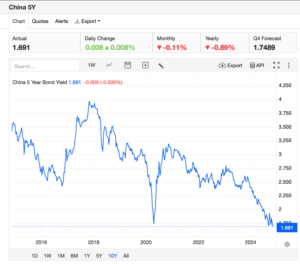
The key question pundits should really be asking is why China needs to raise dollar funding on public markets at all.
One clue comes in how hard it is to unearth bid-to-cover ratios for China’s yuan-denominated domestic sovereign debt auctions. The only public info we could find asserted the sales were “well subscribed”, but since yields are now rising, one has to wonder. Is there something they’re trying to hide?
The hard currency problem: Readers might recall that China first shocked markets with currency devaluation in 2015 when it was forced to intervene to prop up the yuan. It did so by beginning to liquidate its US dollar-denominated assets. The sudden need for hard currency — despite China’s notoriously ample FX reserves — eventually prompted the country to return to dollar-denominated bond markets in 2017, which it had avoided for over 13 years. Before that, the main driver of dollar inflows had been currency manipulation via a process better thought of as QE today.
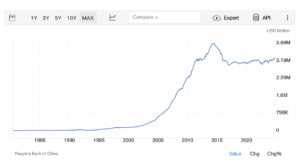
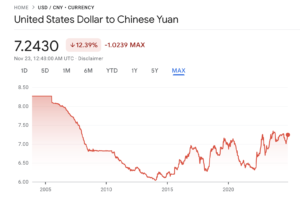
In the below USD/RMB chart you can see the degree to which, despite flooding dollars into the system post 2015, the PBoC struggled to abate the wider depreciation trend over the longer term.
You can also see the degree to which authorities originally overestimated the true ‘neutral’ value of the yuan (something that friend of the Blind Spot Diana Choyleva masterfully predicted and saw coming long before anyone else.)
But, even though the PBOC had, by 2015, stopped consciously appreciating the yuan in favor of supporting it, — something it was forced to do by raising dollars in the market, rather than unwinding its massive balance sheet — over in Hong Kong, the local currency’s dollar peg was still reflecting strong foreign demand. This required continuing foreign asset accumulation to keep it anchored (as can be seen below). But that all changed when Covid (and pro democracy protests) hit in 2019/ 2020. The trend, as can be seen below, was arrested, leading to draw downs.
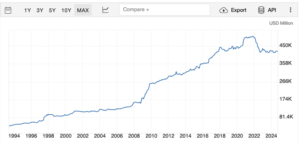
Since then, China’s dollar issues have only got more frequent, which corresponds with the idea Beijing is doing everything it can to delay the day it must inevitably unwind its dollar balance sheet. This is not just because it is worried that US tariffs will radically reduce the inflow of dollars it sorely needs in the future though. It’s because without a large stock of foreign-denominated collateral at its disposal, its overall creditworthiness, as well as the capacity of its entities to trade in international markets, may be compromised.
All the brash talk about exploring dollar substitutes and challenger SWIFT systems could therefore just be bravado.
Chinese propaganda desperately wants Westerners to believe that any reduction in USD holdings is a conscious policy choice and not an act of desperation. The more likely truth is that economic conditions and U.S. counter responses may soon force China to draw down on its reserves whether it likes it or not.
AND IT’S ALL OVER FOR THE YUAN ARB: The FT reported that foreign investors had “dumped Chinese government bonds over the past two months, unwinding a popular and lucrative trade that had been enabled by Beijing’s efforts to support its currency”.
According to the pink periodical: “Investors poured more than $130 billion between November last year and August into a trading strategy that involves lending dollars to Chinese institutions and then using the renminbi [swap] proceeds to buy Chinese bonds. The return from loaning dollars and investing in bonds could be up to 6 per cent — well above the yield on a US Treasury bond.”
Yield farming: The strategy bears the hallmarks of classic yield-farming plays, now most common in crypto markets, where speculators profit from making their own currencies available to counterparties (a process known as staking) whenever the demand (aka a positive basis) is there. The swap rate adjusts to account for rising or falling demand. In the China strategy, speculators double down on the assumption that Chinese institutions will only become more desperate for higher-yielding dollars as Chinese officials ease domestic rates further.
As the FT also noted, Chinese state banks, who are the key counterparties in these trades, rely on the currency swaps to build short positions in the dollar offshore, which in turn stabilize the yuan’s exchange rate.
But China’s gigantic 10 trillion yuan ($1.4 trillion) fiscal support package in November to help local governments recently unhinged the trade. The fiscal move saw bond yields rise, reducing the profitability of the basis trade, strengthening the RMB as Chinese banks rushed to buy back their positions and close down their loans.
RED KEIR: One man who appears to be all in on China come hell or high water is British PM Keir Starmer. Expectations are high tensions between the U.K. and China will soothe, as the two leaders bond over their mutual admiration of great Communist leaders.
CHINA STIMULUS AFTERMATH: China may have acted with gusto in November, but the question remains with its fiscal revenue will be strong enough to prevent it from increasing its fiscal deficit, a JP Morgan note said this week. If it’s not, Beijing will either be forced to increase its debt-to-GDP by issuing more government bonds or it will have to raise funding via asset sales or other transfers,
Failing that, fiscal tightening — which, in China, doesn’t mean the suspension of welfare support as much as the suspension of subsidies to factories, banks and business — might become a reality.
In the meantime, the big question is: Will China roll out fiscal stimulus to support consumption?
A “bazooka” fiscal stimulus well above 2 trillion, JP Morgan says, should not be ruled out.
| BUSINESS, ECON AND FINANCE |
BESSENT FOR TREASURY SECRETARY: As predicted by Zoltan Pozsar, Scott Bessent and his neo-Three Arrows policy has been nominated by Donald Trump to be Treasury Secretary.
Long and short of it: We went through his key policy ideas last week, but it’s worth highlighting, as per this X thread, that Bessent is keen on subsidizing bank lending. If so, that would make Russell Napier’s long-standing argument, that G7 states will be forced to go down the path of financial repression, reality.
Rise of the non-system: Napier’s legacy thoughts on this are here. But he also has a new American Affairs Journal piece out this week which ties things together even more concretely. It is, we stress, a must-read.
Among the many fascinating observations, the piece channels Diana Choyleva’s long-standing point (and something we’ve been arguing for a while) that it wasn’t necessarily Western central banks’ fault that globalization accumulated massive destabilizing imbalances that weren’t properly checked.
This, she has always argued, was due to the unappreciated side-effects of what was really going on: a clash of two rival ideological systems in the marketplace, which ended in the errors of a collectivist command economy state being exported into the global system, rather than the benefits of capitalism being injected into China.
Key to these distorting Chinese effects is how monetary policy works in China. Banks are kept “profitable”, for example, at any cost — even if their lending practices are terrible. This is done by making sure the short-term policy rate is largely irrelevant, with banks mostly being allocated funds on the basis of longer-term “prime rates” (LPR) and the respective spreads they are told to enforce.
So, if the LPR is 3.5 percent, the Medium-term Lending Facility rate would likely be around 2.75 percent-3.00 percent.
But the PBOC simultaneously also dictates that banks must offer a 2 percent deposit rate for savers.
The structure engineers a permanent bank windfall (de facto state subsidy) to keep them lending no matter what. This is ultimately paid for by Chinese taxpayers and backstopped by official Chinese “asset purchases”.
While banks can offer slightly more in competitive situations, they must balance this against profitability and regulatory expectations.
Fighting fire with fire: Napier expounds on this point. “We are now living with the imbalances that followed this failure to move away from the Chinese-imposed system, and we will have to create a new international monetary system that can unwind those imbalances while sustaining, hopefully, both democracy and free markets,” he writes.
Like QE but more destabilizing: And as he continues: “The PBOC’s exchange rate intervention was financed by the creation of new renminbi reserves and continued for as long as there was upward pressure on the Chinese exchange rate.”
As Napier notes: “The country’s managed exchange rate policy has restricted the growth in the PBOC balance sheet, but growth in investment and the economy has been sustained by running ever higher debt-to-GDP ratios. With the growth in money supply restricted by the continuation of a managed exchange rate policy, the country’s total nonfinancial debt-to-GDP ratio has grown from 211 percent in 2014 to 290 percent in 2024. While higher nominal GDP growth in the developed world since 2022 has somewhat reduced debt-to-GDP ratios there, China’s debt levels march ever higher. In just the first three months of 2024, China’s total nonfinancial debt-to-GDP ratio rose from 284 percent to 290 percent of GDP.”
And finally: “The country has falling property prices, falling producer prices, consumer price inflation just above zero, and significant distress in its credit system. Have we finally reached the stage at which the international monetary system, anchored upon China’s managed exchange rate regime, no longer works for China?”
Based on our analysis above, we think the answer is yes.
JAPAN LIKES D.O.G.E.: Deregulation, efficiency and de facto simplification are the only game in town, once again proving that Liz Truss was not wrong, just early.
And in Japan, the country’s Minister of Reform Masaaki Taira has more than got the message. Last week he announced the creation of an ‘Autumn Administrative Review’, a two-day program where experts are expected to assess the effectiveness of government projects. Taira added his team were closely monitoring the progress of Musk and Ramaswamy’s Department of Government Efficiency, stating: “We expect this to be a fairly drastic development. We will closely follow up on it and incorporate it into Japan’s administrative reforms.”
| POLITICS, POLITICS, POLITICS |
REEVES’ MYSTERIOUS BACKGROUND: Memes galore have sprung up ridiculing U.K. Chancellor of the Exchequer Rachel Reeves for massaging her CV to suggest she had been an economist at HBOS, when she supposedly worked in the retail division of Halifax, handling complaints.

But, but, but… We’re hearing there may be more to this story. Reeves may not have been trying to aggrandize herself, but to distance herself from the bad practices at play at HBOS during the pivotal 2006-2009 period before the bank collapsed.
According to knowledgeable sources who worked with Reeves at the BoE, there’s no doubt the chess non-champion did work as an economist in the BoE’s international department. They even say she was quite good at her job. They add that Halifax would not have recruited an accomplished Oxford PPE graduate with time served at the BoE and relegated her to back-office complaints.
The key tip is that she worked in a commercial role in the bank’s “mortgage cessation” department (that’s delinquencies to you and me). Given the bad decision-making there, it makes sense that Reeves would have preferred to describe herself as an economist. Economists are usually seen as auxiliary or support staff in banks — relatively removed from commercial strategy or responsibility.
We’ve also heard — though this is not verified — that Reeves may have had direct dealings with or oversight over HBOS’ relationship with Babcock and Chemring.
Career trajectory: Reeves went straight from working at HBOS to being selected the Labour candidate for Leeds West. Once elected, she was appointed to the Treasury Committee, which — among other things — was leading inquiries into HBOS. Though, while her name is on the final report, it does look like she recused herself throughout committee hearings related to HBOS.
FRENCH BUDGET STANDOFF: In a TV interview this week, France’s right-wing firebrand Marine Le Pen issued a quiet threat to Prime Minister Michel Barnier’s government as it attempts to get its slimmed-down budget over the line before the end of the year, according to POLITICO.
Le Pen said that any move to increase electricity taxes would cross a “red line” for her party and see the party withdraw its support for Barnier’s government.
| SIMPLIFICATION, EFFICIENCY, DEREGULATION, PRIVATIZATION |
THE BIG CLEAN: Elon Musk and Vivek Ramaswamy, who are poised to take charge of Trump’s new Department of Government Efficiency (D.O.G.E.), laid out their vision on how they will accomplish their agenda in a bold WSJ oped this week.
They predicted they could get most of the job done without Congressional approval thanks to this year’s Supreme Court Chevron ruling, which gives them legal cover to scrap “a plethora of current federal regulations” that exceed the authority Congress has granted under the law.
The legitimacy of their actions, they say, is defensible due to the fact they will be “correcting the executive overreach of thousands of regulations promulgated by administrative fiat that were never authorized by Congress.”
Critical to the exploit is this point: “After those regulations are fully rescinded, a future president couldn’t simply flip the switch and revive them but would instead have to ask Congress to do so.”
Here’s a good meme about it.
IZZY’s COMMENT: Like it or not, this is the exact opposite of what’s happening in the U.K.
Unlike in America, the current Labour government appears committed to entrenching bureaucratic overreach for the long term with its own respective attack on Parliamentary authority. Part of that attack involves very conscious devolution to ever greater numbers of regional administrative bodies — all publicly funded — in a framework that will eventually escape Parliamentary oversight.
Another critical point to bear in mind is that while “deregulation” “simplification” “regulatory innovation” and “efficiency” appear to be the new buzz words in town across the G7, this is all a function of Russell Napier’s “non-system” finally becoming cognizant of the weight of its own bureaucratic burden. However, the responses are unlikely to be uniform.
Dario, for one, thinks the creation of new government departments to deal with inefficiency is the height of irony.
This is why the nature of the approach is going to matter.
We previously talked about how Margaret Thatcher succeeded with her dash for growth where Edward Heath failed precisely because his liberalization policies were not accompanied with an associated contraction of public spending liabilities, but were instead focused on stimulating growth via market liberalization and a consumer credit binge, bolstered by enormous tax cuts amounting to almost 3 percent of GDP.
Thatcher, on the other hand, understood that you can’t have your cake and eat it. Liberalization and tax cuts are all well and good, but the size of government liabilities must fall too if the policy is to have any growth-positive effects.
Why privatization is key: For Thatcher, that equated not just to bureaucratic downsizing but privatization of numerous state-owned assets. In the end, the Iron Lady sold off almost 50 government entities, from British Airways to British Gas — a process that liberated the government balance sheet and allowed the private sector to do its bit.
Europe vs America: The critical difference between Trump’s prospective dash for growth and the rest of Europe’s is how great the continuing role of the state will be in the economy. Over in America, Trump has made it clear he aims to stimulate his way out of trouble, but also to unwind or make irrelevant de facto private sector companies in name only such as Boeing, Lockheed, Raytheon, AWS and Intel. He also aims to privatize major areas of government, including the department of education.
The way he and his dissident valley network plan to do this, however, is not via the (mostly disastrous) process undertaken by the former Soviet Union. There will be no equity sales or voucher programs. Instead, all that will happen is that regulatory protections and subsidies will be removed, forcing government agencies to compete fairly and squarely in an open market.
Privatization, you could say, will happen via the process outlined in James Dale Davidson and Lord William Rees-Mogg’s “Sovereign Individual” book. The government will be forced to compete with the private sector, and if it does not provide value for money to taxpayers, it will fail to corner those industries.
That, however, is not Europe’s path: On the contrary, both Reeves and Draghi see their future as emulating the American/China “non-system” that has brought us to this point — even as the U.S. itself starts unwinding what they are trying to emulate. In Europe, this will amount to nationalization via the back door, notably by taking equity positions in growth companies to better “crowd in” the private sector.
The greatest irony of all is that the regulation they plan to unwind is the very sort that was preventing Europe from going entirely the way of the socialist America/China “non system”. All this, just as America opts for radical privatization in a way that forces China to follow or crash.
The biggest and best clue to the contrasting aspirations is not just that Reeves is calling her system “Securonomics”, but her speech to Mansion House last week in which she openly outlined that the risk-taking she wants to empower is mostly that of the government.
As she highlighted: “It was right that successive governments made regulatory changes after the Global Financial Crisis to ensure that regulation kept pace with the global economy of the time but it is important that we learn the lessons of the past.
These changes have resulted in a system which sought to eliminate risk taking. That has gone too far,” she said.
Her solution? 1) Creating a stock exchange to “trade” private stock called PISCES, aka the Private Intermittent Securities and Capital Exchange System, which will lower investor protections while allowing (state-supported) founders to maintain control, while lowering the capacity of shareholders to push through reforms.
2) having the PRA, the Treasury and the newly structured government-venture capital arm within the National Wealth Fund “work together to crowd in” investment by insurers in productive assets “taking full advantage of the new Solvency UK regulatory regime”. Aka, increase the opportunity for the government to beef up its ownership and influence over key strategic and industrial assets.
3) Allow the new Solvency regime to be seen as a pathway for increased government control over lending to support industrial policy, emulating aspects of China’s state-directed credit system.
Just like China: Regarding the new Solvency Regime, the idea is that by reducing capital requirements and incentivizing insurers to invest in long-term, policy-aligned sectors like green energy, housing, and infrastructure, the government will be able to indirectly influence capital flows without outright ownership, as per China’s state-owned bank model.
Insurers and private credit markets are ideal conduits because their long-term liability structures (e.g., pensions) align with projects requiring patient capital, and they are less constrained by short-term liquidity needs than banks.
And like China’s system, profitability protections exist through favorable regulations, such as Matching Adjustment benefits and reduced risk margins, ensuring insurers’ returns remain competitive.
| MARKETS |
NEW ERA FOR GERMAN SWAP SPREADS: IFR’s Chris Whittall had a great X thread about 10-year German swap spreads following in the footsteps of U.S. and U.K. swap spreads and turning negative for the first time in history.
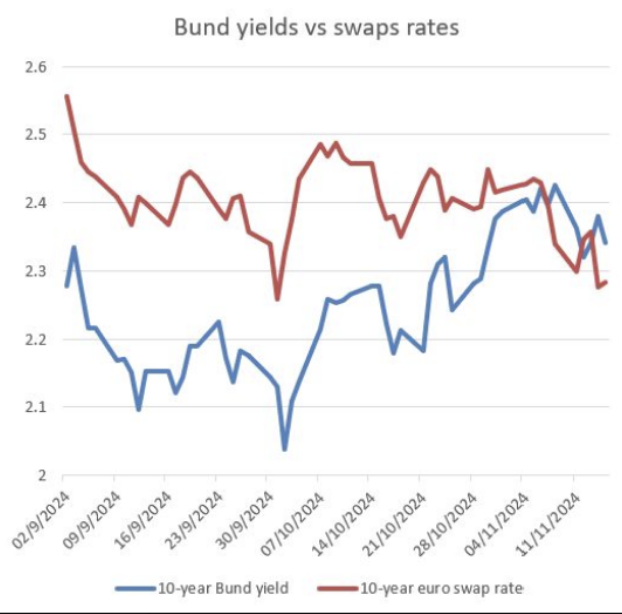
Why is it important? Up until now, an overall scarcity of bunds ensured the same negative basis never applied to German debt. But, due to changing dynamics in repo markets in recent months, bunds are now much more readily available.
Post Trump’s election, Whittall notes, both the U.K. and U.S. spread has also got more negative. This could have a significant bearing on euro markets.
| GEOPOLITICAL HOT SPOTS |
DAM, CHINA: Two China-backed geo-engineering projects with hot geopolitical consequences may be kicking off in Nicaragua and Peru. These involve the construction of numerous railways, ports dams and canals to construct new inter-American canals that will permit China-bound and incoming goods alternatives the increasingly fresh-water-challenged Panama Canal.
Land of the condor: The Peruvian effort is a $10 billion Peruvian-Brazilian gamble on the construction of two major railway lines that will convoy goods from the country’s north and south to the Chancay megaport on the Pacific coast, a Chinese-backed mega commercial port. This railway line would allow Brazilian goods a two-week headstart into China as opposed to routing via the Atlantic into the Pacific through the Panama Canal.

Over in Panama: Nicaragua’s project is a direct challenger to the Panama Canal, titled the “Grand Inter-Oceanic Canal” and similarly backed by China. In announcing the project, Nicaragua’s president outlined historic American attempts to impede the development of the Nicaragua port as a challenger to the Panama Canal in the 19th and 20th centuries, but claims that today’s fresh-water problems with Panama make it a logical moment to build a competitor. Unlike Panama’s canal, which intentionally shortens the route by transiting through fresh-water lakes, Nicaragua’s canal will seek to avoid their own fresh-water lake (the Nicaragua Lake) in order to circumvent the current Panamanian shortages, which stems from their reliance on fresh-water lakes for transport.

| MEDIA MATTERS |
MEDIA DISRUPTION: The power struggle over control of the media narrative is getting ever more heated with a number of key developments this week.
Quick summary: As the FT reported, Donald Trump nominated Brendan Carr, a “vociferous critic” of Big Tech, to head the Federal Communications Commission. He will be charged with the job of regulating television, internet services and radio in the U.S.
Free speech warrior: The Blind Spot’s free speech networks were generally enthused by the appointment, though some worried about his potentially censorious position on NBC
Speaking of NBC… Elon Musk joked he might be up for buying the struggling broadcaster after Donald Trump Jr pitched the idea in an X post. Comcast is currently pursuing a sale. Separately, CNN is also showing signs of distress, and is poised to lay off a lot of assets.
| UPCOMING! |
— We previously promised we would be back with a proper analysis of why Rachel Reeves’ plan to turn the UK into Iceland circa 2007 is bound to end in tears. It remains on our to-do list.
In the meantime, Bob Lyddon has channeled some of our thinking, so you can get a bit of a preview by following the link.
— There’s also a related analysis to be done about how all this applies to Canada, linking back to a certain Mark Carney.
— We still owe readers an in-depth explainer about what’s really going on in Riyadh. That’s coming.
| WHAT WE ARE PROCESSING |
— Two Bank of Italy officials wrote a paper in February anticipating how CBDCs might lead to capital controls and FX interventions.
— Chelsea Manning warned about ongoing censorship in the system.
— Some voices fear Reeves’ inheritance tax on farmland is a precursor to land expropriation. The Blind Spot’s discord had an extensive chat about this and Izzy flagged comparisons from Poland (again).
— Microstrategy’s Michael Saylor seems to think he has stumbled across the modern-day equivalent of a golden goose
— The Dawn Sturgess inquiry rumbles on.
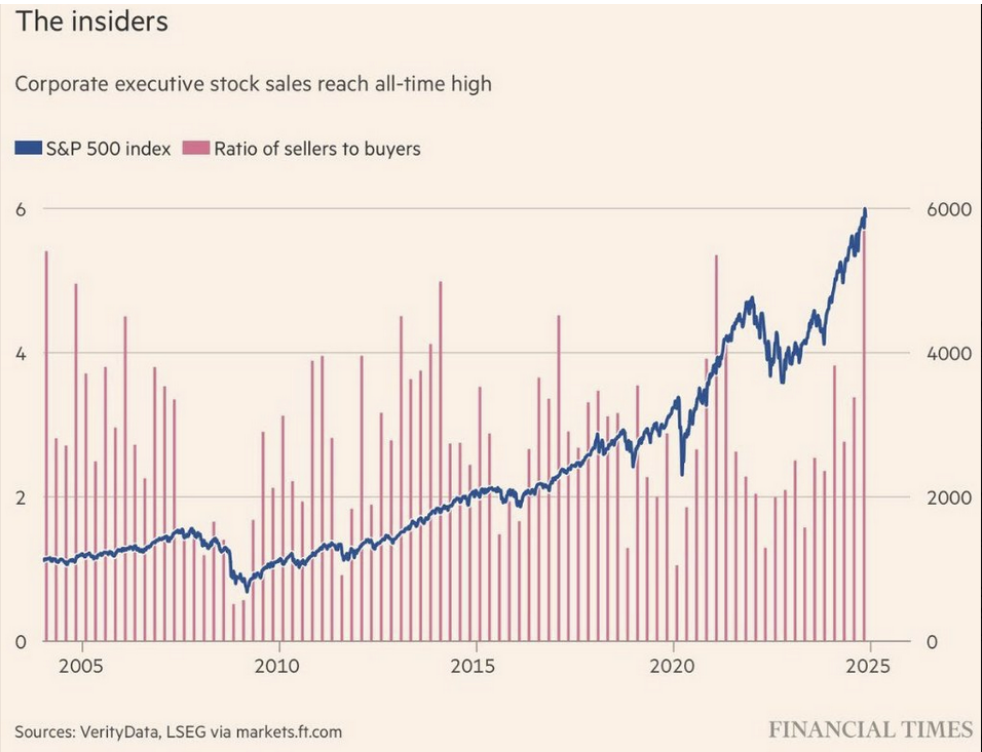
— Insider sales reached an all-time high as executives from Goldman Sachs to Tesla locked in equity gains. What do they know that we don’t know?

One Response