

| SNEAK PEEK |
— Free speech campaigners fear Elon’s status as the champion of free speech is about to clash with his role as efficiency czar in the Trump administration.
— IQM’s Jan Goetz updates us on how quantum developments are going in Europe.
— Germany is reawakening its nuclear ambitions in more ways than one, Dario argues.
Dear subscribers,
We’re back from Web Summit with a bit of a whopper of a newsletter. But hey, there’s a lot going on! Enjoy.
As usual, this newsletter is brought to you by Izabella Kaminska and Dario Garcia Giner.
Send tips to [email protected] or [email protected], or anonymously via our Haya link.
| THE BIG BLIND SPOT THIS WEEK |
WHAT IF US GROWTH IS NOT WHAT IT SEEMS? We keep hearing about how U.S. growth is the exception to the G7 rule. But could we be missing the wood for the trees?
IZZY’s COMMENT: One of the strongest arguments doing the rounds as to why Trump will be bad for U.S. growth is that Bidenomics has made the economy hum. So much so any move to step up tariffs can only be self-sabotaging. If it ain’t broke, don’t fix it.
Yet, in an excellent X thread this week, China expert Michael Pettis set out why the likes of the FT’s Martin Wolf may be wrong to believe that Trump’s “manufacturing fetishism” is destined to fail. And that’s not just because Bidenomics never reversed the Trump-era tariffs.
“In a globalized world, shifts in one economy must be matched by the opposite shifts among its trade partners, one consequence is that more open economies automatically import industrial policy from more interventionist economies,” Pettis noted, reiterating his longstanding point that the hollowing out of the U.S. manufacturing base was an inevitable consequence of Chinese policy. Such policy included conscious currency undervaluation, wage suppression, and low interest rates to achieve trade surpluses. Consequently, deficit countries like the United States were compelled to run trade deficits, which adversely affected their manufacturing sectors.
But here’s the really smart point. Pettis openly rejects the idea being peddled everywhere from Davos to Washington and Brussels, that onshoring manufacturing is pointless because domestic manufacturers will simply automate their businesses, and thus maintain the same level of inequality as before, benefitting nobody.
Indeed, the idea that “because each unit of manufacturing employs fewer and fewer workers over time” is idiotic, he says. Inequality is merely a choice. And, on the contrary, “if workers are paid in line with their rising productivity, they will spend more on non-manufactured goods and services, so that any decline in manufacturing employment is more than balanced by a rise in non-manufacturing employment.”
If Pettis is right, there really would not be any downside to applying tariffs to a nation that doesn’t play fair on the global economic stage, it simply shifts the U.S. from being a term-taker into a term-maker. Import costs of some goods might go up, but the average worker would still benefit from the growing share of output, especially if the dynamics propel the U.S. to manufacture such goods even more cost-efficiently thanks to automation. If that’s the case, the pearl-clutching outrage about abandoning free trade is entirely misplaced.
The emperor is naked? Once you see Pettis’ point it’s very hard to unsee it. As he continues: “The only way countries get richer is by becoming more productive. If productivity growth in manufacturing is high, the US should be eager to expand the role of manufacturing in the US economy, not contract it,” he says. “It won’t lead to unemployment. If workers are paid in line with their rising productivity, they will spend more on non-manufacturing goods and services, so that any decline in manufacturing employment is more than balanced by a rise in non-manufacturing employment.“
And that, by the way, is not a call for universal basic income. It’s a call to embrace productivity. After all, if automative tools help me do my job more effectively, I should become a more compelling asset for the company I work for and be rewarded accordingly.
But, but, but…! The usual refrain at this point is that U.S. productivity and growth are already defying stagnation! Bidenomics is a huge success. And it’s just stupid Trump voters who can’t understand that they’re really better off. After all, have you not seen how U.S. productivity and growth compare to EU and British figures?
But this ignores there’s an obvious and yet-to-be-explained disconnect between what economists are telling U.S. citizens about how well their economy is doing and how they perceive it is doing. If the economy was really humming, chances are Trump would not have been elected.
Time to look at some charts.
Let’s start with the figures everyone likes to celebrate. Straight up U.S. growth per capita. Oh yeah, at over $87k per person that is a humdinger. Well done Joe Biden.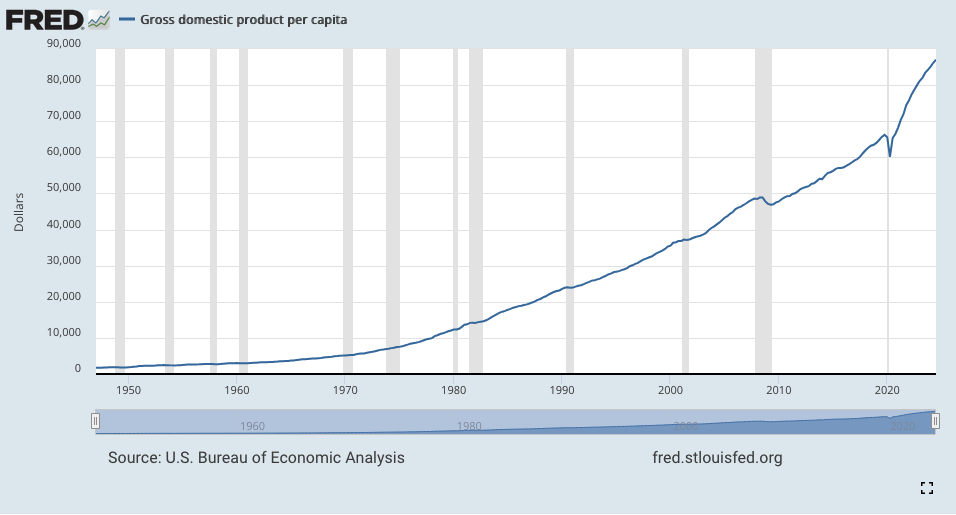
But let’s not forget there’s been inflation. So we need to adjust that accordingly. We’re now closer to $69k per person. Okay, okay. Still not too shabby.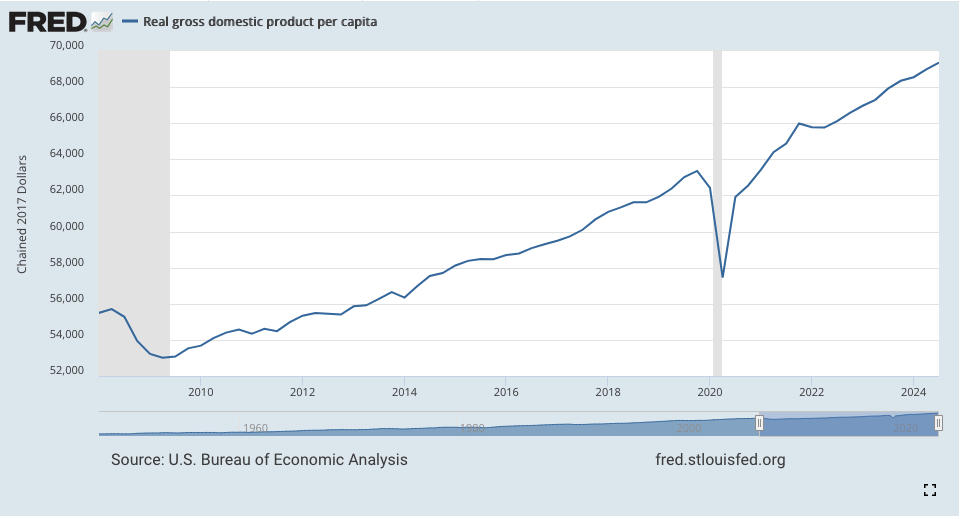
And what about total factor productivity? Looking good, except… well, the data stops in 2019.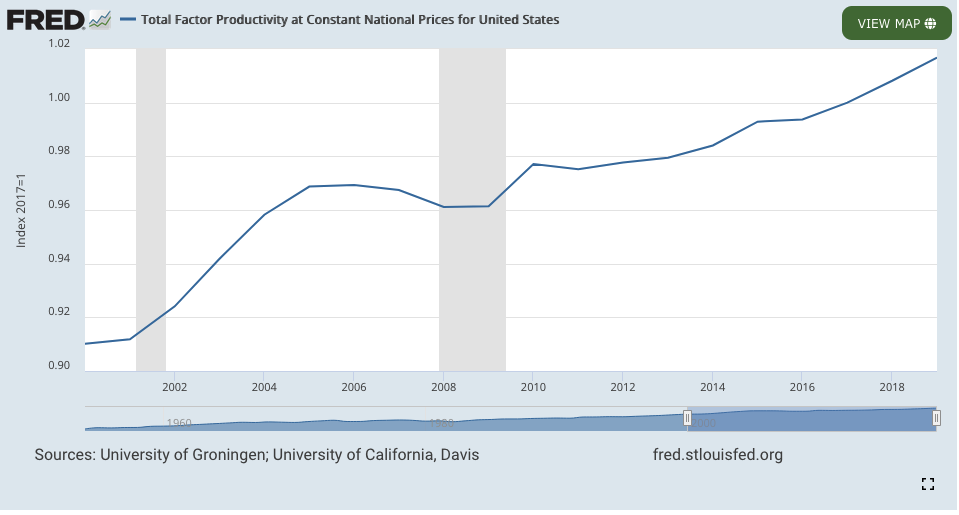
The more regularly updated private nonfarm business sector total factor productivity, which goes till 2023, well that is looking a little bumpy: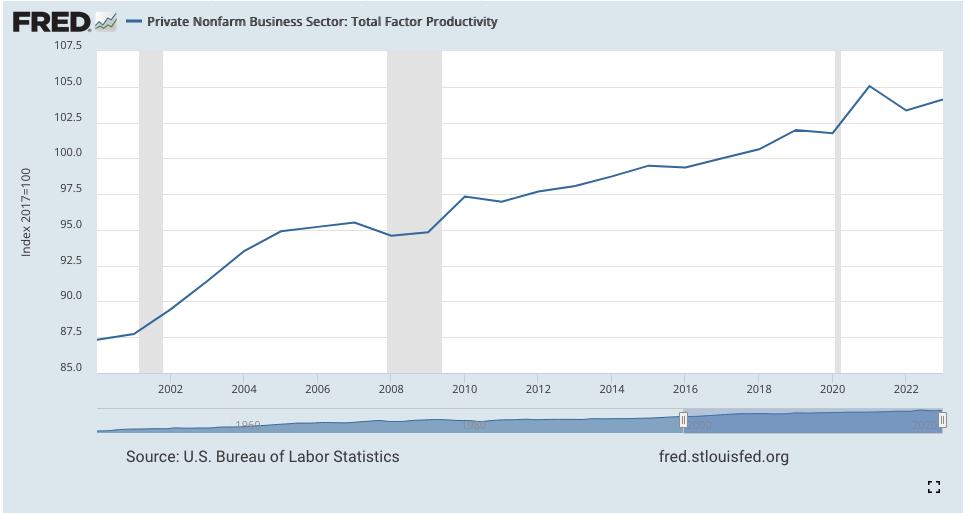
This is probably about the time to remind readers that the U.S. Bureau of Labor Statistics (BLS), has been making an awful lot of revisions the past few years to data, mostly to jobs numbers and mostly to the downside — something even CNN admits.
But here’s the more important question: How much of that Bidenomic growth is really benefiting the average U.S. worker?
Looking at the share of labor compensation in GDP shows that the share has mostly stagnated since 2010. In theory, that still represents a consistent share of a supposedly growing pie and isn’t terrible. And yet it is a problem if, say, high-skilled service or public-sector workers are benefiting disproportionately from the growth than manufacturing or low-skilled workers.
So maybe the better question to consider is who is currently doing even better than the American worker? And what happened in 2001 that reversed a trend that should — in a world of growing automation and digitalization — be a consistent theme? Notably a scenario where labor demands more and more of the pie as productivity empowers more and more high-quality employment?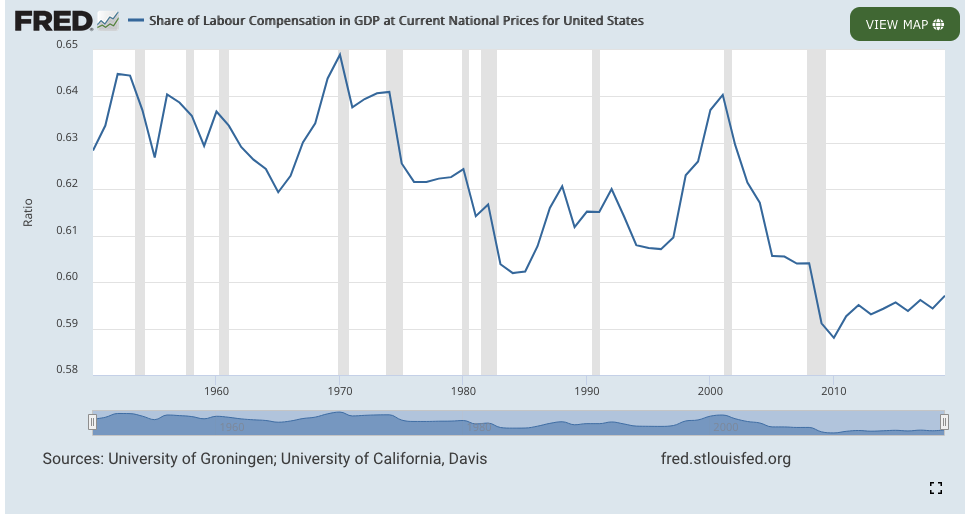
Never fear, SocGen’s Albert Edwards is here to explain. And as he revealed this week, the answer is pretty self-evident: Labor’s share of output was crushed by China’s entry into the WTO in 2001, and only began to recover in the mid-2010s thanks to more public sector spending (at the cost of increasing debt). 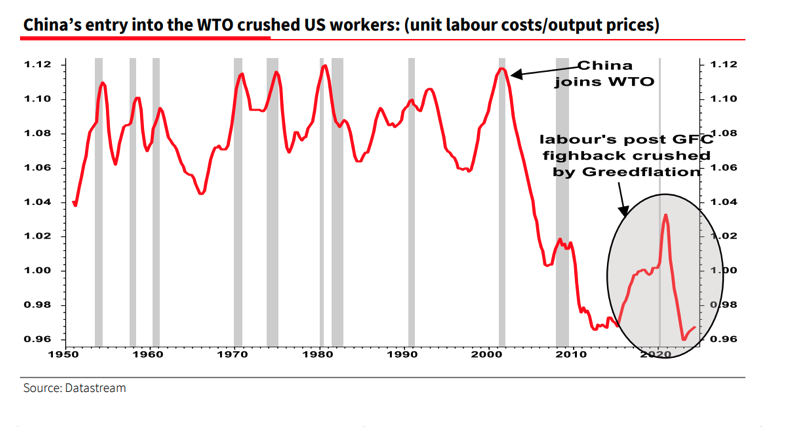
In the meantime, US corporates have never had it so good: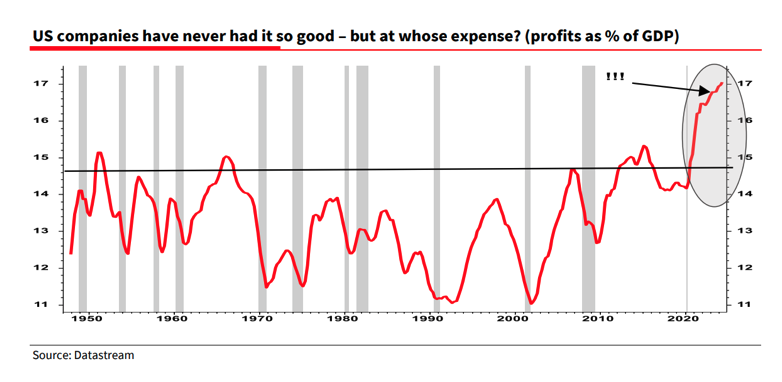
But here are two other charts worth bearing in mind: Interest expense on public debt outstanding, with the below showing the interest being incurred on bills (the spikey chart) and bonds (the more consistent line). 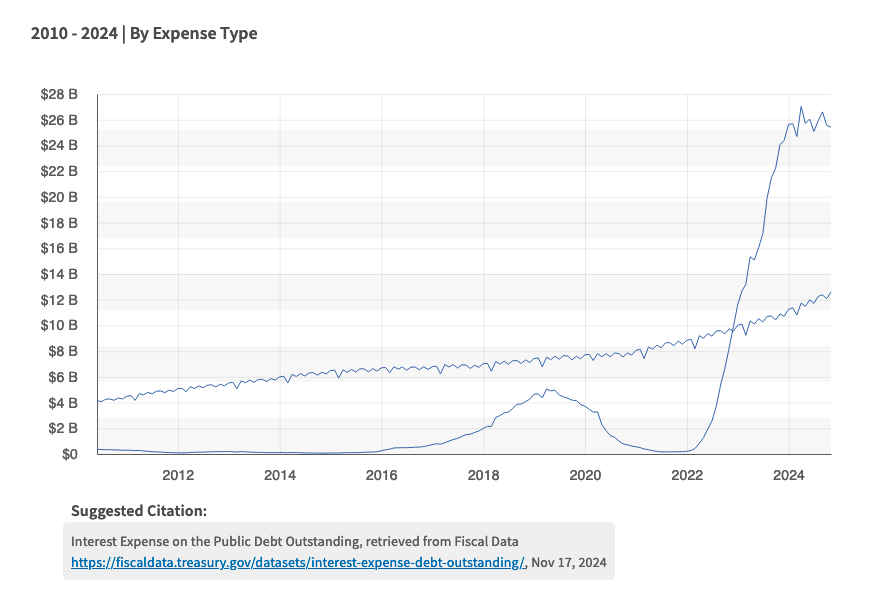
Here, meanwhile, is the total U.S. interest expense on all public issues: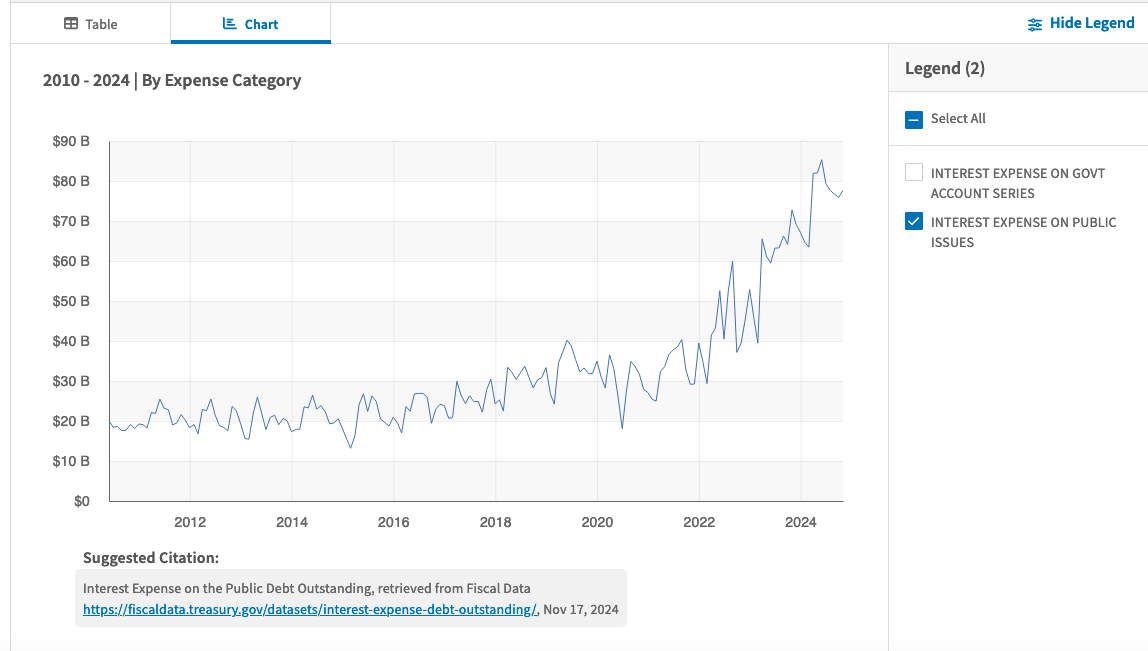
Now consider that a significant wedge of those payments (and thus the proceeds of U.S. growth) are heading to foreign holders of U.S. debt, and you realize that it’s not just that Pettis and Edwards have a point, it’s that there’s a circularity to the current growth situation is yet to be properly and compellingly articulated: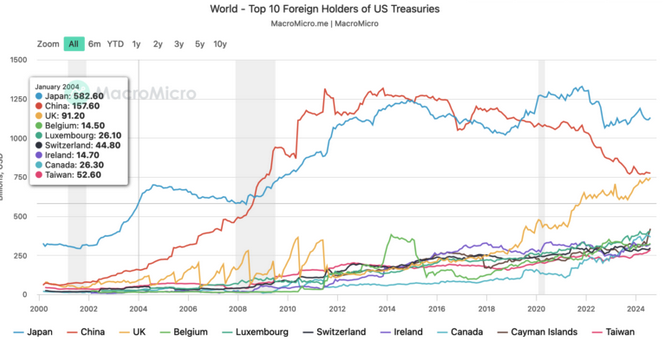
BOTTOM LINE: Rather than driving sustainable growth, it looks increasingly like Bidenomics’ reliance on foreign-held debt and imports is creating a circular dependency where U.S. growth appears robust but leaks wealth abroad through debt servicing and trade imbalances. The scenario primarily benefits U.S. corporations with higher margins from outsourcing as well as the countries to which work is being outsourced. While lucrative for companies and foreign creditors, the situation masks stagnant domestic wages and growing economic vulnerabilities, making the perceived growth and productivity gains largely illusory.
The result? Productivity gains appear strong but are being artificially inflated by cheap foreign labor and unsustainable practices, centered on the continued repression of workers both in the U.S. and in China.
Tariffs, if deployed as Pettis suggests, to boost the productivity of the average worker, would end that vicious cycle and create a productive growth dynamic where workers become the main beneficiaries of an increasingly competitive domestic economy.
There’s no doubt who the losers would be: Those who have benefited most from the current system of global trade imbalances, outsourcing, and wealth concentration — including export-dependent nations like China, multinational corporations, financial institutions, and global elites. Small surprise they’re the ones mostly up in arms about the prospective changes.
| BUSINESS, ECON AND FINANCE |
AND THE NEXT US TREASURY SECRETARY IS? The key contenders so far are Howard Lutnick, Chairman and CEO of Cantor Fitzgerald and BGC Group, and Scott Bessent, a prominent American investor, hedge fund manager, and former CIO of Soros Fund Management, known for his macroeconomic expertise and alignment with Trump’s economic policies.
But some prominent analysts are betting on Bessent.
IZZY’s COMMENT: One man who not only rightly predicted that Trump would be elected but has long held that Scott Bessent will succeed as the likely nominee for Treasury secretary under Trump’s administration is former Credit Suisse star Zoltan Pozsar. His reasoning revolves around the alignment of Bessent’s economic philosophy with Trump’s ambitious agenda. Central to this alignment are Bessent’s “three arrows” domestic policy and the proposed “Mar-a-Lago Accord,” both of which Pozsar deems pivotal for addressing U.S. economic challenges and reshaping the international financial order.
Abenomics-esque: Scott Bessent’s economic plan under Trump’s potential administration appears to draw inspiration from Japan’s Abenomics, which was introduced by former Japanese Prime Minister Shinzō Abe. The policy was famously structured around three policy “arrows” aimed at revitalizing Japan’s economy: 1) Aggressive monetary policy, 2) fiscal stimulus and 3) Structural reforms.
The new “three arrows”: Bessent varies the three arrows theme by targeting 1) U.S. energy independence (3 million barrels/day equivalent in extra energy production), 2) fiscal consolidation (reducing the deficit to 3% of GDP by 2028), and 3) robust economic growth (3 percent real GDP).
If appointed, expect a Mar-a-Lago Accord, which will represent a global realignment strategy where trade partners must adapt via production relocation to the U.S., domestic consumption promotion, or exchanging dollar reserves for century bonds. This framework is essential to reducing global imbalances, with fiscal responsibility and deficit reduction at its core. Bessent’s emphasis on swapping short-term Treasury bills for long-term century bonds would extend debt maturity and lower interest costs, enhancing fiscal sustainability.
Reforms aplenty: Bessent’s tenure should bring about significant financial recalibrations, favoring fiscal tightening, increased energy production, and coordinated global adjustments. This would lower oil prices, reducing inflationary pressures and enabling Federal Reserve rate cuts. The resulting fiscal-monetary synergy is expected to trigger a virtuous cycle of lower rates, reduced federal spending, and stronger economic growth.
What does it mean for the dollar? In one word: weakness. Expect Bessent to prioritize fiscal discipline, regulatory relief for banks, and bilateral accords, culminating in an international consensus around reducing global imbalances.
| POLITICS, POLITICS, POLITICS |
THE POLYMARKET RAID: The Manhattan apartment of Shayne Coplan, the CEO of the election-betting platform Polymarket, which accurately predicted Donald Trump’s victory, was raided by the FBI early Wednesday morning. A source close to the matter told the New York Post that while Coplan had not been arrested, the raid was motivated by “political retribution” by the outgoing administration due to Polymarket’s accurate prediction.
Regulatory response: The source also speculated the FBI was piggybacking off media reports that accused Polymarket of market manipulation such as wash-trading. While a Polymarket spokesperson claimed that such actions are expressly prohibited by the platform’s terms of use, Polymarket’s uncertain regulatory situation in the United States, where it has already been forced to pay fines to the Commodity Futures Trading Commission, and France, means this may only be the beginning of the political betting company’s legal travails.
The U.S. raid follows the French National Gaming Authority moving to investigate the platform last week, with speculation mounting that France could move to ban the service entirely in its markets. In May, tech billionaire Peter Thiel’s Founders Fund led a $45 million round of investment into Polymarket.
A US INCURSION INTO MEXICO? Tom Homan, Trump’s ‘Border Czar’, laid out on air how the President-elect has declared war on Mexican drug cartels and now plans to send American special forces to combat gangs directly inside Mexico.
DARIO’s COMMENT: While the idea of using military force to combat Mexican drug cartels may hold superficial appeal for some Republicans, the reality is far more complex. Beyond the obvious complications of a de facto invasion by the American military, many experts have raised serious concerns about the feasibility and consequences of such a strategy.
The Cato Institute, for example, has warned that the extreme wealth and tactical sophistication of cartel organizations could place the U.S. government in direct conflict with a “sizeable near-peer competitor in asymmetric warfare.” This would leave the U.S. with limited options for escalation — a precarious position for any military operation.
Cartels like Los Zetas, the Sinaloa Cartel, and the Jalisco Cartel Nueva Generación (CJNG) are not only well-funded but also militarily advanced. They wield a formidable arsenal, including drones, IEDs, anti-aircraft missiles, and other heavy weaponry acquired through international arms markets or stolen from military depots. Ironically, their military prowess is bolstered by former members of the Mexican armed forces, some of whom were trained by U.S. Special Operations forces before defecting to the cartels.
Engaging these cartels militarily would be akin to fighting the Taliban on steroids. Unlike the Taliban, the cartels are deeply intertwined with global financial networks, have infiltrated numerous Latin American states (notably Mexico and Venezuela), and boast superior weaponry and training.
But there are issues with this plan that go far beyond the military difficulties.
Unlike the Medellín Cartel under Pablo Escobar, which gained notoriety for its grassroots popularity through large-scale donations to local communities, modern cartels tend to avoid widespread visibility. While they maintain fiercely loyal enclaves, often in neighborhoods tied to cartel families, such popularity can attract unwanted attention. Ironically, nothing could boost their standing more than being cast as defenders of national sovereignty against a foreign invader.
Even in the unlikely event of a U.S. victory, the outcome would likely be riddled with contradictions. Cartels rely almost entirely on the American market for financing. A military campaign that addresses only the symptoms — without tackling the root cause of U.S. drug demand — risks creating a power vacuum. This void would likely be filled by other cartels, potentially based further afield. Worse still, the institutions meant to stabilize the region post-conflict, such as the Mexican military, are already compromised by cartel influence.
The notion that U.S. bureaucrats or military personnel would remain immune to the lure of the drug trade is equally flawed. Just last year, over a dozen Special Forces soldiers at Fort Bragg, North Carolina, were arrested on drug-trafficking charges. The problem is systemic, not simply geographical.
As long as the United States treats drug cartels as a military problem, it will only perpetuate the issue. Rather than attacking the symptoms of the problem, the United States should question why its population is increasingly using addictive substances.
Niall Ferguson, for instance, has claimed that this increasing dependency is reminiscent of climbing alcoholism rates in the late Soviet Union, a point we have argued at the Blind Spot for a while.
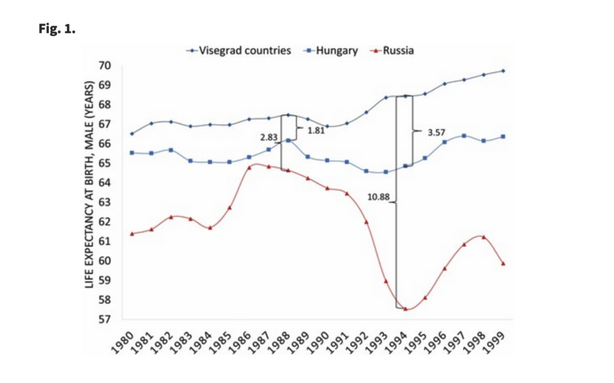
As he has noted, as an Empire collapses and its people cease to believe in its ideology, they automatically turn to the self-numbing and self-destruction of drug or alcohol abuse.
While the solution to this issue continues to evade lawmakers, critics will no doubt suggest Donald Trump will take a page from his own book of isolationism — that foreign interventions only lead to negative foreign entanglements — and refrain from resorting to such extreme actions.
| X-FILES |
NEW UFO LEAK: Around 18 gigabytes worth of data on UFOs appeared online on UFO-related forums before being quickly deleted. The Blind Spot managed to get its hands on a download link. While there is far too much information to verify at once, our preliminary analyses seems to suggest it’s just more of the same old, same old. The material appears to consist mostly of repackaged historical UFO documents and already-published FOIA requests. We will keep you posted.
| GEOPOLITICAL HOT SPOTS |
GERMANY’S RENEWED NUCLEAR AMBITIONS: While the collapse of Olaf Scholz’s government dominated headlines last week, the CDU/CSU alliance seized the moment to release a technical paper on November 5 titled “New Energy Agenda for Germany.” The document subtly reopens the debate on Germany’s energy future, including the possibility of restarting the country’s recently shuttered nuclear power plants.
DARIO’s COMMENT: There’s little doubt about who will take the reins if Olaf Scholz’s government loses its confidence vote — the CDU/CSU has been consistently leading in the polls for months. The real question is how Germany will rise to the challenge as Europe faces up to an increasingly isolationist America, retreating from its role in European affairs, and a resurgent, nuclear-posturing Russia.
What does the CDU/CSU paper outline?
The paper suggests that Germany, in seeking to reclaim its influence on the European and global stage, might consider re-embracing nuclear power. This move addresses the pressures on its heavy industry caused by the loss of Russian gas supplies. However, it raises a critical question: could new investments in nuclear energy also serve a dual purpose, laying the groundwork for Germany to develop its own nuclear deterrent?
Quite a turnaround: In addition to exploring nuclear power, the paper outlines strategies to make German industry more competitive by reducing energy costs. These include potentially rolling back some of the green energy and climate policies enacted by the current government. Notably, the document commits to a thorough evaluation of restarting Germany’s most recently decommissioned nuclear plants — closed in 2024 — to assess whether doing so would be technically and financially viable.
But there are issues: Even if Friedrich Merz, the man most likely to become the next German Chancellor, were interested in rebooting Germany’s nuclear plants, he’d have a hard time. Not just because its most likely allies in a future government coalition — the SPD — are anti-nuclear, or because the German public has traditionally been skeptical of nuclear energy, but because it may already be too late. Despite only being shut in April, these plants have been hosed down with decontaminating acid, and one of the three plants’ primary coolant loops was removed — all costly operations that will prove difficult to reverse.
But the paper — and Merz himself — takes a broader and more ambitious stance, branding their approach as “technological openness.” This strategy encompasses investments in a wide range of energy technologies, from modular nuclear fission and nuclear fusion reactors to small modular reactors (SMRs), hydrogen power plants, and geothermal energy.
Although this bold pivot has caught much of the mainstream press off guard — especially given that it was the CDU who spearheaded the nuclear phase-out following the Fukushima disaster — it doesn’t come as a surprise to us.
What’s the blind spot?
The critical point to grasp about Germany’s relationship with nuclear energy is that its shift away from nuclear power and toward renewables has been the exception, not the rule, in its broader energy strategy. Beneath the surface, and contrary to appearances, Germany has quietly worked hard to maintain technological capabilities to develop nuclear weapons since the end of World War II.
As we noted earlier this year, the rationale behind Germany’s decision to begin phasing out nuclear plants around 2011 has often been underestimated. By redirecting its energy and industrial sectors toward renewable energy, Germany positioned its wind turbine industry to dominate the plains of Central Europe. However, this strategy faltered amid the geopolitical fallout between the United States and Russia, which cut off the supply of cheap Russian gas — a critical stopgap until Germany’s renewables could scale efficiently.
With Russian gas no longer an option and the economic underpinning for subsidizing renewable energy eroded, the CDU appears poised to revert to Germany’s pre-21st-century playbook: advancing nuclear energy development while covertly progressing toward a nuclear weapons capability.
Overcoming that nuclear ban: This is a typical tale of 20th century German behaviour. Germany was banned from creating nuclear weapons in 1954, and has since signed treaties on non-proliferation that supposedly prohibit their government from developing nuclear weapons.
But whenever the country is banned from pursuing military developments, as in the 1919 Treaty of Versailles, it eludes them under so-called ‘Rapallo Agreements’, named after the Treaty of Rapallo, a 1927 deal which enabled Germany to train its airborne and armoured troops inside Soviet Russia. Other examples include its construction of U-boats in Cadiz shipyards in the late 1920s.
For instance, Chancellor Konrad Adenauer saw the creation of the European Atomic Energy Community (EURATOM) as an opportunity to covertly develop nuclear weapons under the guise of a peaceful nuclear energy program. However, France, under Charles de Gaulle, excluded Germany from participating. Undeterred, Germany pursued alternative methods. Its private companies and scientists took on foreign contracts to construct nuclear plants and even warheads — such as for the French navy — enabling the acquisition of nuclear expertise while maintaining public compliance with non-proliferation agreements.
This strategy extends across decades and continents. German companies and engineers have been linked to the development of nuclear weapons programs in Pakistan, Iran, Iraq, Israel, and South Africa. The Urenco Group, a consortium involved in uranium enrichment — critical for crafting nuclear weapons — is a case in point. Co-owned by the Dutch government, the British government, and two private German utility firms, Urenco underscores Germany’s ability to balance its formal obligations with strategic loopholes to maintain its technological edge.
Going forward: While the German public has been consistent in its opposition to the use of nuclear weapons — and remains reticent to any whiff of nuclear weapons training, like its air force’s plans to train with the American nuclear weapons stationed in Germany — the issue is not cut and dry. Since the conflict between Ukraine and Russia, German public opinion has significantly shifted in favor of nuclear weapons. For example, in 2016, 85 percent of Germans said they wanted the U.S. nuclear weapons withdrawn from German soil, but, by 2022, over half wanted them to stay.
Experts do not believe this will lead to a nuclear-armed Germany any time soon; however, it’s increasingly clear that German elites are content to return to nuclear energy in order to save their heavy industry. It also clarifies that the German public is only a few geopolitical tight spots away from accepting the reality of needing nuclear weapons. Luckily for the German public, it seems like the German state has been secretly preparing for this outcome all along.
FUSION UPDATE: Speaking of nuclear, watch out for news from Sam Altman’s big fusion bet, Helion Energy. It had promised investors earlier this year that it was on track to deliver a net energy gain by the end of 2024. So far, it’s all quiet on that front, but last we checked in with insiders they said the company was still on track to make the deadline.
| LAW ENFORCEMENT |
EU VAT SCAM EXPOSED: Italian investigators have broken up a mafia-organised crime ring carrying out VAT fraud in Europe. The individuals had created ‘ghost companies’ that would sell goods among each other in the EU to take advantage of EU rules on cross-border transactions between its member states. These ghost trades then created a paper trail of VAT receipts the individuals would use to claim official ‘reimbursements’, with an estimated €520 million allegedly stolen from authorities.
SPAIN’S NARCO-POLICE DIRECTOR: Spanish authorities have arrested Oscar Sanchez, the chief inspector of the money laundering division of the Spanish police in Madrid, on the suspicion he was working with cartels.
Behold the optics: Over €20 million was found hidden inside the walls of his chalet outside Madrid, with another million being found hidden inside a wardrobe at his office. His wife, another police officer, was also arrested for complicity in the chief inspector’s acts. Spanish police suspect the officer contacted and began a friendship with certain cartel members five years ago, and charged them to facilitate the entry of their drugs in the country.
Worth noting, Madrid was one of the European capitals vying to become the home of the EU’s new Anti-Money Laundering Agency (AMLA).
| QUANTUM |
QUANTUM CHECK: The Blind Spot caught up with Jan Goetz, CEO of IQM, a Finnish quantum start-up building quantum computers and quantum chips, at Web Summit this week.
What’s the update? Goetz reiterated what he told us in 2021: that we are still a long way off from having functional quantum machines and that the recent hullabaloo surrounding reports that Chinese scientists at Shanghai University had reportedly cracked encryption was entirely overdone. None of this can happen at any meaningful scale at the moment.
However, a more interesting point raised was that quantum computers may, in the long run, be our best option for reducing the immense energy footprint of the data centers powering LLMs, since they require only a fraction of the energy of that of conventional computers — even after the cost of maintaining absolute zero is factored in.
Chip advances: IQM, which is part funded by the Finnish government, is investing heavily in quantum chip production and is the first to have started doing so in Europe. But, Goetz warned, it’s wrong to think quantum chips can displace the need for conventional chips from TSMC or Nvidia. Quantum compute is mostly useless for brute force or low-brow computation. It is best applied to highly complex problems such as those related to drug development and the pricing of options (aka uncertainty) in financial markets.
What will the data centers of the future look like? Goetz says they will be a melange of different types of computing systems all in one center, all specializing in their own field. “We’re going from playing a single instrument to conducting an orchestra of different types of compute,” he said.
Brain analogy? We asked if employing a blend of specialized chips in this way — like conventional semiconductors, ASICs, neuromorphic, and quantum — for specific tasks, mirrored the human brain’s architecture. Goetz said he hadn’t thought of it that way before but the comparison felt intuitively right. The brain does not use a single type of “processing” mechanism across all regions but rather utilizes specialized neurons and structures to optimize for different types of cognitive and sensory functions.
In that analogy, conventional semiconductors are similar to general-purpose cortical areas of the brain that support a wide range of cognitive functions, from basic processing to more flexible, cross-functional tasks. ASICs, which are highly optimized for specific tasks, like encoding or cryptography, are comparable to brain regions dedicated to specialized functions, like the occipital lobe for vision or the hippocampus for memory, where specific neurons and circuits are tuned to particular types of information processing.
Neuromorphic chips, meanwhile, mimic the structure and function of neurons, enabling real-time, efficient processing similar to synaptic learning.
And finally, quantum chips will mimic how the brain processes complex, high-level abstractions or multi-layered scenarios, such as making sense of uncertainty and ambiguity.
BOTTOM LINE: The Finnish seem to have the upper hand on quantum chip production in Europe.
| MEDIA MATTERS |
THE ELON PROBLEM: Elon Musk’s closeness to Donald Trump, as well as his imminent integration into the new administration via the formation of the Department of Government Efficiency, is triggering a foreboding sense of anxiety within the free speech community, which previously lauded his takeover of Twitter.
A new round of X defections from the legacy media community (mostly to BlueSky) is currently underway, with even those who previously defended him highlighting concerns about the concentration of power and growing hypocrisy his ownership of X represents, especially regarding government influence over social platforms. Elon, you’re the government now, is the mantra.
IZZY’s COMMENT: Will this be the end of X? We wouldn’t bet on it. Everything above is logically true but ignores three vital factors.
The first is that defections into an even more limited bubble represent a tactical defeat over hearts and minds by the legacy media, not a show of strength.
Consider the original Twitter community as the equivalent of the Donbass population of Ukraine, and Elon’s unsolicited takeover of the territory the equivalent of Putin’s special operation. In that scenario, Elon has consolidated power, won the elections, and persuaded the last remaining Ukrainian troops to give up and move out. If that was Putin, it would represent a formidable disaster for the Ukrainians.
Somewhat awkwardly for the defecting ranks, usage stats on X also set a new record in November, meaning more citizens moved in voluntarily into Elon’s annexed territory even as legacy troops left.
The second key factor, mostly ignored, is that there remains no better alternative to X. Yes, The Guardian will now commit to BlueSky, but this platform has as much appeal to the middle ground as Trump’s Truth platform has with Edward Luce. If anything, BlueSky prides itself on cultivating the type of groupthink that is more commonly found in North Korea.
Not only has it quickly entrenched the worst self-serving practices of the navel-gazing blue checkmark elites on pre-Elon Twitter, but the lack of any opposing viewpoints has also brought out hideous behavioral norms. BlueSky boasts a climate that openly celebrates zero-tolerance for anything other than the party line and delights in throwing dissenters into the digital equivalent of a gulag.
Take as an example the recent experience of my former FT colleague Jemima Kelly in the community. After she wrote a column critiquing the platform as another “social media echo chamber”, she told me she experienced the worst and most vicious pile-on of her career. Considering Jemima is no stranger to pile-ons due to being a bitcoin critic, that is saying a lot.
And when her erstwhile colleague Rob Smith came to her defense, he too quickly found himself set upon due to the crime of “guilty by association”.
As I discovered from Jemima, this occurred because the community believes blocking those guilty of wrongthink is a civic duty, and facilitates such community-initiated purges by publishing an active list of the day’s top offenders, encouraging others to block alongside them. 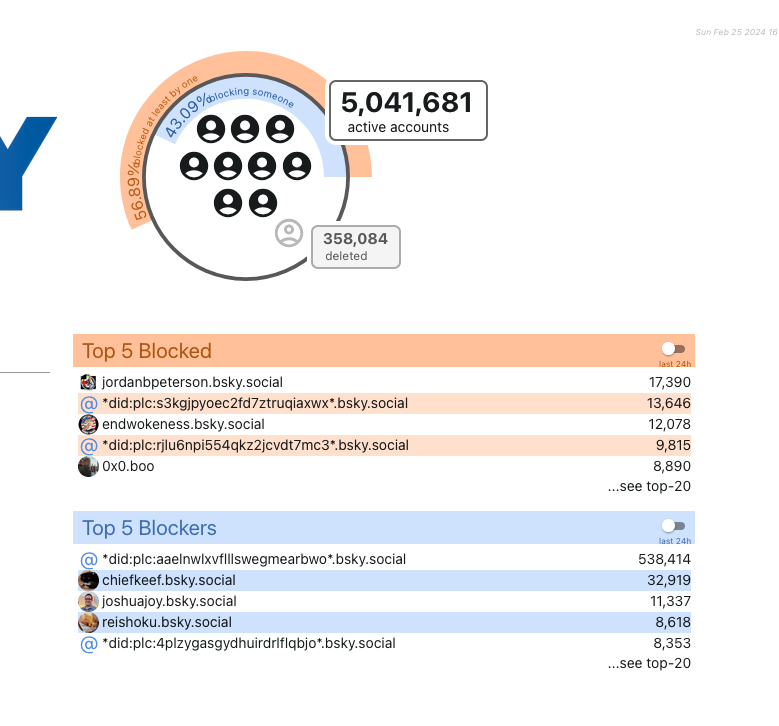
That this is utterly insane, and reflective of the worst social media norms — ones you would be mortified about if they happened in China — doesn’t seem to be noticed.
Interestingly, Bluesky’s ‘safety’ team was recently so overwhelmed by the number of reports about other users, as highlighted (often, with amusement) on X, that it had to triage the queue of complaints.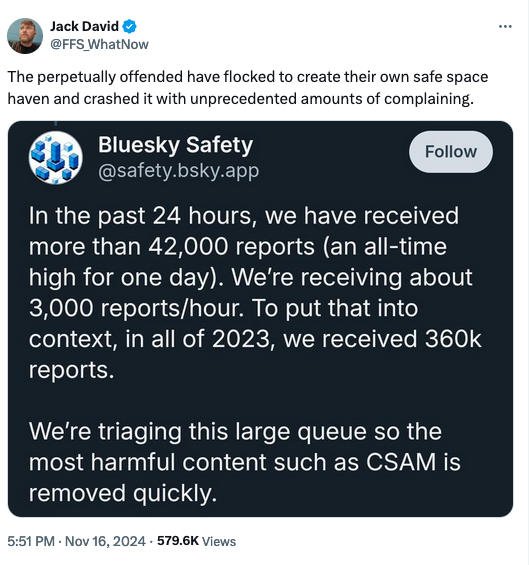
This brings us to the third factor. Many have criticized X since Elon’s takeover, claiming it amplifies his personal views, stifles engagement, and causes follower counts of pre-existing blue checkmarks to stagnate. Yet, in doing so, it has also curbed the “pile-on” phenomenon, reducing the capacity for collective outrage to inflict psychological harm on users. Personally, while my posts no longer go viral as often, I’ve noticed a significant upside: I’m no longer drawn into endless tit-for-tats or overwhelming pile-ons. Regardless of whether I agree with the content being amplified or Elon’s approach, the lack of personal attacks on the platform has improved my overall psychic well-being.
So was it really a disaster takeover? The ongoing mantra that Elon’s $44 billion takeover was one of the biggest corporate failures of recent times is objectively wrong. Even if it amounted to a disaster for those who previously benefited from the old order, it certainly wasn’t for Elon. The platform has not just handed Musk the keys to the U.S. presidency by proxy, it has provided him with a source of data that has now been fed into an AI business valued at $50 billion at the last round. That makes it financially largely a wash.
On a panel at Web Summit this week entitled, “Did Elon Musk destroy Twitter?”, three legacy media journalists, two from the New York Times and one from NPR, made hay with the point that advertisers have nonetheless stayed away from X post Elon’s takeover, arguing that user data has stagnated and revenue declined. But since X is now a private company there isn’t really much data to confirm this.
What everyone may be missing is that with Musk increasingly involved in government affairs, Trump’s return to the platform, and X’s plans to launch payment services, there’s a strong possibility that the company is diversifying its revenue streams well beyond conventional social platform cashflows.
Consider, for instance, Tesla’s previous foray into Bitcoin investments — a move that hints at unconventional monetization strategies Musk might deploy at X. The company has already been beefing up its strategic finance team, which oversees company investments.
Censorship-resistant finance? The biggest indicator yet that X corp plans to get unconventional on payments came this week when it announced it had appointed former Tubi finance chief, Mahmoud Reza Banki, as chief finance officer. Banki is far from a conventional hire.
As the WSJ reported, “In 2010, Banki was charged with violating sanctions against Iran and making false statements. He was found guilty and spent nearly two years in prison before getting released following a successful appeal.
“Banki was pardoned by Trump at the end of his first term in January 2021. In a statement announcing Banki’s pardon, the White House said that the felony charges for making false statements had prevented him from going back to a normal life.”
If Elon plans to make censorship-resistance a central part of any upcoming payments offering, then Banki may indeed be the best man for the job. As Banki wrote in an American Banker oped this year, despite having a doctorate, an MBA and a clean criminal record, minimal debt and credit scores above 800, he cannot open a checking account with a dozen major U.S. banks.
And the ultimate blind spot? Given that the First Amendment specifically defends citizens against the government’s capacity to constrain free speech, not that of private companies, Elon’s new public-private status could, in a weird way, make it more difficult for X to suppress or ban critics of Elon Musk on the platform. This could work to his favor by ending the nauseating recycled argument that private companies can censor whoever they want because they are private companies.
A DISINFO NOTHING BURGER: Tensions flared this week at an invitation-only private panel discussion held on the sidelines of the Web Summit in Lisbon, where a mix of high-profile journalists and academics from different walks of media convened to tackle one of the thorniest issues facing modern media: “Who fact-checks the fact-checkers?” Think establishment press face off with independent press.
Censorship or not? The session unfolded against the backdrop of last year’s controversies surrounding Web Summit co-founder Paddy Cosgrave, who recently returned as CEO after stepping down briefly following critical remarks on Israel in 2023. His return to the summit stage has drawn intense scrutiny, with stakeholders wondering if he can restore the event’s reputation.
The dialogue was particularly heated on the question of whether journalists bear an obligation to report government narratives without challenge or if a more adversarial approach is needed in the interest of transparency.
Some panelists representing mainstream press argued – to the shock of the free-speech advocates — that government data should be trusted as a baseline, particularly under tight deadlines because otherwise what’s the alternative?
Acute disagreement then emerged over the Twitter Files, a series of internal communications published by Twitter in late 2022. Some participants said the files offered evidence of systemic censorship influenced by government and corporate interests, characterizing it as a “censorship industrial complex.” Others dismissed the whole thing as a “nothing burger,” suggesting the revelations were overblown and lacked substantial proof of wrongdoing.
Others highlighted that during the pandemic, critical reporting on lockdowns and vaccine policies was often sidelined, not by explicit bans but by “groupthink” and self-censorship. Another added that editors were taking cues from health authorities, leading to an environment where contrarians were effectively blacklisted.
Context: Web Summit, which this year hosted whistleblower Chelsea Manning, found itself in the center of the cancellation storm last year when CEO Cosgrave was forced to step down for speaking out about the scale of Israel’s response to the Oct 7 terrorist attacks. He was replaced by former Wikipedia CEO Katherine Maher, who has drawn scrutiny from free speech campaigners for describing the First Amendment as “the number one challenge” in combating disinformation, highlighting the complexities it introduces in regulating content and addressing misinformation.
She had also expressed concerns that the “free and open” model of platforms like Wikipedia may perpetuate a “white male Westernized construct,” potentially leading to the exclusion of diverse communities and languages.
Why does it matter? Journalists from the opposing camps rarely meet in the real world and it’s interesting that Cosgrave, who is now back as CEO of Web Summit, should be facilitating such interactions.
| WHAT WE’RE PROCESSING |
— Saudi’s megacity Neom is in disarray after the CEO leaves.
— Peter Thiel sits down with Bari Weiss.
— Biden’s internal polling had Trump winning 400 electoral votes.
— Peter Todd forced into hiding after HBO doc claims he invented Bitcoin.
— Elon Musk has created a Mormon-esque compound for all his baby mommies.
— Basis swaps surge amid US repo market concerns.
— Former Tory MP Steve Baker sat down with Mr. Obnoxious.
— Satoshi era bitcoins are on the move again.
— Rachel Reeves worked in complaints at HBOS, not as an economist. And a former colleague is claiming that she nearly got sacked due to an expenses scandal and for bunking off on company hours to do Labour council business.
— Russia bans ‘child-free propaganda’ to try to boost birth rate.
— The Dawn Sturgess inquiry is bringing up some strange inconsistencies in the official Skripal Novichok poisoning.
