| SNEAK PEEK |
— Why the 90-day pause and exemptions on U.S. tariffs don’t represent capitulation but are rather classic “art of the deal”. **(Updated)**
— Reminder that the Trump administration’s whole objective is transforming exorbitant privilege from a right into a service.
— Now is probably a good time to familiarize ourselves with the dollar’s prominent role in Belt & Road development and lending.
Good morning subscribers,
As per the famous line from Airplane, looks like I picked the wrong week to… go on school holidays! It’s definitely not been short of drama. But also endless speculation and projection. We’ve got a lot to say, and not very much time.
Before we get to it, I’d encourage readers to consider the parallel between Trump’s agenda to disrupt a global economic system built on the quiet exploitation of suppressed labour in authoritarian regimes like China and that of Abraham Lincoln’s agenda during the U.S. Civil War. Call me crazy. But yes, really.
Just as Lincoln’s tariffs were designed not only to build up Northern industry but to sever the economic incentives underpinning slavery, Trump’s trade agenda — however clumsily framed — can be read as a challenge to supply chains that rely on coerced or underpaid labor, especially in China and parts of the Global South. The tariffs don’t just shield — they provoke a reckoning. In this light, they function less as tools of isolation and more as weapons of emancipation, aimed at altering the cost calculus that keeps exploitative systems humming.
No, you won’t read that anywhere else. But the parallels are clear, and perhaps it’s about time someone took a stand against exploitative practices in the global economy. Whatever ESG was, it certainly wasn’t a movement dedicated to liberating anyone.
This edition of the newsletter is written by Izzy.
Send tips to [email protected] and [email protected]
| THE BIG BLIND SPOT THIS WEEK |
CAPITULATION OR ‘ART OF THE DEAL’? It took 11 whole hours for mainstream press, notably Bloomberg, to unearth that the U.S. Customs and Border Protection department had put out a note at 10:36 p.m. EDT on Friday outlining a number of significant exemptions — mostly electronics that go into laptops and phones — on Trump’s Chinese tariffs.
Since coming out, the story has significantly boosted the “Trump is capitulating due to the stupidity of his actions” narrative among the never-Trumper camp. Many of these people were already convinced the 90-day pause announced on Wednesday, April 9, was evidence of Trumpian backpedaling and panic or China having the upper hand.
But there is another perspective. As ever, The Blind Spot’s mandate is to point it out. Not because we take a partisan position, but because investors cannot afford to be blindsided by political agendas in the media and commentariat space.
A more cool-headed reading of events, for example, would suggest that everything that has transpired this week fits the classic “art of the deal” template (something Treasury Secretary Scott Bessent has also explicitly stated). In case readers are still unclear about how that works, here’s ChatGPT’s explainer: 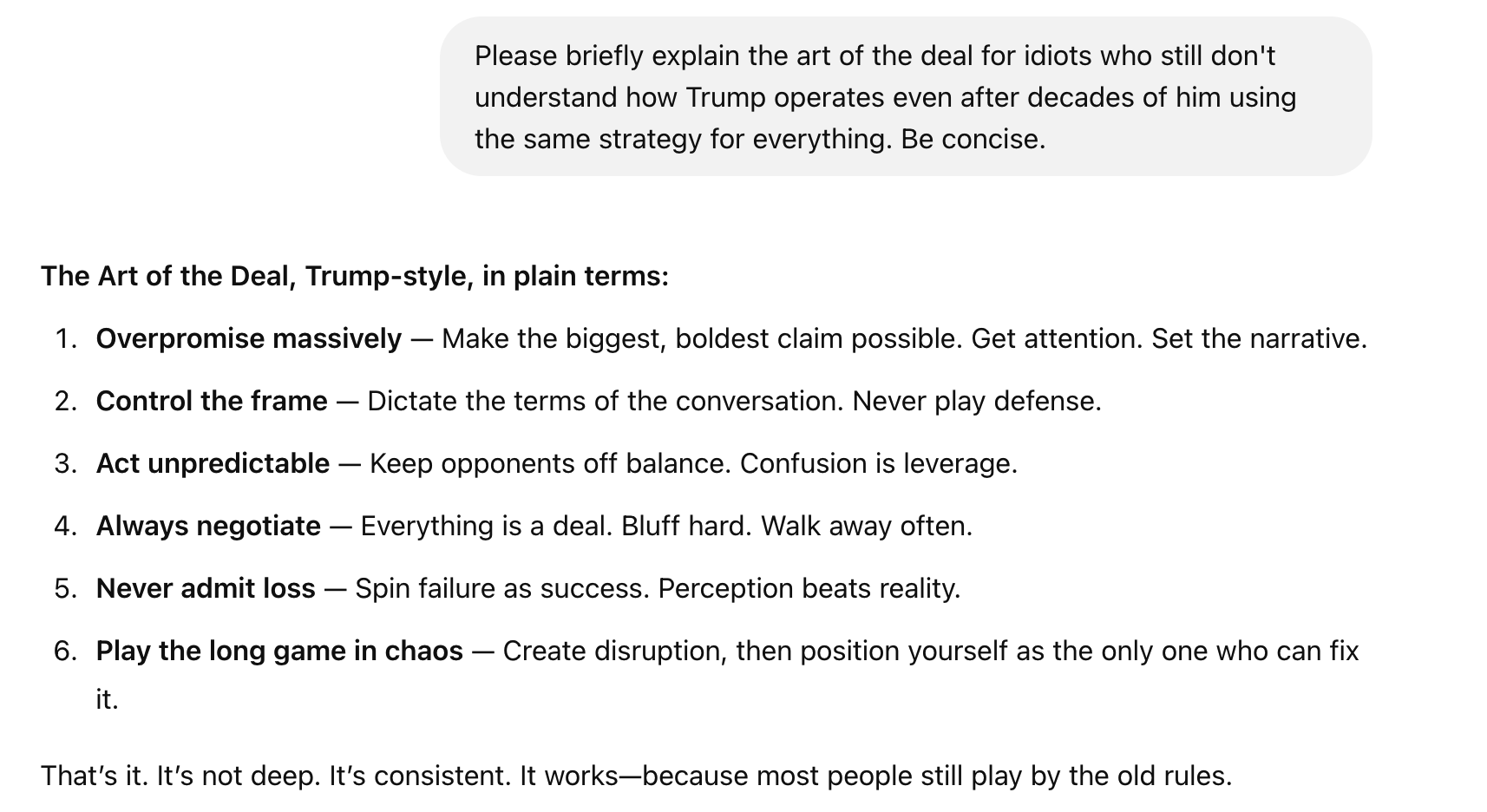
Applying the “art of the deal” framing suggests Trumpian concessions were always going to be on the cards. The strategic objective, as Bessent explained to Tucker Carlson, was ultimately to escalate to de-escalate.
But, but, what about the exemptions? Trumpian rhetoric has been strategically ambiguous about exemptions from the outset, with both Trump and Howard Lutnick seemingly contradicting each other at times. On one hand, Lutnick publicly floated several exceptions, especially for steel and aluminium early on; on the other hand, Trump was heard ruling out anything but blanket tariffs.
But if Liberation Day was a high-level test devised to see which nations would retaliate and which would not, then the subsequent period following the confirmation of 125 percent tariffs against China was arguably a similar invitation for negotiation, but this time to corporations, rather than nations.
Indeed, as POLITICO Pro reported on early on Friday, Big Tech lobbyists immediately interpreted the 90-day pause as a signal that deals were to be done. By Wednesday, Trump himself was signaling he was open to concessions, noting, “as time goes by, we’re going to take a look at it. There are some [industries] that have been hit hard. There are some that, by the nature of the company, get hit a little bit harder. And we’ll take a look at that”.
As my colleagues explained, meanwhile, “Trump previously drew a red line against allowing trade exemptions for U.S. companies affected by tariffs, but his executive order pausing ‘reciprocal’ tariffs appears to have opened the door for companies to ask. That’s left lobbyists, lawyers and executives scrambling for more details”.
By Friday evening, details of exceptions for electronics and smartphones had been discreetly published on the U.S. Customs and Border Protection website. Yet, it wasn’t until Saturday afternoon that the story was largely picked up by the mainstream media, a curious fact in its own right. So why might that be? And what does it signal about strategy? That is definitely not a journalistic norm and hints at cat and mouse play.
One (admittedly tempting) interpretation is that the Trump administration didn’t want to draw attention to the concessions it was making because they really were capitulating and wanted to save face. But if that were the case, would it really make sense to bury the announcement? Everyone knows it would come out eventually, ensuring major reputational blowback (as there is now) anyway.
The alternative explanation is more calculated: the delay was part of a broader signaling strategy. The administration is leaving easter eggs in primary sources and obscure releases, prompting attentive players to decipher its real intentions. This aligns neatly with “Art of the Deal” logic.
After all, in any hardball negotiation, ambiguity is a weapon. If your counterpart doesn’t know exactly where the lines are or when you’ll bend, you maintain the edge. It also leaves other governments or firms unsure whether you’re really backing down or just playing favorites. Overall, it signals: The rules are flexible… but only if you talk to us. At the same time it encourages hedge funds and traders to scour the releases and primary sources themselves rather than depend on journalistic repackaging and spin.
Consider the timing of the exemption communication too. It came late Friday, after markets had well and truly closed. Then consider how Apple has been trading since Wednesday: first up, then down, then up again: 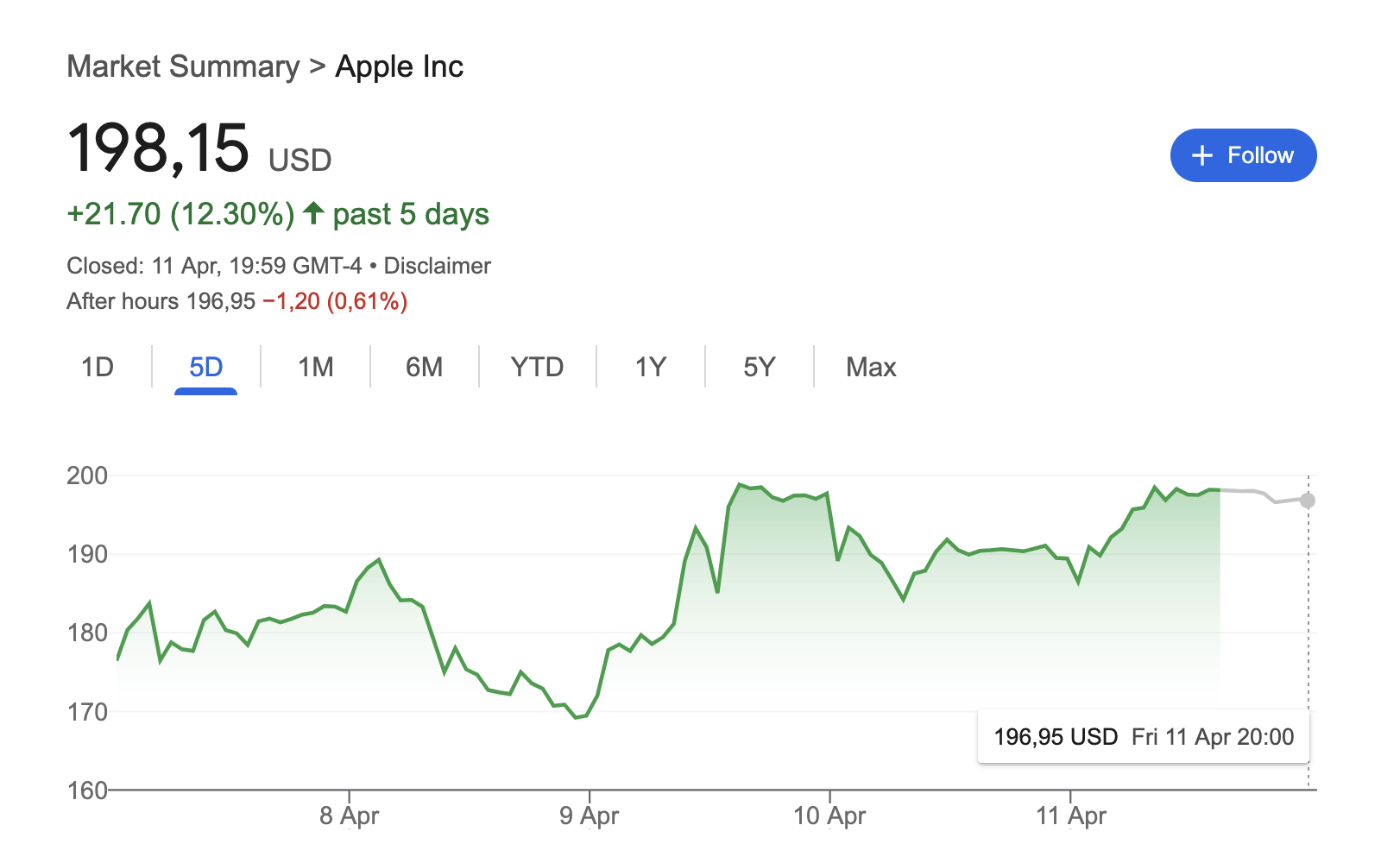 Is this Trump capitulating under pressure? Or is this Apple getting the industrial exemptions it wants because it’s been negotiating and promising to relocate as much of its industrial production as soon as possible to the U.S. in exchange? We might never know for sure. But the chances a quid pro quo was executed are not insignificant.
***UPDATE Monday 0800 BST*** Trump has since claimed that “NOBODY is getting ‘off the hook’ for the unfair Trade Balances, and Non Monetary Tariff Barriers, that other Countgries have used against us…” and that “There was no Tariff ‘exception’ announced on Friday.”
Does this bulldoze our analysis? We don’t think so. Ambiguity continues to reign. As do the conflicting messages and the keep them guessing nature of the comms. Our instinct about there being something off about how the original exemption story was reported was correct too. The news release wasn’t an official announcement for a reason. It came in the form or an operational update. So were they trying to bury the exceptions or is something else going on?
We asked ChatGPT, neutralizing the prompts by asking both perspectives. One perspective: why there might have been a misunderstanding (ChatGPT says the issuance of tariff exclusions is a standard component of trade policy, even with aggressive tariff regimes.) The other: why journalists were right to call it a rollback (ChatGPT says even if it wasn’t technically a U-turn, it looked like a softening.)
What’s certain, we think, is that the ambiguity invites lobbying and negotiation, which we think is the key point.
But, but, even if that’s true, who wants those sorts of jobs in America? Haven’t you seen the memes? Yes, we’ve all seen the memes. China has belatedly figured out that meme warfare works.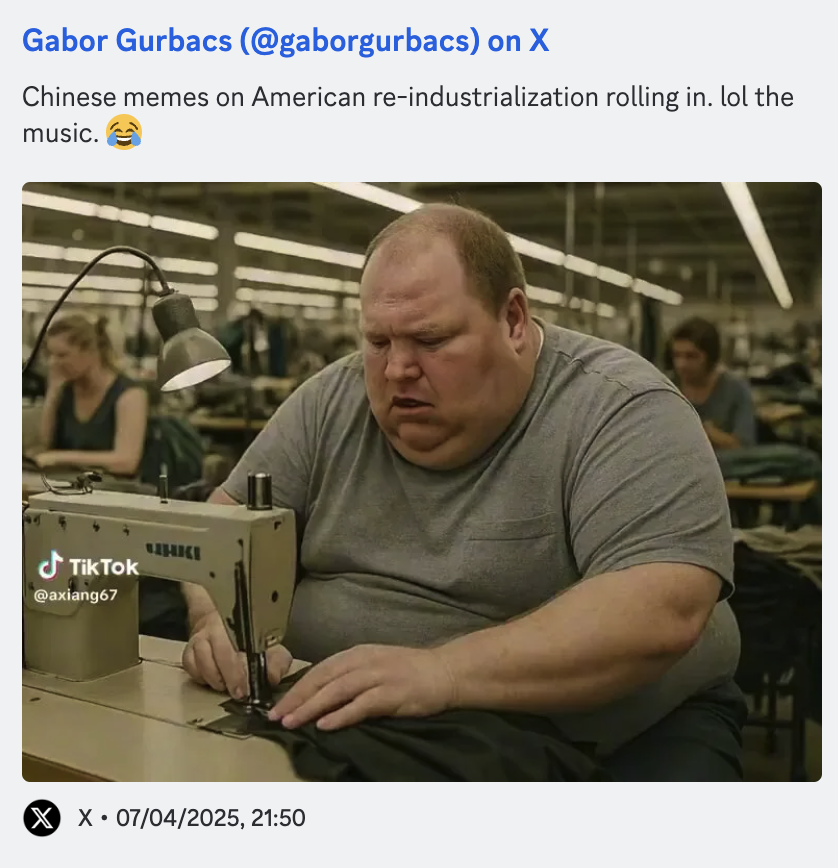
But a dispassionate analysis that gives Trump the benefit of the doubt suggests this is tactical propaganda purposefully released to misdirect U.S. citizens and the world from the true state of affairs.
China, for its part, appears to be wagering that the Western media’s entrenched anti-Trump bias will do much of the heavy lifting to get its spin across. A carefully placed memetic nudge — casting Trump’s economic agenda as chaotic, incoherent, or regressive — may be all that’s needed to drown out more nuanced or strategic messaging emerging from within the administration.
Take, for example, the media treatment of Howard Lutnick’s April 6 appearance on CBS, during which he said: “The army of millions and millions of human beings screwing in little screws to make iPhones — that kind of thing is going to come to America.” The quote was widely circulated, often as evidence of economic fantasy or nationalist delusion.
What was rarely included, however, was the full context of the quote. That went like this (emphasis ours):
SEC. LUTNICK: I’m- not that I’ve- I have not participated in any meetings with respect to that. The country is focused on- you realize, trillions of dollars of factories are going to be built in America. That’s huge GDP. The factories being built in America are huge GDP–
MARGARET BRENNAN: That takes years–
SEC. LUTNICK: And that is going to matter to us.
MARGARET BRENNAN: And you said that robots are going to fill those jobs. So those aren’t union worker jobs.
SEC. LUTNICK: No, it’s really automated jobs. It’s automated factories- automated factories. But the key is, who’s going to build the factories? Who’s going to operate the factories? Who’s going to make them work? Great American workers. You know, we are going to replace–
MARGARET BRENNAN: You said robots on other networks. You said that to FOX.
SEC. LUTNICK: –the armies of millions of people- well, remember, the army of millions and millions of human beings screwing in little- little screws to make iPhones, that kind of thing is going to come to America. It’s going to be automated and great Americans- the tradecraft of America, is going to fix them, is going to work on them. They’re going to be mechanics. There’s going to be HVAC specialists. There’s going to be electricians, the tradecraft of America. Our high school educated Americans- the core to our workforce, is going to have the greatest resurgence of jobs in the history of America to work on these high-tech factories, which are all coming to America. That’s what’s going to build our next generation of America.
It’s all about the new economy, stupid! As we xplained in our previous newsletter, the real takeaway from Howard Lutnick’s comments— and what should have dominated the headlines — is that tariffs aren’t merely about punishing China for trade infractions. They’re about preparing America and the West for a fundamental transformation in the global economy.
And here’s the crux: if we fail to adapt to that reality now by rethinking supply chains and reclaiming industrial capacity, we risk losing any ability to shape how the gains from automation are distributed. That failure wouldn’t just have economic consequences. It could erode the foundations of Western sovereignty.
| BUSINESS, ECON AND FINANCE |
BOND YIELD DRAMA: Since the standard narrative doing the rounds is that Bessent and Trump caved on tariffs because of spiking U.S. bond yields, it’s our job here at the Blind Spot to consider the alternative narrative. H/T to my former colleague Tracy Alloway at Bloomberg for articulating the counter-narrative so eloquently in a single meme.
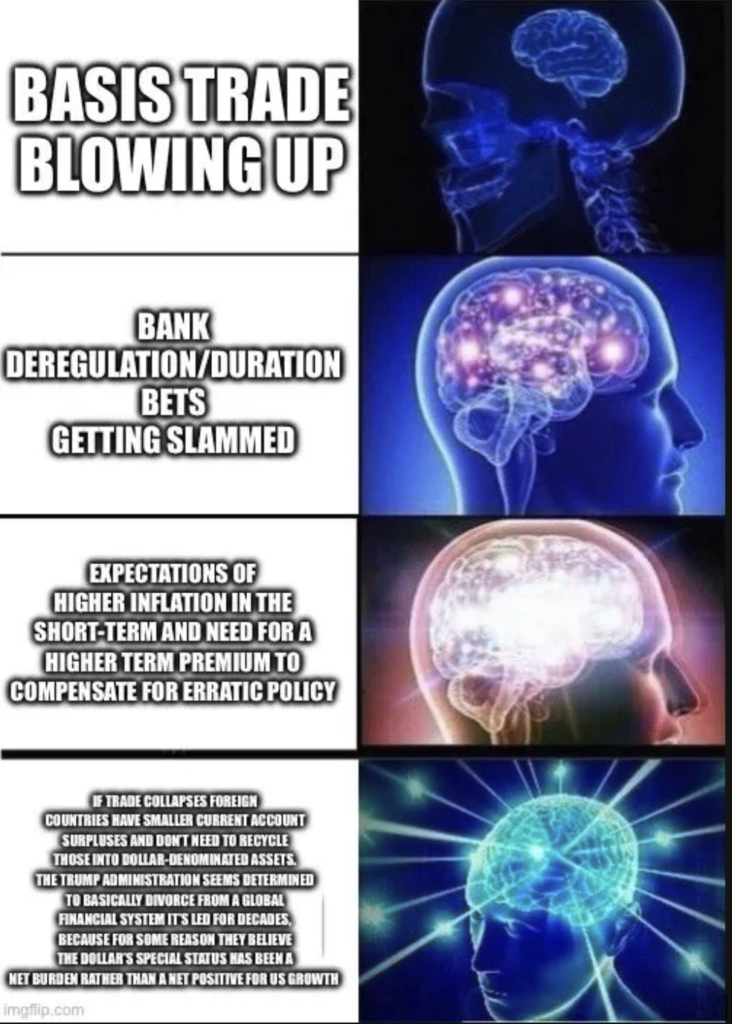
So what’s really going on? As we’ve maintained for a while, the current admin no longer considers the dollar’s reserve status an exorbitant privilege. On the contrary, it sees U.S. fiscal deficits as largely being driven by the demands of lower credit-quality countries that need access to high-quality collateral for trading purposes. Due to how offshore eurodollar markets amplify that demand, U.S. taxpayers inadvertently end up underwriting the risk embedded within such countries’ trade and lending practices, albeit without any say over their lending standards or protocols.
Burden sharing of public goods: Economist Steve Miran, now the chair of the Council of Economic Advisers, spoke at the Hudson Institute went viral last week, laying out that America’s twin deficits are global public goods provided to the world at a cost to American taxpayers that Washington is no longer prepared to fund unilaterally. “There needs to be improved burden-sharing at the global level,” Miran said. “If other nations want to benefit from the U.S. geopolitical and financial umbrella, then they need to pull their weight and pay their fair share. The costs cannot be solely borne by everyday Americans who have already given so much.”
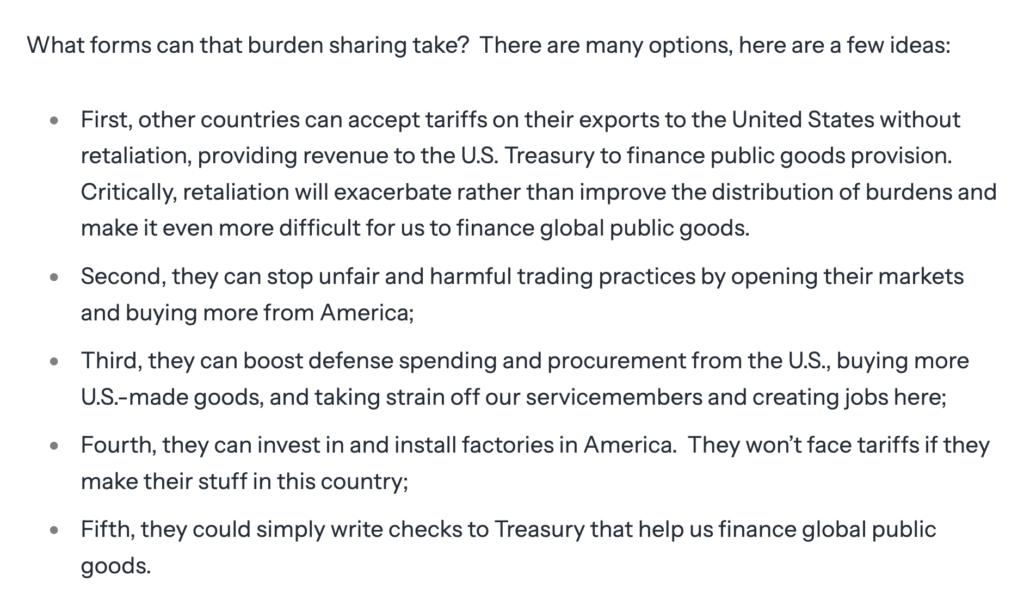 Exorbitant privilege as a service: The idea of writing checks to Treasury to help finance global public goods won’t come as a surprise to Blind Spot readers. We’ve dubbed it a push to turn an exorbitant privilege into “exorbitant privilege as a service”. Ultimately, Miran and co. believe that all highly developed nations have a responsibility to underwrite the global “float” of safe assets. This is the implicit collateral that lubricates trade and commerce across borders, and which operates like a swing balance in the system. At present, this float is overwhelmingly composed of dollar-denominated assets, principally U.S. Treasuries, which serve as the foundation for counterparty confidence. This is due to the belief the U.S. dollar will not be debased, confiscated, undermined, or defaulted upon by its issuer.
The stance of the administration is that all countries that make use of such public goods must commit to the rules of international commerce, walking the walk when it comes to contract law — not just talking the talk.
At a minimum, countries benefiting from this system have a duty not to exploit it for unilateral gain.
And this, precisely, is where China falls short. The litany of grievances from the West’s side is long: persistent currency manipulation, aggressive market intervention, financial repression via a state-directed banking system, and — perhaps most egregiously — the strategic use of industrial tariffs to distort trade and weaken counterparties.But it’s not just the China hawks who feel this way. China expert Michael Pettis has long argued something similar, albeit favoring capital controls over tariffs to achieve the rebalancing effect. In an op-ed for the FT last Friday, he doubled down on the view. “Industrial policies aimed at restructuring more highly controlled domestic economies also in effect restructure the economies of their more open trade partners,” he wrote, adding…
“The challenge is not whether the US should act to correct these imbalances, but rather how it should do so in a way that is both effective and sustainable. The best solution lies in a more co-ordinated approach to global economic governance, perhaps in the formation of a new customs union along the lines proposed by Keynes in 1944. To join, countries must recognise the external consequences of their policies and must take steps to keep domestic demand and domestic supply in overall balance.
However, if the world is unable to come to such an agreement, the US is justified in acting unilaterally to reverse its role in accommodating policy distortions abroad, as it is doing now. The most effective way is likely to be by imposing controls on the US capital account that limit the ability of surplus countries to balance their surpluses by acquiring US assets.”
“The dominance of the dollar in global trade and finance has long been assumed to be a net benefit for the American economy, but this assumption is increasingly being challenged. While it benefits Wall Street and global owners of moveable capital, these benefits come at a cost to American manufacturers and farmers.”
Hence, all paths lead to a Mar-a-Lago Accord being bashed out in June.
Mutual assured economic destruction: During these discussions, the U.S. will plead its case, arguing that for decades it has provided a suite of global public goods: the dollar as reserve currency, U.S. Treasuries as the ultimate safe asset, the Navy as guarantor of shipping lanes, and a deep, liquid capital market open to all. But also that these very offerings have produced a classic tragedy of the commons — a system where beneficiaries, acting in their own short-term interests, have undermined the sustainability of the order itself, threatening mutual assured economic destruction for all.
To back his point, McCauley pointed to the plateauing of global FX reserves (hovering around $12 trillion), the diversification of reserve portfolios into gold, and the waning role of official dollar flows in financing U.S. deficits. His conclusion: it’s no longer credible to blame U.S. external imbalances on foreign dollar buying. The Triffin dynamic is over.
Or, as he summed it up: “for 10 years it has not been possible to blame US external deficits on dollar buying by foreign officials: official flows have played only a bit part in financing the US current account.”
But what if this diagnosis, though directionally true on the surface, misses a deeper transformation in how dollar demand is being expressed — and more crucially, obscured?
A NEW EURODOLLAR CRISIS IN THE MAKING: We all know QE was far from the perfect solution to the global chaos that unfolded in 2008. But one of its key benefits — at least from a Western point of view — was the role it played in initiating reciprocal currency devaluation against China and in collapsing the yield on safe dollar assets. For countries like China, whose economic model was built around large-scale Treasury accumulation, this was a structural shock. The West, in trying to stimulate itself out of crisis, inadvertently triggered a global search for alternative ways to extract dollar rents — especially in systems that refused to liberalize their capital accounts.
And yet, instead of allowing those surpluses to flow back into the U.S. or fund domestic consumption, China engineered new offshore conduits for dollar deployment: mostly made up of over-invoicing schemes, commodity-backed trade financing, and most significantly, dollar-denominated loans to developing nations via the Belt and Road Initiative (BRI).
Brad Parks of AidData — also the author of Banking on China — laid out just how expansive this lending model has become in a revealing interview with former deputy CIA director Michael Morell in 2023 (hat tip MP). At the time, the scheme made up over $850 billion in overseas loans, covering 165 countries, with more than 90 percent structured as debt, not grants. The majority of these loans were denominated in dollars, not renminbi.
Many of these loans, Parks adds, carry high interest rates specifically because Chinese banks were tasked with achieving benchmark returns comparable to what they once received from U.S. government debt.
In that sense, BRI activity has come to represent an attempt to recreate the returns of the old Treasury model — but via riskier, off-balance-sheet, politically strategic infrastructure loans that doubled as foreign policy tools.
This is very different from the U.S. trend, where the vast majority of U.S. government transfers to developing countries come in the shape of grants, rather than institutional loans. Parks says in both U.S. and Chinese cases, grants are often extended to curry favor with local political elites to secure geopolitical allegiance in the UN (e.g., denying diplomatic recognition to Taiwan). In China, this often sees grants directed to projects of questionable economic value — parliamentary buildings, convention centers, and prestige infrastructure.
A synthetic rent model: But, as Parks also explains, whether it’s loans or grants, there’s another layer of sophistication to Chinese BRI flows relative to U.S. ones. Most involve the inflation of project costs, the diversion of superprofits (i.e. the proceeds from marked-up pricing) to Chinese contractors, and the parking of dollar revenues derived from BRI commodity sales in offshore escrow accounts that serve as collateral for Chinese banks and financial institutions.
What has emerged, therefore, is a synthetic system of rent extraction. Instead of dollar returns from Treasuries, Beijing now engineers such rents through bilateral deals, commercial deception, and contractual ingenuity. Crucially, these arrangements do not show up as FX reserve accumulation in official reserves.
That’s why McCauley’s reserve data misses the point. The demand for dollars potentially never went away. It may simply have been rerouted into informal circuits that now generate structural risk — especially for the BRI client states forced to become dollar earners to meet their debt service obligations.
Many of these countries are now trapped: the only way they can repay their Chinese dollar loans is by flooding Western markets with underpriced exports, often enabled by tariff regimes that skew trade in China’s favor. The result is eerily reminiscent of the old dollar disorder — only this time, the U.S. isn’t directly supplying the dollars. It’s indirectly absorbing the consequences of a private, opaque lending system that masquerades as development finance.
An invisible drain: If the above analysis stands up to scrutiny, it suggests China’s response to the collapse in Treasury yields was not to accept the limitations of a closed capital account but rather to invent new ways of simulating capital account openness without actually liberalizing. This was done primarily by creating external dollar dependencies in vulnerable states.
At the same time, Chinese corporations began accumulating dollar-denominated debt — both to finance imports and to exploit lucrative carry trade opportunities, often through over-invoicing schemes. While Beijing made efforts to unwind these exposures starting around 2013, the initiatives largely failed to contain the growing reliance on dollar liabilities within the system.
The result is a deeply dollar-leveraged financial and corporate sector, which significantly constrains China’s ability to devalue the renminbi as a tool to boost exports. Any meaningful depreciation would risk destabilizing balance sheets across the system, triggering financial stress and potential contagion. In practice, this creates a structural bias in the opposite direction: rather than seeking to weaken the yuan, the Chinese government is under constant pressure to support its value against the dollar — not for geopolitical optics, but to avoid setting off a chain reaction of defaults. Doing so in the context of a closed capital account, however, forces China to draw down on its remaining USD-denominated foreign exchange reserves, or increasingly raise dollar financing abroad.
And so we return to the central paradox: if the dollar is “trash” (as the official Chinese narrative likes to suggest), why is the system still so addicted to it? Why are state-owned banks, BRI intermediaries, and even Chinese borrowers still competing for dollar exposure, while Beijing itself issues dollar-denominated bonds in Paris and Riyadh? Why does Beijing force BRI debtor nations to hold dollar escrow as security against their loans in Chinese-controlled bank accounts that can be seized at any second? Why does it force commodity-producing BRI countries to redirect the dollar proceeds of commodity sales toward debt repayment?
McCauley is right that FX reserves have flatlined. But that doesn’t mean dollar exposure has. On the contrary, it may have metastasized into areas most analysis fails to reach: off-balance sheet by way of loan contracts, offshore structures, and state-controlled banking conduits.
But how does that feed into widening U.S. twin deficits? Since these dollar exposures stem from private and offshore dollar liabilities, they do not require foreign central banks to hold Treasuries on their balance sheets.
And yet, due to post-GFC regulatory reforms — particularly Basel III and the U.S. Liquidity Coverage Ratio (LCR) rules — U.S. correspondent banks are still required to hold increasing amounts of high-quality liquid assets (HQLA) to support these growing exposures.
This regulatory requirement reflexively pulls in more Treasuries — but now from domestic financial institutions rather than foreign reserve managers. As a result, while the fiscal deficit appears to be “domestically” financed, the underlying driver remains the offshore dollar system. It is the regulatory plumbing, in other words, which forces U.S. institutions to backstop the global dollar credit architecture engineered by China that continues to depend on dollar liquidity.
At the same time, the U.S. is forced to respond to the distortions created by this global dollar drain through fiscal compensations — particularly via foreign aid and expanded social spending. Part of this is structural: unlike China, the U.S. supports its population through broad welfare programs, which require constant funding. But it’s also geopolitical. Washington, constrained by legal and political limits, cannot compete with Beijing’s ability to offer concessional, strategically targeted loans to high-risk emerging markets. Lacking that financial agility, the U.S. must rely on grants and non-repayable transfers to maintain influence in dollar-poor regions.
This isn’t just a drain on U.S. financial sovereignty. It’s a structural feedback loop that makes the case for fiscal expansion more persistent, more political, and increasingly unsustainable.
THE GOLDEN FACTOR: Gold traded at fresh highs this week, signaling one of two things:
1) The dollar really is trash and big foreign buyers are switching to gold because that’s the next best thing to support global trade (not RMB or the euro)
or…
2) Countries frozen out of the dollar system, like Russia, prefer to be paid for commodities they sell to China in gold rather than be exposed to RMB risk. As a result, much of that Russian gold is now being directed to Hong Kong to underpin Russian commercial activity within the Sino-system.
How broad and organized is the national team? According to the FT, the idea of a national team of powerful institutions deployed to support the stock market when necessary came into prominence after the stock market crash of 2015-2016 (just after the sudden devaluation of the RMB).
It’s hard not to read “stabilization” as a deliberate echo of the U.S. Exchange Stabilization Fund (ESF), one of the most opaque instruments in the American financial arsenal. The ESF is often used to conduct discreet market interventions — typically to support the dollar, manage liquidity, or pursue other undisclosed objectives tied to national security or financial diplomacy.
Beijing’s invocation of a similar framing may serve multiple purposes. On the surface, it signals confidence and coordination in the face of market turmoil. But beneath that, it may also be a quiet acknowledgment — or even a subtle taunt — that China knows the U.S. has long deployed its own “national team,” albeit through less formal channels. After all, it’s not like there hasn’t been speculation that the U.S. Treasury maintains informal arrangements with major financial players like Pimco, BlackRock, or even systemically important hedge funds, using soft power and alignment of interests to ensure Treasury auctions go smoothly or to provide backstop liquidity during periods of stress.How far this shadow-market coordination extends — and how many domestic players have been enlisted in America’s own financial war games — is impossible to know. But the parallels are hard to ignore. When we visited HFT powerhouse Jane Street in New York nearly a decade ago, we couldn’t help but notice the office walls plastered with WWII-era propaganda posters. There was a dedicated room for traders to perfect their games of Poker and Texas Hold’em, and one of the firm’s founders even proudly displayed an original Enigma machine in his office.
In hindsight, the wartime aesthetic was probably indicative of something, not just for Jane Street, but for an entire class of dual-use financial institutions that potentially blur the line between market actor and state proxy. China may be more overt in its coordination, but — given the fortunes at stake — how likely is it that the U.S. is just lying back and doing nothing?
This is all the more the case in a world where the “bad guys” already have no qualms about using hackers, spies, and intelligence advantage to seed secretive hedge funds with a knack for delivering consistent profits.
Why does it matter? The core issue with many Chinese listings, particularly those on U.S. exchanges, is that they’ve often been structured through a legal workaround known as a Variable Interest Entity. This structure creates a number of problems, both legal and financial. The arrangement was developed because Chinese law restricts or outright prohibits foreign ownership in key strategic sectors such as technology, education, and media.
What’s the risk? Because the offshore entity does not own the underlying Chinese company, shareholders have no direct claim to its assets and only limited legal rights. Chinese courts are not bound to recognize or enforce the VIE contracts, particularly if doing so would conflict with domestic law or national interests. In essence, investors are relying on a legal fiction that works only as long as both the Chinese government and the companies involved agree to maintain the illusion. In recent years, this structure has come under growing scrutiny from both Chinese and U.S. regulators.
A better question might be: why did regulators allow these things to be listed in the first place?
| CBANKING |
BREAKING THE PBOC? Could Scott Bessent really be trying to break the People’s Bank of China by forcing Beijing into a reckoning over its unsustainable dollar debts and relative lack of hard currency to defend the RMB? Given Bessent’s background helping to break the Bank of England, the notion that he’s been brought in for a similarly strategic operation — one that could simultaneously lay the groundwork for a new Bretton Woods-style overhaul of the global “nonsystem”— is undeniably compelling.
In retrospect, it seems obvious this would be the case.
But if that is the game plan, it’s worth taking a closer look at the tools Bessent might have at his disposal — and how Beijing could be expected to defend itself.
The obvious line of attack is to force Beijing into a reckoning over its impossible trilemma: that involves pushing it to decide whether it should maintain a stable renminbi to allow domestic entities to service their extended dollar liabilities, or devalue with potentially disastrous economic and credit consequences. Neither option is good. Propping up the currency would require draining potentially limited reserves, while devaluation could jeopardize the country’s credit rating if not risking a default by a major state-owned enterprise or bank.
There are other moving parts to consider, too. Fears are growing, for example, that the U.S. has become an untrustworthy ally and that the Fed might even withhold swap lines from its allies at a crunch if it perceives them as forwarding the liquidity to China. It’s worth turning to McCauley again, this time in the FT, to figure out how foreign central banks might break ranks with the Fed in that case.
Funding coalition: To mitigate a destabilizing dollar shortage, McCauley speculates central bankers could form a dollar “coalition of the willing” to get the dollars where they need to go.
The easiest way to do this would be to use their U.S. assets, of which they have a collective $1.9 trillion worth, as collateral in the FIMA repo pool, which — unlike swap lines — is open to a very large pool of foreign central bank players.
But while the coalition could enlist the Bank for International Settlements for technical support as an agent or to act as an intermediary, the exercise wouldn’t be foolproof. McCauley worries that the Fed could still prevent FIMA from being used to provide much-needed same-day (aka intraday) funding, even in a scenario where US bond yields are spiking (as we saw this week).
Conditionality will be key: Our understanding is that the preference within the U.S. policy establishment is to offer term swap lines selectively — to allies only, and strictly on the condition that the resulting liquidity is not redistributed to non-allies, most notably China, and on the condition that tariff concessions are made. This policy posture, we think, is likely to remain in place as long as Beijing refuses to engage in coordinated negotiations. Bank bailouts, meanwhile, appear to be off the table. There is talk, however, that the terms of the FIMA repo facility could be recalibrated to accept bonds at par value, adding further nuance to the evolving framework.
Crucially, it’s under crisis conditions that long theorized “century bonds” are most likely to come into play. These non-marketable instruments — first proposed by former Credit Suisse analyst Zoltan Poszar and later expanded upon in a seminal November 2024 paper by Steve Miran — could become more attractive to global reserve managers if paired with guaranteed access to dollar swap lines. As Miran wrote, “The desire to maintain access to such swap lines will be a powerful long-term incentive for remaining inside the U.S. security and economic umbrella.”
Miran also argues that century bonds, particularly if issued as zero-coupon instruments, offer a far more sustainable way to finance the public goods underpinning global security than conventional short-term Treasury bills.
How do you persuade counterparties to convert short-term debt into ultra-long-dated century bonds? Easy. You make access to dollar swap lines contingent on such a debt exchange within bilateral agreements. In practice, the figure to be swapped would be no more or less than needed to maintain “the lowest comfortable level of international reserves” — aka the international float. This approach ensures that the burden of funding excess dollar reserves falls on those with the greatest need for dollar liquidity, albeit without any compensatory interest. Crucially, the structure preserves the integrity of the U.S. yield curve by allowing shorter-duration Treasuries to remain subject to normal market pricing dynamics.
The Roosa precedent: This type of conditionality is not unprecedented. Roosa bonds were short-term, dollar-denominated debt instruments issued by the U.S. Treasury in the early 1960s and sold to foreign central banks and governments, primarily in Western Europe. Initiated under a program led by Robert Roosa, then U.S. Under Secretary of the Treasury for Monetary Affairs, the bonds were introduced around 1962 as a tool to address the United States’ growing balance of payments deficit and to protect the dollar’s convertibility into gold under the Bretton Woods system. The purpose was to provide foreign official holders of surplus dollars with an alternative to redeeming those dollars for U.S. gold. By purchasing Roosa bonds, these governments effectively lent their dollar reserves back to the U.S. for a fixed term, earning modest interest while agreeing not to convert those funds into gold.
The arrangement included implicit conditions: the bond proceeds had to remain in the U.S. or be spent on U.S. goods and services, and the participating governments were expected to avoid actions that would pressure U.S. gold reserves. The program was a form of bilateral monetary diplomacy that helped recycle dollar surpluses, maintain international confidence in the dollar, and buy time for the U.S. to address its external imbalances without triggering a crisis in the Bretton Woods system.
Would China go for it? It all depends on the conditionality and how much they otherwise stand to lose. Dispensing unlimited swaplines to allies, while withholding dollars to state-owned Chinese banks and enterprises, could in theory trigger a Chinese default.
Whether that outcome would compel Beijing to come to the Mar-a-Lago negotiating table, prompt it to form a rival bloc with other excluded states, or escalate into open conflict remains an open question.
From Washington’s perspective, however, the strategic calculus is clear: the moral high ground would be firmly on the U.S. side. Any resulting default would be framed as self-inflicted — brought on by China’s refusal to engage, not by American action. This positioning becomes even more significant in light of Vice President J.D. Vance’s proposed legislation to designate China as being in “selective default” for failing to honor historic Republic of China debt, now estimated at around $1 trillion.
As we’ve previously argued, the underlying logic is hard to dismiss. Should China choose to liberalize—opening its capital account and eliminating tariffs—the U.S. could offer a path forward: a debt swap converting China’s remaining short-dated U.S. assets into century bonds. Symbolically, it’s a tidy resolution. After all, it would have taken nearly a century for the CCP to acknowledge the legitimacy of its predecessor’s obligations. If those debts are finally honored, the economy liberalized, and democratic reforms introduced, the U.S. could, in turn, support a peaceful reunification with Taiwan—on the basis that the mainland would no longer pose a threat to Taiwan’s democratic way of life.
Okay but what about the basis trade exposure? It’s not just aggressive hedge funds running these positions. One of the largest participants, we hear from market sources, may be AustralianSuper — Australia’s biggest pension fund, which, as it happens, was targeted in a mysterious cyberattack just recently. With A$244 billion (£128 billion) under management on behalf of 2.5 million members, the fund represents a key pillar of the country’s retirement system and, by extension, is a strategic financial actor whose stability would likely require government-level engagement in the event of serious stress.
A recent interview with AustralianSuper’s chief investment officer, Mark Delaney, provides a strong hint about its investment preferences. He told the Financial Times last week that “the U.S. has a lot going for it — strong economic performance (though it’s given a bit back), strong productivity growth, strong profit growth, and, by any measure, many of the best companies in the world,” he said. “All that makes it an attractive place to store capital.”
SPEAKING OF SWAP LINES: Much has been made of Argentina renewing its $5 billion activated swap line with China just days before U.S. Treasury Secretary Scott Bessent’s visit to the country. While President Javier Milei took a hard line against Chinese financial entanglements during his campaign, his stance has notably softened since taking office. But does the renewal signal a loss of faith in the U.S.? We’d argue otherwise.
Given that the bulk of Argentina’s external debt is denominated in dollars, access to RMB swap lines arguably hands valuation influence — and monetary flexibility — over to a country friendly to Washington. In June 2023, for example, Argentina used $1 billion in renminbi from the swap facility, alongside $1.7 billion in IMF Special Drawing Rights, to meet a payment to the IMF. The implication: RMB liquidity can be readily converted into other currencies when needed, creating FX impact but not necessarily reflecting a strategic pivot toward China.
Meanwhile, Milei has already signaled a willingness to align more closely with the U.S.-led economic order. Argentina is reportedly prepared to eliminate tariffs on 50 export products — an offer now being echoed by the broader Mercosur bloc.
Look mum, no controls! In a further sign of growing U.S. closeness, Argentina announced on Saturday it had sealed a $20 billion, 48-month Extended Fund Facility deal with the International Monetary Fund and, in a major policy move ahead of the deal, dismantled key parts of its years-long currency controls and loosened its grip on the peso.
| DEEP TECH |
FUSION ENERGY: China is catching up with the U.S. in the race to create the first grid-scale nuclear fusion energy source. According to CNBC, a huge state-funded Chinese project, CRAFT, is set to reach completion this year and appears to follow a U.S. plan published by hundreds of scientists in 2020.
| POLITICS |
EU AID WASTE: POLITICO reported this week that the European Union has been handing out billions of euros to nongovernmental organizations each year without properly monitoring how the money is spent — or whether it’s even going to genuine NGOs. According to a damning report from the European Court of Auditors which is likely to intensify a fierce political fight over how nonprofits use EU grant money. Using words like “opaque” and “hazy,” the report found the EU’s entire process for funding NGOs lacked transparency and called for reform in the way grants are provided, monitored and disclosed.
European DOGE necessary? “The picture of EU funding for NGOs remains hazy, as information on EU funding — including lobbying — is neither reliable nor transparent,” said Laima Andrikienė, the ECA member in charge of the report, who is also a former lawmaker with the center-right European People’s Party (EPP). The criticism will give ammunition to conservative lawmakers in the European Parliament who want to overhaul the way EU money is dolled out to NGOs, claiming it lacks transparency and is often used to lobby EU institutions — criticisms echoed in the report.
Hanging over the report is the question of lobbying. Are NGOs using public money to influence EU policymaking? And if they are, is it being done in line with EU values? On these questions, the ECA found the European Commission lacked curiosity and transparency. The Commission “did not clearly disclose the information it held on NGO advocacy activities that were financed by EU grants,” the ECA said.
RHEINMETALL’S AMAZING RAMP UP: We hear from our colleagues at Welt that German artillery maker Rheinmetall has ramped up its production from 70 thousand 155 mm per year to 2 million rounds with three years. A visit to its production site also revealed that many of the old ammunition bunkers from the First World War and other 1940s facilities had never really been fully shuttered. The Economist also has more on the story.
| CRYPTO |
BTC-E KINGPIN EXCHANGE: A high-profile prisoner swap took place between the U.S. and Russia took place this week, involving American ballerina Ksenia Karelina — detained on treason charges for donating to Ukraine—and Russian national Arthur Petrov, accused of stealing sensitive U.S. technology. But this wasn’t the first exchange under the Trump administration.
Back in February, a quieter but arguably more geopolitically significant swap occurred: Alexander Vinnik, the operator of the notorious cryptocurrency exchange BTC-e, was traded for American schoolteacher Mark Fogel. Vinnik’s extradition had been the subject of years of international legal wrangling, making his return to Russia a notable win for Moscow — and raising questions about the broader crypto-geopolitical chessboard now unfolding.
LIZ TRUSS DOES BEDFORD: The great and the good of crypto descended on Bedford, England, this weekend at the invitation of local crypto evangelist and podcaster Peter McCormack. Among the more unexpected attendees was former U.K. Prime Minister Liz Truss, whose name has resurfaced in recent days amid comparisons between Trump’s tariff revival and her ill-fated mini-budget.
According to sources in the crowd, Truss used the occasion to argue that entrenched systems resist disruption—hence the market backlash to Trump’s policy shift. She framed Bitcoin as a tool for wresting power from government, claiming that bureaucracies recognize it as an existential threat, which is why they’re so keen on pushing CBDCs. She reportedly went further, advocating for a “British DOGE” and drawing comparisons between the U.K.’s bureaucratic culture and that of the Soviet Union.
Truss is also said to be in the early stages of launching a free-speech platform.
| WHAT We’re PROCESSING |
— HSBC explores private credit push, sources say (Reuters)
— Top Chinese general removed in Xi Jinping’s latest purge. He Weidong was number-two officer in People’s Liberation Army and member of Communist party politburo. (Financial Times)
— India’s Minister of External Affairs, S Jaishankar slammed China’s economic attacks on India, including unfair dumping.
— The BoE delayed long-dated gilt auction due to market turmoil (Reuters)
— Why the investing rules have changed.
— The Greenland documentary causing a storm in Denmark.