| SNEAK PEEK |
— The risky attempt to transition from an era where America provided the world with liquidity for free to one where access to the dollar is a premium service.
— U.S. Treasury Secretary Bessent provides some more clues about how a U.S. sovereign wealth fund might work.
— Ask not what the EU can do for markets, but what markets can do for the EU.
Greetings from Hay-on-Wye in Wales,
I am in the lovely Welsh countryside attending Russel Napier’s “Weekend of Mistakes” festival, with a wonderful array of guest speakers lined up to talk about money, finance and markets — and what we can learn from history about them.
I had the opportunity to sit next to a personal hero at dinner tonight, Oliver Bullough, author of Money Land. There aren’t many people in the world you can instantly bond with over your mutual eurodollar fascination or Belgian dentist jokes.
The great news is Bullough is working on a new book that sounds just up my street. It’s about why, despite all the anti-money laundering efforts by governments, nothing ever changes. I’m told he will be looking very closely at the FATF (an organization we have focused on at length here at the Blind Spot). We also agreed that AML/KYC compliance is largely a waste of money.
That’s all for now,
Izzy
Send tips to [email protected] and [email protected].
| THE BIG BLIND SPOT THIS WEEK |
BITBOND REBASEMENT? It’s no secret the financial system is cracking under the weight of America’s twin deficits and the shifting landscape of digital finance. It’s also no secret that the Trump administration thinks Bitcoin might play a role in addressing these pressures. On that front, The Blind Spot hears the crew advising Trump on all matters crypto is now pitching the idea of fusing bitcoin with U.S. sovereign debt in a way that reshapes offshore dollar liquidity, and forces the world to pay for the privilege of dollar stability rather than freeloading off the American balance sheet.
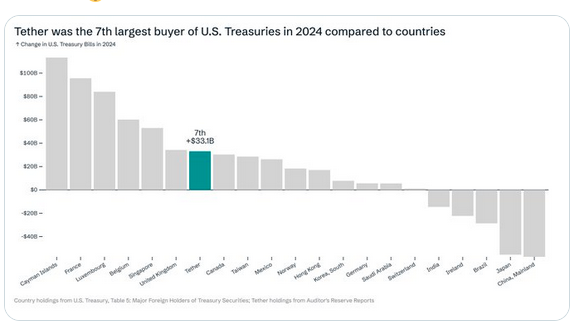
Quick segue: Tether boss Paolo Ardoino reminded the world this week that Tether is now the 7th largest buyer of U.S. Treasuries compared to countries.
The plan now quietly circulating introduces the novel idea of bitcoin-backed Treasury bonds, or “BitBonds”. The idea is that integrating bitcoin into the U.S. sovereign debt system would rebase the dollar while ensuring stable liquidity for global trade. At its core, it is a radical but pragmatic acknowledgment that the dollar system can no longer be subsidized for free.
By attaching bitcoin incentives to Treasury bonds, the hope is this would make them more attractive to investors and drive down borrowing costs while also creating a new sovereign reserve asset in bitcoin itself.
But it’s also worth connecting this idea to what Gillian Tett reported she was hearing last week: that the Trump admin might soon consider applying a tax to coupon payments on U.S. Treasury securities held by foreign players. If that was to happen those using offshore dollars would pay a price — not just in interest rates, but through a de facto tax-synthesized demurrage fee.
At its heart the strategy echoes the Carter Bonds of the 1970s, when the U.S. issued dollar-denominated debt indexed to foreign currencies to maintain global confidence in its financial system. Just as those bonds stabilized the dollar in a time of crisis, BitBonds could now serve as a hedge against devaluation by anchoring part of the Treasury market to Bitcoin’s appreciating supply. Investors seeking both security and upside exposure to Bitcoin’s price movement would flock to these bonds, in theory pushing yields lower than conventional Treasuries. In time, this would establish an international benchmark for bitcoin-denominated returns, just as U.S. Treasuries define the global risk-free rate today. Or so the bitcoin bros believe.
FROM DESTABILIZATION COINS (i.e. EURODOLLARS) TO STABLECOINS: But, arguably, the implications go far beyond sovereign debt. For years, the global economy has depended on offshore dollar liquidity — first via the eurodollar system, and more recently (as noted above) through Tether, the dominant offshore stablecoin. In many ways, Tether has become the de facto central bank of an unregulated, synthetic dollar network, facilitating trade and capital flows beyond U.S. oversight.
On one hand, Washington is now moving to rein this in, crafting stablecoin legislation that favors onshore issuance while imposing potential taxes on foreign-held U.S. Treasuries to redirect offshore liquidity back into a controlled system.
But, on the other hand, this does not necessarily spell the end for Tether. If it reshored itself under U.S. regulation, it could actually benefit from the shift, pivoting from a shadow banking entity to a legitimate player in global trade finance. Rather than simply issuing stablecoins for speculative trading, Tether and similar entities could take on a new role: providing liquidity for cross-border commerce, facilitating trade settlements, and even lending U.S. Treasuries as collateral in American capital markets on behalf of foreign customers.
The key change is that stability would now come at a price. Historically, the world has been able to hoard dollars for free, storing excess reserves in offshore accounts and stablecoins without any penalty. Under the new system, especially if the aforementioned tax is applied, a type of demurrage fee would be applied to offshore stablecoins, discouraging hoarding and encouraging active circulation beyond practical trade usage. Companies and institutions using offshore dollars would now have to weigh the cost of holding excess liquidity against the convenience of dollar stability. Those who genuinely need dollars for trade and commerce would continue to use them — but would be incentivized to keep only what is necessary. This prevents abuse of the U.S. balance sheet while ensuring that global demand for dollars is met on American terms.
Exorbitant privilege as a service: By pricing the privilege of dollar stability, the U.S. would in this way reassert control over the very foundation of global finance. At the very least, it would ensure that even as digital assets grow, they do so within a structure where the U.S. government sets the rules rather than reacting to them. If it were to happen it would be a bold but necessary shift: the transition from an era where America provided the world with liquidity for free to one where access to the dollar is a premium service — one that generates revenue, reinforces financial stability, and secures America’s dominance in the future of money.
The crypto community, often fixated on internal battles, has largely missed the gravity of this shift. This is not about bitcoin vs. ethereum, or centralized vs. decentralized finance. It is about who controls the offshore dollar system in a world where digital capital flows are outpacing traditional monetary structures. If this plan succeeds, bitcoin will no longer be an isolated asset class, but a pillar of sovereign finance, stabilizing the dollar itself while forming the basis of a new global monetary order.
America, itself, meanwhile maintains influence over the world no longer because of perceived military might or the value of its GDP or assets, but because of its soft power. Aka the fact that U.S. Inc is a brand that can be trusted.
| BUSINESS, ECON AND FINANCE |
BESSENT ON TRUMP’S SWF: “Trump wants to create assets for the American people not just debt,” Treasury Secretary Scott Bessent said this week. In the same breath he ruled out any prospect of the administration funding it all with a revaluation of the US gold supply. “We are looking for the assets we can mobilize, like energy leases, and owning land in downturn urban areas or suburban areas, can we use that land?”
The administration is also exploring the integration of Fannie Mae and Freddie Mac into a sovereign wealth fund as part of a broader strategy to privatize these government-sponsored enterprises (GSEs). The hope is the SWF would be professionally managed — potentially by a public-private board — with a mandate to invest prudently in a diversified global portfolio, generate long-term returns for U.S. taxpayers and possibly support public infrastructure or strategic innovation.
All in all the objective of the fund is to provide the American system with a better return on investment than where the 10-year yield is currently trading, so that there is a de facto arbitrage created between what income the government can generate and what it owes on the debt.
Distortion control: As we’ve mentioned before, however, this is unlikely to resemble a conventional SWF model, where the asset side of the government balance sheet engages in active investment in everything from domestic equities to foreign debt in a way that influences and distorts markets to suit a government industrial policy agenda. The objective here is to use the proceeds to fund longstanding public works and infrastructure, technological research (of the DARPA variety), as well as stakes in a limited number of strategic assets that the country can’t afford to lose control of, especially to foreign buyers. There is also discussion about using the funds to revitalize domestic manufacturing sectors, aiming to enhance competitiveness and reduce reliance on foreign production. While this could be construed as interventionist and market distortive, proponents argue this is merely rebalancing the distortions created under previous administrations which created the manufacturing imbalances in the first place. Once rebalanced, there would be no need to maintain government support.
In that sense it emulates more what Rachel Reeves is trying to do with the National Wealth Fund.
SPEAKING OF COPYCAT POLICIES: As POLITICO’s Financial Services UK team reported this week, Chief Secretary to the Treasury Darren Jones has announced plans to “rewire the British state” through the modernization of the architecture of public spending across government. This includes transforming and upgrading the government’s central finance system to improve the timeliness and accuracy of data shared between departments and the Treasury. “I am convinced that through investment and reform, we can deliver a more productive and agile state that delivers better outcomes for people and reduces the cost of running public services,” Jones said.
Sounds, err, familiar, no? Under the plans, ministers will have access to live and real-time performance data at both a departmental and program level, which means they will be able to see in real-time what programs are over or under-spending, which projects are delivering and not, and how departments are performing against their budgets and objectives. However, the Treasury didn’t provide a timeline for when the reforms will happen. But, hey, since it’s not Elon Musk leading the efficiency drive, we’re sure it will go down a treat.
| REGULATION |
COMMISSION UNVEILS CAPITAL MARKETS PLAN: This was the week the European Commission published its capital markets battle plan, noting it will plow ahead with a controversial plan to move toward EU-wide supervision of capital markets — a years-old and politically deadlocked goal for the bloc.
As Politico’s Kathryn Carlson reported, in its new “savings and investments union” strategy, the EU executive says it will issue legislative plans in the fourth quarter of 2025 to “achieve more unified supervision of capital markets … including by transferring certain tasks to the EU level.”
The key objective is to create a U.S.-style investment culture to get Europe’s risk-averse savers to start investing the roughly €10 trillion they have languishing in their bank accounts in the stock market instead. Brussels believes this would give EU companies more cash, allowing them to spend on priority projects like defense, boosting Europe’s economy. The probelm is, Brussels has been trying to get this underway for more than a decade, with little success. In the meantime, Europe has been left with a system where money, fragmented by national barriers, sits idle in bank accounts, perennially undershooting its potential.
In stark contrast, deep and unified capital markets in the United States, coupled with a cultural instinct for risk-taking, make it far easier for companies there to raise funding. In the U.S. almost 60 percent of households own stocks, either directly or indirectly through their pensions. In France and Germany, that number is closer to 18 percent. Indeed, an amazing stat we learned this week, is that Europeans under 30 years old are more likely to be invested in crypto than conventional equities.
Part of the reason for Europe’s underwhelming take-up is the sheer complexity of its market system. Instead of a unified structure, Europe operates 27 separate financial markets, each with distinct regulations and infrastructure. The upshot is that just as it’s difficult to open a bank account in Madrid if you’re in Berlin, it’s also hard to invest in a company in Riga if you’re in Budapest. Both the financial plumbing and the rules on investing vary across countries.
But while governments say they’re committed to streamlining the system, too often they don’t act on it. For many, national interests get in the way at the last hurdle, while at other times efforts are derailed by market players whose profits depend more on fragmentation than harmonization.
EU Finance Commissioner Maria Luís Albuquerque recently criticized such actors, stating that excessive lobbying was hampering progress on key financial regulations, including rules concerning financial data and retail investment. “We must take a stronger approach to tackling such blockages,” she told a conference in Brussels on Tuesday.
The key to progress is developing single rules for businesses as well as the creation of a single supervisor to oversee them all.
Breaking the stalemate: A dual-pronged attempt to break the stalemate, however, is emerging.
In the first instance, the Commission will put forward its strategy on how to make investing more attractive for EU citizens. According to a leaked draft seen by POLITICO, it will push countries to promote the national uptake of savings and investment accounts, recommend favorable tax treatment, and promise future proposals to reduce national barriers in capital markets.
Spain, meanwhile, has rallied a “coalition of the willing” around a pilot project to test capital markets ideas like simple investment products that could be rolled out to citizens EU-wide. Finance ministers from six other countries — Germany, France, Italy, Luxembourg, the Netherlands and Poland — are backing the project, while the Nordic countries are said to be working on a similar effort.
The thinking is that if 27 countries can’t agree on a way forward, progress can still be made by the countries that will. But the project already has its critics. Paschal Donohoe, the Irish finance minister who chairs the Eurogroup format of eurozone finance ministers, told POLITICO he has “always recognized the right of countries to cooperate in smaller groups but as president of the Eurogroup, I prefer if we act together.”
Contradictions run deep: Despite the goodwill, there’s something deeply troubled in the Commission’s approach. For example, it believes that under its plans “households will have more and safer opportunities to invest in capital markets and increase their wealth. At the same time, businesses will have easier access to capital to innovate, grow and create good jobs in Europe.” There’s a contradiction there in terms of wanting to simultaneously encourage a more risk-on attitude among EU citizens while at the same time wanting to do so by delivering “safer opportunities” for investments.
| WHAT WE’RE PROCESSING |
— FT Film on Lars Windhorst and H20, scandal, spies and the superyacht.
— Ripple/Mt Gox’s Jed McCaleb is building a space station.