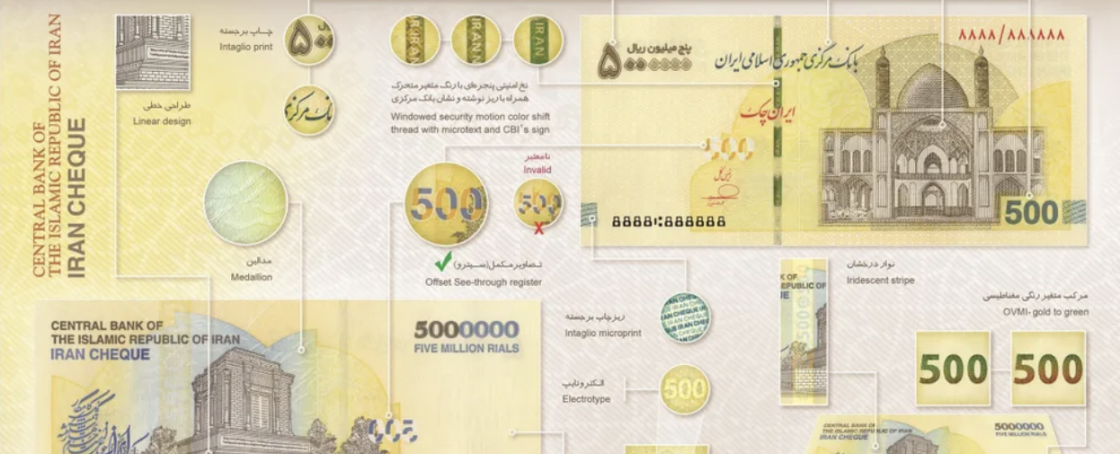
During testimony to lawmakers this week, Treasury Secretary Scott Bessent made a striking comment about the role a lack of access to dollar funding has played in triggering the past month’s disturbances in Iran.
Bessent stated that U.S. policy had deliberately created a dollar shortage inside the country and linked that shortage directly to the banking crisis that culminated in late 2025, when one of Iran’s largest private banks collapsed and depositors began to panic. He described the episode as the “swift culmination” of financial pressure that had been building for months, adding that capital flight and emergency measures by Iranian authorities were further signs of systemic strain.
We, like many others, were late to this obvious causation. Looking back, the dollar-squeeze operation appears to have been active in plain sight, unfolding in stages that only fully connected once the banking crisis, currency collapse, and protests converged.
It is worth looking back at how this unfolded, not least because it is very possible a similar strategy could be used elsewhere, including against larger and more resilient financial systems.
The origins of the squeeze go back several years, but a decisive early turning point came in July 2023, when U.S. authorities tightened enforcement against Iraqi banks that had been serving as one of Iran’s most important channels for obtaining dollars. For years, these banks had effectively acted as the lungs of Iran’s financial system, supplying liquidity to banks that were otherwise isolated from the global dollar network. When those channels were restricted, Iran’s financial sector lost a critical source of hard currency, increasing its dependence on shrinking reserves, informal exchange networks, and increasingly fragile domestic credit structures.
But pressure intensified in 2025 as Washington shifted from incremental sanctions to a strategy explicitly designed to produce rapid economic impact.
Bessent outlined his “Making Iran Broke Again” strategy in a speech to the Economic Club of New York in March, noting:
“Iran has developed a complex shadow network of financial facilitators and black-market oil shippers via a ghost fleet to sell oil, petrochemical and other commodities to finance its exports and generate hard currency.”
From then on, senior Treasury officials publicly emphasized a policy of enforcing sanctions with “immediate maximum impact,” aimed at sharply reducing oil revenues, choking access to foreign exchange, and accelerating financial stress rather than allowing gradual adjustment. This change in tempo mattered. Iran’s banking system was already burdened by large portfolios of non-performing loans and structurally weak balance sheets. Restricting dollar inflows did not merely slow growth; it began to threaten the solvency of institutions that depended on access to foreign currency to settle trade and stabilize their books.
The strain became most visible in October 2025 with the collapse of Ayandeh Bank, which failed under the weight of nearly $5 billion in losses tied largely to bad loans. The authorities moved quickly to dissolve the bank and transfer its liabilities to the state-run Bank Melli in an effort to prevent panic, but this decision effectively shifted private-sector losses onto the public balance sheet and exposed how limited the central bank’s room for maneuver had become. Reports at the time suggested that several other banks were in similarly weak condition, raising fears of a broader systemic crisis.
To prevent a chain reaction of failures, the government resorted to large-scale money creation to cover deficits and stabilize deposits. This response prevented an immediate collapse of the banking system but accelerated inflation and eroded household savings, particularly among the urban middle classes and merchant groups that held assets in local currency.
As confidence weakened, the exchange rate began to slide rapidly. By late December 2025, the rial had fallen to record lows against the dollar, and the loss of purchasing power became impossible to ignore.

The currency collapse triggered protests, notably among merchants in Tehran’s Grand Bazaar, a constituency historically associated with economic stability and often considered a pillar of regime support. Their participation underscored that the crisis was not confined to the margins of society but was affecting core commercial networks. What began as a financial problem had become a social and political one, driven by the visible destruction of savings and the rising cost of basic goods.
In tandem, as dollar pressure mounted and confidence in the banking system weakened, Iranians increasingly turned to cryptocurrencies as an alternative means of preserving savings and moving money across borders.
Transaction volumes rose sharply during 2025, with estimates suggesting activity reached many billions of dollars over the year, driven both by households seeking protection from inflation and by businesses and state-linked networks attempting to bypass sanctions restrictions.
Analysts observed that periods of currency volatility and protest were often accompanied by spikes in crypto trading, indicating that digital assets were functioning not only as a hedge against the collapsing rial but also as a channel for capital flight.
In June 2025, Nobitex, widely described as Iran’s largest cryptocurrency exchange, was hit by a major cyberattack in which roughly $90 million in cryptocurrency was stolen or destroyed.
The attack was claimed by a group known as Predatory Sparrow, widely suspected by analysts of links to Israeli interests, though not officially acknowledged.
Financial pressure did not ease after the bank and crypto collapse. In January 2026, the United States imposed additional sanctions targeting networks used by Iranian banks to move money internationally, including front companies and exchange houses that had formed part of a “shadow banking” system enabling trade despite earlier restrictions.
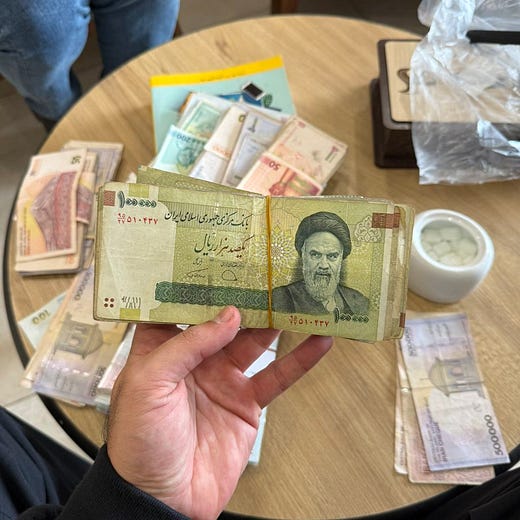
At roughly the same time, reports indicated that Iran’s currency had lost about half its value in six months, forcing authorities to issue higher-denomination banknotes and prompting both ordinary citizens and state-linked actors to increase their use of cryptocurrencies in an attempt to bypass the banking system altogether.

Bessent’s remarks were striking not because they revealed a new policy, but because they confirmed openly that this chain of causation was understood in Washington and, to some extent, intended.
Speaking to lawmakers this week, Bessent was blunt. “We have seen the Iranian leadership wiring money out of the country like crazy,” Bessent told senators.
“The rats are leaving the ship, and that is a good sign that they know the end may be near.”
Seen in retrospect, the events of the past year illustrate how financial pressure applied at the level of currency flows and banking liquidity can transmit through an economy in stages, first appearing as technical financial stress, then as institutional failure, and finally as social unrest.
Whether this model is repeatable in larger or more globally integrated economies is now the question, but the Iranian case provides a clear recent example of how constraining access to dollars can, over time, destabilize not only markets but political conditions as well.
Looking to China
The key question now is whether Bessent is pursuing a similar, albeit more veiled, strategy against China?
If so, the thing to remember is that in China, the fundamentals are different. Exerting pressure on Beijing requires the dollar to depreciate significantly against the RMB rather than appreciate against it. If we keep that in mind, recent developments suggest something may indeed be in play, probably with a view to forcing Beijing to liberalize its system.
For example, the week when markets were seriously entertaining the possibility of Rick Rieder becoming Fed chair — known to be a dollar dover — coincided with three things happening at once: a weaker dollar, a surge in gold and precious-metal activity, and unusually intense speculative trading in China.
That combination is suggestive, even if not definitive, proof of stress in Chinese dollar funding.
This is difficult for many to compute due to the substantial dollar reserves the country holds.
The key thing to remember, however, is that the central constraint on China’s financial strategy is that it cannot easily reduce its dependence on dollar assets simply by selling them.
Large-scale sales of U.S. Treasuries would push the renminbi upward, both through direct foreign-exchange flows and through market expectations. This is problematic because China’s trade and financial system still requires large quantities of U.S. dollars for invoicing, shipping, and debt service. A stronger currency, however, would erode the price competitiveness of Chinese exports, which remain a critical source of employment and growth.
Thus, if you thought Iran was hooked on the dollar, China’s situation is about a million times worse. Beijing is largely stuck between a rock and a hard place.
Rapidly shrinking its stock of dollar reserves is dangerous because it tightens external financing conditions rather than easing them. This creates a structural dilemma: China is both deeply embedded in the dollar system and cannot disengage from it abruptly without destabilizing its exchange rate and export sector, and thus its entire political model.
Because of that constraint, Beijing has spent years looking for ways to diversify external financing channels without triggering disruptive currency movements or openly dismantling capital controls.
One theoretical path often discussed in policy and market circles is the creation of alternative settlement instruments — digital currencies, commodity-linked units, or tokenized trade finance — that could operate alongside the dollar system rather than replacing it outright.
On that front, things seem to be coming to a head on this front.
As Bessent told lawmakers this week:
“We don’t know that for sure. There are lots of rumors that China may be developing digital assets backed by something other than the RMB, perhaps gold-based. We haven’t seen that.”
The idea that China is looking to issue an RMB gold-backed stablecoin is certainly consistent with the country’s steady accumulation of gold and its interest in cross-border digital payment infrastructure. A structure of that kind could, in theory, provide an external funding or settlement vehicle that is not directly dependent on dollar clearing, while avoiding the political and financial shock of fully liberalizing the capital account.
But it’s not necessarily as easy as that because China’s main constraint isn’t technological but rather structural.
Reserve-currency issuers historically run external deficits, supplying safe assets to global markets and absorbing foreign savings.
China’s economic model, built around export surpluses and high domestic savings, produces the opposite balance-of-payments configuration.
Countries that run persistent current-account surpluses do not easily achieve what economists call “exorbitant privilege” — and via that the ability to finance themselves cheaply by issuing liabilities that the rest of the world eagerly holds as reserves.
That makes large-scale “yuanization” of global finance difficult, because there are not enough freely circulating, trusted RMB assets abroad to satisfy global demand, and because China has been reluctant to open its financial markets fully enough to create them because that would involve the CCP losing control.
For that reason, the search for alternatives often focuses on mechanisms that could act as a soft bypass around capital controls rather than a full replacement for them. In other words, what Bejing really wants is the ability to “lose control” of the financial system, without having to admit domestically that it has done so. Admitting explicitly that it has lost control is too politically compromising.
In theory, digital instruments, commodity-linked settlement units, or offshore platforms could allow cross-border financing to expand incrementally without formally dismantling the existing system.
One way to achieve that is via a system that “prefunds” the capital that underpins the issuance of a new type of RMB currency. Of course, since China’s USTs are locked down, they can’t easily be assigned to that goal. China would need to raise hard currency elsewhere to implement any such system. At the same time, if it’s not prepared to run a current account deficit, however, it can’t be in RMB.
So what are the alternatives?
One alternative is forging partnerships with foreign investors — including countries seeking to diversify away from dollar exposure — that are prepared to provide the asset backing or liquidity base for this new type of monetary instrument, whether through gold holdings or other reserve assets. From this perspective, the appeal of a gold-linked structure would be less about promoting the yuan itself and more about creating a neutral asset pool that can facilitate trade and financing outside the dollar sphere while allowing China to maintain domestic financial controls.
Yet such arrangements would come with their own trade-offs. A gold-backed or otherwise hard-asset-linked currency unit would impose discipline on monetary expansion, limiting the authorities’ ability to stabilize growth through credit creation or currency depreciation — tools that have been central to China’s development model and what some economists describe as its “soft budget constraint” system.
In that sense, even if such a mechanism reduced dependence on the dollar, it could constrain domestic policy flexibility in ways Beijing has historically tried to avoid.
A stablecoin solution?
A more logical route for China is to finance itself in euros rather than USD, via a euro stablecoin backed by common EU debt rather than national debt.
This fits with recent news broken by Reuters that ECB is going to weigh issuing euro stablecoins.
The logic of such a system would be less about replacing the dollar outright than about creating a parallel pool of liquidity that both sides have an incentive to support. Europe would supply the underlying safe assets by issuing common debt, while a jointly owned stablecoin vehicle — held and governed by both European and Chinese private interests — would transform that debt into a widely usable settlement instrument. The proceeds from the system, including the fees and income associated with issuing and managing the stablecoin, would be shared rather than captured by one side alone, allowing both European and Chinese authorities to tax and regulate the entities involved.
In that sense, the arrangement would resemble a jointly operated financial utility rather than a unilateral extension of monetary power.
For China, the appeal of such a structure would be clear. It would gain access to a deep and liquid external funding and settlement channel without having to liberalize its capital account or supply the world with large quantities of renminbi liabilities.
That would reduce its exposure to the dollar system and to scenarios in which it might be forced to liquidate reserves or allow its currency to float sharply in response to external shocks. Europe, for its part, would absorb some of China’s external surpluses in goods and capital while strengthening the international role of the euro, but without bearing the political cost of appearing to subsidize a rival power, since the financial rents generated by the system would accrue in part to European institutions and taxpayers.
Crucially, such an arrangement would not really amount to yuanization of the global system. The reserve asset in circulation would still be denominated in euros, and the balance-sheet constraint would remain in place: China would be using liquidity created elsewhere rather than issuing it itself.
Importantly, both sides would remain interdependent, and that interdependence — reinforced by joint ownership and shared revenues — would serve as the political glue holding the system together.
In short, the financial relationship would carry an implicit geopolitical dimension. If Europe were increasingly financing itself through instruments whose global demand depended in part on Chinese usage and trade flows, and if European growth remained tied to absorbing Chinese exports, the economic relationship would begin to resemble a form of soft security interdependence.
China would not provide a military “umbrella” in the traditional sense, but it would become a central pillar of Europe’s financial stability and trade balance, creating incentives on both sides to avoid confrontation and to coordinate in times of crisis.
Even so, the arrangement would not be without limits. Europe itself remains deeply embedded in the dollar-based financial architecture, and the credibility of any alternative system would depend on whether its underlying assets and governance structures were trusted in times of crisis.
However, even this is not foolproof, since Europe has its own dependence on the U.S. dollar, and this would have to be resolved before either system could be truly free of the dollar.
As one Fed insider told us last week, “if the Chinese can’t quit the dollar system, the Europeans sure as hell can’t.”