The analyst community remains divided between two competing perspectives on China. Indeed, these competing views are so contrasting that they’re almost two completely different versions of reality.
On one side are the China bulls, who see the persistence of China’s trade surplus as evidence that the Trump administration has failed to achieve the global rebalancing it sought to achieve. They frame this as a major win for China.
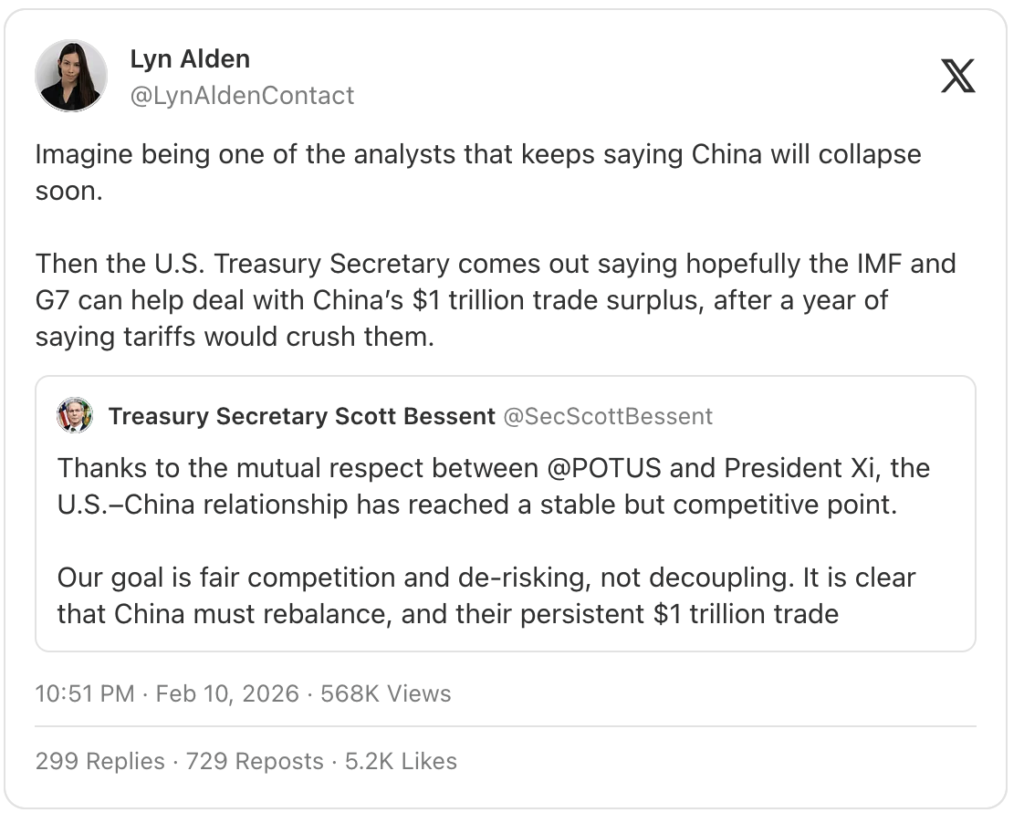
A good example of this thinking came yesterday when finance analyst Lyn Alden interpreted U.S. Treasury Scott Bessent’s comments about China needing to address its $1 trillion trade surplus as indicative of Chinese superiority over America.
On the other side are what I would call the China realists. I use the term realists rather than bears because there is no plausible scenario in which China’s economy collapses without dragging the rest of the world down with it. To be a China bear, in other words, is to be a bear on global growth. That is not an outcome anyone should welcome.
Realists, many of whom hold sway over the Trump administration, understand that China’s economic model currently sits at an incredibly precarious juncture and is very close to running aground in a way that destabilises the whole world. They also understand that the best outcome for everyone lies in helping China course-correct in a way that produces a mutually beneficial outcome for both China and its global trading partners.
This is why it’s important to highlight how and why Alden’s comment is misleading. Contrary to the impression conveyed, U.S. tariffs have significantly narrowed the U.S.- China trade deficit. There’s no doubt about that.
Since tariffs were announced in April 2025, U.S. imports from China have declined steadily, while imports from Vietnam, Mexico, and, more recently, Taiwan have risen correspondingly. China’s surplus with the rest of the world, meanwhile, has expanded sharply—particularly vis-à-vis Vietnam, ASEAN, and Europe — offsetting much of the drop in U.S. demand.
Here are some useful charts from Laura Alfaro and Davin Chor over at VoxEU depicting these trends:

When Alden points to the persistence of trade surpluses as evidence of a Chinese victory, she is therefore likely arguing that re-routing has failed to reduce America’s dependence on imports that still largely originate in China. The declining trade deficit with China, therefore, is mostly a mirage.
But this leaves out an important element.
When China engages in re-routing, it typically has to extend supplier credit to counterparts in places such as Vietnam to enable them to absorb its intermediate goods in the first place. Alternatively, Vietnamese firms must obtain dollar-denominated loans to finance these imports and recondition them into final products in Vietnam to avoid being classified by the United States as transshipments.
Crucially, it is these “connector countries,” not China, that capture the additional value created in the process. China, one way or another, is giving up critical margin when it engages in rerouting.
The entire re-routing operation, meanwhile, is commercially viable only because Washington’s differentiated tariff policy has created tariff arbitrage — 20 percent tariffs for Vietnam versus about 30–35 percent for China. The United States tolerates this gap in part because Vietnam has committed to opening its markets further to U.S. goods, most recently reflected in some $8 billion in Boeing orders.
The United States also retains a critical advantage: it continues to pay for these imports in dollars, preserving the privileges that come with issuing the world’s reserve currency.
That is no small matter. The arrangement has generated substantial Vietnamese demand for dollar funding, increasing the country’s exposure to U.S. currency. Greater dollar exposure, in turn, makes it harder for Vietnam to weaken the dong to gain further export competitiveness without risking financial instability.
This is apparent in the USD/VND exchange rate. As can be seen below, the depreciation of the dong, which began just ahead of U.S. tariffs, came to a sudden, and some might abruptly managed, stop around September last year.

Yet for re-routing to remain commercially viable over the long term, the Vietnamese dong must stay relatively weak against the dollar. That is not easy to manage, because the dong must at the same time remain strong against the yuan to encourage imports of Chinese intermediate goods. With the yuan itself strengthening against the dollar, this creates an inherent tension in the arrangement.
There is also a credit dimension to the story. Much of the trade expansion has thus far been financed by a rapid increase in Vietnamese lending, particularly through the issuance of letters of credit.
As the Singaporean Business Times reported on January 28, citing a Fitch report (TBS emphasis):
Banks’ loan guarantees rose 19 per cent to 52 trillion Vietnamese dong (S$2.5 billion) in the first nine months of last year, according to data compiled by VIS Rating on 27 listed lenders. That outpaced a 13 per cent rise in their total equity over the same period last year, adding to a similar mismatch in 2024.
That dynamic is being closely monitored because Vietnamese banks are already operating with thin capital buffers to absorb potential losses. Standby letters of credit (SBLCs), a promise to repay debt if the client borrower cannot, have been a popular way to make guarantees. They are kept off-balance sheet and not broken out in overall data, increasing the chances of surprises if borrowers stumble.
The credit boom has had a meaningful footprint on the price of Vietnamese bank equities. Below, as an example, is the share price of Vietnam’s top publicly listed bank, Vietnam Prosperity Joint Stock Commercial Bank (VPBank):

A similar trend is observable in other Vietnamese banks.
But the really interesting thing about the credit surge, much of which has to be dollar-denominated to capture the re-routing arbitrage, is the nationality of the entities putting up the underlying dollar funding.
The obvious candidate, you might think, is China. Yet, as far as I can see, there really isn’t much evidence that Chinese banks have stepped in to provide credit or funding in a meaningful way at all. On the contrary, the largest providers of dollar financing to Vietnam in 2025 appear to have been Japanese banks.
A standout investment was a $1 billion syndicated loan to VPBank by Sumitomo Mitsui Banking Corporation. This was followed by a much larger financing round in mid-2025: a $1.56 billion syndicated loan involving nearly three dozen lenders, one of the largest bank-borrower syndications ever arranged in Vietnam.
Moreover, just after the tariffs were announced, Vietnam announced it would be lifting the cap on foreign ownership of Vietnamese banks from 30 percent to 49 percent for certain key banks, including VPBank, HDBank and MBBank.
Japanese and South Korean banks are now expected to be among the main beneficiaries of Vietnam’s decision to raise foreign-ownership limits.
Winner or loser?
As discussed above, one interpretation of developments in 2025 is that, despite the United States’ aggressive tariff measures aimed at rebalancing trade, these measures did not substantially reduce the United States’ dependence on imported goods, nor did they materially diminish China’s export capacity. Trade flows adjusted, but the underlying structure of demand and supply chains proved more resilient than anticipated. China was the winner.
Another way to interpret these developments, however, is to note that these export flows persisted only because Japanese banks provided the necessary dollar financing that enabled re-routing through countries such as Vietnam.
This is particularly significant in light of the broader geopolitical context: Japan has been actively expanding its economic presence and influence in Vietnam — through infrastructure finance, industrial investment, and supply-chain integration — placing it in quiet but tangible competition with China for long-term influence in the country.
Cui bono in the long term, in that case? A newly emboldened and increasingly pro-United States Japan — especially following Sanae Takaichi’s super-majority victory just last week?
The consequence is that, even as supply chains diversify and trade routes shift, Vietnam may find it increasingly difficult to distance itself from American economic influence, because that influence is now being reinforced indirectly through its financial and industrial ties with Japan.
Which brings us to another element that is being grossly misunderstood by the international analyst community.
When the Trump administration speaks of rebalancing, it does not necessarily mean pursuing full economic decoupling with China or taking global imbalances to zero.
U.S. Treasury Secretary Scott Bessent and other officials have been explicit about their intention to preserve the dollar’s global dominance.
Indeed, as we understand it, the administration views tariffs as part of a broader strategy tied to the sustainability of the U.S. economic position, the dollar’s global role, and, most importantly, national security.
The logic here is that a reserve-currency country will inevitably import more than it exports because global demand for its financial assets must be satisfied, so tariffs cannot permanently eliminate the deficit; however, they can generate government revenue and reduce fiscal pressures.
This means the administration primarily views tariffs as a revenue tool within an “optimal tax” framework, in which part of the burden falls on foreign exporters so that the resulting proceeds can offset other, more distortionary taxes elsewhere. This, in theory, helps make the overall system of financing the reserve-currency role more sustainable, because the fiscal cost of managing the Pax Americana system is apportioned equally across all beneficiaries, not just U.S. taxpayers.
This, by the way, is why it’s unlikely that the U.S. will turn to policies that would undermine trust in the dollar system, such as weaponizing financial arrangements like swap lines. This would be counterproductive since it would damage the very dominance policymakers are trying to preserve. Something really drastic, such as direct foreign aggression in a kinetic war, would have to happen first.
More broadly, an even stronger motivation for Trumpian tariff policy is national security.
Much of the administration agrees that protecting or rebuilding domestic manufacturing capacity is necessary so the United States can produce defense equipment and sustain military and logistical capabilities that underpin the global trading system, including the protection of shipping lanes and the ability to support allies.
From this perspective, tariffs are not only an economic instrument but also a way to maintain an industrial base and the fiscal capacity required for defense; without those, the United States would struggle to uphold both its security commitments and the global economic order that supports dollar dominance.
And if that is the objective, the easiest way to wean America off a dependency on Chinese manufacturing is naturally by upping military spending on everything from critical-mineral stockpiles and rare-earth production capabilities to shipbuilding and the manufacturing of dual-use technologies or munitions.
This is probably why copper imports into the U.S. have been surging for the past year, reaching roughly 1.7 million metric tons according to the U.S. Geological Survey, almost double the volume last year. See the chart below from Bloomberg:

The imports indicate a significant wave of construction and capacity expansion in the year ahead. Of course, until the United States and Japan are able to scale up production of key intermediate goods directly, U.S. consumers will have to rely on re-routed supply chains from China, which are de facto funded by Japan’s enormous war chest of dollar reserves.