The system is developing an abundance of stablecoin experts. Where will we put them all? To think, when I first wrote about Tether in September 2017, absolutely none of the academic world had even heard of a stablecoin. I did, however, accumulate some interesting exchanges with the fabulous Perry Mehrling, one of a handful of academics who took an interest and didn’t scoff at the prospect of stablecoins developing eurodollar-esque characteristics.
Academia:
— Macro model of CBDC leaves stablecoins in the wings as competing private money (via NBER)
Summary: Paul, Ulate, and Wu develop a macroeconomic model of a retail CBDC and its effects on bank intermediation, interest rates and welfare. The focus is squarely on CBDCs versus bank deposits and cash; stablecoins appear mainly as part of the broader landscape of “new private monies” that CBDCs might crowd out or compete with. The authors show how different CBDC design choices (remuneration, limits, access) shift funding away from banks, with potential knock-on effects on credit and financial stability. For the stablecoin debate, the implication is indirect: the more compelling a CBDC design, the less room remains for large-scale adoption of privately issued stablecoins as everyday money, and vice versa.
— Stablecoin-based remittances beat banks on cost and speed in digital dollar wallet study (via SSRN)
Summary: Lisa Nestor at Stanford studies cross-border payments made via a “digital dollar wallet” that relies on stablecoins and on-chain settlement, comparing them against traditional remittance and SWIFT-based transfers. Using transaction-level data, the authors find markedly lower fees and faster settlement using stablecoins — often minutes instead of days — particularly for small-value, high-frequency remittances. They also document more transparent FX pricing and better user experience, while noting continued frictions around on/off-ramps and compliance. For policymakers, the paper quantifies what has mostly been anecdotal: stablecoins can materially improve cross-border payment performance, even when users never interact with crypto directly.
— Stableconis are a revolutionary payment technology with financial risk, academics say (via NBER)
Summary: An Andersen Institute for Finance and Economics study argues stablecoins could revolutionise domestic and cross-border payments by cutting costs, enabling 24/7 settlement and improving inclusion — while simultaneously creating new channels for leverage, runs and regulatory arbitrage. The authors stress that even fully reserved “payments-only” coins remain runnable and, at multi-trillion-dollar scale, could reshape demand for Treasuries, bank deposits and money-market funds. They also warn that automatic conversion into tokenized yield products and non-bank issuance could transmit stablecoin shocks into both crypto and traditional markets.
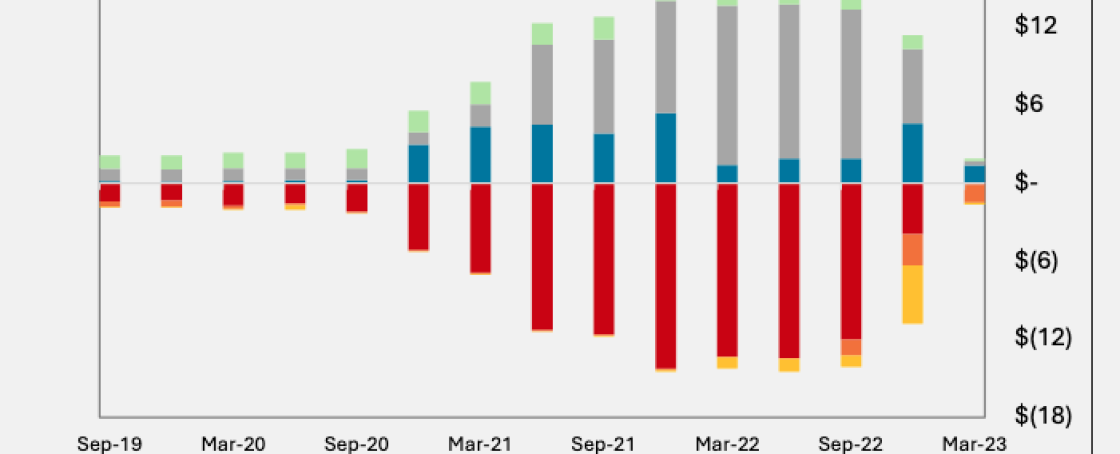
The study also highlights that Silvergate Bank, a $16 billion intermediary that shut down after experiencing severe deposit outflows in a matter of days in 2023, had a business model and balance sheet that was remarkably like that of a dollar-backed stablecoin issuer.

The authors argue that the run on Silvergate provides an example of how stablecoin issuers could end up succumbing to the financial stability risks they face.
”Like stablecoins, 99.5 percent of Silvergate’s $14.3 billion deposits did not pay any interest, nearly all were uninsured, and Silvergate’s depositors participated heavily in crypto market activities. Most of Silvergate’s assets, nearly 90 percent, were invested in HQLA, again following the structure of most stablecoin reserve portfolios, including those that will be GENIUS-compliant.”
The study also highlights where the stablecoin holdings of top issuers like Circle and Tether, as of December 2024, are located:

— Eichengreen on how the “underappreciated” international reserve system hints at future stablecoin collateral dynamics (via NBER)
Summary: The paper focuses on how demand for safe dollar assets is generated and intermediated is directly relevant to large dollar-backed stablecoins, whose reserves sit inside this system. For stablecoin watchers, the value here is contextual: understanding how reserve demand, regulatory shifts, and geopolitical fragmentation might shape the availability and pricing of the very assets that will back multi-trillion-dollar stablecoin markets.
Killer quote: “The paper argues that global demand for safe dollar assets is shaped as much by institutional design as by macro fundamentals — a key backdrop for any dollar-backed stablecoin regime.”
CEPR Frontiers of Digital Finance Series:
— Gersbach et al: Stablecoins still face run risk — and policy must allow controlled redemption gate
Summary: Hans Gersbach (ETH Zurich), Hugo van Buggenum (KOF-ETH Zurich), and Sebastian Zelzner (KOF-ETH) argue that fiat-backed stablecoins remain structurally susceptible to runs, largely due to reserve illiquidity, weak issuer commitment, and unstable public signals. They emphasize that redemption suspensions or gates are often seen as dangerous, but their modelling shows that well-designed, temporary restrictions on redemption could prevent destabilizing first-mover behavior. A key insight is that active secondary markets provide an important stabilizer: when redemption is slowed, trading gives holders an alternative exit mechanism, reducing panic incentives.
The authors caution against paying interest on stablecoin holdings, arguing it would spark undesirable competition among issuers, complicate reserve composition, and destabilise monetary policy transmission.
They also assess the banking system impact: large-scale adoption could realign deposit funding, affect liquidity transmission, and impose procyclical pressures unless regulation permits stabilizing tools like redemption gates, disclosure rules, and strict reserve composition.
Killer quote: “Depegging episodes underscore their vulnerability to run risks due to illiquid reserves, limited issuer commitment, and noisy market signals.”
The Peg: The financial market is evolving like an ethereal realm, where only the most creditworthy and trustworthy get access to eternal liquidity. To enter, you must pass through the regulatory gates of heaven, which involves persuading Peter in compliance that you are on balance more good than bad.
If you fail to convince Peter, of course, you might have to endure some time in the liquidity and volatility gray zone. It’s quite crappy there. For one thing, there’s little to no privacy (because, you know, you can’t be trusted, and Peter needs to “know is customer” well if you’re to achieve access one day). Achieving escape velocity, meanwhile, gets harder every year because living within your means is challenging when everyone else is cheating the system or signing up to Faustian pacts — aka writing checks their bodies can’t cash. Your only chance at this point is to convince someone on the inside to vouch for you. But since that’s risky for them, they’ll need up-front pre-funding in the form of a fully audited attestation of your net worth, voluntary reconditioning, and repeated public statements — ideally while kneeling — that you have no ties or affiliations with the sanctioned. Failing that, you might be able to get some traction with stablecoins.
If you have the unfortunate luck of slipping from the gray zone and into the black zone, not only will there be no liquidity for you, you’ll likely be banished to the mining furnaces of crypto. There, you will burn cash for all eternity with little to show for it, or, alternatively, wander forever burdened by a gold-encrusted blockchain.
The problem is, at some point, the dark zone will begin to encroach on the light. At that point, the whole system will have to be reset, or face cataclysmic collapse. The question is: will it be a great redeemer who bails out the sins of the market, and gives us all a second chance? Or, will it be a liquidity downpour from a central bank that breaks all the levees and redemption gates in one?
Garratt: Banks will transform the stablecoin market — but only if a universal clearing layer emerges.
Summary: Rodney Garratt of the University of California, Santa Barbara, argues that the US stablecoin market — now dominated by Tether and Circle — will be reshaped by the entry of commercial banks following new regulatory clarity in the U.S. Banks are likely to issue regulated stablecoins to serve corporate and institutional clients on public blockchains, while legacy crypto-native issuers remain active in the crypto ecosystem.
He likens stablecoins to digital travellers’ cheques [channelling Tony McLaughlin of Ubyx) — redeemable at par but detached from individual customer accounts. The analogy reveals a structural problem: with multiple issuers, redemption frictions and interoperability gaps will proliferate, much like pre-clearinghouse cheque settlement. For stablecoins to function as a safe, fungible payment medium, Garratt argues the system must develop a universal stablecoin clearing network ensuring par exchangeability across issuers. [Perhaps like what used to happen in the City of London’s square mile? — IK]
He further notes that stablecoins offer limited advantages in domestic payments, where instant bank payment systems already exist. Their real promise lies in programmable global corporate payments and automated cross-border settlement. Yet he predicts bank-issued coins will have short lifecycles: they will serve as transient payment instruments rather than long-term stores of value.
Killer quote: “Many of the problems that we currently see with the current redemption process for stablecoins (redemption frictions, costs and deviations from par value) are similar to what we observed historically with cheque processing before the creation of cheque clearing houses. ”
— Cecchetti & Schoenholtz: Under the GENIUS Act, tokenized deposits are safer than stablecoins.
Summary: Stephen Cecchetti (Brandeis International Business School) and Kermit Schoenholtz (NYU Stern School of Business) analyze the U.S. GENIUS Act and show that it meaningfully improves the regulatory landscape but still leaves major gaps. Platforms can circumvent the interest prohibition with “reward-like” structures, and issuers can still hold run-prone assets, such as prime MMFs or uninsured bank deposits.
Most critically, the GENIUS Act imposes no capital requirements on stablecoin issuers, undermining the ability of stablecoins to function as information-insensitive safe assets, especially in stressed conditions. They argue that the combination of redemption risk, the ease of transferring tokens, and potential exposure to risky reserve assets makes fiat-backed stablecoins less stable than their marketing suggests.
In contrast, they find that tokenized bank deposits — issued by FDIC-insured banks with central bank access — provide programmable settlement, real-time clearing, and cross-platform interoperability without the structural fragility. They also avoid privacy issues, reduce cross-border redemption concerns, and can naturally support multi-currency usage.
Killer quote: “Most notably, the absence of capital requirements raises doubts about the ability of stablecoins to serve as safe, information-insensitive assets under stress.”
Andolfatto: Tether’s two-tier redemption model exposes deep fragilities in dollar substitutes
Summary: David Andolfatto, University of Miami and formerly of the Federal Reserve Bank of St. Louis, examines Tether as a case study of private digital money operating outside banking regulation. Despite its enormous global usage — ranging from crypto asset trading to emerging-market dollar substitution — Tether’s structure creates material vulnerabilities. Verified institutional users enjoy par redemption directly with the issuer, while retail users rely solely on secondary-market liquidity, creating a two-tier system with asymmetric risk.
Tether claims full reserve backing, primarily in short-term US Treasuries, but only provides attestations rather than full audits. It is legally organized to avoid U.S. regulatory reach. Nonetheless, Andolfatto notes its strategic dependence on Cantor Fitzgerald, a U.S.-regulated primary dealer that manages its Treasury portfolio. This dependence gives US policymakers a hidden leverage point: by imposing fiduciary obligations on Cantor — via its Federal Reserve master account — regulators could indirectly enforce reserve discipline, AML/KYC compliance, and systemic-risk mitigation.
He concludes that although Tether is “unregulated by design,” it has become embedded in global financial plumbing in ways that policymakers can no longer ignore.
Killer quote: “Pegged to the U.S. dollar while operating outside the traditional banking system, Tether fills critical roles… yet its two-tier redemption structure and absence of regulatory oversight raise financial stability concerns.”
The Peg: Tether’s redemption policy is actually highly ambiguous. Almost, as we’ve argued before, strategically ambiguous (in the Taiwan statecraft sense). The “Terms of Service” say that issuance/redemption is reserved for verified customers, and where Tether allows it. For example: “Tether reserves the right to delay the redemption or withdrawal … if such delay is necessitated by the illiquidity or unavailability or loss of any Reserves held by Tether to back the Tether Tokens.”
Portes: Multi-Issuer Stablecoins Threaten Financial Stability Through Regulatory Arbitrage”
Summary: Richard Portes of the London Business School examines the emerging multi-issuer stablecoin (MISC) model, in which EU-regulated entities co-issue a stablecoin alongside entities located abroad. This model was not foreseen under MiCA and creates a structural loophole: issuers inside the EU face strict rules while offshore partners may not, but the token itself circulates freely as a single fungible asset.
This introduces multiple vulnerabilities: fragmented reserve management, unclear issuer accountability, potential ringfencing of foreign reserves during crises, and uneven redemption rights. Because the tokens appear interchangeable to users, the system masks underlying jurisdictional differences, heightening the risk of disorderly runs.
Portes outlines three policy responses: (1) ban MISCs, (2) amend MiCA to explicitly regulate cross-jurisdiction co-issuance, or (3) pursue global regulatory standards. He notes strong opposition within parts of the EU policy community, arguing that without decisive action, MISCs could undermine financial stability, erode trust in MiCA, and facilitate regulatory arbitrage on an international scale.
Killer quote: “This arrangement… creates loopholes for regulatory arbitrage, fragmented reserve management, and accountability confusion, particularly during redemption runs or crises.”
Uhlig: U.S. policy makes stablecoins ‘fragile by design’ while Europe bets on a CBDC
Summary: Harald Uhlig of the University of Chicago contrasts the EU’s push for a CBDC with the U.S. strategy of promoting privately issued stablecoins. In Europe, CBDC is framed as essential for preserving monetary sovereignty and reducing reliance on foreign payment platforms. In the U.S., scepticism toward government involvement and greater trust in market mechanisms have led policymakers to focus on regulating private issuers rather than creating a digital dollar.
Yet Uhlig highlights a major inconsistency: U.S. policy denies stablecoins access to Federal Reserve master accounts and prohibits interest payments. Without interest, stablecoins cannot operate as fully reserved narrow banks; without access to the Fed, they cannot guarantee liquidity under stress. This ensures they remain “fragile by design”, perpetually exposed to depeggings.
He also notes the inconsistency between paying interest on reserves to banks while forbidding interest to the public through digital cash — an implicit subsidy to incumbent institutions. Ultimately, he argues that neither approach resolves deeper issues like liquidity mismatches and run risk; instead, stablecoins and CBDCs represent ongoing “creative destruction” in monetary technology.