Rather than reflecting a “debasement trade,” which spells doom for the dollar, current price action may point to something more profound: a scramble for physical bullion by distressed entities that lack the creditworthiness to finance international trade unless agreements are underpinned with high-quality collateral.
The extraordinary 35 percent silver lease rate that appeared in the market this week may even be indicative of the true cost of borrowing for such players.
In reminiscences of the breakdown of the Libor markets in 2008, anecdotal evidence is circulating online that, for hook or for crook, there doesn’t seem to be a large silver holder in the market willing to lease or sell physical bullion to anyone.
But rather than being a death knell for capitalism, this dynamic will be especially destabilizing — and self-reinforcing — for distressed players who not only need monetary bullion to maintain access to trade finance, but also rely on it to produce the very goods that sustain their export-driven growth.
Yes, yes. We’re talking about China.
If we’re right, the prevailing narrative that soaring bullion prices and surging lease rates are a show of China’s strength — a demonstration of de-dollarization momentum and a shift to “real money” — could well be the exact opposite: a show of its fragility.
This is especially the case if you consider that China’s central bank has in the past decade, been among the biggest buyers of gold. If you want to get right to the bullion dynamics of what’s going on (as we see it) skip the following China backgrounder, and scroll down to the bullion squeeze section. But if you have the reading time, it’s worth cacthing up on the broader China context, as there’s a bigger story to tell about Beijing’s silver and gold vulnerability.

Key to the analysis are the following facts: Gold as a percentage of China’s total foreign exchange reserves (in weighted terms) is a puny 7 percent compared to Western averages, which are closer to 75 percent (77.8 percent for the U.S, 77.5 percent for Germany, 74.2 percent for Italy, and 74.9 percent for France).
Even on a global basis, China falls short. The World Gold Council estimates that the global average for central banks is 11 percent, which goes to show the extent of Western firepower in the domain.
What stats like this indicate is that, unlike Western countries, China’s financial stability and strength have historically depended more on access to large stacks of foreign currency than gold or positive-yielding domestic assets.
Why would that be?
For one thing, a high weighting of foreign-exchange assets in a country’s official reserves is a natural balance-sheet byproduct of a mercantilist policy orientation.
It signals to the world that the state is more interested in accumulating and retaining foreign assets — usually dollars or euros — rather than allowing those earnings to flow back into the global system through reciprocal trade or private investment in a way that benefits all. What’s more, the setup restricts China’s own citizens from enjoying the full consumption benefits of their hard-earned export-derived income, since the relative depreciation of the yuan makes imports prohibitively expensive for most (beyond inputs).
After all, why compete on merit in a free and global marketplace at fair prices when you can play god at home?
Historically, China has enforced this repression with a combination of measures, among them capital controls, constrained access to Western goods domestically (beyond luxury products, which can’t compete with Chinese output in terms of scale), and migration/travel controls.
The outcome was an industrial policy that consciously inhibited the personal enrichment of China’s working classes, while redirecting their stolen savings to CCP-guided agendas under the flag of “common prosperity”.
But the resulting indebtedness of Western countries was not a wilful undertaking or a symptom of Western “laziness”.
In a globalized economy, the West had no choice but to bridge China’s lack of reciprocity and the resulting imbalances. And it had to do so at taxpayers’ expense.
This is the balance of payments reality when — in the name of true global common prosperity — you engage in “free trade” with an outsized global player who refuses to conform to a rules-based system.
And indeed, for as long as Western taxpayers were happy to subsidize the hollowing out of their own industrial sectors by paying the Chinese government handsomely on its growing holdings of U.S. debt, Beijing had little incentive to push ahead with liberalization or rebalancing.
Most online commentary about China, sadly, misses this point (with the exception of the wonderful Michael Pettis who talks about it all the time).
So what does it mean now that China’s gold share is increasing?
Pro-China cheerleaders would say it is a show of Chinese force.
But the basic economic reality suggests otherwise. It seems more likely that the old model of FX accumulation has reached its limit because Western budgets are now exhausted and can no longer fund China’s growth at their expense.
With the West no longer prepared to bankroll China’s industrial policy experiment, this is why the country is scrambling to find other safe and positive-yielding financial assets to accumulate. The problem for China, of course, is that it has exhausted the global supply of such assets. This leaves only zero-yielding gold as an option (far from perfect, for reasons we will explain later).
Failing that, the only path left to defend “China Mercantile Inc” is an ugly one, given the lack of positive carry on offer: liquidating the country’s remaining, still-valuable foreign-exchange reserves to keep the RMB afloat. In effect, this would be tantamount to selling off its own balance sheet to buy time — a forced unwind that betrays just how far the model has drifted from sustainability.
The consequences of that would be immediate and embarrassing for China. Not only would China be forced to shut down its vast, loss-making industrial projects and face the discipline of competing at genuine market break-even rates, not state-subsidized ones. It would be forced to admit its system had failed.
Soon enough, China’s pain would become the West’s gain, with nearly every industrial activity becoming viable on fair economic terms.
The backstory to rebalancing
We didn’t end up here overnight, mind you. China’s slow march toward an inevitable rebalancing began in earnest after the 2008 financial crisis, when the advent of Western quantitative easing quietly ended its ability to “have its mercantilism cake and be subsidized to eat it.”
When interest rates cratered to zero post-2008, the one silver lining of QE was that China would have to seek its yield elsewhere.
But who do you turn to when the world’s largest consumer markets wake up to the reality that your goods aren’t really cheap when the cost of the interest rate payments you’re extracting are factored into the equation?
China’s solution was to become a colonialist. If the West was no longer prepared to pay it the subsidies it needed to fund its loss-making model, Beijing would force them out of less developed countries instead.
Thus, the Belt & Road Initiative was born, and with it, China’s efforts to turn countries within its sphere of influence into captured and dutiful vassals.
Except, there was a rudimentary problem with the setup.
First, those countries needed dollars, not RMB. Second, those countries tended to default. Third, those countries needed investment, not finished products (indeed, distributing more of the latter only amounted to subsidizing them). And fourth, replacing dollars with Rupiah was hardly going to improve China’s external capital position.
At best, BRI was a precarious vendor-financing loop, propped up by a false hope that teaching those countries how to play China’s own game with the West could extend its model for a few years more. (Especially if China could then extract those dollar revenues from those countries for itself.)
At worst, the initiative risked unraveling social cohesion at home as it became obvious to domestic workers that they were breaking their backs to sustain expensive client states that would never reciprocate in kind. (At least not without China turning to duress or active enslavement.)
While it is true that China is now trying to address these challenges by slowly transforming its BRI loan-book into a yuan-funded one, this is proving more difficult than expected. The move requires not just persuading borrowers to accept yuan, but convincing the wider world to treat it as a credible reserve collateral.
This is especially difficult given that the vendor financing loops in play are putting further pressure on China to devalue its domestic currency. [It turns out it’s difficult to engineer exorbitant privilege when you’re the one bankrolling your supposed creditors — at a loss!]
The result is that the so-called “yuan internationalization” project remains mostly circular: Chinese banks lend yuan to overseas projects that spend it on Chinese contractors, who then repatriate it back to China. The currency never truly leaves the ecosystem. It’s a closed-loop accounting trick that looks like internationalization on paper but functions more like an internal subsidy for China’s overbuilt industrial base.
Mo’ subsidies, mo’ problems
To make matters worse, the more Beijing pushes yuan-based lending abroad, the greater the domestic liquidity stress becomes at home. Every yuan lent overseas is a yuan not available to support China’s internal credit system, which is already creaking under the weight of property-sector losses, local-government debt, and slowing consumer demand.
Hence the paradox: in trying to export its excess capacity and financial influence, China is actually importing a dollar-style liquidity problem — but without the institutional architecture or trust that make the dollar system work. The result is a self-reinforcing squeeze that U.S. Secretary Scott Bessent is more than likely watching closely.
That’s why the bullion story matters so much. As access to dollar liquidity tightens and yuan internationalization stalls, Beijing’s only viable stopgap is to pledge or accumulate hard collateral — gold, and perhaps increasingly, silver — to keep trade and credit channels alive.
If that’s the case, the scramble for metal isn’t the expression of a rising monetary power. It’s the manifestation of a country trying to paper over the absence of one.
Exploding prices for gold and silver, and especially the extraordinary spikes in silver lease rates, then look less like an assertion of confidence and more like a sign that major players (notably China and Russia) are running out of funding options and turning to bullion as collateral of last resort.
And while all the focus is on London as the location of the biggest squeeze, it’s pretty obvious the distressed buyer is China.
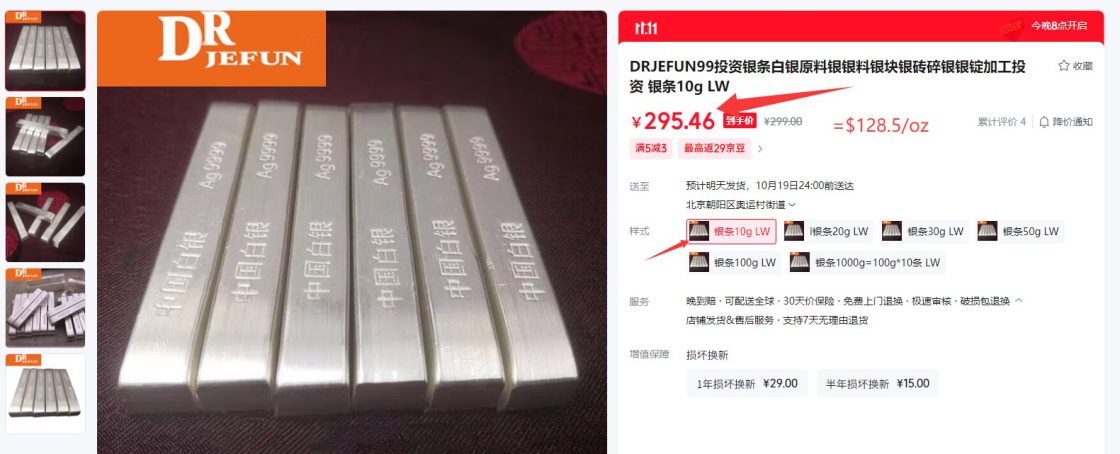
One needs only to look at anecdotal reports online to see that the country’s top bullion marketplaces are posting prices at $128/oz for physical silver, four times the record of this week’s “official” rate. This contrasts with still entirely reasonably priced bids for spoons and even silver bars on eBay in the U.K.

Moreover, Chinese social media is chock full of videos of opportunists hawking silver bullion bars, heavily implying the bid is local and increasingly desperate.
Explaining how the bullion squeeze works
As we’ve asserted, this is not a story about fiat collapse. It’s a story about collateral scarcity and the quiet desperation of a system straining to stay liquid without dollar access.
To understand the mechanics of what’s playing out, it’s worth looking more closely at how bullion lending markets work (chart via Bloomberg):
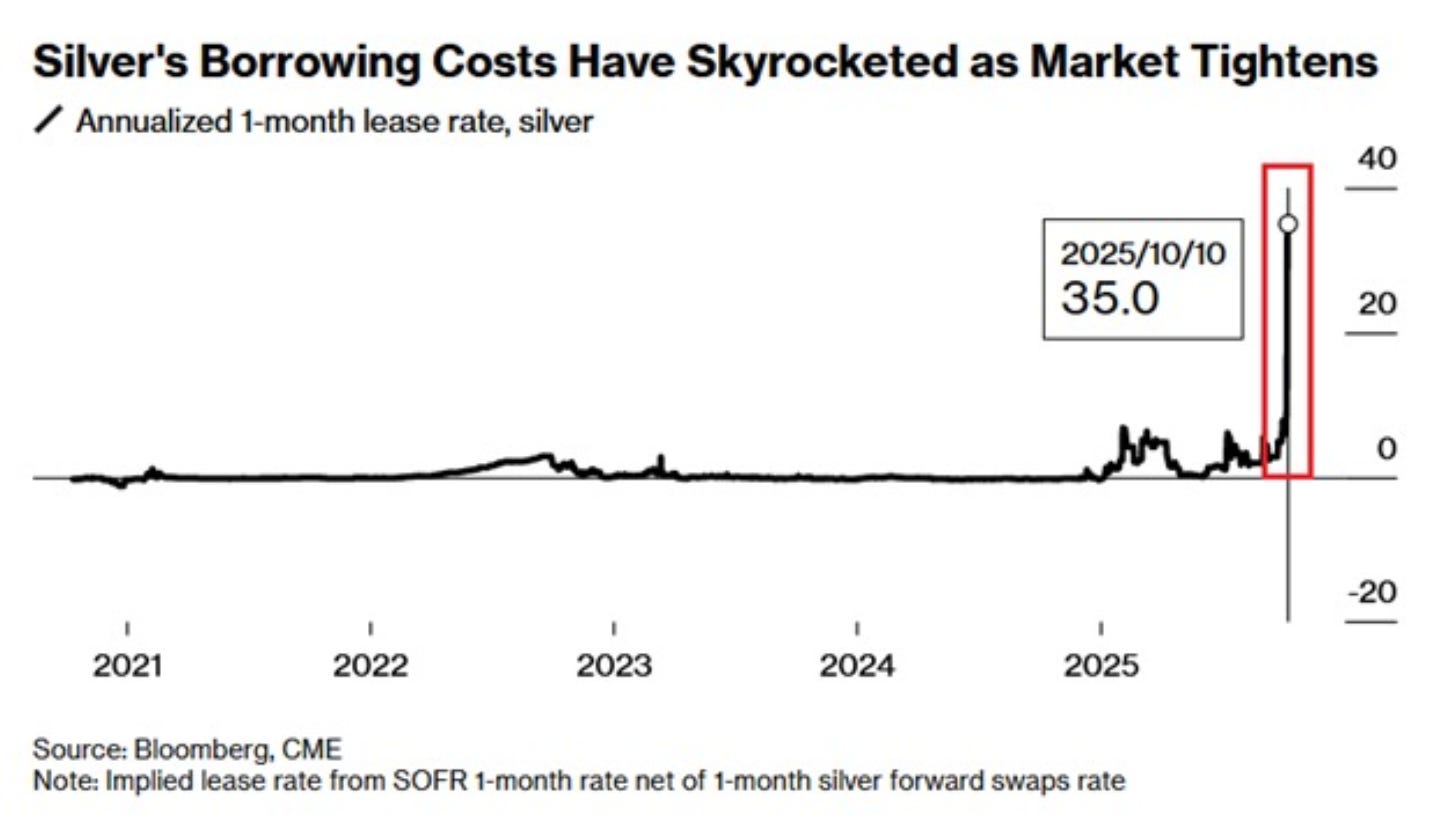
Gold and silver lending have always been a closed club — dominated by central banks, bullion banks, and a few large producers.
As a result, much of the commentary from outside that circle misses how profoundly the market has changed since 2008, when the LIBOR scandals — and the subsequent shift toward secured rates — forced sweeping structural adjustments across the sector.
Reflecting that transition, the London Bullion Market Association (LBMA) quietly discontinued publication of the Gold Forward Offered Rate (GOFO) in 2014, citing declining participation and reliability concerns. Yet GOFO had long served as the foundation for calculating lease rates.
Today, there is no official, transparent benchmark for those rates. Prices are determined in opaque ways via private dealer screens or reverse-engineered from forward prices, creating an environment ripe for distortion by a small number of well-positioned players.
But the monetary transition from an unsecured interbank system, where “dollar liquidity” was the binding constraint, to a collateralized system, where the real constraint has become access to “safe collateral” itself, also plays a part.
In this new regime, bullion lease rates function equally as much as funding costs for market participants whose only acceptable collateral is gold, as they do as a market for hedges.
There are other LBMA mysteries afoot too. Chief among them is the nature of the relationship between the legacy bullion banks and Chinese lenders.
Back in 2015, the LBMA proudly broadcast that Chinese lenders were set to join its tight-knit club. Yet by 2023, every single Chinese lender had quit and removed itself from the LBMA system. Neither side ever provided the world with a formal explanation for the rift.
All we know is that since then, Beijing has been furiously working to build a parallel delivery network and trading hub. It has already opened bullion vaults in Hong Kong and is said to be planning further ones in Dubai, Singapore, and Switzerland. The new gold pool will reference rates transacted on the rival Shanghai Gold Exchange, denominated in RMB, and be predominantly geared to interface with “friendly” central banks rather than “hostile” ones.
But again, rather than being a show of strength, the move points to growing tension in China’s domestic financing system.
The People’s Bank of China’s recent behavior backs the theory up. Already in September the Bank was forced to pump almost 300 billion yuan ($42 billion) into the Chinese banking system with tools it hadn’t used since January.
Separately, domestic loan growth is stalling, and banks are already being recapitalized. An even bigger concern for regulators is that much of this liquidity is not reaching productive private enterprise at all. Most is ending up in government bonds, state-owned firms, precious metals — or worse, leaking offshore.
To offset the pressure this puts on the RMB exchange rate, authorities have been actively steering banks to direct as much of the excess liquidity into domestic equities as possible — a market that, until recently, remained heavily repressed.
One of the clearest signs of this shift is the recent surge in margin financing. In 2025, Chinese investors reportedly borrowed as much as $322 billion to fund stock purchases — a record high, according to Reuters. Many of these leveraged positions are said to have been backed by consumer loans or repurposed credit, as investors sought ever cheaper funding to chase momentum in “hot” shares.
Goldman Sachs, among others, has noted that recent gains owe more to bursts of central-bank liquidity than to any genuine earnings optimism.
It’s a familiar pattern in China’s markets: ahead of every inflection point for its export-led model, equities briefly surge as the state mobilizes capital around its next industrial campaign — whether that’s solar panels, the Belt and Road Initiative, pandemic stimulus, electric vehicles, or now, chips, rare earths, and robotics.

But this time, as American capital is forced to retreat from China under Washington’s new investment curbs and Trumpian tariffs, it could all prove different.
Tellingly, in September, China’s cabinet announced it would now allow more qualified foreign investors to take strategic stakes in listed companies — a tacit admission of Beijing’s growing need for foreign capital.
Before that in July, Caixin reported that after a two-year pause, China would once again allow its unprofitable but high-potential tech companies to go public by reviving its long-dormant “fifth listing standard”.
This shift matters because, in the CCP’s worldview, equity markets are not supposed to be laboratories for risk-taking or vehicles for creative destruction — that, in Party thinking, is a hallmark of decadent Western capitalism. Instead, markets are supposed to be instruments to fund and legitimize SOEs, the institutions that embody the Party’s developmental mission. Profitability — or at least the appearance of it — serves as proof that an enterprise has delivered tangible economic value.
Allowing a loss-making company to list inverts that principle: it means granting access to the public’s savings before a company has “earned” it through tangible output.
Against that backdrop, China’s accumulation of gold and (potentially) silver looks more like an emergency collateral campaign — an effort to secure assets that can still clear international credit lines as dollars become ever more inaccessible with direct liquidations.
The silver mystery
A speculative but compelling theory, outlined by Bullion Trading LLC, posits that China may also be quietly building silver reserves to preserve its export competitiveness. No official data confirms this, and it remains conjecture — but the theory makes sense to us, especially given that more than 75 percent of global silver output lies within the Western sphere of influence.
For China, a silver squeeze would be devastating. The country is the world’s largest silver consumer, driven by its vast solar and electric-vehicle industries, which are key to its export advantage.
So critical is silver to solar manufacturing that the recent price rally has forced China to try to substitute or reduce silver content in its panels — seriously damaging the cost economics of its products.
In that context, the West’s “rare earths” vulnerability is merely a mirror of China’s silver shortage — with the latter arguably more critical for the sustainability of China’s industrial policy than America’s shortage of rare earths is for its industrial model (especially when you factor in that China also has to contend with food and energy shortfalls, and that rare earths aren’t really rare, just toxic to produce).
The combination of tariffs and rising silver costs, nonetheless, is starting to seriously test China’s loss-leading model is fast emerging.
After an 18-month price war, Wood Mackenzie reported this month that Beijing is finally pivoting from its “volume at any price” strategy to price stabilization. Not only has the government tightened investment rules and reduced export rebates, but it is now signaling capacity controls. Analysts now expect module prices will rise as much as 9 percent from Q4 2025, as production is curtailed and tax support withdrawn.
At the upstream point, leading polysilicon makers are planning to shutter about a third of capacity under an “OPEC-style” quota system — an effort to end the destructive pricing cycle long sustained by subsidies and rebates that China can no longer afford.
On the EV front, meanwhile, Samsung’s new solid-state battery requires a much higher share of silver than conventional batteries, and, whether Chinese EV producers go for it or not (they allegedly have a sodium-ion alternative), is still likely to increase demand for industrial silver.
All pressures that put China in a corner not the West.
The mechanics of a silver squeeze
Here’s how all these pressures are set to play out at the market level.
Key to the unfolding drama is the fact that holding gold and silver is more than an expensive opportunity cost for investors. Not only does bullion yield nothing, but the sizable costs associated with storing, insuring, and securing such assets mean the whole enterprise suffers from “negative carry”.
To reduce these costs, bullion banks strive to engineer synthetic yields.
They do this by routinely selling the metal forward and establishing what is known in commodity parlance as a contango trade. The counterparts to these arrangements are usually miners or large industrial consumers, all of whom benefit from locking in predictable break-even prices or hedging against price surges.
The problem is, all these trades have a tendency to unravel as soon as a distressed buyer enters the fray, especially one that is adamant on taking physical delivery. This is all the more the case if the structure of the forward curve slips into backwardation.
At this point, the cost economics of unwinding and reestablishing the trade at a better forward yield are more favorable than keeping the short positions open at an ever higher financing cost.
In such circumstances, the longs will move to buy back their hedges, often at a premium, or move to deliver the bullion they have forward sold (when at other times they would have just cash settled and rolled on).
As forwards unwind, it’s these market forces that draw metal out of vaults and even from mint inventories — not least because contracts often insist on specific bullion grades being delivered (Sorry, no spoons from Ebay, etc). Each unwind tightens liquidity further, feeding a mechanical squeeze, until all the distressed contango trades are unwound.
Hence, what’s happening now is unlikely to be a conspiracy or a mass awakening to “sound money.” If anything, it represents the messy internal mechanics of satisfying China’s rapacious collateral demand, itself likely fanned by Russia demanding to be paid in gold for the oil it is selling Beijing.
In 2008, when interbank trust collapsed, LIBOR stopped reflecting normal lending and instead became a barometer of systemic fear. Spiking bullion lease rates may now be playing the same role.
Except this time, the divide isn’t between banks, but between blocs and systems: BRICS versus non-BRICS, sanctioned versus unsanctioned, dollar-connected versus dollar-excluded, free-market versus planned.
It turns out, when counterparties don’t trust each other enough to trade on credit, and dollar channels are closed, bullion becomes the only collateral everyone can still just about agree on.
But far from implying that the West is dead, the bullion spike may genuinely be the West’s Trump card.
Former BoE rate-setter Willem Buiter’s recent argument in the FT that central banks should take advantage of the gold rally and sell their stocks (basically to China) on that basis isn’t entirely insane. It would be the easiest and neatest way to get back what was taken from the West by China due to unfair trade.
Consider this. If prices were to hit as much as $5,000 per troy ounce, that could enable a revaluation of U.S. gold reserves at a level that fetched $1.5 trillion for the U.S. Treasury. Nice trade.