Friday’s de-pegging of Ethena’s USDe rocked crypto markets and came as if out of the blue. With more than 72 hours to gather intel and reflect on what went on, here’s our post-mortem of the bloodbath that day — and what it augurs for DeFi resilience and delta-neutral strategy stablecoins more broadly. You can listen to the related Spaces chat here.
Anatomy of a crash
On Friday, October 10, what began as a localized pricing dislocation on a centralized exchange spiraled unexpectedly into a “crypto bloodbath”.
The result? Nearly $20 billion was wiped from crypto market capitalization in less than 24 hours, as cascading liquidations led to the temporary de-pegging of a key decentralized stablecoin.
While Bitcoin held up comparatively well, the shockwaves through DeFi and stablecoin markets exposed newfound fragility in crypto’s plumbing.
Adding to the intrigue, a mysterious whale is said to have profited handsomely from shorting the market within minutes of the crash, making out with close to a $1 billion.
For some, all this was evidence of structural weakness, which will inevitably invite regulatory responses; for others, a stress test that the system passed with flying colors.
At the center of the drama, in any case, was USDe, a so-called delta-hedged stablecoin that briefly traded below its $1 peg — a concept most hadn’t even heard of until the weekend.
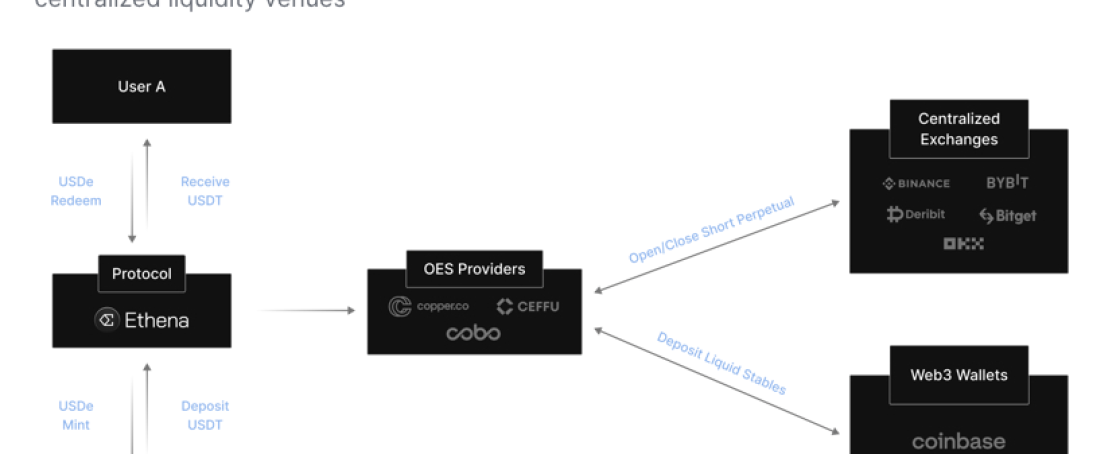
USDe, issued by the Ethena protocol, is not your usual fiat-backed stablecoin like Tether’s USDT or Circle’s USDC. Instead, it belongs to a new class of “synthetic dollar” assets — coins that attempt to hold a dollar value by hedging crypto collateral with futures.
The structure looks like this:

Commodity market veterans will recognize the above as a type of contango trade, where underlying assets are hedged through the derivative market to synthesize a positive yield for the holder. This can remain positive yielding for as long as the structure of the forward curve remains intact and does not invert.
At least, that is the structure USDe was going for.
According to Sébastien Derivaux, a crypto scholar who joined us for our Spaces chat on Monday, these days USDe is mainly backed by Treasuries (in the form of other stablecoins) with only about 20 percent representing a delta position. That’s due to yield compression across the curve brought on by the trade’s growing popularity, which undermined the benefits of holding a delta-neutral position.

In spirit, though, USDe has the capacity to run a classic “basis trade” strategy whenever it is profitable to do so. This consists of going long spot, then shorting futures to lock in a positive yield. In calm markets, the strategy behaves predictably enough. Yet, as we learned on Friday, when prices move fast or liquidity dries up, the system becomes susceptible to unintended feedback loops.
In this case, variable liquidity for USDe across varying exchanges triggered a self-correcting feedback loop that ultimately saw the coin trade significantly below par on the least liquid exchange, which was Binance.
Despite the commotion, defenders of the strategy argued that at no point was the on-chain collateral itself threatened. “The stablecoin itself didn’t depeg,” Derivaux told us, explaining that the discount was mostly unique to Binance, due to its inferior liquidity.
The irony, though, is that Binance’s own price feed — known as an “oracle” in crypto — served as the pricing backbone for numerous other leveraged markets, turning an isolated data error into a chain reaction across the ecosystem.
According to Derivaux, those automated systems treated the oracle’s numbers as gospel, so when the feed showed a falling price, collateral was deemed insufficient, and liquidation orders were fired off automatically. “On Binance, a lot of people use a lot of leverage… so as soon as one started to be in bad debt…the price fell quite a lot, and that triggered new liquidation, and so on and so on,” he said.

The outcome was a textbook “tightly coupled system failure”.
Craig Pirrong, professor of finance and veteran of market-structure analysis, at the University of Houston, compared the event to historical episodes of systemic fragility:
“We’re calling them stable coins — with the associated caveats — but they have all the fragility of traditional instruments like bank deposits, but these become especially dangerous when incorporated in a trading system that operates in a very tightly coupled way and at a very tight timescale,” Pirrong told Cash Equivalence during the Spaces session.
A tightly coupled system is one where things have to work in a perfect sequence. If just one element breaks down, that event can cause the whole system to become unstable and potentially collapse.
Pirrong invoked parallels with 1987’s portfolio-insurance crash and the 2020 Covid-era basis trade unwind. “When you’re relying on a dynamic hedging strategy in order to maintain something, that can go wrong and be destabilizing,” he warned.
The point here is that just as portfolio insurance in ’87 created self-reinforcing selling, delta-hedged stablecoins can exacerbate dislocations when the underlying futures basis blows out.
Schrodinger’s depeg
But was it really a depeg? By the weekend, many voices embroiled in the semantics of the question were edging toward the conclusion that the answer was probably not.
Their rationale rested on the point that on-chain oracles such as Chainlink never registered prices below 99 cents. Again, it was only Binance where trades reportedly cleared as low as 60 cents and only for a moment. For many, that discrepancy paradoxically proved the stablecoin’s design had worked.
“If you can buy the same stablecoin at 60 cents and sell it at $1 somewhere else, there is an arbitrage,” Derivaux argued.
But Pirrong wasn’t convinced. He cautioned that arbitrage “takes time,” and in tightly coupled markets, “the arbitrage mechanism can’t keep up.” The latency — mere minutes — may be enough to allow a local liquidity shock to metastasize.
This, in his opinion, is the true paradox of DeFi’s self-correcting logic: in theory, arbitrage restores parity; in practice, speed kills.
The market-structure lesson
For Pirrong, traditional finance has seen this movie before. The combination of margin calls, automated liquidation, and oracle dependency makes crypto trading systems exquisitely sensitive to microstructural failure.
“What’s happened with perps and with crypto more generally is that the time clock on that has been very rapidly accelerated. That increases the tightness of the coupling of the system and means these kinds of breakdowns are more likely to occur,” he said.
In centralized markets, circuit breakers and clearinghouses provide buffers. In DeFi, the design philosophy is automation first, discretion never. That means when something breaks, it breaks completely.
Friday’s cascade, in that sense, was not a bug but an emergent property of algorithmic leverage, which encourages the system to purge itself of its misallocations abruptly so that it can recover and move on quickly.
In other respects, it illustrates the type of “gridlock” risk that already runs rampant through real-time settlement systems, and which requires incrementally higher quality collateral to abate.
Pirrong described the root issue as one of operational tempo: the faster the feedback loop, the thinner the margin for error.
All this is bad enough for conventionally structured stablecoins, which regulators say are already resurrecting uncomfortable memories of when Primary Reserve Fund broke a buck in 2008. But it’s even worse for stablecoins that depend on perpetual futures, as USDe does, to engineer stability.
As Pirrong noted, so-called “perps” — one of the most significant derivative innovations in crypto — were designed as “a way to trade crypto spot with leverage”. Yet, once integrated into a stablecoin mechanism, they only introduce more complexity and interconnection between markets, and thus more susceptibility to feedback loops.
Echoes of Terra?
It’s tempting to compare the episode to the infamous “depeg” of algorithmic stablecoin Terra Luna in 2022, which depended on mint-and-burn reflexivity to engineer stability. In practice, though, the incident was something else. Not only is USDe a collateralized and hedged stablecoin, but the destablization originated from a marketplace issue, not a feedback loop within the coin itself.
That doesn’t mean the risks are any less concerning.
Vinay Gupta, founder of Mattereum, told us that for him, delta-hedged designs are “custom-designed for unstoppable, automated flash crashes every time they come out of that stabilization envelope.” The real question, he argued, isn’t whether they’ll break but how much damage they do when they do.
Still, the fact that USDe’s core collateral remained intact while Binance’s synthetic pricing imploded suggests a key distinction: this was not a protocol-level failure.
What is clear is that DeFi’s plumbing now mimics traditional market mechanics closely — something bound to invite further regulatory scrutiny. For traditional finance professionals, the event looked less like a crypto oddity than a classic margin spiral in a thinly capitalized market.
“Think of it as the basis trade that blew up during Covid,” Pirrong said. “That’s the closest analogy.”
Derivaux remained adamant that the system worked as designed. Again, he argued, the problem sprang from Binance’s localized mechanics, its lack of “authorized participants,” its excessive leverage, and its failure to use aggregate oracle data.
When decentralized stablecoin architecture faced one of its biggest tests to date, it actually came out on top, he added. The fact that on-chain prices on decentralized exchanges held, and off-chain venues faltered, demonstrated this clearly.
Key takeaway:
No single smoking gun explains Friday’s sudden market collapse.
The timing coincided — perhaps a little too neatly — with the U.S. Treasury’s $20 billion rescue package for Argentina via its Exchange Stabilization Fund. That operation, by unexpectedly redirecting dollar liquidity offshore without direct Federal Reserve support, may have tightened conditions in the most speculative corners of the dollar ecosystem, such as crypto. The outcome may have been an ironic destabilization of dollar-pegged stablecoins just as the peso itself was being stabilized.
By most accounts, it was Donald Trump’s sudden threat to impose 100 percent tariffs on Chinese imports and export controls on critical software that served as the immediate catalyst.
This resulted in markets trading risk-off instantly, dragging down equities and crypto in tandem.
Of course, in reality, it’s impossible to say whether Trump’s post was sufficient on its own to explain a $19 billion liquidation cascade. Or, for that matter, whether the Argentina rescue or any other factor, such as jitters over a looming U.S. government shutdown and the crowded rush into the “debasement trade”, played a role.
The most plausible explanation is that all these factors came together to expose fragilities already embedded in an over-leveraged crypto system.
The outcome, as they say, was a perfect storm.
Questions that regulators and academics will be asking:
— What does the incident spell for the integration of perpetual futures into the formal financial system?
— What does the incident indicate about the fungibility of stablecoins and whether it needs to be further regulated?
— Does it embolden the case for CBDCs and tokenized deposits, on the basis that only they can protect the singleness of money?
Related links:
— Tether boss brags USDT traded above par value during the rout, proving itself to be the crypto safe haven.
— No, Ethena’s USDe Didn’t De-peg (Coinbase)
— Did Ethena really depeg? (Dragonfly MP)
— Was the Oct.10 market crash a coordinated crypto attack? Here’s what the on-chain evidence says (CCN)