This is the story of how the Exchange Stabilization Fund (ESF) became one of the most powerful yet least transparent organs of U.S. financial statecraft.
It also explains why, despite Congressional efforts to roll back much of that secrecy in recent decades, the true scale of its remit remains shadowy and obscure.
This is important because of the fund’s recent deployment in Argentina, an intervention that — once you are aware of the history — says more about the political battle on the ground than about the robustness of Argentina’s economic turnaround.
Though the ESF’s formal mandate is to protect the value of the U.S. dollar, public awareness of the fund resembles that of a financial cicada: it emerges only when the ESF unexpectedly springs into action after long periods of quiet, only to fade away again quickly. During those brief awakenings, the true scope of the fund’s origins and functions is often misunderstood.
Most recently, it has resurfaced with the U.S. Treasury’s use of the ESF to back a $20 billion currency swap to provide direct support for the Argentine peso. Yet even this burst of attention has remained superficial, focused mostly on Trump, Argentine President Javier Milei, and “bailouts,” while the fund’s New Deal-era birth in a gold revaluation — and the relevance of that history to today’s gold-revaluation debates — remains almost entirely unexamined.
Few are aware of the powers the fund has bestowed on the U.S. executive branch to operate without Congressional oversight in far-flung corners of the world since its creation in 1934.
Even fewer are wise to its evolution over time into a quiet but central instrument of global finance and covert action.
Among academics, Bordo, Schwartz, and Henning have studied the territory most closely. Yet, much of their work is dated, going back to pre-2001. The work is also chiefly concerned with only one question: can the United States maintain democratic accountability for executive branch officials engaged in ESF-enabled international financial rescues and, at the same time, preserve its capacity to respond to financial crises with speed, flexibility, and effectiveness?
Beyond that, only a handful of figures have dared to tread more deeply.
Eric de Carbonnel is one such person. A shadowy figure in his own right, he claims to be the great-grandson of Frank Vanderlip, a banker who was closely involved in the processes that established the Federal Reserve in 1913 albeit an opponent of the system that later empowered the ESF.
In 2011, when Western economies were still reeling from the effects of the Great Financial Crisis of 2008, De Carbonnel posted a series of provocative videos on his Markets Skeptics blog, arguing that the ESF was far more closely involved in the financial crisis than people realized. While Henning’s academic work had acknowledged the ESF’s historic role as a U.S. government “slush fund,” De Carbonnel took it further, describing the fund as an ongoing clandestine financial tool of the U.S. government that operates as such to this day.
De Carbonnel has since retreated from the blogosphere, raising questions about the legitimacy of his narrative.
Red flags include a notable inclination to shift the blame for the financial crisis from Wall Street financiers to the U.S. government, and a broader conspiratorial framework, including the idea that everything went awry when the financial system left the gold standard and adopted “fiat currency”.
Successive attempts to contact De Carbonnel over the years, as well as attempts to verify his family connections, have mostly fallen flat. The best we’ve come up with is a New York Times marriage announcement linking the Vanderlip and De Carbonnel families. It highlights that, on the De Carbonnel side, the author may be the descendant of Eric Charles Marie de Carbonnel, the former French Ambassador to Poland in 1956, to the EEC in 1958, and later the Secretary General of the French Foreign Office until his death in 1965. At the very least, it seems to have been a family of some international and political influence.
The videos live on online, for now. But De Carbonnel himself could, as far as we know, be an imposter. And not all of his claims check out.
And yet, the videos bring attention to credible primary material, even if selectively interpreted to support more conspiratorial conclusions. At a minimum, they provide a useful framework for exploring the real reach of the ESF in today’s global financial system.
Where De Carbonnel’s account becomes far more difficult to assess is in the portions that rely on purported family insights — claims that remain unverifiable.
I’m shocked to find that the ESF is secretive!
The arrangement supplied Buenos Aires with dollars to help stabilize the peso, but it has faced public criticism for the perceived U.S.-funded bailout of Argentina. Many say it exposes taxpayers to undue risk. Yet U.S. Treasury Secretary Scott Bessent, a former hedge-fund manager known for his market acumen, has pushed back on that characterization, describing the swap as a “trade” that has already generated a profit for U.S. taxpayers, not a bailout.
Setser’s recent analysis shows that Argentina’s usable foreign-exchange reserves amount to less than $10 billion, despite headline figures of roughly $40 billion. This raises questions about what Bessent, long known for his aggressive, government-testing FX trades, is really attempting to achieve in Buenos Aires. Is it a bailout, or something more paradigm-shifting? A gradual shift to the dollar outright? Or a strategic play to oust China from the U.S. sphere of influence?
By law, the details of the swap should appear in the Treasury’s quarterly and annual reports to Congress.
Still, it is also true that there is little academic dispute that, prior to the 1970s, the ESF really did operate with an extraordinary degree of secrecy and executive latitude.
Congress received no regular reports in its early years, had no statutory access to the fund’s accounts, and exerted virtually no oversight of its activities. The ESF’s currency interventions, gold operations, and emergency lending to foreign governments were carried out quietly — often through back-channel arrangements with central banks and finance ministries. Treasury was under no obligation to disclose these transactions publicly, and many remained outside the public record for years or even decades, if they surfaced at all.
The turmoil of the early 1970s changed the political calculus. The Nixon shock, the breakdown of Bretton Woods, and mounting Congressional frustration over unilateral executive actions in economic and foreign policy led to a broader push for transparency and statutory checks across the national security and financial apparatus. The ESF was swept into that reformist moment.
Over the following decade, it shifted from one of the most opaque financial instruments in the federal government to a more regulated, periodically disclosed, and scrutinized tool of economic policy.
Yet the post-1970s reforms stopped well short of full transparency. ESF operations remained shielded in the short term, with disclosures arriving only after a lag. And side agreements or supporting arrangements could still be withheld from Congress on national-security grounds. That residual secrecy, even now, leaves room for unexpected developments — particularly if emergency war powers are ever invoked.
The ambiguity came to a head in 1995, when President Bill Clinton tapped the ESF to support the collapsing Mexican peso. Many members of Congress were blindsided by the action since they had not realized the ESF could be used for large-scale intervention and assumed any rescue package would require their approval. What followed was a lengthy dispute over access to basic program details.
Many Congress members were worried that taxpayer funds were being used to support a ‘‘corrupt government, narco dealers, [and] an agriculture secretary who is a billionaire, whose sons are involved in narcotics trafficking”.
While Congress eventually succeeded in extracting the information it sought, doing so required sustained pressure and considerable political effort.
The question today is whether that legacy of opacity still endures — especially in light of the scrutiny surrounding the Argentina swap.
More pertinently, it raises the question of whether ESF-empowered swaps are linked to political conditionality from Washington or to other forms of democratically unaccountable dealmaking.
De Carbonnel’s ESF narrative, as supposedly passed on to him by his great-grandfather Frank Vanderlip, is worth examining here.
The historical record confirms that Vanderlip was indeed, as claimed, among the bankers present at the 1910 Jekyll Island. That meeting has since been mythologized in conspiracy circles as the birthplace of a plot by elite financiers to control or debase the dollar. But De Carbonnel argues Vanderlip diverged from the group on key issues, particularly fiat money and the thinking that would later justify the creation of the ESF. Moreover, De Carbonnel claims that the state strategically cultivated the Jekyll Island “bad banker” trope, which has since fanned conspiracy theories to deflect from what really happened there.
In reality, none of the bankers present at the meeting were happy with the final draft of the Federal Reserve Act, because the Treasury had radically redesigned the bill to make the dollar a fiat currency backed by the government’s taxing authority. On the contrary, the bankers believed the creation of the Fed in its final form constituted an “unprecedented level of government interference in the most sensitive area of the capitalistic economy” and a step towards socialism.

To put Vanderlip’s claim simply: if the Federal Reserve Act of 1913 represented a false flag “bankers’ coup” of America, then the Gold Reserve Act of 1934 — which created the ESF with appropriated private sector gold — functioned as the true power-grabbing counter-coup of the state over the people. In De Carbonnel’s view, the Fed has operated as a façade for the ESF ever since. Though, remember his videos were posted in 2011.
By modern standards, the 1933 executive order prohibiting the hoarding of gold coins, bullion, and certificates does indeed feel a lot like executive overreach. Economists estimate that Americans surrendered between 62 and 93 metric tonnes of gold under the order. The following year, the Gold Reserve Act simply formalized its transfer to the Treasury and established the ESF.
Still, these actions must be read against the backdrop of the Fed’s perceived failure to deliver the stability it was created to provide. By the early 1930s, the U.S. was mired in bank runs, collapsing credit, and severe deflation — a crisis that shattered public faith in both the financial system and the bankers behind it.
Roosevelt, who was far less committed to a laissez-faire approach than his predecessors, argued that only sweeping emergency action could stop the economic collapse. Centralizing all monetary gold in the Treasury and devaluing the dollar were framed as essential steps to arrest deflation and restore liquidity.
In effect, the process resembled a one-time Treasury-run asset purchase financed by money creation (a parallel to modern-day quantitative easing). The move immediately increased liquidity and broke the link between gold reserves and the domestic money supply.
The resulting gains from the revaluation landed the Treasury with roughly $2 billion to establish the ESF. At the same time, the Act empowered the Treasury to use that capital in foreign-exchange interventions aimed at stabilizing the dollar.
ESF power grab
From the outset, the money was placed under the exclusive control of the Secretary of the Treasury, whose decisions were deemed final and not subject to review by any other U.S. officer.
The outcome was an unprecedented level of secrecy that made the ESF nothing short of perfect for financing covert actions and operating as an executive-controlled “slush fund”.
Yet, according to the Vanderlip narrative, the Act also had a less-noted consequence: it shifted key elements of monetary and foreign-exchange authority from the Federal Reserve to the Treasury, altering the balance of institutional power over currency and credit.
This was harder to detect publicly because, from its earliest days, the ESF operated out of the New York Federal Reserve Bank, which helped it keep a low public profile.
The Fed’s independence in that sense was never real, says De Carbonnel. To his mind, it was more of a public-facing front intended to shield the real powers, namely the politicized ESF, from public scrutiny.
Those in the know, know, and signal accordingly.
De Carbonnel says the term “U.S. monetary authorities” is frequently invoked in official reports and statements to hint at who is really calling the shots when the ESF is guiding Fed actions.
He also argues that this influence shows up most clearly in decisions about extending dollar swap lines — and, crucially, in determining which institutions or countries are granted access to them.
Dollar swap lines famously came to prominence in the aftermath of the 2008 crisis, when “U.S. monetary authorities” were forced to bail out the international financial system. Many analysts, among them plumbing expert Zoltan Pozsar, described the extension of the lines, especially beyond the G7, as arguably the most powerful of the Fed’s operations during the crisis, since they allowed foreign dollar liabilities issued by non-U.S. banks to be backstopped by Fed liquidity at U.S. taxpayer expense. Merely having access to the facilities, whether tapped or not, had a stabilizing effect on domestic financial systems at the time and ever since.
Yet, in the reams that have been written about the swap lines over the years, few have ever suggested, as De Carbonnel has, that it’s the U.S. Treasury that really dictates how and when they are used, and not the Fed.
This is no doubt because the Fed does not technically need Treasury permission to initiate currency swap lines, which it has been engaging in since the 1960s. So, while in theory the Fed tends to coordinate swap lines with the Treasury as a matter of courtesy, legally, any swap lines it initiates via the FOMC fall under the power of Section 14 of the Federal Reserve Act and are treated as open-market operations via and are protected by the Fed’s legal authority to engage in open-market operations, including FX and foreign currency transactions.
Some academics, such as Perry and Menand have quibbled with that interpretation. They claim the Fed would be “on stronger footing if it reconstructed its liquidity swap framework as an emergency power under Section 13(3) of the Federal Reserve Act”. This, however, was amended by Dodd–Frank in 2010 and does now officially offer the Treasury a veto. “The Board may not establish any program or facility under this paragraph without the prior approval of the Secretary of the Treasury,” the legislation reads. Yet, it is the FOMC that determines swap lines. This creates a tension because swap lines function like emergency lending, yet legally fall under an authority the Board cannot veto and the Treasury cannot block.
In short, it gets complicated. In light of Donald Trump’s return to power, some believe the power balance has already started to shift. Even so, any direct Treasury assault on swap lines — notably their removal — would still have to be carried out by installing an administration loyalist as chair through the executive’s appointment power.
Former New York Fed man Robert McCauley posed a question in a CEPR piece in May, for example, that hinted at this reassessment: “What if some future Fed leadership were to decline to extend its credit through central bank swaps, taking the view that they ‘just hate bailing out Europe again,’ in the unguarded phrase of the U.S. Vice President? Or to condition swaps on bilateral political considerations?”
To guard against the weaponization of swaps, McCauley proposed that central banks without access to the Fed form “a dollar coalition of the willing” to guarantee dollar supply in the event that access is denied.
BRIC nations, McCauley said, were already operating informally along those lines, with China a central node in such dollar supply pools. So much so, in fact, that Argentina’s pre-existing yuan swaps weren’t really an exercise in Buenos Aires becoming less dependent on the dollar, but a pathway to acquiring the dollars it needed to repay IMF loans with China’s pre-existing dollar stash.
According to the cited evidence, the BCRA and PBOC formalized a renminbi-for-dollar leg in 2023, expanding the swap arrangement with a second-step swap with the PBOC (meaning the BCRA would swap pesos for renminbi, and then renminbi for dollars). Such swaps were initiated before Milei (whose plans to liberalize the Argentine economy have been supported by the IMF from day one) came to power.
Reuters reported this week that European financial stability officials were already preparing for the worst and looking to pool dollars held by non-U.S. central banks to reduce their reliance on U.S. swap lines in the event that Washington applied political conditionality to their use.
All this implies that efforts to break free from a newly repoliticized ESF are already underway in earnest.
Dexter White’s system
It’s when geopolitical tensions heat up or nations go to war that a potentially limitless and secretive financial facility really comes into its own. And that’s exactly what happened in WW2, when America’s ability to tap the ESF for covert financing in Europe became a crucial — and largely hidden — weapon against the Axis powers.
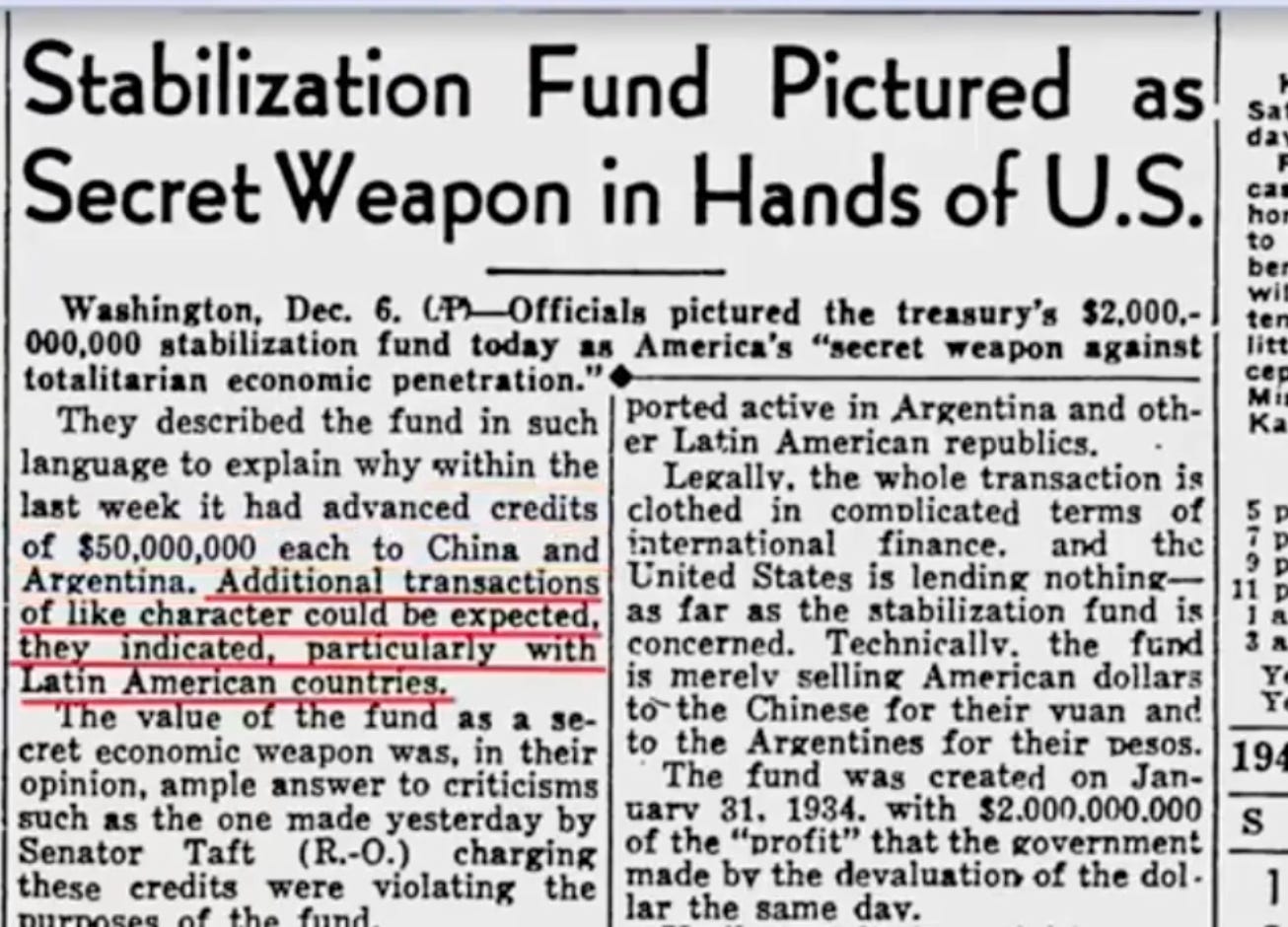
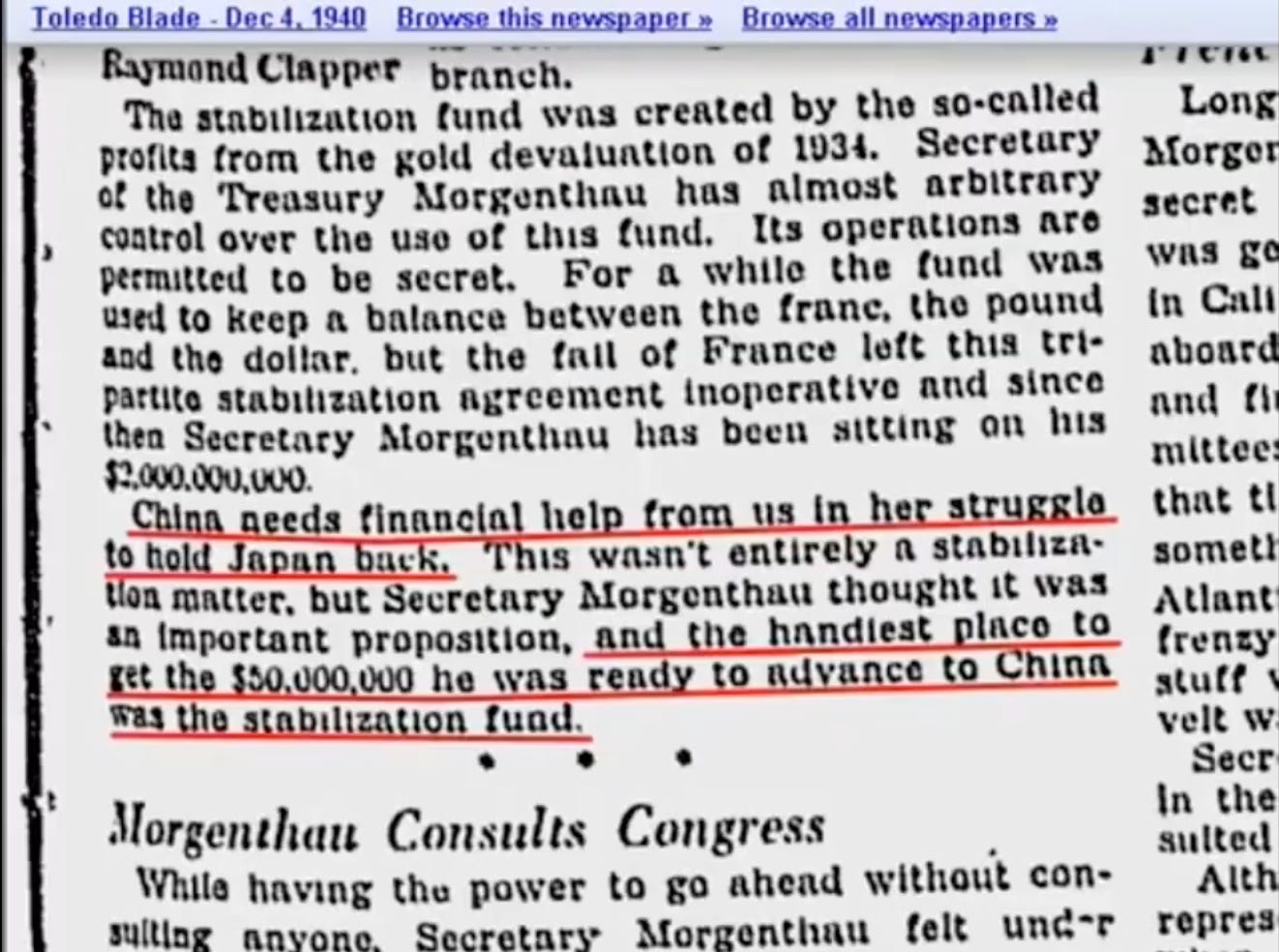
But the ESF wouldn’t just operate as America’s secret wartime weapon. It would go on to lay the foundations for the postwar Bretton Woods financial system.
Beginning in 1942, the Treasury laid out an ambitious postwar monetary blueprint proposing a $10 billion United Nations Bank (the future World Bank) and an $8 billion International Stabilization Fund (the future IMF). The chief architect of these plans was Harry Dexter White, who had overseen ESF wartime operations while also serving, among others, on the advisory committee of the Office of Strategic Services, America’s first intelligence agency and precursor to the CIA.
In De Carbonnel’s telling, White functioned as the ESF’s covert operative — less a conventional economist and more a specialist in slush funds and wartime financing.
White worked closely with Britain’s John Maynard Keynes to design the new system, but the two often clashed. From the outset, White favored a framework modeled on the ESF — built around a loan fund partly backed by ESF capital — rather than Keynes’s vision of an international central bank or clearing union. He also insisted on tougher terms for debtor countries, whereas Keynes argued that chronic creditors should be penalized as well. And while Keynes proposed a new global currency, the bancor, White wanted the system anchored to a gold-linked dollar.
The eventual compromise was a hybrid monetary order that blended the U.S. desire for stability and dollar leadership with the British desire for some policy flexibility and protection against deflation.
Still, the adoption of a dollar anchor meant that the IMF and World Bank ultimately functioned as vehicles for channeling large volumes of U.S. capital abroad, at times supporting covert Cold War initiatives. The ESF, for its part, remained the Treasury’s discretionary foreign-exchange reserve, serving as a rapid-response instrument to defend the dollar and maintain the fixed-exchange-rate system.
Black ops
Yet, as De Carbonnel notes, the ESF’s legal framework — which granted it extraordinary freedom from oversight — made it ideal for financing covert operations, supplying untraceable cash, and supporting the government’s broader black budgets.
It wouldn’t be long before it was engaging in all sorts of covert actions across the world. One of the first, according to De Carbonnel, involved providing $10 million in funding to help defeat the communists in the April 1948 Italian elections.
From there, De Carbonnel’s account veers into Tom Clancy territory, with many assertions difficult or impossible to verify. Important context here is that Frank Vanderlip, De Carbonnel’s most credible source, died in 1937, long before any of these actions took place. De Carbonnel’s French diplomatic relatives, however, were positioned in Poland in the 1950s and might have had unique personal insights of their own.
But the core of his argument is clear: the ESF oversees the U.S. government’s black budget by pooling funds from multiple sources and channeling them into covert operations. Beyond its own balance sheet, it allegedly shapes how IMF and World Bank loans are deployed for geopolitical aims and manages revenues from clandestine U.S. activities — including, at times, morally dubious but lucrative operations that Cold War exigencies were said to justify.
But De Carbonnel argues that this moral ambiguity began even earlier. He points to a 1941 provision of the War Powers Act that allowed the ESF to act as a holding pool for seized Nazi assets — a trove that, he claims, later became a clandestine source of funding for covert operations.
An intriguing aside, supported by my own personal family story, is the question over how the late Jan Kulczyk, Poland’s richest man, obtained the initial capital for his business empire in breweries, energy, and telecoms.
Officially, the money came from his father, Henryk.
But according to a story passed down from my grandfather, it was Henryk Kulczyk — a former member of the wartime Home Army — who somehow accumulated a substantial cache of gold in the immediate postwar years while running semi-clandestine supply routes between Poland and West Germany. As told by one of Henryk’s former associates, this gold may have been of Nazi origin and possibly the true source of Kulczyk’s early fortune.
That associate, who went by the very un-Polish nickname “Samos”, was a known peddler of valuables salvaged from abandoned German homes in Western Poland, and it is in this context that he somehow encountered Kulczyk. [Coincidentally, “Samos” was also the name of a top-secret U.S. satellite surveillance program targeting the Soviet bloc in the 1960s, declassified only in 2012]
It is well established that Kulczyk senior emigrated to West Germany in 1956, after running into trouble with the Poland’s communist authorities.
From that base, he and his son Jan founded Interkulpol in 1981, one of the first quasi–joint-venture trading firms allowed in communist Poland. The company imported chemicals and construction materials from West Germany, and by 1988 had become Volkswagen’s official importer and distributor in Poland.
Their real financial breakthrough, however, came in the 1990s, during the wave of large-scale privatizations that often required Polish heritage to participate. The Kulczyks capitalized on the moment, acquiring major stakes in former state enterprises, including the national telecom, TPSA.
For decades, Polish journalists wondered about the true source of the substantial capital that the Kulczyks invested at that time. Some speculated it reflected a privileged relationship with the communist-era security services. Jan’s firm apolitical posture both fueled and dampened such theories. Yet, what cannot be denied is that the Kulczyk enterprises benefited greatly from Poland’s capitalistic market opening and the international lending programs that accompanied it.
The story connects to the ESF because, according to Henning, Poland in 1989 was one of the few transparent examples of ESF usage in international diplomacy. “Rather than serving to check lending by the Treasury, members of Congress pressed the Department to lend to Poland in 1989 on a longer-term basis and argued that the Secretary had the authority to do so from the ESF,” Henning notes.
But the story also connects to another tale recounted by De Carbonnel.
Drawing on the book Legacy of Ashes, by New York Times reporter and Pulitzer winner Tim Weiner, De Carbonnel traces the ESF/covert operations nexus back to around 1948, when Defense Secretary James Forrestal and Allen Dulles realized they lacked sufficient private funds to run covert operations.
As the Weiner account goes, Forrestal and Dulles first solicited money from friends and colleagues on Wall Street and in Washington, but it was never enough. It was then that Forrestal went to his friend, Treasury Secretary John W. Snyder, and convinced him to allow the CIA to tap the ESF instead.
Shortly after, millions of dollars from the ESF found their way into the bank accounts of wealthy American citizens (especially Italian-Americans), who then “donated” the money to CIA-created political fronts.
By the early 1950s, Weiner writes, CIA leaders had become convinced that a robust anti-Soviet underground was forming in Poland under the name WiN — Wolność i Niezawisłość, or “Freedom and Independence” — and sought to support it. They believed “WiN inside” represented a formidable force: 500 fighters on the ground, 20,000 armed partisans, and as many as 100,000 sympathizers ready to resist the Red Army.
This intelligence came largely from “WiN outside,” a small group of émigrés in Germany and London. To fund the supposed resistance, the CIA launched an operation that air-dropped an estimated $5 million, including, among others, gold bars, submachine guns, rifles, and radios, into Poland.
The mission was a catastrophe. Communist security forces — aided by moles inside British intelligence — had already infiltrated the network and turned it into a trap. The airdropped funds were swiftly captured. As the broader story goes (told to me by other sources), many of these funds would eventually find their way into Swiss bank accounts and become the basis of the early eurodollar market.
These ever-expanding non-U.S.-bank-issued dollar liabilities famously operated beyond the Fed’s reach and would eventually underpin the global shadow banking system — aka the very same system that would need rescuing in 2008 with the emergency extension of the Fed’s dollar swap lines.
The shadow banking system
By the early 1960s, the massive scale of ESF spending on covert operations had led to enormous balance-of-payments deficits and a severe drain on the U.S. gold stock. Facing imminent dollar collapse, or so the De Carbonnel spin goes, the ESF began a desperate dollar defense, focused on borrowing, currency swaps, and derivative gambling.
Much of this borrowing came in the form of Roosa bonds, named after the Undersecretary of the Treasury, Robert Roosa. These were short-term, foreign-currency-denominated bonds issued by the U.S. Treasury and bought by several friendly foreign governments in the mid-1960s — often at yields equivalent to or lower than their own — as part of a coordinated effort to stabilize the dollar.
But it also came in the form of currency swaps with friendly central banks and direct interventions in the forward market, with the Fed acting as its agent, selling foreign currencies it didn’t yet possess. Those forward positions eventually led to heavy losses and pushed the ESF’s capital deep into the red.
Yet, negative capital wasn’t enough to stop ESF operations. After the Nixon shock severed the gold link and devalued the dollar, the ESF was able to benefit from the resulting large revaluation gains and return to its old operating mode. This, as it were, marked the beginning of Paul Volcker’s famous “non-system”, which would see other countries, notably Japan and China, engage in similar monetization and reserve-accumulation plays of their own.
The difference is that they would invest the proceeds in domestic overinvestment and export dominance, rather than in international stabilization operations, aid programs, international bases, wars, or international investments. In China’s case, however, things are now clearly moving in that direction too.
In a contemporary echo of the Roosa-bond era, it’s also worth noting that the Chinese government has recently been issuing USD-denominated bonds — sometimes through financial centers like Paris or Riyadh — at interest rates below what Washington itself pays to borrow dollars. The geopolitical context differs, but the mechanism is familiar: a sovereign is issuing foreign-currency debt not to fund domestic spending but to support its exchange-rate strategy, while foreign investors are accepting unusually low yields because the arrangement serves larger macroeconomic or political goals.
Returning to South America, De Carbonnel argues that after the Nixon shock severed the link between U.S. deficits and inflation, vast quantities of U.S. currency “went missing” overseas, ending up in foreign hands throughout the 1970s and 1980s. Some of those dollars, he claims, were funneled abroad to finance the Reagan Doctrine — consisting of destabilizing operations in places like Nicaragua, and yes, Iran-Contra — with the ESF allegedly serving as the financial conduit.
In a plot twist that sounds like a page from Jay Newman’s Undermoney, De Carbonnel also claims that much of this money became tied to the cash smuggling operations that underpin narcotics and weapons trafficking. This is because, as the U.S. Treasury intensified its anti-money-laundering pressure on banks, launderers had no choice but to shift to moving physical dollars, which, in turn, helped dollarize swaths of the global underground economy. In regions entwined with the drug trade, the U.S. dollar became the de facto medium of exchange.
From here, De Carbonnel’s claims turn increasingly outlandish. He speculates, for example, that it may even have been the ESF that was behind the so-called “Super Dollar” — a counterfeit $100 bill series so technically flawless that some have long suspected official involvement. The other contentions aren’t worth mentioning.
Back to Argentina
The message is unsubtle: the United States is increasingly willing to use its stealth dollar machinery in plain sight to crowd out Chinese swap lines in its own hemisphere. But this time, if Scott Bessent’s proclamations about “the fentanyl scourge” are to be believed, the intention isn’t to enable narco-dollarization but to stamp it out, in favor of shoring up a capitalist experiment that could, if it works, serve as a template for wider reform in South America. For once, the argument is not that the ESF does not exist, but that it should be used — and judged — as a political instrument in a strategic contest over values and economic ideologies.
Once the scope and detail of the Argentina agreements become public, we’ll have a better clue of the agenda. But if there’s conditionality at play, we’ll bet it involves pushing China out of the country or having Argentina adopt the dollar more explicitly, less so bailing out Bessent’s hedge fund mates.
None of this absolves the ESF of its history. The same opacity that made it invaluable in World War II clearly also enabled morally corrosive operations during the Cold War and beyond.
The fund is not inherently virtuous or evil. It is, as De Carbonnel accidentally reveals, an amoral technology: a legal and institutional hack in the U.S. system that amplifies whatever values and incentives are wired into it at a given moment.
All one needs to remember is that it’s currently under the control of one Donald J. Trump.
UPDATE: The piece has been updated to clarify that the ESF cannot initiate swap lines, only FX swaps, and that the Fed’s historical accommodation of the U.S. Treasury on swap-line matters reflects convention rather than legal obligation. Whether the Fed’s authority to act entirely unilaterally would withstand a formal challenge remains untested.