
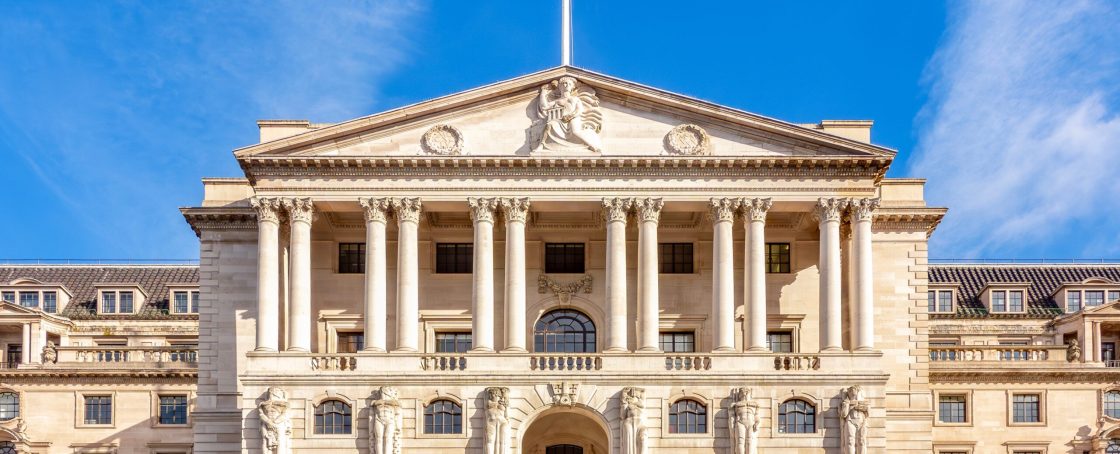
The Bank of England revealed its long-awaited stablecoin strategy on Monday, with most coverage focusing on its decision to apply a £20,000 per-coin holding limit for retail users.
But that headline missed the real story.
Beneath the cautious tone lies one of the most radical monetary reforms in decades: the first step toward a segregated payments infrastructure, where the float that underpins money transmission can be managed independently from the credit system that funds the economy.
Far from a clampdown, the new framework also quietly opens the door for sterling-denominated stablecoins to access official central bank liquidity — a concession no other major jurisdiction has yet made.
That is a profound shift from the earlier stance that treated stablecoins strictly as private-sector payment instruments with no call on public liquidity.
As Varun Paul, a former BoE official now at Fireblocks, put it in an emailed statement: “The fact that the Bank is considering a liquidity facility is probably the most powerful statement here.”
The absence of specifics notwithstanding, the direction is unmistakable: the BoE is co-opting systemic stablecoins into the formal liquidity safety net — under robust constraints.
Leading up to the announcement, there had been speculation that the Bank — and, notably, a wary Governor Andrew Bailey — was under pressure from U.S. crypto firms and the U.S. Treasury to align its stance more closely with America’s proposed GENIUS Act. The areas of friction centered on holding limits and the earlier insistence that 100 percent of reserves be held as central bank deposits.
The compromise the Bank produced, however, is characteristically of the City — modest in presentation, radical in implication. While retail holdings are capped at £20,000 per coin and corporates at £10 million, the “per coin” framing means overall access remains effectively unlimited.
With respect to asset composition, meanwhile, the Bank has backtracked on its previous recommendation and is now signaling a framework wherein 40 percent of deposits are to be held as central bank deposits and the remaining 60 percent can be invested in short-dated government debt.
Overall, it’s quite a clever compromise. The BoE is okaying the rollout of stablecoins in a potentially unbounded way, provided market growth is highly distributed and avoids market concentration that could one day create a too-big-to-fail problem.
Another notable feature of the proposed regime is the Bank’s willingness to build in explicit exemption pathways. Indeed, the BoE repeatedly signals that it may waive or modify certain obligations where doing so supports innovation or where rigid compliance would impose unnecessary frictions without adding stability. In practice, this means systemic stablecoin operators could obtain relief on aspects of backing-asset composition, operational risk buffers, or reporting schedules — provided the BoE is satisfied that equivalent protections are maintained. The existence of such escape valves underscores how the Bank is trying to cultivate a supervised, adaptable ecosystem rather than impose a monolithic rulebook that may quickly become obsolete in a fast-moving market.
In that vein, the Bank’s consultation paper specifically describes the holding limits as “temporary,” to be loosened as the market matures and risks subside. This suggests Threadneedle Street knows there’s no stopping the stablecoin juggernaut but its aim is to choreograph a smooth, supervised transition to a more tokenized future while preserving what it calls the “singleness of money.”
“The Bank has a low risk appetite for a significant shift away from settlement in central bank money towards settlement in privately issued money,” it warns.
Most intriguingly, and for the first time, the BoE hints that some degree of separation between payment and credit money might not be all bad.
This, however, isn’t explicit. The inference is detected in how the Bank seeks to reconcile the opposing forces of innovation and protectionism.
On one hand it warns there may be costs for the wider economy if payment infrastructure is decoupled from credit provision. On the other it resigns itself to the reality that the shift is happening no matter what, and that it is better that the Bank ensures the transition happens gracefully than not at all.
“As systemic stablecoins gain traction, there could be a reduction in bank deposits as funds are increasingly allocated to stablecoin-based activities. The degree to which this decoupling of payments and credit takes place could reduce the availability of bank funding… Given the important role of the banking sector in providing credit to households and businesses in the UK, it will be crucial to ensure that the transition does not cause undue disruption to the supply of credit and to support the real economy as it adjusts.”
Some yet-to-be acknowledged realities of 2008 may play a role here. Back then, both the Bank and the government had no choice but to backstop the financial system because credit losses had become entangled with the payments system.
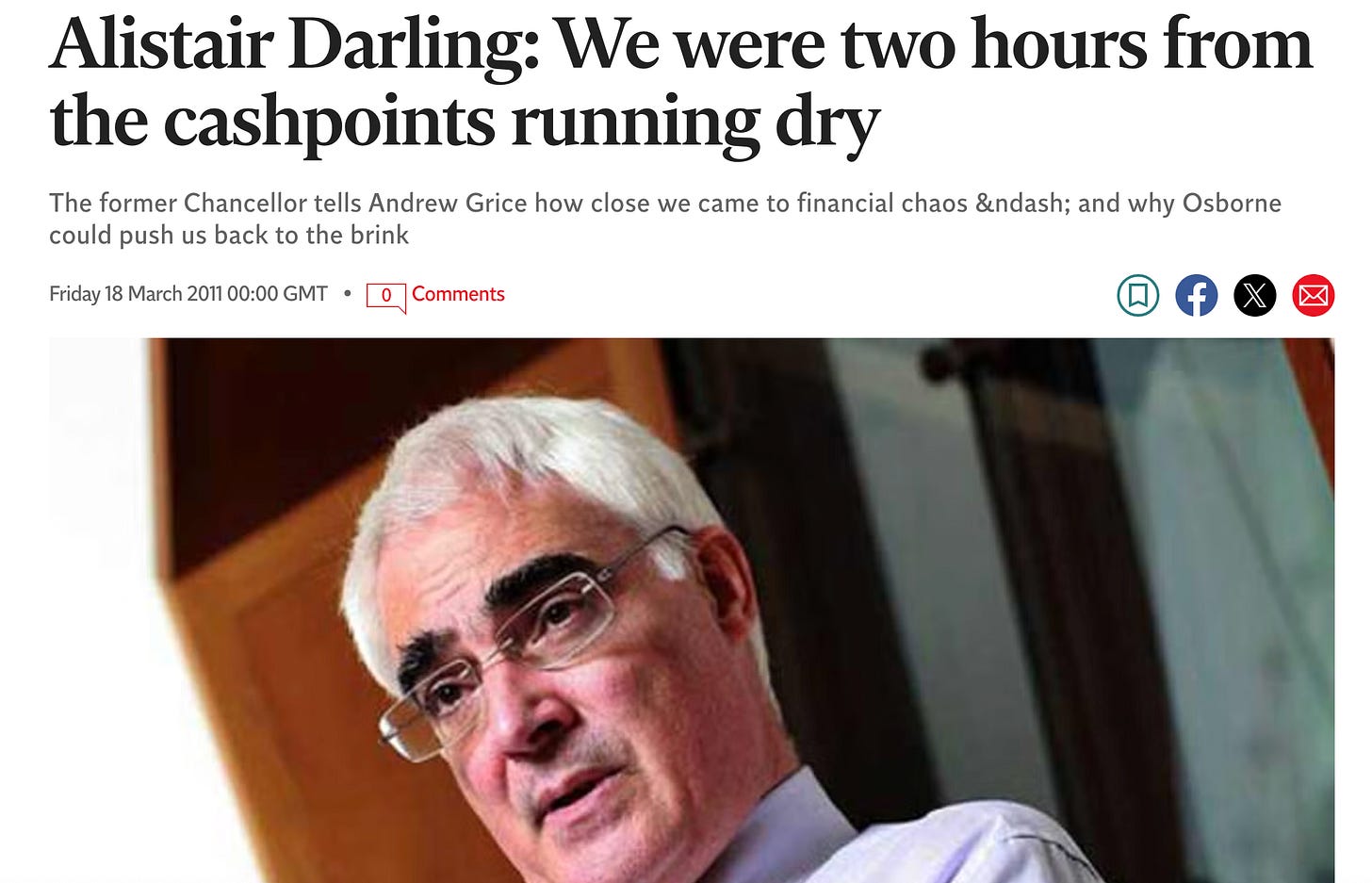
As then-Chancellor Alistair Darling realized during the RBS crisis, the immediate fear wasn’t just bank losses — it was that ATMs could run dry and the international settlement system could seize up if a major institution failed. Credit losses had become so entangled with payments plumbing that the state had to backstop both.
The BoE’s new stance implicitly targets that vulnerability. Whether intentionally or not, it de facto ring-fences the payments float from credit risk so settlement can keep running via stablecoins even when bank balance sheets wobble.
Yet that insulation cuts both ways. By moving to safeguard the payments layer in this way, the Bank also acknowledges it risks introducing the very depositor shifts that stand to unsettle banks in the first place.
“As systemic stablecoins gain traction, there could be a reduction in bank deposits as funds are increasingly allocated to stablecoin-based activities,” the report says. “The degree to which this decoupling of payments and credit takes place could reduce the availability of bank funding … Given the important role of the banking sector in providing credit to households and businesses in the UK, it will be crucial to ensure that the transition does not cause undue disruption to the supply of credit and to support the real economy as it adjusts.”
Intellectually, the recommendations channel the thinking of economist Gary Gorton who has long argued that monetary systems are more resilient when “information-insensitive” payment money is insulated from credit risk. If stablecoin reserves are properly ring-fenced, the payments float becomes structurally safer, allowing the credit system to fluctuate without threatening settlement continuity.
But it also means banks will no longer be able to tap the payments float to fund their credit businesses. The obvious risk here is that this makes funding more costly for banks, and encourages credit to be pulled back from the real economy. In practice, capital and leverage rules implemented after the crisis already contributed to that effect years ago. Moreover, under the proposed regime, banks may be able to offset some of those costs with additional savings derived from greater usage of public blockchains.
To be clear, that’s not because public blockchains are necessarily more cost efficient than prevailing bank settlement systems. The cost advantages arise because under a stablecoin framework banks can pass on payment-system operating costs — and any associated liquidity exposures — to the speculators who fund and backstop blockchain systems.
Banks are not entirely off the hook for bearing payment costs under the proposed regime. The Bank would like to keep key interbank transactions settling “as is” to ensure the monetary system remains under its direct influence.
No more tragedy of the commons?
Arguably, the most profound structural shift comes by way of the Bank’s quiet acknowledgement that the payment system is a type of public good which must not be opportunistically exploited by those with privileged access to it.
In that vein, the Bank proposes that all stablecoin reserves that are held as central bank deposits go entirely unremunerated. Ouch. “Since participation in the transmission of monetary policy is the primary rationale for remunerating central bank reserves held by commercial banks, the Bank therefore proposes that the central bank deposits held by systemic stablecoin issuers as backing assets should not be remunerated,” it says.
If adopted, that single clause should quietly rewire the logic of monetary transmission. By withholding interest on stablecoin reserve accounts, the BoE effectively removes the cost of maintaining payment float from the broader financial system. This means that if the Bank ever needs to expand its balance sheet again to fend off a payment system gridlock crisis — via QE or other liquidity injections — it won’t face the same losses from remunerating excess reserves. The float supporting stablecoins will sit idle, zero-yielding, and costless to the taxpayer, with the Bank/public purse the exclusive beneficiary of the seigniorage and interest spread derived from such sums.
This is precisely the sort of structural reform BoE veterans Paul Tucker and Mervyn King champion: reducing the interest burden paid to banks while making the plumbing of payments more efficient. In the proposed set-up, payments float would no longer cost the system, and the infrastructure would, as mentioned above, be partly underwritten by the speculators who maintain permissionless blockchain networks.
This is in fact a throwback to the very earliest settlement structures, wherein the state exclusively drew on the profit drawn from issuing coins and notes at a higher face value than their material worth. This was known as seigniorage revenue. Banks in such regimes could not generate income or yield by simply accumulating the float and sitting on it. They had to take active relending risk in order to create returns. In the case of metallic coins, specifically, the liquidity risk was taken by speculative commercial entities prepared to invest in digging up new supply or in hoarding existing supply at cost.
The Bank also signals new thinking on crisis management. In one of the most revealing sections, it highlights how stablecoins could incentivize banks to adapt emergency liquidity protocols more broadly.
“In previous stress scenarios, such as the global financial crisis, we observed depositors rapidly moving funds from some banks into other banks which were perceived to be safer, as well as into cash and other safe assets. In future banking stress, digital money could provide additional perceived safe havens… The banking sector could prove unprepared to withstand rapid large outflows of deposits… Over time, banks would be able to take steps to ensure operational readiness, such as pre-positioning collateral to enable borrowing from the Bank during periods of stress.”
This “pre-positioning” is crucial. It signals a systemic redesign where stress liquidity can be managed via diversified collateral — not just high-quality liquid assets (HQLA) — thus making the system less dependent on procyclical asset classes. It also hints at a more active role for the Bank as liquidity coordinator in a multi-tiered money ecosystem.
The viability factor
Stablecoin issuers had argued that if they could not hold interest-bearing assets, as proposed in the original BoE guidance, their models would be unworkable.
The Bank’s response is both pragmatic and forward-looking: it acknowledges that prospective stablecoin issuers are currently only attracted by the short-term promise of being able to harvest the difference between what tokens pay to depositors (zero) and what they earn on underlying assets (the prevailing short-term interest rate).
But it also recognizes the need for issuers to look beyond short-term gains. Positive interest rates may make the business attractive now, but those conditions aren’t guaranteed to last. Issuers, the Bank suggests, will be better off considering more adaptable and resilient business models that can withstand a collapse in interest rates.
“Lower interest rate levels would reduce their income significantly and could make those business models that are overly reliant on income from backing assets unviable… We encourage focusing stablecoin business models on the generation of revenue by payments-related activities and building new use cases that drive efficiency, reduce cost, and enhance functionality.”
In other words, “don’t extract rent from interest-bearing float; build real functionality.” The most obvious of these would be two-sided models that monetize customer transaction data or offer surveillance services.
There are limits to that sort of opportunism, of course. The Bank, for instance, cautions issuers against offsetting operational costs by imposing premium redemption fees when liquidity conditions are tight.
“Fees should not be used as a mechanism to disincentivise the redemption of the coins,” the Bank says, adding that “issuers must not use fees to pass on any costs or losses arising from the sale of assets in the backing asset pool as part of meeting redemptions.”
What it doesn’t explicitly rule out is using gifts or good-based compensation mechanisms as part of alliances with retailers or service providers to dissuade depositors from liquidating. Imagine, as an example, a grocer who deters redemptions by offering flash in-store discounts to those who pay with the store’s native stablecoin.
But perhaps the bigger story lies in what the Bank leaves unsaid. There is, for example, a striking lack of commentary about restrictions on multi-issuer stablecoins or detailed rules for non-sterling stablecoins. Does that mean the Bank is okay with them? Could be.
“Since the publication of our discussion paper, we have further considered our approach to non-sterling-denominated stablecoins that could become systemic in the UK. As with sterling-denominated systemic stablecoins, they may pose risks to financial stability, and we have been considering how best to mitigate these risks.”
This suggests the Bank isn’t frightened that USD stablecoins bring forth dollarization by stealth, either because it believes sterling is far too entrenched to be knocked off its perch (especially in light of the lender of last resort advantages sterling stablecoins will benefit from) or because it doesn’t mind if some sectors do become more dollar dominated.
The takeaway, either way, is that the BoE’s new regime is as much about re-engineering the monetary system’s plumbing for a post-QE world as it is about quelling the risk embedded in privately-issued stablecoins.
Stablecoins, far from being an existential threat, are being conscripted into that redesign.
In short: the Bank of England is not fighting stablecoins. It may in fact be attempting to co-opt them in its unique very British way.

One Response