As mentioned in Spot Markets Live on Monday, lots of people are talking about this chart tracking Fed remittances to the Treasury.
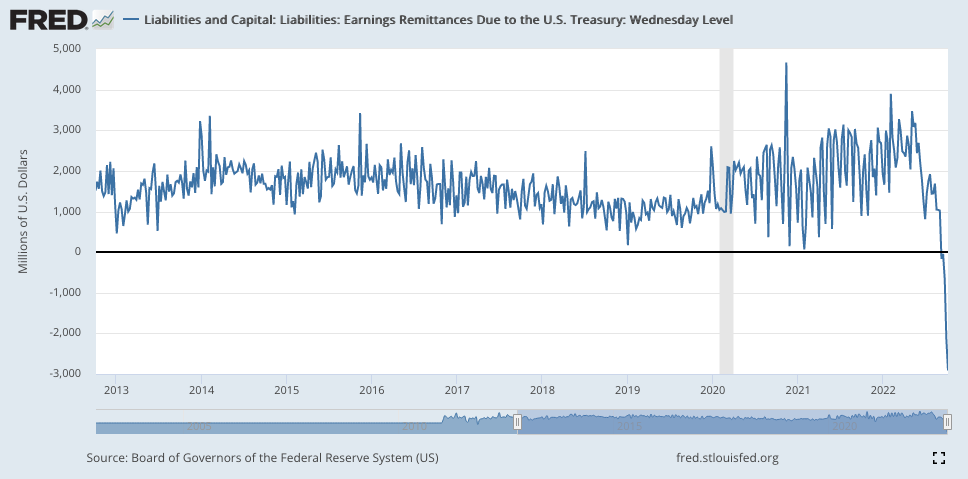
The striking collapse into negative territory since the summer is a function of the Fed finally having to materialise losses on the assets it purchased post-2008 as it unwinds QE. Does it mean that the Fed, as well as many other central banks, are now poised to go into permanent negative equity? And does that in turn mean taxpayers will once again be on the hook for losses?
The real expert on such issues is Willem Buiter, formerly chief economist at Citi as well as a former member of the Bank of England’s monetary policy committee.
His original thinking on the topic hails from a 2008 paper called Central banks and financial crises in response to the circumstances surrounding the bailout of Bear Stearns. But it wasn’t until February 2012 that the former MPC man once dubbed Maverecon went deep into the issues that may or may not come about if a central bank such as the ECB was to incur a loss.
How seriously such losses are treated, as my former colleague Tracy Alloway explained in 2011, turns out to be mostly a matter of accounting conventions. Buiter’s take is similar to hers:
The ECB is exempt from regulatory capital requirements and from complying with externally set accounting rules. It could run on negative equity or ‘evergreen’ its exposures indefinitely.
If hypothetically the ECB did make a loss, Buiter’s take on what we might expect is as follows (our emphasis):
5.1. What happens if the ECB makes a loss? Would it default?
The ECB is not subject to either regulatory capital requirements or national or international accounting rules (statutory or otherwise). That means that the ECB could choose to realise losses and potentially run with negative regulatory equity should the losses exceed its on-balance sheet loss absorption capacity. Or the ECB could choose to ‘evergreen’ its exposure indefinitely, for example, by recording assets at purchase prices even if these assets are non-performing or in default.
The ECB is exempt from the EU’s Capital Requirements Directive (CRD). The ECB does have two obligations to submit to external auditing. One is to an independent external auditor recommended by the Governing Council and approved by the European Council to audit the ECB’s accounts.
3But this audit is not consequential in the sense that even if the auditor did not sign off on the accounts, such a judgment would not carry any corrective or enforcement implications (though it may clearly have reputational effects). On top of that, Article 26 of the ECB’s Statute makes clear that it is the ECB GC that determines the ‘principles’ according to which the annual accounts of the ECB are drawn up, and it is the GC that approves the accounts. The auditor is thus there to check that the ECB conforms to its selfimposed rules. The second auditing obligation is to the EU’s Court of Auditors, but this obligation only applies for ‘examination of the operational efficiency of the management of the ECB’.
And as he went on:
That negative equity or endless evergreening are possible for the ECB does not mean that they are likely. The ECB has realised losses on its exposure in the past. In fact, there is a more or less standard procedure in place to deal with losses: In the event of a loss, the ECB first reduces its so-called ‘risk provision’. Once the risk provision is exhausted, the remaining losses are deducted from the ECB’s general reserve. Provisions and the general reserve are built up over time out of retained profits to guard against potential losses but are capped at 100% of the level of the ECB’s regulatory capital (the Statute is not quite clear whether that is the subscribed capital, currently €10.8bn, or the paid-up capital, currently €6.4bn to go up to €7.5bn by end-2012).
The ECB Statute prescribes that up to 20% of the profit of the ECB/Eurosystem can be transferred to the general reserve, with the remainder of the profit to be distributed to the NCBs, but profits are only calculated after additions and subtractions to the risk provision are accounted for. The risk provision was thus created to allow the ECB to build up reserves more quickly than the general reserve. Once the risk provision is exhausted, losses will be deducted from the general reserve, and only then against the monetary income (see footnote 36).
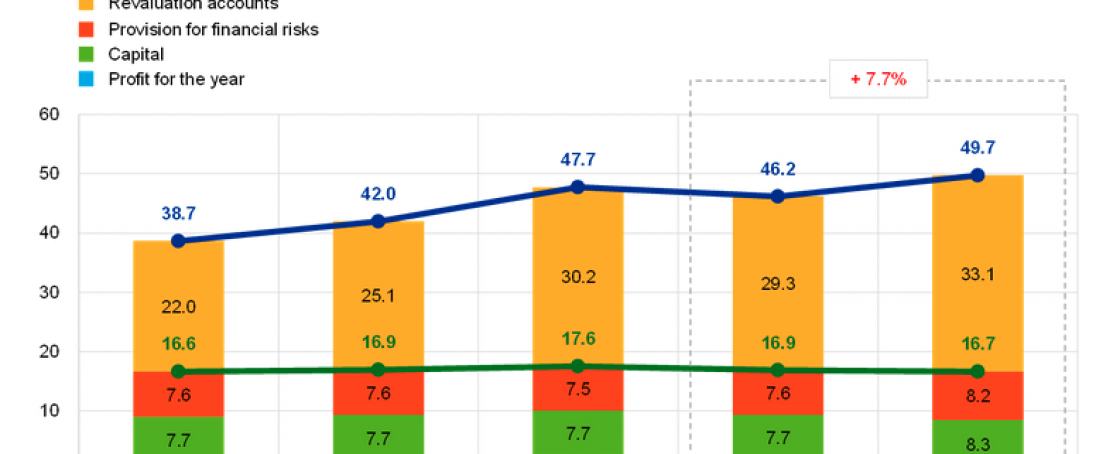
The reference to the risk provisions is key. In the case of the ECB, those provisions looked like this in the last annual report:

The growth in the buffers, it turns out, also helped to offset falling profitability elsewhere. As the ECB noted:
As at 31 December 2021, the ECB’s financial resources totalled €49.7 billion (Chart 11). This was €3.5 billion higher than in 2020 owing to increases in (i) the revaluation accounts following the appreciation of the US dollar against the euro as well as the rise in the market price of gold in euro terms in 2021, (ii) the paid-up capital and (iii) the provision for financial risks[12]. These increases more than offset the lower profit in 2021 compared to 2020. These increases more than offset the lower profit in 2021 compared to 2020.
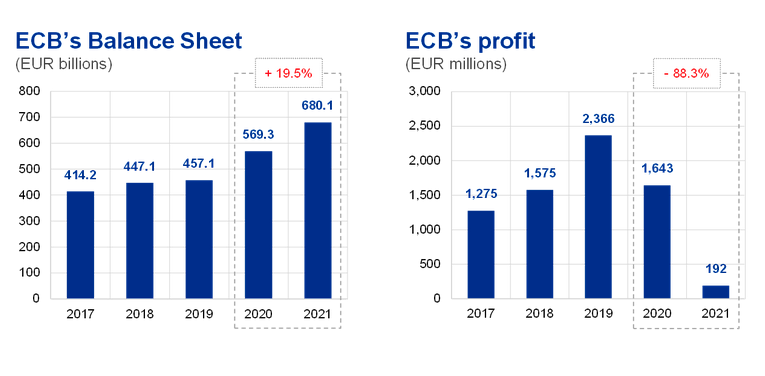
As rates begin to rise and the difference between the cost of funds on the ECB’s liabilities and the returns on its assets widens further losses are likely for the ECB’s balance sheet, says the Official Monetary and Financial Institutions Forum (OMFIF). What’s more, the ECB has explicitly recognised this. For the most part, risk provisions will be there to absorb the worst of the losses. But once these buffers are eroded, the ECB may have no choice but to turn to direct income to balance the accounting. After that, the next stage is borrowing from the ECB’s own hypothetical future income. Or as the OMFIF puts it (TBS emphasis):
Unlike commercial banks, central banks cannot take offsetting financial measures to hedge against or prevent such losses from occurring. Instead, they have to make risk provisions. The ECB making a loss can be offset by the general reserve fund first and foremost. In the most recent annual accounts, this fund was equal in size to the ECB’s capital buffers. Failing this, the loss can be offset ‘against the monetary income of the relevant financial year’ according to the capital key. Should this be insufficient, the ECB notes that losses can be ‘recorded on the ECB’s balance sheet, to be offset against any net income received in the future,’ much in the same way the Federal Reserve has accounted for ‘deferred assets’ on its QE portfolio.
But it’s not all doom and gloom. OMFIF says several central banks – including those of Switzerland, Sweden, Chile and Slovakia – have operated with negative equity in the recent past and survived quite happily.
What will prove trickier for the Eurozone is any variance in the size of the losses generated by the respective national central banks that make up the Eurosystem. The question then will be how the ECB might distribute such losses across the wider system. Would the periphery central banks, for example, be happy to absorb negative equity from Bundesbank? Probably not.
But while none of this is optimal, one needs only to look to crypto platforms like Bitfinex and BitMEX to see how institutions with the power to print their own money can handle negative equity events quite. Many crypto companies have resorted to very similar structures to fend off liquidity events or offset losses generated by cyber hacks. Success has been variable, but not zero.
Either way, in the short to medium term, keeping an eye on the capitalisation of central banks is probably a good idea.