

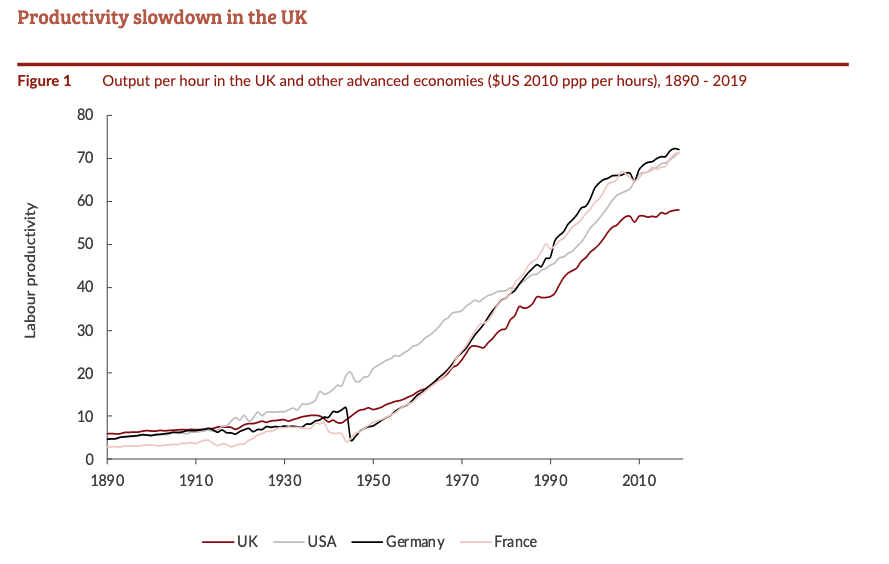
Productivity has been faltering in the UK since at least 2008. We know this because the UK’s Productivity Commission says so.
That’s not to say the UK is alone here. Productivity rates have been falling all over the western world. It’s just the situation in the UK is particularly bad, for reasons not properly understood but often cited as being linked to our service-intensive economy and globalisation. The Robert Gordon thesis – that all the low-hanging productivity gains have now been picked and extinguished – may also be a contributing factor. Either way, something significant has clearly been holding productivity back.
I like to think of the UK’s problem as also being linked to its position as “outsourcer in chief”. This, to me, is a function of the UK’s heritage as a former colonial power, its timezone geopositioning, and the dominance of the English language in the global economy, all of which make the UK uniquely suited to offshoring core economic activity. This is important because when times are tough, especially in a globalised economy, the configuration of economic incentives is such that those who can outsource do outsource. It makes sense, therefore, that the 2008 crisis would have magnified these forces.
Since the UK outsources more than anyone, this has transformed the UK’s domestic economy into a consumption-intensive one. Where there is “productivity”, it has more often than not been relegated to high-tech industries centred on resolving administrative or bureaucratic challenges rather than manufacturing ones. This creates its own vicious circle.
As an indicator, here’s a chart from the Productivity Commission’s first publication, which illustrates the scale of the UK lag:
And yet, there could be hope on the horizon for productivity.
As the Sunday Times’s David Smith noted this past week, a stagflationary crisis could be the very thing we need to boost productivity over the short to medium term. This may seem counterintuitive but, actually, – if we assume what’s really holding productivity back is the West’s consumption-oriented economy – there’s a lot of logic behind it.
The bigger issue may be what happens if the powers-that-be misinterpret how and why such a boost comes about and inadvertently move to stifle it.
The bureaucratic state
To understand the bigger picture, one first has to understand that there is a prevailing bias in the system that assumes only good things have stemmed from greater connectivity, computer technology and globalisation.
This certainly makes intuitive sense.
Computers and apps make everything quicker. Better. Faster. Globalisation, meanwhile, allows businesses to access every corner of the world, which brings with it the opportunity to scale up operations and apply savings and efficiencies thanks to specialisation.
To suggest otherwise would be hugely illogical. Possibly even mad.
But if productivity begins to pick up in the context of a suddenly deglobalising and fragmenting world – as well as a commodity crisis – it might be the strongest signal yet that the economy doesn’t necessarily work the way we think it does.
Notably, it might imply that the information-technology-supported globalised system we have created, far from being a guaranteed generator of efficiency and progress, needs to be configured alongside productive incentives that give individuals a sense of positive-sum contribution to the economy. This is to ensure that it doesn’t descend into a dystopian bureaucratic totalitarian surveillance state that is only interested in managing consumption.
This is hugely counterintuitive. Nevertheless, a good way to think about it is from the point of view that just doing things more quickly (which is often what information technology allows) does not always translate into doing them better. This is especially the case if the time saved is wasted on less productive activities (or more leisure) or introduces new problems that inevitably need resolving instead. Another key point is that information technology can empower both positive-sum forces in society as well as negative-sum ones. If you’re doing something wrong or potentially worthless more quickly, you will just do more of that worthless or bad stuff. That is not necessarily productive.
So yes, positive-sum workers benefit from email, iPhones, Slack, and accounting software. But so do negative-sum hackers and criminals.
If that’s the case, a lot of the gains generated by IT might end up being a wash, with the added complexity merely masking underlying inefficiency and a net-net consumption increase relative to production. Our continuing failure to understand these counterintuitive effects may be a key factor dragging productivity down.
Hyper-scaled stagnation
We know hyper-scaling business opens the door to the creation of oligopolies and monopolies. What is less appreciated is that it also puts off investment in menial-labour-saving innovation.
A small or medium-sized operator who is focused on differentiating himself in the market via quality or convenience is often disadvantaged by his lack of scale. The average employee at such an organisation is usually responsible for a much greater number and variety of tasks than in any comparable large-scale organisation, which impacts overall output per hour worked or per dollar invested. Even at a fairly vanilla manufacturer (say an artisanal type), most workers are likely to be involved in both manual and intellectual/administrative work.
At some point, however, if such an operator wants to grow, they face a choice: they will have to invest in additional labour or technology.
When menial labour is cheap and plentiful, and intellectual labour is expensive, the temptation is always to invest in human labour to take care of menial tasks and computer software to take care of intellectual ones.
Scaling of the business proceeds in this fashion. Intellectual workers – who mainly deal with bureaucracy, managerial or cultural tasks – are soon crowded out in favour of menial labour. The fewer intellectual workers there are, the greater the number of cheap, menial labourers can be hired per intellectual worker in the business. All well and good. Except, over time, the elimination of bureaucracy/management usually begets complexity and the creation of new bureaucracy/management. At this point, the need to hire expensive intellectual workers to oversee the growing complexity of the system re-emerges.
New bullshit jobs (to use the late anthropologist David Graeber’s term) thus end up being created to replace the redundant ones. The reason nobody recognises this as a perpetual vicious cycle, however, is because the purpose of the jobs – consumption management – is too often conflated with being a productive activity when really it is not.
At this point, productivity at the firm begins to suffer because output continues to be measured in concrete product or service terms. You’ve got more menial workers, but you’re back to where you started with intellectual workers. What’s more, you still have to fund the technological investment that got you to this point. And yet, how much bureaucracy or administration has tangentially been reduced up to this point is actually irrelevant.
It matters not, in other words, that 40 years ago, you may have needed 20 typists, 10 telephone operators, and two clerks to oversee a core menial labour force of 100 people, whereas now you only need two workers to do the same level of administration. That is because, on top of that, you now need 20 IT help desk operators, 10 social media managers and two compliance officers…it’s all a wash.
The prosperity trap
If our hypothesis is correct, automation and globalisation alone can’t help boost productivity. The type of work being automated really matters if it’s going to make a difference. Applying these forces to consumption activity, on the contrary, only intensifies the wealth-destroying forces because it skews towards lowering consumption (and thus wealth) as a whole.
Consumptive or bureaucratic/regulatory work must be differentiated from the truly productive sort.
To explain more concretely, it’s worth citing James Goldsmith’s The Trap (1993), on why the fundamental logic behind David Ricardo’s theory that specialisation and comparative advantage doesn’t always apply:
For example, take two enterprises, one in the developed world and one in Vietnam. Both make an identical product destined to be sold in the same market, say the USA, Great Britain or France; both can use identical technology; both have access to the same pool of international capital. The only difference is that the Vietnamese enterprise can employ forty-seven people where the French enterprise can employ only one. You don’t have to be a genius to understand who will be the winner in such a contest.
High-tech industries can, indeed, survive and prosper under these circumstances, for the very reason that they are highly automated and therefore employ few people. Labour is no more than a minor item in the overall cost of the products they make. But obviously they cannot compensate for the lost manufacturing jobs: the fact that they employ few people means that they are incapable of employing very many. As soon as they need to employ a reasonable number, they will be forced to move offshore.
This amounts to a self-limiting trap by design.
Cheap labour jobs focused on productive activities are forced abroad to take advantage of even cheaper labour (delaying their automation). Expensive bureaucratic or management jobs, are retained at home but only for as long as there aren’t too many of them. As soon as they become too plentiful, however, they too are outsourced offshore or automated away but only until they become reinvented in some other way.
A good example of this is the outsourcing of call centres to India. The process may briefly boost margins for UK corporates, but in the grand scheme of things does little to expand the domestic pie. By making a large section of UK employees redundant, it instead forces populations onto welfare while increasing the attraction of predation/speculation to compensate for the lack of opportunity. Where job creation does occur, it focuses instead on welfare or consumption/security management to compensate for the former effects. All of this leads to ever lower productivity, regardless of how much IT you throw at the problem.
Since none of these jobs can add efficiency without reducing outright consumption or downsizing populations, everything ends up instead being geared around rationing goods ever more intensively. The end effect drives wages ever lower or encourages cheaper workers from abroad into the remaining service jobs that cannot be outsourced abroad.
This is why Goldsmith argued there was a need to differentiate productive economic activity from pure consumption (our emphasis):
A nation’s economy is split into two broad segments, one which produces wealth and the other which dispenses it. That in no way means that the latter is inferior; it includes such vital activities as health and education. Despite the fact that both kinds of activities are measured by GNP, one cannot reduce that part of our economy which produces wealth and expect to be able to maintain the other part which dispenses it. You must earn what you spend.
Consumers are not just people who buy products, they are the same people who earn a living by working, and who pay taxes. As consumers they may be able to buy certain products more cheaply, although when Nike moved its manufacturing from the US to Asia, shoe prices did not drop. Instead profit margins rose. But the real cost to consumers of cheaper goods will be that they will lose their jobs, get paid less for their work and have to face higher taxes to cover the social cost of increased unemployment. Consumers are also citizens, many of whom live in towns. As unemployment rises and poverty increases, towns and cities will grow even more unstable. So the benefits of cheap imported products will be heavily outweighed by the social and economic costs they bring with them.
A high-tech capital expenditure sink-hole
If intellectual tasks (due to the nature of bureaucracy) continue to grow exponentially while menial tasks stay linear, in the long run, margins can only be generated by taking on more menial labourers relative to intellectual workers. For as long as the pool of cheap global workers remains abundant, there is little incentive to invest capital in automating such jobs away. This stagnates productivity.
The remaining intellectual jobs, meanwhile, become a kind of capital expenditure sinkhole. No matter how much money a corporation throws at downsizing these jobs, it’s never enough. The bureaucracy or admin these jobs are addressing always reemerges. Entrepreneurs instead become obsessed with trying to reduce or solve the bureaucracy problem – wasting ever-larger amounts of capital on the problem – not realising everything amounts to a Sisyphean paradox. The bureaucracy is structurally baked into the system for a reason.
Unsurprisingly organisations deal with this challenge by seeking to hyper-scale their businesses. All investment is soon geared around the unicorn model in the hope that the teeny tiny margins that can be extracted, can still be worthwhile if hyper-scaled. This is especially the case in highly competitive sectors like food management, agriculture or taxis.
But all this emulates is a type of medieval serf structure, or would-be imperial system, where a small body of elites dominate an ever-expanding pool of menial labour that they directly influence and control.
This, arguably, is where we are now.
Despite all the hype about AI and information tech (and all the fear about intellectual workers being displaced by algorithms), in reality, elite jobs never end up being automated away because new “first world problems” are always recreated for elites to manage. What does change is their expanding global influence and reach.
Necessity is the mother of invention
The hypothesis we have outlined centres on the following rule of thumb: Algorithmic resolution of bureaucracy only begets more bureaucracy because the bureaucracy in a consumption-oriented economy is a feature, not a bug focused on managing consumption.
To back this thesis up, it’s worth flagging some academic evidence that supports it. One paper that has had a profound influence on this theory is The Paradox of Civilization: Preinstitutional Sources of Security and Prosperity, by Ernesto Dal Bo of Berkeley, Pablo Hernandez-Lagos of Yeshiva, and Sebastián Mazzuca of Johns Hopkins. First published in 2015, it was recently revised in 2022.
Its key finding is that civilisations flounder and stagnate whenever they are forced to expend more resources on security (or bureaucratic management) than they do on creating additional prosperity. The expense of the security drives them back to subsistence level, undermining the positives of economic scaling:
Since civilization entailed the joint achievement of prosperity and security, its emergence is a fundamental paradox. Primitive societies that held production close to subsistence levels could hope to mitigate predation, but stagnation would foreclose the civilization process. To reach civilization, primitive societies with the capacity for surplus production had to overcome the dangers of self-defeating prosperity without relying on the relative safety of stagnation. A proper balance was needed between surplus production and surplus protection.
Signs that a civilisation is decaying, meanwhile, include an increasingly bloated defence sector, alongside burgeoning bureaucracies that continue to expand like cancers no matter how much capital and innovation is allocated to keeping them under control.
The reason why the bureaucracy problem is unsolvable is because it manifests subconsciously to counter self-sabotaging forces of corruption and internal predation.
Bureaucracies, however, are not self-aware of the fact that their core purpose is to manage or guide consumption by applying frictions to those deemed by the system to be unworthy of consumption (i.e. to stop criminals, hackers, other free-riders accessing too much output etc.).
As the wealth pie contracts, the pool of those deemed unworthy expands with it.
Applying technology to reduce bureaucracy without addressing the causes of bureaucracy – distrust and social friction that manifests when systems get hyper-large and cross-jurisdictional – is thus worse than counterproductive.
Only an increase in social trust and/or cohesion can limit bureaucracy. Ironically, economic fragmentation, friend shoring and deglobalisation could be our best chance to achieve that.
What’s more, as deglobalising forces make menial labour dearer – relative to intellectual or administrative labour – the incentive to invest in menial labour-saving devices will accordingly increase.
If successful innovation follows, this could finally boost productivity and margins without the need for hyper-scaled structures that confuse prosperity for freedom-limiting technocratic security.
Scale, instead, is replaced with productivity, allowing small and medium-sized businesses to flourish, further driving trust and feelings of influence over how life is going. This, in theory, reduces the need for capital to be continuously sunk into bureaucratic management, opening the door to a virtuous positive-sum circle and a far less capital-intensive economy.
The risk, of course, is that the transition might be hampered by short-sighted political governance that continues to direct capital to consumption management rather than enhanced production.

One Response
This analysis is excellent, so far as it goes, but surely has been superseded by events. We have long since descended “into a dystopian bureaucratic totalitarian surveillance state that is only interested in managing consumption” and the “political governance” of current elites will always “direct capital to consumption management rather than enhanced production” because this is the basis of their elite position. “Transition,” I suspect, means revolution, in the sense of a fundamental reconsideration of people’s relationship to the economy and society. Enhanced productivity? Sure. But what for? The problems facing all western societies are social in nature—they have to do with social organization—and won’t be solved by more private consumption.