

“The scriptwriters of Game of Thrones could not have made this up.”
When Stefano Marani, CEO of South Africa-based Renergen, began exploring for gas in the country’s Witwatersrand basin he never expected he would find gold. But then one day in early 2021, he struck what some might say was the next best thing: a rare natural deposit of helium.
Little did Marani know what a strange and opaque market he was about to enter into.
Everything about the industry had the makings of a Game of Thrones episode, he says. There is the fact that helium’s geological rarity and non-renewablity make it unbelievably scarce. Then there are the mysterious players who control its supply and distribution on the international market. And finally, there are the many varied and strategic applications of the gas in industry.
To most, helium comes to mind as the gas that makes balloons fly at children’s parties. To those in the know, however, it is an indispensable input in some of the world’s most critical industries, among them defence, semiconductors, and aerospace.
Other essential uses include deep-sea diving, decompression chambers and MRIs. Even scientific experiments such as those conducted at the particle accelerator at CERN in Geneva, Switzerland, would not be possible without helium.
“The scriptwriters could not have made this up,” says Marani. He is now intent on adding transparency to some of the shadier practices in the industry which he believes may have artificially supported prices in recent years while also encouraging underinvestment.
“Helium can be manufactured as a by-product of the gas extraction process or made in a laboratory – but it’s about $14m a kilogram to make in a lab,” Marani told The Blind Spot.
“There are a handful of gas deposits in the world too, and when I say handful, we’re talking about less than 20,” he says.
For now, the expense of synthesising the gas gives Marani’s natural deposits an edge over the incumbent competition.
To learn more about how the fuel is used in the space industry, Marani recently visited Elon Musk’s SpaceX in Florida where he was given a tour of the company’s rocket-launching facilities. Marani now hopes some of his production will go towards supplying the Falcon rockets that are launched there.
“Rockets need a propellant to fire the fuel into the rocket engine,” he says. “If your liquid oxygen is minus 220 degrees Celsius, you need something that is still liquid at minus 220 degrees Celsius.”
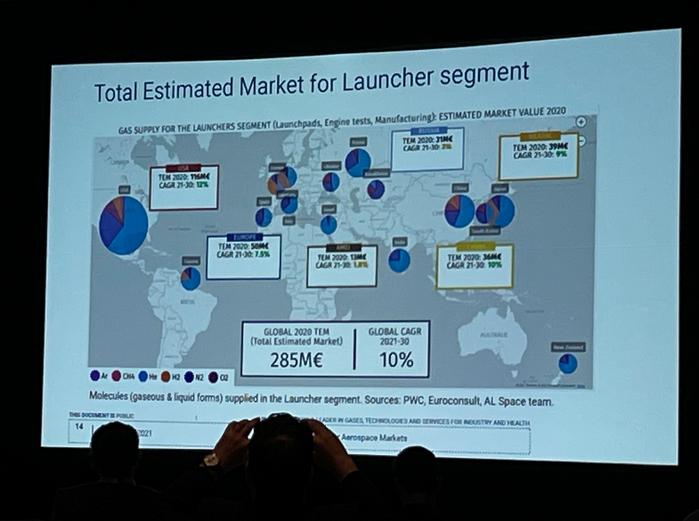
Helium’s unique thermodynamic, chemical, and electrical properties mean the gas’ industrial uses extend far beyond that space rockets. “You use it for the cooling of power stations. In the weapons industry, you use it in the enrichment process, and with a lot of these ballistic missiles, particularly the intercontinental ones, they use a fuel predominantly made up of cryogenic liquids such as liquid oxygen and liquid hydrogen,” says Marani.
A Fluke of Nature
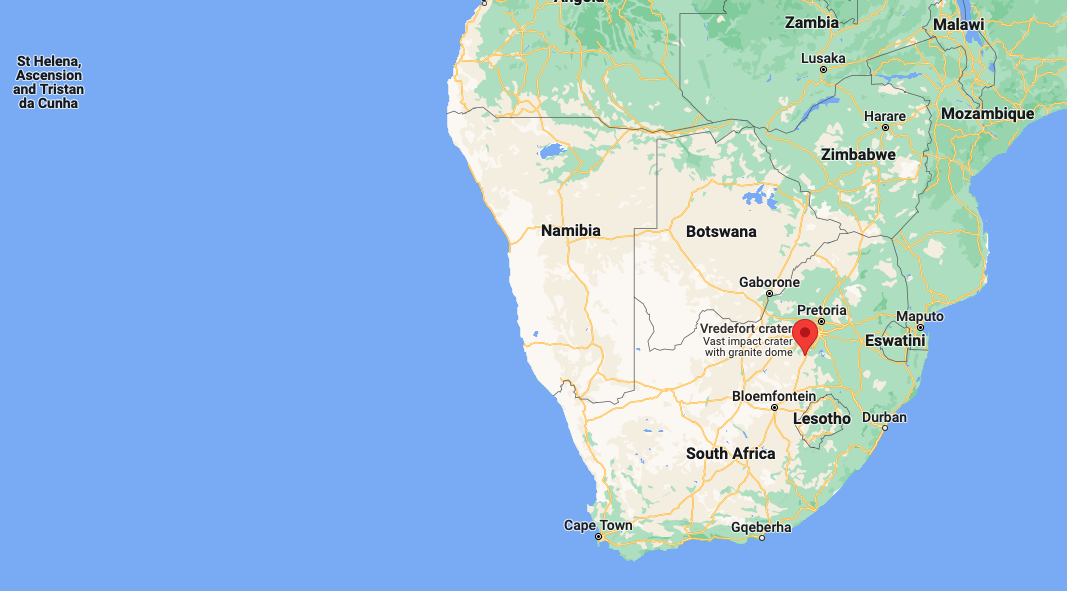
Renergen is currently in the process of developing a proof of concept for the delivery of its natural deposits of helium as part of a wider Liquefied Natural Gas (LNG), compressed natural gas and solar hybrid-power facility at the Virginia Gas Project in South Africa’s Witwatersrand Basin.
But how the site’s deposits came to be in the first place is fascinating in its own right. They appear to be connected to a freak cosmological event that occurred approximately 2 billion years ago, which saw the largest known asteroid ever hit the planet at South Africa’s Witwatersrand geological complex, home to the largest known crater on earth, roughly 330km in diameter.

As Renergen’s marketing material reads:
The impact essentially created a seal, capping ultra-rich underground deposits of uranium and thorium in place, allowing the minerals to undergo natural radioactive decay to produce alpha particles, which become helium. The impact of the asteroid also established the ideal conditions for early bacteria to congregate. Much like how chlorophyll in plants feed off radioactive energy from the sun, these early bacteria evolved to feed off the radioactivity from the uranium to metabolize[sic] carbon in the rocks into methane.
The helium reserves at the Virginia Gas Project, they say, count as among the richest in concentration in the world. The only comparable natural deposit to date has been found at the United States’ Amarillo complex, but this is now almost entirely depleted.
A Very Noble Gas Crisis
Helium is not alone in being a strategic industrial gas. It is joined in that role by neon – an equally rare and valuable noble gas.
As with helium, neon is absolutely critical to the production of semiconductors where the gases are needed both chemically and electrically to create an inert environment to produce microchips.
Cliff Cain, a former employee of Linde, one of the biggest noble gas producers, purifiers and distributors, started his own consultancy, Edelgas, a few years ago in the hope of adding transparency to the market for the benefit of the purchasing side – specifically concerning supply availability and pricing.
As he explained to The Blind Spot, while helium is used mostly as an atmospheric control and coolant in the semiconductor manufacturing process, neon is used more in the lasers with which they etch the wafers. “Without the neon, there would be no synthetics [semiconductors] out there really at all,” he says.
Since February, global production and supply of both gases has come under severe pressure due to souring global relations on the back of the war between Ukraine and Russia. Both countries are key players in the supply of the two gases.

Most critical to the supply picture is the fact that Ukraine, which is now in a state of total war, was producing about 90 per cent of the world’s global neon supply until 2014, when the war with Russia broke out. *Some supply has been deflected to China since then, but industry experts still put Ukrainian supply at between 50-70 per cent. Accurate figures are hard to come by due to the opacity of the market. Korea has recently entered the market with a new facility that is expected to satisfy 16 per cent of the country’s domestic demand. There are also hopes to convert plants in Indiana.
The helium market, however, was already facing supply issues even before the war broke out. Now a vital source of new Russian supply looks unlikely to hit Western buyers.“ The semiconductor industry is actually getting a double whammy right now,” says Cain. “Obviously, the shortage of helium is absolutely critical. And now you add neon into that layer, and I would say we’ve got the perfect storm, it’s not good at all.”
The tight-lipped nature of the industry, however, means much of the panic is failing to make its way into the mainstream.
TSMC’s latest financial filings still, for example, only hint at the issue (TBS’ emphasis):
Our revenue and profitability may decline if we are unable to obtain adequate supplies of raw materials in a timely manner and at commercially reasonable prices.
Our production operations require that we obtain adequate supplies of raw materials, such as silicon wafers, gases, chemicals, and photoresists, on a timely basis and at commercially reasonable prices. In the past, shortages in the supply of some materials, whether by specific vendors or by the semiconductor industry generally, have resulted in occasional industry-wide price adjustments and delivery delays. Moreover, major natural disasters, trade barriers, and political or economic turmoil, including military conflicts and inflation, occurring within the country of origin of such raw materials may also significantly disrupt the availability of such raw materials or increase their prices.
Also, since we procure some of our raw materials from sole-sourced suppliers, there is a risk that our need for such raw materials may not be met or that backup supplies may not be readily available. Importation and domestic production limitations may also limit our ability to obtain adequate supplies of raw materials as well as materials of the necessary quality. In addition, recent trade tensions could result in increased prices or even unavailability of raw materials due to tariffs, export control or other non-tariff barriers. Our revenue and earnings could decline if we are unable to obtain adequate supplies of the necessary raw materials in a timely manner or if there are significant increases in the costs of raw materials.
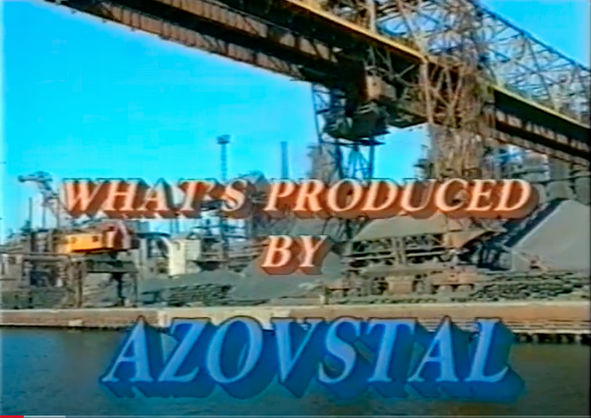
For neon, one of the direct constraints is that the vast majority of global supply is produced not just in Ukraine, but at the Azovstal plant in Mariupol, currently under siege by the Russian military.
How did we end up in a situation where so much of the global neon supply is concentrated in just one country?
To understand that, it’s important to get to grips with the industrial processes which allow for neon production. These depend on huge amounts of oxygen, which can only really be sucked from the air by a handful of steel manufacturing plants in the world. Most are found in the former Soviet Union because the sheer size needed to make neon extraction viable was uneconomic in anything other than a totalitarian communist system.
The only other plants capable of drawing neon from the air, says Cain, are found in China, also due to the country’s socialist foundations. But even Chinese markets rely on additional supply from Ukraine.
“Because there is so little neon in our atmosphere, the only way to make it economically viable is that you have to be producing a lot of oxygen,” says Cain. “The biggest oxygen users are the steel industry, but not all steel industry plants are the same.”
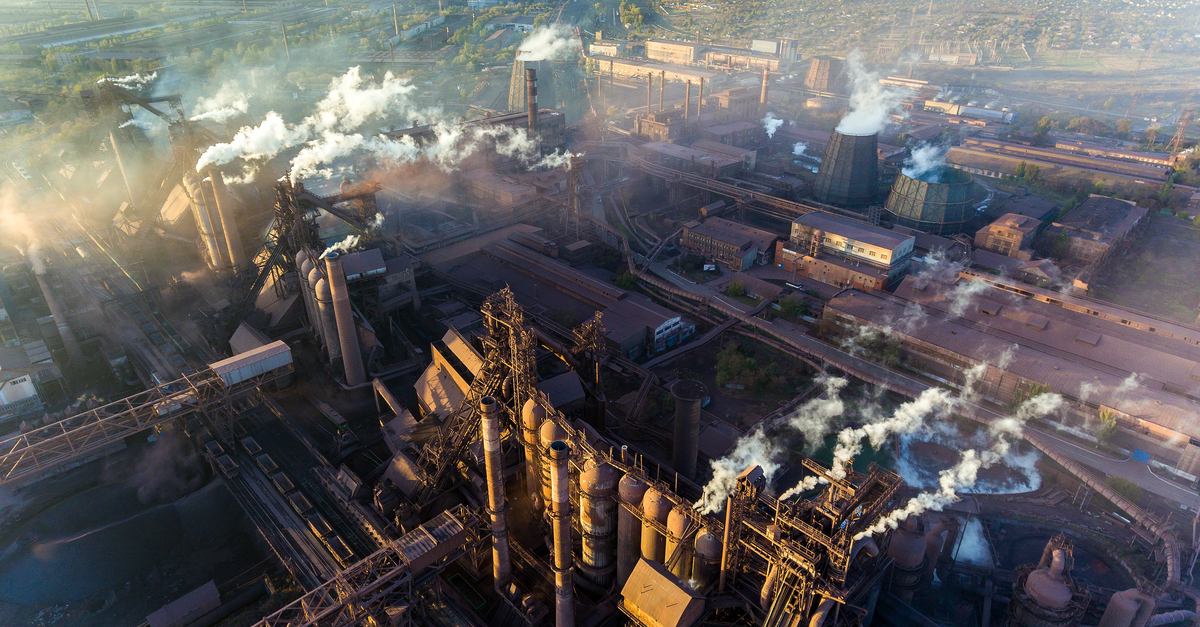
Cain continues, “It is only the Soviet-era steel plants, because they are so big, that are capable of operating neon distillation chambers.”
“I would say 80 per cent of all plants in the world are not big enough to pull the neon off the gas input. It would take one to two years to add the capacity to current air separation plants. And that’s just to upgrade,” says Cain.
For now, that means the Azovstal steel plant in Mariupol, and the Zaporizhstal steel plant nearer Dnipro, with a river route to Odessa, both owned by Metinvest – the industrial conglomerate owned by Ukrainian billionaire, Rinat Akhmetov — have few equivalents in developed countries.
Zoltan Pozsar of Credit Suisse brings more insight into the important industrial process that underpins neon production in his latest note out this Friday (referencing The Blind Spot’s curtain-raiser on the noble gas market last week).
As he writes:
Oxygen and steelmaking are inseparable, and steelmakers get oxygen through an industrial process called air separation. Air is 78 per cent nitrogen and 21 per cent oxygen plus residuals. When steel plants conduct air separation, they separate oxygen and nitrogen for the basic oxygen process, an oxidation process that converts a charge of liquid blast-furnace iron into steel. Steelmakers aim to forge iron ore into steel with pure oxygen – not air – because nitrogen can cause inconsistent (faulty) mechanical properties in steel.
He goes on:
Steel plants perform air separation on an industrial scale. The bigger the steel plant, the more air separation they do, and the more air separation they do, the more neon gas they get. Because neon makes up only 0.002 per cent of the air around us, we need lots of air separation to be able to produce neon on an industrial scale.
But Pozsar is onto another important issue. Neon’s vital application to the aerospace and chip sector may be behind the reason why control of air-separation capacity in Ukraine is high on Putin’s agenda (TBS’ highlights):
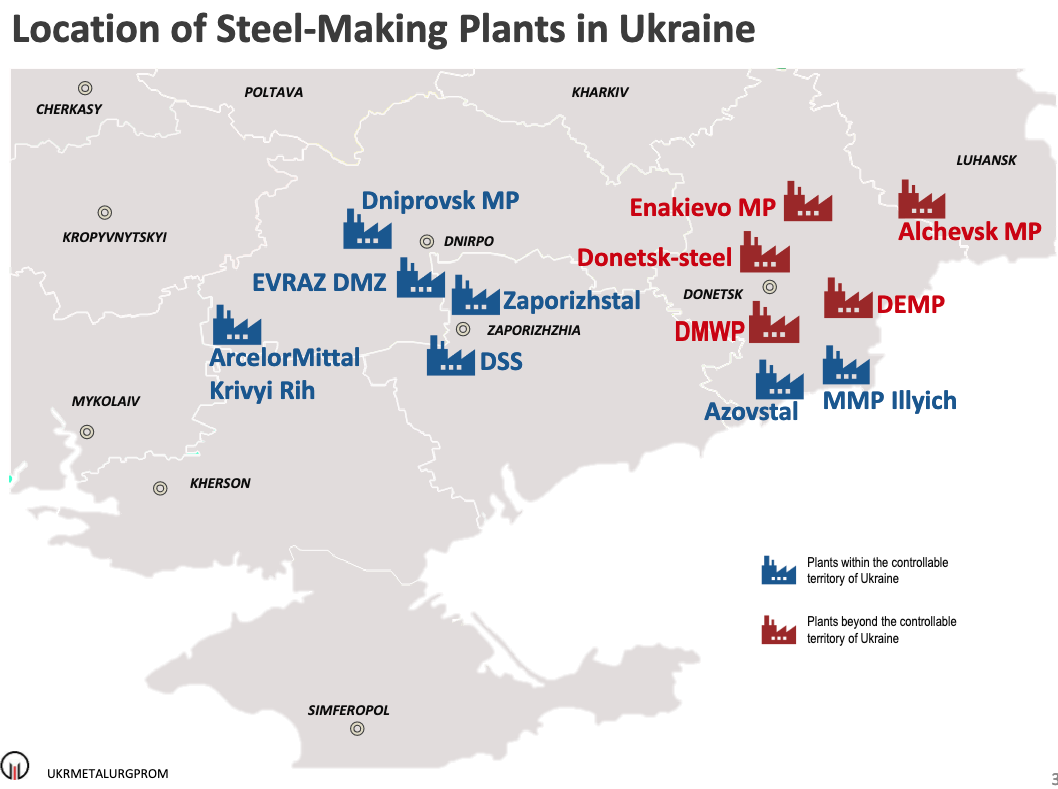
Metinvest’s portfolio also used to include the Yenakiieve Iron and Steel Works which, according to a statement by the company, it lost control over in 2017 over a tax dispute between the steel plant and the Donetsk People’s Republic. The Yenakiieve plant was the site of another major air separation operation for its basic oxygen furnace, which it updated in 2014. Furthermore, the map on page 4 of this presentation to the OECD, shows that southern Ukraine has a total of twelve steel plants, and this map by the FT that tracks territories under Russian control in Ukraine shows a near-perfect overlap – Russia’s control of southern Ukraine effectively means a Russian control of Ukraine’s steel plants… and by extension the Russian control of air separation capabilities in Ukraine!
Big steel plants are usually not the companies that purify the non-oxygen, non-nitrogen “parts” of air into component gases. Rather they typically sell the residual gases in bulk to companies that further separate them into components, like neon gas, and then sell them to the largest consumers of neon, which are…chipmakers.
Pozsar, however, may only be scratching the surface with respect to the true scale of the troubles facing the broader noble gas industry.
Trouble in the Secondary Market
While Ukraine is a key producer of neon, access, distribution, and refining of the gas is largely controlled by a small cadre of Western Tier One providers, companies like Guildford-based Linde, France’s Air Liquide, and US-based Air Products – many of whom struck key offtake agreements with suppliers in the early 90s. The helium market is also dominated by these players, with the addition of Matheson, Nippon Helium, and Messer.
Sanjiv Lamba, CEO of Linde, the largest producer of refined neon in the world, was asked about the neon shortages in the company’s Q1 earnings call this week. His reply was illuminating in that it deflected from Ukraine’s dominant production role by focusing on refining capacity instead:
So the overview is about a third of the world’s refined neon comes out of Ukraine and Russia. Most players around the world have that sourcing built into their model. We are lucky in that our refining capacities really sit in Germany and the US, and feed the entire world. So our kind of dependence on Ukraine and Russia is in the mid-teens [percentage], if you will, relative to other people being around a third.
… we produce refined neon in Germany and the US in multiple locations, which ensures that we’re able to meet the entire global demand out of these locations. Of course, we can also meet all the offshoring needs that our customers like Intel, Samsung, TSMC, and others have in terms of coming out of either Germany or the US as well. So we are well-positioned.
This may be true, but the comments downplay the severity of the shortages and the fact that refiners still need access to primary supply.
As Cliff Cain told The Blind Spot this week: “Some 70 per cent of the world’s neon supply is off the market – all backup storage, which was designed to last about 90 days, is pretty much burned.”
Other sources, however, suggest that in recent years chipmakers have tended to store up to 5-6 months supply.
Has the West sleepwalked its way into a potential ransom situation? Possibly. Cain notes that if Russia succeeds in dominating Ukraine’s steel plants, 95 per cent of all neon production will be controlled by only two countries: China and Russia.
What’s more, unlike the West, both Russia and China have long treated these gases as strategic resources they wish to control due to the important role they also play in refining and purifying rare earth elements. This means they are far more likely to have been accumulating emergency reserves.
The situation has not benefited from the market’s reliance on the opaque and clubby world of Tier One players, which not only influence prices in their favour, but also dissuade competitors from shining a light on potential supply disruptions, concentrations, and other supply-security vulnerabilities.
Why Helium’s Supply Crunch is Much Broader
Natural deposits of helium are optimal, but thanks to a scientific process discovered in 1958, it has been possible to separate helium from gas for many decades. The economics of doing this, however, only make sense at very large natural gas production facilities with certain characteristics.
Today, ExxonMobil in the US is the single largest supplier of helium in the world using this process. The energy giant draws the gas from two separate fields, LaBarge and Hugoton. The problem for global supply, however, is that the latter, which for a long time fed supply into the strategic helium reserves at the Bureau of Land Management (BLM) at Amarillo, is due to be shut down in 2023 as the helium there is nearing full depletion.
The second-largest suppliers are to be found in Russia, Qatar, Algeria, and Canada. Poland has some supply too, says Marani, but not enough to make any meaningful difference in the global supply balance. Australia’s much smaller resources, meanwhile, ran dry about two years ago.
Companies like AIM-listed Helium One are exploring in Tanzania but haven’t had much luck yet. Another 20 or so explorers are also active in the market, but are not well funded.
That leaves only Marani’s South African deposits – set to produce about 7 per cent of supply once fully operational in 2025 – as the only fresh source to come to market in the short to medium term from a relatively neutral territory.
“We’re pretty well tucked away, which, incidentally, is what makes us quite attractive as a helium jurisdiction,” he says.
But while Russia’s dominant role in helium production means the Ukraine war is adding stress to the supply market, Marani is keen to point out the helium market has been facing supply challenges for years.
“What’s happening now is really the perfect storm.”
How the Helium Market Got Broken
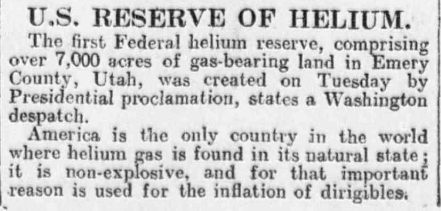
When helium deposits were first and exclusively discovered in Amarillo in the United States during the 20s, the government immediately recognised that the reserves could have important commercial applications that would give America an edge in international markets and technology. At the time, the primary use of helium was in lifting airships, and the US hoped it could use it to manufacture large models capable of dropping bombs.
To that end, a decision was made at the government level to preserve American supplies for tactical and military purposes. In 1925, the US passed the Helium Act, banning the export of helium – a move that forced rival European producers to depend on much less stable hydrogen power for their airship equivalents.
The result of the act was the mass stockpiling of helium even after aeroplanes became the favoured mechanism for air travel. This was conducted under a programme managed by the US Bureau of Land Management (BLM).
Then Robert Oppenheimer, the renowned physicist behind the 1942-1946 Manhattan Project, discovered that helium was an essential input in the enrichment of uranium, and the helium reserves became vitally strategic again.
“If you want to avoid another Chernobyl, you have to change your coolant from water to helium,” Renergen’s Marani tells me. This is because helium is the only element that is completely incapable of being contaminated by radiation.
With the help of additional Fed funding, the government soon went about buying up helium for BLM reserves from private suppliers, creating a Federal Helium System which would serve as a major Cold War deterrent protecting America’s nuclear capabilities, due to its gargantuan size.
After the Cold War ended, however, the asset became seen as an overly expensive government liability that was no longer strategically vital to support. By 1995, growing private-sector production had made the US entirely self-sufficient. Congressional efforts to privatise many of the federally managed helium facilities soon began in earnest since legislators believed it made little sense to force continued government purchases at prices that were now seen as artificially supporting the market.
As the NYT reported at the time:
Determined to balance the budget in seven years, Congressional Republicans have their eyes on the program’s assets – 31 billion cubic feet of helium stored underground about 10 miles north of Amarillo. The world’s largest helium stockpile, the reserve contains enough gas to supply the government at present consumption levels for 100 years.
The new legislation, finally passed in 1996, directed America’s helium reserves to be sold off in 20 years in a bid to cover the costs of building up the programme in the first place. It was hoped that the sales, if strategically placed on the market rather than dumped, would be able to generate up to $1bn for government coffers.
Those projections, however, became moot once the MRI scanner — which depends on helium to run its magnets — was invented and began to be rolled out to healthcare providers around the world from the mid-90s onwards.
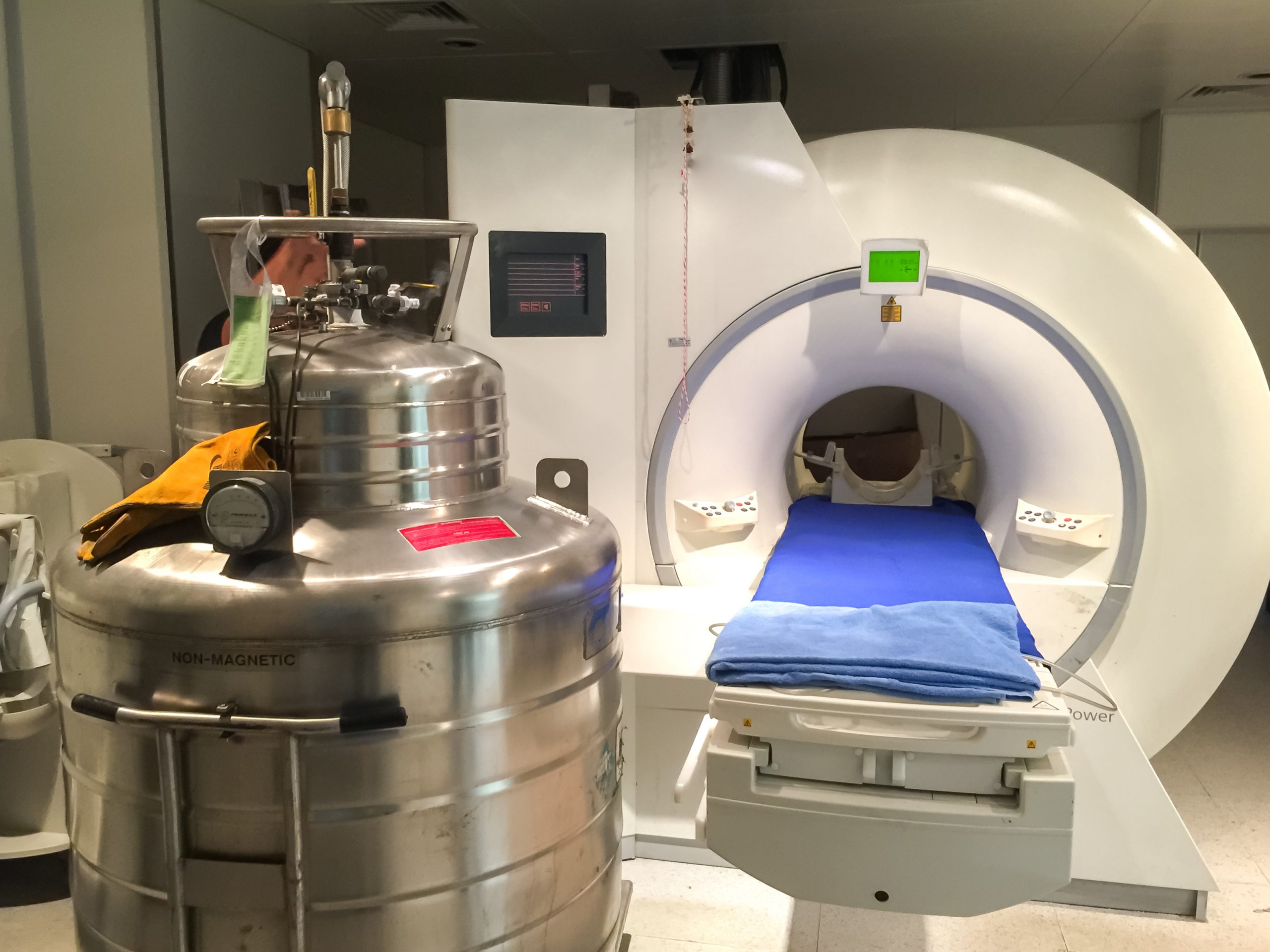
“All of a sudden, the demand for helium vastly began to outstrip supply,” says Marani. “New supply represented only about 50 per cent of the world’s helium being sold, which means that 50 per cent was coming from this BLM, which took them seven decades to stockpile.”
Even so, by the time the laws passed under the Clinton administration began approaching their 2014 expiry, the market had become entirely dependent on the BLM supplies to maintain a balanced supply and demand situation. Some feared that without continuing sales significant disruptions would hit the semiconductor industry and others.
In 2013, the Helium Stewardship Act was passed extending the auctioning-off period in a bid to calm the market.
None of this, according to Marani, was properly thought through.
“If any commodity market is basically relying on 50 per cent of its supply to come from stockpiles, eventually that’s going to run out,” he told The Blind Spot. “It’s just a really stupid strategy, right?”
In 2020, the BLM officials reported the programme had returned $2bn to the US Treasury from sales and auctions since 2005.
The Perfect “Trifecta” Helium Storm
With demand continuing to outstrip supply since the Stewardship Act came into force, the rate of BLM depletion has only been accelerating versus earlier projections. In that vein, the market was hit by its first supply crisis in 2018 when it was unexpectedly revealed that BLM supplies, which were anticipated to last until at least 2023, ran out five years early.
With the last remaining dregs – known as “the tail” – being auctioned off from the BLM ever since the market has become increasingly sensitive to supply disruptions. This has led to significant price volatility in the market.
In 1997, prices of helium being sold from the BLM stood at around $47 per million cubic feet (Mmcf). At the peak of the 2018 crisis, they topped $119 per Mmcf. The last ever auction price for the period October 2021-Sep 2022 completed at $100 per Mmcf.
By 2020, the supply crisis was deemed significant enough for President Trump to declare it a national emergency under the Emergencies Act. The proclamation drew on a list of “critical minerals” published by the Interior Department in 2018, which included helium.
Then, before the Ukraine war broke out, another crisis hit the market. The last remaining dregs from the BLM coming from the tail – which were supplying up to 15 per cent of the market, were curtailed because both compressors feeding the plant collapsed at the same time.
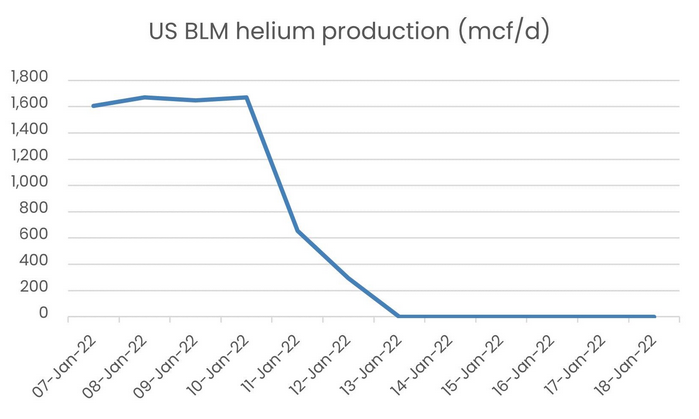
The operational report issued on January 17 noted somewhat mysteriously that (TBS’ emphasis):
Over this last week, several strange events occurred in the plant. We had an electrical failure on half the plant site. We had operators reporting droplets of liquid/misting off the TSA vent stacks (potentially NGLs which shut down the plant).
Monday, Jan 17, we found a natural gas leak on the Booster Compressor. We are also coincidentally responding back to OSHA on their findings this summer. The BLM needs time to review these reported and observed issues to understand what the root cause may be and take corrective action for continued safe operation. The current COVID surge is also a concern for contractors coming to the worksite to do repairs. The BLM is working with our partners to address the needed maintenance repairs to make plant restart possible as quickly and safely as possible. Projected Plant start-up is late April 2022.
It is now May but the plant remains offline. A final notice on April 22 read that Messer had been awarded an operations contract to get the plant back online, noting that this will be “a key milestone in the return to operating the Cliffside facility and to deliver helium safely to private industry.”
Of possible relevance is the fact that the Stewardship Act features a clause that, if the pressure at the facility drops below 600 psi (as occurred at the plant), BLM helium is no longer allowed to be used for commercial purchases. According to the specifications of the act, in such circumstances, the helium deposits become the property of the Secretary of Defence.
“This means that, as a result of this catastrophic failure, legally speaking, the BLM is now not allowed to supply anywhere unless for military purposes,” a source with knowledge of the details explained to The Blind Spot.
A Series of Unfortunate Events
A couple of weeks before the troubles first started at the BLM, strange events also started occurring in Russia’s Gazprom-owned Amur plant. The plant, which is based in Svobodny in Russia’s Far East Amur region, is expected to become one of the biggest providers of pipelined gas and LNG to the world when it becomes fully operational in 2022.
Amur, however, was also positioned as the great white hope for the helium industry thanks to a cryogenic gas separation plant on the site built by Linde capable of producing up to 700 Mmcf per year. This, it was hoped, would finally ease the market tightness that had been plaguing the market since the BLM’s unscheduled early demise in 2018.
The trains from the facility were slated to supply up to 30 per cent of world demand by 2027.
Sources tell The Blind Spot this expected supply prompted Linde, which is also building a plant in Qatar, to lobby the US government to remove helium from the critical mineral list in a bid to retain influence over how the helium could be traded in the market. *We have not confirmed this with Linde.
The intent it seems was to ensure the US government would not sponsor or fund any development of competing helium fields. But the decision, sources say, was based on incorrect data about supply stability.
“What Linde was not anticipating was the explosion at Amur, which means they are now in a pickle because they’re not getting that the world is in a helium crisis,” the source said.
Helium was removed from the list in November 2021.
On January 4, however, Reuters reported that the plant had experienced a major gas fire. On January 17, the same day that the BLM went down, Gasworld reported the fire had taken out any prospect of helium supply coming from the plant for at least six months.
The January fire followed another fire that occurred in October 2021, and another incident that interrupted operations in December 2021.
As Gasworld explained:
Amur actually produced helium from its first helium plant for several weeks in September before taking a planned shutdown that was originally expected to last for a month or two. Gazprom had also been planning to start-up its second helium plant in the first quarter (Q1). During the shutdown period, there was a fire at the gas processing plant on 8th October, which apparently was a factor in delaying the plant restart. Amur was expected to restart helium production soon, when the 5th January explosion and fire occurred. As word has got out that helium production will be delayed until at least Q3, Gazprom’s customers have begun to redeploy the 100+ empty containers sitting in Russia to other sources.
Industry sources have hinted to The Blind Spot that there may have been more to these fires than meets the eye.
“The first LNG train turned on in September of last year, they managed to produce one container load of Helium and then, supposedly, according to Russian press, there was a small fire in the administrative office or something,” the source said. “Then come January, the second LNG train, wouldn’t you know it, there’s another fire and it doesn’t turn on either.”
The source alleged the damage done by the fire may be much greater than is being publicly revealed. The Blind Spot has not been able to confirm this.
On December 22 2021, Russian News Agency TASS reported that Gazprom had been discussing supplying China with Liquefied Petroleum Gas (LPG) and helium from the Amur plant for the creation of an underground gas storage facility on Chinese territory.
Regarding the Amur helium setbacks, Linde’s CEO Sanjiv Lamba noted in the company’s Q1 earnings call that (TBS’ emphasis):
Most people were banking on some helium coming out of Amur in Russia, and we recognise that that’s going to be delayed. So it’s likely for the rest of his year I expect helium to remain quite tight. We’re obviously seeing that incremental costs and pricing reflect a lot of that as we speak. So from our perspective, we didn’t have any Russian helium in our sourcing last year.
Lamba added that he was seeing pricing trends holding up and that he expected them to stay that way for the rest of the year.
But as Upstream Online reported in March, fears are running high that pressure on companies like Linde to exit Russia on the back of international sanctions could mean the completion and repair of a number of major gas projects is entirely stalled.
Revisiting the topic this week, Cliff Cain said that current prices for helium were still running at nearly five times the rate to be expected in more stable times at $2.50 per Mcf.
The industry is now calling the confluence of all of these events “Helium Shortage 4.0” as a result.
The Qatari Last Resort
Until Amur is properly up and running, Qatar’s helium processing facilities, operated by Qatargas, remain the world’s largest and most strategic.
Qatargas has been producing helium since its first separation facility opened in 2005. A second facility, twice the size of the first, was added in 2013. A third plant, with the capacity to produce another 400 Mmcf per year, was initially supposed to become operational in 2017 but was delayed until 2021.
On February 18 of this year, just two days before Russia’s invasion of Ukraine, market rumours began to circulate, on the back of visibly reduced loadings, that Qatar’s Ras Laffan liquefaction plant had suffered some sort of unplanned shutdown too.
Qatargas denied that the shutdowns were unplanned, stating that the company operates a rolling programme of planned maintenance and these shutdowns were well coordinated.
Informed sources, however, tell The Blind Spot that a major incident may have occurred at the site. They say that satellite imagery shows the signs of a significant explosion, one that is capable of setting back the third helium train’s operational status entirely.
No better cure for high prices than high prices
It’s not all bad news for the helium market.
Linde announced on April 25, perhaps inspired by recent events, that it had signed a new long-term helium off-take agreement to recover helium contained in Freeport’s LNG production site in Texas.
“Linde will also construct a new helium processing plant in Freeport to purify and liquefy the recovered helium, securing an additional source of liquid helium in the U.S,” the press release stated.
Linde added that the project is on track to start producing nearly 200 million cubic feet of helium per year by 2024.
Cliff Cain, however, is not as optimistic. He says none of this will change the fact that the current shortage of neon will continue to affect helium end users who need both gases to operate, such as semiconductor producers.
“The Chinese know this, and this shortage will be used in their favour to apply pressure to Taiwan,” Cain told The Blind Spot.
“Linde is one of the biggest producers in China – so they have a double whammy to deal with themselves, a $6bn issue in Russia [with Amur] but also the CCP dictating where additional neon goes.”
Market prices in this context may become pretty meaningless. “The Chinese government is going to dictate where it goes,” says Cain.
He says the semiconductor war has now begun in earnest but nobody in the western world seems to be any the wiser.
The Blind Spot’s noble gas series continues next week with a closer look at the economics of the market as well as its pricing structure.
*This piece was updated on May 2 to reflect that some sources question whether the 90 per cent Ukrainian supply picture is still accurate.

5 Responses
Actually please delete Redstone and replace by ellipsis … as it wasn’t kerosene.
Great piece, as always. And I was interested to learn about how SpaceX use Helium in upper stage of Falcon 9. Just one quick note re:
“In the weapons industry, you use it in the enrichment process, and with a lot of these ballistic missiles, particularly the intercontinental ones, they use a fuel predominantly made up of cryogenic liquids such as liquid oxygen and liquid hydrogen,” says Marani.
though, because I think you’ll find that neither the US or Russia use cryogenic fuels in ICBMs, and haven’t done in since mid 60s. All US land and sea long range ballistic missiles (Minuteman, Trident) use solid fuel, and while some (I think the older) Russian ICBMs use liquids, they are storable at room temperature (though not particularly nice chemicals). Basically, cryogenic fuels or oxidisers for large rockets are now a space thing, and no longer a missile thing. Problem is well explained here https://en.wikipedia.org/wiki/Intercontinental_ballistic_missile#Modern_ICBMs: “Most modern boosters are solid-fueled rocket motors, which can be stored easily for long periods of time. Early missiles used liquid-fueled rocket motors. Many liquid-fueled ICBMs could not be kept fueled all the time as the cryogenic fuel liquid oxygen boiled off and caused ice formation, and therefore fueling the rocket was necessary before launch. This procedure was a source of significant operational delay, and might allow the missiles to be destroyed by enemy counterparts before they could be used.”
Interesting! I will take that to the experts who told me otherwise. Wouldn’t be surprised though.
ICBM and space paths diverged in the late 50s, as explained in same Wiki entry:
“These early ICBMs also formed the basis of many space launch systems. Examples include [cryogenic LOX/room temp kerosene Soviet and US] R-7, Atlas, Redstone, [and storable liquid US] Titan, and [Soviet] Proton, which was derived from the earlier ICBMs but never deployed as an ICBM. The Eisenhower administration supported the development of solid-fueled missiles such as the LGM-30 Minuteman, Polaris and Skybolt. Modern ICBMs tend to be smaller than their ancestors, due to increased accuracy and smaller and lighter warheads, and use solid fuels, making them less useful as orbital launch vehicles. ”
There are clearly many uses for Helium etc in space industry, e.g. the one your quoted source describes of pushing cold fuel or oxidiser into an upper stage’s combustion chamber in zero G, but I doubt there would be many takers in the long range ballistic missile world for the application as described.