
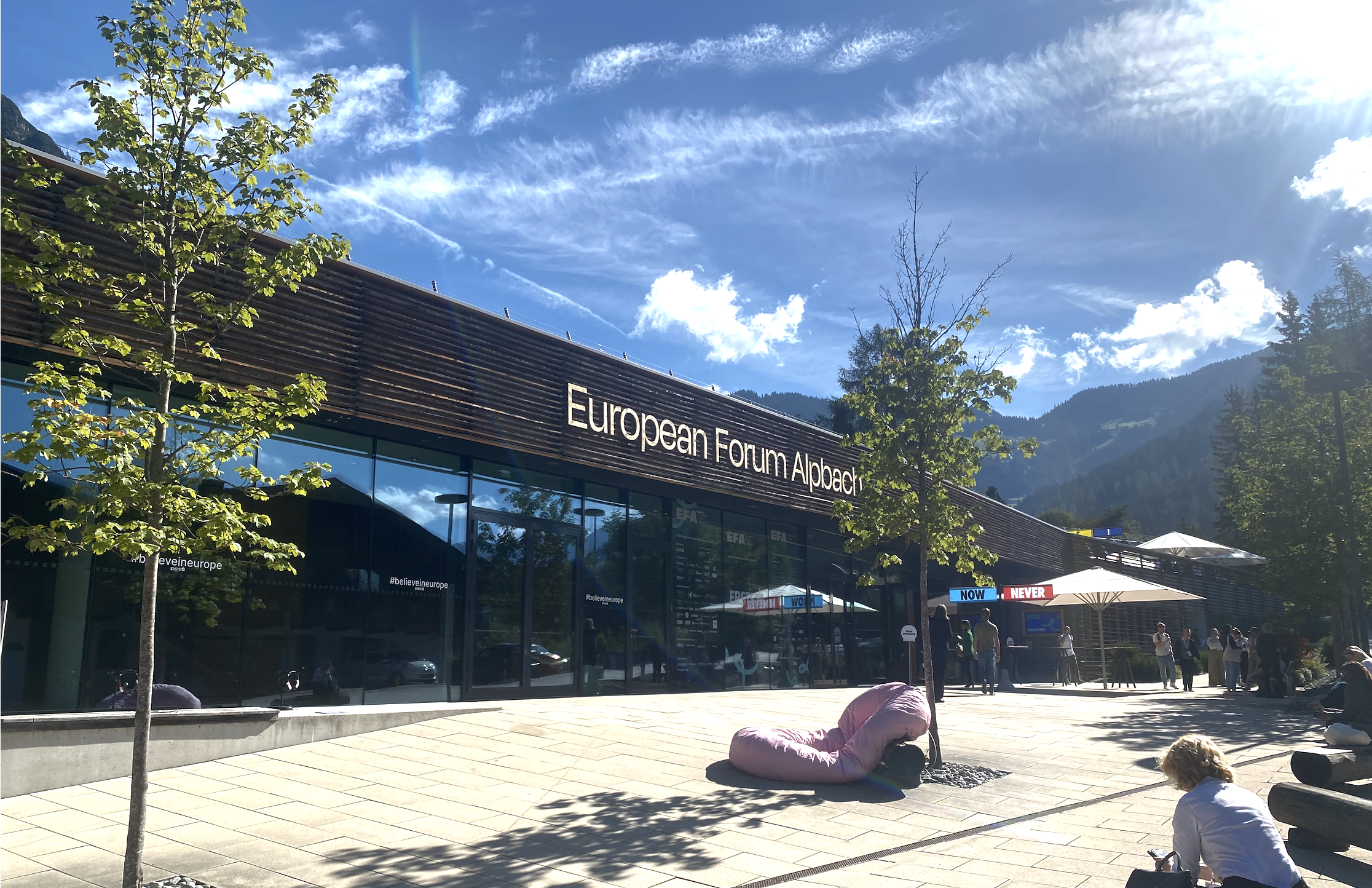
I’m on the road this week on the way back from the European Forum in Alpbach, Austria, where I participated in a bitcoin panel — so excuse typos etc (writing on my phone).
As it happens, American economist Jeffrey Sachs was also there. For those who don’t know, Sachs is a key figure in sustainable development, but he is perhaps even more famous for having designed and applied Harvard economic thinking to the transition pathways for numerous developing world and former iron curtain countries, among them Russia. These policies later became known as shock therapy, due to Sachs’ belief that free-market reforms should be implemented quickly rather than slowly to get the pain of transition over as quickly as possible. Critics, however, have come to refer to him disparagingly as the ultimate shock therapist. They believe that in many cases the policies backfired, wrecked the underlying economies and courted mass distrust in the capitalist liberal system.
In more recent years, however, Sachs has turned his attention to debt alleviation and other, some might say “kinder” (but still provocative mechanisms) for encouraging development and poverty reduction.
Even so, he has remained a key establishment figure throughout. His reinvention as a champion of a more moral and virtuous type of capitalism — centred on social justice and climate awareness — has, after all, echoed a similar ESG-oriented turn that is afflicting the thinking of the global “Davos” elite.
Until now, that is.
In recent months, Sachs has increasingly been seen breaking rank with establishment thinking. Most significantly, he has openly argued that the war in Ukraine is “the culmination of a 30-year project of the American neoconservative movement” and a direct result of Nato expansionism in the area. He has also spoken out on Covid origins. This is significant because of his role as chair of the Lancet’s Covid-19 commission.
Annoyingly, Jeffrey’s Alpbach panel coincided with mine so I couldn’t hear from him directly. But the word from conference organisers was that his views on Ukraine came across as very provocative — especially given the Ukrainian presence at Alpbach — and that some at the session even deemed him as having been “radicalised”.
The other session I was hoping to see him at, well, long story short, I didn’t realise it took the form of an actual hike up the mountain. So I got the coordinates entirely wrong and missed it. (That’s the sort of place it was.)
Despite missing the chance to speak or hear from Jeffrey on the ground, however, I still wanted to direct readers to the following podcast he did with Robert F. Kennedy Junior on August 20.
In the podcast, the two actively discuss the Covid origins story, in the scope of Sach’s extremely informed Lancet position. While it proved educational to me on several matters, it also corroborated many of the findings I arrived at independently while investigating the lab leak theory at the Financial Times.
As I’ve recounted before, the FT didn’t see fit to publish the majority of that work — including what I felt was incredibly important context about America’s biological weapons development history, Nixon’s move to cancel these programmes and the biodefence mechanisms that were developed and funded by the Patriot act in the wake of the anthrax attacks that hit Washington after 911. There is also the incredibly important context about British weapons inspector David Kelly to be considered.
In the end, I published the bulk of this work in a two-part Spotlight premium series on the Blind Spot in March of this year.
Having listened to Sachs’ podcast I have decided it is now time to lower the subscriber tier on that work. Those who subscribe to the basic £20 per month package will as a result be able to access the two-part series as of today. I will take this opportunity to flag that I plan to make this work, and some other select pieces I consider in the interest of the public domain, entirely free from October onwards.
Getting the balance right on what to retain behind the paywall and what to circulate for free is hard. But I hope subscribers who have already benefited from exclusive access to this work for many months, will be understanding. There is at the end of the day a mutual interest here. The more reach I can get at the lower tier, the better the economics for The Blind Spot. The better the economics for the Blind Spot, the better the quality of future work and the greater the advantage of being a top-tier premium subscriber.
So without further ado, part one is available here. And part two is available here.
What did I learn from Sachs?
Since its publication on August 20, it’s fair to say that the RFK Jr podcast has caused a bit of a sensation online. Sachs has either been widely ridiculed for engaging with RFK Jr, who is already persona non grata in establishment circles due to his well-known vaccine scepticism, or has been praised for being open-minded enough to take a contrary position.
I personally consider it telling that among those now seemingly pushing to cancel Sachs as a result of his engagement with RFK Jr are virologist Angela Rasmussen, one of the champions of the natural Covid origins theory. Rasmussen happens to be the co-authors of a paper that the media prominently framed as having finally settled the debate over Covid’s origins earlier this summer by establishing with a high factor of probability that the Wuhan wet market was the source of the outbreak. This is despite the paper not providing any conclusive proof of an upstream disease pathway to the market.
Rasmussen’s thoughts on Sachs’ appearance on the RFK Jr podcast were as follows:
For anyone who still had any doubts about Lancet COVID-19 Commission Chair Jeffrey Sachs’ full descent into whichever level of hell the unredeemable cranks populate, he’s now done a podcast on SARS-CoV-2 origins with the world’s foremost anti-vaxxer. pic.twitter.com/Xq9lTywtOP
— Dr. Angela Rasmussen (@angie_rasmussen) August 22, 2022
In my book, that is more reason than not to listen to the podcast. (Perhaps Rasmussen is not familiar with the Streisand effect?)
I recommend readers take the time too, but for those who would prefer a synopsis the key takeaways (in no particular order) for me were as follows:
- Sachs notes many times that he was shocked by the degree to which people lied to him in the scope of his work organising the Covid-19 commission, and specifically the origins investigation task force. He notes this has included those he has long considered friends.
- He cites (without naming) one particular friend/acquaintance who had insisted they were not subject to any conflicts, at the same time that FOIA documents revealed their position as a co-investigator on entirely conflicting research.
- Sachs says his decision to appoint Eco-Health’s Peter Daszak to head the origins task force was in good faith. He had no idea about Daszak’s conflicts at the time and had thought he was a good choice for the position because of his experience. Upon learning about Daszak’s conflicts, as well as others’ in the task force, he decided it prudent to shut the body down. This is separate to the wider work of the commission which continues on.
- Sachs talks candidly about his suspicion that the intelligence services have been intimately involved in not just the work that EcoHealth has been doing but also significant chapters of the National Institutes of Health (NIH) and the National Institute of Allergy and Infectious Diseases (NIAID) under Anthony Fauci. He believes this is a function of the institutes having been coopted into the military defence complex via their work on biodefence, which has significantly contributed to a lack of transparency in the area of gain of function in particular.
- RFK Jr informs Sachs about the important role Nixon played in disbanding America’s biological weapons programmes in the 1970s, and in signing the biological weapons convention. Sachs, I was very surprised to hear, says he was not aware of this background.
- RFK Jr then tells Sachs that despite the signing of the convention, the BWC has been structured into US law in such a way that no government workers can ever be held to account by it. RFK Jr, who is a lawyer by training, notes this is down to an exception in the wording. (I have not personally corroborated this, but I will try to.) The implication is that the US is legally free to pursue biological dual-use research intended for offensive military use, not just defensive, with no international community recourse.
- The two then talk more about other aspects of spooky involvement in the world of health, including the Welcome Trust’s close connection to Mi5.
- RFK Jr points out that the anthrax used in the 2001 attacks, which helped to justify the Patriot Act — which provided billions of dollars of funding for dual-use biodefence research — was later discovered to have come from America’s Fort Detrick facilities, home to the United States Army Medical Research and Development Command (USAMRDC).
- Sachs believes we haven’t seen the truth behind Covid’s origins come out at all. Sachs references many times how he believes the odds of the furin cleavage part of the virus’ spike protein evolving naturally are incredibly low. This is important because that’s the bit of the virus that makes it particularly contagious to humans.
- Sachs says he believes there has been an active strategy in play to make people like him look the other way, or to distract them from looking more closely at US relations with the Wuhan Institute of Virology and at what’s going on in biodefence in general.
- There is talk about Ralph Baric and his humanised mice, and how freely they were shared with researchers in China.
- RFK Jr urges Sachs to read his book on HIV, saying he will be interested in what he might discover in it. Sachs promises he will do so.
- Sachs treats RFK Jr with respect throughout, and the two seem to genuinely view each other in a positive light.
The above is just what caught my eye but there’s much more to the interview that that, especially for those who haven’t already gone a bit native on the topic. For further background do of course also read my two-part series, which offers even more of the broader context.
2 Responses
Jeff Sachs tried to rescue his reputation with sustainable economics. But the damage he inflicted on Russia and causing its fragmentation and sale to oligarchs is incalculable. He pushed his brand of the neoliberal order under the auspices of the Kennedy School at Harvard. Its impact can still be seen on how the IMF weakens developing countries when financial disorder occurs and uses the same playbook, weaken the currency, deregulate and sell national assets to the market. We see his brand of UN sustainable economics really, he has no consideration of how the poor or middle class can cope with the impact. Yes they can stop reproducing, cut their consumption, afterall we have to cut our population dramatically so the elite and privilege can live in harmony with Nature.
Jeffrey Sachs’ intellectual contribution to the reforms undertaken in Central/Eastern Europe tends to be overstated. And so is the ‘shock therapy’ label (while it does perhaps accurately describe what went down in East Germany ,the term ‘rapid adjustment’ is a much more accurate term in the case of Central European economies, with slower adjustment in Ukraine/Russia). Sachs did make a very positive impact though, primarily through his advocacy and support in the West, particularly around the issue of Poland’s foreign debt.
Intellectually, things went downhill from there, especially when it came to his truly misguided position on foreign aid and developing countries.
He may or may not be right on COVID-19 origins, but he is not really an authority on the subject matter. Still, always interesting to see a new perspective from someone reputable enough that he is likely to stir things up and provoke some interesting debates.