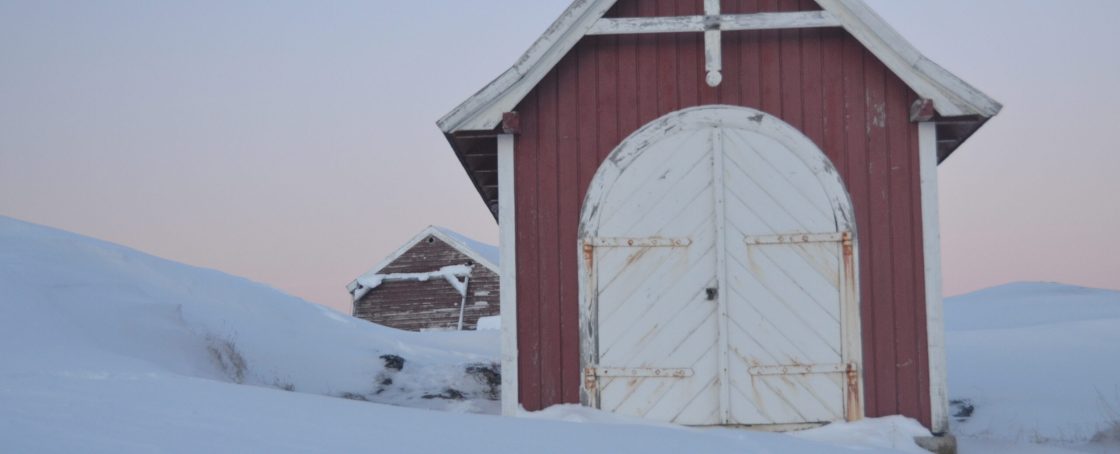
On the outskirts of Nuuk, just beyond the airport, a solitary little slope rises from the scrub and rock. Quassussuaq — Lille Malene, in Danish — is the Greenlandic capital’s ski hill: two button lifts, a single slope, and a base area marked by a nondescript corrugated-metal building that looks more like a storage shed than the gateway to winter leisure.
When I visit, the lifts hang motionless in a pale Arctic light. There is no action, no queue, no chatter of skis on hardpack. The slope hasn’t opened. It hasn’t been able to. The winter has been too warm.
In town, there is talk — half joke, half hope — of trucking in snow to the main ski area, as was apparently attempted in previous lean years. Nuuk residents really do love this place. It’s not professional. It’s not trying to be an Alpine fantasy. It’s simply theirs.
A driver who takes me up there tells me his son used to spend spare afternoons on the hill. Another resident, in Greenland for nearly a decade, says he goes with his own son when conditions allow, and he’s hoping February brings snow enough to open the lift.
But it’s not looking good.
The empty slope would be a tidy metaphor if Greenland weren’t already drowning in them. It is, depending on what media you read, a frozen frontier that’s thawing. A geopolitical storm in the making. A battle for more than ice.


It doesn’t take long for it to dawn on me that most outsiders settled on their preferred “take” long before arrival. Now they’re spending days photographing it, narrating it, exporting it, as if the place exists mainly to support whatever story they brought with them.
I should admit something up front: I am not an expert on Greenland. Nor am I immune to projections of my own. I was there for six days during a uniquely weird period. That is long enough to see patterns and be unsettled by them. It is not long enough to speak with authority — even if Nuuk is suddenly full of outsiders who do.
About 100 journalists, give or take, arrived around the same time I did. In a town of 20,000 residents, that feels notable. They came because Donald Trump had returned, once again, to the idea of buying the country — a move the media at large judged a modern-day Sudetenland moment. Friends back home messaged me with concern. Was it safe? Was I worried about an invasion? Would the Americans “do something”?
On the ground, the question seemed absurd. Nuuk did not feel unstable. It did not feel tense. It felt like a tiny capital doing what tiny capitals do: commuting, shopping, working, waiting for the school to open, waiting for snow, watching the same cars pass by the harbour. The only real disruption was the media circus itself.
And that is the first Greenland lesson: when something is far away enough, in this age of frictionless images and viral narratives, you can make up almost any reality about it and sell it to millions. Distance is now an accelerant for fiction.
In 1991, during the U.S.-led assault on Iraq, the French philosopher Jean Baudrillard wrote a series of essays later collected as The Gulf War Did Not Take Place. He did not deny the bombs or the deaths. His argument was stranger and more unsettling: that for much of the world, the war existed primarily as a media event — a continuous stream of briefings, graphics, satellite images, and missile-camera footage that created a self-contained spectacle.
The conflict, as experienced by global audiences, became a simulation: cleaner, more legible, more narratively coherent than the chaotic reality on the ground. What circulated was not war as lived experience, but war as representation.
Watching the drama over Greenland metastasise online and in foreign capitals, it is hard not to feel we are inside a more advanced version of the same condition — a geopolitical episode that spreads as image, discourse and performance, while daily life in Nuuk proceeds with a stubborn, almost defiant normality.
This time, however, no costly U.S. military deployment was required to create the illusion. Like a horror film that withholds the monster because imagination is more efficient than revelation, the media’s reactionary circuits needed no more than a few suggestive prompts from the world’s most powerful man for their greatest fears to be realised on camera. The result was a narrative momentum of its own.

Nuuk itself became all of a sudden a theme-park version of a battleground — a set rather than a place. For journalists on the ground, it offered a suite of ready-made visual symbols: the photogenic American consulate, the statue of the Danish missionary Hans Egede looming over the old town, the stark Arctic light that turns any backdrop into allegory. These elements functioned less as context than as props, arranged within a spectacle that required scenery but not substance.
At a packed press conference in the town’s main community centre, even Greenland’s prime minister, Jens-Frederik Nielsen, conceded he had little sense of what was actually unfolding. “In relation to the agreement, I do not know what is specifically in it,” he said about Trump’s Davos deal that rocked the internet last Wednesday. Then, more personally: “Imagine how it is, as Greenlanders — people here, peaceful people — to hear and see in the media every day that somebody wants to take your freedom.”

It’s why I wanted to go. To see for myself what was true. And what was not.
Greenland, from the outside, is unusually vulnerable to projection. It is geographically enormous and demographically tiny; an Arctic blank space on the map with just enough geopolitical significance to attract big fantasies. From a warm desk in London, Washington or Madrid, it can become whatever you need it to be: a mineral vault, a climate warning, a military asset, a security threat, a “prize.” It is so remote that the correction mechanism — the lived texture of ordinary life — struggles to travel back out through the noise.
For those of us in Nuuk, the correction should have been a supermarket aisle filled with premium goods while a local Inuit man in a wheelchair asks for food outside.
The main supermarket is, frankly, excellent — more fully stocked and higher-quality than many mid-range shops in Europe, shelves glossy with goods that have no business being here, given how far they travelled.

Food, building materials, electronics, medical supplies, furniture, clothes — all arrive by ship or by plane, routed through Denmark and beyond, highlighting that if Greenland’s autonomy exists, it does so alongside a dependency in logistics.
Indeed, if Greenland enjoys autonomy today, it is only because Copenhagen offsets the fundamental economic imbalance at its core through annual subsidies of up to 4.3 billion Danish kroner — roughly £500 million.
That duality — modernity layered onto fragility — appears everywhere. Most glaringly, it appears in Nuuk’s still-closed “mega school.”
The structure, which was completed in early 2024, sits empty in a prominent part of town surrounded by half-finished landscaping. Locals talk about it the way people talk about stalled megaprojects everywhere: with a cocktail of anger, embarrassment, and helpless humour. They tell me it cost around €80 million, and that it has been in the works for nearly a decade. The latest rumour is that the contractors failed to account properly for European regulations — fire safety standards, in particular — meaning the building cannot open even though it looks physically close to completion. They’re hoping it might be ready this summer.
When I walk around it, there are signs of life: contractors moving through entrances, stacks of furniture visible through windows, supplies piled and waiting. It’s the uncanny sight of a place ready for children but empty of them. I’m told pupils were moved out of smaller schools in anticipation of the mega school’s opening last year. As that opening date shifted, the very same children had to be moved back out.


In a place this small, a school is not just a school. It is a declaration about the future: we will grow; we will educate; we will be a substantial community. That Greenlanders want such a school is not a minor detail. It speaks to the positive vision many have: a belief in modern infrastructure, in institutions, in a country that doesn’t have to apologise for being small.
Yet the very fact it remains closed — for reasons that sound at once bureaucratic and profoundly consequential — feeds a darker local narrative: that Greenland lacks not ambition but capacity; not desire but systems that can reliably deliver for their people. Self-rule, which Greenland has had since 2009, is empowering, but it comes with governance inexperience and potential for cash flow mismanagement.
Two-track system
A Dane I meet later in Copenhagen — a respected economist with a protective view of Greenland — tells me something that sticks. Denmark, he says, is often described as “socialistic,” but it survives because it maintains a workable tension: public planning and welfare on one side, market dynamics and private capital on the other. In Greenland, he argues, some of Denmark’s more rigid impulses were exported — and the island became, at times, a kind of petri dish for technocratic social engineering in ways Denmark itself was not. The result is an economy that grows, but not in a way that consistently translates into opportunity.
Whether or not you accept his framing, you can see the outcome on Nuuk’s streets: a town where the state is present and functional, and yet certain people remain invisible.
One morning, walking near a main electronics shop, I see a man lying sprawled across the steps. He looks unconscious. It’s cold. He is not dressed for it. Two local Greenlanders hover nearby, uncertain, as if paralysed by the question of what the correct thing to do is — or perhaps by the assumption that whatever is happening is too familiar to be dramatic. I don’t know if he’s had a heart attack or fallen. Another outsider and I intervene. We call for help. An ambulance arrives within minutes. The paramedics are calm, unflustered. They lift him onto a stretcher with the practiced composure of people who have done this before.
Later, in a locally owned coffee shop by the museum, the barista tells me, matter-of-factly, that Nuuk has a significant homelessness problem and a substance abuse issue. People get drunk. People pass out. It happens.
To be homeless in Greenland feels, from the outside, unfathomable — not only because of the climate but because Greenland is, in many respects, a welfare society supported by Denmark.
The fragility shows up in the macroeconomy. Economists expect GDP to grow by just 0.5 percent in 2025 — barely above the pandemic year of 2020. The slowdown reflects reduced activity on major airport construction projects and weaker shrimp catches, one of Greenland’s main export earners. Cod fishing has helped cushion exports, but the broader picture is of an economy struggling to generate new engines of growth.
Tourism, long seen as a future pillar, is expanding — boosted by publicity from Donald Trump, whose particular talent lies in converting real estate into brand value — but almost entirely within a short summer window when capacity is already near its ceiling.
Greenland’s Economic Council notes that without more flights, hotels, and tour infrastructure, tourism cannot significantly lift national output. Mining, often presented politically as a path to greater economic independence, remains largely at the exploration stage, with only limited extraction underway.
Multiple people tell me variations of the same thing: that there is a “left behind” Greenland — often Inuit, often older, sometimes people whose lives were derailed by the rapid modernization of recent decades — and that the most populist independence energy, call it Greenland’s own equivalent of a MAGA base, often comes from this left behind quarter.
This is where the official story begins to feel off. Outsiders tend to imagine independence politics as a neat ideological contest. In Nuuk, it feels messier, more social than philosophical.
Representatives of the Inuit Circumpolar Council, which advocates for Inuit communities across the Arctic, frame the debate not simply as one of national romanticism but of Indigenous rights and dignity.
They argue that Greenland’s economy was built in ways that prioritised administrative integration over local ownership, leaving communities reliant on Danish funding yet with limited authority over how development unfolds.
“We do not wish to debate which state is better or worse to live in or is a better or worse colonizer,” Sara Olsvig, the Council’s chair, told the press the week I was there. “Rather, we want to debate how we improve Inuit lives, livelihoods, wellbeing, and self-determination across all our regions.”

Then there are the cars. I couldn’t stop noticing them. Greenland has plenty of vehicles, about 10,000 supposedly. Mostly they’re practical, reliable, winter-ready. But there are also a surprising number of luxury brands, and one in particular became my running visual joke: a Porsche Cayenne I see repeatedly. Gliding past the harbour. Reappearing near the hotel. Indicating at the lights. It just kept showing up.
When I mention it to locals, they shrug. It’s not the only one. There are other Porsches. They belong to entrepreneurs. A point of pride. But there were also whispers of people having to leave suddenly, of wealth of unclear origin, and of assets suddenly abandoned. In a small town, rumours often circulate on wheels.
It felt like a neat symbol of Nuuk’s contradictions: luxury consumerism and European prices in a town whose most important civic projects can stall for decades. Where the local homeless contend with extreme winter temperatures, and where substance abuse, obesity, and domestic violence are commonplace.
Indeed, it turns out, Greenland’s darkest secret of all is the degree to which gambling addiction is soaring across the country. Even under Danish regulatory oversight, public-health data suggests problematic gambling affects up to 22% of men and 18% of women — markedly higher than in mainland Scandinavia. Researchers and social workers link this to a mix of factors: rapid modernisation that disrupted traditional social structures, long winters and geographic isolation, high unemployment or underemployment in some communities, and the normalisation of state-run lotteries that are easily accessible even in small settlements.
No casino capital, please
This is why Trump’s provocative post in 2019, a picture of a gold-tinted and Trump-branded Tower block on the icy Greenland rock, and the caption “ I promise not to do this to Greenland”, landed so badly. Critics suspected he was hiding his intentions in plain sight. John Bolton even said it out loud: Trump really did want to build a casino on the territory. The trouble wasn’t that it sounded ridiculous. The problem was that it sounded so plausible. After all, the US has done it before. Indigenous land rights and self-sovereignty in North America have long been entangled with outside interests seeking legal grey zones for gaming empires, with lasting social costs for locals
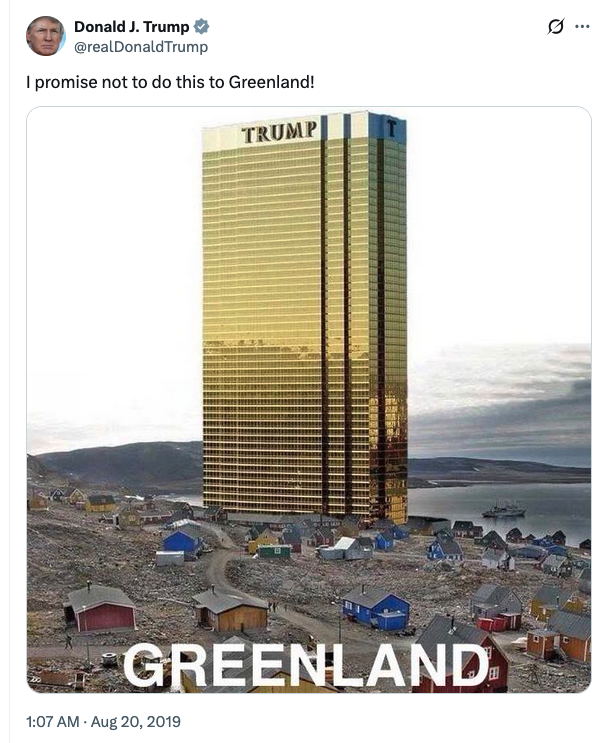
The idea that a newly independent Greenland might be steered toward becoming a new offshore Las Vegas or tax haven, welcoming spivs and speculators as fiscal saviours, would follow a well-worn pattern where small jurisdictions push to monetise sovereignty when other economic levers are weak.
In theory, the country’s harsh and expansive terrain, small population, and still-developing regulatory capacity make it highly susceptible to taking shortcuts to economic independence.
Moreover, everyone knows Trump’s transactional approach to geopolitics often mirrors his business career, where places are assets, leverage is value, and scale creates brand. The U.S. President’s renewed interest in the island, therefore, is stirring fears that Greenlanders may be steered down this darker path.
The risk for Greenland, in that case, is not annexation in the literal sense, but a subtler dynamic in which investment flows become tied to extraction rights, special zones, or deregulated sectors that promise revenue quickly but leave long-term governance burdens at home. The risk, in other words, is of following Iceland’s pre-2008 trajectory, when financial growth outstripped supervisory capacity, and the eventual crash forced the state into years of crisis management rather than easy prosperity.

The simulcrum, however, doesn’t care about what locals really think about Trump.
On right-wing social media platforms, reams of content insinuate there is robust support for both America and Trump. Much of it depicts seemingly happy Greenlanders enthusiastically wearing MAGA hats, while dining out with Don Jr and Charlie Kirk.

Multiple locals tell the same story: that the most marginal, the most easily influenced, the most “left behind” were recruited as props. Offered meals in exchange for photo ops. That the connection to Don Jr. came by way of one solitary Trump supporter — a figure described with contempt.
Whether every detail is true or embellished almost doesn’t matter. What matters is that Nuuk residents recognise the mechanism: you can manufacture a political image here cheaply, because the outside world knows so little and is so eager to believe.
But the desire to turn Greenland into a simulacrum doesn’t end with Trump: if Don Jr. and Charlie Kirk engineered a false reality for social media, so do the journalists this week.
The media circus in Nuuk is its own parallel theatre. Journalists who cannot name a single Greenlandic political party suddenly need urgent shots of themselves looking “Arctic.” Outside the U.S. consulate, reporters take turns filming stand-ups against the same grey wall. I’m asked more than once to step into other journalists’ photos — background “atmosphere,” apparently.
This is what parachute journalism looks like: arrive, harvest, perform, leave. It produces not knowledge but content.
And Greenland, because it is far away, is easy content. Easy to manipulate, too. You can frame it as a looming war zone, a strategic prize, a climate catastrophe, a nationalist awakening, or even as the new Area 52 — the place is so remote that it becomes a canvas for any narrative you want.
This is why, after six days, my most honest conclusion is the least satisfying one: nobody really knows what is happening or why Trump truly wants Greenland, not in the deep sense outsiders pretend to.
Even Greenlanders don’t claim to know. Trump’s Davos deal, which supposedly provides America with parcels of sovereignty for geopolitical and security reasons, passed through the press corps as a simple matter of fact. Yet it should have revealed something more striking: that decisions and conversations about Greenland still have a habit of happening without Greenland fully present. That is exactly the historical fear: things decided over heads, not with voices.
It would be easy to make Greenland sound like a pure victim — a colony, exploited, mismanaged.
But Greenlanders are sturdy people. They are definitely not looking to be “rescued”. Not Denmark. Not Washington. Their dominant mode is practical calculation: what improves our lives; what strengthens our autonomy; what protects our ability to be ourselves?
The exhibits at Nuuk’s local museum deepen that story.

Visitors are reminded that Greenland was effectively a closed country until 1953.
A Danish-Norwegian colonization system built on monopoly trading restricted access; entry was controlled; tourism was not allowed; outsiders were rare. As a result, Greenlanders had limited contact with other people beyond the colonists and their systems. Centralism ruled: with authority, political leadership, and administrative power all concentrated in Copenhagen.
Another exhibit describes how World War II “opened the world up.” Contact with the U.S. and Canada increased. With that, the variety of goods expanded. Greenlanders ordered items through major American mail-order firms. American military bases appeared along the coast. Radio broadcasts began. Films were shown. Newspapers emerged. The country moved from controlled isolation to sudden connection.
That U.S. association with “freedom” still lingers, even if only on a subconscious level. It’s audible in the almost exclusively 80s-era American pop that drifts through restaurants and bars. I laugh when I hear Wind of Change play over the speakers at breakfast one morning. It’s ironic. Internet lore holds that the Cold War classic by the Scorpions was supposedly crafted by the CIA as a cultural psyop aimed at prompting regime change in communist Eastern Europe.
But the museum’s exhibits suggest that, in Greenland, too, culture is being used as a means of political awakening.
They describe the evolution of literature from colonial-era religiosity and European-inspired “national feeling,” through the 1970s rise of political and provocative poetry and music — anti-colonialist, anti-imperialist — the search for identity expressed in art. They point to movements like Aasivik and cultural institutions like Tuukkaq Theatre and later Silamiut Theatre, drawing inspiration from Inuit culture and its encounter with Europeans.
But the most arresting exhibit, for me, is the one on cosmology.
Long before Washington, Copenhagen, or Beijing took an interest, the Inuits would talk about Sila — the visible world — and Silap Aappaa, the invisible one that shapes it. The words blur weather, mind, and world to create a single idea of balance. The Inuit believe Sila is damaged when the rules and taboos that govern balance in the world are broken. When that happens, people lose their footing. To restore balance, a shaman must mediate with the shadow realm. But he must also look inward to the hidden conditions and imbalances of the human being.
The ancient concept applies well to Nuuk’s modern social contradictions and its need to negotiate a new equilibrium between visible systems, such as who controls the country under international law, and invisible influences, such as whose cultural memory, historical trauma, and spiritual inheritance hold sway over the people themselves.
Walking through town — past the closed school, the supermarket, the harbour road — it is hard not to see Greenland through that Inuit lens.
Like Poland in another tumultuous era, Greenland’s geography places it between key powers at a uniquely sensitive time. There may be no shamans operating here today, but it certainly feels as if Greenland is destined to serve as a shaman once again. This time, however, in attending to far more macro imbalances.
If that’s the case, the road to a newly rebalanced order might not lie in a new ownership structure for Greenland, but rather a deal that allows Greenland to first find equilibrium within itself.