
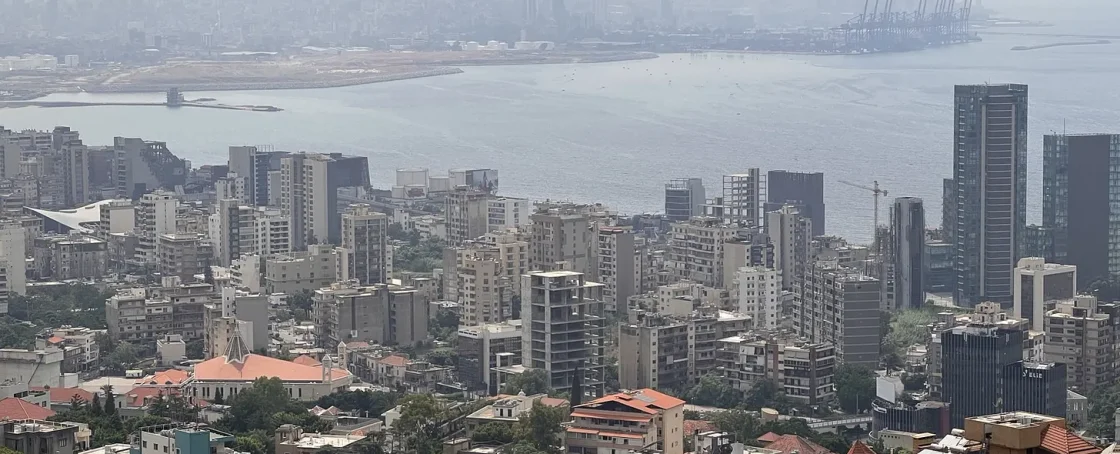
A striking sentiment is emerging on the ground in Lebanon: 20 years of regional political stagnation may have shifted within a few weeks.
And it may speak to a greater transformation. One that is secretly reshaping the entire Middle East.
I’ve been obsessed with this theory since I first heard of it last year, from a mysterious Kurdish insider who posts on X under the name EvanOnX. His analysis resonated with my long-held suspicions as an avid student of the region.
The theory claims that the Middle East is quietly undergoing an elite-pacted transition, discarding the traditional Shia-Sunni political divide and entering a period of pacification.
If this were the case, many things brought it about. Key being America’s desire to exit the region under the new Donroe Doctrine. The theory claims the new regional power is the Gulf Cooperation Council (“GCC”), a nascent alliance between the Gulf states. It asserts that the GCC will end the internecine conflict that America required to assert its influence in the region.
From this perspective, the Iranian war, like the 12-day war in 2025, is mere theatre. A necessary conflict that lets elite insiders eliminate internal hardliners. By leaking their coordinates to supposed enemies like Israel or the United States, powerful radicals can be sidelined without their ideological supporters catching on to the secret deal.
It sounds implausible. But enough bits of signal have surfaced to make me believe it’s on the money. For instance, a fascinating FT piece following the 12-day war in 2025 claimed that internal movements favouring moderation in Iran’s political system meant that “even without toppling the regime, Israel and the US’s assault is set to bring sweeping change rivalling the 1979 revolution.” Read more about it here.
And this week’s Lebanese conflict appears to back the theory even further.
It started when Hezbollah made the bizarre decision to launch an insignificant volley of rockets into Israel this week. This broke an American guarantee that Israel would not intervene in Lebanon and effectively invited the Israelis back into the country.
The speed and nature of the Lebanese reaction surprised even veteran Lebanese observers.
Not because of the wider Lebanese establishment’s general reaction; it has long hated Hezbollah’s power. Particularly its powerful Christian factions. This long-running resentment resulted in a disarmament order against Hezbollah in 2025, which, until this week, appeared relatively toothless.
The key development instead lies within Lebanon’s Shiite political establishment, Hezbollah’s traditional political ally. Recent comments suggest their perspective has shifted, and they have begun to see Hezbollah less as a protector and more as a destabilising liability.
As a recent Reuters article title outlined, “Hezbollah’s entry into Iran crisis deepens its isolation at home.”
For example, Nabih Berri, Lebanon’s Speaker of the House, leader of the Shiite Amal movement, and a key ally of Hezbollah, has publicly outlined that he felt misled by Hezbollah, and has refused to shield the group politically after the escalation.
To understand why this is so unprecedented, we need to start from the beginning.
Hezbollah’s original political logic
From the 1990s onwards, Hezbollah presented itself as more than a sectarian militia. It cultivated the image of a national protector of Lebanon against Israeli intervention.
A narrative that solidified after the 2006 Israel-Hezbollah war, when Hezbollah effectively fought against Israeli forces while the Lebanese army remained largely passive.
Its allies could convincingly claim that Hezbollah was the only true defender of Lebanese sovereignty.
Its strong narrative and military/political strength won over even Christian factions like former Lebanese President Michel Aoun’s Free Patriotic Movement, who defended that its arms and power meant it de facto served a national defensive purpose.
This uneasy arrangement became the shaky bedrock of Lebanon’s fragile political equilibrium.
But these senseless strikes have undone this image. And they left even Lebanese Hezbollah supporters questioning whether the movement actually cares about Lebanon’s plight.
The strategic puzzle
The current situation raises very important questions.
Why would Hezbollah act so irrationally?
The militant group is anything but. It has historically demonstrated a strong instinct for political survival, pragmatism, and manoeuvrability.
But after being left strategically decimated by the Mossad’s pager operations and decapitation strikes of last year, it still chose to launch a small and meaningless rocket barrage that effectively invited Israel into Lebanon.
Why would a group that has so carefully managed its position in Lebanon provoke a confrontation that risks destroying it (and its political rationale) at its most fragile moment?
Superficially, the decision appears almost suicidal. And it plays into worn-out tropes that depict Islamist factions as self-immolating.
But it may reflect deeper political dynamics.
One hard to untangle without studying the transformation of Lebanon’s Shiite political class since the 20th century.
Decades of Hezbollah dominance mean many individuals within the broader Shiite political ecosystem have risen into prominence in the Lebanese state and economic class.
They have accumulated wealth, international connections, and access to the global financial system. Their children go to school in Switzerland, and they invest in contemporary art and London real estate.
This means their interests have shifted from perpetual conflict to seeking stability.
In other words, the allies that Hezbollah placed atop Lebanese society now function less like allies of a revolutionary militant group and more like a conventional elite class with assets to protect.
This means the radical militant base of Hezbollah, thrilled to fight Israel to the end, is increasingly seen as a liability rather than a source of power by these Shiite elites.
A self-destructive attack
From this perspective, the provocative rocket attack by Hezbollah must have two purposes: a covert elite function and a desperate bottom-up sentiment it can trap.
Let’s start from the top.
If newly de-radicalised elites secretly goaded mid-level Hezbollah leaders to create an Israeli military response, it could not only destroy the organisation’s armed wing, but also shed its remaining credibility with the Lebanese establishment.
Once this occurs, the Lebanese armed forces, backed by the same Shiite political elites who heretofore have backed Hezbollah, could reposition themselves as the only legitimate security authority.
This repositioning may begin with a reinforcement of the disarmament drive by Shiite leaders. Critically, the disarmament may now be backed by Berri, a 180-degree shift from his previous position, according to Le Monde’s government sources.
In short, the militant base is defanged while the political superstructure remains.
But how to convince the Hezbollah militants to launch this suicidal operation?
Perhaps mid-level Hezbollah commanders are gambling on renewed confrontation with Lebanon’s Israeli enemy to harden their credentials. These military-minded men could be unaware of the internal political trap they’ve played into.
If that were the case, the Lebanese situation could be the perfect microcosm of the theorised regional pact transition.
This wouldn’t be the first secretive, history-defining pact
These so-called “pact transitions” tend to appear suddenly after long periods of apparent stalemate.
In political science, a pact transition is defined as when revolutionary ideological movements gradually give way to elite bargaining and stabilisation.
Former ideologues and radicals become stakeholders in a new order after accumulating wealth, power, and international ties.
Just look at the end of the Cold War. Most observers never believed that communist elites would abandon ideological confrontation. But once large portions of the Soviet elite began prioritising economic survival and personal wealth, the system unravelled surprisingly quickly.
The same happened in Spain after Franco’s death in 1975. Franco famously said on his deathbed: “I’ve left matters tied, and well tied”, and predicted his system would withstand the turmoil following his death. But within a short year, most right-wing Franco allies quickly turned towards democratisation to guarantee their status and power in a new order.
But let’s take a step back.
A pragmatic transition from backers of Hezbollah, often described as radicalized and incapable of true moderation, would appear naïve. Especially from a conventional perspective.
But history repeatedly shows that ideological systems quickly collapse when the elites sustaining them develop material interests incompatible with permanent confrontation.
And yet, none of this is guaranteed. As we wrote last year, these gambles for peace resemble a bargain laid out over a minefield.
As we’ve written, the Hezbollah commanders may genuinely believe these strikes are their best shot at reclaiming political and military momentum.
Wildcards and unexpected outcomes are just as historically real as pact transitions.
But if they could hardly beat back Israeli forces at the apex of their power last year, what are the odds of them succeeding today?
