
| SNEAK PEEK |
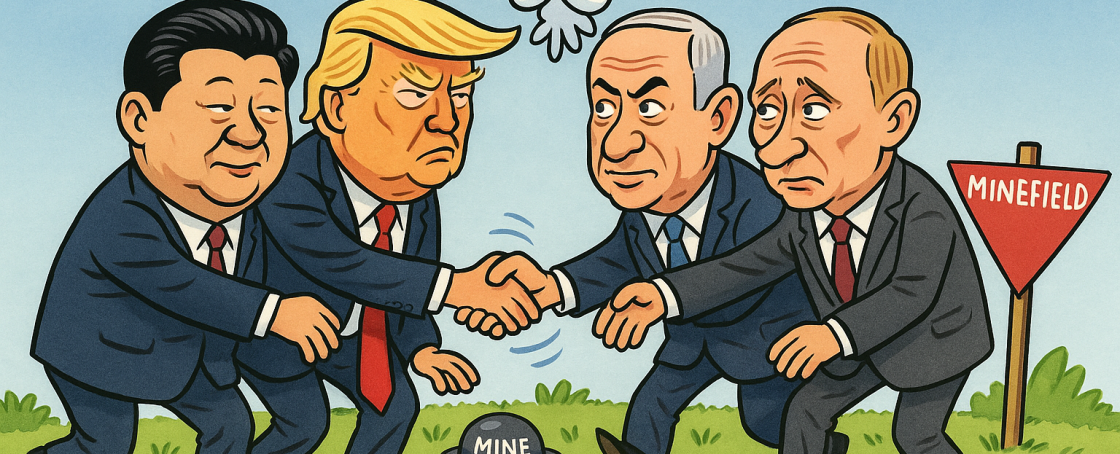
— The long-awaited grand geopolitical bargain for peace is finally showing itself in public. But can it hold?
— Spain’s Pedro Sanchez throws a wrench in the NATO works. But is it real opposition or a domestic distraction?
Hello, subscribers!
Dario here.
Finding myself juggling this newsletter and organizing our Berlin event means our coverage of geopolitical events has dramatically shrunk.
As always, send tips to [email protected] and [email protected].
Let’s dive right in.
| THE BIG BLIND SPOTS THIS WEEK |
TRUMP IS WORKING ON A PLAN TO END THE GAZA WAR in exchange for expanding the Abraham Accords to other countries in the Middle East, according to Israel Hayom. The Israeli journal claimed that the Netanyahu and Trump administrations had reached consensus on the following general terms: Gaza hostilities to conclude within two weeks, the Abraham Accords to be signed by Syria and Saudi Arabia, and a two-state solution to grant limited Israeli sovereignty in the West Bank.
Other broadcasters have also linked Trump’s widespread demands to cancel Netanyahu’s criminal trial to this effort, as part of a process to accustom Israeli public opinion to a pardon process.
The ceasefire appears to be coming into effect as of July 3, with Trump reporting the Israelis have agreed to conditions for a 60-day Gaza ceasefire, while Israeli media report that Hamas has okayed the deal.
Trump had a ‘great conversation’ with Zelensky at the Hague, where Zelensky claimed the two discussed joint defense cooperation and the purchase of U.S. air defense systems. This conversation took place just a few days before Putin’s largest air attack of the three-year war on Ukraine, according to Kyiv on June 30.
And China is planning to invite Trump to a military parade scheduled for September 3 in Beijing’s Tiananmen Square to mark the 80th anniversary of the end of World War 2, with the U.S. proposing that Chinese President Xi Jinping visit the country that same month to coincide with a U.N. General Assembly in New York. If this happens, it would be the first meeting between the two world leaders since Trump’s return to the White House.
Let’s start with the obvious. Who is who? I’m not sure we can definitively know. One of the clearest-cut examples of the public ‘guys for war’ would be President Xi Jinping, who has amassed power in China through the use of corruption trials, increased tensions with Taiwan, and seemingly geared his country towards an inexorable conflict with the United States. Another is Benjamin Netanyahu, ‘Mr. Security’, who exemplifies the Western habit of exploiting war and the state of emergency to increase his power over domestic and foreign rivals. The last would be the IRGC faction, the Iranian Revolutionary Guard, which have used their narrative of the ‘Great Satan’, Israel and the United States, to enmesh the great Persian nation in scarcity and global isolation.
That’s not to say any of these actors are inherently evil. It just means they achieved their positions by emphasizing the need for violence and warfighting over peace and commerce. And all three of these examples seem to be on the way out.
Trump’s vocal demands that Israel postpone Netanyahu’s corruption trial are part of the same exit strategy for the war guys. Key to this grand bargain will be securing safe exits for power players, to avoid what Izabella has long called the ‘in power or in prison’ dynamic, which encourages these war-friendly players to increase tensions and strife to stay safely in office. To bring Israel into the peace-for-commerce side, a safe exit needs to be ensured for Bibi to lead himself out the door.
And in Iran: The last example is how Khameini has been replacing the long list of top Iranian IRGC officials killed by Israeli strikes with replacements from the regular army: the IRGC Major General Mohammad Bagheri was replaced by Absolrahim Mousavi as the new Chief of Staff of Iran’s Armed Forces — the first man from Iran’s conventional army to hold this commanding role. The significant shifts at the head of Iran’s government have so clearly favored moderation that even the Financial Times noted the undertones of a quiet regime change in the country with an article subtitled: “Even without toppling the regime, Israel and the US’s assault is set to bring sweeping change rivalling the 1979 revolution.”
These are just the most visible examples we at The Blind Spot can offer about these global dynamics of remarkable implications, which have been whispered about for years without much by way of public proof.
But now is the time to put our foot down. We are seeing a global coup in favor of commerce and peace. It’s not high-minded or idealistic: it’s just that bombs aren’t great for real estate.
And it’s not certain to happen. Rather, as we can see with Putin’s historic strikes on Ukraine or the abortive escalation in the Iran-Israel war, it’s being negotiated on a knife’s edge. You could read it on Trump’s face as he angrily claimed Israel and Iran “have been fighting for so long, they don’t know what the fuck they’re doing.”
In other words, it’s not so much a grand bargain laid over a carpeted floor in Versailles where representatives get on their knees to scramble over how to remake the world, like at the end of World War 1. It’s a grand bargain conducted under fire, laid out over a minefield, where one unlucky step can still ignite the very real descent into World War 3 we have been witnessing over the last decade.
Every person’s perspective counts. Especially amid such a polarizing and uncertain environment. A great metaphor is that Federer became the world’s greatest tennis player by only winning 52 percent of his games. Just 2 percent made him the best.
Being able to understand and witness these peaceful intentions creates significant network effects, even as an individual not directly involved with politics or statecraft, which may have a very real impact in bringing about this peaceful future.
Or, in other words, that simply sharing the perspective above is a critical part of the road towards global peace.
Hat tip to Pippa Malmgren for being so consistent in her analyses of our slow descent towards World War 3, and of the undercurrent of quiet moves trying to impede it, over the past few years — and to Ian Grigg for pointing out the fantastic Middle-East-related grand bargain theorist named EvanOnX.
SPAIN WON’T PAY 5% OF GDP ON DEFENSE. Spanish PM Pedro Sanchez, threw a spanner in EU plans to boost defense spending just a week prior to the NATO summit which took place in The Hague last week. Sanchez’s decisive ‘no’ to more spending came just as it was reported the 32 delegates from NATO countries had agreed to a working compromise for countries that weren’t so keen to boost spending. This would focus on slicing the 5 percent figure into two: 3.5 percent military spending, with 1.5 percent in ancillary investments.
Sanchez’s government has claimed that rushing to this 5% target would obstruct European Union efforts to become self-reliant in defense production, pushing governments to procure equipment outside the bloc.
This set the Spanish government on a collision course with Trump’s administration, which has raised NATO’s spending target from 3 to 5%. Trump vowed revenge for this move, claiming, “We’re going to make them (Spain) pay twice as much” as a result of this refusal.
COMMENT: There’s a lot more to this surprise refusal than meets the eye. Most Spanish analyses that have focused on Sanchez’s position have noted that his government is facing its worst crisis yet. Foreign interpretations underscore Sanchez as the European rebel against EU countries’ increasing acquiescence to Trumpian demands on NATO spending. This leads to the easy conclusion that Sanchez’s rebellion is motivated by seeking short-term political victory.
But while Sanchez will certainly benefit from a foreign policy win, it rings hollow when his government is under threat of collapse by a litany of corruption cases. This suggests deeper motivations belie his choices. I suspect part of this is that Sanchez’s weakness has forced his hand, meaning he is content to play the ‘opposition force’ or OpFor, military terminology for a fake enemy deployed in exercises, for Western institutions against the United States.
By now, Sanchez is arguably Europe’s most seasoned and hard-weathered politician. Having run successively smaller and weaker minority governments for almost seven years in a country traditionally governed by majorities and near-majorities has been no easy task. Especially surviving his novel alliance with hard-leftists and secessionists, which made him lose the Spanish center. Spaniards with a sense of humor have pointed out that Frank Underwood, famously portrayed by Kevin Spacey in House of Cards, is but a poor imitation of Sanchez when it comes to cunning political moves.
But that doesn’t mean he’s invincible.
Scandal! Anti-corruption agents of Spain’s paramilitary police, the UCO of the Civil Guard, entered the Socialist Party’s headquarters on June 20. This may mark the first genuine crack in Sanchez’s ability to continue governing.
What led to this latest series of events was nothing short of incredible. Leaked audios showed advisors close to Sanchez openly discussing ‘bites’ (‘mordidas’ or pieces of corruption money) in exchange for political favors. The crimes centered around his previous Minister of Transport, Jose Luis Abalos, his advisor Koldo Garcia, and the third most powerful individual of the Socialist party: Santos Cerdan.
The case started in 2022 when the Civil Guard opened an investigation into the socialist party’s handling of public contracts for facemasks during the COVID emergency, Operation Delorme. The judges suspected that 10 individuals around Abalos formed part of a criminal enterprise designed to milk public sector contracts that used EU funds.
The matter then gained a life of its own, with subsequent investigations finding this criminal network’s footprints in every major scandal that has rocked Spanish politics in recent years: from the influence peddling of Sanchez’s wife, to the suspected delivery of 104 gold ingots by the Venezuelan Vice President to Abalos in a clandestine meeting aboard a private jet in Barajas airport.
The audio leaks are nothing short of astonishing. Most of the audio recordings seized by the UCO were done by Koldo himself, and later released as part of the investigation. They outline how members of the Spanish government casually spoke about their ‘bites’: the quantities they are ‘owed’ by certain individuals in exchange for favors. A particularly shocking instance occurs when Koldo tells Abalos of a shady deal presented by a Venezuelan-owned oil company controlled by the Guaido government of Venezuela in exile. This anonymous company was ready to pay €500,000 per month over three years for arranging a single meeting between Guaido and Sanchez.
Some of the findings seem devised for hilarity. One of the recordings shows both men enthusiastically discussing their favorite prostitutes for a night out. Another hilarious example was from a UCO raid on Abalos’ house, where they found a USB with private WhatsApp conversations with the Spanish PM. This USB was located after detaining a prostitute who attempted to flee from the raid with the device concealed inside her underwear.
True to Spanish political intrigue, the drama surrounding it is complex and hard to untangle.
But the problem for Sanchez is deeper than just a few rotten apples. Because this case goes further than mere corruption: it comes close to proving that systemic underhanded policies were approved at the highest levels of the Spanish government. For instance, the judge on the case claimed the leaks prove that Santos Cerdan, the former secretary of the PSOE, was not just responsible for distributing the ‘bites’ around the PSOE government. He was also unofficially in charge of carrying out purges to root out internal adversaries. As a result of the evidence at the disposal of the Spanish justices, a Supreme Court judge decided to place Cerdan in preventive prison, so as to minimise the danger of Cerdan destroying evidence, as of June 30.
Such cases can easily bring down governments. For instance, the previous PP government of Mariano Rajoy was brought down after the justice system discovered a similar network of undermoney payments distributed in letters to members of the right-wing PP — the famous ‘Gurtel’ and ‘Barcenas’ corruption cases.
And both of these corruption cases have a lot in common. Rather than showing individual corruption, they seem to prove that an undermoney system is in operation behind the scenes in the Spanish government, where large amounts of private sector money is quietly shuffled into the pockets of ‘connected’ functionaries in exchange for disbursements of public money and favors.
Even more crucial is that amidst these crises, both governments relied on coalition partners to sustain their majorities. What brought Rajoy’s government down was that their coalition partner, Ciudadanos, had run a vigorous anti-corruption campaign during the previous elections. Its founder, Albert Rivera, found it impossible to defend the PP’s credibility once a judge had ruled the corruption was systemic.
Similar tensions exist in the PSOE’s even more fragile coalition between the left-wing Sumar and Podemos parties and secessionist ERC. Especially because many of the motley band of leftist groups that make up Sumar, the only other party in the PSOE’s government, are afraid of being seen as complicit in the PSOE’s corruption, threatening the PSOE’s strongest coalition party with an internal fracture if it doesn’t leave.
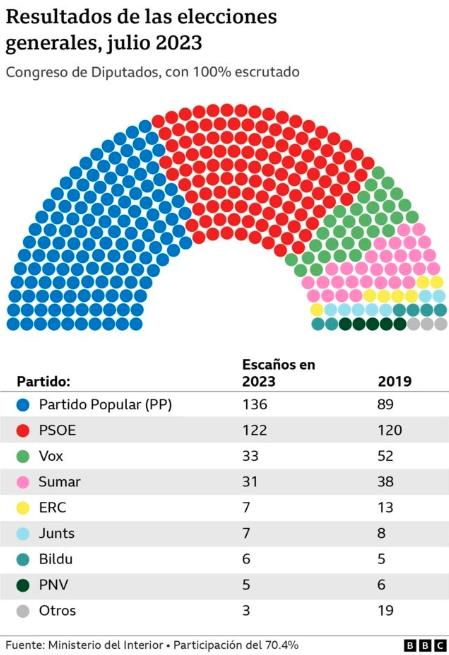
Some may point to Spain’s obligation to form a ‘constructive’ motion of censure, which requires an alternative candidate to gain a majority, as an obstacle for Sanchez’s government to collapse. But they shouldn’t forget the nature of Spain’s congressional arithmetic. The PP and Vox are a larger majority than PSOE and Sumar — they simply don’t have the political capital to disburse favors to the myriad separatist-friendly groups in Congress. Should some of these parties manage to formulate an agreement with these right-wing parties, which was about to happen after the latest elections in 2023, an alternative candidacy could foreseeably be created.
Looking ahead: Going into predictions about whether Sanchez will remain in power or not, and the incentives towards resigning and moving towards new elections, would necessitate an entire article. In short, if elections were held tomorrow, the right-wing is currently set to comfortably win a majority. Pedro Sanchez, a bitter enemy of the right-wing, has gone from the PSOE’s strength to a critical weakness.
And recent news that the Spanish Constitutional Tribunal vouched for Sanchez’s amnesty deal will only buy him a temporary reprieve. And current parliamentary arithmetic that grants a potential right-wing coalition in Spain an ample majority based on recent polling is sure to force Sanchez’s coalition to stick together until 2027. That is, unless a decisive and unequivocal corruption case is convincingly made by the Spanish judges that would force his coalition partners (and his own party’s) hand.
Brussels as patient zero: But what’s really important to note is how this scandal started: with funds disbursed by the EU that ended up in the pockets of PSOE-aligned companies. That means Europe’s anti-fraud office OLAF is hot on its trail. And it also suggests that Pedro Sanchez needs all the European backing he can muster to avoid yet another sword hanging over his government’s head.
This means the ample international press coverage of Sanchez’s opposition to the NATO spending goal is leading to two incorrect conclusions. On the one hand is the perspective that this move is designed to shore up internal support. This misses the mark: the gravity of the corruption cases means this move will hardly make a dent beyond superficially positive publicity. These corruption cases can drag on for years until they inflict a fatal blow: the Barcenas case emerged in 2013 and caused Rajoy’s overthrow in 2018.
On the other hand, the positioning of Sanchez as the sole opposer of the NATO spending target is incorrect. This has been widely reported in the international press. Quite the opposite: Sanchez’s weakness means he is the happy bringer of others’ bad news to the NATO summit.
And consider how Sanchez secured his opt-out. Rather than a specific carve-out for Spain, Sanchez’s opt-out, as reported by the Financial Times, rests on a change in the NATO statement from “we” to “allies” in a sentence referring to the pledge to spend around 5% of GDP on defense by 2035.
As Giorgia Meloni told reporters later that day, Sanchez has signed the same declaration as the rest of the NATO powers. If Spain can secure an opt-out while signing the same piece of paper, it effectively grants all EU spending laggards, like Greece, Italy or Portugal, the ability to defer their increase in defense spending. Sanchez has ferried this message and risks the broadside of the Trump administration for two purposes: temporary shielding from domestic woes and gaining leverage with key European allies that can help soften any European investigation into his corruption cases. And while EU Competition Chief Teresa Ribeira doesn’t directly represent Sanchez’s PSOE, which she is a high-ranking member of, her interview push against suggestions that Europe’s digital rulebook is to be watered down for a trade deal with the U.S. has the same distinct ‘OpFor’ ring to it.
| OTHER BLIND SPOTS THIS WEEK |
THAI PM SUSPENDED BY JUDICIAL DECREE. This is the political fallout from a controversial leaked call between the Thai PM Paetongtarn Shinawatra and former Cambodian leader Hun Sen continues to make waves in Thailand.
How did this begin? Well, rumours of a coup began as a consequence of a controversial leaked call on June 17 between the young Prime Minister of Thailand, Paetongtarn Shinawatra, and the former Prime Minister of Cambodia, now its Senate President — Hun Sen. In the call, Shinawatra and Sen discussed a minor skirmish on the Thai-Cambodia border, which had resulted in the death of a Cambodian soldier.
But the call was leaked by Hun Sen later that day, which caused uproar in the upper echelons of the Thai military, particularly since Shinawatra referred to General Boonsin Padklang, a powerful Thai military leader, as the “opposing side.” The leak immediately led to the resignation of the Bhumjaithai Party from the Thai governing coalition, which precipitated its government into the crisis it now faces.
Rumours of a military coup: Key moves by ultraroyalist supporters and the military made Thai experts sound the coup alarm: the Council on Foreign Relations claimed the conditions were becoming highly similar to how the army has operated before the coups of 2014 and 2006: particularly the use of Cambodian geopolitical tensions and nationalist protests as a pretext for intervention. They suspected that if civilian politics became increasingly destabilized, a coup would happen in less than a month.
And they weren’t off by much. While the blow was inflicted by the Thai Constitutional Court rather than the military, the impact has been similar: Paetongtarn Shinawatra’s government now teeters on the verge of collapse, as the court will now decide on whether to dismiss the suspended Thai PM from office.
AMERICAN INTEL WORRIED ABOUT PAKISTAN. Intelligence reports indicate that Pakistan is developing nuclear-armed intercontinental ballistic missiles, which may be capable of reaching the U.S. mainland.
According to the reports, this is because Pakistan intends to deter potential American preemptive strikes or interventions in favor of India in a future conflict between the two powers.
While Pakistan has long held a tolerated nuclear program to counterbalance India’s, the decision to pursue ICBM development represents an escalation in the region’s arms race.
More interesting is the increasing closeness of China and the Pakistani regime, suggesting that China may use Pakistan’s ICBM program to exert pressure on the United States, as it has used North Korea’s nuclear program as leverage over South Korea.
PEACE UNDER THREAT IN ETHIOPIA, as outlets report a growing divide between the powerful Tigray People’s Liberation Front and the Ethiopian federal administration in Tigray threatens to bury the Pretoria peace agreement, which pacified the region in 2022.
This divide has sent power players in opposite directions. While the TPLF has sought to strengthen its ties with Ethiopia’s traditional foe, Eritrea, Ethiopian PM Abiy Ahmed has been strengthening a new party designed to challenge the TPLF’s dominance in Tigray.
While it remains to be seen how these growing tensions will affect the Pretoria peace agreement, critics note its generally insatisfactory implementation means it may have been dead on arrival. If so, we should expect the breakout of another civil conflict in one of Africa’s largest states soon.
KENYA PROTESTS INTENSIFY as several were killed and another 400 reportedly wounded, according to Reuters this Wednesday. These protests are only the latest in a long line of violent outbursts at the economic ills plaguing the East African nation.
The latest protests were specifically organized to commemorate those that took place on June 25, 2024, which took the lives of at least 60 individuals according to Kenyan rights groups.
The anti-tax protests last year were organized to condemn the high tax rises proposed by President William Ruto in his Financial Bill, which officials insisted were necessary for the Kenyan government to fulfill its loan agreements with the IMF.
