
| SNEAK PEEK |
— Why the Big Beautiful Bill has more in common with Poland’s stabilization programs of the 1980s than Chinese industrial policy.
— CBDCs are so yesterday! And even China is turning to stablecoins.
— How Robinhood opened a can of worms regarding equity ownership.
Happy Sunday!
There’s a lot going on as always, but this week we wanted to build on our long-standing argument that Trump’s agenda has less to do with industrial policy and more to do with restructuring the American economy so that it reorientates itself back into a market-based system. In that respect, we think it’s useful to describe it as a stabilization package that balances the needs of those “left behind” by the previous unbalanced system, with those whose jobs and systems are now threatened by the re-orientation. More on that in our big blind spot below.
Separately, it’s less than two weeks now until our summer party in Berlin. There are still tickets available, but not many! So please do join us on July 17 if of interest.
We have our Cold War-themed playlist ready as well as a thematic cocktail list. Given it’s a need-to-know off-the-books operation, we’re not publicizing the headliners. But if you really want to know the order of play before committing, just email Izzy directly, and she might be inclined to share some details.
Next week we will be in full party preparation mode, so we might not be able to issue a newsletter. We’ll see how things go. After that, we’ll be in recovery.
Which is to say, Izzy’s newsletter will be on hiatus until early August. However, fear not. Dario’s geopolitical newsletter will still be operational, and Izzy reserves the right to keep posting on a standalone basis.
Take care, and hopefully see as many of you as possible in Berlin.
Send tips to [email protected] and [email protected]
| THE BIG BLIND SPOT THIS WEEK |
GLOBAL RE-STABLIZATION OP? Those living through extraordinary times often fail to recognize it. Too often, system transitions hide in plain sight.
That’s why here at the Blind Spot we think it’s useful to read the political fallout related to the passing of the Big Beautiful Bill (BBB) not as another partisan skirmish in Washington, but rather as the natural political commotion to be associated with any grand transition story.
Key to this observation is that BBB represents a bid to wrest the U.S. economy back from its own unique form of market failure. As ever, there is disagreement over the nature of the market failure, and hence also over the policy prescriptions to address it.
Whether it does so consciously or not, we think what few understand is that BBB seeks very specifically to address the Trumpian view that what ails America is the inherent imbalance at the heart of its economy, which, on the face of it, is no different from China’s. The only difference is that while China channelled its imbalance towards industrial dominance in the world of atoms — manufacturing, infrastructure, and heavy industry — the U.S. engineered version channelled it towards the world of finance and bits. As a result, capital-intensive production took a back seat to capital itself, leaving only digitization and service-sector innovation as viable routes for entrepreneurial escape. This, in part, explains the dominance of the so-called Magnificent 7.
Alex Karp, the CEO of Palantir, explains well how this de facto U.S. industrial policy impacted the start-up scene in his book, The Technological Republic:
“The entrepreneurial energy of a generation was essentially redirected toward creating the lifestyle technology that would enable the highly educated classes at the helms of these firms and writing the code for their apps to feel as if they had more income than they did.
“The creative energies of Silicon Valley engineers would end up being directed toward solving their own problems, which for many, stemmed from a fundamental disconnect between the life they thought they had been promised as a result of their intellectual talents — a life of ease and wants sated, of car services and assistants at the ready to fetch meals and groceries — and the reality of their relatively modest incomes. This generation was told that they were bound to become the next masters of the universe, but there was little for them to inherit. So they would ultimately go about constructing the apps and consumer services that would create an illusion of the good life for themselves and their peers by making it possible to summon taxis, make restaurant reservations and book vacation home rentals with only a few swipes on a phone.
But there was a far more fundamental misallocation of resources, of capital and talent. The failing of that early internet era was its rush to serve the needs of the consumer at the expense of those of the nation-state or the public. And that focus on the consumer endures to this day. The lack of ambition from many startups today is and remains striking. Far too much capital, intellectual and otherwise, has been directed to sating the often capricious and passing needs of late capitalism’s hordes.”
Rebalancing myopia? But while economists across the political divide are happy to call for the urgent need for China to rebalance its economy at every possible opportunity, few demand the same thing of America. On the contrary, those who do call for a rebalancing towards reindustrialization — and an economy where industry can once again compete with finance — are usually dismissed as reactionaries, nostalgic for an America that “no longer exists,” simpletons, or worse, as MAGA populists.
This myopia explains why the Big Beautiful Bill — pandering as it does to such MAGA base inclinations — is easily caricatured as an assault on free-market capitalism in establishment circles. Or worse, as the rise of capitalism with “American characteristics” or the adoption of Chinese-style industrial policy with a nationalistic bent.
Objectively, this is a huge mischaracterization. Returning to balance from a position of imbalance is not the same as industrial policy. On the contrary, it constitutes the unwinding of industrial policy and the making of a true level playing field.
That’s why we think BBB has more in common with the stabilization programs of the Communist-to-capitalism transition period than a push towards a Chinese-style capitalist model. One of the best comparatives in that respect may be Poland.
How to rebalance and not alienate voters: In 1989, economist-turned-policy-maker Grzegorz Kołodko published Reform, Stabilization Policies and Economic Adjustment in Poland, a blueprint for rescuing a failing socialist economy without destroying its social fabric. His argument offers an uncanny field guide for how to revive the U.S. economy while addressing both the interests of MAGA populists and their opportunistic tech-bro allies.
Kołodko was the gradualist counterweight to the other heavyweight economist of the era, Leszek Balcerowicz, best known for applying Jeffrey Sachs’ shock-therapy doctrine to 1990s Poland. Both participated in the 1989 Round Table negotiations, which hashed out the grand bargain for Poland’s transition from communism to capitalism, though Kołodko was on the government side, while Balcerowicz was aligned with the Solidarity movement.
While both Kolodko and Balcerowicz shared the goal of transitioning Poland to a market economy, their approaches diverged sharply: Balcerowicz’s rapid “shock therapy” prioritized speed and neoliberal principles, achieving macroeconomic stabilization but at a high social cost, while Kołodko’s gradualist, socially conscious strategy focused on balancing growth with welfare and structural reforms.
Their rivalry, rooted in competing visions and personal dynamics, shaped the discourse on Poland’s economic transformation, with Kołodko’s critiques highlighting the social downsides of Balcerowicz’s reforms, and Balcerowicz’s legacy credited with setting Poland on a path to long-term growth.
Later on, Jeffrey Sachs would become one of the most prominent critics of aspects of his own early policy prescriptions due to the upheaval that shock therapy rendered on the Russian economy and other transition states.
Yet, viewed through the Polish lens, today’s Big Beautiful Bill looks far closer to Kołodko’s own prescription than that of Balcerowicz’s.
Getting the balance right: Much like Kołodko, the Trump administration appears to be pursuing a stabilization-driven reform agenda aimed at rebalancing the U.S. economy — nudging it back toward a genuine market system in the hope of unlocking sustainable growth. Trump critics will say that’s putting too much confidence in strategic thinking where there is none. But one shouldn’t neglect that policy often carves itself out around the path of least resistance. Thus, the emulation of transition proscriptions of the past may be more incidental than strategic — the natural result of having to create policies that address similar economic challenges without throwing the very same interests that empowered you under the bus.
So while the MAGA movement initially aligned itself with Silicon Valley libertarians and tech-fueled market fundamentalists to gain power, it is now fracturing in a way that echoes the historical fallout between Balcerowicz and Kołodko. This comes most glaringly in Elon Musk’s public trashing of the Big Beautiful Bill and promise to start a competing party to displace Trump, the man he thought would operate in his interests, but is turning out not to. [The analogy here is also to Boris Berezovsky, who, after bankrolling Putin’s ascent to power to protect his own interests, decided to fund opposition movements to displace him when Putin turned against him by using state power to disempower him and his fortunes.]
Ironically, even though Kołodko today is an outspoken critic of Trump, Trump’s policies may be closer to the middle-way capitalism he once championed than to the hardline shock therapy of Sachs or Balcerowicz. This is especially evident in the Big Beautiful Bill’s refusal to implement the deep welfare cuts or tax hikes on SMEs and working Americans so favored by market purists in Silicon Valley.
Historic parallels: “The syndrome of crisis phenomena in Poland is composed of three planes: systemic, structural, and political,” Kołodko wrote back in 1989, insisting that adjustment had to engage all three at once.
America’s 2020s malaise lines up neatly: institutional dysfunction, hollowed-out supply chains, and a body politic at daggers drawn. But it’s Kołodko’s deeper warning from the era that really resonates: that raising prices without raising output replicates shortages irrespective of price hikes. Kołodko even coined the phenomenon “shortageflation dilemma” to highlight the choice between visible price inflation and invisible queues. “The dilemma comes down to the trade-off between the shortage rate in the socialist economy and the scale of price inflation”.
While Poland had export advantage in a few strategic areas like steel and coal, like America, its broader economy was mostly import-dependent and highly indebted to external creditors. But Kołodko’s key point was that until Poland created a domestic production and manufacturing capacity, inflation would never be held at bay, irrespective of what austerity measures were imposed on the domestic population.
Domestic balance first: Against IMF advice to fix the external account first, Kołodko insisted: “Domestic balancing should be given priority, as it is the key to successful systemic adjustment … and it offers better chances to eventually pay back foreign debts”. Poland learned that starving the home market to feed exports merely deepened popular resistance and killed reform momentum. This is echoed in the Big Beautiful Bill’s mix of re-shoring subsidies, freight-rail credits, and Main Street tax relief.
But it’s Kołodko’s signature line that really resonates with today’s America: “The fine art of stabilization … must consist in striking the balance between economic necessity and political practicability”.
So while shock therapists saw politics as a nuisance to be overruled, Kołodko treated it as the binding constraint. The Bill follows suit, shielding welfare entitlements, farm programs, and small-business tax credits even while clawing back industrial policy levers — a centre-left social cushion married to centre-right supply-side revanchism.
Vested interests: But there are further echoes, too. Poland’s key reform obstacle was a strong dose of inertia from the steel and coal lobby [the primary beneficiaries of the old model], along with party bureaucracy, all of whom were interested in maintaining the current economic structure. Moving quickly with shock therapy would impoverish all these groups by leaving them jobless and lacking rudimentary cash flows for subsistence living. Yet conceding to them would mean upsetting international creditors who had little patience for “Poland first” policy.
The challenge for Kołodko then was to persuade the powers that be that unless Poland refloated its domestic economy first, finding new productive sources of income for these people rather than leaving them on the trash heap (as happened in Russia), nobody would benefit in the long run.
America faces a similar dilemma today. It is torn between establishment and bureaucratic interests who err on the inertia and welfare, and the forces of Big Tech and Wall Street, who were happy to back MAGA for as long as they thought Trump would protect their rents and move towards shock therapy.
But is America really a skewed economy? Establishment voices will argue that America is far from an economy dominated by state-owned enterprises, heavily subsidized goods, or even industrial policy. But this ignores the insidious nature of the American imbalance. Even before Joe Biden’s IRA bill made U.S. industrial policy explicit, the state was steering capital according to political, not market sensibilities by way of the ESG investing trend. This openly directed investment toward ideological goals rather than economic merit, under the guise of market neutrality.
Meanwhile, the elevation of finance, services, and defense to privileged positions acted as a de facto industrial policy — one that systematically deprioritized tangible production and made the country dependent on cheap Chinese imports, which acted as subsidies in their own right.
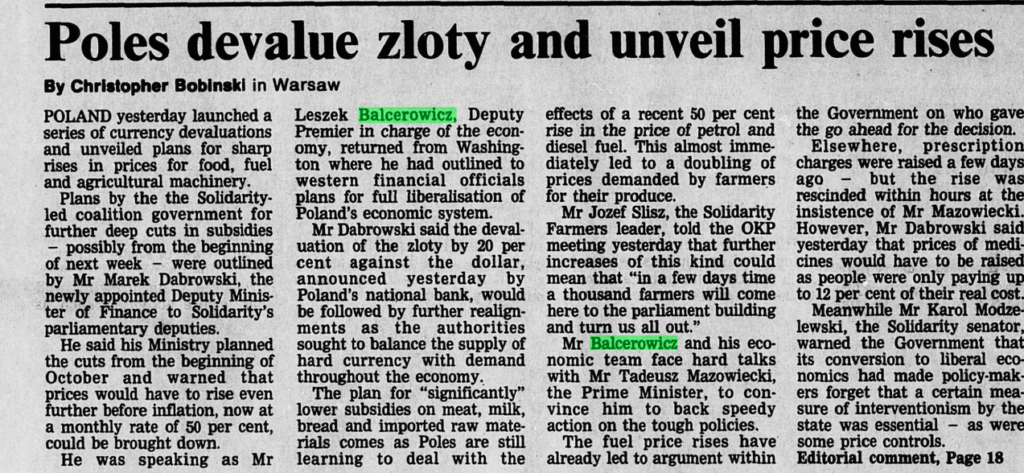
As per Poland, weaning the American system off these distortive policies and foreign subsidies will inevitably trigger temporary inflation. It may also require significant dollar devaluation if not a wider currency reset (along the new Polish zloty line).
The takeaway: Kołodko’s playbook championed exactly the middle course the Big Beautiful Bill claims to chart: firm-handed macro discipline, yes, but never at the expense of political consent or basic social protection. A similar stance now puts MAGA populists at odds with Silicon Valley libertarians, much the way Kołodko’s gradualism clashed with Balcerowicz’s shock therapy.
The only real difference is that BBB also leans on military spending as a key mechanism to aid America’s transition from a financialized system to a more balanced system that once again puts manufacturing on an even footing with services and bits. Calling the policy “strategic autonomy” or military Keynesianism is just about fair. But calling it industrial policy or capitalism with American characteristics (alluding to the idea it is emulating China) is not.
If anything, the policy is reminiscent of Putin’s actions once he took control of the Russian state from the oligarch class, circa 2000-2010, during which time Russia’s defense budget nearly tripled.
Looking back at Poland, it succeeded where other communist transition economies failed precisely because there was a check on Balcerowicz’s shock therapy policy prescriptions. This ensured Poland fused stabilization with genuine structural retooling — new export sectors, hard budget constraints, and, later, EU accession rules that locked reforms in. America’s version now hangs on whether the Bill can translate reshore slogans into factories, gigabit grids, and middle-skill wages before the debt loop tightens and before new oligarchs freeze the playing field.
Kołodko himself would bristle at the comparison, and his forthcoming September 2025 book reportedly brands Trumpism a dead end. Yet the empirical kinship remains: both projects seek market dynamism without social carnage, both distrust global creditors, and both prize political viability over doctrinal purity.
| FINANCE |
EREBOR RISES! Erebor is the neo bank offering from tech disruptors Palmer Luckey and Joe Lonsdale (co-founder of Palantir and managing partner at 8VC), named after yet another Lord of the Rings concept, this time the mountain which housed Smaug’s treasure. It is being set up to fill the void that Silicon Valley Bank left behind (worth remembering who started that bank run, eh?) and focus on “Stability” and “crypto integration.”
The bank reportedly intends to maintain a conservative financial strategy, potentially capping loan-to-deposit ratios at 50 percent or less, to ensure liquidity and stability, contrasting with riskier fractional reserve banking practices.
Mind you, Erebor isn’t exactly a VC model. While Admati wanted banks to hold more shareholder equity to cover potential losses directly from bad credit extension directly, Erebor is looking to emulate higher equity buffers by issuing equity-like instruments. e.g., tokenized claims backed by real assets like USTs) that perform a similar systemic stabilizing function.
| STABLECOINS |
CBDCs ARE SO YESTERDAY: The FT reported on Monday that “a speculative frenzy in dollar-backed stablecoins has prompted South Korea to lift a 14-year ban on domestic financial institutions buying so-called kimchi bonds as it seeks to draw in offsetting capital inflows.”
Meanwhile, it’s bad news for the e-yuan: “The official digital yuan, a project that was accelerated in response to Zuckerberg’s Libra, isn’t exactly a bazooka. Even domestically, the use of the e-CNY has been rather limited,” writes the Japan Times. “Nor has it made much headway outside China. Monetary authorities in other countries that could have facilitated the exchange of e-CNY into their domestic legal tender, and vice versa, have lost interest in central bank digital currencies, particularly the retail variety. For China, which is already embroiled in a trade and technology spat with the U.S., all this makes for a dangerous vulnerability,” they write.
Hong-Kong’s stablecoin desires: As e-yuan momentum wanes, there’s growing talk that Chinese authorities are thinking of embracing stablecoins to fend of U.S. dollar stablecoin competition. Reuters reported this week that China’s tech giants JD.com and Ant Group are urging the central bank to authorize yuan-based stablecoins “to counter the growing sway of U.S. dollar-linked cryptocurrencies, people with direct knowledge of the discussions said.”
Offshore yuan stablecoins: According to Reuters the two firms propose China allows the launch of stablecoins in Hong Kong pegged to its offshore yuan to help promote global use of the Chinese currency and fend off the dollar’s growing digital influence, the two sources said.
Euro-denominated and GBP-challengers are coming too: It’s not just the Chinese wising up to the useful role stablecoins play in creating permanent bids for home-country debt issuance. A new start-up called AllUnity by Flowtraders, Galaxy and DWS, is looking to issue a euro-denominated stablecoin. The Blind Spot had a chat with the CEO and he emphasized that Europe couldn’t wait for a digital euro to defend its payment systems from dollarization via external dollar-denominated stablecoins. That’s why a viable euro-denominated stablecoin like his, now licensed by Bafin, should be supported by governments. Furthermore, it could become a key source of demand for both bunds and eurobonds, something governments should like. [More on that next week fyi.]
But it’s not just the Germans figuring out that stablecoins can be a useful mechanism to have one’s cake and eat it while issuing ever more debt … [It’s worth remembering that by funnelling debt into onshore stablecoins, the proceeds of interest-rate arbitrage can be more easily taxed than if the proceeds end up in foreign holdings.] U.K. startup Agant is seeking to do a similar thing in the U.K. with their GBP-denominated stablecoin. We spoke with Agant’s co-founder, Reuben Blamey, and he said that one of the most underappreciated issues with the U.K. payment system, notably Faster Payment, was that while it was incredibly efficient from a user’s perspective, it was incredibly cumbersome in the back-end and expensive. When asked what problem would a GBP stablecoin solve, he also reiterated the point about being a prominent buyer of U.K. gilts.
The public blockchain subsidy: The consistent message we’re hearing from everyone in the stablecoin space, is that the real opportunity for banks and issuers is leveraging the capacity of public blockchains to provide much cheaper, yet still equally resilient, payment systems. Given the current brouhaha in Brussels over who will bear the cost of the digital euro’s infrastructure (vendors, merchants or users), this gives stablecoins an immense advantage. Payment infrastructure is not cheap.
THE BOLIVIAN STABLECOIN CASE STUDY: While Washington’s dollar stablecoin assault continues to panic the powers that be in Basel and Frankfurt, Bolivia is quickly becoming a case study in what dollar stablecoins can do to uproot local monetary authorities from their core centers of influence.
Once one of Latin America’s most anti-crypto jurisdictions, Bolivia overturned the sweeping ban it introduced on virtual assets in 2014 in June year due to intensifying dollar shortages, collapsing reserves, and rampant parallel market activity. This has opened the door to regulated digital asset activity for the first time in a decade.
Twelve months on, the shift has been dramatic. The Banco Central de Bolivia (BCB) now officially tracks crypto flows and reports that transaction volumes has hit $294 million in the first half of 2025, up from just $46.5 million in the same period last year — an increase of more than 530 percent. Total volume over the full year has reached $430 million. The central bank now also formally acknowledges that these flows help households and micro-businesses access foreign currency in the face of economic dysfunction.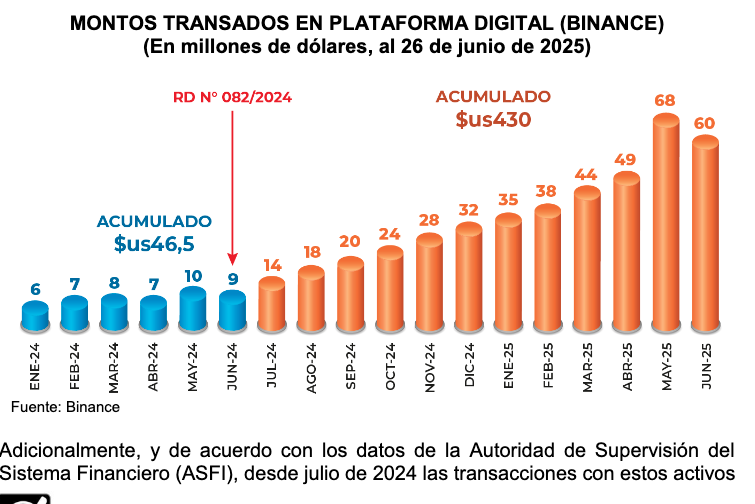
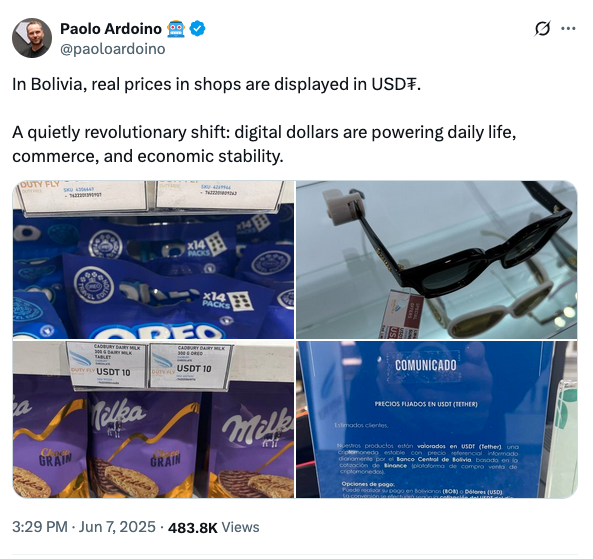
The appeal of digital dollars is clear: official FX reserves are nearly exhausted, inflation is running at a 40-year high, and the black market exchange rate for the boliviano has diverged sharply from the official peg of 6.96 BOB/USD — rising to as much as 16-17 BOB per dollar in street trade. Anecdotal reports suggest some merchants have begun listing prices in USDT, with images shared by Tether’s CEO on his X account seemingly confirming such practices in Santa Cruz. Even Bolivia’s state oil company YPFB was recently authorized to import fuel using crypto to circumvent hard currency shortages.
Not giving up yet. Despite the crypto love in, Blind Spot sources say the BCB has adopted a paradoxical strategy: while hosting representatives from Binance and Tether at economic forums, it is simultaneously advancing plans for a retail central bank digital currency (CBDC) and tightening AML oversight of virtual asset service providers. In a recent communication, the central bank also hinted at intentions to regulate crypto payment infrastructure more formally.
Why it matters: Bolivia’s trajectory hints at a broader shift in global financial dynamics, where stablecoins — not traditional IMF interventions or formal dollar pegs — are emerging as default monetary stabilizers for countries in crisis. But the rise of offshore-issued stablecoins like USDT also raises uncomfortable questions about sovereignty, transparency, and control: in a world where the dollar is programmable and privately intermediated, who gets to write the rules for access — and at what cost? Some in any case are wondering: Might Tether or affiliated entities lend directly to governments, much like Pablo Escobar once offered to pay off Colombia’s debt?
KAZAKH BITCOIN RESERVE: Cointelegraph reported that Kazakhstan’s central bank is set to establish a state-run crypto reserve, likely funded by seized digital assets and government-linked mining.
I’m sometimes asked how stablecoins are supposed to resolve the global debt imbalance when, in practice, they just create a new bid for Treasuries — arguably intensifying the incentive to issue even more sovereign debt.
It’s a fair question. But it misses the transitional nature of what’s playing out.
My working assessment is that stablecoins are not a final solution to the global liquidity mismatch. They’re lifeboats — temporary vessels engineered to maintain global payment integrity while more fundamental reforms rebalance the economic plumbing, which may or may not maintain their use case after the bulk of the great global rebalancing is done with. For now, their role is to absorb excess U.S. Treasury stock while the world decouples from the logic of permanent dollar hoarding and persistent U.S. deficits.
Their equally important purpose is to make it easier to tax the cash flows paid out by the U.S. Treasury to bondholders.
What this transition edges us towards is a new international settlement architecture where the real-time “float” that enables trustless trade no longer needs to be funded by a permanent mega-stock of taxpayer-backed safe assets. In this new order, code becomes the guarantor. Smart contracts and consensus mechanisms become the foundation of trust, not sovereign liabilities. Currencies underpinned by these systems become the new hard currencies, while currencies that maintain elasticity become the soft currency offsets.
Yes, yes. This is not infallible. Remember, I was for years a major critic of outsourcing trust to code, not least because of its messy and hackable dimensions. I was also very sceptical of any hard-rule system that had zero fault tolerance. There must, in my opinion, be a capacity to guard against the “Computer says no” problem.
However, I’ve evolved my thinking as I think it’s conceivable to structure the financial system around “soft” and “hard” systems. As long as the two interact with each other you have capacity for flexibility within the ultimate “rules-based order”.
And in theory, when things go really wrong, you still have the potential to overwrite the rules-based order provided true consensus is reached by all players. The analogy here is how, post-2008, George Soros campaigned for a special one-time boost in SDR allocations, which were previously used to balance the system. Similarly, hard-set coded currencies or global settlement systems can also amend their rules in a crisis, providing all stakeholders that provide energy and resources to the system reach consensus. The downside (or potentially the upside) is that, unlike the redrafting of the SDR system, the consensus in a hard-coded system would be rendered entirely by economic, not political means. Whether this is ultimately any different in the UN system (where powerful countries bribe weaker countries into voting in line with them) is up for debate.
Either way, once the global economy rebalances — helped along by policies like tariffs, reshoring, and strategic decoupling — the demand for dollars held for anything other than settlement float (i.e. currency manipulation or mercantilism) should, in theory begin to collapse. When that happens, there may be a temporary glut of Treasuries relative to dollar liquidity outstanding, creating an inadvertent liquidity shortage. Stablecoins will be able to cater to that need by creating money-like tokens purely oriented at rebalancing the system, albeit in a segregated and controlled way.
May that encourage governments to pursue overly profligate policy? Possibly. But, chances are, competition between stablecoin systems would become a disciplinary check. Customers using stablecoins for transactional (rather than store-of-value) purposes would naturally flock to systems subject to the lowest opportunity cost. Issuers too, would be inclined to set themselves up only in jurisdictions where increasingly desperate governments are not inclined to overtax them just to balance the books. (What’s the good of interest rate arbitrage if you can’t keep it? After all, the government’s budget only squares in a stablecoin environment if the interest being handed over to stablecoin issuers can mostly be clawed back, synthesizing a type of financial repression by the back-door.)
Either way, eventually, funding the government would become distinct from funding the payment float.
If extreme profligacy ensues, fiat currencies would likely become as volatile as cryptocurrencies, edging users to embrace cryptocurrencies directly for settlement instead. At that point, the system float that empowers trade would become fully funded by speculators, not governments, or by proxy taxpayers.
| EQUITIES |
FAKE EQUITY FLARE-UP: Robinhood, the equity trading platform that turned Wall Street Bets and Gamestop into household names, launched a suite of so-called “tokenized equities” for European users this week. These operate as digital representations of both public and private company shares, tradable 24/7 on an Arbitrum-based blockchain. At first glance, it appeared to be another incremental move in the tokenization trend sweeping capital markets. But within hours of launch, the platform found itself engulfed in a reputational mess — accused of misrepresentation, legal grey-zoning, and, in the words of Elon Musk, selling “fake equity.”
Unlisted exposure: The problem began when users noticed Robinhood offering tokenized shares not just of blue-chip U.S. names like Tesla and Apple, but also of elusive private giants like OpenAI and SpaceX. These tokens — marketed via partner platforms such as Xade Finance — appeared to offer investors exposure to firms that remain tightly held and largely inaccessible. While the tokens promised dividend entitlements, they notably excluded any voting rights or shareholder privileges. That alone might have warranted caution. But confusion escalated when OpenAI publicly disavowed any involvement with the offering, stating on X that “These ‘OpenAI tokens’ are not OpenAI equity. We did not partner with Robinhood… Please be careful” (source).
X-tremely upset: Elon Musk, never one to miss a dramatic moment, chimed in, responding to OpenAI’s clarification with a blunt rebuke: “Your ‘equity’ is fake.” The backlash quickly snowballed as legal experts began parsing the mechanics of Robinhood’s offering. It turns out the tokens are not issued by Robinhood itself but are generated synthetically via third-party protocols that rely on Robinhood market feeds to simulate price exposure. In other words, they’re derivatives in disguise, not actual equity instruments.
The mechanics: Robinhood CEO Vlad Tenev has since clarified that the structure involves indirect ownership through a special-purpose vehicle, and that the product is “a seed for something much bigger” — a comment which raised eyebrows among critics who argue that dressing up synthetic exposure as equity, especially in the case of private companies, edges dangerously close to misrepresentation (source).
The regulatory tension is clear. In the U.S., securities law would likely prohibit the broad retail distribution of such instruments without full registration and disclosures. But Europe, operating under a looser regime when it comes to digital asset experimentation, appears to have become the playground for financial engineering that might not pass muster in more tightly governed jurisdictions. That arbitrage may be precisely the point. As U.S. firms look to export financial products constrained at home, Europe increasingly becomes a sandbox for testing market appetite — often at the cost of legal clarity.
Robinhood’s stock initially surged on enthusiasm around the tokenization news, hitting fresh 52-week highs. But the rally was short-lived. Following OpenAI’s public distancing, the stock gave up gains, closing down several percentage points the next day. Whether the fallout ends with a few angry tweets or escalates into regulatory scrutiny remains to be seen. But what’s already clear is that the push to “on-chain” real-world assets is colliding with the question of what actually constitutes ownership — and whether the crypto ecosystem is prepared to offer genuine shareholder protections, or merely clever simulations of them.
1) It opens a can of worms about what really constitutes bona fide stock ownership and what doesn’t in a “free markets” system that theoretically shouldn’t prohibit secondary sales but in practice does. [Arguably, mechanically these structures have a lot of similarity with already existing ADR and GDR structures, and in some cases synthetic ETFs, and single-stock ETFs — albeit without the legal permission and certainty.]
2) It reminds me of the controversy surrounding Alibaba’s listing in 2014. Investors also weren’t technically buying equity in Alibaba Group Holding Ltd. in China. They were buying shares in a Cayman Islands SPV, which had a contractual relationship with the operating entity in China. This structure was necessary because Chinese law prohibited foreign ownership in key sectors like internet services. Investors technically owned no claim to the actual assets or operations in China — only contractual rights to receive a portion of profits.
This was flagged as a major governance and legal risk, since if Chinese regulators or the company ever invalidated the VIE agreement, foreign shareholders would be left with nothing but a shell. Yet the structure was tolerated by global capital markets because it was disclosed, and demand for Chinese tech exposure was enormous.
3) it’s part of a wider trend to synthesize liquidity in unlisted equity on a caveat emptor basis. For example, the U.K. is backing the PISCES exchange, which aims to create a market in unlisted stocks with fewer protections.
But the funniest thing of all, to my mind, is that these structures were born out of trying to find ways to dodge traditional payment rails and all the inherent legal structures and regulations that come with them. Now that they’re being applied to the stock of techies who, in some cases, championed such developments when it suited them, there’s seemingly a lot of fallout!
| WHAT WE’re PROCESSING |
— AI psychosis is becoming even more of a thing.
— Mega bitcoin wallets are on the move.
— The U.S. island that speaks Elizabethan English.
— Hong Kong intervenes once again to protect its currency peg.
— Bulgaria records a significantly worse budget balance for January-May than expected, just weeks after being given the green light to join the euro.
— Behold the incoming banter police.
— Two significant stablecoin papers landed in the EU parliament in June. Cash Equivalence, a new stablecoin dedicated media, delved into the commonalities between the authors. The findings are interesting.

One Response
Apropos sovereign tokens, the BIS today opines on the matter again. In case you don’t have enough to read (it is only eight pages):
Tokenisation of government bonds: assessment and roadmap
BIS Bulletin | No 107 | 10 July 2025
by Iñaki Aldasoro, Giulio Cornelli, Jon Frost, Priscilla Koo Wilkens, Ulf Lewrick and Vatsala Shreeti
Government securities play a crucial role in the financial system – as a savings vehicle for households and firms, collateral in a range of transactions and a means of pricing assets. Despite their early stage of development ($8 billion in issuance to date), tokenised bonds have lower bid-ask spreads than conventional bonds and comparable issuance costs. Government bond tokenisation could improve market efficiency and support financial innovation, but its success depends on addressing regulatory and infrastructure challenges.