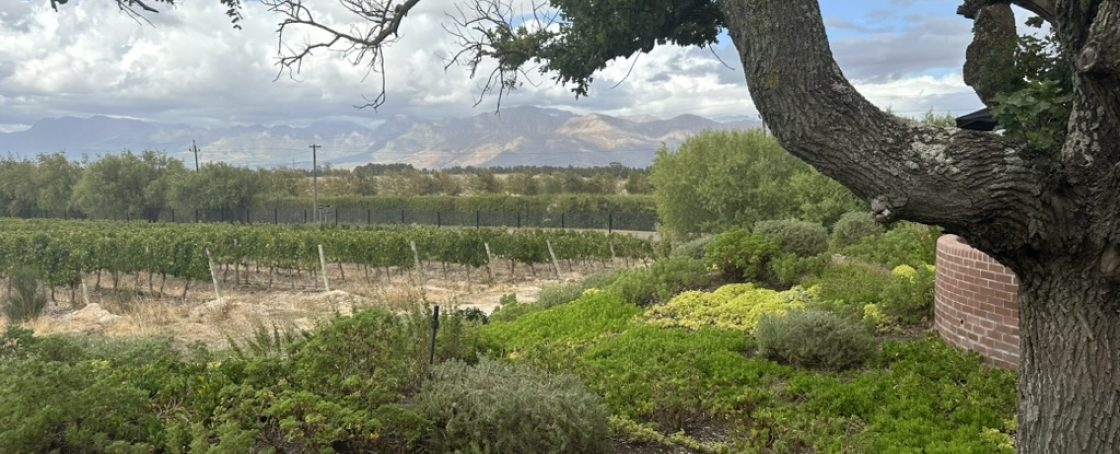
I’m writing this from South Africa, where I’ve been spending the past few days at a retreat hosted by Gold Republic alongside a small group of macro thinkers including Brent Johnson, Whitney Baker, John Butler, and Michael Every.
It’s been a strange vantage point from which to watch the sudden escalation around Iran — slightly removed from the noise but immersed in long conversations with people who spend their lives thinking about systemic risk, geopolitics and monetary order. The result has been a useful opportunity to compare notes, stress-test ideas and step back from the daily news cycle to think about the broader pattern emerging beneath the headlines.
Not all of us agree on everything. But where we’ve disagreed, we’ve tended to disagree “well”, as Whitney likes to say. And, really, I can’t stress how wonderful it has been to be put in a position where people you would usually be bickering with on X are here face to face, and the human psyche does what it does best. Moderating microagressions and helping all of us see beyond the areas of disagreement to what we have in common. And what we all have in common is a common and mutual belief in truth, justice, and the classic American liberal way.
Not all of us see the world in exactly the same way. But where disagreements have surfaced, they’ve tended to be the productive kind — what Whitney likes to call “disagreeing well.” And I really can’t overstate how valuable it is to have those disagreements face-to-face rather than through the distortions of social media. People you might normally find yourself sparring with on X suddenly become three-dimensional again. The human psyche does what it does best: it moderates the micro-aggressions, softens the tribal instincts, and helps everyone see past the points of friction to the deeper areas of alignment.
And what has become clear over the past few days is that, beneath the analytical differences, there is a shared foundation. A common belief in truth, justice, and the classical liberal values that have historically underpinned the American-led order.
As to the disagreements, they’ve focused mostly on what the best pathway for restoring a functional pro-growth system is: Gold or dollar stablecoins? Isolationism or engagement? Diplomacy or military action.
With the caveat that I haven’t been covering every twist and turn this week, I thought it might be useful (in the spirit of the cartography journalism principle) to share my overview of how I see things right now.
What follows is not a claim to certainty. Rather, it is an attempt to synthesise several strands of analysis that together help explain the shape of the current moment.
For me, three ideas currently stand out.
First, there is a compelling theory now circulating among regional analysts that much of what we are seeing in the Middle East may be partly theatre designed to facilitate de-escalation rather than escalation.
Second, there is increasing evidence that the West has been engaged in a long hybrid struggle for systemic survival, unfolding quietly over the past decade, which is only now coming into view.
Third, the emergence of new institutional proposals — including what has been described as a “Board of Peace” — suggests that preparations are underway for a major restructuring of the international order.
Taken together, these ideas offer one possible framework for interpreting what is happening. They are not absolute. And they may have missed key twists this past week. But in the clutter of the information flows right now, they might offer some opportunity for a bigger picture assessment.
The theatre of defeat
One of the more interesting interpretations currently circulating comes from a Kurdish geopolitical commentator on X known as @EvanWritesOnX, who over the past year has built a reputation for accurately anticipating several Middle Eastern developments.
His latest analysis centres on a basic insight from game theory.
Within rigid military hierarchies such as Iran’s Islamic Revolutionary Guard Corps (IRGC), collective surrender may be rational but individually impossible.
Every commander faces the same dilemma. If everyone stops fighting simultaneously, the organisation survives and negotiations can begin. But if one commander stops first while others continue, that commander is branded a traitor or coward. The safest individual choice may therefore be to keep fighting — even if everyone involved knows the overall battle cannot be won.
Economists would call this a collective action trap.
According to the theory, the purpose of external strikes is not simply to destroy military assets but to remove the decision to surrender from the chain of command entirely.
Instead of commanders voluntarily laying down arms — an act considered dishonourable in many military cultures — they can claim to have been defeated by overwhelming force. In military culture, defeat in battle can be honourable; surrender rarely is.
Under this framework, strikes against command nodes, communications infrastructure and leadership targets are not merely tactical operations. They are psychological mechanisms for dissolving the collective decision structure.
Once coordination collapses, the organisation fragments into isolated units that can quietly stand down without the stigma of betrayal. Those still left standing can face off against what is likely to be newly energised Kurdish paramilitary forces.
In other words, what appears to be escalation may in fact be a structured off-ramp from escalation.
The theatre allows hardened military actors to accept defeat without admitting surrender.
The possibility of a longer war
If that interpretation holds, it implies something else: much of the real diplomatic work may already have taken place.
This connects to a broader analytical perspective that has been developing in parallel — the idea that the world has already been in a form of hybrid global conflict for more than a decade.
Unlike traditional wars, this conflict has not primarily unfolded through large-scale battlefield confrontation. Instead, it has taken place across multiple domains simultaneously: information warfare, financial systems, technology platforms, trade networks, and cultural influence.
The blocs involved are not perfectly coherent, but the broad contours are becoming clearer.
On one side sit states and actors that still broadly believe in the primacy of national sovereignty, liberal capitalism, democratic governance and cultural autonomy.
On the other side are coalitions pushing toward more centralised forms of governance — whether through state capitalism, militant theocracy, or technocratic corporate globalism.
Russia occupies a peculiar and fluid position in this landscape. It is neither fully aligned with either camp nor completely independent of both.
From this perspective, many of the political disruptions of the past decade — from Brexit to the Trump phenomenon to the intensifying culture wars across the West — begin to look less like isolated domestic events and more like symptoms of a deeper systemic contest.
This framing also sheds light on developments in the technology sphere.
The increasingly visible tensions surrounding advanced AI systems — including disputes between companies like OpenAI and Anthropic and their relationships with national security institutions — are partly about who controls the most powerful cognitive infrastructure ever created.
In a wartime environment, states historically assert control over strategic technologies. Nuclear research, satellite systems, cryptography, and the internet itself all passed through similar phases of national security integration.
Artificial intelligence may now be entering the same stage.
At the same time, political communication around these developments has been inconsistent and often confusing. Movements such as MAGA frame events in highly emotional terms without clearly explaining the strategic logic behind them.
That lack of clarity fuels legitimate concerns about authoritarian drift.
Emergency powers, after all, can always be abused.
But it may also reflect a deeper reality: governments may believe they are operating within a wartime framework while being reluctant — or unable — to openly describe it as such.
The emergence of a “Board of Peace”
This brings us to the third piece of the puzzle.
Since Davos, there has been growing discussion of the diplomatic initiative known as the “Board of Peace.”
Conceptually, this appears to be a successor to the earlier idea of a Mar-a-Lago Accord, which aimed to bring major economic powers together to renegotiate the architecture of global trade, currency relations, and security guarantees.
That diplomatic effort struggled to gain universal participation, particularly from parts of Europe and China.
The Board of Peace concept appears to shift the strategy.
Rather than seeking universal agreement on (Trumpian) American terms, it seeks to operate as a coalition of willing states prepared to coordinate economic restructuring, security cooperation, and strategic resource allocation among themselves.
In practical terms, this could function as a hybrid institution — part security alliance, part financial stabilisation mechanism and part geopolitical coordination platform.
In effect, it could also resemble the early foundations of a new global financial architecture, loosely analogous to the IMF or Bretton Woods system but built around a narrower strategic bloc.
If that interpretation is correct, the increasingly dramatic rhetoric coming out of Washington begins to make more sense.
In wartime environments governments often deploy white propaganda — messaging that emphasises morale and unity while withholding the full operational picture.
The language may sound theatrical, but the underlying claims remain broadly truthful.
Poland and the return of war finance
Recent developments in Poland provide an interesting example of how these dynamics might be playing out in practice.
Poland’s right-wing president Karol Nawrocki is reportedly exploring a mechanism whereby the National Bank of Poland (NBP) could help finance purchases of American military equipment.
Legally, central banks are generally prohibited from directly financing government spending. But the proposal reflects a growing strategic tension.
Brussels is pushing for European defence integration under programmes that prioritise purchasing European equipment. Nawrocki’s camp fears that shifting away from American suppliers would weaken Poland’s strategic relationship with Washington.
Meanwhile, Poland’s central bank governor Adam Glapiński has spent years aggressively accumulating gold reserves while repeatedly citing geopolitical instability.
As I retold on X, his favourite historical example is the story of how Poland evacuated its gold reserves during the outbreak of the Second World War — reserves that ultimately helped fund the Polish government-in-exile and resistance movement.
The parallels are worth noting, not least because when states begin reorganising central bank balance sheets around strategic assets, it usually signals that financial architecture and war planning are beginning to converge.

The rise of white propaganda
Our sense is that it won’t be long before the information war that has been quietly unfolding for the past decade sheds the ambiguity that has defined it. Information warfare works best when the targets don’t realise they are being targeted. It relies on shaping perceptions indirectly, nudging people into positions they believe they arrived at independently. But the conditions that made that possible are beginning to break down.
We may be approaching the moment when the fog lifts.
This is the “apocalypse” moment that Peter Thiel seemed to be hinting at in his controversial Financial Times column last year — not apocalypse in the literal sense of destruction, but in the original Greek meaning of the word: revelation. The revealing of what was previously hidden.
As that happens, the lines of alignment will become more explicit. Who is on which side, and what they ultimately stand for, will be harder to obscure. And with that clarity will come pressure to choose.
Up to now the propaganda environment has functioned by appealing to everyone’s sense of moral righteousness. Almost nobody — not even those engaged in destructive or criminal acts — believes themselves to be acting without justification. Every actor constructs a narrative that casts their actions as necessary, defensive, or morally justified.
What happens when those narratives collide openly?
The moment of clarity may be both striking and unsettling. It will force a reckoning about the kinds of political and cultural systems people are actually willing to defend. It will shape the belief systems and norms that define the next phase of the international order.
Questions that once felt abstract will become more concrete.
What exactly constitutes a culture worth defending?
What kind of social order do you ultimately want to live under?
And how far are you willing to bend your own norms to accommodate those imposed by a more forceful power?
The space for comfortable ambiguity may shrink.
For many in the West, one of the clearest tests may revolve around the question of whether liberal societies are prepared to defend their own rulebooks. Are democratic systems willing to assert the primacy of their own institutions and values, or are they prepared to allow external ideological systems — whether authoritarian or theocratic — to rewrite those rules within their borders by exploiting the very open processes they cherish? [That, after all, has always been the Achilles heel of an open democratic system.]
History offers plenty of examples of what happens when that balance shifts.
If societies choose to accommodate external ideological frameworks, they inevitably find themselves adapting to those frameworks. The experience of Iranian families after the Ayatollah’s revolution offers one such example of how quickly social norms can be transformed once a new authority takes control.
If the answer is no, however — if societies decide their institutions and cultural norms are worth defending — then they may increasingly find themselves in the position that stateless or contested peoples such as the Kurds have occupied for generations: forced to struggle, politically or materially, to maintain control over their own territory and the rules that govern it.
That choice, in other words, may soon become harder to avoid.
What to watch for
Several developments will help determine whether this broad interpretation holds.
First, the Kurdish question. The Kurds may become the geopolitical equivalent of pre-World War I Poland — a stateless partner that could eventually be rewarded with sovereignty if the regional order is redrawn.
Second, Turkey’s response. Any Kurdish statehood scenario would place enormous pressure on Ankara and could trigger political upheaval within Turkey itself.
Third, Russian energy flows. Large volumes of Russian oil circulating in shadow trade networks could become a strategic reserve for the West if a broader détente with Moscow emerges.
Fourth, China’s position. China’s energy security remains heavily dependent on Middle Eastern supply routes. Instability around Iran could force Beijing into difficult strategic recalibrations.
Fifth, the position of the United Kingdom. London’s reluctance to fully align with certain operations could strain intelligence relationships and potentially weaken the City of London’s global financial role.
For now, the most important takeaway is this: events that appear chaotic may in fact be part of a structured transition from covert competition to overt geopolitical realignment.
If so, the theatre we are witnessing today may be less about starting a war than about ending one that has already been quietly underway for years.
And as that transition accelerates, the alliances shaping the next global order are likely to become increasingly visible.