

“Surplus production provokes a destructive backlash that precludes civilization for societies that do not have, or cannot build, defense capabilities. Yet, an optimal first public choice offers a resolution to the paradox of civilization along two paths. One is being twice-lucky in terms of growth and defense capabilities. The other is to create artificial defense capabilities, which requires high initial income.
Attempting future prosperity raises insecurity, which in turn depresses incentives to attempt that prosperity.”
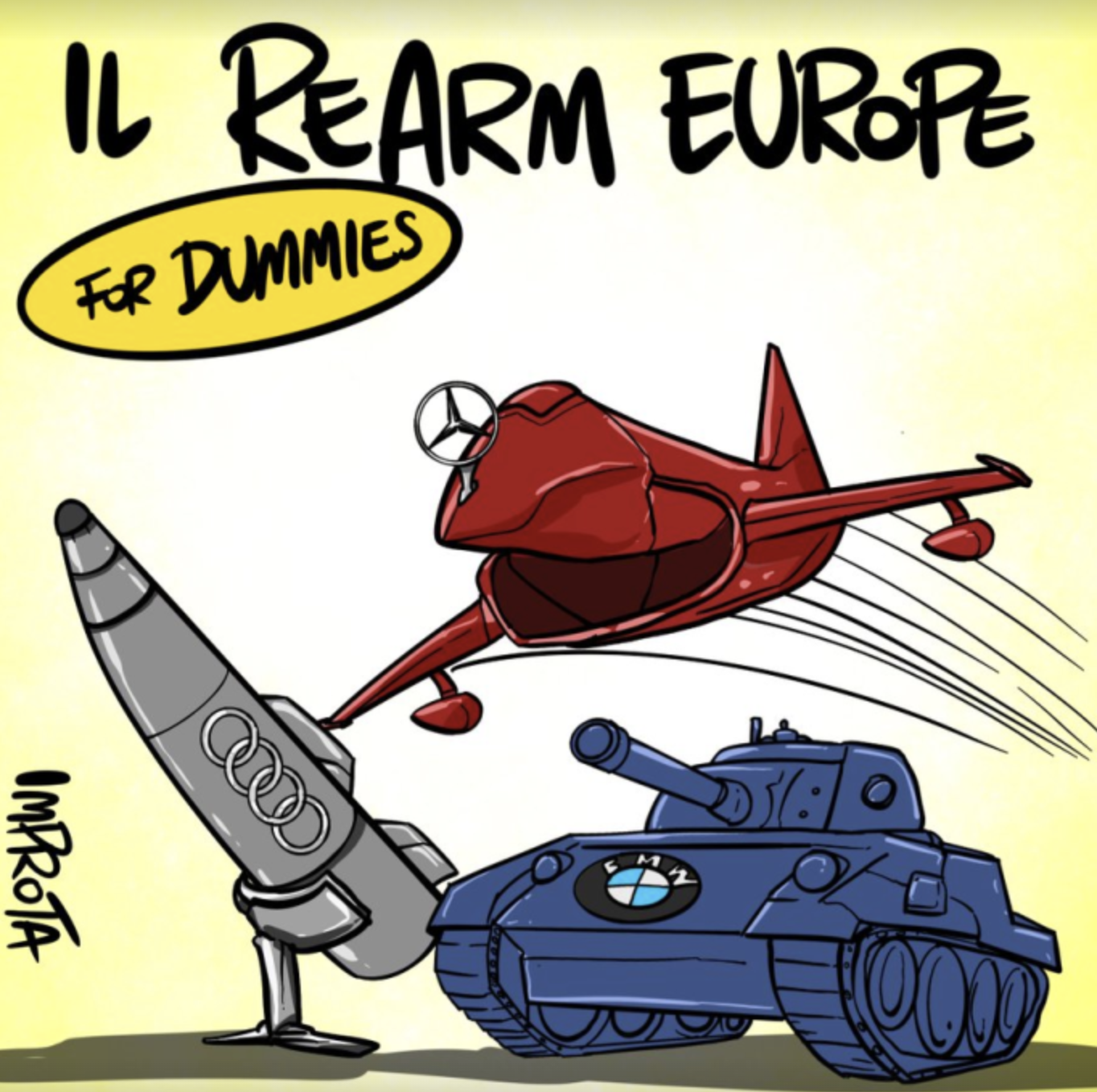
A meme is worth 1,000 words.
As every single media site is reporting, Europe is getting serious about rearming itself to deal with the threat from Russia and, increasingly, MAGA Red America. (Our new common enemy, apparently.)
But key figures on the left, among them Yanis Varoufakis, are calling bullshit on the narrative.
They think the panic in Brussels and London has less to do with a real Russian threat and everything to do with rescuing Europe’s dire economic fundamentals. Their claim? That rearmament is a thinly veiled experiment in “military Keynesianism” — the idea that massive defense spending can stimulate the economy, much like government-funded infrastructure in a classic Keynesian stimulus.
To be clear: this does not mean the Russian threat is exaggerated or unreal. Russia’s actions in Ukraine and broader geopolitical ambitions present a serious challenge to Europe’s enlarged status.
But what today’s left-wing economists argue is that Europe’s €800 billion rearmament drive is about more than just an external threat — it’s an intentional economic strategy. While Varoufakis denounces the approach outright, others, such as Isabella Weber, appear to see some merit in it. They believe that, if executed correctly, military Keynesianism could provide the stimulus Europe desperately needs.
Does this logic hold up? Not really.
Military Keynesianism, as a concept, is deeply flawed. The idea that war spending can drive sustainable economic growth is an illusion, a trick that governments have tried before, usually with disastrous consequences.
For one, the type of “growth” generated by a war economy is not real growth — it’s temporary, inefficient, and ultimately destructive. The resources poured into military production are diverted away from productive civilian industries, often leading to long-term stagnation rather than prosperity.
Heterodox economists like Seymour Melman have long argued that excessive military spending hollows out an economy by starving key industries of investment. The U.S., for instance, has suffered from what Melman called a “permanent war economy,” enriching defense contractors while weakening competitiveness, productivity, and innovation in other sectors.
But this isn’t a fringe view. Historian and establishment poster child Adam Tooze has extensively documented how Nazi Germany’s reliance on military Keynesianism led to disaster. The German war machine was unsustainable — its military spending drained resources, and the economy collapsed when territorial expansion could no longer fund it.
Similarly, Joseph Stiglitz, in The Three Trillion Dollar War, showed how U.S. military engagements, particularly in Iraq, were not just strategic failures but also economic disasters, leading to ballooning deficits, stagnation, and a misallocation of resources that harmed long-term growth — while being fantastic for the military industrial complex’s coffers.
The paradox of civilization
But just because the military Keynesianism argument doesn’t apply doesn’t mean there isn’t a logical economic agenda to Europe’s massive rearmament program.
The logic is closely tied to what academics Hernandez-Lagos, Dal Bo and Mazzuca call the “paradox of civilization“. Loosely summed up, they argue that civilization is almost always a product of getting the balance between security and prosperity just right. In other words, too much surplus spent on prosperity and not enough on reinvestment or defense, threatens civilization — since it invites predation. Equally, though, too much surplus spent on defense (as per the Stiglitz argument) and not enough on reinvestment also threatens collapse.
Europe is currently failing to get the security-prosperity balance right. And one of the key reasons for this is that its democracy is defending an overly generous welfare state that is not only stifling its own growth through a lack of reinvestment but also attracting growing predation.
At the core of the current shift, therefore, is a reality few want to admit: Europe is ageing rapidly, its welfare state is out of control and its most disciplined and productive region, Germany, has until very recently refused to do its bit reallocating surplus to where it’s really needed (as it once did when it funded East German integration into the West post the collapse of communism).
That, however, all changed in 2022 with the Ukraine war. All at once, Germany was forced to break off its dependence on cheap Russian gas, a move that instantly made its manufacturing industry uncompetitive versus those around the world with access to much cheaper energy. In turn, the EU’s economic stability was shaken to the core.
The options on the table at that point were limited for Europe.
-
Accept decline and restructure. Europe could embrace a new economic order (as per the Draghi Plan), allowing Germany to fade into the background while the bloc reoriented its economy toward services, high-tech industries, and other areas where it has a comparative advantage — albeit at the increasing mercy of China.
- Repurpose German industry for military production and fight to maintain strategic autonomy. If global cost competitiveness was no longer achievable, the obvious alternative was to reorient industry toward a price-insensitive, strategically motivated market — defense.
In other words, German factories would shift from producing luxury cars to producing tanks and military drones, with the additional expense — as demonstrated by Chancellor Friedrich Merz’s blinding fiscal u-turn this month — funded by Germany itself in the form of higher yields.
In that context, as Michael Every at Rabobank has been eloquently explaining in his must-read “economic statecraft” series, the new question investors must be mindful of when assessing Europe is not how much GDP can be generated from the prevailing economic system, but rather how Europe can use the GDP it has to resist cyclical factors threatening its strategic autonomy.
“What is GDP growth?” (e.g., 1%, 2%, 3%, etc.) versus “What is GDP growth for?” The latter answer might involve a GDP growth target, but it’s not the actual target. In terms of economic statecraft, that broader answer involves understanding what a state’s perceived national interests are, something that involves reflection far beyond just economics – which is the key point: why should economic policy have the answers to questions which fall well outside of its strictures?
It matters not in that scenario if inefficient factories are kept afloat, since the objective is no longer maximizing efficiency by engaging collaboratively in global markets and growing GDP on collaborative grounds. The objective is maximizing efficiency within the parameters of the systems Europe controls, and hoping that will be enough to protect its turf and sustain its population.
Investors, however, are by and large yet to get this message. This is a problem, since the old models aren’t going to work in a framework where the pursuit of higher GDP is no longer the goal. It doesn’t matter if you can source the same piece of equipment elsewhere at a cheaper rate … cheapness — as has been the prevailing assumption for the past 50 years or more — is irrelevant. Who produces that good, and where, is what matters now.
Is the new framework going to be domestically inflationary? Absolutely. Autarky always is.
But labeling Europe’s current drive to rearm as “military Keynesianism” is ultimately a mischaracterization. The key distinction is that Keynesianism typically responds to cyclical downturns by utilizing state-led spending to counteract underutilized resources, whereas Europe’s current economic malaise is fundamentally supply-side driven. The core issues — ageing demographics, declining productivity, and structurally high welfare liabilities — are inflationary and capacity-constraining rather than demand-deficient.
Indeed, using deficit-financed military spending to absorb excess capacity and spur demand, would only strain the resources Europe is already short of.
Spurring demand is therefore not the objective. The objective is finding a way to engineer the financial repression and welfare cutbacks needed to prevent social collapse while a reboot to a more productive economy is attempted.
Military Thatcherism, with some caveats
What is unfolding, then, is not a Keynesian response to economic slack but a political reconfiguration of the economy under the guise of security concerns. After all, the push for strategic autonomy is not an economic necessity in the here and now but rather a moral and geopolitical choice, undertaken with a view to buffering Europe from tomorrow’s economic shortfalls and crises, and the predatory forces they might invite.
The military build-up serves as a convenient mechanism to redirect economic organization toward a more disciplined and controlled form of expenditure — one that would allow governments to justify sacrifices and structural shifts that would have been politically unpalatable under normal circumstances.
Thus, this isn’t about Keynesian stimulus. It’s something much more radical:
It’s austerity by another name.
Governments are effectively gearing up to redirect resources from welfare to warfare, using security threats as the justification. This shift allows them to enforce economic discipline, reduce reliance on foreign labor, and accelerate investments in automation and domestic production — without having to openly dismantle the welfare state.
In this sense, what Europe is pursuing is not Military Keynesianism, but Military Thatcherism.
And it’s a tried and tested formula. After all, nothing distracts from domestic economic woes quite like a good war — or at least the preparations for one. History offers plenty of examples, from ancient Rome to modern Britain. Margaret Thatcher’s strategic use of the Falklands War in 1982 remains one of the most well-known cases.
At the time, Thatcher’s government was deeply unpopular due to painful economic reforms, including deregulation and public spending cuts that had led to soaring unemployment and widespread unrest. The swift and decisive victory over Argentina, however, galvanized national pride and bolstered her standing, buying her time to push through her neoliberal economic agenda. Whether this was deliberate or not, the war’s timing proved pivotal in reframing her leadership.
Like Thatcher’s Britain, the goal is to strip down bureaucracy and redirect state power toward productive capacity — but unlike Thatcher, the tool isn’t privatization, it’s militarization. The ultimate aim is to free up capital for innovation and growth — not through social spending or market-driven efficiency, but through state-directed reindustrialization under the guise of defense.
The weak point in the argument, of course, is that Thatcher’s restructuring was aimed at liberalizing the economy and unleashing financialized globalization. On the contrary, the current wave of militarized restructuring — what U.K. Chancellor Rachel Reeves dubs “securonomics” — is aimed at deglobalizing and definancializing the economy, by reasserting industrial policy and financial repression.
The hope is that by appealing to patriotic fervor and external threats, voters will yield to economic transformations and austerity they would otherwise never voluntarily accept.
This does not mean that the external threat narrative is entirely fabricated, but it does imply a degree of strategic exaggeration — what could be described as a “wag the dog” scenario — to justify military expenditure that serves a broader economic and political end.
A perpetual war economy?
Europe’s fundamental economic dilemma has always been its ageing population and the unsustainable nature of its welfare commitments. Yet, no government could openly advocate for the contraction of these entitlements without severe political backlash. The current security realignment offers an alternative path: by emphasizing external threats, governments can reorient economic priorities toward national security and industrial resilience while implicitly forcing a recalibration of labor markets and social expectations.
The shift doesn’t only allow for the reimposition of economic discipline, however. It neatly addresses a number of other challenges Europe has been facing, not least its dependence on foreign labor and general underinvestment in technology and innovation.
In that sense, what is happening is not military Keynesianism but a controlled transition to a more austere and interventionist economic model. This new system eschews neoliberal laissez-faire principles in favor of a managed system where military-industrial expansion serves as a politically palatable substitute for the hard choices that a pure economic reckoning would have otherwise required.
Whether militarization can in and of itself successfully deliver growth is yet to be determined. As Dario has already argued, chances are it’s more likely to do so if it focuses its “defense spending” on dual-use technologies that have both civilian and military applications.
What it certainly can do is provide the likes of Volkswagen with a new raison d’etre as a producer of armed personnel vehicles.
More importantly, it might just be Europe’s best chance to stave off a chaotic and disorderly economic collapse (of the USSR variety) once its liabilities become impossible to honor.
‘Wag the dog’
For those who don’t know: Wag the Dog (1997) is a political, satirical film that explores how media manipulation can be used to distract the public from a political scandal. The plot revolves around a fictional U.S. president who, just days before re-election, is caught in a sex scandal involving an underage girl. To divert public attention, a spin doctor (the Robert De Niro character) is brought in to manufacture a crisis that will dominate the news cycle and rally public support for the president.
The spin doctor enlists the help of a Hollywood producer (played by Dustin Hoffman), and together they fabricate a fake war in Albania. They create staged footage, enlist an unwitting soldier as a “war hero,” and use the media to generate patriotic fervor. As the ruse unfolds, it becomes clear that public perception can be entirely controlled through spectacle and misinformation.
The film’s central theme is the ease with which governments (and their media allies) can distract and manipulate populations by manufacturing crises — essentially “wagging the dog”.

One Response