

| SNEAK PEEK |
— Why Europe should be pursuing a different type of rearmament.
Dear subscribers:
Dario here.
I have to be upfront about my deficiencies. With things moving so quickly, it’s hard to keep up and analyse the goings-on. I’ve never felt more stupid than in the first three months of 2025.
But that doesn’t mean we don’t have confidence in our ideas. That’s why we want to propose our rearmament plan to Europe — one that is explicitly dual-use and adapted to the lessons of 21st-century warfare — unlike Europe’s current plan.
Without further ado, let’s jump in:
| HOW EUROPE CAN ACTUALLY REARM |
THE COMMISSION UNVEILED THE EU’S REARMAMENT PLAN, which outlined plans to borrow €150 billion to fund a major rearmament push.
Dubbed “REARM Europe”, it plans to mobilise around €800 billion over the next four years. Ursula Von der Leyen explained that most of these funds will come from member states increasing their spending on defence and security — around 1.5% of GDP on average.
The impetus behind European rearmament is obvious — a result of both Trumpian isolationist policy and the alleged Russian threat to the East.
Summarizing the European elite sentiment, Friedrich Merz, head of the CDU, claimed that Donald Trump “does not care about the fate of Europe” within hours of winning the German election. Europe’s priority was to “step by step… achieve independence from the USA.”
DARIO’S COMMENT: But Europe’s rearmament isn’t about independence from America or defense against Russia. Those are just pretexts. The real goal is to stave off economic collapse.
Framing war — real or false — to mobilize national resources to rebuild Europe’s economy and stave off the ghost of bankruptcy may work. Whether the weapons are ever used is secondary.
It’s an interesting — albeit totalitarian-esque — plan. But it could work a whole lot better if they prioritized dual-use weaponry.
Otherwise, it’ll just be another taxpayer-funded windfall for arms manufacturers, with economic repression thrown into the mix.
IT’S THE ECONOMY, STUPID: In short, most of the world is hurtling towards bankruptcy. Not just Europe but the United States, Russia and even China. Something has to give.
Trump’s approach? A controlled market implosion and domestic growth via tariffs — China’s playbook, essentially.
Like America, Europe is also struggling with de-industrialisation, particularly in the car sector. But unlike the U.S., it has an untouchable welfare state. And no elected politician can realistically reform it. Even if they could, they’d be faced with a total electoral blockage on most fronts — both in European and national parliaments.
Enter the ultimate workaround: war or its pretense. Military procurement will flood Europe with military aircraft, tanks, military drones, cyber capabilities, sensor equipment, artillery shells, etc.
And, most importantly, the war footing justifies austerity: The drums of patriotism could be played to justify folding welfare spending into the war economy — where benefits are provided in exchange for war-related activities and restricted consumer spending habits.
This quiet financial manipulation redirects investment into industry and skilled labour. Merz’s government is overtly pursuing defense spending to finance a revival of its industry sectors by shifting German industrial production from car to tank parts, for example.
Lastly, the emergency nature of this spending permits the circumvention of limiting instruments like debt brakes and EU spending rules to spend big on other investments like infrastructure, for example.
And for EU institutions, it’s the perfect excuse to centralize. Talk of a European Defense Union is logical; grouping EU countries for defense purchases will lower per-unit cost. But there’s more to it: European leaders fear the Commission may use the aforementioned hold on fiscal rules as leverage for a ‘power grab’ on defense.
THE ROTTEN APPLE: There’s one core issue in this plan: we’re buying the wrong weapons.
Europe’s rearmament-for-growth strategy is unsustainable because our weapons are too expensive and inefficient.
Firstly, there’s a cost to producing assets (tanks, jet fighters, military helicopters) that can only be used for war.
They’re not exactly zero-sum. But if there’s no war, they’re pretty close.
And if there is a war, they will still be quite useless. Why?
Because Western weaponry has largely underperformed in the Russo-Ukrainian war. (The notable exception being drone-guided artillery).
Capability isn’t the issue. Western tanks are faster, more well-armoured and more precise than Russian tanks. Western missile systems are cutting edge. Like most things the West makes, they’re the best of the best.
But they are also exorbitantly expensive, manpower-intensive, and dependent on fragile, hyper-specialized supply chains.
If Europe went to war, these high-cost weapons would drain our budget faster than welfare ever could.
And no war is winnable if you end up broke.
THE SOLUTION: Winning wars requires adaptation.
Today, that means shifting to low-cost, high-tech, dual-use weaponry. These would not only be more effective but also cheaper, while still having uses in the civilian sector.
Warfare always shifts between two pendulums: quality-focused and quantity-focused warfare.
Quality-focused warfare is when the best equipment is costly and inflicts outsized damage. An example is how the musket made European armies ditch the knight and revolve around protecting their musket-wielding units, like the Spanish tercios.
Quantity-focused warfare is when just-as-good equipment becomes absurdly cheap. Think about the Napoleonic era’s armies of hundreds of thousands of foot soldiers, facilitated by the massive decrease in the cost of musket and cannon.
The Cold War was the last peak of quality-focused warfare, where nuclear-tipped ICBMs were expected to determine the outcome.
But the cheapness of modern microchips means the scales have now tipped towards quantity. Now, with a few hundred dollars of C4, you can basically turn a drone into a short-range guided missile.
Europe is doubling down on expensive, high-tech weapons.
It should instead focus on the best high-tech weapons that can be mass-produced.
And here’s the kicker: dual-use weaponry is not only more effective. It’s also more economically versatile. Consider two options:
Option A – Leopard II tank.
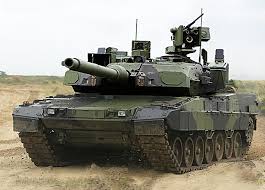
- Price: €28 million.
- Role: Shoots, moves, absorbs fire.
- Maintenance costs? Don’t ask.
Option B – The ‘Boom Clio’
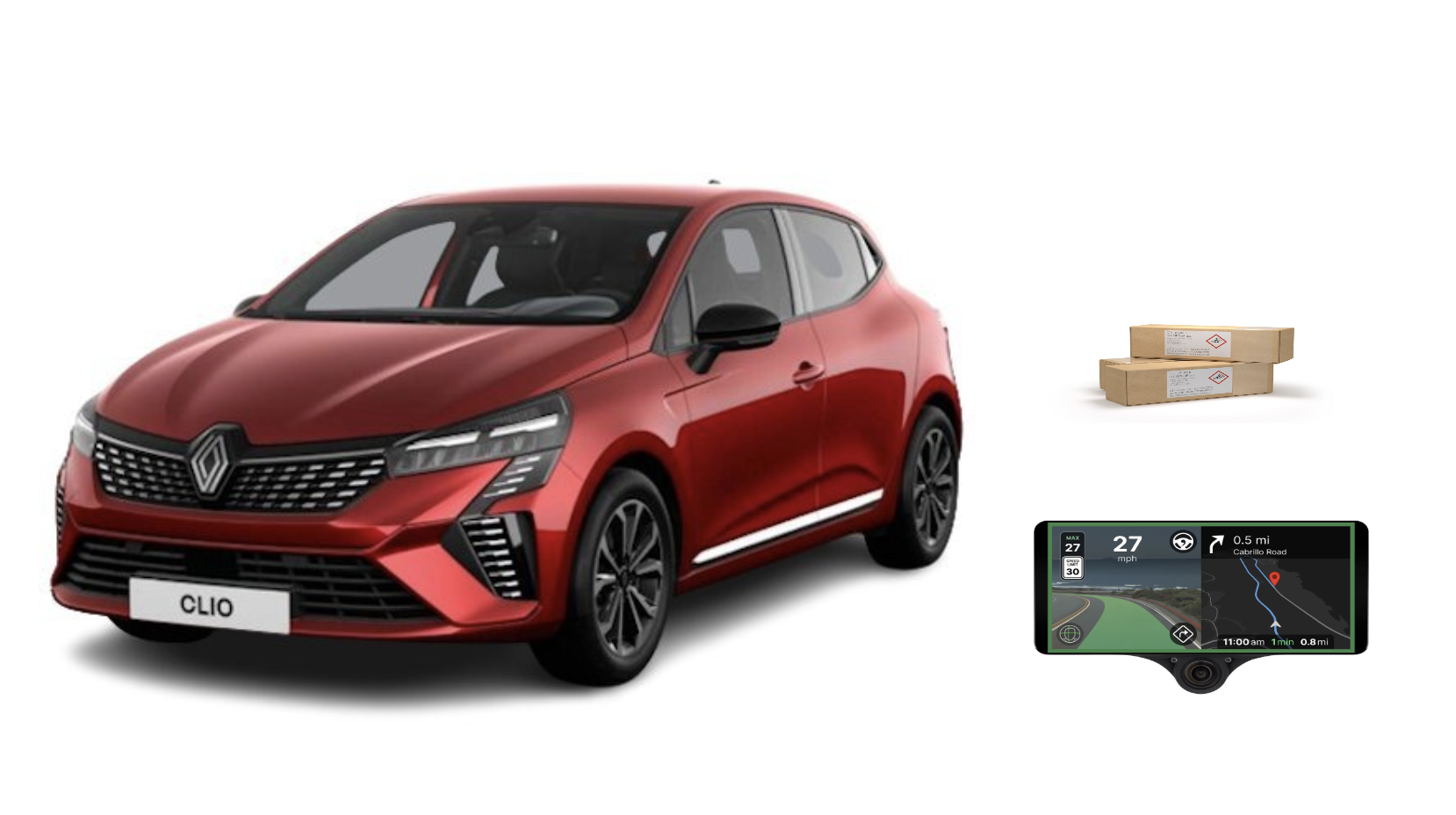
- A Renault Clio + CommaX AI self-driving kit + 100kg plastic explosives.
- Price: ~€25,000 per unit.
- Role: Drive to target, explode on cue.
Breakdown: For the cost of one Leopard II, you could deploy 1,100 Boom Clios.
And a legion of ‘Boom Clio’s is infinitely more productive – both for war and the economy.
Let’s start with the war. You may say that a Leopard II’s advanced targeting means it can hit opponents miles away, that it doesn’t need to run next to an enemy to inflict damage, and that it isn’t a slightly modified Renault Clio.
But that’s how old wars were fought. In tomorrow’s war, a coordinated group of 1,100 Renault Clio’s is far more deadly.
A single drone, mine, or shell can take out a Leopard II. All of these are orders of magnitude cheaper than the Leopard.
But you’d need 1,100 drones, tank and artillery shells to take out the 1,100 Boom-Clio’s. And this ammunition is only slightly cheaper.
In short, the Boom-Clio legion can soak up and overwhelm enemy resources far more effectively than a Leopard II. It puts none of our (very expensive) soldiers’ lives in harm’s way. And it can still get the explosive part of the job done.
The dual use: And imagine if there is no war. Simple. Remove the explosives, and you have a fleet of autonomous Renault Clios.
The same goes for air power. The replacement for jet-bound smart missiles is cheaper drones, which can be easily repurposed into agricultural, surveying or logistics drones.
The low-cost revolution: We’ve seen this play out in the Red Sea.
The Houthi’s were launching sub $20k drones, many of which were modified commercial drones, at Western vessels. And the West were forced to respond by launching multi-million dollar missiles, supported by exorbitantly expensive sensor suites and extensively staffed control rooms.
And they didn’t always work — the U.S. Navy even shot down one of its fighter jets.
When low-cost quantity faces high-cost quality, low-cost wins even when it loses.
The caveat: Europe shouldn’t abandon it’s high-end weapons. These should remain the backbone of our forces.
It’s the ‘meat’ of our armies that should be dual-use and low-cost because they are the most cost-effective both on and off the battlefield.
The new structure for Europe’s armies should be a Hi-Hi, Lo-Hi, Lo-Lo sandwich:
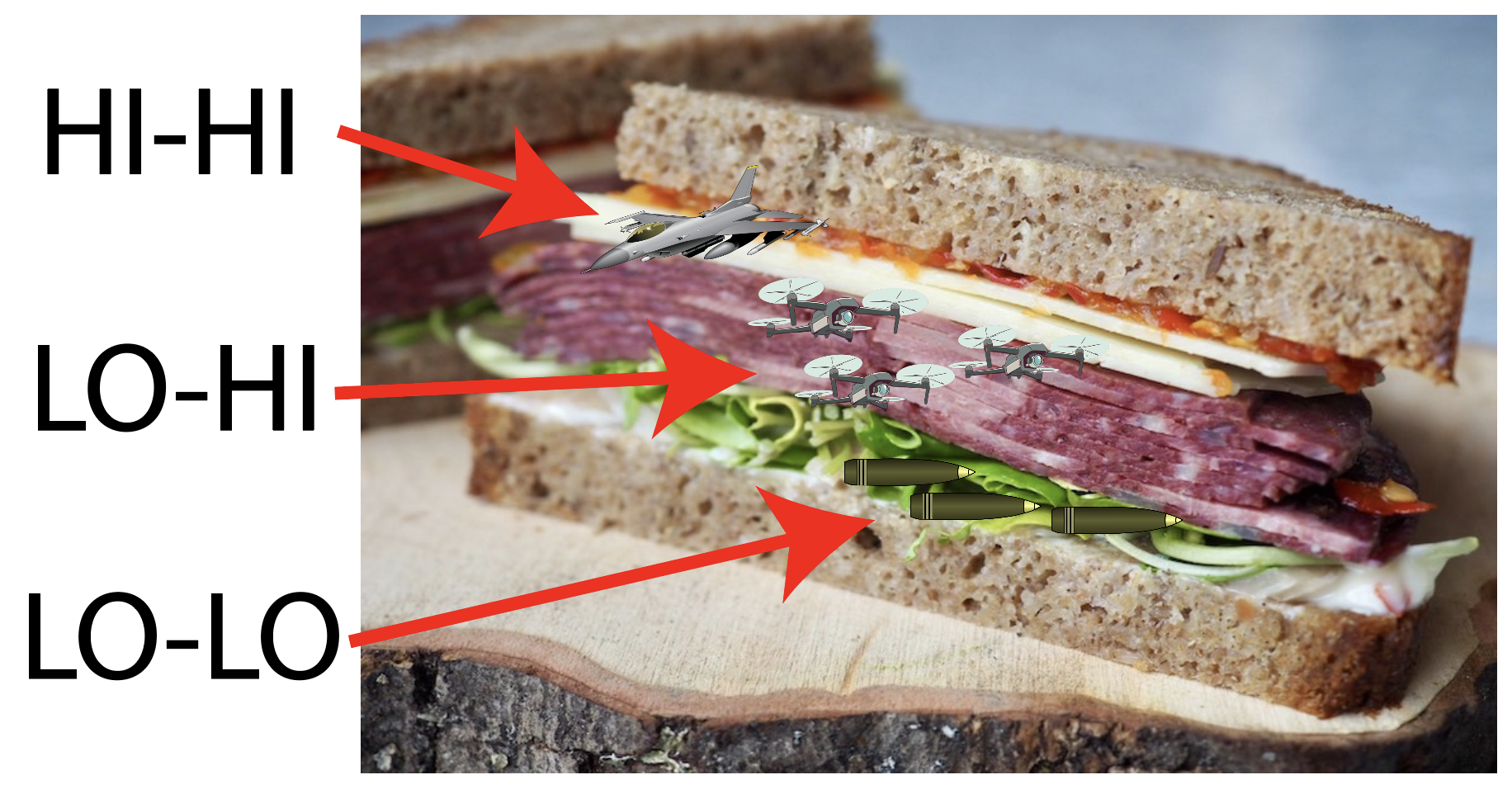
- Hi-Hi: High-cost, high-technology weapons (F-16, guided missile, Leopard II)
- Lo-Hi: Low-cost, high-technology weapons (GPS-guided car bomb, homemade drone)
- Lo-Lo: Low-cost, low-tech weapons (ammunition, shells, rifles, grenades)
BUT IT WON’T HAPPEN: European defense officials aren’t ignorant of the Lo-Hi revolution. So why don’t they act on it? Simple: taxpayer grift.
Dual use weaponry would allow startups and smaller companies to bid competitively for contracts, threatening the monopoly of firms like Airbus, Rafale, Leonardo or Rheinmetall.
This tech is also efficient to manufacture, deploy and maintain. And Western defense relies on producing weapons that are expensive and complex to maintain and operate.
You don’t need to believe me. Believe the RAND Institute paper on this dilemma. The industry’s worst nightmare? Weapons that are too cheap, too simple, and too easy to maintain.
And if war does ever break out, Europe will pivot to the Lo-Hi weapons overnight. Because they always could have.
But that would mean losing the chance to double-dip into taxpayer funds.
In other words, the defence-industrial mafia can have their cake and eat it too. And European taxpayers are left holding the bag. And if the warmongers get their way, the rifle too.
| OTHER INTERESTING LINKS |
GAZA WITHOUT HAMAS? Remember the far-out-there theory on how Trump’s plan for Gaza may preempt an Arab plan to take control of the area and expel Hamas? The Jury’s still out — but the Arab nations have coalesced around a $53 billion reconstruction plan. Let’s keep an eye out.
THE BRITISH WEATHER OFFICE MAY BE DODGY: A very interesting thread on journalist Ray Sander’s discovery of irregularities in the Met Office’s methodologies. For instance, a station in Aberdeenshire, which the Met claimed was operating since 1959, was only installed in 2005. Read on for more.
UPRISING IN SYRIA BY MILITANTS against Syrian authorities in the Alawite-majority cities of Tartous and Latakia. The worst violence since the end of the civil war began just after the Russians made a deal to keep their Tartous port with Syrian authorities. Suspicious. We’ll keep an eye out.

One Response