| SNEAK PEEK |
— Why Tether’s investment in the Twenty One Capital spac is a stabilization play.
— What if Xi fails? Xi’s grip on power may be weaker than people appreciate. In which case, is the true purpose of tariffs catalyzing regime change in Beijing?
— We explore the curious case of the missing Chinese data.
Good morning, subscribers!
Apologies for the lack of note last week, but luckily Dario was on hand to do the heavy lifting. In today’s edition, we get deep into the finance wonk.
A quick reminder, don’t forget to book your tickets for our Berlin-based summer party. It’s on July 17. Cover story: Bruce’s 50th. As well as performative journalism the evening will include a tour of the former NSA Teufelsberg listening station and an audience with a certain investigations editor who became an inadvertent expert in German payments companies.
Send tips to [email protected] and [email protected].
| THE BIG BLIND SPOT THIS WEEK |
STRUCTURED STABLECOINS: You may have noticed that Cantor Fitzgerald partnered with Tether and SoftBank in April to launch a $3.6 billion SPAC dedicated to buying Bitcoin for corporate treasury purposes.
The new venture will be called Twenty One Capital and will be operated by Bitcoin advocate and Strike founder Jack Mallers, under the chairmanship of Cantor’s Brandon Lutnick. But we think there’s more to this initiative than meets the eye.
If our hunch is correct — that the Trump administration intends to promote apolitical and “neutral“ USD stablecoins in world markets to help impose price discovery on dirigiste, industrial-policy-driven economies — then this venture could serve as a critical stabilizing mechanism behind those efforts.
Tapping Bitcoin-based liquidity: For many, Twenty One Capital is a self-evident grift. But even if that is the case (we can’t rule it out, after all) there is something rather new and clever about the structure. At its heart, it both emulates and evolves the stabilization mechanisms original made famous by algorithmic stablecoins such as Terra/Luna, which collapsed spectacularly in May 2022.
Reminder: The Terra Luna system worked by letting people swap between TerraUSD (UST), which was meant to stay at $1, and another token called LUNA. If UST fell below $1 — say to $0.95 — you could buy it cheaply and then redeem it with the Terra protocol for $1 worth of LUNA, making an instant $0.05 profit. That buying pressure was meant to push UST back up to its $1 peg. If UST went above $1, you could mint new UST by trading in $1 worth of LUNA, then sell the UST for more than $1 on the market, again making a profit. This arbitrage loop was supposed to keep UST stable. But in May 2022, people lost confidence in the system and started dumping UST en masse. The mechanism responded by creating huge amounts of new LUNA to redeem all the UST, which crashed LUNA’s price. As LUNA became worthless, the whole peg mechanism broke down, and UST collapsed too. The very system meant to stabilize the price ended up accelerating its failure once trust disappeared.
With hindsight, we know Terra’s vulnerability was drawn from the infinite endogenous risk associated with being able to mint an endless supply of new Luna tokens to maintain its peg with Terra. The emdedded arbitrage stopped self-stabilizing.
The Tether/Twenty One relationship is both similar and different. As with the algo stablecoins, Twenty One has the ability to stabilize Tether by giving it the ability to raise USD through equity issuance if and when its tokens begin to break their peg. The difference is, the stablization is drawn from the relative values of Tether, Twenty One and bitcoin, and specifically the ability to transfer bitcoin between two systems: one system which has recourse to a variably priced dollar liquidity valve and another one which doesn’t. The added beauty of the mechanism is that since such transactions can easily be processed between the respective organizations’s accounts at Cantor Fitzgerald (Tether’s primary bank) no dollars need ever leave the U.S. banking system. What emerges is a pure commodity transfer, not a payment or offshore remittance — meaning the scheme has engineered a dollar liquidity backstop without having to comply with onshore regulation.
Stabilization potential: Thanks to the structure, if Tether ever faces offshore redemption pressure, it can now meet those obligations by asking Twenty One to issue new equity shares to raise fresh USD, which can then be spent buying Bitcoin from its offshore self. Twenty One receives Tether’s offshore Bitcoin, while Tether, in turn, gets the dollars it needs to fulfill redemptions.
While the set-up mimics the arbitrage-based stabilization loop familiar from Terra/Luna there are three crucial differences:
-
Tether’s capacity to tap new liquidity (dollars) is limited via the dilution effect associated with market-driven equity issuance.
-
Bitcoin, an externally priced and finite asset, acts as a reserve anchor. But if its value collapses so do the schemes.
-
Stability is contingent on investor appetite, not protocol mandates.
Risk management through market discipline: If confidence erodes, Twenty One’s stock price would fall, relative to its Bitcoin NAV (net asset value), attracting arbitrageurs to buy cheap shares. In this case, dilution acts as a brake — not an accelerator — on system instability. Unlike Terra, where infinite token printing triggered reflexive collapse, here real USD risk capital must enter voluntarily at every stage. If necessary, the Bitcoin treasury can be partially liquidated to meet obligations, but importantly, there’s no implicit dependence on taxpayer bailouts or central bank liquidity.
A new model for shadow liquidity? This model addresses one of the longstanding challenges facing post-crisis international finance: how to replace the lubricating role of the eurodollar system without importing its fatal endogenous risk loops.
The old eurodollar market was brilliant for global commerce but systemically unstable — creating unlimited offshore USD credit without matching reserves, ultimately requiring repeated central bank interventions.
Twenty One’s design potentially addresses some of those risks. If it works, it opens the door to a new form of narrow-banking alchemy, one capable of recreating the global dollar liquidity function of eurodollars, but tethered (no pun intended) to finite, transparent collateral pools.
In the best case scenario it could create a template for the post-eurodollar offshore finance, blending decentralized hard money principles with Wall Street’s capital markets expertise. In the worst, it could open the door to a whole new form of liquidity risk.
The bigger picture: The structure potentially provides the Trump administration — should it want it — with a clean, non-state-aligned, dollar-adjacent monetary tool with the capacity to operate outside traditional banking channels; a tool that could, if necessary, force transparent price discovery on economies heavily reliant on opaque credit support and directed industrial policies. And all of it — crucially — remains visible, regulated, and market-driven.
PREVIOUSLY, IN BANK EQUITY: One reason this structure is so compelling is that it addresses a rarely discussed — but critically important — dynamic exposed during the 2008 financial crisis: when banks lose the ability to raise equity at or above par value ($1 per share), they effectively lose their capacity for self-stabilization.
During the crisis, it wasn’t just liquidity that dried up. The deeper shock came when markets realized that bank equity could not be issued at book value — and worse, that confidence in that equity couldn’t be rebuilt without state guarantees. Our contention is that the dollar “peg” of the stock price became a psychological and mechanical constraint. When it broke, systemic fragility emerged.
Post-crisis regulations compounded this problem. Banks were restricted from skimming early profits on long-duration bets, making it harder to use “overvalued” equity to pre-fund future earnings. Bank equity, in effect, became structurally brittle. A hidden boundary emerged: when 1 share ≈ $1, banks lose their capital elasticity.
Surprisingly, this relationship between equity issuance capacity, market value parity, and systemic fragility has gone largely unexamined in the academic literature. Indeed, we originally thought no one had formally articulated how critical it is that a bank — or any liquidity backstop mechanism — be able to issue fresh claims above the value of its base currency.
Further inquiries, however, suggested otherwise. One of our central banking sources, for example, quickly directed us to the work of John Vickers, formerly chief economist at the Bank of England. As Vickers observed during an international conference of banking supervisors in 2018 regarding the persistence of sub-1 price-to-book ratios across the banking sector from 2008 onwards:
“Where price-to-book ratios are persistently below one, there are at least serious questions about regulatory measures of capital. Price-to-book ratios should substantially exceed one because market capitalization reflects a view of the value of current exposures, less obligations to depositors and bondholders, plus the franchise value of future profits in excess of the cost of capital, plus the option value arising from shareholders’ limited liability,” adding:
“Pre-crisis they were about two, which shows how wrong markets can be, but markets reflected the problems emerging through 2007-8 much more quickly than the regulatory numbers,” he said.
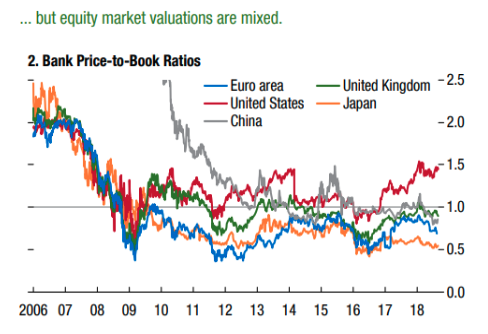
While such metrics are certainly instructive, not everyone in the central banking community agrees they should necessarily be relied upon too concretely by regulators.
“The point about lags is often true, but the advocates of relying entirely on market equity miss something important,” one central banking source told us. “This is that when there is a capital markets liquidity crunch that is truly not caused by anything fundamental, then the market valuation will fall because of illiquidity premia in the required yield. But it would be perverse to resolve a bank because of a cap markets illiquidity crunch.”
When equity issuance is no longer elastic because investors won’t buy at or above par, the institution effectively loses the ability to stabilize itself without dilutive collapse.
| BUSINESS, ECON AND FINANCE |
THE BASIS TRADE’S STABLECOIN CONNECTION: Iñaki Aldasoro, principal economist at the Bank for International Settlements, recently flagged an intriguing connection between the hedge fund-driven U.S. Treasury basis trade and the stablecoin ecosystem — specifically Circle’s USDC operations.
In a social media post referencing BIS research, Aldasoro drew attention to how the basis trade — where hedge funds exploit price differences between Treasury futures and cash bonds — is increasingly being funded through sponsored repo arrangements with money market funds.
Eh, what? Sponsored repo is a structure that allows hedge funds — who traditionally couldn’t access centrally cleared repo markets directly — to do so via an intermediary, or “sponsor,” typically a large bank. The sponsor guarantees the hedge fund’s obligations to the central clearinghouse, allowing the hedge fund to borrow cash cheaply and at scale using U.S. Treasuries as collateral.
This matters because it dramatically increases leverage capacity for hedge funds engaging in the basis trade — a strategy that involves arbitraging tiny price differences between Treasury bonds and their corresponding futures contracts.
Systemic implications? This arrangement not only intensifies systemic leverage but also blurs the boundary between traditional and shadow banking.
Stablecoin factor: What’s particularly notable is that some of the hedge funds most active in this trade are also key participants in the Circle Reserve Fund — the vehicle backing USDC’s dollar reserves. In other words, the same actors taking leveraged positions in U.S. government debt via basis trades are simultaneously integral to the stablecoin infrastructure, raising concerns about the hidden interdependencies between crypto dollar systems and fragile Treasury market plumbing.
Aldasoro’s observation suggests that disruptions in one domain — such as Treasury market volatility — could have knock-on effects on the credibility or stability of digital dollar ecosystems, and vice versa. This kind of overlap might warrant closer regulatory scrutiny, especially as the boundaries between crypto finance and traditional finance continue to erode.
TRUMP’S MIDDLE-EAST FOOTPRINT: Donald Trump is due to embark on a tour of the Middle East starting May 13, starting with Saudi Arabia and hitting Abu Dhabi on May 16. But he’s not the first Trump to have been dispatched to the Middle East in recent weeks. Eric Trump was doing the rounds in the region at the end of April, notably in Dubai, where he attended a high profile crypto conference which also featured Zoltan Pozsar and Balaji Srinivasan among others. But it was this the following detail from Semafor’s report of the trip that caught our eye:
“The Trump Tower in Dubai — built by Saudi developer Dar Global — features 75 million dirham ($20.4 million) penthouses and three- to four-bedroom apartments priced around 5 million dirhams. The Trump Organization is also planning real estate developments in Riyadh, Jeddah, Oman, and Abu Dhabi, and Reuters reported it’s in talks with developer Qatari Diar for a golf course and villa project in Qatar.”
That’s some footprint.
PORT CONTROL: Most of the world’s attention is focused on Donald Trump’s trade deals, but it’s the economic statecrafty corporate deals going on on the side that possibly hint of wider geopolitical machinations. In case you missed it, Italian billionaire Gianluigi Aponte’s family-run business became the lead investor of a group seeking to buy 43 ports from Hong Kong tycoon Li Ka-shing, reported Bloomberg in April. They added that’s been fiercely opposed by China over “US involvement”.
European concerns: Meanwhile, POLITICO reported this week that Brussels is starting to worry about the concentration of Chinese ownership in its port network. Chinese giants COSCO and China Merchants, as well as Hong Kong-based Hutchison hold stakes in more than 30 terminals across the EU. Transport Commissioner Apostolos Tzitzikostas on Thursday told industry leaders that Europe’s ports must “reconsider security … and examine foreign presence more carefully.” It was one of the clearest signals yet from Brussels that what once was seen as a benign investment is now starting to look like a security liability.
| CBANKING |
ONE YEAR INTO THE ECB’S NEW OPERATIONAL FRAMEWORK: And… a recent ECB survey showed that a large majority of banks were still holding abundant reserves relative to their desired reserve targets. “Reserves are still abundant in the banking system overall. Yet, their distribution is uneven. This means that it is important to assess whether reserves are sufficient at the individual bank level,” the report noted.
But why? A footnote apportions some of the blame to one of our favorite underappreciated sources of risk being: “Banks’ preference to hold reserves beyond minimum required reserves relates to settlement needs including intraday liquidity, the wish to signal a strong liquidity position to investors, prudent internal liquidity management rules to account for sudden market volatility or margin calls, and based on supervisory guidance. Banks also set internal targets for the LCR and the NSFR above the 100 percent minimum regulatory requirement for prudential reasons for example, in the internal liquidity adequacy assessment process. The targets represent a reference point for banks’ internal liquidity risk management processes.”
SNB LOOKS TO ITS ELF: Along with many others, the Swiss National Bank is rethinking the design of its liquidity facilities for financial stability purposes, with a view to reducing stigma. The SNB’s solution? ELF.
Competing considerations: As Politico has reported, the so-called “Extended Liquidity Facility,” currently in development, is intended to navigate the classic moral hazard dilemma. Liquidity must be accessible and affordable enough that banks are not deterred from tapping emergency support when genuinely needed. At the same time, it must be restrictive enough to discourage routine or opportunistic use, SNB Vice Chair Antoine Martin explained in a speech at the beginning of the month.
Stigma: Martin, whose institution is still haunted by the collapse of banking giant Credit Suisse in 2023, said that a key goal of the ELF is to reduce the stigma that can be associated with liquidity support. “Banks may hesitate to use liquidity support for fear of signalling financial distress to the market,” he said. “With the simplified access to limited volumes of liquidity, the ELF brings liquidity support closer to standard operations and reduces its ‘emergency’ nature. Thus, the ELF encourages banks to seek liquidity support at an early stage if they need it, without hesitation.”
Not yet: Martin revealed that the SNB is currently working with the banks and SIX, Switzerland’s largest financial market infrastructure provider, to make the ELF operational on a large scale but said that the process “will take some time.”
| ESG |
LABOUR VOLTE FACE: From Keir Starmer’s sudden embrace of America and India, to Tony Blair’s climate turnaround, there’s something suspiciously “new Labour” about Labour.
As a reminder, Blair highlighted just a couple of weeks ago that: “Leaders must acknowledge that the coming decade is likely to see rising demand for fossil fuels, driven by increases in energy demand from populations in developing economies together with new technologies such as AI. As such, even a net-zero future is likely to include continued emissions from fossil fuels, especially in electricity generation in developing economies, as well as increased forecast demand in sectors such as aviation.”
Who saw that coming, eh? Though, no prizes for guessing what’s behind it. The rise of Farage’s Reform in the polls to the number one spot in May was always bound to have a weird and wonderful effect on political consistency.
| AMERICAN MITTELSTAND |
THESE AREN’T THE FACTORIES YOU’RE LOOKING FOR: Both Commerce Secretary Howard Lutnick and Treasury Secretary Scott Bessent have recently taken significant efforts to spell out what they really mean when they talk about a reindustrialized America. “The goal here is to bring high-quality industrial jobs back to the U.S. @POTUS is interested in the jobs of the future, not the jobs of the past,” Bessent tweeted out.
Lutnick, meanwhile, made a number of interesting points during a Hill & Valley Forum, among them that, while automated manufacturing might be slightly more expensive, tariffs can close the gap. He added that high-tech factories require a skilled workforce of technicians to maintain the automation, necessitating a large training program across various educational levels. These jobs are expected to pay well, starting around $75,000 to $125,000+, he said, adding it opened the door to a “new industrial revolution of America”.
NOBODY LEFT BEHIND: You may have noticed that Scott Bessent has also been actively campaigning to boost financial literacy in the United States. If, like us, you see the Trump administration’s core agenda as jolting the system out of its dirigiste stupor through a dose of global shock therapy, then this initiative makes perfect sense. One key reason shock therapy faltered in many post-Soviet states was because of the public’s lack of preparedness for the complexities and risks of a free market economy. Encouraging everyday Americans — mom-and-pop investors included — to participate in capital allocation, whether through equity markets or entrepreneurial ventures, is essential to making such a transition work.
MAGA PARALLEL ECONOMY: As we noted earlier, DJT is set to embark on a tour of the Middle East next week. And it seems the region is far more enamoured with his agenda than the West is. One interesting indicator is how the blurb describing DJT’s upcoming participation in a panel at the Qatar Economic Forum on May 21 had to be scrubbed and reworded after drawing unwelcome attention on social media. In its initial guise it was titled “Monetizing MAGA” and featured a discussion about “chasing profit in the United States “parallel” economy of right-leaning ventures and understand how their investments could impact American society.”
Apparently, the idea of a parallel economy is central to the investment thesis of Omeed Malik, of 1789 Capital, who is set to share the stage with DJT during the session. This is based on the idea that it’s necessary to create an alternative economic system that exists alongside — but independent from — the dominant, often progressive-leaning or ESG-driven, corporate and financial infrastructure.
| STATECRAFT |
WHAT IF XI FAILS? Western policy toward China often rests on a dangerous assumption: That Xi Jinping’s grip on power is permanent, and that China will remain autocratic and economically closed indefinitely. But recent military purges — including the unexplained disappearances of key PLA Rocket Force officials and top aerospace industry leaders — have hit Xi’s own faction, hinting at internal instability. Perhaps there’s a reason why the CIA currently feels emboldened to make overt approaches towards Xi’s cronies on public media, highlighting to them that there are plenty of “reasons for choosing cooperation” among them “becoming the master of your own destiny”?
If Xi were to lose control, and a more liberal, market-oriented leadership emerged — possibly even flirting with democratic reforms to rebalance the economy — it would upend global investment assumptions overnight. Yet Europe is still behaving as if no such change is possible, aligning trade and industrial policy around a static model of Chinese authoritarianism.
Britain in the bag: Over in Britain, it’s a different story. While local reports claim the U.K. was totally shafted in Thursday’s trade deal, the real hint to what’s going on lies in the details. As The Telegraph highlighted, the deal wasn’t really just about trade. It wasn’t even about the imbalances induced by the U.K.’s dumping of Royal spare capacity on America in the form of Prince Harry. Its most critical component related to strategic ownership of assets.
As The Telegraph explained:
“…under the terms of the deal, the US will also have the ability to object to Chinese companies investing in the UK, in a clause the Conservatives said amounted to a ‘veto’. The agreement said that both countries “intend to co-operate on the effective use of investment security measures”, which could involve blocking Chinese takeovers. Government sources said the US would not have an outright veto, but that Washington could “flag” concerns about Chinese companies buying up key infrastructure. That could trigger the National Security and Investment Act, which allows ministers to intervene in takeovers on national security grounds.”
This is important stuff. In 2020, I was informally approached by a member of the U.S. State Department seeking more information about the U.K. parliamentary debate on the screening of inbound Chinese investments. The concern, as it was explained to me, was that China was using the U.K. as a pathway to building up indirect control of strategic U.S. industries. Significant stakes in U.K. firms, in other words, were being bought up by Chinese entities, and then being used to acquire U.S. businesses because the British veneer helped China bypass restrictions on its investments under the Committee on Foreign Investment in the United States.
America’s key gripe from then on has been that the UK’s National Security and Investment Act 2021 continues to fall short on screening out potentially problematic Chinese investment.
During parliamentary debates, concerns were raised about the potential risks associated with foreign investments, particularly from countries like China. Instances such as Huawei’s involvement in the UK’s 5G network and the acquisition of Imagination Technologies by a China-backed fund highlighted the need for a robust investment screening mechanism.
Too generic: Some lawmakers argued for a more targeted approach that would explicitly address investments from countries posing higher security risks. However, the government maintained that a country-agnostic framework would be more effective and legally sound, focusing on the nature of the transaction rather than the origin of the investor.
Since its implementation, the NSIA has been actively used to review and, in some cases, block transactions involving Chinese investors. Notably, the UK government ordered the Chinese company Nexperia to divest its ownership of Newport Wafer Fab, a semiconductor facility, citing national security concerns.
Additionally, the government intervened in the operations of British Steel, owned by China’s Jingye Group, to prevent the closure of critical infrastructure, emphasizing the importance of maintaining domestic control over strategic industries.
Deal factor: The UK has, however, now agreed to even more stringent U.S. security requirements on deals affecting sectors like steel and pharmaceuticals, effectively limiting Chinese involvement in these industries.
Takes one to know one? During the 1920s and 1930s, American companies, including GE, sought to expand their influence in the global electrical industry. This expansion often involved acquiring stakes in foreign companies, including those in the United Kingdom. The British electrical industry was undergoing significant consolidation and modernization, making it an attractive target for foreign investors.
British proxies: To facilitate these acquisitions and mitigate public and political backlash, American firms sometimes employed British intermediaries or proxies. These individuals or entities would front the acquisition, presenting it as a domestic investment, while the underlying control or significant influence rested with the American company. This strategy aimed to circumvent nationalist sentiments and regulatory scrutiny that were prevalent in the UK during the interwar period.
The use of such proxies and the influx of American capital into British utilities sparked debates within the UK. Critics argued that foreign control over essential services like electricity could compromise national interests and economic sovereignty. Supporters, however, contended that foreign investment brought much-needed capital and technological expertise to modernize the industry. All very familiar these days.
Tariff de ja vu: One of the reasons the U.S. wanted a foothold in U.K. companies back then was to get round the British Empire’s extensive protectionist tariff regime. Producing from the U.K. got around that problem and allowed American tycoons to tap into Britain’s expansive imperial trade zone.
Speaking of which: Shortly after he was elected Prime Minister of Canada, Mark Carney’s blind trust investment company Brookfield announced it was planning to invest in U.S. manufacturing operations. Rhetoric may not always align with action, it would seem.
CHINA’S MANY FAILING INDICATORS: Despite the growing volume of indicators confirming it is China, not America, that is hurting most from the tariff war, for the China perma bulls, it’s still the case that Beijing can do no wrong. As a consequence, the internet remains chock-full of Chinese boosterism and rampant denial about its growing weaknesses. Yet, stories like the following can’t be ignored for too much longer.
As Bloomberg reported on Friday, “One of China’s largest online recruitment platforms has quietly stopped providing wage data it’s compiled for at least a decade, making it more difficult to gauge the health of the world’s biggest labor market just as it comes under strain from US tariffs.”
On the ground, meanwhile, the New York Post reports protests by furious factory workers in China demanding back pay are spreading across the country, echoes of the scenes that became common place in the communist bloc in the 1980s.
According to Goldman Sachs, at least 16 million jobs across many industries in China are at risk due to President Trump’s imposing of a 145 percent tariff on Chinese imports.
The curious case of the missing data, continued: The WSJ, meanwhile, has also picked up on the suddenly disappearing data. “Land sales measures, foreign investment data and unemployment indicators have gone dark in recent years. Data on cremations and a business confidence index have been cut off. Even official soy sauce production reports are gone,” it noted.
Too much government control: China expert, Michael Pettis picked up on a fascinating speech recently given by Liu Shijin in which the former Deputy Director of the Development Research Center of the State Council argues “China’s insufficient consumption is not an acceptable deviation from international average levels, but a significant gap of 20 percentage points, which can be described as a structural deviation.” He goes on to point out that “in 2022, the Chinese government sector’s net assets accounted for 38.6 percent of society’s total net assets, significantly higher than other countries,” and that “China’s high savings rate and low consumption rate are related to the significantly high proportion of government net assets and state-owned equity capital in society’s total net assets.”
Big choices ahead: While such a dominant government position may have been advantageous when China was in its industrialization phase “now that this stage has passed and the problem of insufficient consumption shows a structural deviation, we face a choice: should government net wealth and state-owned capital returns continue to be used for savings and investment, or should they be redirected to support consumption? Clearly, we need to achieve an important transformation, driving the economy from investment-driven to consumption-driven.”
BOTTOM LINE: There’s all to play for ahead this weekend when U.S. Treasury Secretary Scott Bessent and chief trade negotiator Jamieson Greer meet with China’s economic tsar He Lifeng for trade-related talks.
| WHAT WE’RE PROCESSING |
— When offshore funding systems partner-up with censorship-resistant media systems.
— Why Trump 2.0 needs to provide a face-saving exit strategy for China, and Xi needs to take it.
— Former hedge funder, Hugh Hendry had some pointed thoughts thoughts about the FT’s “hit piece” on Steve Miran: “No argument, no analysis, just prejudice wrapped in gossip from the same chinless wonders who always get quoted.” He adds “Tariffs aren’t madness. Madness is thinking global capital imbalance will fix itself while sipping wine in Davos.“
— Musk’s xAI joins TWG Global, Palantir for AI push in financial sector.
— Trump’s election maestro works to topple Albanian prime minister (Politico)
— Robert McCauley on how to avoid Kindleberger’s trap with a dollar coalition of the willing.
— Taiwan dollar flash back to August 2024 when the Financial Supervisory Commission took steps to reduce the burden of life insurers’ foreign-exchange hedging costs, which had risen because of the wide gap between Taiwan and US interest rates.
— Meta are in talks to deploy stablecoins three years after giving up on landmark crypto project.
— Who is He Lifeng, the Chinese trade tsar taking centre stage in US tariff talks? (Reuters)