

Greetings, dear subscribers. Given the “we are not alone” UAP news this week, I’ve let Dario loose on his favourite subject in today’s newsletter, as there is nobody I know who has a more authoritative, informed and critical-minded understanding of the area than him. And there’s no doubt it’s a blind spot topic. He’s also spent a good couple of months researching the ultimate UAP aerial risk piece, contacting many civil aviation bodies for their latest data. It is this week’s spotlight feature. Check it out here.
But it has also been a meaningful week for finance and economy news, with the euzozone officially falling into recession. So don’t switch off just yet if UAPs are not your cup of tea.
On a programming note, this month (June 27-28) the organisers of the Grimaldi fund forum in Monte Carlo would like me to give a heads up to my subscribers that it’s happening. I’ll be engaging in a debate at the forum about whether ETFs are riskier than people appreciate. Any subscribers who want to go can get 10 percent off the ticket price by using the code FKN3253EMSPK and clicking here.

Separately, if you want to catch up with Politico’s stellar central bank coverage (which I’ve been overseeing), you can catch up with the latest newsletters here, here, here etc… (just search “central banker” in the search engine). And if you want to sign up for the rest of the month’s free trial, click here.
Enjoy the weekend.
Commodities cornered:
- The European Commission began investigating the flow of apparently fraudulent biofuels into the EU after a complaint from Germany. These referred to Chinese imports that “have potentially been mislabeled as more profitable biofuels”.
The fraud apparently pertains to the de facto ‘laundering’ of conventional biofuels to make them appear to meet EU standards when they do not. Chinese biofuel producers however say they have zero tolerance for such fraud, according to the Global Times.
- Trafigura CEO Jeremy Weir’s latest post for the Australian Financial Review claimed that for Australia to benefit from the shift in commodities markets resulting from net-zero targets much more needs to be done “to identify the strategic minerals, streamline the approvals of new mines, and target investments in processing.” The implication is that currently, it’s not going to go swimmingly.
. - A Chinese oil company will prospect for oil in a hole over 10,000 metres deep in the remote Taklamakan Desert, which would become the deepest hole in the world.
. - A super-contango in Copper, which the FT reported back in May was sending warning signals over the global economy, dissipated last week only to return with gusto this week after a whopping 43,000 tonnes of metal landed in exchange storage in Asia two days — the biggest delivery in more than a decade. (The chart below is from the FT May 23 article).

Economics, business, finance and more:
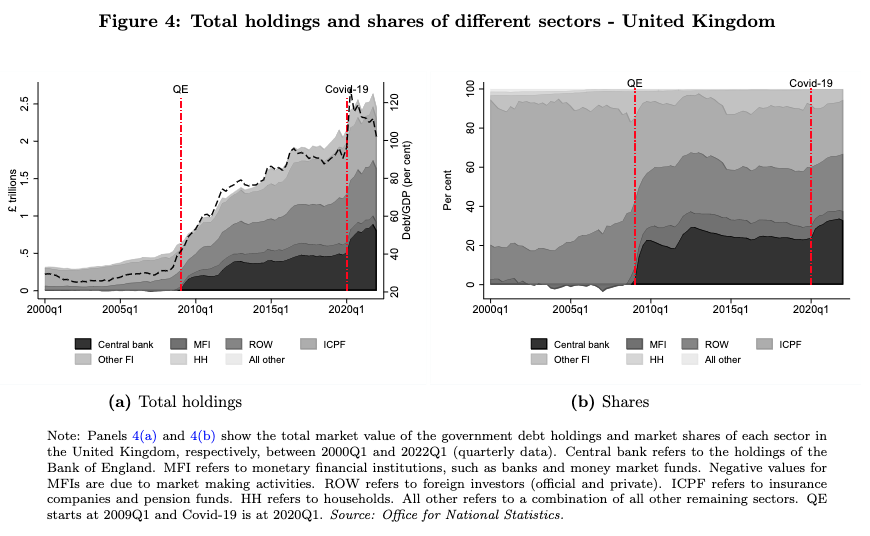
- The BIS published a comprehensive assessment of the impact and scale of central bank asset purchases, and what may lie ahead when those purchases are finally unwound. The following charts contextualise the relative positions of the different banks, and show the UK is perhaps the most exposed on a relative basis:


- Politico’s Ben Munster flagged how the Italian government has launched a new series of “patriotic bonds”, known as ‘BTP Valore’.
What’s unique about the four-year paper, which drew €5.4 billion from nearly 30,000 buyers when it was sold to retail savers, is the “step-up” mechanic which pays 3.25 percent interest for the first two years and then 4 percent for the final stretch, on top of a 0.5 percent “loyalty premium.” It’s a nice incentive for savers to hold the securities to maturity ahead of potential ECB sales which could re-fragment the Eurozone bond markets. — IK
- Social media site Reddit announced it will lay off around 5 percent of its workforce, or 90 employees, as employee layoffs in tech continue.
. - Amidst rising geopolitical tensions, VC giant Sequoia Capital said it would become three separate, geography-based entities in a dramatic move that would take effect from March 2024.
. - Latest speech from Philip Lower, Governor of the Reserve Bank of Australia where he discussed how the RBA aimed to control inflation while promoting growth in the economy and a tight labour market. Lowe predicted this “is a narrow path and likely to be a bumpy one, with risks on both sides.”
Apparently Lowe is under pressure, and could be pushed out of his position once his term expires this year. Ongoing inflation and wage spiral fears are underpinning the negative sentiment around him. The RBA’s recent review is likely to be used as an excuse, according to the gossip in the Blind Spot discord group.
Separately, the Australian economy, small surprise, appears uniquely exposed to the Chinese slowdown. “Initial optimism at the turn of the year over a resurgent economic recovery in China, which was predicated on an upturn in investment fuelling commodity demand, has petered out, weighing on the AUD,” Standard Chartered’s Steve Englander wrote this week. Both China’s and Australia’s equity markets are flat year-to-date whereas other major equity markets have seen double-digit gains, he also notes. — IK
- Bank of International Settlements wonks modelled the HODL effect in a paper titled, “The Crypto Multiplier”. What they discovered is kind of obvious, though.
The multiplier assesses the sensitivity of a cryptocurrency’s market capitalisation to aggregate inflows and outflows of investors’ funds. The less transacted a cryptocurrency is, the greater the market capitalisation. “The analysis explains why announcements by large investors, celebrity endorsements or financial crises can result in substantial price movements,” the researchers noted.What the research implies is that rather than being exclusively deflationary because of limited money creation, the value of crypto versus other currencies is ultimately a function of how well it is circulated. Thus, high velocity is bad for bitcoin.
Hold on for dear life: This is evidenced by what happens to crypto prices when large speculative positions are liquidated. “The crypto multiplier predicts that winding down a large speculative position is likely to have a significant price impact unless the position is absorbed by other speculators,” the researchers concluded. But did you really need a sophisticated model to tell you this? I made a similar assessment here in the FT years ago. — IK
- Finews.com dug out an interesting tidbit from a UBS SEC filing this week. Apparently, the newly merged Credit Suisse/UBS entity “doesn’t have to fully secure its balance sheet until the end of 2029.” They were also granted a moratorium on capital adequacy requirements until Q1 2026.
Not surprising, considering the enormous risk the Swiss National Bank has taken on the success of this merger. This came just before UBS and the Swiss government finalised the scope of the state’s loss guarantee agreement for the takeover. “The provisions will see the Swiss government cover losses of up to 9 billion Swiss francs ($10 billion) following UBS’ acquisition of its former rival. This is guaranteed on a “designated portfolio of Credit Suisse non-core assets,” once UBS incurs the first 5 billion Swiss francs in losses,” CNBC reported. — IK
- Despite Japan’s sluggish growth, the East Asian giant mysteriously continued to benefit from a surge in tax collection, with the nation’s tax revenue expected to top $430bn in the 2022 financial year despite ongoing economic contraction. COVID-related support to business owners, which boosted tax revenues, as well as an increase in taxes from large corporations is said to be among the causes.
. - The Bank of Japan’s reluctance to roll back QE, meanwhile, pushed some local yields back below zero, as the scourge of negative-yielding debt remains ever-present in Japan.
. - ICYMI, Rowan Atkinson wrote an op-ed for the Guardian on his feeling “duped” by the new range of EVs. Among other things, Atkinson focused on how greenhouse gas emissions for EVs’ production is around 70 percent higher than in manufacturing petrol cars, particularly due to the complex lithium-ion batteries required.
. - In the continuing mystery of what is really going on at Stony Brook College (as propagated by Thiel Capital’s Eric Weinstein), the Simons Foundation, run by Renaissance Tech’s Jim Simons — a former Stony Brook math professor and current hedge fund billionaire — donated an uncommonly large gift of $500m to the college last week.
. - Former New York Fed research head, economist Stephen Cecchetti took part in a conference in Helsinki where he called for a moratorium on CBDCs. But he also provided an excellent account of why regulators were asleep at the wheel with respect to the mounting unrealised losses on banks’ balance sheets, especially since they had been warned about the situation on multiple occasions.
Cecchetti also provided one of the best quotes yet about bank research, which he noted (as per the slide below) had also picked up early on the issues but had somehow been ignored. “They [bank analysts] were computing these numbers and publishing them in the junk that you get in your email when you’re on their mailing lists,” he told the forum. “Some of this spam is worth opening it turns out. The problem is which stuff?” — IK

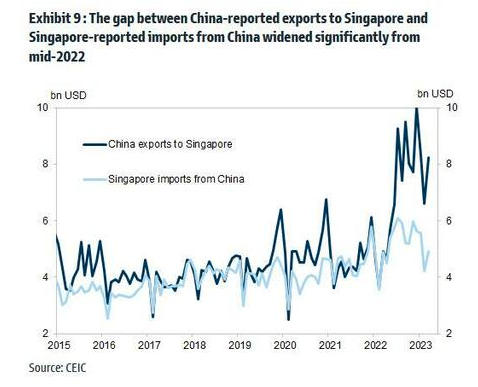
. - ZeroHedge picked up on a recent report from Goldman Sachs, which suggested that someone may be cooking China’s trade books. The bank analysed China’s trade data and found their reported imports from and exports to Singapore appeared highly inconsistent with China’s actual export figures.
 .
.
- The Kenyan Central Bank announced in its latest press release that the implementation of a CBDC “may not be a compelling priority in the short to medium term”.
Media matters:
- The Wall Street Journal reported on how Instagram’s systems were fostering communities of paedophiles on Meta’s social media network.
. - More Twitter File-esque revelations this week revealed that the FBI assisted Ukraine’s SBU intelligence unit in the censoring of Twitter users, including journalists. Though Twitter refused to provide the details of two American and Canadian journalists, some say the incident may represent the most brazen example of censorship requests revealed in the Twitter Files.
. - Lloyds Banking Group took control of the Telegraph Media Group as part of a long-running dispute between the Barclay family and their debtors, Lloyds. Lloyds made the unprecedented move of seizing the Bermuda-based parent company for The Telegraph and The Spectator in order to recoup part of the $1bn debt, which was secured by the Barclay family against the media group.
.. - New revelations from the Discord leaks showed the CIA had learned last June that a six-person Ukrainian special operations team planned to sabotage the Nord Stream pipelines.
. - Beijing’s anti-spy chief urged a stronger crackdown on dissidents using new anti-spying laws and an intensification of enforcement, as Beijing continues to prioritise its national security while it faces increasing geopolitical pressure from the US and its allies.
. - Robert Kennedy Jr.’s Instagram account was restored almost a month after relaunching his presidential bid. His account was removed from Instagram in 2021 for allegedly repeating “debunked claims about the coronavirus or vaccines”.
.
- The UK’s DSMA committee Spring report (previously known as the D-notice committee) referenced the growing difficulty of keeping info secret in the age of OSINT, ChatGPT disinfo potential and the rise of independent journalists who don’t have ethics codes.
.
- The Kremlin claimed that an emergency TV and radio broadcast, which showed Putin announcing Ukraine had invaded Russia, was a deep-fake hacking attack. Meanwhile, the WSJ reported how a man in China was duped, by a deepfake video of his friend, into transferring $600,000 into a fraudster’s account.
. - New revelations from the Assange-linked court case regarding claims the CIA endorsed illegal espionage activities during Assange’s time in the Ecuadorian embassy.
The Blind Spot was invited by Assange’s legal team, this Wednesday, to hear about new developments in the CIA’s alleged spying of both Assange and US Attorneys.
The CIA had previously presented a motion to dismiss the case brought forward by Assange’s team. The case alleged the CIA had employed a Spain-registered security business to conduct illegal espionage on Assange, including placing microphones in the Embassy’s womens toilets. The CIA had put forward a motion to dismiss the case on the grounds the plaintiffs did not have sufficient evidence linking the CIA to this espionage operation.
However, a parallel legal case in Spain against the Spanish security company produced documents through discovery that proved the security company had some links to the CIA. For instance, one user had a folder titled “CIA documents” that related to material extracted from the Ecuadorian embassy. The security company also had several images of the inside of phones, images that clearly suggest the company had some type of ongoing espionage operation.
As a result, Assange’s legal team have submitted a rebuttal to the CIA’s motion to dismiss, stating the Madrid legal discovery findings proves their case has sufficient grounds to be considered.
This ongoing case, and the clear difficulties in getting Assange’s story to the mainstream press, continue to show the ongoing contradictions in modern-day media’s claims to stand for press freedom while actively ignoring the most clear example of a truth-tellers’ state-sponsored persecution.
Of course, the case against Assange is that he knowingly put U.S. intelligence assets and their families at risk by uploading the entire cache of diplomatic cables onto the Wikileaks site, without any redactions. — DGG
European politics:
- Alexander Downers’ latest article for the Australian Financial Review highlighted his surprise in meeting Italian PM Giorgia Meloni. “As things stand the new Italian PM has the potential to become the European Union’s most significant leader”, he noted. Downers’ primary point is that where Europe is turning rightwards’ Meloni’s conservative firebrand traits may prove effective in uniting conservative power in EU institutions.
American political drama:
- Republican legislators prepared to file contempt of Congress charges against FBI Director Chris Wray for not turning over a Biden “bribery” document. The Republicans claimed this document proved then-VP Joe Biden was involved in a criminal scheme worth $5 million with a foreign national. The FBI ultimately relented and allowed the Congressional committee to see the document in question.
. - A Congressmember of the House Oversight Committee alleged the FBI is afraid the informant who is accusing President Biden of being involved in a bribery scheme may be killed if their identity is unmasked.
. - Attorney General Andrew Bailey used his Twitter account to speak on notable moments in the First Amendment case of Missouri v. Biden. Apparently, the federal government isn’t faring too well in convincing the discerning judge it hadn’t been working with and coercing social media companies to censor free speech.
. - Twitter co-founder Jack Dorsey endorsed Robert F. Kennedy Jr. for the Democratic nomination of the 2024 American presidential race.
. - Trump’s lawyers quit after he was indicted on federal charges for handling classified documents.
Geopolitical hot spots:
- Serbia announced it won’t prevent the sale of its weapons to Ukraine, and will not render assistance to Russia in re-exporting weaponry either.
. - The European Investment Fund will launch a €200m defence and security fund. This comes soon after NATO’s announcement of a €1bn equity defence fund, as Western investors warm up to the idea of murder-friendly industries.
. - Arnaud Montebourg, the former French Minister of the Economy, provided a detailed explanation of how the United States waged economic warfare against France. For instance, Montebourg delves into how the NSA’s phone-tapping of French nationals is used to benefit American companies, such as in the Alstom affair.
Montebourg’s claims are extraordinary and seem unprecedentedly candid for a former Cabinet member of the French government, with quotes such as “Americans are different (to work with) because they are predators”. Worth reading in full. — DGG
- The senior officials of around two dozen countries’ intelligence agencies held a secret meeting in the Shangri-La Dialogue security meeting in Singapore last weekend. The topics discussed apparently concerned Russia’s war in Ukraine and transnational crime networks — no Russian representative was present.
. - The Five eyes intelligence network on Friday issued a joint declaration aimed at countering Chinese attempts to bully countries into closely adhering to its economic order. You can view the document here.
. - Emmanuel Macron objected to a NATO plan to open an office in Tokyo, believing the transatlantic alliance shouldn’t “lose focus” over its primary mission of security in the North Atlantic region.
. - A piece by Semafor looked at the high number of occasions in which Ukrainian authorities have used the threat of revoking press passes to shape Western media coverage in their favour. Ukrainian officials are reportedly very sensitive about conditions on the frontline, troop morale, and the political status of Crimea, and will revoke the press passes of Western journalists whose articles may run counter to their official narrative.
. - Blast from the past: Cuba was set to host secret Chinese electronic eavesdropping facility that will focus on spying on the United States, in a sign that recent Biden administration moves to pull the Havana government closer may be facing headwinds.
. - The Institute for the Study of War shared near-infrared imagery captured on June 7 that showed how the flooding along the Dnipro River has heavily disrupted Russian defensive positions on the river’s east bank.

Tech developments:
- Caltech managed to bring space-based solar power to Earth for the first time, beaming the power gleaned in space to a receiver on the rooftop of a building on Caltech’s campus with the use of microwaves.
Unidentified anomalous phenomena:
- Vetted whistleblower David Grusch blew the lid on the claimed ownership of non-human intelligence-built flying craft by sections of American intelligence units and associated private corporations.
Lenin’s phrase, “There are decades where nothing happens; and there are weeks where decades happen”, could never have been applied better.
After decades of strong denials, the recent efforts by certain American institutions, notably the American Congress and Senate, to bring to light official interest in the UFO phenomenon is certainly historic. But nothing comes even close to what we learned this week.
Allegations by so-called “whistleblowers” from the American intelligence establishment making similar claims are nothing new. These have often claimed that companies like Lockheed Martin and Raytheon were given access to such craft following the release of new oversight and Freedom of Information Laws in the 60s and 70s — as private corporations were unaffected by these legislative changes. In the midst of a heated Cold War, whatever elements of the US government, military and intelligence community were involved in this programme understood that secrecy was a prime directive — or so the story goes. But these claims were often pointed to by cautious UFO fans as parts of the (still ongoing) efforts by certain agencies to discredit serious insight into the ‘Phenomenon’ by drawing the public away from real stories.
This time is different. The key difference between David Grusch and all other whistleblowers so far is the extent to which he is clearly backed by a strong section of the American government. This becomes especially clear in light of what the Inspector General of the Intelligence Community of the United States had to say about his claims, calling them “urgent and credible”.
Though many have pointed to Grusch’s inability to produce pictures or video evidence of his claims, I would remind the readers that this process isn’t public-focused. Should Grusch’s claims be true, it suggests that rumours which have abounded in UFO circles for the last few years may be true: that the ongoing “Disclosure” effort is more the U.S. government and military trying to get their hands on toys they believe rightfully belong to them. If so, whether the public cares or believes the disclosures is secondary — what matters is for the American government and legislative branch to create legal backing to seize the potential non-human IP from the private companies sequestered in impossible-to-reach Special Access Programmes (SAPs).
All about the reverse-engineering? We would suggest our readers take a look at the Wilson/Davis memo to better understand one more of the crucial pieces of evidence the public has at its disposal to understand the events underway. The Wilson/Davis memo shows a meeting between defence company insider Eric Davis and Admiral Wilson, then J-2 of the Joint Chiefs. The memo (the veracity of its contents was denied by Adm. Wilson — but if it were true, his denial seems logical) showed how Wilson attempted to survey the activities of certain SAPs that were apparently involved in reverse engineering crashed vehicles.
To his shock, the civilians in charge of the SAP in question informed him they were not subject to his oversight — a surprising claim for a civilian running a military-funded project to tell the J-2 of the Joint Chiefs. Later in the week, the memo recounted that Wilson received a phone call from an unnamed superior in which he was told to “let go” of the matter lest he face a demotion. Though these documents have always seemed pertinent, these revelations all but confirm their relevance.
Otherwise, what these revelations clearly suggest is that our engagement with the presence of non-human intelligence on this earth will be more consequential than previously thought. Far from being limited to the sociological and philosophical consequences of realising we’re not alone, there may be significant proceeds in material sciences from any advancement in our understanding of this already possessed non-human technology.
A new industrial revolution possibly lies around the corner if the claims confirmed. Or, of course, it could just be a big fat hoax/psyops to scare the Chinese.
Covid collateral damage:.
- Scientists from the John Hopkins University and Lund University‘s landmark study on lockdowns found they saved as few as 1,700 lives across England and Wales, concluding the benefits were “a drop in the bucket compared to the staggering collateral costs.” The Telegraph noted that “had people been presented with the right information they would have adjusted their behaviour accordingly, but we never trusted them to.”
. - ICYMI, here’s a link to Sharyl Attkisson’s 2021 report on how Amish communities in the United States successfully braved Covid-19 without the need for lockdowns, masks, or vaccines.
