| SNEAK PEEK |
— Is spytech contractor Palantir miscast as the source of all evil? As the company takes control of the U.K MoD’s contracting review, Izzy considers the counter-narrative.
— U.K. Chancellor Rachel Reeves’ National Wealth Fund announcement invited more questions than answers. We look at what we know for sure.
— There’s a new wave of rubbish balloons being dispatched by North Korea over South Korea. Dario takes a closer look at what it all means.
Good morning subscribers!
It’s a bumper edition so we will keep the greeting short. There’s a lot we couldn’t get into this edition, including the deteriorating budgetary situation on the continent and Germany being caught out by the very fiscal rules it itself insisted on.
But we’ll revisit all soon. Including our case that the best chance for Europe may be leaning into what it does best: selling “Inefficiency-as-a-service”.
As usual this newsletter was brought to you by me, Izabella Kaminska, and my colleague Dario Garcia Giner.
Send tips to [email protected] and [email protected]
| THE BIG BLIND SPOT THIS WEEK |
PALANTIR AS THE ULTIMATE FIFTH COLUMN: Have you ever wondered what all the fuss about Palantir is all about? And why the company attracts so much negative attention? Invariably on the basis that it is a “U.S. military contractor” and a “Peter Thiel company”.
It’s funny because… Despite the negative view being the dominant one, notorious and contrarian critics of the establishment like Whitney Webb of Unlimited Hangout fame still focus endlessly on Palantir being the source of all evil.
But is there a blind spot with that view? Disclosure first. We have absolutely no financial interest in Palantir or any other Thiel complex company. But we do think, and have for a while, that the hysteria surrounding the company reeks of inorganic media manipulation. Very rarely can the most ardent public critics of Palantir actually explain what the company does or how it originated. That’s not to say, by the way, that Palantir are not the source of all evil. It’s simply to say that coverage is clearly skewed and the other perspective, which is actually pretty interesting, deserves consideration. Luckily, we have the perfect excuse to air it now.
In defense of Palantir: In a piece titled “Reflections on Palantir,” former Palantir engineer Nabeel S. Qureshi this week reflected on the company’s unique approach to engineering and associated culture — so derided in the mainstream — in a bid to shed light on the many misconceptions surrounding the company.
Palantir, of course, is best known for providing “data fusion” services and high-quality data interfaces for corporate and government institutions but also, rather famously, for having been seeded with InQTel — aka CIA — money. Those who have seen the tech in action tell the Blind Spot it’s pretty impressive stuff, even if questions are often raised on the investment side about whether the system is really scalable.
Embedded approach: A key calling card of the business, according to Qureshi, is the company’s strategy of embedding engineers directly within client organizations to solve deep, complex problems, often going beyond what they are formally contracted to do.
“Forward-deployed engineers” These embeds, or “forward-deployed engineers”, as they are known, are explicitly charged with integrating themselves into companies, gaining intricate knowledge, and implementing tailored solutions to address internal dysfunctions — a bit like what management consultants did before they became part of the problem themselves.
If you thought that sounds an awful lot like something a spy would do, well, that’s because it is… with two important exceptions: spies usually infiltrate systems with the objective of sabotaging or exploiting them, whereas Palantir — at least at face value — does so to enhance the underlying organization. The second is that spies usually operate clandestinely, whereas Palantir — like any good blood-sucking Vampire — does so in plain sight, openly invited in to do its “dirty” work and even paid for it.
Strategic transparency: The bigger point, rarely discussed, is that if Palantir is facilitating spycraft — as most people allege it is — it’s doing so totally in plain sight. This is an important step change in how that world operates.
No country for corrupt men. Whereas the old ways focused on embedding software engineers under false pretenses in organizations — with the software they were peddling or managing in their day job adding little to no value — the new ways are focused on being upfront about everyone’s agendas while simultaneously selling an objectively good product. CEO Alex Karp makes no secret of the fact, for example, that the company is unashamedly pro-West and pro-liberal democracy. “We have chosen sides,” he wrote in his 2020 letter to shareholders. “And we know that our partners value our commitment. We stand by them when it is convenient, and when it is not.”
Turning the ship around: Being explicit about one’s motives and loyalties in this way has other benefits too. It nips in the bud, for example, the paranoia that has over the past few decades engulfed the entire IT sector (where nobody could be sure which software company had a secondary agenda and which one didn’t, or whose values they were really pushing). It also explicitly states that we can fight terrorism and authoritarian enemies, without having to stoop to the same authoritarian and deceptive tactics they use. There is another way.
A messianic cult of critical thinkers: Qureshi admits such a footing skews the organization into something of a cult. But he defends it by arguing it’s a cult of skeptical people who care deeply about using critical thinking to argue about where the world is going and how software should fit into it.
ESG in reverse: There are, naturally, downsides too. As with any business that puts values and beliefs before business, it can cost them money. In Palantir’s case being transparent about its intel associations has certainly limited uptake in key private sectors like healthcare and consumer goods, where privacy is highly valued. But it has also upped the ethics in the game in the intel world. You know who and what you are dealing with. And unlike some other ESG values, there’s at least a proven track record that being unashamedly pro-West as a founding principle adds value and generates wealth.
All about the audit logs: But there’s more to Palantir’s moral high ground than merely wearing its loyalties on its sleeves. The company insists on maintaining “immutable audit logs” in all its operations — a process that in theory levels the playing field for all players.
My log is my honor: As Karp has stressed on many occasions these logs record every action taken within a Palantir system — making sure the company’s powerful analytical tools are not abused by clients, including government and intelligence agencies. In many respects, it’s core blockchain thinking in action, straight from the Satoshi white paper.
Anti-corruption mechanism. According to Karp it is this immutable log mechanism that imports democratic oversight into clandestine systems, ensuring that if someone abuses the data for unauthorized purposes (like leaking it to the enemy or running an unsanctioned black op), there will be a clear and unchangeable record of it. This is a central part of Palantir’s argument that their software can be trusted to handle sensitive data in a responsible and ethical manner.
Pragmatic ethics: On the question of company ethics, Qureshi channels the old Remain argument that applied to Brexit. In short, he says, it pays to be on the inside of even questionable entities, because then you can influence them to change by encouraging them to adopt new processes. “You’re at the mercy of history, in some ways, and you’re betting that (a) more good is being done than bad, and (b) being in the room is better than not,” he says.
There are, in his opinion, three ethical scenarios the company is regularly faced with:
- Operating with morally neutral companies – that’s corporate work with companies like FedEx, CVS, or finance institutions. He describes these as industries most people feel comfortable with and posing little moral conflict.
- Unambiguously good projects – efforts like anti-pandemic work with the CDC or child protection efforts with the National Center for Missing and Exploited Children (NCMEC).
- Gray Areas – such as working on immigration enforcement, with oil companies, or on military work. Qureshi acknowledges these sectors involve morally ambiguous decisions but argues that completely disengaging from such work would leave these institutions to operate without oversight.
Know your impro and your psyop: But influence work isn’t easy, as any good spy or confidence trickster well knows. It requires flair and stage presence — skillsets rarely associated with the IT nerd space and more commonly found among graduates of the dramatic arts.
That’s why it’s fascinating to discover, that among the books new employees are given to read when they are contracted, is Keith Johnstone’s Impro, all about improvisatory techniques used in theatre.
Qureshi says that’s because being a successful FDE requires “an unusual sensitivity to social context” to succeed in the political games that can engender the highest level of trust. Impro, he says, is popular with nerds partly because it breaks down social behavior mechanistically.
But the games FDEs are encouraged to play, he notes, are not about manipulation; they’re about building trust and influence in environments where power and status dynamics can determine success or failure.
It’s all very LOTR: In a compromised world that’s resistant to change or weeding out corruption, transparently embedding engineers to help influence orgs to do the right thing, while also applying key checks and balances on the power they wield through immutable logs may just be the best way to rebalance the system in favor of “good”.
The question those considering hiring Palantir have to ask themselves is whether FDEs are really any more resistant to corruption than those they are trying to reform?
Famously, in The Lord of the Rings, the Palantíri are the magical seeing stones that allow users to communicate across vast distances and see events happening elsewhere. They’re immensely powerful, and no side has a chance against an enemy that uses them without deploying them themselves. But, as with modern surveillance tech, in the hands of the wise and strong-willed, the Palantír can be a tool for gathering critical information and communicating with allies, helping to coordinate efforts in the fight against unabashed evil.
However, if used by someone with weaker willpower or malevolent intent — immutable audit logs or not — they can still be corrupted to use the stones to manipulate and deceive others, including by showing them misleading visions.
IZZY COMMENT: At first glance, building better data interfaces might seem like a fairly straightforward task. Yet, over the years, this has proven to be a significant pain point for many institutions, particularly government ones. Even today, countless organizations are burdened by outdated, poorly integrated systems.
Who hasn’t, for example, sat in a GP office waiting for a prescription to be printed out and marveled at the antiquity of the practice’s computer interface, or pondered why it is that one’s medical history still isn’t instantly known to your doctor?
Without channeling Dominic Cummings too much, it’s well known that public institutions — and even large private sector corporations — are often plagued by entrenched inertia and a resistance to change. When they do commit to new projects, deadlines are frequently missed, and budgets spiral out of control. The supposed improvements often fail to live up to expectations. As the Palantir story shows, military technology systems have suffered from similar shortcomings. By the mid-2000s, these systems had begun to lag behind even the private sector’s capabilities, further hampered by a stagnant contracting system that lacked both competition and innovation. That is, supposedly, until Palantir came along.
The company was initially bankrolled by Thiel, but struggled to attract VC investment beyond – somewhat famously – the CIA’s VC arm InQtel. That funding eventually paved the way to counter-terrorism contracts within the wider intelligence community. But breaking into the military-industrial complex more broadly proved far more challenging.
By the 2010s, it had become self-evident that most of the army’s intel systems were failing to match even the basic usability functions of commercial systems like Google while leading to major inefficiencies on the ground, especially in deployment areas like Afghanistan.What was the problem? A particular bugbear was DCGS-A, developed by Raytheon, Northrop Grumman, Lockheed Martin, and General Dynamics. Soldiers found the system clunky and prone to crashing, and counterintuitive to use relative to what they were used to in the real world.
Hacking the MIC: Instead of lobbying to officially displace incumbent military-industrial complex contractors at the contract level, Palantir’s approach was to hack the system from the inside up by letting their software do the work from the ground up.
This involved, in a lot of cases, demo-ing their capabilities to active but lower-ranked army personnel, getting them trained on how to use it, and then letting those soldiers (rather, Palantir’s marketeers) campaign to have commanders switch to the tech. The strategy was very effective.
Unfortunately, when higher-ups cottoned on to what was going on, they realized the free giveaways and trainings were in breech of key contracting rules. The army would have to make up for it by paying for the services belatedly.
As NYMag explained in 2020: “Shyu, the Army’s chief weapons buyer, warned that it was illegal for soldiers to accept free training and software from Palantir. She resolved the issue by putting the company on a modest contract to pay for what it had been providing for free. Palantir’s marketing campaign had not only worked, but the Pentagon was essentially picking up the tab for it.”
That modest contract, however, set an important precedent that allowed the company to fight for consideration in future contracting rounds.As director of the Defense Intelligence Agency, Flynn’s support was instrumental in pushing for the adoption of Palantir’s technology in military intelligence operations, arguing it was more effective and user-friendly than the Army’s DCGS-A system. Not that this was universally accepted in the MIC. There was apparently a big fight, with Flynn infrequently being labeled a Silicon Valley stooge.
In 2016, Palantir took its case to the courts arguing the Federal Acquisition Regulations required government agencies to consider all commercially available products before building custom solutions. Palantir won that lawsuit, forcing the Army to open its contracts to commercial bids, enabling it to win its first major contract for battlefield intelligence software. The rest as they say is history.
IN CONTRACTING NEWS: Today, Palantir’s tentacles reach deep. And in a significant contract win just this week, the U.K. government announced it would be adopting a Palantir AI model to help it put together its landmark review of Britain’s armed forces in what POLITICO said amounts to a radical shakeup of how Whitehall functions.
The custom-built AI program will be deployed by the MoD to sift through submissions for a comprehensive review of the nation’s defense capabilities.
All anxieties far from tranquilized: Not everyone is amused. One defense expert told POLITICO that AI could be a “trojan horse” for rogue actors attempting to hack into the British government.
“It’s going to be a glorified word cloud,” another defense industry figure said. “This isn’t the review to be trialing this stuff on.”
Who’s who: The review is being led by former NATO Secretary General George Robertson along with Fiona Hill, a former foreign policy aide to ex-U.S. President Donald Trump — and is set to examine aspects of Britain’s defense capabilities including military recruitment, new weapons procurement and the future of Trident, Britain’s nuclear deterrent.
| BUSINESS, ECON AND FINANCE |
REEVES’ NATIONAL WEALTH FUND REVEALED: In the summer, when U.K. Chancellor Rachel Reeves first announced that Britain was going to be creating a National Wealth Fund to drive growth, there was lots of speculation about what it would look like. On our part, we worried she might be inclined to birth a U.K. equivalent of the China Investment Corporation, known for underwriting foreign investors for as long as they agree to be partnered with local corporations, who retain a majority stake. But this was not to be.
In the end, Reeves took the opportunity of hosting the likes of Larry Fink and Bill Gates at the U.K. investment summit last week to reveal that the U.K. version of a national wealth fund wouldn’t be a fund at all. Instead, the headline news was that what was originally billed as a £7.3 billion investment would be watered down to £5.8 billion, while also being rolled into the assets of the existing U.K. Infrastructure Bank.
The key details: Believe it or not, they’re still a bit sketchy.
The government says the new structure will allow the funds to be conjoined with the UKIB’s pre-existing £22 billion capitalization, mobilizing a total £70 billion investment force at a 1:3 mobilization ratio. The £5.8 billion, it added, would be funded with gilts or NWF bond issuance. The UKIB pairing will also help the government save on administrative costs and support services like human resources and office space.
Separately, the NWF will work in partnership with the British Business Bank to attract pension money for co-investments, which for the most part will be determined on a deal-by-deal basis. Separately still, there will also be a “growth partnership” created which, according to sources, will actually operate as a fund. However, this will sit not under the framework of the NWF, but under the auspices of the British Business Bank. No details yet, however, on how much money it seeks to raise or what its scope, governance structure or mandate will be. All we know is that it will take at least a year to get going.
A somewhat chaotic launch: Sources close to the task force recruited to advise Reeves on the fund tell the Blind Spot, that the original objective was to replicate the Canada Growth Fund, which was structured to operate at arm’s length to its equivalent of an investment bank. In the end, however, what we got was a limited venture capital firm – or per government parlance, a ‘catalytic fund’ — that will be embedded within an infrastructure bank.
Here be dragons: The problem with that structure is that the competencies of managing an investment bank are very different to those of managing a VC fund. And, as yet, there’s little clarity on the governance structures or how the incentives will be laid out. VC incentives are known to be linked to the idea of “carried interest” and skin in the game. Venture capitalists also undertake a key mentoring role with the start-ups they fund, helping to shape the businesses directly. How that can be mirrored on a bureaucratic salary without impairing incentives is yet to be determined. Running the whole thing for government profit, meanwhile, comes with its own issues.
It’s hard to imagine that it will be easy to attract talented and experienced venture capitalists to the job, especially in the context of slamming everyone with higher capital gains taxes.
The American precedent: Objectively speaking, the only government venture firm that’s had any real success is the CIA’s In-Q-tel, which was founded by CIA director George Tenet in 1999. But as one seasoned watcher of the space told us, it only works because the CIA already had a pre-existing reputation for blurring the lines between public and private incentives in the name of duty.
CONGRATULATIONS POPPY! Britain’s new investment minister will be… former Darktrace CEO (and former Autonomy auditor) Poppy Gustafsson. She was appointed on October 11, after what we were told was a panicked and last-minute scramble to find anyone with investment competencies and a desire for public service to fill the job before the Investment summit began last Monday. “Know anyone who knows about investment and wants a peerage?” was apparently what the headhunters were ringing around the City saying.
Where’s the due diligence? We plan to return in more detail to the question of Gustafsson (nee Prentis)’s appointment next week. In the meantime, all we will say is that she is named over a dozen times in court documents pertaining to one of the largest corporate scandals in UK history, which led to the five-year incarceration of Autonomy’s CFO Sushovan Hussain. Gustafsson, meanwhile, was not just a corporate controller at Autonomy in the years leading up to the contested $11.1 billion HP acquisition of the company. Before that, she worked in the Deloitte team charged with auditing Autonomy. Nice!
ECONOMIC NATO PUSH: It’s not the first time the idea of an economic Nato has popped up. Liz Truss famously floated a similar idea. But in yet another example of “it’s alright providing it’s not Truss doing it”, the U.S. ambassador to Japan, Rahm Emanuel — previously Obama’s former chief of staff — is making similar noises on the international stage. “It’s not the United States-China. It’s United States with 50 countries where China stands alone because their actions created an opportunity for us to fill a void,” he was reported in POLITICO as saying.
But how? According to Rahm, the idea is to model the system on the Article 5 guarantee of NATO where an attack on one is an attack on all. “Having an Article 5-like principle embedded into an economic alliance will have its own deterrence,” he said. He added it could take its cue from the European Union’s anti-coercion instrument which was designed and legislated into law after Lithuania was bullied by China for showing support for Taiwan. It’s yet to be used, though.
| leaks |
ISRAELI STRIKES ON IRAN LEAKED: Prolific Middle-Eastern Telegram news outlet, the Middle East Spectator, claims to have received an “extremely sensitive” top-secret U.S. intelligence assessment from October 15-16 that details extensive Israeli preparations for a strike inside Iran. 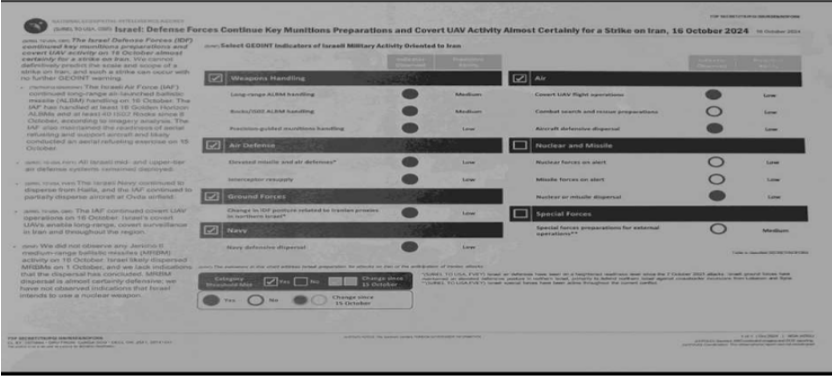
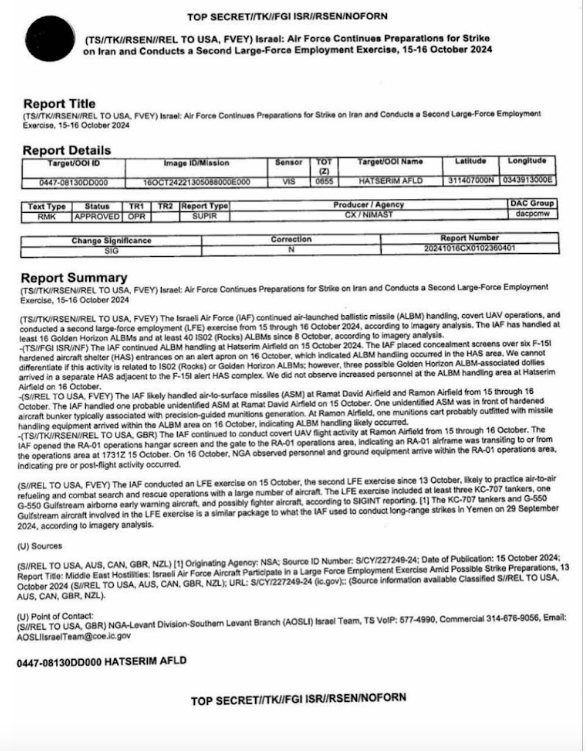
DARIO COMMENT: The documents, whose veracity and origin we cannot yet vouch for, outline the preparation of at least 56 ballistic missiles that may be used to target Iranian military targets, alongside numerous air-to-air refueling exercises being practiced by the Israeli Air Force.
The leaks, apparently originating from the National Geospatial Intelligence Agency (NGIA) contain some interesting details on heretofore unknown Israeli assets, such as the “Golden Horizon” Air Launched Ballistic Missile, or the “RA-01” Airframe.Additional documents released by the Middle East Spectator suggest this material leak may have the scale of Teixeira’s leak earlier in February 2024, and may contain documentation from the Department of Defence and the National Security Agency (NSA).
As for the contents of the documents, 56 missiles would be significantly more than the handful of drones Israel retaliated with against Iran in the spring, we note this response to Iran’s use of a similar number of missiles appears to be proportional. As such, it suggests that Israel will for the moment heed American advice to keep the number of strikes relatively limited and pull back from the brink of all-out war against Iran.
| GEOPOLITIcAl HOT spoTS |
NILE RIVER AGREEMENT DIES ON ARRIVAL: The Nile Basin Cooperative Framework Agreement (CFA) officially came into effect last week, despite continued rejections by both downstream Nile River countries: Egypt and Sudan. The agreement, signed for by upstream countries which includes Ethiopia, is the first multilateral effort by countries on the Nile to create a legal and institutional framework to govern the use and management of the river’s resources. But Sudan, and particularly Egypt’s continued refusal to sign the accord, means the agreement may as well be written on wet paper. Three days before the agreement kicked in, Egypt agreed to boost security cooperation with both Somalia and Eritrea as a sign of further diplomatic deterioration between Ethiopia and Egypt. While the deal is ostensibly to prepare the Somalian army to confront “terrorism” along its land and sea borders, the agreement is unsubtly aimed at threatening Addis Ababa’s ambitions along the Somaliland coast, and the Somaliland region’s independence.
SOMETHING EU-THEMED IS HAPPENING IN SYRIA: While Israel continues to hammer Lebanese positions from the air and ground, Lebanon’s neighbor Syria looks like it’s getting dragged into the fight. Over the past two days, Israeli planes have struck the otherwise peaceful port of Latakia which has avoided conflict since the start of Syria’s civil war in 2011, while Russian planes have bombed the embattled jihadist enclave of Idlib.
DARIO COMMENT: In Syria, where nothing has happened for years, a lot seems to have happened in just a few days. But, as is often the case in Syria’s incredibly complex geopolitics, the what and the why remains unclear.
The first page of this potentially new chapter of the Syrian Civil War happened in the European Union. On October 16, Politico published a piece that signaled Syria’s cooperation with EU countries was increasingly seen as necessary to facilitate the deportation of migrants. Led by Giorgia Meloni’s Italy, some EU countries are seeking to normalize ties with Bashar al-Assad’s regime. Relations with the EU were severed after Assad’s violent crackdown on protesters of his government in 2011.
This news comes amidst a new refugee crisis from Israel’s invasion of Lebanon, where almost 200,000 Syrians and Lebanese refugees have fled to Syria since the start of October, further risking destabilization in the embattled and divided Levantine country.
And just the same day on October 16, curiously, Russian military aviation launched targeted strikes against their enemies in the country. Israeli warplanes attacked their targets the day after.
We’ve been privy to reports on Telegram that these strikes may presage a new conflict brewing up in the country. Before we begin, let’s use a map: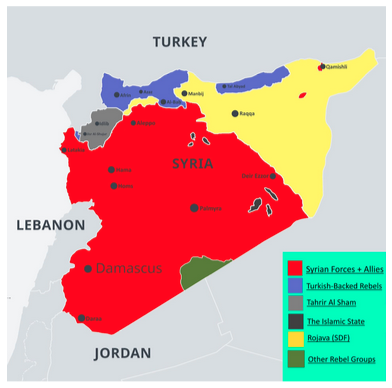
In red you have the Assad regime, which included its military allies in Hezbollah, the Russians, and the Iranian IRGC. In yellow (Eastern Syria) you have the Syrian Democratic Forces — the majority Kurdish-led, American-backed coalition that is based east of the Euphrates. In green (Southern Syria – Tal Rifaat) you have American-backed rebel groups, alongside a U.S. army base along the border between Jordan and Syria. In blue (Northern Syria) you have the Turkish-backed militias (titled the ‘Syrian National Army’), some extremist militias and their allies, the Turkish Army. In grey (Idlib), you have the supposedly unaffiliated extremist militias, primarily the Hayat Tahrir al-Sham militia, the former al-Qaida branch in Syria.
Some reports have also shown the Assad regime has been launching increased artillery strikes on targets in the Idlib area alongside Russian airstrikes.
For the last few days, it was apparently rumored that groups aligned with Turkey’s Syrian National Army (the bit shaded in blue) were planning on going against Assad’s forces in the Aleppo area. But since October 16, it seems the Turkish coalition is no more: numerous leaks and videos have attested to a mini-civil war breaking out between different factions in the Turkish coalition. These clashes happened between the Sultan Murad Division, members of the Syrian opposition that organized around their Syrian Turkmen identity, and the Suqour al-Sham brigades, a former member of the Syrian opposition Islamic Front with a history of deep cooperation with al-Qaeda.
Unsurprisingly, Turkey appears to be siding with the Sultan Murad Division, while the Suqour al-Sham brigades appear to be going on the offensive against Turkish military strongholds in Northern Syria. Turkey appears to be mobilizing its armed forces in support, with large Turkish military convoys seen moving into the region alongside increased Turkish drone activity over Syrian skies.
It’s far too early to tell what is going on. We also caveat that a consistent theme in our analyses of Syria since 2022 is that whenever the country seems on the verge of further conflict, it dissipates soon after. But the blind spot we should pay attention to lies elsewhere.
First, you may have noted that one of the armed factions with a deep history of working with al-Qaeda was until recently funded and armed by Turkey — a NATO member. You may be similarly surprised to know the area shaded in grey, Idlib — which is primarily held by a former al-Qaida affiliate — was taken with American approval. That’s because most of the tank forces of the Assad-aligned Syrian Army there were annihilated by CIA-supplied TOW missiles to the handful of supposedly ‘moderate rebels’ that acted as specialist troops for the al-Qaida affiliate’s offensive in 2015.
That’s because whenever countries of the Western alliance act outside of the media spotlight, they freely prove that Western interests frequently align with foreign jihadist insurgencies. Similar events happened in Mali. For instance, we wrote about the Malian President’s justified assertions that French forces collaborated with current and former jihadists.
The second point is to study qui bono from this recent flareup, so curiously timed after efforts by Italian PM Giorgia Meloni to normalize relations with Assad. Could this Syrian crisis be related to Meloni’s comments? Well, we don’t — and can’t — know that. Any normalization of relationships would begin the process of repatriating Syrian refugees hosted in Europe. But almost all foreign actors involved in Syria would not stand to benefit from the potential diminishing of racial tensions on the European continent that could follow. These are Israel, Russia, and Turkey.
Israel benefits from the refugee crisis in Europe because of the corresponding increase in anti-Islamic sentiment, and the rise of far-right parties that are strongly aligned with Israel’s actions against Arab countries. The rise of the far-right also benefits Russia, as these parties will often be in favor of prioritizing domestic policies and against further action to support Ukraine’s fight against Russia. And Turkey has benefited greatly from its continuing migrant deals with the EU, receiving up to €9 billion to host the Syrian refugees on its soil.
While the current flareups in Syria is still inconclusive, therefore, one thing is for certain: Western politics may continue to lie at its heart.
NORTH KOREA FLARES UP: North Korea has threatened to turn South Korea into a ‘pile of ashes’, as it sent an additional 600 rubbish-filled balloons into its southern doppelganger this week. According to reports more than 80 balloons full of household rubbish landed on South Korean territory in the continuing fracas over Seoul’s dropping of propaganda leaflets on Pyongyang this year.
The latest warning comes after the country accused South Korean drones of carrying propaganda leaflets that flew over Pyongyang three times this month — an operation that first started in May. North Korea’s vice minister of defense Kim Kang II warned last week that Pyongyang would send back “rubbish in a quantity 100 times greater,” if the propaganda didn’t stop.
In an additional sign of increased tensions, North Korea blew up parts of two major inter-Korean roads. While the roads are hardly used, they were symbolic of long-standing efforts to unite the Korean peninsula. Now, analysts are suggesting that Kim’s North Korea intends to abandon these plans.
DARIO COMMENT: What are these flareups about?
The only significant piece of news we’ve received in the West is that North Korea has committed around 10,000 of its soldiers to fighting the Ukrainians in Kursk. Tied to this, on Monday Putin submitted a draft law to the Russian State Duma to ratify a new strategic partnership between Moscow and Pyongyang that was hammered out in June, which includes promises of mutual assistance in times of war.
And Friday saw reports by Kim Jong Un that it would label South Korea as a ‘foreign and hostile country’ in an amendment to North Korea’s constitution showing the goal of reunification between the two Koreas has been abandoned. Kim Jong Un also pointed to increased military exercises and maneuvers between South Korea and the United States, alongside South Korea’s drone flights, as the reason for these actions. This was publicly demonstrated by this summer’s enhanced joint military exercises between the United States and South Korean militaries, during which an American supersonic bomber was paraded over Korean territory for the first time.
But, despite these actions, analysts clearly outline the lack of preparations for any large-scale conflict between the two countries. And Korean commentators online remind Western viewers such flareups are common.
While such actions do not necessarily presage any short-term military flareup, or even nuclear warfare, they do point to how the global rise in geopolitical tensions is driving an increasing wedge between the Koreas. The path to unification appeared to advance, albeit haltingly, since the end of the Cold War, reaching a peak with Kim Jong Un’s failed negotiations with Donald Trump in 2018. But it has now ground to a halt.
The key issue with the Koreas is not the intentional build-up of troops or a planned war, however. Neither side would be interested in what would effectively be an all-out, mutually destructive conflict. The problem is that the war never officially stopped, and both sides never went beyond the signing of a ceasefire agreement. As we saw this week, where North Korean rubbish balloons caused South Korean artillery to fire warning shots into unpopulated land along the Korean border, the real risk is that such a conflict may escalate of its own accord.
| DEFENSE |
US ARMY WILL 3D PRINT UNDER FIRE: News Defense reports have shown that plans for 3-D printing by the United States military will include the printing of spare parts under fire and near the frontlines. This report interestingly noted that since Covid’s supply-chain issues, officers at Army Materiel Command have increasingly relied on the 3-D printing of parts for its military units. Now, American officials seek to broaden the use of these 3-D printers, by extending their use on the frontline, and re-cataloguing large quantities of its plastic parts internally as 3D models. Adequate use of this technology could significantly alleviate the length and complexity of any individual unit’s supply chain.
| POLITICS, POLITICS,POLITICS |
POLL DISPARITY: Social media and prediction markets are convinced that Kamala Harris’ lead has completely collapsed in the polls, but a Reuters/Ipsos poll found that Harris held a marginal 3-percentage point lead over Trump at 45 percent to 42 percent. Who is telling the truth? Only time will tell. But here to compare is Polymarket:
| CONSOLIDATION WATCH |
FRANCE FREAKS OUT ABOUT SANOFI: The week before last, French pharmaceutical giant Sanofi revealed it was in talks to sell a majority stake of the subsidiary, Opella, that produces over-the-counter drugs like paracetamol to an American private equity firm CD&R for €15 billion. French politicians, however, freaked out and threatened to use their investment screening and veto powers to block the deal unless guarantees could be made to ensure company management and production stayed in France. But the government itself doesn’t seem hostile to the deal, describing the buyer as “a serious investment fund that presents positive prospects for the overall development of Opella as well as for the sites located in France.”
| WHAT We ARE READING |
— Grieftech is now a thing. Isabel Woodford, now at the BBC, takes a closer look.
— Lionel Barber discusses his new book about Softbank’s Masayoshi Son.