
Happy coronation weekend to all my royalist readers, but also commiserations to the republicans. It’s been an extraordinarily busy week for me, but things will get into more of a normal flow as soon as the new Charles era begins proper. This edition of the Blind Spot Wrap was mostly compiled by Dario Garcia Giner, but it was edited by me, Izabella Kaminska.
De-dollarisation and multipolarity — the debate goes on:
- ICYMI, Gal Luft from the Institute for the Analysis of Global Security outlined the inevitable nature of global de-dollarisation. Luft put it down to the overreach of American sanctions reducing the appeal of the greenback as a safe store of value, as well as the US’s high federal debt-to-GDP ratio. This is now an increasingly common theme to the argument.
. - Also, from April, academics Stephen Brooks and William Wohforth made the opposite case, arguing in Foreign Affairs, that despite the ascent of China or Russia to a more shared geopolitical plateau, the United States still casts the largest shadow across the globe, and will continue to do so in the near future. They claim that the only thing that has fundamentally changed is the nature of the continuous, unipolar order. American unipolarity may have narrowed, they say, but its lead is still substantial “which is why the distribution of power today is best described as ‘partial unipolarity, as compared with the ‘total unipolarity’ that existed after the Cold War”.
Also they make a good point that for the system to be truly multipolar you need an obvious third power player in the mix, and currently there are none that match up to the U.S. or China. – IK
- China expert Michael Pettis continued to argue that de-dollarisation might actually be good for the West in a Twitter thread that explored common misconceptions about the winners and losers of de-dollarisation. Loss of dollar dominance will not be a loss to the middle-income or working-class American, Pettis claimed, as maintaining the greenback’s reserve status comes at their cost. On the other hand, it is bad news for many American elites, international banks, and certain countries whose “structural distortions in domestic income have locked in weak domestic demand” like Japan.
.. - Five Arab states, Saudi Arabia, the United Arab Emirates, Egypt, Algeria, Bahrain, and Iran came together to form the total of 19 nations who have no expressed their readiness to join the BRICS group of nations.
.. - Indian billionaire Uday Kotak claimed the “US dollar is the biggest financial terrorist (…) the world is desperately looking for an alternative. These changes happen every hundred years or so.”
Business, econ and finance etc:
- In another blow to Macron’s reform drive, Fitch cut France’s debt rating from AA to AA-, claiming its projected budget shortfall is “well above” the median of its peers.
. - Apple launched a high-yield savings account, offering depositors a 4.15 per cent annual return on their deposits. Only four days in, Apple announced it had over $990m in deposits, with $400m being deposited on the first day.
. - Money market holdings hit a record $5.31tn in May, up $47bn in one week and $100bn in two weeks.
.
- Bloomberg’s Lionel Laurent noted that, while the French economy was performing better than expected, French politics were suffering from a “vibecession” — an upbeat economy amid political gloom, driven by the unpopularity of Macron’s reforms.
A recent conversation with a taxi driver in Paris opened an interesting angle to the oppositional nature of most of French society towards Macron’s pension reforms. It turns out the French may not be as lazy as they seem. Most non-French media on the issue amply questioned the legitimacy of these protests; “the white-flag-waving cheese eaters are complaining about retiring at 62 again,” most papers broadly stated. I — as someone who doesn’t envision retirement as a realistic possibility — certainly found the notion ridiculous.
But there appears to be far more to the issue than I had realised. The taxi driver, himself an immigrant from Algeria, claimed nobody in France — or very few — actually retire at 62. “These people, they want to keep working. But they would rather start earning their pensions two years early to support their income, as they continue to work without declaring” — or as they say in Spain, working in “B”.
Seen from this light, the shadow economy appears to haunt the centralised states of the West like a plague. But this sector, often misunderstood as the black economy, the shadow or ‘grey’ economy is not just comprised of illegal activity. In reality, it covers imbalances and unrealistic expectations of state power — a fixer rather than a problem child.
For example, the taxation regime in Spain falls heavily on small business owners. This is why if you venture into most industrial towns in Spain, you’ll be hard pressed to get a receipt in any low-margin retail store. Are they stealing revenues that should morally belong to the state? Perhaps. But it’s questionable they could survive without their “B”.
France’s shadow economy stands at around 11.6 percent of its GDP — a slightly lower share than the almost 18.6% in Spain. Despite these figures going through a dramatic and record-breaking drop in 2020, as state aid and furloughs were only provided to those with contracts, taxation pressures are likely forcing individuals “back to Black”. In Spain, for instance, there has been no relief or changing of taxation margins — severe inflation meaning most individuals will now be paying more taxes for mere nominal raises in income, as VAT costs continue to increase hand-in-hand with a rise in product prices.
And it may very well be Spain, however, that holds the keys to France’s conundrum. The Spanish government announced in December 2021 that doctors will be able to retain their pensions while extending their age of retirement. This measure will allow doctors to undergo an “active retirement”, where they can earn up to 75 percent of their pension while continuing to work alongside. Alternatively, these doctors would be able to reduce their work hours to 50 percent. Though the measure is “temporary and exceptional” and is aimed to cover a severe shortfall in medical expertise, one can’t help but see promise in a more flexible retirement scheme.
Opposition to a later retirement in France, then, seems to galvanise both the hard-working, and the not so hard working. But if the hard workers feel the need for a supplementary state pension so near the peak of their earning years, it suggests that France has a taxation — and not a motivation — problem. – DGG
Also, the case that the French pay so much in taxes, they deserve an early retirement – IK.
- Jay Newman, senior portfolio manager at Elliott Management, argued in a piece for the Financial Times that Apple’s exposure to the Chinese markets essentially makes them a Chinese company. The SEC, auditors and investors don’t yet realise this, he claimed, but the symbiosis of Apple with the Chinese government should be cause for concern amidst rising geopolitical tensions.
The same can be said of many companies though, especially HSBC. – IK
- Dan Neilson coined the term “Schrodinger’s insolvency” to describe the growing influence of unrealised losses on global dollar portfolios as a result of rapid interest rate hikes.
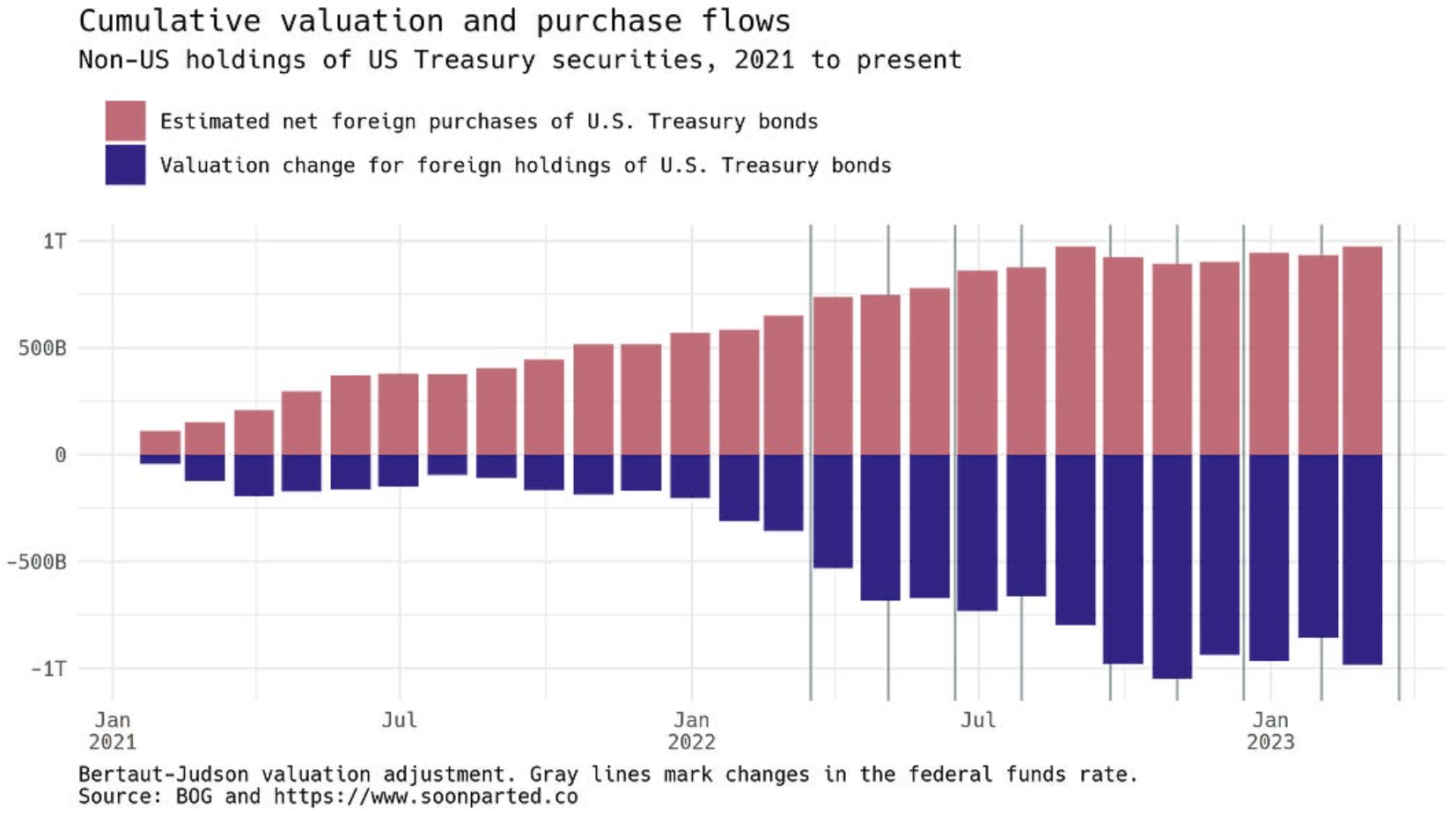
.. - Russell Napier stated the covert control of commercial banks by governments is leading to the creation of a new financial system, which could channel large amounts of capital into renewables.
.. - In a recent disclosure, Goldman Sachs revealed it was cooperating with various governmental investigations into the company’s business with Silicon Valley Bank in March 2023.
.. - Eccentric hedge funder Hugh Hendry hosted Brad Setter, senior fellow of the Council of Foreign Relations for a conversation on foreign trade and the conduct of sovereign nations: capital controls, yuan reserves, and trade surplus as a function of valuation.
.. - The ECB was trying to figure out how many unrealised losses were related to their rapid interest rate hikes, according to supervisory chief Andrea Enria.
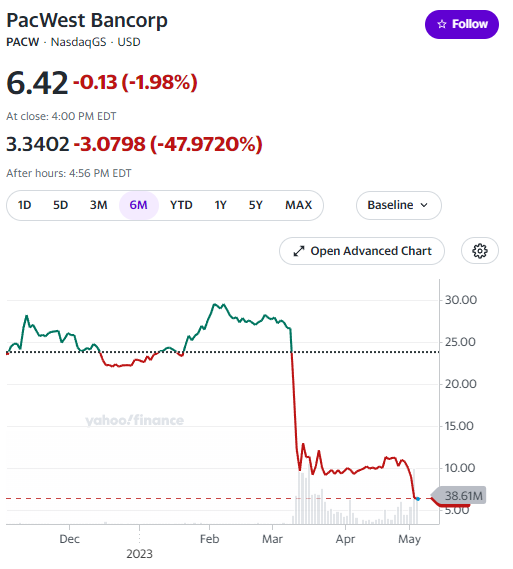
.. - Shares in Pacific Western Bank, with total assets worth $44bn, experienced a big selloff this week, clocking in an 85 per cent loss since the start of 2023. Bloomberg reported the bank was exploring strategic options, including a sale.
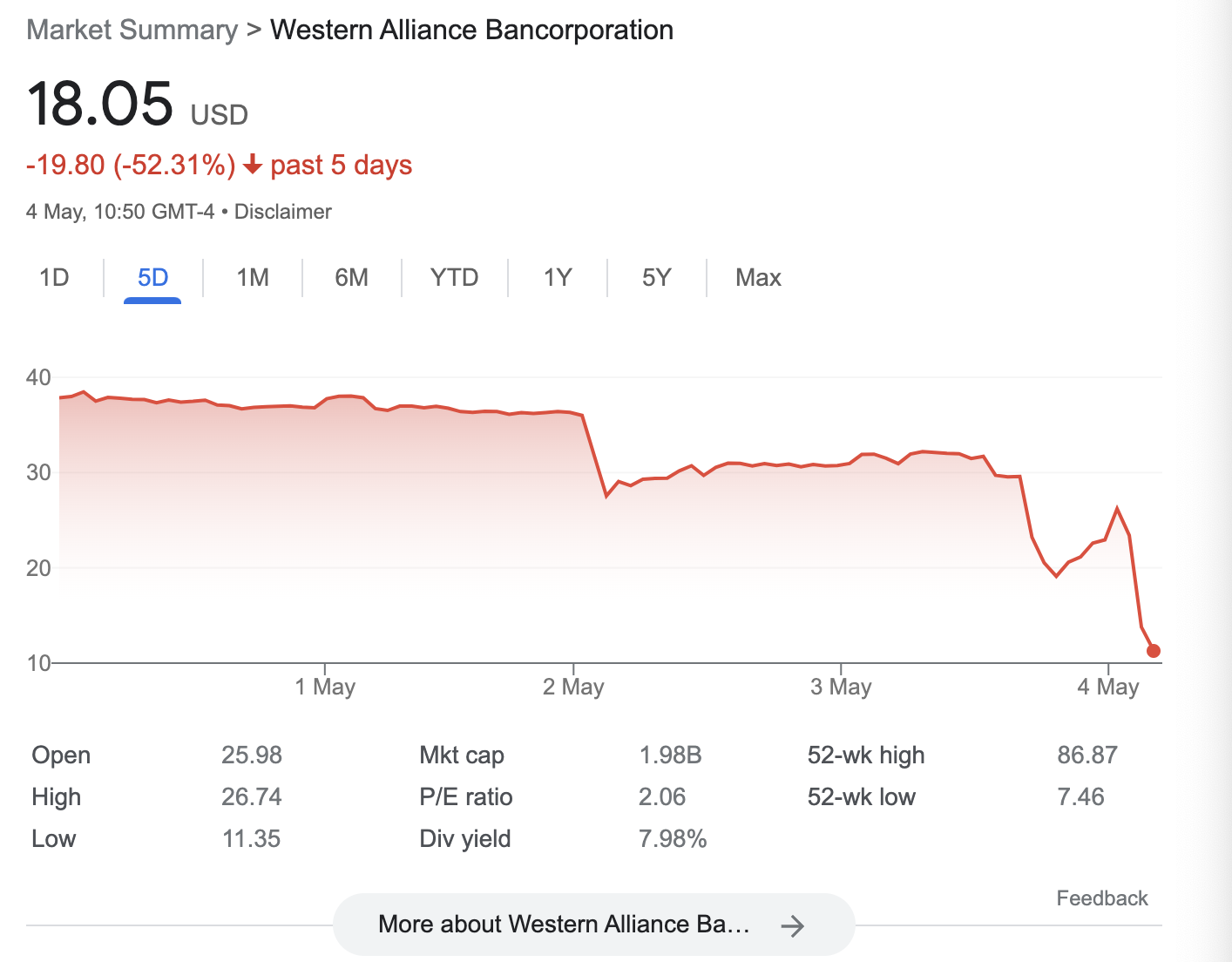
- Arizona-based Western Alliance Bank, with around $71tn in assets at March end, courted potential buyers for all or part of its business after its share price fell 52.3 per cent over the last five days.
- Gold prices hit an all-time high on Thursday, briefly being traded at $2082.
American political drama:
- Ron DeSantis banned public funds from being invested in ESG projects in a bid to stop a ‘plague’ on US finances, claiming such projects were fundamentally left-wing in nature. “They (the so-called ‘Davos elite’) want to use economic power to impose this agenda on our society. And we think, in Florida, that is not gonna fly here.”
.. - Unherd’s Freddie Sayers bagged an interview with US presidential candidate Robert Kennedy Jr — the so-called “black sheep” of the Kennedy family — whose latest polling shows 20 percent of support for his Democratic presidential nomination. Sayers’ interview, interestingly enough, left aside any discussion on vaccines to focus on Kennedy’s other political views.
.. - Jeffrey Epstein’s private calendar was released by the Wall Street Journal, detailing lists of schedules and emails exchanged in the years after he was convicted as a sex offender. Unexpected entries included William Burns, director of the CIA since 2021, who had three meetings with Epstein in 2014, and Noam Chomsky, who reportedly told the Wall Street Journal these meetings were “none of their business”.
Cryptocurrency evangelism:
- After revelations that the minute Himalayan kingdom of Bhutan had millions stashed away in cryptocurrency, which got caught up in the FTX collapse. Bhutanese officials confirmed they have greenlit bitcoin mining activities by DHI — the investment arm of the Royal Government of Bhutan — on their soil. The Bhutanese see cryptocurrency mining as a means to monetise the country’s large hydropower excesses.
.. - Italy enacted a 26 per cent capital gains tax on cryptocurrency gains as part of its 2023 budget law. Until the end of 2022, capital gains earned in crypto did not count towards income unless the crypto held were worth more than €51,000.
.. - RFK Jr said he liked bitcoin but not CBDCs.
. - Nigeria unveiled its new National Blockchain Policy, which aims to create a blockchain-powered economy. Nigeria’s Federal Ministry of Communications and Digital Economy cited data from a PwC report that predicted blockchain tech would contribute up to $1.76tn to the GDP by 2030.
Absolutely implausible – IK
Media matters:
- Michael Shellenberger and Alex Gutentag’s latest Substack piece reviewed recent initiatives by Western governments to censor online speech in the name of combating ‘misinformation’. They were particularly concerned with the United States’ RESTRICT Act, which allows American authorities to monitor the online activities of any citizen under suspicion, and the European Union’s EU Digital Services Act, which would cede content moderation to NGOs and their state sponsors.
.. - Aris Roussinos, a former war reporter for Vice News, penned an excellent analytical piece for Unherd discerning the reasons for the media outlet’s shutdown amid news of its bankruptcy, so soon after the Vice group seemed set to take over the modern media landscape in the 2010s. Roussinos notes that Vice, which had won acclaim for dispassionately showing viewers how the world really is, became excessively concerned with its own virtue. Liberal reporters like him, meanwhile, thought in the hey day of Vice that they could change the world; instead the world changed them.
.. - A journalist from the Inquirer scanned all the tweet “likes” of the President of Thomas Jefferson University and found that the President had ‘liked’ tweets by MRNA vaccine critic Alex Berenson, forcing a public apology from the academic and calls for his resignation.
Understanding the minutia of how your Twitter behaviour will be understood by online sleuths and their corporate masters is key to being able to thrive in today’s advertiser-dominated online world, particularly if you rely on an audience for revenue.
At Kroll, we often dealt with luxury beauty brand clients who had very high expectations of their influencers. Our priority was to assure a “values match” — whether the influencer matched with the values of the brand they were being sponsored by. In other words, that they didn’t pose a risk of being “cancelled” for the corporate.
Let’s assume you are an influencer or you run your own small business online, which does not rely on political engagement for revenue (political influencers are exempted from these rules). The following will make large corporates think twice about working with you:
1. Any political engagement. Most corporates detest politically active accounts, with rare exceptions around mass-protest events such as BLM. But make no mistake, prior to the BLM moment in 2020, public sympathy with BLM was flagged. Right-wing politics is especially maligned, unless the influencer thrives in a particularly red state like Texas.
2. Anything smacking of conspiratorial or radical beliefs, particularly if it’s seen as right-wing, from the Kennedy assassination to anti-vaccine beliefs.
3. Racism, harassment, and violence.
4. Engaging negatively with followers or other users online.
But these rules go further. How do different social media interactions, outside of a direct post, change the perception of the behaviour outlined above?
1. Retweets suggest a high level of complicity with the opinion being shared. Since they appear on their followers’ feed, RT’s are weighted like posts.
2. Likes only occasionally appear on a followers’ feed, and as such are weighted much less than posts or RTs.
3. Repetition. The corporate may ask the influencer to delete a post that was xenophobic, for example, or a relatively extreme political viewpoint, without cancelling their cooperation — particularly if the identified post had flown below the radar and was only identified by Kroll’s analysts. However, repeated instances of swearing, or ongoing political engagement, would be flagged. The same goes for any mild post that becomes controversial — if this happens, you’ve already lost.
Geopolitical hot spots and drug wars:
- Arnaud Bertrand’s drew attention to a story doing the rounds in China but largely being missed by Western media: that in retaliation for Japan’s increasing support for Taiwanese independence, China has started backing the independence of the Japanese islands of Ryukyu.
..
- Everyone’s favourite moustached interventionist, John Bolton, claimed re-stationing US tactical nukes to South Korea would reassure their ally in the Korean peninsula while “sending a clear message to North Korea”.
..
- The Kremlin claimed the United States, not Kyiv, ordered the odd-looking and odd-sounding drone assassination attempt on Vladimir Putin. All this while unconfirmed reports indicated the Russian Strategic Nuclear Force was ordered into a heightened state of alert, with nuclear weapons being readied across Russia.
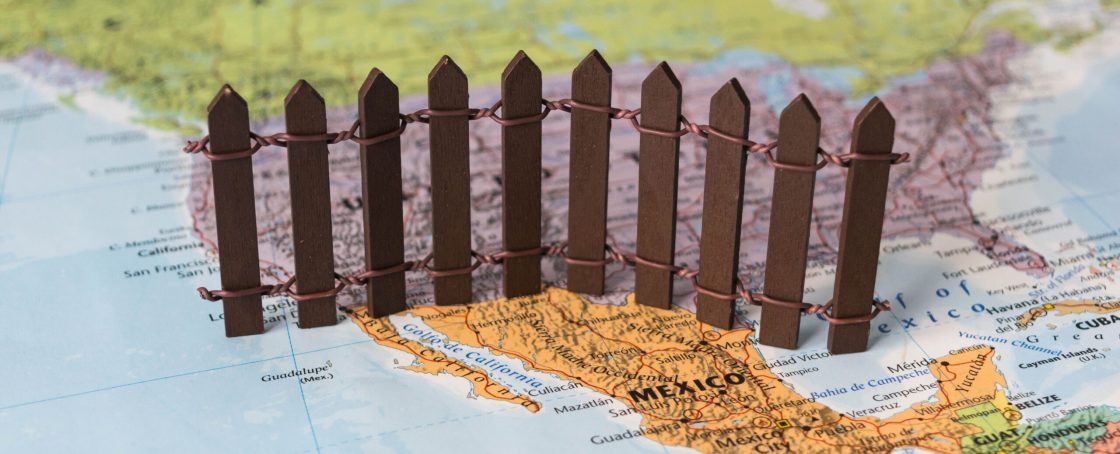
.. - Mexican President Andres Manuel Lopez Obrador (a.k.a Amlo) escalated his protests against claimed American intervention in Mexican politics. The United States, the Mexican President claimed, was supporting the financing of NGOs that were allegedly openly opposed to his presidency, meaning Amlo considered this an assault on Mexican sovereignty.
2023 is becoming a nadir for Mexican-American relations.
Despite publicly seeming ideologically opposite, media sources indicate Amlo and Trump’s relationship was relatively amicable.
However, Amlo’s intractable nature has raised serious concerns in the House of Congress and a Biden White House pressured by record levels of fentanyl-related deaths and illegal migration. The fentanyl epidemic has even inspired some GOP members to claim the United States must invade Mexico and take care of the cartel problem themselves.
Fentanyl deaths are particularly controversial since most fentanyl outflows come from China, the US’s increasingly ‘hot’ rival. But in recent years, fentanyl production for American consumers appears to have shifted into Mexico. And the high-profile armed kidnapping of four Americans in the Mexican border town of Matamoros last month did not help tensions either.
The emergency situation at the southern US border continues to escalate as a result. President Biden recently deployed 1,500 active troops, bringing the total number of active duty soldiers at the border to 4,000. These troops will be kept in a supporting role, allowing law enforcement officers to directly respond to an anticipated surge in migration levels. Travel warnings for Americans travelling through Mexico have also been officially issued, endangering Mexico’s “golden goose”: American tourism.
But this ain’t the first straw placed on the camel’s back. These troops will be added to the already 10,000 or so Texan military and law enforcement personnel which, recently equipped with M113 armoured personnel carriers in November 2022, were deployed by Texan Governor Greg Abbott since March 2021 in Operation Lone Star (OLS).
It is the Texan State which has taken the lead on counter-migrant and narcotics operations, particularly since Abbott declared Texas was suffering from an “invasion” via Executive Order GA-41 in July 2022, after which he designated Mexican cartels as terrorist organisations. According to the Texan Governor’s office, as of November 2022, OLS has resulted in 325,000 migrant apprehensions, 21,900 criminal arrests (including 19,400 felony charges), and 352 million doses of fentanyl seized.
Yet Amlo’s stance remains immovable. He maintained, not completely incorrectly, that the fentanyl crisis is a more partial result of the societal breakdown in the United States rather than one in Mexico. Amlo retorted to the GOP’s sabre-rattling by describing the notion of an American anti-cartel attack as “an offence to the people of Mexico” and a “lack of respect for our independence (…) we don’t take orders from anyone”. In response to the travel warnings, Amlo even claimed, dubiously, that “Mexico is safer than the United States”.
He also claimed that USAID, the United States’ foreign aid office, and the National Endowment for Democracy, were attempting to unseat him from the Mexican presidency by funding civil society organisations that publicly oppose him. Though Amlo’s rhetoric and actions are clearly partisan, and must be contextualised by Mexico’s upcoming elections, where his rising poll numbers show such anti-American rhetoric isn’t falling on deaf ears, we cannot throw out the baby with the bathwater. USAID explicitly claims to further the interests of American sovereignty overseas, unlike Britain’s UK Aid, and has been tied with attempts to unseat oppositional governments in both Venezuela and Cuba.
The crisis does not appear to be skin-deep. For instance, Mexico passed a law in January that restricted the activity of “foreign agents” on Mexican soil, and that Mexico would cease to cooperate cross-border drug crime investigations “without respect for our sovereignty”. This followed the arrest of a Mexican General, Salvador Cienfuegos, on drug and money laundering charges in the United States, before he was extradited back to Mexico and cleared of charges.
The following charge is laced with speculation, but historical precedent and contemporary rumours suggest their veracity: American lawmakers are clearly suspecting some Chinese involvement in their fentanyl crisis, particularly as providers of the substance, but also increasingly as facilitators and money launderers for Mexican cartels.
But the issue is, naturally, not so simple. Yes, Mexican cartels’ have been cooperating with CCP-protected Chinese triads for decades. El Chapo’s Sinaloa, Mexico’s blue-chip cartel, has entertained these relationships since the early 2000s with active import-export networks in the Golden Triangle and in the Asia-Pacific region. But relationships have been forced into a more competitive and hostile stance by Sinaloa’s main rival, the Cartel Jalisco Nueva Generacion’s (CJNG) entry into Chinese markets, forcing both Sinaloa and CJNG to abandon caution and bypass triads in their brutal competition. This raises the potential for a Chinese triad-Mexican cartel war in Asia Pacific, according to Vanda Felbab Brown, Director on the Initiative on Nonstate Armed Actors.
All in all, the situation appears to be rapidly escalating. One can’t help but look back at parallels in the British-Chinese Opium Wars, forever forged into Chinese memory as part of their “century of humiliation” at the hands of European merchants of addiction. The Chinese recall the Opium Wars differently than Britain, with a belief this was a devious strategy to demoralise the Chinese people and facilitate a breakdown of their sovereignty. Now the situation appears to be reversing, with American legislators accusing China or Mexican cartels of exactly the same thing.
History may not repeat itself, but it certainly rhymes. – DGG
- Wagner head Yevgeny Prigozhin released another incendiary video directed towards the leaders of the Russian Army, Generals Sergei Shoigu and Valery Gerasimov, for allegedly hoarding ammunition supplies. Prigozhin has been repeatedly warning the Russian chain of command publicly in recent weeks that, faced with a severe ammunition shortage, Wagner will be forced to withdraw.
Standing before corpses of Wagner soldiers, Prigozhin shouted among expletives: “Look at them, you bitches (…) you sit in expensive clubs (…) your children make YouTube videos (…) you think you have the right to dispose of their lives? They came here as volunteers and died so you could gorge yourselves in your red-wood offices.”
All in all, Prigozhin warned that Wagner will exit from Bakhmut on May 10 in order to leave “vertically” rather than “horizontally” (i.e., in a body bag). – DGG
- NATO was set to open a liaison office in Japan, its first such office in Asia, to allegedly facilitate “consultations in the region”.
.. - Author and former US presidential advisor Harald Malmgren claimed that Jamal Khashoggi was an intelligence asset of the United States, suggesting the failure to warn Khashoggi of his imminent capture meant it may have been convenient for some in the United States’ government.
.. - Chas Freeman, former Assistant Secretary of Defence for Richard Nixon outlined a perfect summary of the Taiwan issue.
Politico’s finest:
- Public figures expressed doubt that Bulgarian prosecutor Ivan Geshev was targeted by a real roadside bomb, claiming the attack may have been staged.
.. - Brigit Malsack-Winkemann, the former German lawmaker for the Alternative for Germany (AfD) that was part of the group accused of plotting to overthrow the German government, employed a fortune teller as a part-time clerk. Both women are currently held in custody.
.. - Rishi Sunak’s Conservatives got battered in local elections today in the United Kingdom, with Labour taking key target councils.
.. - Britain’s Online Safety Bill, set to regulate social media giants online, have set the government at loggerheads with WhatsApp. The company claims they would rather exit the country before handing UK authorities their encryption.
Eyes in the sky:
- The American National Reconnaissance Office, one of 18 members of the intelligence community and whose existence was only declassified in 1992 after being created in 1961, recently lifted the veil of secrecy to discuss some of its past activities, which included the establishment of America’s powerful spy satellite arrays.
. - The Europeans announced they would together to create a challenger to Elon Musk’s starlink.
Liability management:
- In 2018, a French woman named Sophie Lacaille was walking past a gilets jaunes protest when a policeman’s rubber bullet wounded her in the neck. However, a French tribunal has since considered she was “co-responsible” for the wound, for “imprudently” walking near a protest scene.
Technological developments:
- American sanctions on China’s ability to import chips appeared to be hampered by the advanced nature of U. tech companies’ chips compared to China’s. For instance, despite Nvidia offering Chinese customers the H800, which takes 10-30 per cent longer to carry out AI tasks, with some costs doubled compared to Nvidia’s equivalent chips in the US, Tencent Holdings still estimated that despite these handicaps H800 will still “cut the time it takes to train its largest AI system by more than half”.
.. - Of the two pictures below, one was generated by Midjourney, an AI image-generating software. The other is real. Which is which?

Fixer-uppers:
- It’s not just abandoned French chateaux that are being fixed up by foreigners, the New York Times reported on Japan’s abandoned houses, which are so prevalent one can purchase them for as little as $25,000 — and a lot of foreigners are doing exactly that.
Covid hangovers:
- Princess Anne revealed the high cost Covid restrictions incurred on the British royal family, particularly Prince Philip. “Covid stole my father”, Princess Anne said of Prince Philip, “who lost a lot of the people who would have gone to see him and come and talk to him and have those conversations that would have kept him interested. He lost all of that.”
.. - Something that didn’t make it into Brussels coverage this week: the European Parliament hosted an International Covid Summit organised by Robert Kennedy’s controversial Children’s Health Defence, a vaccine-sceptic organisation. The Summit covered a diverse range of topics whose discussion was severely restricted during the pandemic, such as the suppression of Ivermectin, the efficacy of Covid-19 vaccines and the cost of imposing pandemic mandates without proper data. Some controversial names in the field, among them Dr. Robert Malone, came to Brussels for the event.

One Response