| SNEAK PEEK |
— How central bank gold swaps may be linked to the current rally.
— Why Elon’s Robotaxi dreams lack basis in economic reality.
— The Kashmir attack that could reshape global trade by leveraging India’s hold on Europe’s industrial future.
Greetings, subscribers!
The invitation to our Summer Party should have hit your inboxes by now, so do please check it out if you haven’t already. The last time we hosted a Blind Spot event was in December 2022 in London, so apologies for taking this long to organize another one. Our readership is global, so this time we’ve decided to be a bit more adventurous with the location. The event will take place in Berlin on July 17 at the former Teufelsberg NSA listening station.
Given prevailing geopolitical tensions, the theme is Cold War chic. In terms of what to expect? Think performative journalism meets Cold War cosplay meets low-key counterintelligence mixer. And/or the vibe of a hastily organized underground meeting of dissidents, complete with music (including all the critical Cold War 80s classics), booze, food trucks, and short-film showings.
And no, it probably won’t be like anything else you’ve ever attended (unless you were one of the lucky few who got to take part in Alphaville’s Vaudeville spectacle in 2019).
We’re still shoring up the content, but trust us, it should be fun! And we’ve got some great guests lined up already. Including a session with the site’s historian.
If you’re wondering why it’s also cast as Bruce’s birthday party, and who the hell is Bruce? That’s just the cover story, geddit?
Bruce is Bruce Packard, an old friend of Alphaville and a former bank equity analyst at Credit Suisse. He has kindly offered to underwrite the event, on the condition that cardboard cutouts of David Hasselhoff will be plentifully distributed and his transition into the 50s fully acknowledged. These days, Bruce can be found poring over the financials of random German real-estate stocks and AIM-listed currency management corps at platforms like MoneyWeek.
Send tips to [email protected] and [email protected]
| THE BIG BLIND SPOT THIS WEEK |
GOLD REVALUATION SPECULATION: With rumors flying that the U.S. Treasury under Scott Bessent might consider revaluing the country’s gold stock to earn itself some budget-neutral fiscal headroom, it’s worth looking a little more closely at what exactly has been driving the current gold rally. Gold continued its meteoric rise this week — surpassing $3,400 an ounce and setting new inflation-adjusted records. Yet curiously, this surge has not been accompanied by the kind of retail mania typically seen in Western markets.
According to the World Gold Council, the rally is being fueled largely by central bank buying. February data shows global central bank gold reserves rising by 24 tonnes, with Poland, China, Turkey, and the Czech Republic leading the demand. Poland’s appetite has been particularly robust, with the President of the National Bank of Poland, Adam Glapiński, proudly declaring this week that the country had overshot its target of holding 20 percent of reserves in gold, now boasting more than 500 tonnes. (Chart below via the WGC):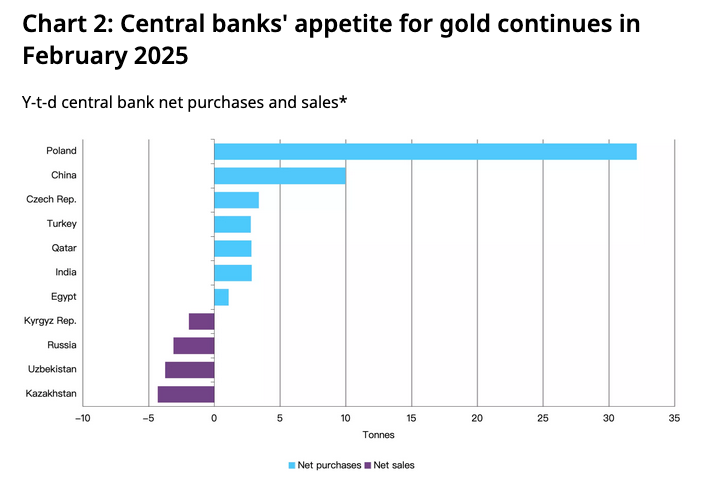 Here for your pleasure is a picture of “Glapfinger” in the NBP’s gold-buying nerve center: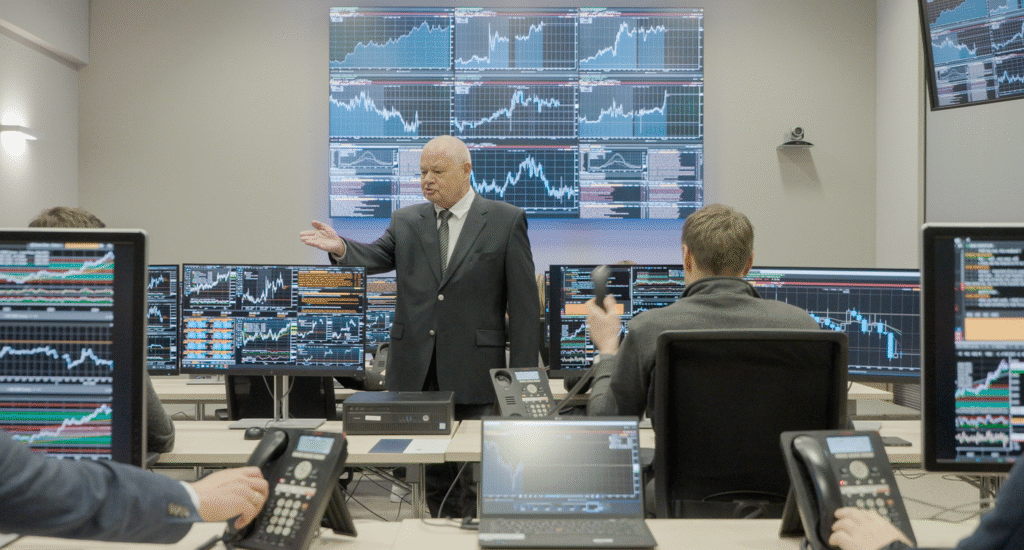
But why are the NBP buying? That, is harder to answer. For over a year, Adam Glapiński has been offering cryptic hints during his press conferences about the importance of holding gold in the central bank’s coffers. He has described gold as a symbol of the nation’s strength and sovereignty, and the NBP’s accumulation of it as a strategic move to ensure financial stability for future generations. He’s also gone to some lengths to tell stories about Polish gold during WW2 and how it had to be evacuated from the country, eventually helping to fund Poland’s government in exile in London.
Simultaneously, he has also been known to argue, as he did in June 2024, that the introduction of the euro would be detrimental to Poland. Is the gold buying a subtle NBP hedge to defend the zloty (which, incidentally, means gold in Polish) from euro-related instability? Could be.
But there are other curious trends afoot on the European side that are worth paying attention to.
A physical gold squeeze? Back in January, Reuters reported that London bullion market players were racing to borrow gold from central banks, especially those that store bullion in London, following a surge of gold deliveries to the United States. This was attributed to the prospect of U.S. import tariffs. According to the news wire, the minimum waiting time to load gold out of the Bank of England, which stores gold for central banks, surged to four weeks when the usual is closer to one.
Separately, The Telegraph reported in April, that German officials were supposedly considering removing an enormous stockpile of gold from a vault in New York over worries about Donald Trump’s unpredictable policies.
But there’s more. Below is a chart from the ECB data portal of “Monetary gold, of which gold under swap for cash collateral, Euro area (changing composition), Monthly”: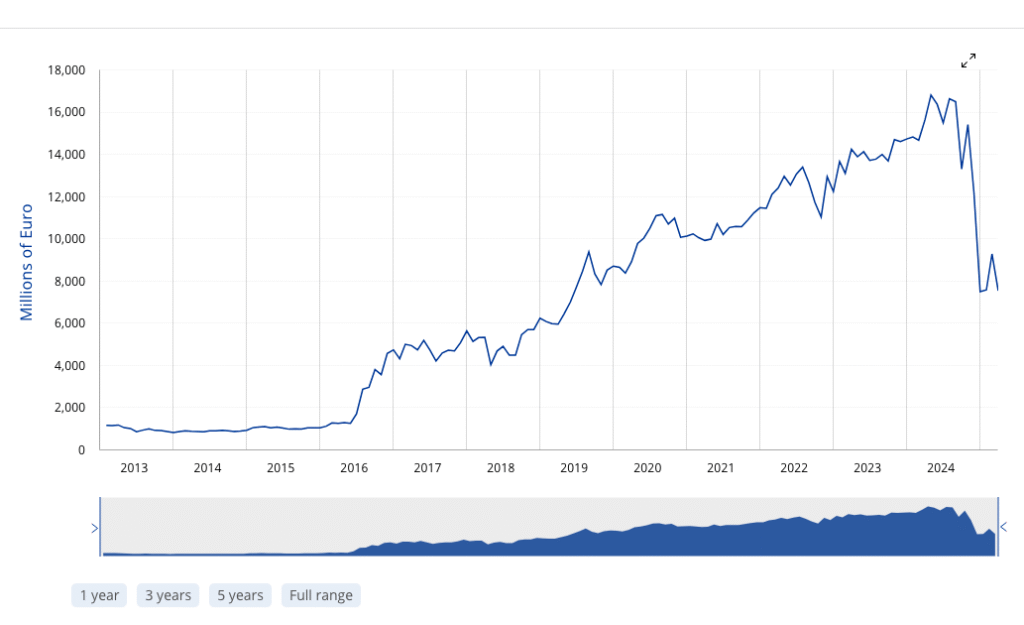 As shown above, the amount of gold under swap for cash collateral dropped very sharply at the start of 2025, around the time the London Bullion market got squeezed. This implies central banks moved to unwind pre-existing gold swaps (aka covering pulling back their loans). The related short-covering may have been a key contributor, therefore, to the recent rally.
Gold swaps: Eh, what? Well, yes, precisely. Welcome to the most esoteric corner of the gold market, a realm so obscure that only a small pool of professional bullion traders can speak about it with real authority. It’s also where the more conspiratorial narratives about gold tend to thrive.
To understand the theories that circulate in this space, some historical context is necessary.
Back when fiat currencies were tied to gold, central banks established a de facto cartel known as the London Gold Pool to prevent the price of gold from depegging from $35 per ounce. Founded in 1961, the Pool was a coordinated effort among eight central banks, led by the United States and the United Kingdom, to stabilize the dollar’s value by pooling gold reserves and intervening in the London bullion market against speculative pressures.
Over time, however, mounting U.S. deficits, rising inflation, and growing geopolitical tensions drove relentless demand for gold. As confidence in the dollar eroded and concerns over dwindling U.S. gold reserves intensified, the system became unsustainable. The London Gold Pool collapsed in 1968, marking a major step toward the eventual breakdown of the Bretton Woods system.
A modern gold pool revived? While the collapse of Bretton Woods in 1971 officially depegged the dollar from gold and opened the door to the rise of the so-called “non-system”, theories abound that central banks still club together to suppress gold prices in a bid to shore up the credibility of their currencies. The logic goes that even in a system of floating exchange rates, soaring gold prices are never a good look for central bank authority.
A key way central banks are said to influence the price of gold is by lending their gold reserves via trusted intermediary bullion brokers or the Bank for International Settlements to hedge funds and bullion traders prepared to short gold in the market. In a stable market, this is usually a cost-effective strategy because gold is a zero-yielding asset, meaning hedge funds can put the proceeds of such sales into higher-yielding investments and generate a tidy arbitrage.
Either way, once central banks retreat from supplying gold, there is little left to contain the rally. At least, that’s the theory promoted by groups such as the Gold Anti-Trust Action Committee (GATA). Traditionally, such claims have been dismissed as goldbug conspiracy talk. But, given the swap unwind data highlighted earlier, perhaps there is more substance to the theory this time around.
It’s also interesting that while market watchers often focus on who is buying gold, far less attention is paid to who is selling it. In 2024, for instance, Germany ranked as the fifth-biggest seller of gold — a detail that slipped largely under the radar. Over the past decade, G7 nations have almost never appeared among the top gold buyers, with emerging market central banks driving the bulk of global purchases. This makes Poland’s recent buying spree all the more striking — and arguably more controversial — within the context of Western central bank orthodoxy. Did Poland break ranks in a meaningful way? Is that why Glapiński is perceived to be such a threat to the rules-based order?
The potential for intrigue is limitless. At a minimum, it does make you wonder about what really motivated Gordon Brown’s poorly timed U.K. gold sales in 1999, no?
| BUSINESS, ECON AND FINANCE |
FT BURIES THE BASIS SWAP LEDE: There are 2,697 words in the Financial Times’ big read about how the bond market and, specifically, the basis trade forced Donald Trump into a partial retreat on tariffs “after a rout in US government debt threatened to spill over into a financial calamity”. It takes them 1,231 words to get to the key point. And that is that:
“…it remains unclear exactly how big a contributor the basis trade was to the overall severity of the Treasury rout. Analysts and fund managers say the prices of Treasury futures and the ‘cheapest to deliver’ bonds that can be handed over at the contract’s maturity suggest the unwind was orderly this time, unlike the chaotic liquidations of March 2020.”
And that…
“A close examination of Treasury futures bases show little signs of stress, and suggest that this is one corner of the broader market that is weathering the crisis very well so far,” JPMorgan’s bond analysts wrote in a report.”
This, however, is followed swiftly by “nonetheless, the scale of the Treasury basis trade — hedge funds were net short $1.14tn of Treasury futures in mid-March, according to the OFR, and estimates of the aggregate size of the basis trade itself are generally around the $800bn mark — still meant that even a controlled retrenchment had a sizeable impact on the market, according to Gregory Peters, co-chief investment officer of PGIM Fixed Income.”
Which means? It’s not for us to downplay the scale or importance of the basis trade. It’s clearly a monumental driver of Treasury demand. And, as the saying goes, those living in glass houses shouldn’t throw stones. But stories like this don’t really tackle the fundamentals.
We ourselves only fully appreciated the dynamics after speaking directly with market practitioners this week.
The unexpected takeaway from those conversations? Much of the basis trade is designed to be market-neutral and is often self-reinforcing. And broad moves in absolute Treasury yields are less likely to trigger unwindings than changes in the cost of funding, duration mismatch risks, and distortions in the shape of the yield curve, particularly as it relates to the derivatives used to hedge the physical bond exposures. This, however, is not something we’ve seen widely referred to.
Market incentives: But there’s more to the market’s resilience than that. First, after the basis trade “fell apart” about five years ago (around the COVID shock), the standards for hedge funds and other participants to put on basis trades became much tougher. Every part of the trade — repo funding, futures contracts, cash bond holdings — now has to be stress-tested extremely thoroughly before anyone can even put the position on. Second, it’s not just hedge funds anymore. Other big players like Australian superannuation funds and large asset managers are participating. These institutions typically have longer-term, stickier capital — they aren’t fast money. They don’t need to deleverage quickly if market conditions worsen slightly. That stabilizes the trade.
What’s their incentive? Rather than buying Treasury bonds outright with all their capital, asset managers often choose to gain equivalent exposure through Treasury futures. Why? Because futures, as leveraged instruments, require only a fraction of the capital up front. This means that once an asset manager uses futures to replicate, say, $1,000 worth of bond exposure, they might only need to commit a portion of that $1,000 in margin. The rest of the capital remains free and can be redeployed elsewhere.
This is where the strategy becomes truly lucrative. The leftover cash can be reinvested into short-term, higher-yielding instruments such as commercial paper, repos, or corporate bonds. These typically offer better returns than Treasuries themselves. By layering these investments on top, managers can boost the overall yield of their portfolios.
This practice is known as “enhanced cash” — a strategy made famous decades ago by Bill Gross at PIMCO. It’s not about speculative gambling, however; it’s about optimizing cash efficiency to squeeze out a few extra basis points. In the world of fixed income, those few additional points can make a substantial difference — especially when compounded across large portfolios and long time horizons.
Naturally self-limiting: One often-overlooked factor is that if the spread — the profit opportunity — in the basis trade narrows too much, fewer participants are incentivized to pursue it. In other words, the trade is naturally self-regulating: when the rewards diminish, so does the appetite for leverage. This dynamic acts as a kind of built-in circuit breaker for the system.
That said, some, such as Meyrick Chapman, a former portfolio manager at Elliott Management, think asset managers are the ones distorting the market by pushing futures prices too high and creating the dislocations that hedge funds then exploit. When futures trade at a premium to cash bonds, arbitrageurs — typically hedge funds — step in, shorting the expensive futures and going long the cheaper bonds. But as Chapman emphasized, hedge funds are reacting to the dislocation, not necessarily causing it.
Structural support: Given the sheer volume of U.S. Treasury issuance, the system actually relies on participants who can absorb, leverage, and intermediate that supply. There are therefore, strong incentives on the U.S. government side to ensure that leverage-driven players like basis traders remain operational. While not highly probable, it remains within the realm of possibility that such participants could gain access to Federal Reserve funding support in a pinch. If that were to happen, one of the key risks to the stability of the trade would be substantially neutralized.
Worth remembering the gold rule of financial distress: The crisis you prepare for is never the one that actually hits.
TESLA STOCK IS GOING BACK UP: Over the past two days, Tesla’s stock has rebounded sharply, rising approximately 15 percent despite reporting disappointing first-quarter results. The company’s earnings revealed a 71 percent drop in net income and a 9 percent decline in revenue, with automotive sales falling 20 percent year-over-year. These declines were attributed to factors such as weakening demand, increased tariffs, and brand challenges linked to CEO Elon Musk’s political involvement.
The stock’s resurgence is largely driven by investor optimism surrounding Tesla’s autonomous vehicle initiatives. During the earnings call, Musk announced plans to launch a pilot robotaxi service in Austin, Texas, starting in June with 10 to 20 Model Y vehicles equipped with self-driving software. He projected that autonomous vehicles would significantly impact Tesla’s financial performance by the second half of 2026. Additionally, Musk’s commitment to refocusing on Tesla by reducing his involvement in other ventures has been well-received by investors.
The worst application, as we’ve argued for years, remains the taxi model. Remember, Uber is yet to achieve profitability in its core operations, with the substantial net income it recently reported primarily due to non-recurring financial adjustments. This indicates that, although the company is making progress toward sustained profitability, it has not yet achieved consistent profitability based solely on its operational performance. Why? Because its business is not profitable without cross-subsidization from something else. This is despite all sorts of efforts the company has taken to rein in costs.
Algo discrimination: Most egregiously, in its bid to turn a profit, Uber has been accused of compromising passenger and community safety by reducing driver pay rates. CEO Dara Khosrowshahi has even acknowledged that the company targets different trips to drivers based on their preferences and drivers’ “behavioural patterns” to determine pay, a practice that has been criticized as “algorithmic wage discrimination”.
And it doesn’t just apply to drivers.
Uber has also been reported to consider factors such as a user’s previous acceptance of surge pricing, location, and even device type to determine fare prices. This means that two customers requesting the same ride could be quoted different prices based on their individual profiles and past behaviors. Such practices have raised concerns about fairness and transparency, as they can lead to price discrimination where some customers consistently pay more than others for the same service.
Not economic: Elon Musk’s core proposition — that people will rent out their cars when idle — is seductive in theory but problematic in practice. It ignores the ongoing costs: wear and tear, maintenance, electricity or fuel, cleaning, and insurance. The taxi market is already highly competitive and low-margin. Unless you’re operating during peak surge periods, or have a location-based advantage over a human-driven vehicle, profitability vanishes quickly.
And then there’s the issue of cleanliness and vehicle condition. Unsupervised robotaxis are likely to be misused and will require far more frequent valeting. For riders, there’s no reliable guarantee the last passenger didn’t leave behind a mess — or worse. Installing CCTV might discourage bad behavior, but the hassle of claiming damages, pursuing penalties, or dealing with disputes is a logistical headache. Meanwhile, requiring users to post deposits or submit to strict vetting simply makes human-driven alternatives more attractive again.
Robotaxis will also struggle in countless small but meaningful ways: they can’t assist elderly passengers with bags, adjust a car seat for a toddler, or refill their own windshield fluid. They can’t troubleshoot a weird noise or a low tire pressure warning. In edge cases, they fall short.
Damage liability? Add to this the still-unsolved insurance question — who pays in a multi-party accident involving autonomous systems? — along with hacking and surveillance risks, and it becomes clear: the robotaxi dream is a captivating story, but an economic mirage.
To understand robotaxi economics, look to the refining business: In refining, profits depend on the spread between input costs (crude) and output value (fuel products). Margins are razor thin and surge only in times of acute supply constraint or demand spike. Likewise, robotaxi profitability will depend on the spread between the costs of operating the vehicle (capital depreciation, maintenance, energy, cleaning, insurance) and fares earned. That spread is only favorable during surge pricing scenarios, not in everyday operation — just like refiners make real money when something breaks in the supply chain.
And, as in refining, utilization is king. A robotaxi that isn’t in use is dead weight. But unlike a refinery, robotaxis are subject to unpredictable human behavior and social factors: dirty interiors, user abuse, regulatory inconsistency, urban congestion, and the complexity of dealing with the public. Human labor, in this context, is not just a cost — it’s a competitive feature.
Also worth adding: robotaxi fleet economics look far better on spreadsheets than they do in lived environments, because they rarely account for the tail risk events — litigation, vandalism, system failures — that can wipe out profits for the entire fleet. Just like a fire or leak at a refinery can obliterate margins for months, a single highly publicized robotaxi accident (especially involving children, elderly, or the disabled) could impose disproportionate reputational and legal costs.
| TRUMPIAN SHOCK THERAPY |
U.S. SOLAR ATTACK: Sitting down with colleagues this week who cover renewables, I was struck by how deeply the China solar narrative remains distorted by interested parties. In one conversation, a colleague expressed bewilderment about why the U.S. would target producers who, in his view, had proven the cost competitiveness of solar. Hence, he reasoned, China’s extraordinary dominance.
While there’s no doubt China is advancing in efficiency and automation across many industries, the story in solar is different.
I don’t speak without some authority. Decades ago, I worked for BP as associate editor of Horizon, its internal magazine, where I covered the company’s renewable business. I visited solar panel manufacturing sites, interviewed scientists and commercial managers, and saw firsthand an industry still globally distributed: Japan, Germany, and the U.S. led in photovoltaics and silicon wafer production. Companies like Q-Cells (Germany), Sharp and Kyocera (Japan), and SunPower (U.S.) dominated, backed by decades of R&D, strong patent portfolios, and early government incentives.
At the time, the key challenge was scaling. Handling photovoltaics was delicate and labor-intensive, limiting automation. Hopes for scaling rested on emerging technologies like thin film.
Then, around the mid-2000s, something strange happened. Western solar manufacturers began collapsing at a startling speed.
This coincided with China identifying solar photovoltaic (PV) manufacturing as a strategic industry. The Chinese government began to pour massive amounts of subsidies into the sector — cheap loans, free land, discounted electricity, and direct R&D grants. Importantly, Chinese provincial governments competed to offer even better terms to manufacturers.
Chinese firms like Suntech, Yingli, Trina Solar, and JA Solar ramped up production at breathtaking scale. The official story was that they were focusing heavily on economies of scale rather than on the newest tech. This allowed them, they said, to push down manufacturing costs drastically — by around 80 percent between 2008 and 2012. Unofficially, however, suspicions were running high that they were merely throwing huge amounts of cheap labor and dirty energy at the problem.
Solar secrecy: The reality inside China’s solar factories, however, remains largely opaque. Chinese manufacturers operate under extreme secrecy to this day. Virtually no independent, third-party audits of their manufacturing processes exist. Energy inputs, sourcing, labor conditions, and environmental impacts remain mostly hidden.
As The Blind Spot’s 2023 co-investigation with Michael Shellenberger’s Public revealed, political sensitivities meant few NGOs or international agencies ever pushed for proper inspection. Adding to the problem, global estimates of solar’s carbon footprint still rely on outdated European manufacturing data, not on Chinese production where the vast majority of panels are now made. That means critical institutions like Ecoinvent and the IEA — which underpin government climate policies worldwide — base their assessments on anonymous, unverifiable surveys rather than direct measurement, creating a circular, opaque system that dramatically underestimates solar’s true carbon intensity.
What’s more, the industry is incredibly hostile to anyone asking awkward questions about these facts. Nonetheless, growing awareness of some of these issues has prompted reactions.
Chinese solar laundering: Beginning in 2012, after U.S. anti-dumping tariffs hit, Chinese firms began relocating parts of production to Southeast Asia to evade duties. Companies like Trina Solar, JinkoSolar, and JA Solar set up factories in Malaysia, Vietnam, and Thailand, maintaining global supply dominance.
After 2020, when revelations about Uyghur forced labor tied to Xinjiang polysilicon popped up — at the time the province was responsible for 45 percent of global supply — this led to the passage of the U.S. Uyghur Forced Labor Prevention Act (UFLPA) in 2021, and sparked a second, sharper migration. Production rapidly expanded into Cambodia and Vietnam to sanitize supply chains.
Despite these shifts, ownership, financing, and core technologies largely remained in Chinese hands.
All this suggests that, contrary to the narrative of China being a cutting-edge solar innovator, its dominance is built mainly on massive scale, cheap coal energy, and labor cost advantages, rather than on technological breakthroughs. This is underscored by the fact that the most serious Western challenger, First Solar, relies on more advanced cadmium telluride (CdTe) thin-film technology, a completely different and less energy-intensive process than the mainstream crystalline silicon panels produced by Chinese firms.
Did you know about America’s 3,521% tariffs on Chinese solar? Yes, really. Rather than de-escalating, The Guardian reported this week that the U.S. Department of Commerce now plans to impose tariffs of up to 3,521 percent on imports of solar panels from four Southeast Asian countries: Cambodia, Thailand, Malaysia, and Vietnam. This decision followed an investigation initiated a year prior, spurred by American solar manufacturers’ accusations that Chinese companies were flooding the market with subsidized, cheap goods via these countries.
Cambodia faces the highest tariffs due to its non-cooperation with the investigation. Products from Malaysia by Jinko Solar face duties just over 41 percent, while Trina Solar’s products from Thailand incur tariffs of 375 percent. The International Trade Commission is expected to make a final decision on these tariffs in June.
Implications: Given solar’s critical role for both geopolitical energy independence and climate goals, it’s vital that the true production costs and carbon intensity of Chinese solar manufacturing are fully exposed — not to hinder solar adoption, but to drive real innovation. Tariffs of this scale are sadly needed to realign price signals with innovation incentives.
After all, if China’s dominance in solar is suppressing innovation and solar’s true carbon footprint rivals that of natural gas, the entire foundation of the energy transition might one day be exposed as a costly illusion. Instead of achieving meaningful decarbonization, the West will discover it has merely been outsourcing its energy future to a coal-reliant adversary, squandering trillions on outdated technology, and embedding strategic vulnerabilities into its grid. The “green transition” would not only fail to deliver promised climate benefits but also deepen Western dependence on authoritarian supply chains — locking the world into a brittle, stagnant, and increasingly dangerous energy system.
The problem for journalists attempting to confront this reality is severe: raising such questions risks being branded a “climate change denier,” while access to reliable verification is almost impossible. Without the capacity to infiltrate factories or obtain independent data, much of the solar industry’s true environmental impact remains a matter of faith, not evidence.
| ECONOMIC STATECRAFT |
INDIAN STEEL WARS: You might have missed it (because we originally did too), but a major attack in Kashmir on April 22 left 26 civilians dead, mostly Indian tourists, sparking a fierce diplomatic and economic backlash from India against Pakistan. In response, India swiftly shut border crossings, suspended the historic Indus Waters Treaty (which had survived multiple wars), and expelled Pakistani diplomats. The attack has dramatically heightened tensions in the region at a critical moment — just days after U.S. Vice President JD Vance wrapped up a high-profile trip to New Delhi.
But Vance’s visit wasn’t just ceremonial; it was backed with real offers, including F-35 stealth fighters and big-ticket energy deals, underscoring Washington’s pivot toward deepening ties with India as a strategic counterweight to China.
A great thread from @the_socialcode lays out the basics: It argues this marks a significant shift, as India has traditionally relied on Russian military equipment. However, somewhat more awkwardly, the U.S. also simultaneously approved a $397 million package to support Pakistan’s F-16 fleet in February, albeit with added conditionality, sending mixed signals in terms of its intentions. The Kashmir terror attack thus places the U.S. in a challenging position, balancing relationships with two nuclear-armed neighbors amid rising hostilities.
Does New Delhi have all the cards? To figure out how Western nations react to the attack, it’s important to evaluate the trade context. For example, India — a highly protectionist economy — has been negotiating a comprehensive trade deal with the European Union for many years. Only recently, there was, finally, real hope of a breakthrough. European Commission President Ursula von der Leyen visited Modi in February 2025, signaling serious momentum. As part of those talks, there’s been discussion about India committing to major defense procurements from European arms manufacturers — think fighter jets, naval hardware, and advanced surveillance systems.
Nation of steel and fuel: But India’s leverage isn’t just about being a massive consumer market or a counterweight to China. It’s about steel. And oil products. Right now, India has swing capacity over both markets. European steel manufacturing, increasingly reliant on cost dynamics involving Indian input, would be far less viable without India’s cooperation. The collapse of British Steel and its emergency nationalization by the UK government earlier this year exposed just how fragile Europe’s steel industry has become. Without India’s operational collaboration and market influence, many of Europe’s legacy plants would simply rust away.
India’s dominance in steel is no accident. Historically, India has had abundant access to key raw materials like iron ore and coal, and a vast domestic labor pool to support industrialization. Over decades, companies like Tata Steel, JSW Steel, and Steel Authority of India Limited (SAIL) have built up formidable global supply chains. Tata Steel, notably, acquired British steelmaker Corus in 2007, dramatically expanding its reach into Europe. JSW Steel has aggressively expanded capacity, while SAIL remains one of the largest state-owned producers. Another major force is ArcelorMittal, led by Indian-born Lakshmi Mittal, which became the world’s largest steel producer following its 2006 merger and maintains substantial global influence, especially throughout continental Europe, including major facilities in France, Belgium, Germany, Spain, and Poland. India’s ability to offer competitively priced semi-finished and finished steel products to both emerging and developed markets — while ramping up “green steel” initiatives — has made it an indispensable player in the global steel ecosystem.
Backbone of nations: Global spare steel capacity isn’t just about economics; it’s also a proxy for military power. A country with spare steel capacity can, after all, rapidly pivot into arms production if needed. Trump, for one, has been hammering home the idea that U.S. steel must not be foreign-owned — a view he’s made no secret of in recent speeches.
The problem? Steel production is wildly unprofitable without massive subsidies. The golden era of Bethlehem Steel is long dead. Today, former communist economies and Chinese plants dominate by sheer government support. On that front, The Blind Spot hears there’s real tension brewing within MAGA circles and big business about how to address this. Hardcore MAGA wants to rebuild old-school, massive steel plants in America — cost be damned.
The alternative strategy, being quietly floated, is to cut a “new 50-year”-type deal with Saudi Arabia based around steel. This is because Saudi Arabia, more so than any other Middle East country, is currently poised for substantial growth in its steel industry, supported by robust government initiatives and strategic investments in infrastructure and construction projects. Much of this is centered on green production.
While it’s not top of the leaderboard for steel production yet, NEOM — the Saudi giga-project — already accounts for 20 percent of global steel output.
Steel buyer of last resort? While NEOM has gained a reputation as a massive MBS vanity project and white elephant, seen through this geopolitical lens, its real purpose may be less about building future cities and more about serving as a “buyer of last resort” for excess steel and oil. By creating steel demand, the project acts as a sort of stabilizer for global markets, much like Saudi Arabia’s traditional role in energy. But NEOM is also aiming to become a leader in clean hydrogen and “green steel” production, crucial for future “beautiful clean steel” initiatives.
Indeed, by becoming a swing producer of heavy industrial goods (steel, green hydrogen, etc.), Saudi Arabia is not just aiming to survive the end of oil dominance but to anchor the next global industrial economy around itself. Many speculate NEOM could become a platform that shifts global supply chains closer to Saudi Arabia — much as the steelworks and associated town of Nowa Huta in communist Poland shifted Polish and Soviet bloc economies toward heavy manufacturing. Nowa Huta, whose steelworks are now owned and operated by Arcelor Mittal, was an equally “visionary” urban planning project, literally meaning “New Steelworks”. NEOM, incidentally, is named after the Greek word for new and the Arabic word for future, meaning “New Future”.
In Nowa Huta, five large boulevards fanned out from the Central Square, giving it a distinctive pentagonal shape which was intended to emphasize its monumental character. Not quite NEOM’s Line, but equally gargantuan and idealistic in its ambition at the time.


During our recent trip to Riyadh, insiders working on NEOM’s green hydrogen project, situated in Oxagon — an industrial city within the NEOM region, along the Red Sea coast — speculated openly that German industrial production could, and should, relocate closer to energy sources like those being developed there.
ECSC throwback. Now is no time to forget that the foundation of today’s European Union was the European Coal and Steel Community. At the time, post-war Europe understood that whoever controls steel and coal controls security. It’s fair to speculate that Trump’s emerging strategy for a “commonwealth” of free-trading states could hinge on a similar architecture, centered not around old commodities but around “Beautiful Clean Steel and Energy.”
The theory, at the very least, dovetails nicely with reports that Washington is poised to offer Saudi Arabia an arms package exceeding $100 billion, echoing the historic arms for oil arrangement struck between U.S. President Franklin D. Roosevelt and King Abdulaziz Ibn Saud in 1945.
Back to India: But if Saudi represents the future of global steel swing capacity, it is India that effectively controls global swing refining capacity today. In a world where refinery construction is economically insane (new ones take a decade and billions to build), the dominance of India’s Reliance facility today makes it arguably more important than even the U.S. Strategic Petroleum Reserve.
BOTTOM LINE: Europe can’t afford to antagonize India in the event that tensions over the Kashmir attack escalate, especially if reports that the U.S. is close to finalizing a trade pact with India are true.
At the same time, however, siding explicitly with India against Pakistan will be diplomatically delicate for Brussels, not only due to Europe’s exposure to Islamist threats but also because of growing discomfort with Modi’s government. Several EU bodies and leaders have criticized Modi over concerns ranging from the treatment of religious minorities, crackdowns on press freedom, and broader democratic backsliding. For example, in 2023, the European Parliament passed a resolution expressing concern over human rights violations in India, and several European leaders, including Germany’s Olaf Scholz and France’s Emmanuel Macron, have raised human rights issues directly with Modi in bilateral discussions.
| WHAT WE’RE PROCESSING |
— Tweet thread looks at how China is really looking to respond to U.S. tariffs in practice.
— Virginia Giuffre, who accused Prince Andrew of sexual assault, has died aged 41.
— Japan has doubled down on stimulus to counter the effects of tariffs.
— Pete Hegseth’s Pentagon chaos is exactly what you would expect if a factional war were going on over the chain of command.
— Ukraine’s government has not been able to agree to a deal with holders of its GDP-linked warrants to restructure the bond-like debt instruments, although it did intend to continue talking with them.
— Florida’s condo crisis may be related to the ballooning cost of ownership, says the WSJ.
— Rachel Reeves is under pressure to ditch ringfencing to boost the UK economy.